Showing posts with label MORGAN STANLEY. Show all posts

Friday, April 5, 2024

RIP OFF! Study Finds Wall Street Mega Banks Have Overstated Income for Years on Commercial Real Estate Loans They Sell to Investors


SUBSCRIBE TO THIS NEWSLETTER TO RECEIVE TIMELY REPORTS


Study Finds Wall Street Mega Banks Have Overstated Income for Years on Commercial Real Estate Loans They Sell to Investors

By Pam Martens and Russ Martens: April 2, 2024 ~

Finance Professors John Griffin (left) and Alex Priest

Last August, the Journal of Finance published a study by two finance professors that should have made bold headlines in every major business newspaper in America. It didn’t – suggesting that Americans will eventually learn about Wall Street’s chicanery in commercial real estate the same way they learned about Wall Street’s subprime residential mortgage scams after the 2008 financial collapse: from a movie like The Big Short or Inside Job.

Wall Street On Parade only learned about this paper recently from one of our engaged readers.

The paper was authored by John Griffin, Professor of Finance at McCombs School of Business at the University of Texas, Austin and Alex Priest, Assistant Professor of Finance at the Simon Business School at the University of Rochester.

The paper takes a forensic look – from an exhaustive number of perspectives – at why the income stream on Commercial Mortgage-Backed Securities (CMBS) is being consistently overstated by 5 percent or more when sold to investors by certain originators of these loans.

The largest participants in this overstatement of income are the same Wall Street mega banks that were bailed out by the U.S. taxpayer after they blew up Wall Street in 2008 with their subprime residential mortgage scams and then received trillions of dollars in secret revolving loans from the Fed for more than two years at below-market interest rates in order to resuscitate themselves.

The authors find that more than 40 percent of CMBS loans originated by UBS and Goldman Sachs have income overstatements of more than 5 percent, while between 30 and 40 percent of loans originated by Citigroup, Morgan Stanley, JPMorgan Chase and Bank of America feature such overstatement. (Smaller players are included as well in the study.)

The authors write:

“Underwritten net operating income (NOI) is the most important input for a commercial loan as it largely determines a loan’s debt service coverage ratio (DSCR) and loan-to-value (LTV) ratio. As such, there are rigorous and conservative guidelines for calculating underwritten income. Nevertheless, to sell a loan at a higher valuation and maximize profits, originators have a strong incentive to overstate underwritten income, at the expense of longer-term reputational and monitoring concerns.”

Among the key findings in the study are the following:

Income overstatement above 5% in loans that were not guaranteed by a government sponsored enterprise (GSE) grew from 36 percent in 2013 to 43 percent in 2019;

Loans with income overstatement in the first year continued to exhibit income short-falls in the next four years;

The study found no evidence that end investors are compensated for income overstatement. [Translation, they’re being ripped off in a fashion reminiscent of the 2008 financial crisis.]

Excluding loans that were already in distress at the onset of the COVID-19 pandemic in March 2020, the authors found that “in every vintage from 2014 to 2019, CMBS loans from the worst originators are more than twice as likely to experience distress,” with the correlation occurring across commercial property types.

The most shocking finding for most Americans is likely to be that the much touted “risk retention” rule enacted under the Dodd-Frank financial “reform” legislation of 2010, where the banks had to hold 5 percent of their securitized loans in order to have “skin in the game,” thus ostensibly deterring them from peddling toxic deals to customers with no harm to themselves, has been effectively obliterated. (For how the Dodd-Frank derivatives rule was similarly obliterated, see our report: Meet the Two Congressmen Who Facilitated Today’s Derivatives Nightmare at Wall Street’s Mega Banks.)

MUST READ! 

ILLINOIS REPUBLICAN RANDY HULTGREN
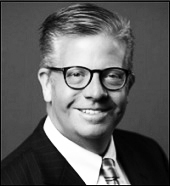

Former Congressman Randy Hultgren

Former Congressman Randy Hultgren Is Now President and CEO of Illinois Bankers Association


KANSAS REPUBLICAN KEVIN YODER

Former Congressman Kevin Yoder

Former Congressman Kevin Yoder Is Now a Registered Lobbyist


Griffin and Priest explain that the rule didn’t even become effective until 2016 and now “risk retention by the originator is rare.” That’s because deal sponsors can get around the rule by selling the risk retention piece to up to two unaffiliated buyers.

A major question left unanswered in the academic study is if Wall Street mega banks are shorting the CMBS market to profit further on their inside information of their income overstatement, as they did on their toxic subprime paper in the lead up to the 2008 financial collapse.

On April 13, 2011, following a two-year investigation, Senators Carl Levin and Tom Coburn, Chairman and Ranking Member of the Senate’s Permanent Subcommittee on Investigations, released a 635-page report on the 2008 financial crisis which included specifics on the fraudulent role that Wall Street mega banks had played in burning down Wall Street and the U.S. economy in the greatest collapse since the Great Depression. The report includes this paragraph on how Goldman Sachs attempted to profit from its own “shitty deals”:

“When Goldman Sachs realized the mortgage market was in decline, it took actions to profit from that decline at the expense of its clients. New documents detail how, in 2007, Goldman’s Structured Products Group twice amassed and profited from large net short positions in mortgage related securities. At the same time the firm was betting against the mortgage market as a whole, Goldman assembled and aggressively marketed to its clients poor quality CDOs that it actively bet against by taking large short positions in those transactions. New documents and information detail how Goldman recommended four CDOs, Hudson, Anderson, Timberwolf, and Abacus, to its clients without fully disclosing key information about those products, Goldman’s own market views, or its adverse economic interests.  For example, in Hudson, Goldman told investors that its interests were ‘aligned’ with theirs when, in fact, Goldman held 100% of the short side of the CDO and had adverse interests to the investors, and described Hudson’s assets were ‘sourced from the Street,’ when in fact, Goldman had selected and priced the assets without any third party involvement. New documents also reveal that, at one point in May 2007, Goldman Sachs unsuccessfully tried to execute a ‘short squeeze’ in the mortgage market so that Goldman could scoop up short positions at artificially depressed prices and profit as the mortgage market declined.”

See the video clip below from a related hearing, featuring the late Senator Carl Levin questioning a Goldman Sachs executive, Daniel Sparks.


Bookmark the permalink.

Thursday, March 7, 2024

Wall Street Mega Banks Have Created a Circular Firing Squad with Credit Derivatives and Capital Relief Trades – with the Fed’s Blessing


SUBSCRIBE TO THIS NEWSLETTER TO RECEIVE TIMELY REPORTS


Wall Street Mega Banks Have Created a Circular Firing Squad with Credit Derivatives and Capital Relief Trades – with the Fed’s Blessing

Jamie Dimon Is In a Whale of a MessBy Pam Martens and Russ Martens: March 6, 2024 ~

On June 11, 2015, the Office of Financial Research (OFR) released a sobering report on how banks were reducing their requirements to hold adequate capital against potential losses by engaging in non-transparent “capital relief trades” with potentially questionable counterparties. The OFR researchers summarized the problem as follows:

“Capital relief transactions may have benefits to banks. But, even if real risk transfer is involved, these transactions can pose financial stability concerns by increasing interconnectedness, transforming credit risk into counterparty risk, and obscuring capital adequacy to investors and counterparties. And while bank supervisors have extensive data about banks, they may have less information about the nonbanks who are selling credit risk to those banks and ultimately bearing the risk of loss.”

The Office of Financial Research was created under the Dodd-Frank financial reform legislation of 2010 to make sure that Wall Street mega banks could never again ravage the economy and financial system of the United States — as they did in 2008 – by engaging in reckless derivative trades and toxic bets. OFR describes its mission as follows:

“Our job is to shine a light in the dark corners of the financial system to see where risks are going, assess how much of a threat they might pose, and provide policymakers with financial analysis, information, and evaluation of policy tools to mitigate them.”

Buried in the June 2015 OFR report was a bombshell. When JPMorgan Chase was initiating hundreds of billions of dollars in risky derivative trades in London in 2012, using deposits from its federally-insured bank in the U.S., it was attempting to engage in tricked-up capital relief trades. The insanity of this gamesmanship resulted in $6.2 billion in losses at the bank; an investigation by the FBI; embarrassing Senate hearings; a scathing 300-page report by the U.S. Senate’s Permanent Subcommittee on Investigations; charges of engaging in “unsafe and unsound” banking practices by the Office of the Comptroller of the Currency; and the payment of $920 million in fines to its regulators.

Credit derivatives are frequently used in capital relief trades. In an effort to curb the trillions of dollars in credit derivatives that the Wall Street mega banks are using for non-transparent purposes with non-transparent counterparties, on July 27 of last year the FDIC, the Office of the Comptroller of the Currency (OCC), and the Federal Reserve released a proposal to require higher capital levels at banks with $100 billion or more in assets; (only 37 banks would be impacted). Community banks will not be impacted at all by the new proposals according to the federal regulators.

On September 12, 2023, the banking cartel made its anger and intention to push back known in a 7-page letter. The cartel demanded that the three federal agencies turn over all “evidence and analyses the agencies relied on” in making the proposal.

One of the signatories to the letter was the Bank Policy Institute (BPI), whose Board of Directors consists of the CEOs of the biggest banks. BPI is Chaired by none other than Jamie Dimon, Chairman and CEO of the notorious London Whale bank, JPMorgan Chase.

BPI next launched an ad campaign that grossly distorted what the increase in capital would do, claiming that it would harm working families. (The mega banks that will be most impacted are the same mega banks that blew up the U.S. economy in 2008; put millions of Americans out of work; left millions of working families in foreclosure; got a secret $29 trillion bailout from the Federal Reserve; and then used big chunks of that bailout money to lavish million-dollar bonuses on bank executives.)

Sixteen days after the big bank cartel had posted its September 12, 2023 letter attacking the newly proposed increase in capital rules, the Federal Reserve issued a suspiciously timed announcement of how banks could game the newly-proposed capital rules, with the Fed’s blessing, through the use of a specific style of capital relief trade. The Fed wrote as follows:

“In some synthetic securitizations, a Board-regulated institution transfers the risk of a reference portfolio of on-balance sheet exposures to a special purpose vehicle using a guarantee or credit derivative. The special purpose vehicle issues credit-linked notes to investors, and the Board-regulated institution takes the cash proceeds of the notes as collateral supporting the special purpose vehicle’s performance on the guarantee or credit derivative.

“Under the Board’s capital rule, a Board-regulated institution can recognize the credit risk mitigation of the collateral on the reference portfolio under the rules for synthetic securitizations provided that the requirements in section 41 or 141, as applicable (12 CFR 217.41, .141), are met and that the transactions satisfy the definition of ‘synthetic securitization’ (12 CFR 217.2, ‘synthetic securitization’).”

All you need to know about the above two paragraphs is that the words “synthetic” and “special purpose vehicle” and “credit derivatives” played a central role in crashing Wall Street and the U.S. economy in 2008. The Federal Reserve has apparently learned nothing from the worst financial crash since the Great Depression.

For the most hair-raising part of this story, let us back up to September 29, 2022 – almost exactly one year before the Fed gave its blessing to capital relief trades using credit derivatives. On that date the OFR issued a report that concluded: “When Choosing Counterparties, Banks Tend to Pick Riskier Ones.”

The report was authored by Dasol Kim, a Research Principal at OFR, and Andrew Ellul, a Visiting Fellow at OFR and Professor of Finance at Indiana University’s Kelley School of Business. In a blog post, they summarized their findings as follows:

“In a recent working paper analyzing who banks chose as counterparties in the over-the-counter (OTC) derivatives market, the authors found that banks are more likely to choose riskier nonbank counterparties that are already heavily connected and exposed to other banks, which leads to an even more densely connected network. Furthermore, banks do not hedge these exposures, but rather increase them by selling rather than purchasing credit derivative swaps against these counterparties. Finally, the authors found that common counterparty exposures are correlated with systemic risk measures despite greater regulatory oversight following the 2008 financial crisis.” (Italic emphasis added.)

The only common-sense way to think of this is that Wall Street has once again created a circular firing squad with the U.S. banking system and U.S. economy as collateral damage.

For an idea of what can happen when a mega bank sells credit default swaps, consider how Howie Hubler, a star bond trader at Morgan Stanley, lost $9 billion. Hubler was one of those who made early derivative bets that the lowest-rated subprime bonds would fail during the 2007-2008 financial crisis using credit default swaps. He bought protection by purchasing credit default swaps on subprime debt. But because Hubler had to pay out premiums on these credit default swaps until the price collapse arrived, he sold $16 billion in credit default swaps on higher-rated debt, obviously to collect the premiums to offset what he was paying out while he waited. When the $16 billion turned out to be toxic as well, Morgan Stanley lost at least $9 billion.

According to a government audit of the Fed’s secret loans to the Wall Street mega banks and their trading subsidiaries from December 2007 through early July 2010, Morgan Stanley was the second largest recipient (after Citigroup) of the Fed’s secret bailout loans. Morgan Stanley received a total of $2.04 trillion in cumulative loans from the Fed; Citigroup received $2.5 trillion in cumulative loans from the Fed.

Federal regulators were caught napping in the lead up to the 2008 financial collapse. They are clearly still napping. According to the most recent trading and derivatives report from the Office of the Comptroller of the Currency for the third quarter of 2023, just four commercial banks (JPMorgan Chase, Citigroup’s Citibank, Goldman Sachs Bank USA and Bank of America) hold 94 percent of all credit derivatives held at 4,600 commercial banks. If you want the quintessential definition of concentrated risk, this is it.

https://wallstreetonparade.com/2024/03/wall-street-mega-banks-have-created-a-circular-firing-squad-with-credit-derivatives-and-capital-relief-trades-with-the-feds-blessing/


Wednesday, July 26, 2023

July 25, 2023 HEATHER COX RICHARDSON


Tuesday, April 11, 2023

First Republic Bank: Dark Pool Trading by “Rescuers” Exploded in Volume as FRC Tanked

 SUBSCRIBE TO THIS NEWSLETTER TO RECEIVE IT IN A TIMELY MANNER

First Republic Bank: Dark Pool Trading by “Rescuers” Exploded in Volume as FRC Tanked

By Pam Martens and Russ Martens: April 10, 2023

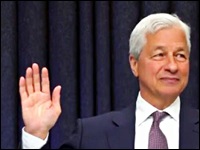
Jamie Dimon Being Sworn In at House Financial Services Committee Hearing, May 27, 2021

Jamie Dimon Being Sworn In at House Financial Services Committee Hearing, May 27, 2021

Jamie Dimon, the Chairman and CEO of JPMorgan Chase, has cranked up his public relations machine since March 16 to promote the narrative that he came to the “rescue” of the plunging regional lender, First Republic Bank. The so-called “rescue” consisted of 11 banks, including JPMorgan Chase, dumping a total of $30 billion in “uninsured” deposits into First Republic.

But one of the bank’s key problems was that it already had too many uninsured deposits. (This was like seeing a house on fire and throwing 11 expensive martinis at it.)

According to First Republic’s regulatory filings, as of December 31, 2022, it had total deposits of $176.25 billion, of which $119.47 billion (or 68 percent) were uninsured. The Federal Deposit Insurance Corporation (FDIC) caps federal deposit insurance at $250,000 per depositor, per bank. But banks such as First Republic, that cater to the very wealthy, have a significant number of customer accounts that dramatically exceed the $250,000 cap. In the digital age, those deposits can rapidly move elsewhere when a bank panic sets in.

The stock market was unpersuaded that this Dimon rescue plan was anything more than a hastily thrown together p.r. stunt. First Republic Bank’s stock closed on March 16 – after the news about the $30 billion hit the wires – at $34.27. It has continued to move lower, hitting $14.03 by the closing bell on Friday. That’s a year-to-date decline of 90 percent – not exactly anyone’s idea of a “rescue.”

S&P Global also wasn’t buying the idea of the “rescue” either. Three days after the p.r. news of the 11 banks tossing $30 billion of uninsured deposits at First Republic, it downgraded the bank’s credit rating by three notches, putting it deeper into junk territory.

Wall Street mega banks have a long history of talking a good game while surreptitiously doing deceitful things behind a dark curtain. Let’s not forget that some of the biggest names on Wall Street, in the leadup to the financial crisis of 2008, were driving the U.S. housing market deeper into despair by shorting (making bets against) the residential mortgage bonds they had sold to their own customers as solid investments.

Our suspicions about the “rescue” of First Republic Bank were aroused further last week when multiple news reports indicated that Morgan Stanley, one of the 11 Wall Street banks that chipped in for the $30 billion “rescue” of First Republic Bank, was now hiring some of its largest advisor teams and providing a home to the billions in assets managed by those teams. (See here and here.)

We decided to take a look behind one of the darkest curtains on Wall Street – the trading that occurs in the Dark Pools owned by these wily mega banks on Wall Street. (See Related Articles below.) Dark Pools are effectively unregulated stock exchanges operating inside the largest trading houses on Wall Street.

Wall Street’s self-regulator, FINRA, after public uproar, began releasing weekly aggregated totals for trading in Dark Pools in 2014. But the data is far from transparent. For example, a number of the Wall Street banks own more than one Dark Pool. There is no way to tell if a two-sided market is occurring between Dark Pools owned by the same parent. There is no hour-by-hour or day-by-day breakdown of trading, just data lumped together for each Dark Pool for an entire week. There is also a multiple-week delay in reporting the data. For example, the most recent data for Dark Pool trading in the shares of First Republic is for the week of March 20.

Despite the Dark Pools continued ability to operate in the shadows, what we could discern from the FINRA Dark Pool data was that there was an absolute explosion in the quantity of shares of First Republic Bank traded by its “rescuers” in their Dark Pools as the bank was plunging in value in mid-March.

The volume of shares traded by Dark Pools went from 2.8 million shares in a little more than 32,000 trades for the week of February 27, 2023; to 13 million shares in more than 123,000 trades for the week of March 6; to an explosion of 70.8 million shares traded in Dark Pools for the week of March 13 in a stunning 653,922 separate trades.

Dark Pools owned by the “rescuers” of First Republic – including JPMorgan Chase, Goldman Sachs, Morgan Stanley, and Bank of America’s Merrill Lynch – were among the largest Dark Pool share traders of First Republic for the weeks of February 27 through March 13.

And this is by no means the full story. As we previously reported, Goldman Sachs Is Quietly Trading Stocks In Its Own Dark Pools on 4 Continents. 

Related Articles:

The SEC Is Allowing 5-Count Felon JPMorgan Chase to Trade Its Own Bank Stock in its Own Dark Pools

A Massive Increase in Trading in GameStop by Dark Pools Owned by the Mega Wall Street Banks Coincided with the Spike in its Share Price

After Charges of Running a Price Fixing Cartel on Nasdaq in the 90s, Wall Street Banks Are Now Trading Their Own Stocks in Darkness

Dark Pools Traded 791% More Boeing Stock During Week of 737 Max Crash

Another Wall Street Inside Job?: Stock Buybacks Carried Out in Dark Pools

Should This Be Illegal – Banks Recommending a Stock to the Public then Secretly Trading It in their own Dark Pool?

Shades of 1930 in Wall Street Banks’ Dark Pools?


LINK


Friday, March 17, 2023

JPMorgan’s High Risk Footprint; Bloomberg News as PR Agent for Jamie Dimon; and the Untold Story of the Failed “Rescue” of First Republic by the Mega Banks


SUBSCRIBE TO THIS NEWSLETTER TO RECEIVE TIMELY REPORTS

JPMorgan’s High Risk Footprint; Bloomberg News as PR Agent for Jamie Dimon; and the Untold Story of the Failed “Rescue” of First Republic by the Mega Banks

By Pam Martens and Russ Martens: March 17, 2023 ~

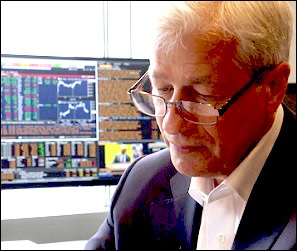
Jamie Dimon Sits in Front of Trading Monitor in his Office (Source -- 60 Minutes Interview, November 10, 2019)

Jamie Dimon Sits in Front of Trading Monitor in his Office (Source: 60 Minutes Interview, November 10, 2019)

At 6:33 a.m. this morning, this big, bold headline appeared at the very top of Bloomberg News web page: “How Dimon and Yellen Helped Secure $30 Billion Lifeline for First Republic.” This headline is part of a very long, highly questionable promotion of Jamie Dimon by Bloomberg News as the wunderkind of Wall Street banking.

In reality, under Dimon’s tenure as Chairman and CEO, JPMorgan Chase has been on an unprecedented crime spree, including being charged with five felony counts by the U.S. Department of Justice, and his bank is annually ranked by U.S. banking regulators as well as the Basel Committee on Banking Supervision as the riskiest bank on the planet. (See charts at this link at the U.S. Treasury’s Office of Financial Research. Give the page time to load the charts.)

This morning’s headline at Bloomberg News was clearly meant to suggest that Dimon was the modern reincarnation of John Pierpont (J.P.) Morgan, who famously came to the rescue during the financial panic of 1907 with a private pool of money. The Bloomberg headline refers to the fact that JPMorgan Chase, along with Bank of America, Citigroup and Wells Fargo, each ponied up $5 billion to place as uninsured deposits into the teetering First Republic Bank, which has lost 72 percent of its market value year-to-date (as of yesterday’s close). The balance of the $30 billion came from seven additional banks.

The Federal Deposit Insurance Corporation (FDIC) caps federal deposit insurance at $250,000 per depositor, per bank. The stock market looked at the teacup of $30 billion in rescue money, weighed it against the tsunami of facts in First Republic’s regulatory filings which showed, among other things, that the bank at year end had total deposits of $176.25 billion, of which $119.47 billion (or 68 percent) were uninsured by the FDIC, and said to itself, the last thing First Republic Bank needs is more uninsured deposits. The stock of First Republic Bank (ticker FRC) fell 14.7 percent in after-hours trading.

Another troubling detail is that the securities units of JPMorgan Chase and Bank of America were among the book-running underwriters of a secondary stock offering of 2 million shares of First Republic on or around February 10 of this year. First Republic closed at $135.45 on February 10 versus $34.27 yesterday – meaning these underwriters may have legal exposure. In addition, the same underwriters led an August 1, 2022 sale of shares of First Republic Bank to the public, raising over $400 million for the bank. First Republic’s shares were even higher then, priced at $155.48.

Units of Goldman Sachs and Morgan Stanley were the other two underwriters in both the August and February secondary offerings. Both banks were part of yesterday’s $30 billion “rescue,” contributing $2.5 billion each in uninsured deposits to First Republic.

Michael Bloomberg, the former Mayor of New York, is the majority owner of the publishing and data terminal empire that keeps publishing these slobbering headlines about Jamie Dimon. In 2016, Michael Bloomberg even co-authored an opinion piece with Dimon for the opinion section of Bloomberg News. The same year, the New York Post reported that JPMorgan Chase was the second largest customer of Bloomberg’s data terminal business with 10,000 leases of Bloomberg’s terminals. At the time, the terminals cost around $21,000 each per year or approximately $210 million being forked over by JPMorgan Chase to Michael Bloomberg’s company. Bloomberg’s data terminals are the cash cow of the company.

During JPMorgan Chase’s London Whale scandal in 2012 and 2013, where the bank gambled with bank depositors’ money in exotic derivative trades in London and lost at least $6.2 billion, Michael Bloomberg was Mayor of New York City. Instead of condemning this outrageous risk-taking with federally-insured deposits, Bloomberg was quoted in the Wall Street Journal calling Dimon “a very smart, honest, great executive,” adding “The controls failed. He’ll look at that and fix it.” That statement appeared in May of 2012. The five felony counts followed from 2014 to 2020.

On September 16, 2019, for the first time that anyone on Wall Street can remember, RICO charges were brought against traders at JPMorgan Chase by the U.S. Department of Justice. Its precious metals trading desk was characterized at the time as a racketeering enterprise by the Justice Department. The DOJ couldn’t bring itself to state the name of the bank where the traders were located, calling JPMorgan Chase simply “Bank A.”

On September 29, 2020, the Justice Department brought the fourth and fifth felony counts against JPMorgan Chase. One count involved traders rigging the precious metals markets and the other count was for rigging the U.S. Treasury market.  As the Justice Department had done in all the previous felony charges against the bank, it settled the charges with large fines, deferred prosecution agreements, and a probation period. (The bank has had three probation periods since 2014 for criminal activity.) But the Justice Department did one thing on September 29, 2020 that was unprecedented for a felony charge involving the rigging of the U.S. Treasury market. The Justice Department announced the charges without holding its usual press conference and taking questions from reporters.

The Justice Department’s deal was so sweet for a criminal recidivist that it wrote in its deal with the bank that “an independent compliance monitor was unnecessary” despite also revealing that the bank “did not voluntarily and timely disclose to the Fraud Section and the Office the conduct described in the Statement of Facts.”


LINK


Tuesday, July 5, 2022

Atlanta Fed’s Model Forecasts GDP to Contract by -2.1 Percent in Second Quarter; Morgan Stanley Says S&P 500 Could Drop Another 22 Percent If that Happens


SUBSCRIBE TO THIS NEWSLETTER


Atlanta Fed’s Model Forecasts GDP to Contract by -2.1 Percent in Second Quarter; Morgan Stanley Says S&P 500 Could Drop Another 22 Percent If that Happens

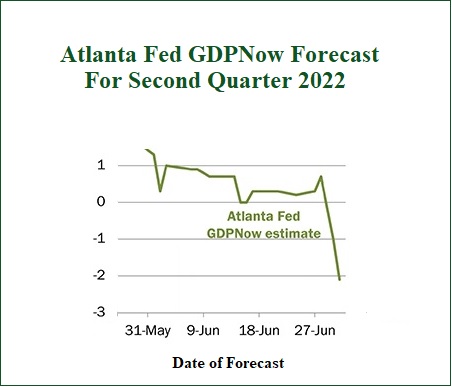
Atlanta Fed GDPNow Model Forecast, Second Quarter 2022, as of July 1, 2022

By Pam Martens and Russ Martens: July 5, 2022 ~

The Department of Commerce’s Bureau of Economic Analysis (BEA) will release its advance estimate for U.S. Gross Domestic Product (GDP) for the second quarter of 2022 at 8:30 a.m. on July 28. All eyes on Wall Street will be glued to that number as a gauge of where stock prices are headed.

As of this morning, the highly respected number crunchers at the Atlanta Fed’s GDPNow model are forecasting a contraction of -2.1 percent in U.S. economic growth in the second quarter. (That’s the real GDP growth/seasonally adjusted annual rate.) The Atlanta Fed’s GDPNow modelers will update their forecast five more times, based on additional economic data releases, before the advance estimate for second quarter GDP is officially released by the BEA on July 28.

GDP contracted at a -1.6 percent annualized rate in the first quarter. Two quarters of negative GDP growth has been the criteria on Wall Street for characterizing the economy as in recession. The definition of recession at the National Bureau of Economic Research (NBER) is “a significant decline in economic activity that is spread across the economy and that lasts more than a few months.” NBER’s Business Cycle Dating Committee is the official word on classifying when a U.S. recession has begun and ended.

If there is a meaningful contraction in the U.S. economy, Wall Street trading house, Morgan Stanley, sees the potential for the stock market, as measured by the S&P 500, to sink to as low as 3,000. As of Friday’s close, the S&P 500 stood at 3825.33, which was already a loss of 19.7 percent year-to-date.

The S&P 500 closed out last year at 4,766.183. If it were to reach 3,000 this year, that would be a year-to-date loss of 37 percent – and that could actually be the good news compared to what is likely to happen to Nasdaq if there is a significant GDP contraction.

The Nasdaq composite index closed out last year at a reading of 15,644.97. The Nasdaq closed Friday at 11,127.85 – a year-to-date decline of 29 percent. A GDP contraction would be likely to hit the Nasdaq much harder than the S&P 500 because the Nasdaq is stuffed with tech companies trading at lofty price-to-earnings multiples; numerous companies with negative earnings histories; many companies paying no dividends; and companies which should have never been brought to public markets in the first place. (See our report: SEC Chair Jay Clayton Left Markets in the Biggest Mess Since 1929.)

According to a study (see Table 9) released last year by Professor Jay Ritter in the Department of Finance at the University of Florida, there were more traditional IPOs with negative earnings issued in the four years of the Trump administration than at any time in the last 40 years. (The study only goes back to 1980.)

The study focuses on traditional IPOs and eliminates the following: “IPOs with an offer price below $5.00 per share, unit offers, ADRs, closed-end funds, partnerships, acquisition companies [SPACs], REITs, bank and S&L IPOs, and firms not listed on CRSP [Center for Research in Security Prices] within six months of the offer date are excluded.”

According to Ritter’s research, 77 percent of the traditional IPOs issued in 2017 had negative earnings; 81 percent in 2018; 77 percent in 2019; and 80 percent in 2020.

We could find no other era in the last 40 years that even came close to this hubristic record. For example, in the four years leading up to the historic dot.com crash in 2000, the percentage of IPOs with negative earnings looked like this: 36 percent in 1997; 46 percent in 1998; 76 percent in 1999; and 81 percent in 2000. That four-year average comes to 59.75 percent versus the four-year average from 2017 through 2020 of 78.75 percent of traditional IPOs coming to market with negative earnings.

Morgan Stanley is not the only trading house on Wall Street that is making bold predictions of what might lie ahead for markets. In a communique on July 1, analysts at JPMorgan Chase predicted that “global oil prices could reach a ‘stratospheric’ $380 a barrel if US and European penalties prompt Russia to inflict retaliatory crude-output cuts….”

At the other end of predictions on the price of oil, Citigroup analysts say that crude oil could plunge to $65 a barrel by year end if a deep recession hits.

As of 8:16 a.m. (ET) this morning, U.S. domestic crude oil, West Texas Intermediate, was trading at $108.74 a barrel (front month futures market).

JPMorgan Chase and Citigroup are two of the four largest derivatives traders on Wall Street. Since they are taking wildly divergent views of what might happen in the oil market, one must factor in the possibility that they are simply talking their book.

LINK


Top News | 'He’s Not Going to Run Unopposed': Sanders Rejects Schumer for Majority Leader

                                                               LOTS OF POSTS IGNORED BY BLOGGER..... OR REMOVED ON THEIR WHIM! ALL POSTS ARE...