Brace yourself, this is serious. This year, 143 manatee calves have died — the most of any year on record. Pregnant manatees are suffering from malnutrition and miscarriages, and mama manatees can’t find food for their babies, causing them to starve.
Mega-polluting industries like Big Cruise are fueling this tragedy with reckless dumping and massive quantities of CO2 emissions. And Trump wants to make it easier for them. These companies dump filthy, contaminated wastewater – including toxic, acidic wastewater – directly into ocean habitats that are critical for vulnerable species. This harmful pollution feeds destructive algae blooms that kill manatees' primary food source, seagrass.
But it gets worse. Cruise ships never stop running, even when they dock – and they’re powered by some of the dirtiest heavy fuel. Every day, a mid-sized cruise ship can emit as much particulate pollution as ONE MILLION CARS. Coastal communities are trapped, breathing in this harmful pollution and suffering higher rates of respiratory diseases as a result.
Trump has been tied to the cruise industry for years through his friendship with top executives at Carnival Corporation, one of the worst perpetrators of dumping in the industry. And with Trump coming into office in January, this could mean more breaks for cruise companies to wreak havoc on manatees, coastal communities, and our planet!
We MUST hold cruise companies and other Big Polluters accountable for the damage they cause. Right now, a generous group of donors is MATCHING every gift up to $160,000 – and we’re counting on supporters like you to make the most of this match before it expires at midnight TONIGHT.
After pandemic travel restrictions lifted, the cruise industry’s pollution has come roaring back and continues to grow. Greedy cruise companies take advantage of weak regulations to dump their pollution (legal and illegal) in our oceans and communities.
Worse, some companies are looking to block coastal communities from exercising their rights and protecting themselves from emissions-induced diseases and habitat destruction – and under Trump’s Project 2025, they could get their way! No company should be able to take away our right to fight for our health and the health of our neighbors. For the sake of our oceans, our people, and our planet, we MUST fight back.
Friends of the Earth is standing up against the greedy cruise industry and the Trump administration that will prioritize profits over human lives, helpless wildlife, and the health of our planet. We are working to strengthen regulations for these industries and urging the EPA and states around the country to improve wastewater regulations. Reaching our Giving Tuesday goal is critical to continuing this planet-saving work, and stopping ocean-wrecking, climate-destroying pollution from entering our ecosystems. But we rely on the membership support from people like you, who understand how high the stakes are right now.
By Charles Colgan, Middlebury Institute of International Studies | –
Ocean-related tourism and recreation supports more than 320,000 jobs and US$13.5 billion in goods and services in Florida. But a swim in the ocean became much less attractive in the summer of 2023, when the water temperatures off Miami reached as high as 101 degrees Fahrenheit (37.8 Celsius).
The future of some jobs and businesses across the ocean economy have also become less secure as the ocean warms and damage from storms, sea-level rise and marine heat waves increases.
Ocean temperatures have been heating up over the past century, and hitting record highs for much of the past year, driven primarily by the rise in greenhouse gas emissions from burning fossil fuels. Scientists estimate that more than 90% of the excess heat produced by human activities has been taken up by the ocean.
That warming, hidden for years in data of interest only to oceanographers, is now having profound consequences for coastal economies around the world.
Understanding the role of the ocean in the economy is something I have been working on for more than 40 years, currently at the Center for the Blue Economy of the Middlebury Institute of International Studies. Mostly, I study the positive contributions of the ocean, but this has begun to change, sometimes dramatically. Climate change has made the ocean a threat to the economy in multiple ways.
Flooding at high tide, even on sunny days, is becoming increasingly common in places such as Miami Beach; Annapolis, Maryland; Norfolk, Virginia; and San Francisco. High-tide flooding has more than doubled since 2000 and is on track to triple by 2050 along the country’s coasts.
These effects are still small and highly localized. Much larger effects come with storms enhanced by sea level.
Higher sea level can worsen storm damage
Warmer ocean water fuels tropical storms. It’s one reason forecasters are warning of a busy 2024 hurricane season.
Tropical storms pick up moisture over warm water and transfer it to cooler areas. The warmer the water, the faster the storm can form, the quicker it can intensify and the longer it can last, resulting in destructive storms and heavy downpours that can flood cities even far from the coasts.
When these storms now come in on top of already higher sea levels, the waves and storm surge can dramatically increase coastal flooding.
What Hurricane Hugo’s flooding would look like in Charleston, S.C., with today’s higher sea levels.
Tropical cyclones caused more than $1.3 trillion in damage in the U.S. from 1980 to 2023, with an average cost of $22.8 billion per storm. Much of that cost has been absorbed by federal taxpayers.
It is not just tropical storms. Maine saw what can happen when a winter storm in January 2024 generated tides 5 feet above normal that filled coastal streets with seawater.
What does that mean for the economy?
The possible future economic damages from sea-level rise are not known because the pace and extent of rising sea levels are unknown.
One estimate puts the costs from sea-level rise and storm surge alone at over $990 billion this century, with adaptation measures able to reduce this by only $100 billion. These estimates include direct property damage and damage to infrastructure such as transportation, water systems and ports. Not included are impacts on agriculture from saltwater intrusion into aquifers that support agriculture.
Marine heat waves leave fisheries in trouble
Rising ocean temperatures are also affecting marine life through extreme events, known as marine heat waves, and more gradual long-term shifts in temperature.
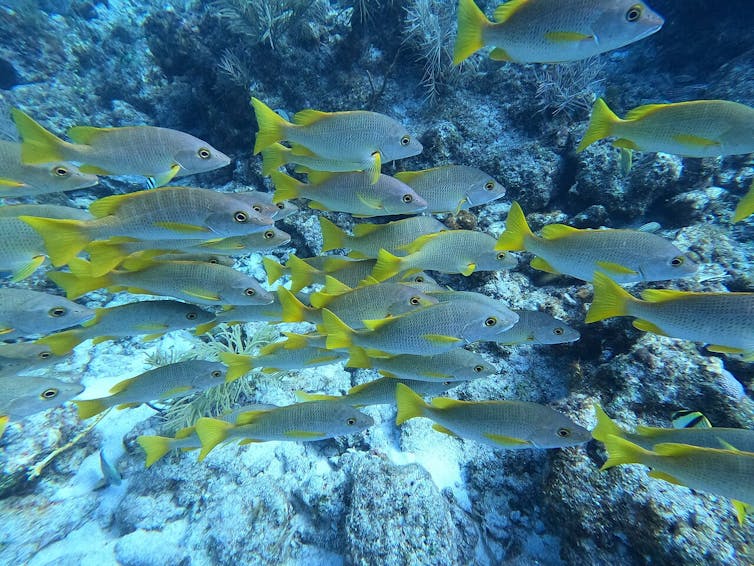
Healthy coral reefs serve as fish nurseries and habitat. These schoolmaster snappers were spotted on Davey Crocker Reef near Islamorada in the Florida Keys. Jstuby/wikimedia, CC BY
Losing coral reefs is about more than their beauty. Coral reefs serve as nurseries and feeding grounds for thousands of species of fish. By NOAA’s estimate, about half of all federally managed fisheries, including snapper and grouper, rely on reefs at some point in their life cycle.
Warmer waters cause fish to migrate to cooler areas. This is particularly notable with species that like cold water, such as lobsters, which have been steadily migrating north to flee warming seas. Once-robust lobstering in southern New England has declined significantly.
How three fish and shellfish species migrated between 1974 and 2019 off the U.S. Atlantic Coast. Dots shows the annual average location. NOAA
In the Gulf of Alaska, rising temperatures almost wiped out the snow crabs, and a $270 million fishery had to be completely closed for two years. A major heat wave off the Pacific coast extended over several years in the 2010s and disrupted fishing from Alaska to Oregon.
There is no cold-water tap that we can simply turn on to quickly return ocean temperatures to “normal,” so communities will have to adapt while the entire planet works to slow greenhouse gas emissions to protect ocean economies for the future.