Showing posts with label CHEMICAL WEAPONS. Show all posts

Monday, December 2, 2024

RAY McGOVERN: Neocons Try Again in Syria


RAY McGOVERN: Neocons Try Again in Syria

A day after Israel agreed to a ceasefire in Lebanon last week the long dormant war in Syria reignited as jihadist forces seized the city of Aleppo and advanced virtually unhindered in its quest to overthrow the Syrian government until finally meeting resistance from the Syrian Army backed up by Russia. This is the last chance for neocons in the United States to topple Syrian President Bashar al-Assad before Donald Trump, who tried to withdraw U.S. troops from Syria, resumes the presidency in 49 days.

By Ray McGovern
Special to Consortium News

On the neocon list of ways to make the world safer for Israel, Iran originally occupied pride of place. “Real men go to Tehran!” was the muscular brag. But Prime Minister Ariel Sharon was persuaded to acquiesce in a less ambitious plan — to “do Iraq” and remove the “evil dictator” in Baghdad first.

As the invaders/occupiers got bogged down in Iraq, it seemed more sensible to “do Syria” next. With the help of “friendly services,” the neocons mounted a false-flag chemical attack outside Damascus in late August 2013, blaming it on President Bashar al-Assad, whom U.S. President Barack Obama had earlier said, “had to go.”

Obama had called such a chemical attack a red line but, mirabile dictu, chose to honor the U.S. Constitution by asking Congress first. Worse still for the neocons, during the first days of September, Russian President Vladimir Putin pulled Obama’s chestnuts out of the fire by persuading Syria to destroy its chemical weapons under U.N. supervision.

Obama later admitted that virtually all of his advisers had wanted him to order Tomahawk cruise missiles into Syria.

Morose at CNN

HMS Diamond escorting the merchant ship Ark Futura during the disposal process of Syria’s chemical weapons stock, July 1, 2014. (MOD, Wikimedia Commons, OGL)

I was lucky enough to observe, up-close and personal, the angry reaction of some of Israel’s top American supporters on Sept. 9, 2013, when the Russian-brokered deal for Syria to destroy its chemical weapons was announced.

After doing an interview in Washington on CNN International, I opened the studio door and almost knocked over a small fellow named Paul Wolfowitz, President George W. Bush’s former under-secretary of defense who in 2002-2003 had helped craft the fraudulent case for invading Iraq.

And there standing next to him was former Sen. Joe Lieberman, the Connecticut neocon who was a leading advocate for the Iraq War and pretty much every other potential war in the Middle East.

On the tube earlier, Anderson Cooper sought counsel from Ari Fleischer, former spokesman for Bush, and David Gergen, long-time White House PR guru.

Fleischer and Gergen were alternately downright furious over the Russian initiative to give peace a chance and disconsolate at seeing the prospect for U.S. military involvement in Syria disappear when we were oh so close.

The atmosphere on TV and in the large room was funereal. I had happened on a wake with somberly dressed folks (no loud pastel ties this time) grieving for a recently, dearly-departed war.

In his own interview, Lieberman expressed hope-against-hope that Obama would still commit troops to war without congressional authorization. I thought to myself, wow, here’s a fellow who was a senator for 24 years and almost our vice president, and he does not remember that the Founders gave Congress the sole power to declare war in Article 1, Section 8 of the Constitution.

The evening of Sept. 9 was a bad one for more war and for pundits who like to joke about “giving war a chance.”

Menendez: ‘I Almost Vomited’
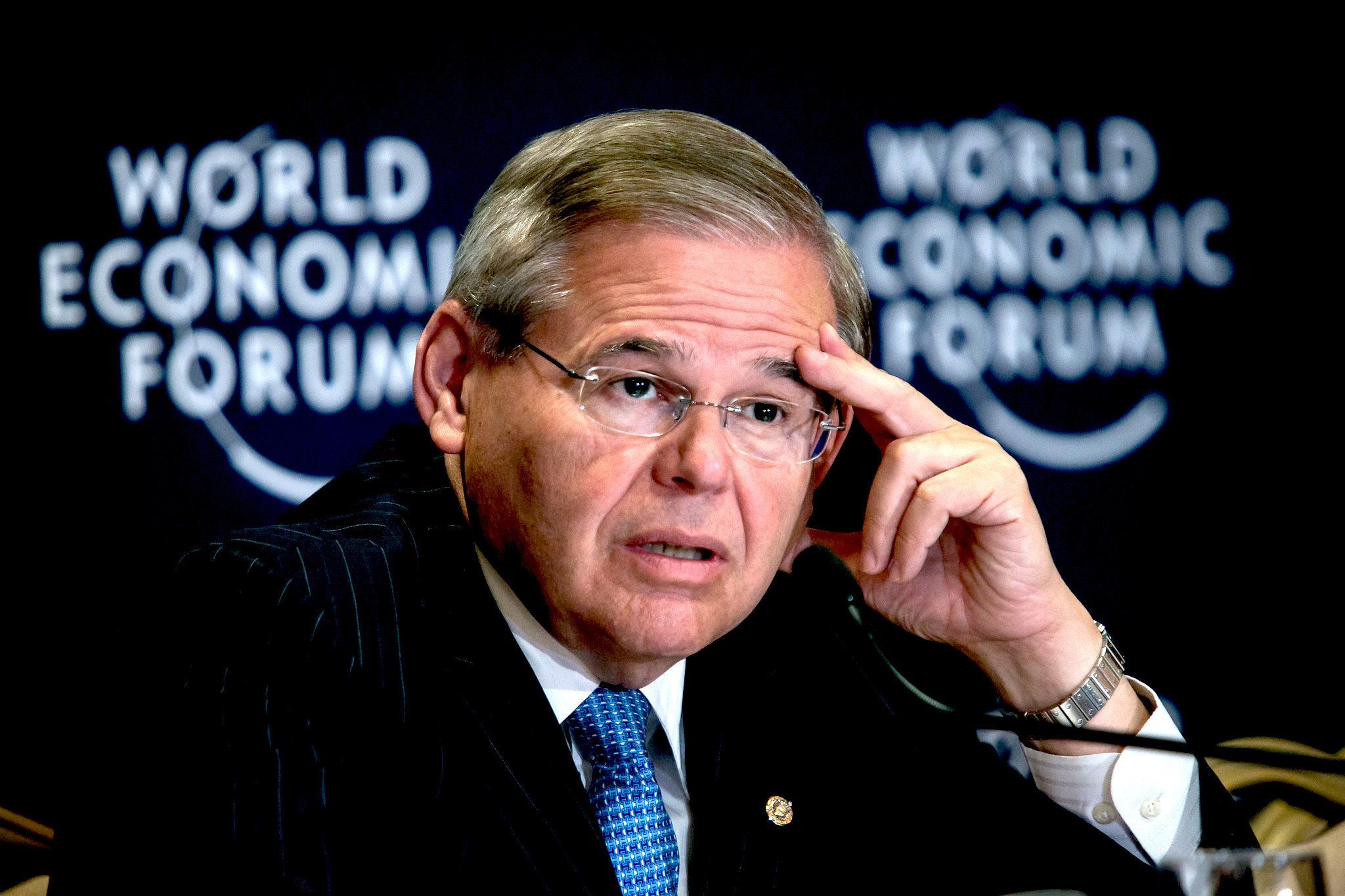
Sen. Robert Menendez, chairman of the Senate Foreign Relations Committee, in 2013. (World Economic Forum, Benedikt von Loebell, CC BY-NC-SA 2.0)

The neocons would face another humiliation three days later when The New York Times published an op-ed by Putin, who wrote of growing trust between Russia and the U.S. and between Obama and himself, while warning against the notion that some countries are “exceptional.”

Sen. Bob Menendez (D-NJ), then chair of the Senate Foreign Relations Committee and an Israeli favorite, spoke for many Washington insiders when he said: “I was at dinner, and I almost wanted to vomit.”

Menendez had just cobbled together and forced through his committee a resolution, 10-to-7, to authorize the president to strike Syria with enough force to degrade Assad’s military. Now, at Obama’s request, the resolution was being shelved. 

Cui Bono?

That the various groups trying to overthrow al-Assad had ample incentive to get the U.S. more deeply involved in support of that effort was clear. It was also quite clear that the government of Israeli Prime Minister Benjamin Netanyahu had equally powerful incentive to get Washington more deeply engaged in yet another war in the area — then, and now.

NYT reporter Judi Rudoren, writing from Jerusalem had the lead article on Sept. 6, 2013, addressing Israeli motivation in an uncommonly candid way. Her article, “Israel Backs Limited Strike Against Syria,” notes that the Israelis have argued, quietly, that the best outcome for Syria’s at the time two-and-a-half-year-old civil war, at least for the moment, was no outcome.

Rudoren wrote:

“For Jerusalem, the status quo, horrific as it may be from a humanitarian perspective, seems preferable to either a victory by Mr. Assad’s government and his Iranian backers or a strengthening of rebel groups, increasingly dominated by Sunni jihadis.

‘This is a playoff situation in which you need both teams to lose, but at least you don’t want one to win, we’ll settle for a tie,’ said Alon Pinkas, a former Israeli consul general in New York. ‘Let them both bleed, hemorrhage to death: that’s the strategic thinking here. As long as this lingers, there’s no real threat from Syria.’”

US Arming ‘Moderate Rebels’

Instead of Tomahawks, Obama approved (or winked at) covert action to topple Assad. That did not work out very well. An investment of $500 million to train and arm “moderate rebels” yielded only “four or five still in the fight,” as then-CENTCOM commander Gen. Lloyd Austin explained to Congress on Sept. 17, 2015.

In late September 2015 at the U.N., Putin told Obama that Russia is sending its forces into Syria; the two agreed to set U.S. Secretary of State John Kerry and Russian Foreign Minister Sergei Lavrov off to work out a ceasefire in Syria; they labored hard for 11 months.

A ceasefire agreement was finally reached and approved personally by Obama and Putin. The following list of events beginning in the fall of 2015 is instructive in considering how the revived conflict might work out (probably minus U.S.-Russian talks), if the ongoing jihadi attack on Syrian forces continues for more than a few weeks.

Does 2015 Chronology Foreshadow 2025?
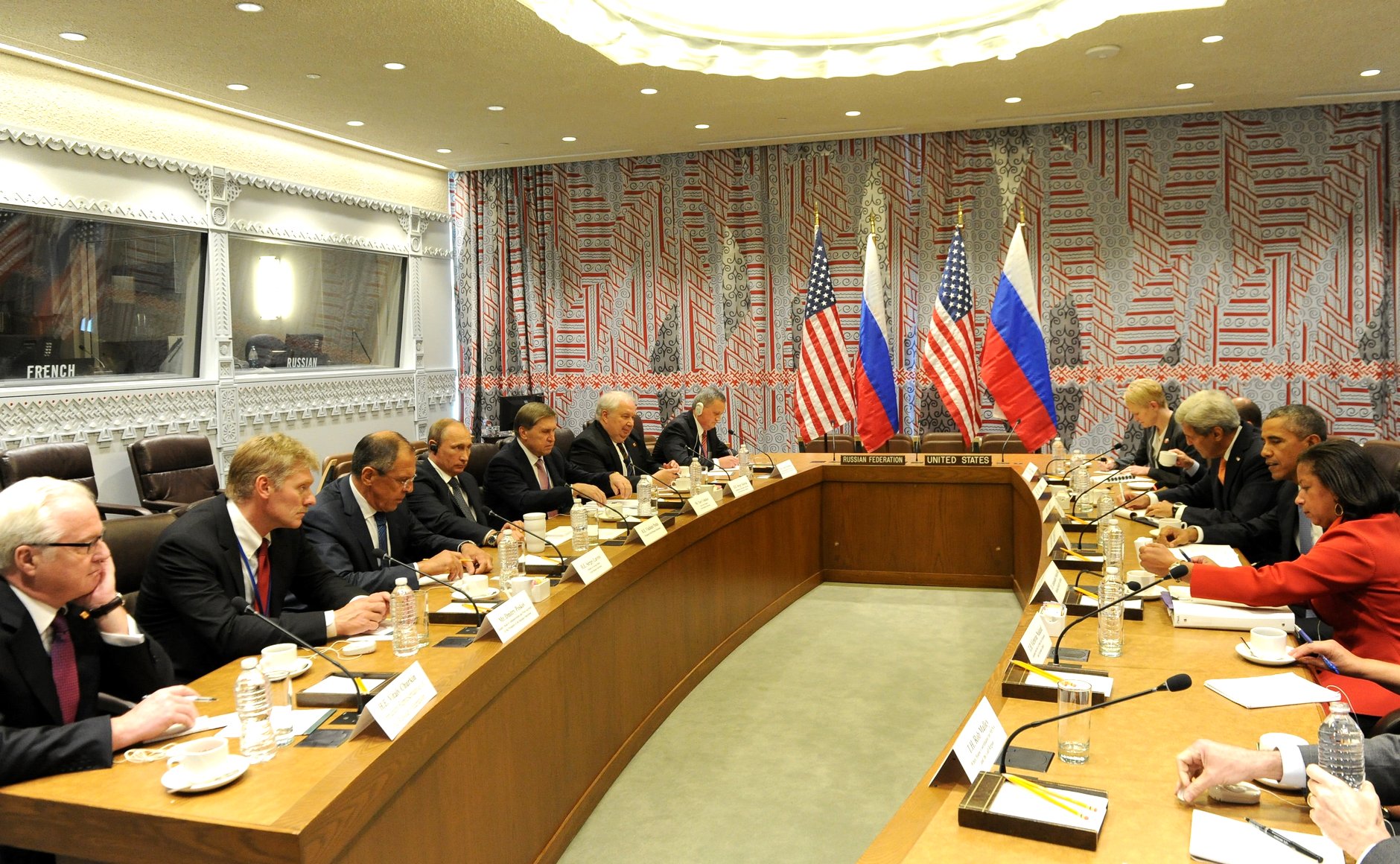
Russian and U.S. representatives meet to discuss the situation in Syria, Sept. 28, 2015. (Kremlin.ru, CC BY 4.0, Wikimedia Commons)

Sept. 28, 2015: At the U.N., Putin tells Obama that Russia will start air strikes in Syria; invites Obama to join Russia in air campaign against ISIS; Obama refuses, but tells Kerry to get together with Lavrov to “deconflict” U.S. and Russian flights over Syria, and then to work hard for a lessening of hostilities and political settlement in Syria — leading to marathon negotiations.

Sept. 30, 2015: Russia starts airstrikes both against ISIS and in support of Syrian forces against rebels in Syria.

Oct. 1, 2015 to Sept. 9, 2016: Kerry and Lavrov labor hard to introduce ceasefire and some kind of political settlement. Finally, a limited ceasefire is signed Sept 9, 2016 — with the explicit blessing of both Obama and Putin.
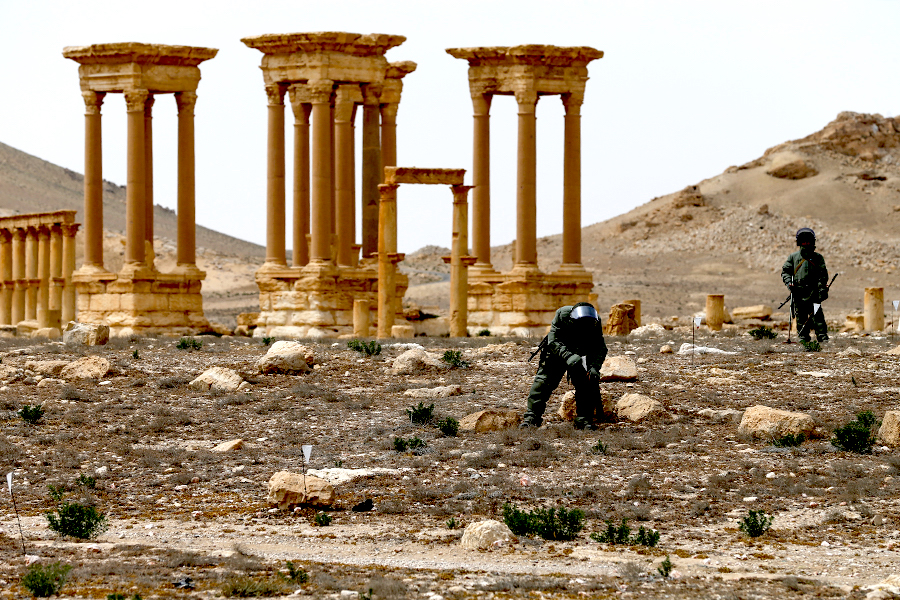
March 2016: Russian sappers clear liberated areas of Palmyra, Syria, which had been mined by Islamic State jihadists. (Mil.ru, CC BY 4.0, Wikimedia Commons)

Sept. 12, 2016: The limited ceasefire goes into effect; provisions include SEPARATING THE “MODERATE” REBELS FROM THE, WELL, “IMMODERATE ONES.”  Kerry had earlier claimed that he had “refined” ways to accomplish the separation, but it did not happen; provisions also included safe access for relief for Aleppo.

Sept. 17, 2016: U.S. Air Force bombs fixed Syrian Army positions killing between 64 and 84 Syrian army troops, with about 100 others wounded — evidence enough to convince the Russians that a renegade Pentagon was intent on scuttling the ceasefire and meaningful cooperation with Russia AND FELT FREE TO DO SO AND THEN MERELY SAY OOPS, WITH NO ONE BEING HELD ACCOUNTABLE!

Sept. 26, 2016: Russian Foreign Minister Lavrov said:

“My good friend John Kerry … is under fierce criticism from the U.S. military machine. Despite the fact that, as always, [they] made assurances that the U.S. commander in chief, President Barack Obama, supported him in his contacts with Russia (he confirmed that during his meeting with President Vladimir Putin), apparently the military does not really listen to the commander in chief.”

Lavrov went beyond mere rhetoric. He specifically criticized Joint Chiefs of Staff Chairman Joseph Dunford for telling Congress that he opposed sharing intelligence with Russia, “after the agreements concluded on direct orders of Russian President Vladimir Putin and U.S. President Barack Obama stipulated that they would share intelligence. … It is difficult to work with such partners. …”

Sept. 29, 2016: KERRY’S HUBRIS-TINGED FRUSTRATION: Apparently Assistant Secretary of State for European and Eurasian Affairs Victoria Nuland, U.S. Ambassador to the U.N. Samantha Power, National Security Advisor Susan Rice, Israeli Prime Minister Netanyahu, et al. had told Kerry it would be easy to “align things” in the Middle East.

And so, this is how Kerry started off his remarks at an open forum arranged by The Atlantic magazine and the Aspen Institute on Sept. 29, 2016. (I was there and could hardly believe it; it made me think that some of these stuffed shirts actually believe their own rhetoric about being “indispensable.”) Kerry said:

“Syria is as complicated as anything I have ever done in my public life in the sense that there are probably about six wars going on at the same time: Kurds against Kurds, Kurds against Turkey, Saudi Arabia, Iran, Sunni, Shia, everybody against ISIS, people against Assad, Al-Nusra…this is a mixed up sectarian and civil war and strategic and proxies, so it is very difficult to be able to align forces.” 

Ultimately, Syrian, Russian and Hezbollah forces beat back the jihadists and liberated Aleppo and other parts of the country in spite of U.S. opposition and are being called upon again now to do the same.

Ray McGovern works with Tell the Word, a publishing arm of the ecumenical Church of the Saviour in inner-city Washington. His 27 years as a C.I.A. analyst included leading the Soviet Foreign Policy Branch and conducting the morning briefings of the President’s Daily Brief. In retirement he co-founded Veteran Intelligence Professionals for Sanity (VIPS).

Views expressed in this article may or may not reflect those of Consortium News.


CONSORTIUM NEWS


Thursday, November 24, 2022

POLITICO NIGHTLY: What 2022 tells us about the 2024 electoral map


View in browser
 
POLITICO Nightly logo

BY CHARLIE MAHTESIAN

A supporter of President-elect Joe Biden holds up his mobile phone to display the electoral college map outside the Philadelphia Convention Center after the 2020 Presidential Election is called.

A supporter of President Joe Biden holds up his mobile phone to display the electoral college map outside the Philadelphia Convention Center after the 2020 presidential election is called. | AP Photo/John Minchillo

THE NARROW PATH — Iowa, Florida, and Ohio are gone. Minnesota is fool’s gold for Republicans. Texas remains out of reach for Democrats.

These are some of the early signs from the midterm election results, which provide some clues about the outline of the presidential battleground map in 2024.

One of the biggest questions about the next presidential race — whether election deniers and conspiracy theorists would be in charge of counting and certifying votes in key swing states — has been settled: They won’t. Election-denying candidates who ran for top offices in states such as Arizona, Michigan, Nevada and Pennsylvania failed in their bids.

A few other things have become clear as well. Iowa, Florida and Ohio — each of them carried by former President Barack Obama as recently as 2012 — weren’t really considered core battleground states in 2020. Now, after Republican blowouts in those states this fall, they should be removed from the 2024 discussion altogether. If there were any remaining doubts about their drift to the right, they were dispelled by this year’s election results, which featured a GOP sweep in Iowa (where Republicans now hold all four House seats, both Senate seats, a state government trifecta and nearly all statewide elected offices); a red wave across Florida (where GOP Gov. Ron DeSantis won by nearly 20 percentage points) and Ohio (where Republican J.D. Vance won an open Senate seat and Gov. Mike DeWine won reelection by 26 points).

While Democratic prospects might not be as grim in Texas, the recent results don’t give much hope either that 2024 will be the year that rapid demographic change finally leads to a Democratic breakthrough: Republicans won their 14th consecutive sweep of statewide offices , led by GOP Gov. Greg Abbott’s top-of-the-ticket romp.

At the same time, strong Democratic midterm performances in New Hampshire and Minnesota — a state which offered former President Donald Trump a rare offensive opportunity in 2020 — suggest they might not be worth contesting in 2024. Minnesota, which some Republicans regarded as a Trump sleeper state in 2020, turned out to be a mirage. This year, there was even more evidence of that: Democrats won every state constitutional office for the third straight election cycle. In 2024, it will be 52 years since a Republican presidential nominee last carried Minnesota.

New Hampshire, which hasn’t voted for a Republican presidential nominee since 2000, also appears to be moving in the wrong direction — at least for a Republican Party led by Trump. In his first bid for president in 2016, he lost the state by less than one-half of a percentage point. Four years later, that margin was eight points. This year, Trumpist candidates lost both House races by healthy margins and the Senate election by double-digits. All of this took place as GOP Gov. Chris Sununu, a Trump nemesis, routed his Democratic foe to win reelection.

For Democrats, perhaps the most important midterm revelation of all was that the party is well-positioned to defend its “Blue Wall,” the term applied to a northern tier of 18 states, stretching from coast to coast, that appeared to provide a structural advantage for a Democratic nominee — at least prior to 2016, when Trump blew it up.

Michigan and Pennsylvania, big industrial states that serve as key building blocks in that wall, delivered sweeping victories for Democrats this year, two years after they rejected Trump’s bid for a second term. The populous suburbs outside Detroit and Philadelphia once again produced big Democratic margins — margins that buried Trump-endorsed, election denying GOP nominees for governor. Erosion in traditionally Republican western Michigan was another point of concern for the GOP. Since the two big industrial states have moved in tandem in every presidential election since 1988, it’s an ominous sign for Trump’s third bid for the White House.

Election results in North Carolina and Virginia were less conclusive. North Carolina, which now has 16 electoral votes, is too big and too competitive for Democrats to write off in a presidential race. Democrat Roy Cooper won the governorship in 2020, but it’s now voted Republican in three consecutive presidential contests, and in two open Senate races in the past two years. In Virginia, Gov. Glenn Youngkin’s 2021 victory and the ouster of a Democratic House incumbent will spark some Republican interest in the state, on the off chance that it isn’t as blue as it’s looked over the past decade.

One of the sharpest election analysts, Ron Brownstein , concluded that one of the lessons from the midterms is that the two parties have further consolidated their holds over states that already lean in their direction. Recent election results, he wrote , “point toward a 2024 presidential contest that will likely be decided by a tiny sliver of voters in a rapidly shrinking list of swing states.”

That small universe of states includes a handful of battlegrounds where photo-finish outcomes were commonplace in this year’s midterm contests — Arizona, Georgia, Nevada and Wisconsin . All were home to bitterly contested statewide races or mixed results that suggest the states remain as competitive and evenly divided as ever. It shouldn’t come as a surprise: in the 2020 presidential election, the four states were decided by a total of just 77,000 votes between them.

Welcome to POLITICO Nightly. Reach out with news, tips and ideas at nightly@politico.com . Or contact tonight’s author at cmahtesian@politico.com or on Twitter at @PoliticoCharlie . A programming note: Nightly will be off for Thanksgiving this Thursday and Friday but back to our normal schedule on Monday, Nov. 28.


GO INSIDE THE MILKEN INSTITUTE FUTURE OF HEALTH SUMMIT: POLITICO is featuring a special edition of our “Future Pulse” newsletter at the 2022 Milken Institute Future of Health Summit from Dec. 6 to 8. The newsletter takes readers inside one of the most influential gatherings of health industry leaders and innovators solving the biggest global health issues to ensure a healthier, more resilient future for all. SUBSCRIBE TODAY TO RECEIVE EXCLUSIVE COVERAGE .


THE NEW CONGRESS

BACK TO THE FUTURE — Republican Kevin Kiley, a conservative favorite in California for his attacks on Democratic Gov. Gavin Newsom, was declared the winner of the newly drawn 3rd District last night by the Associated Press. But as the picture in the House comes into focus, some defeated lawmakers and candidates are already looking towards 2024 .

This week, Rep. Alex Mooney (R-W.V.) announced that he would be running for Senate in 2024 with the hopes of making it through a Republican primary to challenge Democratic Sen. Joe Manchin. Rep. Yvette Herrell (R-N.M.) will fight to regain a newly drawn seat that she lost to Democratic Rep.-elect Gabriel Vasquez. And Bo Hines, a young, Trump-endorsed candidate who lost in North Carolina, has also filed paperwork for a rematch against Democratic Rep.-elect Wiley Nickel.

Of course, plans change, and sometimes candidates don’t follow through even if they originally intend to run. However, these moves show people are thinking and moving earlier and earlier in the cycle. There’s very little time anymore for a break or to pause before thinking of your next electoral plans.

WHAT'D I MISS?

Virginia Gov. Glenn Youngkin speaks about the Walmart shooting in a video.

— Virginia police: Multiple people killed in Walmart shooting: A shooting at a Walmart in Virginia on Tuesday night left several people dead or wounded, though the exact numbers were not immediately known, police said. The shooter was among the dead, officials said. Officers responding to a report of a shooting in Chesapeake found several victims as they swept through the store over the course of about 40 minutes, Officer Leo Kosinski said in a briefing. Rescue teams were sent in to tend to the wounded. He did not know how many people died but said it was “less than 10, right now.”

— Georgia high court reinstates ban on abortions after 6 weeks: The Georgia Supreme Court today reinstated the state’s ban on abortions after roughly six weeks of pregnancy. In a one-page order, the high court put a lower court ruling overturning the ban on hold while it considers an appeal. Abortion providers who had resumed performing the procedure past six weeks after the lower court ruling will again have to stop.

— White House condemns twin Jerusalem bombings: The White House today condemned the two bombings overnight in Jerusalem that killed a Canadian teenager and left at least 18 injured. “We condemn unequivocally the acts of terror overnight in Jerusalem,” White House press secretary Karine Jean-Pierre said in a statement. “The United States has offered all appropriate assistance to the Government of Israel as it investigates the attack and works to [bring] the perpetrators to justice.”


POLITICO APP USERS: UPGRADE YOUR APP BY DECEMBER 19! We recently upgraded the POLITICO app with a fresh look and improved features for easier access to POLITICO's scoops and groundbreaking reporting. Starting December 19, users will no longer have access to the previous version of the app. Update your app today to stay on top of essential political news, insights, and analysis from the best journalists in the business. UPDATE iOS APP – UPDATE ANDROID APP .


AROUND THE WORLD

CHEMICAL CONCERNS — Biden administration officials have assessed that Russian President Vladimir Putin may use chemical weapons in Ukraine first before resorting to a nuclear confrontation with NATO if his troops continue to lose ground, write Erin Banco and Lara Seligman .

The concerns, according to six people with knowledge of the matter, come amid a push by the administration to ensure allies are prepared for such an event, as well as to mobilize new resources and investments in manufacturing of detection systems for when the chemicals are used. The people, who spoke on condition of anonymity to discuss sensitive, internal deliberations, include U.S. and Defense Department officials.

The U.S. does not have any intelligence to suggest such an attack in Ukraine is imminent, the people said. In fact, many DoD officials believe the fighting will stall during the winter months, with neither side able to take much ground.

But in the case of continued battlefield losses, or a complete collapse of the Russian army, some top officials working on the issue have determined that Moscow might resort to employing chemical weapons — including those the country has been associated with using in the poisoning of Alexei Navalny.

NIGHTLY NUMBER

More than 100

The number of times recreational drones made by a Chinese company have been detected inside no-go D.C. airspace zones , triggering agency and congressional alarms about pathways to spying. DJI, the manufacturer, denies any control over users’ activity, and officials don’t think Beijing is directing these drones. But the company has reportedly tried to hide its financial ties to the Chinese state, and the drones’ presence in restricted D.C. airspace worry some in the U.S.

RADAR SWEEP

ANOTHER KIND OF THANKSGIVING — Thanksgiving is a complex holiday for indigenous people in the United States, not the least indigenous chefs , who are often conflicted about what to do on a holiday that’s all about cooking, but also includes painful reminders of their ancestors’ past. Part of what was lost when Europeans colonized America was many indigenous cooking techniques, and how traditional foods were cultivated and produced. Now, many indigenous chefs are trying to harken back to their traditions on Thanksgiving to give everyone a chance to understand where they came from, and why that’s important to them. Harmeet Kaur reports for CNN.

PARTING IMAGE

Supporters of Club Q stand beneath a 25-foot historic pride flag displayed on the exterior of city hall to mark the weekend mass shooting at a gay nightclub in Colorado Springs, Colo.

Supporters of Club Q stand beneath a 25-foot historic pride flag displayed on the exterior of city hall to mark the weekend mass shooting at a gay nightclub in Colorado Springs, Colo. | AP Photo/David Zalubowski

Did someone forward this email to you?  Sign up here .


Follow us on Twitter

Charlie Mahtesian @PoliticoCharlie

Calder McHugh @calder_mchugh

Katherine Long @katherinealong


FOLLOW US

Follow us on FacebookFollow us on TwitterFollow us on InstagramListen on Apple Podcast


 POLITICO, LLC 1000 Wilson Blvd. Arlington, VA, 22209, USA


Wednesday, April 13, 2022

RSN: FOCUS: Eliot A. Cohen | This Is the War's Decisive Moment


Reader Supported News
13 April 22

Live on the homepage now!
Reader Supported News

SMALL DONATIONS ALONE CAN’T DO IT — We are getting donations. The problem is that they are all very small. This is a major contributing factor to our recent funding struggles. We sincerely love every donation and every donor. However don’t expect the progress bar to move much if it’s five and ten dollar donations alone. RSN was built on $30 donations. Try to stay in that range if you can. Sincere thanks to all.
Marc Ash • Founder, Reader Supported News

Sure, I'll make a donation!


Ukraine. (photo: Diego Herrera/Xinhua/Eyevine/Redux)
FOCUS: Eliot A. Cohen | This Is the War's Decisive Moment
Eliot A. Cohen, The Atlantic
Cohen writes: "The United States and its allies can tip the balance between a costly success and a calamity."

The United States and its allies can tip the balance between a costly success and a calamity.

The relatively brief but bloody war in Ukraine is entering its fourth phase. In the first, Russia tried to depose Volodymyr Zelensky’s government and sweep the country into its embrace in a three-day campaign; in the second, it attempted to conquer Ukraine—or at least its eastern half, including the capital, Kyiv—with armored assaults; in the third, defeated in the north, Russia withdrew its battered forces, massing instead in the southeastern and southern areas for the conquest of those parts of Ukraine. Now the fourth, and possibly decisive, phase is about to begin.

For those of us born after World War II, this is the most consequential war of our lifetime. Upon its outcome rests the future of European stability and prosperity. If Ukraine succeeds in preserving its freedom and territorial integrity, a diminished Russia will be contained; if it fails, the chances of war between NATO and Russia go up, as does the prospect of Russian intervention in other areas on its western and southern peripheries. A Russian win would encourage a China coolly observing and assessing Western mettle and military capacity; a Russian defeat would induce a salutary caution in Beijing. Russia’s sheer brutality and utterly unwarranted aggression, compounded by lies at once sinister and ludicrous, have endangered what remains of the global order and the norms of interstate conduct. If such behavior leads to humiliation on the battlefield and economic chaos at home, those norms may be rebuilt to some degree; if Vladimir Putin’s government gets away with it, restoring them will take a generation or longer.

There will be time enough for recriminations. Germany long claimed that it was extending the hand of reconciliation to Russia when in fact it chose to pursue a policy based on greed and naivete. It was not alone in delusion and hypocrisy. For more than a decade, American leadership proved inept, complete with red lines that melted and indifference to the rending of nations in Europe and the leveling of cities and gassing of civilians in Syria. Smug asides about leading from behind seem particularly reprehensible now, as we see what a world without American leadership looks like.

In the years to come, culpable politicians will attempt to excuse these follies and historians will acidly dissect them. What matters now is that we judge the present moment correctly. And here, again, the West faces potential failure. Those who talk of a stalemate on the battlefield, perhaps lasting years, are likely making as big of an error as when they dismissed the possibility of effective Ukrainian resistance two months ago. Decisive action is urgently required to tip the balance between a costly success and a calamity.

In most intense conflicts of this kind, armies engage in a kind of competitive collapse, victory going to the side that can hold out longer. The Ukrainians have kept their own losses and exhaustion well-guarded secrets, as they should, but outgunned as they are, and seeing their civilians slaughtered and tortured, they have to feel the strain. As fighting shifts to open areas where guerrilla tactics and handheld anti-tank and surface-to-air missiles will no longer be as effective, they face daunting, if not impossible, odds. They are as motivated as soldiers can be, and creative tacticians too. But they are not supermen, and they desperately need all that the arsenals of the West can provide them.

The Russian military—revealed as inept at tactics, unimaginative in operational design, obtuse in strategy, and incompetent at basic logistics and maintenance—can do only two things well: vomit out massive amounts of firepower and brutalize civilians. It has been bloodied very badly indeed. If, as seems plausible, it has taken losses (killed, wounded, missing, and imprisoned) of a quarter or more of the forces it committed to this war, it may teeter on the verge of collapse. We can see the indicators in reports from the battlefield: equipment abandoned, officers killed by their own men, desperate attempts to dragoon young men into military service, and blocking units to shoot deserters. The Russian military has not established, let alone maintained, control of the air. Russia threw three-quarters of its ground-combat forces into Ukraine, where they were driven from one theater and severely handled in the others, and now has no real reserves on which to draw.

Why, then, the impending escalation of the war in the east and the south? What explains the desperate throw of the dice by the Russian high command? One may assume that neither Putin, nor his senior advisers, nor even senior subordinate commanders have an accurate picture of the situation on the ground. They know that they have been humiliated, but they do not have a feel of the battlefield. As stewards of a military that cannot adequately care for its wounded and that abandons its dead, they don’t care about the human price they are paying. In a system built on lies and corruption, they receive or pass on falsely optimistic information. Having sought to upend the notion of truth in the West, they now fall victim to their own pervasive untruths.

And so Putin will order offensives that, if confronted by a well-resourced Ukrainian foe, can effectively destroy his own army. The challenge for the West is to ensure that this is its fate.

The Europeans have been, unsurprisingly, far from uniform in their reactions: Within Germany, the foreign minister from the Green Party is staunch; the chancellor is erratic; some members of his own party are timid. Britain is splendidly assertive. Poland and the Baltic states are positively heroic, while Hungary, Austria, and a few others are ambivalent or worse.

The United States is doing many of the right things. It has provided a lot of portable missiles, as well as drones and nonlethal gear. It has facilitated the transfer of heavier equipment, such as Slovak S-300 surface-to-air missiles, which it backfilled with Patriot systems. President Joe Biden and some of his key aides have said the right things about Ukraine’s right to freely exist within its rightful borders. But in other respects, America has failed.

In Washington, the metronome of war ticks too slowly. The administration has not taken advantage of the near-unanimous support for Ukraine in Congress—a marvel of bipartisanship in this contentious period of American politics—to press for much larger sums (in the tens of billions of dollars) for the Ukrainian military. It has moved slowly to procure for Ukraine the heavier kinds of weapons that it knows are needed. Its attention wanders to a domestic agenda that was in trouble before the war, and that pales in significance now. It does not seem to have senior leaders inclined to bulldoze bureaucratic obstacles and cut red tape. It feels like business as usual in the Pentagon. Some Russian banks have been sanctioned, but not others. And multinational corporations have not yet been confronted with a simple ultimatum: You can do business in the United States or in Russia, but not in both.

The United States has failed to take many of the symbolic actions that matter in wartime. If British Prime Minister Boris Johnson can visit Kyiv (as did Ursula von der Leyen, the president of the European Commission, and heads of government and senior officials from other nations), so can Secretary of State Antony Blinken or Vice President Kamala Harris. If other countries can reopen embassies in Ukraine, so can the United States, which never should have closed its own. Instead of treating Zelensky’s pleas to Congress as a singular event, the U.S. should find ways, on a daily basis, to celebrate his courage and that of his people, and to continually remind the American people what is at stake here. Part of wartime leadership is theater, and the administration should embrace it. The moment requires a bit of Shakespeare’s Henry V, but what has been on display has been too much of Beckett’s Waiting for Godot.

The United States has been unwilling to take some steps because of its own self-deterring beliefs about Russian behavior. It should accept that the Ukrainians are now the world’s experts in fighting Russians—not us. They have proved by their skill and success that they can handle much more than we give them credit for. So rather than questioning whether they need fixed-wing aircraft or can use Western military hardware, the U.S. should err on the side of generosity. And if American expertise is needed, it can be provided without the U.S. entering the war directly. Before Pearl Harbor, the American Volunteer Group, known as the Flying Tigers, was sent to China to fly P-40 fighters against the Japanese air force there. The group did so with the support of the U.S. government. Something similar can be done in Ukraine, if only there is the will to do it.

If the Soviet Union could deploy thousands of advisers to North Vietnam in the middle of the Vietnam War without triggering a nuclear conflict, the U.S. can deploy advisers to western Ukraine, or at least to Poland, to train Ukrainian soldiers. Instead, we ship Ukrainian troops to Biloxi, Mississippi, to learn how to operate the Switchblade drone, where their congratulations come from the secretary of defense on a Zoom call from his Pentagon desk. It would be better if he were draping his arm about their shoulders in some muddy field a lot closer to their homeland.

The war may get worse. If the Russians use chemical weapons, the United States should rethink its unwillingness to introduce a no-fly zone over Ukraine. The Obama administration, many of whose veterans serve in this White House, failed wretchedly when it declared a red line over the use of chemical weapons in Syria and then walked away from it. Ukrainians and Syrians alike have paid cruelly for that pusillanimity. But that does not make it wise or moral to fail to act here in the name of cowardly consistency. The use of chemical weapons opens up the path to the massacre of civilians on a scale that is indeed genocidal. If it happens, the free world must stop it.

Upon what the United States and its allies do in the next few weeks hangs more than the American people realize. The evidence suggests that Russia’s armies can, if met by a well-equipped Ukrainian force, be thoroughly wrecked and defeated. While Russia itself will likely remain a paranoid and isolated dictatorship after this war, it can be defanged, even as its own folly reduces it to the ranks of a third-rate power. But war is war, and the future is always uncertain. All that is clear right now is that a failure to adequately support Ukraine will have terrible consequences, and not just for that heroic and suffering nation.


READ MORE

Special Coverage: Ukraine, A Historic Resistance
READ MORE


Contribute to RSN

Follow us on facebook and twitter!

Update My Monthly Donation

PO Box 2043 / Citrus Heights, CA 95611


Together we're building the power to shape our shared future

        LOTS OF POSTS IGNORED BY BLOGGER..... OR REMOVED ON THEIR WHIM! ALL POSTS ARE AVAILABLE ON MIDDLEBORO REVIEW AND SO ON BLOGGER DOESN...