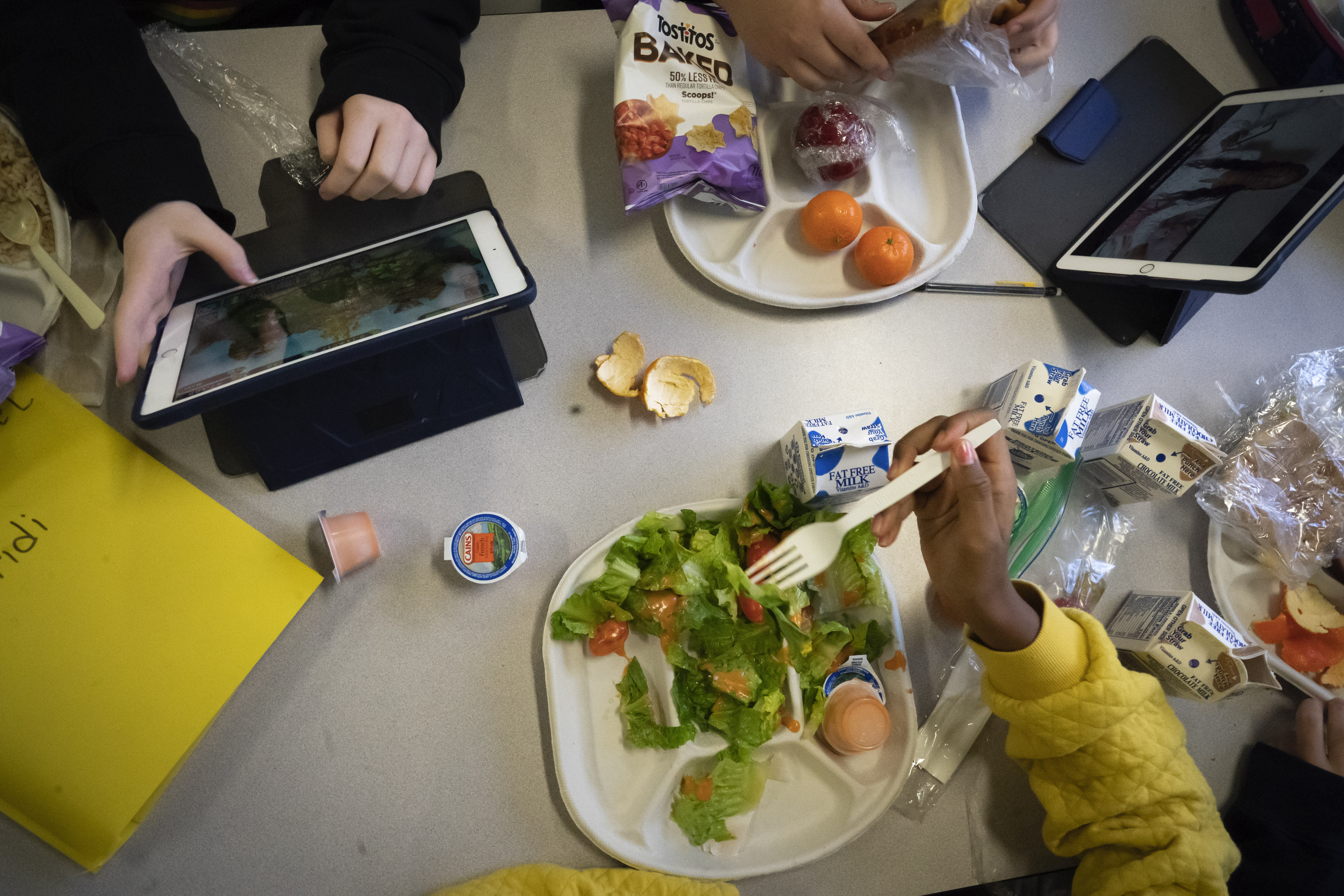
Seventh-graders sit together in the cafeteria during their lunch break at a public school in Brooklyn, N.Y., on Feb. 10, 2023. (AP)
When Republican lawmakers secured cuts to the United States' largest food assistance program last year, Paige Shoemaker DeMio wasn't worried about children going hungry just at home — but at school.
"Anytime we're hearing about cuts to SNAP or Medicaid, we're worried about what's going to be the domino effect of this," she says.
Shoemaker DeMio is a senior policy analyst at the Center for American Progress, a left-leaning think tank. She usually focuses on K-12 education, but in recent months, she has been following the changes to the Supplemental Nutrition Assistance Program, also known as SNAP or food stamps.
That's because SNAP connects children with other critical resources, such as free breakfast and lunch at school. So when a family loses access to food assistance, the family's child may stop automatically receiving free food at school. And when scores of families fall off SNAP, universal free meal programs at tens of thousands of schools fall into jeopardy.
The Center on Budget and Policy Priorities estimates thatover a million childrenhave lost food benefits since July 2025, when the One Big Beautiful Bill Act was signed into law. Among the changes, the legislationled to stricter work requirementsto receive food assistance.
Going into this academic year, dozens of schools nationwide have ended their universal free meal programs — including schools in San Antonio,HoustonandMiami-Dade County. School nutrition experts say it's unclear to what extent a decline in SNAP participation played a role. But Diane Pratt-Heavner, a spokesperson for the School Nutrition Association, which represents about 50,000 school nutrition professionals in the U.S., says that the full impact on free school meals will emerge in the coming years as SNAP changes take effect.
Support WBUR
"This moment in time could potentially be a tip-of-an-iceberg situation," she says "It could get much, much worse."
In a statement, the U.S. Agriculture Department, which administers SNAP and school meals on the federal level, said it invests $385 million for low-income communities and people in need of nutrition assistance.
"School meal programs have varying income limits, and while SNAP participation may ease the application process, a family not on SNAP is not automatically disallowed participation," the department stated.
School districts will have to reassess whether they can afford free meals
The Agriculture Department's Community Eligibility Provision helps pay for universal free meals at a school or district if at least a quarter of students participate in assistance programs like SNAP. (If it's 62.5% or more, the federal government covers the full tab.) More than 49,000 public schools participated as of the 2024-2025 school year,according to the Center for American Progress.
Federal reimbursement fluctuates based on the percentage of families receiving assistance. A decline in food stamp participation can lead to a decrease in federal funding, forcing schools to pay more for universal free food when their budgets are already stretched thin, according to Pratt-Heavner.
This could push schools to shift funds away from classroom needs or decide to stop offering universal free meals altogether, she adds. If districts decide to do away with their free food programs, they may still incur costs in the form of debt from unpaid meals.
That's what happened in 2023. When the U.S. ended a federal pandemic waiver allowing schools nationwide to offer free meals, districts reported accruing meal debt as high as $1.7 million, according to areportby the School Nutrition Association.
"Unpaid meal debt becomes an issue not only for the school meal program, but for the school district budget, which has to pay teachers and for textbooks," Pratt-Heavner says. "It's just a no-win situation for anyone."
Erin Bronner is the director of child nutrition and wellness for a small school district in central Phoenix that participates in the Community Eligibility Provision (CEP). Arizona has seen the most dramatic decline in SNAP participation in the country, withmore than 400,000 people— including about 180,000 children — losing food assistance over the past year.
Now, Bronner's district is due to reapply for the provision next year. She says she's worried whether her district can afford to keep offering universal free meals.
"Due to the dramatic decline in SNAP assistance, the percentage of eligible families [is] not high enough for us to be able to financially sustain operating this provision," she says. "So we would actually lose money if we were to continue to operate CEP."
The kids in the "danger zone"
Students qualify for free food at school if their family earns at or below 130% of the poverty line, which is$42,900 for a family of fourin 2026. Reduced-price meals are offered to such families making $61,050 or less.
Support WBUR
To access free or reduced-price meals, students can fill out a school meal application. But the form tends to be a source of confusion and administrative burden, according to Shoemaker DeMio.
"It's easier and faster for children to get fed when meals are universally given rather than individually applied for," she says.
Another issue with the application is that it factors in only income and doesn't take into account a family's expenses or unique hardships, according to Pratt-Heavner. There are no exceptions or waivers.
"So, a family that's struggling with a recent rent increase or has a family [member] undergoing cancer treatment may be spending more than they're taking in and might not be eligible for any help at all," she says.
Bronner, in Arizona, calls it the "danger zone": when a student's family makes just above the income threshold but is still cash-strapped.
"They do fall through the cracks," she says. "And because of where they fall income-wise, it doesn't leave us too many options to try and provide an alternative for them."
School policy experts say they're also concerned for children of noncitizens, even though free or reduced-price meals are available to all students regardless of immigration status. They're concerned because such children's parents may be afraid to share personal information in theschool meal application— such as the last four digits of their Social Security number — amid a nationwide immigration crackdown.
Losing access to free meals could require families to spend on average nearly $1,000 per student each school year, according to theCenter for American Progress. Shoemaker DeMio says that cost burden comes as many families are already grappling with high living costs and steep gas prices.
" That's a lot of money," she says. "Especially when we're talking about these families who are on the cusp of eligibility and who are also facing an affordability crisis."
Concerns about growing hunger
Currently, nine states offer permanent universal free school meals: California, Colorado, Maine, Massachusetts, Michigan, Minnesota, New Mexico, New York and Vermont. In recent years, other states have introduced legislation to move toward this direction.
But those universal free meal programs also have been a topic of debate. Opponents say that they're costly and that the government shouldn't pay for students whose families can afford school meals. Meanwhile, advocates argue that school meals tend to be healthier and promote better education outcomes.
Support WBUR
" Schools provide books, they provide pencils, they even provide laptops these days to help students be ready to learn, and nutrition is no different," Shoemaker DeMio says. " Nutrition is a foundational ingredient to student success."
Sharon Glosson, the executive director of school nutrition at North East Independent School District in San Antonio, supports universal free school meals. Glosson says she has seen it remove stigma and shame for low-income students in the lunch line.
" It's open to everyone, and there's no differentiation between those that qualify for free and reduced price and those that don't," she says.
But this school year, her district announced that it would have to stop offering universal free meals at nearly half its campuses. Glosson believes the biggest factor was a decline in the number of families receiving food assistance — though the need to help ease hunger is still there.
"We know that within our families in our school district, their economic status between now and four years ago, they don't feel that it has improved to the point where they are now able to pay for school meals," she says.
POSTS THAT INCLUDE FUNDRAISING THAT 'VIOLATES THEIR
UNDEFINED COMMUNITY STANDARDS SO ALL 'FUND RAISING'
IS DELETED - CONTRIBUTE AS YOU ARE INCLINED TO SUPPORT
IMPORTANT ISSUES! THESE ARE NOT SOLICITATIONS
WHERE DID THIS BIMBO BROOKE ROLLINS COME FROM?
SHE'S THE BRAIN DEAD BIMBO WHO TOLD PEOPLE TO GET CHICKENS!
REPUBLICANS AND MAGA IGNORE THE CONSEQUENCES OF THEIR CRUELTY!
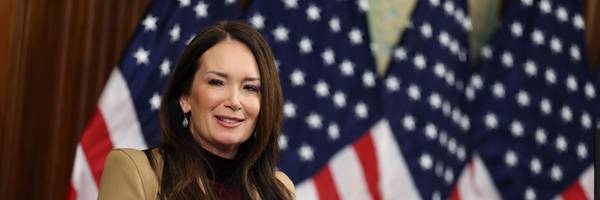
US Agriculture Secretary Brooke Rollins speaks at a news conference on Capitol Hill on October 31, 2025 in Washington, DC.
(Photo by Anna Moneymaker/Getty Images)
Trump Official Tells Millions Kicked Off Food Aid That They’re ‘Moving Into the American Dream’
“Unless the Trump administration has redefined ‘the American dream’ to mean ‘losing the help your family needs to afford groceries because of federal cuts,’ I have some bad news for Secretary Rollins,” said one expert.
The head of the US Agriculture Department on Thursday celebrated that millions of people have lost federal nutrition assistance under the second Trump administration, declaring that families who have seen their modest aid disappear are closer to realizing “the American dream.”
Speaking at an event in Arizona, USDA Secretary Brooke Rollins—who has an estimated net worth of around $15 million—said that the Trump administration has “moved about 4 million off of SNAP,” referring to the Supplemental Nutrition Assistance Program. Rollins suggested, without evidence, that some of those who have lost SNAP benefits were receiving them fraudulently.
But others, claimed Rollins, are “moving into the American dream and off of welfare.”
Katie Bergh, a senior policy analyst at the Center on Budget and Policy Priorities (CBPP), wrote in response that “unless the Trump administration has redefined ‘the American dream’ to mean ‘losing the help your family needs to afford groceries because of federal cuts,’ I have some bad news for Secretary Rollins.”
Watch Rollins’ remarks:
Trump administration officials, including President Donald Trump himself, have repeatedly used euphemistic language to describe the large-scale loss of food aid following passage of the Republican budget reconciliation package last summer. That measure contains $186 billion in SNAP cuts over the next decade—the largest in the program’s history.
During his State of the Union address in February, Trump boasted that his administration has “lifted” millions of Americans off SNAP, falsely suggesting that the mass loss of benefits was attributable to stronger economic conditions rather than deliberate policy changes designed to boot people from the program.
“Economic conditions haven’t been improving as the number of people receiving SNAP has plummeted in recent months, representing the sharpest decline in decades,” CBPP noted in a recent analysis. “The last time there was such a steep decrease in participation in such a short period of time (other than temporary spikes following natural disasters) was nearly three decades ago, after Congress enacted very deep cuts to SNAP (then the Food Stamp Program) in 1996.”
“SNAP participation has fallen in every state,” the think tank added, “and in some, the drop is particularly alarming.”
“The government hasn’t ‘lifted’ Americans facing food insecurity; it’s simply decided to kick them down the elevator shaft.”
Arizona, the state Rollins visited on Thursday, saw a roughly 50% decline in the number of people receiving SNAP benefits between January 2025 and February of this year, with hundreds of thousands of people losing benefits.
“We certainly are not seeing a drop in the number of folks that are participating because we’ve solved hunger,” Adrienne Udarbe, executive director of the nonprofit group Pinnacle Prevention, told AZFamily earlier this week.
One Tucson, Arizona resident, a single mother of three, told the Unrig Our Economy coalition on Friday that “even working full-time, I’ve been unable to access SNAP benefits since March thanks to Republicans’ cuts.”
“Costs are already rising everywhere because of Republicans’ tariffs and their war in Iran, and cutting food assistance is pushing families like mine over the edge,” said the mother, identified as Angelica G. “It’s difficult to work so hard to make ends meet just to watch Republicans in Congress give even more tax breaks to billionaires while cutting food services that families like mine rely on.”
In Kansas, more than 21,000 people have lost SNAP benefits since July. Haley Kottler, senior campaign director at the advocacy group Kansas Appleseed, said in a statement Thursday that “these are not just abstract numbers.”
“These are Kansas kids losing access to food,” said Kottler. “This has real implications for Kansas children to access the nutrition they need to learn, grow, and thrive.”
Rollins’ comments Thursday came amid a flurry of data showing the weakness of the US economy and the struggles of working-class families under Trump’s leadership, from rising inflation to falling personal savings rates.
Earlier this week, as Common Dreams reported, the Federal Reserve Bank of New York released an analysis showing that the US has seen “a remarkable increase in food insecurity” in recent months, “particularly among lower-educated and lower-income households and households with young children.”
Political analyst Steve Benen wrote in a column for MS NOW on Tuesday that “Republicans seem to think this is worth bragging about.”
“Trump’s routine use of the word ‘lift’ makes it sound as if struggling families were put onto an elevator that carried them to a stronger and more secure position,” wrote Benen. “That turns reality on its head: Thanks to the inaptly named One Big Beautiful Bill Act, the government hasn’t ‘lifted’ Americans facing food insecurity; it’s simply decided to kick them down the elevator shaft, depriving much of the public of food aid.”
In case you missed it — as Donald Trump’s reckless shutdown continues, 25 states and the District of Columbia are standing strong for millions of Americans at risk of losing access to food.
Led by California, New York, and Pennsylvania, this powerful coalition has filed a lawsuit against the Trump administration’s cruel and unlawful freeze of SNAP food stamp benefits, which millions rely on to put meals on the table. Their message is clear: no family should go hungry because of political games in Washington.
✍️Add your name to applaud the 25 states and D.C. for defending food assistance, fighting hunger, and standing up for the millions of Americans Trump left behind SUBSCRIBE & SPEAK OUT WITH CIVIC SHOUT!
Thank you for standing with us!
In solidarity,
Emily from The Smile
P.S. Know someone who could use a dose of good news? Forward this email and encourage them tosubscribe to The Smile. Let’s spread the positivity together. 🌟