On Christmas Day, I like to recall the significance of Jesus and the nativity for Muslims. I’ve talked about Rumi, Attar, and other mystics. Today it is Nezami’s turn. The great Persian poet Nezami (1141-1209) was from the city of Ganja in northwestern Iran when it was ruled by the Seljuk Empire. That was the […]
On Christmas Day, I like to recall the significance of Jesus and the nativity for Muslims. I’ve talked about Rumi, Attar, and other mystics. Today it is Nezami’s turn.
The great Persian poet Nezami (1141-1209) was from the city of Ganja in northwestern Iran when it was ruled by the Seljuk Empire. That was the era of the Crusades and Richard Lionheart, though the Crusader kingdoms were far from Iran and Nezami only once left home, to see the king. In his Treasury of Mysteries, this Muslim poet refers to Christian themes several times.
The most famous reference is an anecdote clearly rooted in folk culture, though it captures something of Jesus’ love for the despised humble folk (courtesans and tax-collectors). Here is my hurried, loose rendering:
The feet of Christ, which traced the world, passed by a small market one day. A dog big as a wolf lay fallen. Like Joseph, the coat of its beauty was bloodied.
A crowd of spectators gathered at the scene, like vultures circling the carcass. One said, “This gruesome sight poisons the mind, the way a breath blows out a lamp.”
Another said, “It is a pure blight — It is blindness for the eye, a plague on the heart. All expressed their own opinion, heaping scorn each in turn.
When came the turn of Jesus to speak, he eschewed blame and went straight to the truth of the matter. He said, “How fine was its bodily form, and no white pearl can compare to its teeth.”
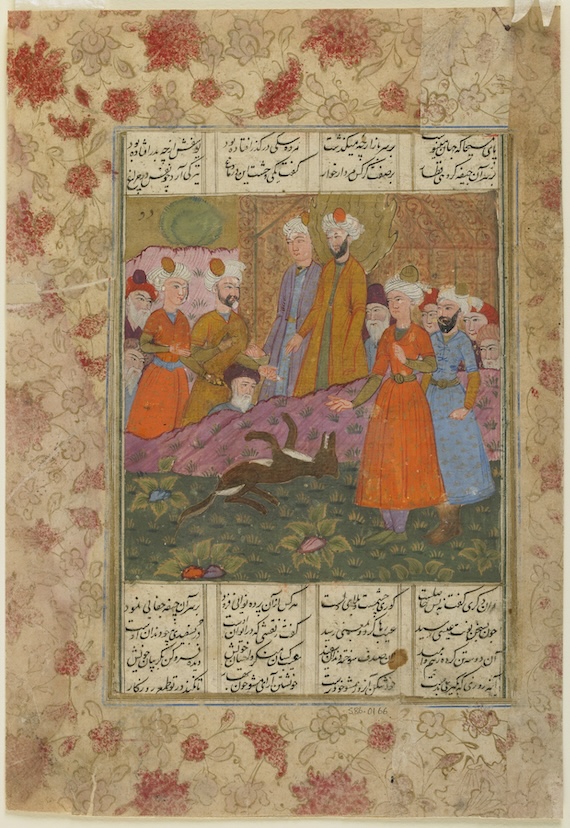
Unlike the others around him, Jesus is here depicted as finding something to admire even in the disgusting, putrid carcass of a dead dog, according to this mystical teaching story. Nezami goes on to advise people not to focus on the faults of others and preen about their own virtues. He warns against being too full of admiration for yourself when you look in a mirror. He says that decking yourself out in finery fresh as the spring is dangerous. Fate is out there, looking for prey to devour, and you don’t want to attract attention to yourself.
Here is an Iranian artist’s rendering of the scene from the Safavid period, early 1600s:
The entirety of this world, old or new, is fleeting, and not worth two barley grains. Do not grieve for this world, but rise, sir, and if you do grieve, pour out some wine for Nezami.
Nezami’s story is an illustration of Matthew 7:3-5
3 Why do you see the speck in your neighbor’s eye but do not notice the log in your own eye? 4 Or how can you say to your neighbor, ‘Let me take the speck out of your eye,’ while the log is in your own eye? 5 You hypocrite, first take the log out of your own eye, and then you will see clearly to take the speck out of your neighbor’s eye. (New Revised Standard Version Updated Edition).
The Gospels also show Jesus as reminding people that they are in no position most of the time to judge others for their flaws, as when he defended the woman accused of adultery from being stoned in John 8:7
7 When they kept on questioning him, he straightened up and said to them, “Let anyone among you who is without sin be the first to throw a stone at her.” (New Revised Standard Version Updated Edition)
Muslim poets and story-tellers told lots of anecdotes about Jesus that are not in the Gospels. He was a figure of wisdom and self-denial, and the Persian mystics used him to symbolize the potential of the soul for spiritual growth.
Eleftheria Kousta ( Waging Nonviolence ) – After the war and genocide in southeastern Bosnia in 1993, two very important forces shaped the society that emerged. One was the denial of war criminals and genocidal actors, who smeared and discredited victims to evade accountability. The second was the uphill battle of the survivors to not […]
(Waging Nonviolence) – After the war and genocide in southeastern Bosnia in 1993, two very important forces shaped the society that emerged. One was the denial of war criminals and genocidal actors, who smeared and discredited victims to evade accountability. The second was the uphill battle of the survivors to not only deal with the crimes committed against them but also make sure that the truth didn’t get buried by preserving the memory of the events as they happened.
While investigators and other experts flooded Bosnia in the aftermath to collect evidence for the Yugoslavia Tribunal at the International Court of Justice and the International Criminal Court, it was grassroots activists and genocide survivors — like theMothers of Srebrenica— who made the biggest impact. Their efforts ensured that the evidence was not only collected to be presented in courts, but also preserved for future generations. They saw this as a guard against the actors who still — to this day — spread disinformation and deny the genocide and war crimes that took place.
Malicious disinformation campaigns continue wherever crimes against civilians are committed. In Syria, Ukraine and elsewhere, many grassroots efforts have been formed out of the necessity to collect and preserve evidence of war crimes and crimes against humanity. Now, in Gaza, over a year after Israel’s invasion, Palestinians are in the same uncomfortable position, forced to face the enormous task of accounting for their dead and how they were killed, as well as making sure that the evidence leads to accountability — not to mention sets the record straight amid orchestrated attempts to discredit what has happened.
One of the leading forces behind this effort is the grassroots movement and human rights organizationLaw for Palestine, which is composed of volunteer experts, scholars and researchers. I spoke to two of its members, legal advocate Kathryn Ravey and Palestinian researcher Layla (not their real name), to learn about the work of archiving evidence of genocidal intent in Gaza. Since the early days of October last year, the Law for Palestine team has been tirelessly compiling a database containing evidence of genocide incitement by Israeli leading figures. To this day, they have logged more than 500 instances, which they continue to update. We discussed their motives for doing this work, the challenges they face and lessons learned along the way.
Tell me about Law for Palestine and the work you do?
Kathryn: We’re a global network of legal professionals. We answer legal questions, organize legal training and conduct legal advocacy for Palestinians, including submitting communications to U.N. entities. We are working as a grassroots movement, and we are network-building across the world.
Layla: We started working on the database on Oct. 8 last year. The purpose of the database is to showcase the intent [of Israel’s violence] versus the actual action. We collected any type of statement or material that contained incitement or intent to harm and genocide within the Israeli media, political scene and society. We aim to compile it into one place that can serve not only as evidence but also serve anyone who wants to research the ongoing acts of violence by the state of Israel in the future.
What results and conclusions have you reached through your research?
Kathryn: The legal categorization of genocide is a very difficult one to prove in international law. It’s a case that no one ever wants to bring in international courts because there’s a very high threshold to meet it.
What makes it difficult is that, in addition to showing the act of genocide has occurred, you have to show that this act was done with the intention to destroy the whole or part of a population. We’ve seen that the actions Israel has committed over the last year have constituted genocide, through starvation, forced displacement, killings, targeting of civilian infrastructure, torture, dehumanization and imprisonment. We’ve attempted to show that these ongoing acts have been inextricably linked to the intent.
We’ve seen from Oct. 7 until today, statements by officials as well as people within Israeli society calling for the destruction of the Palestinian people, which includes calling for the withholding of humanitarian aid, eradication and forced displacement. This discourse has significant implications for international law and — with the case of genocide South Africa has brought to the ICJ — this database is an indispensable tool showcasing that all of these calls are materialized in Israel’s actions and wider policy.
Why choose archiving as a form of activism? And why is it important to the wider Palestinian movement?
Layla: Archiving is important not only for legal but also research purposes. As a Palestinian, I have not seen it done very widely, but archiving is pivotal for the events that happened to be remembered, for holding the people responsible accountable, and for future generations to have an opportunity to learn the key patterns that led to these events. Our archives must be accessible to people, because not only can such information become harder and harder to find but also these actions follow a pattern and are not isolated instances.
Kathryn: We live in times where digital activism is new. Most past genocides have been reported only through text, video and photos that are usually retrieved quite a while after the events have occurred.
This is the first time that a genocide has been live-streamed, tweeted and put on TikTok and Instagram. We’re witnessing genocide in a new way. We have been trying to work with various forms of media and try to capture all of this evidence, especially in the digital era where things can be deleted or removed quickly.
One big challenge has been how to capture and share this elusive information. We have made a significant effort to permalink everything, but a lot of times it’s not possible — or it’s very difficult to maintain a video that’s been deleted. It’s a new form of activism to try to hold people accountable for things that can easily disappear online.
What’s unique about your perspective as a grassroots movement that practices archiving and trying to preserve all this evidence in a non-institutionalized way?
Kathryn: This practice came out of necessity. This was not something that Law for Palestine had done before, but after Oct. 7, all of us in civil society circles — along with the Palestinian colleagues we were speaking with — agreed it was an important thing to do.
A year ago, after Oct. 7, it was just chaos. There were so many things to respond to and people and resources were pulled. A lot of this work came out from the fact that no one else was doing it, and we responded to a role that needed to be filled.
As time went on we figured out and experimented with how to maintain and present the database, find safe ways to do the research, secure digital evidence, deal with ownership, prevent information from getting leaked or traced back to a person and protect our researchers from being doxxed or tracked. We also found ways to preserve evidence that might not meet the legal threshold of genocide but are still important to highlight. It’s been an enormous learning process along the way to figure out what’s useful and impactful as an exclusively grassroots effort.
Layla: It’s important to mention that everything in the database is just public information. Palestinians who live within Israel and Palestinians who live in the West Bank and Gaza are exposed to these statements by Israeli news, zionist activists and members of the Knesset.
We hear these types of statements on national news all the time. We need to start tracking who’s been saying what and logging this information instead of accepting it as the status quo because the people whose statements have been logged in the database were pretty vocal about these things way before Oct. 7. So the idea of archiving and exposing these types of statements and making them public to people who are not exposed to Israeli media is very crucial because of the way that the genocide has escalated.
By November, we have already collected 150 statements, and I’m sure we’ve missed some. It is important to start as early as possible to capture as many of these sentiments and make them available to people who are unfamiliar with the Israeli media landscape.
What difficulties did you encounter along the way?
Kathryn: We had countless difficulties. We had to find the sources and translate them — and then ensure we fact-checked our sources that the statement was valid and that the link to the source could be captured. The same story can appear on multiple links so we have to go through large quantities of material.
We were getting so many statements, more than we could categorize or deal with. By that time the ICC and the ICJ were happening. A lot of people were raising the question of genocide and the question of intent. We had all this evidence but very few resources. Most of us do this voluntarily on top of other commitments. This is a lot of work but thankfully over the last few months, we have been working withVisualizing Palestine, which helped us to organize the database andpresent itin the best way possible.
There are plenty of sources that we’re still trying to permalink, sources that we had to remove, but it’s hard to capture a societal narrative. That being said, the reception of our work has been amazing. A lot of people have been using our database, and we’ve gotten some of the data back on what people are searching for. The amount of people visiting the database demonstrates that it has been a useful tool for anyone looking to advocate or learn more about the situation.
Layla: There’s a very difficult psychological aspect that comes with compiling copious amounts of material of extremely infuriating content and having to sift through things that are fitting the purpose of the database. For example, watching a two-hour-long right-wing TV show where panelists are calling for the extermination of Palestinians can easily take a toll on someone who spends hours being exposed to such materials.
There are also challenges with translations. Many times it is hard to capture the essence of a sentence that does not have a direct way to be translated in English and people who speak the language can understand the nuances but will have a hard time explaining to English speakers.
Kathryn: In addition to the translations, we also had to provide context because — for a lot of the statements we collected — readers might not know the locations, persons or events they are referring to if they are unfamiliar with Israeli discourses.
I would also like to reiterate that the secondhand trauma through reading all of this is a real thing. Also, when asking about people’s perceptions when shown the database, we quickly realized that many people weren’t ready to be confronted with the gravity of what was being said.
This is an invaluable lesson. After all, you are immediately hit with how much has been said because not everyone is a daily witness to those narratives like the Palestinians are and don’t understand how common they are to mainstream Israeli discourse. When we are talking about genocide most people assume this is coming only from more extremist wings of society, but in reality it’s really widespread and our database accurately captures that. I think a lot of people react quite strongly because they’re sort of being questioned on their own perception of this.
Have you been on the receiving end of smear campaigns due to the content of your work?
Layla:I am not doing this work openly as it could complicate things for me given my citizenship. There was an article in an Israeli website that ran a story about our database and how “a group of Palestinians” are trying to implicate Israel in acts it is not doing. Also, in the Law for Palestine Twitter account you can see a lot of bots and pro-Israel accounts trying to discredit us and calling people who are working on the database “antisemites” and questioning our intentions and identities. Other than that, all I’ve seen is just support. People are finding the database useful which is our main goal.
Kathryn: Luckily we haven’t gone through personal attacks, but Israel has attempted to shut down all and everyone in the Palestinian civil society. There is always anticipation for smear campaigns, but I think what is guarding us from them is the fact that the evidence we provided speaks for itself and comes directly from Israeli sources, which is very difficult to dispute.
What have you learned so far and what kind of wisdom would you like to pass to others who have to do this work where genocide and war crimes are also happening?
Layla: If you were to start this type of project, it is very important to have a supportive team, with everyone on the same page, because this is not a one-person project. It is very time-consuming and mentally tiring.
I would also say: Start as early as possible because these types of situations get bad quickly, and if we had waited until the end of October to start archiving we would have missed a lot of crucial information, and we would be drowning in the sheer amount of material that is out there to cover. If you can start early you’ll be able to capture much more in a way that is more efficient and organized.
Kathryn: Because digital evidence in such cases is an emerging field it means that it’s a great opportunity to reshape the human rights and international law landscape. I think we should encourage creativity as there is a ton of new types of evidence we are going to be able to use in the court of law. For example, there is a group looking specifically at TikToks of Israeli soldiers committing war crimes and posting them on the platform. That would have been unheard of even a few years ago.
It’s all a matter of staying creative and flexible. Oftentimes solidarity movements can get rigid or difficult to organize and that’s how they lose momentum. We never intended to make this what it is today. It was something that we started because it was important, and had no idea where it would go. With Visualizing Palestine we worked on aninteractive visualization, which is a creative and artistic way to present this database. We never even knew it would get there, so staying responsive, creative and flexible to the changing tides of international law and human rights is very important.
Anything you’d like to add?
Kathryn: Everything in the database is efficiently categorized. It is still very shocking content to go through. Everything you can imagine is there: starvation, torture, forced displacement and more.
Normally, if you’re presenting a case in front of an international law court, you have to read through hundreds of pages and it’s boring. You never get evidence presented in this way, this is such a unique tool that I hope to see more in future cases.
Layla: Not only is this a great and creative source for legal procedures, but it’s also a great source to educate people who are not familiar with legal settings. Many find it hard to read through long articles and stories, so the interactive database offers people a push to dive into this topic and makes it easier for them to digest.
Most people might not be very comfortable to research and read through large quantities of atrocious stories about families being wiped out or starved. But when seeing these types of things, people still want to find out what is being said, or the context, and understand what the connection is between the statement and the real-life actions.
Our database is a good tool for people to start learning about the situation in Palestine and then draw parallel lines with other causes that are going through similar struggles. I feel like that can help create a more emotionally-invested generation, one that can empathize beyond the news. So it’s a tool that can provide a lot to people from different backgrounds with an insight into our situation, and I hope that people get to utilize this opportunity to its fullest.
Eleftheria Kousta is a freelance journalist and researcher with an MSc in Security Studies from UCL. Having worked and volunteered in the advocacy space, she is interested in covering movements, civilians in conflict and refugees.
Waging Nonviolence is an independent, non-profit media platform dedicated to providing original reporting and expert analysis of social movements around the world. They believe that when ordinary people organize they have incredible power and are the drivers of social change — not politicians, billionaires or corporations. Since their founding in 2009, they have published reporting from contributors in more than 80 countries — with a special focus on overlooked movements in the Global South, as well as issues that traditional media tend to ignore.
By Oscar Berglund, University of Bristol and Tie Franco Brotto, University of Bristol (The Conversation) – Climate and environmental protest is being criminalised and repressed around the world. The criminalisation of such protest has received a lot of attention in certain countries, including the UK and Australia. But there have not been any attempts to […]
(The Conversation) – Climate and environmental protest is being criminalised and repressed around the world. The criminalisation of such protest has received a lot of attention in certain countries, including theUKandAustralia. But there have not been any attempts to capture the global trend – until now.
We recently published areport, with three University of Bristol colleagues, which shows this repression is indeed a global trend – and that it is becoming more difficult around the world to stand up for climate justice.
This criminalisation and repression spans the global north and south, and includes more and less democratic countries. It does, however, take different forms.
Our report distinguishes between climate and environmental protest. The latter are campaigns against specific environmentally destructive projects – most commonly oil and gas extraction and pipelines, deforestation, dam building and mining. They take place all around the world.
Climate protests are aimed at mitigating climate change by decreasing carbon emissions, and tend to make bigger policy or political demands (“cut global emissions now” rather than “don’t build this power plant”). They often take place in urban areas and are more common in the global north.
Four ways to repress activism
The intensifying criminalisation and repression is taking four main forms.
1. Anti-protest laws are introduced
Anti-protest laws may give the police more powers to stop protest, introduce new criminal offences, increase sentence lengths for existing offences, or give policy impunity when harming protesters. In the 14 countries we looked at, we found 22 such pieces of legislation introduced since 2019.
2. Protest is criminalised through prosecution and courts
This can mean using laws against climate and environmental activists that were designed to be used against terrorism or organised crime. In Germany, members of Letzte Generation (Last Generation), a direct action group in the mould of Just Stop Oil, werecharged in May 2024with “forming a criminal organisation”. This section of the law is typically used against mafia organisations and had never been applied to a non-violent group.
Criminalising protest can also mean lowering the threshold for prosecution, preventing climate activists from mentioning climate change in court, and changing other court processes to make guilty verdicts more likely. Another example is injunctions that can be taken out by corporations against activists who protest against them.
3. Harsher policing
This stretches from stopping and searching to surveillance, arrests, violence, infiltration and threatening activists. The policing of activists is carried out not just by state actors like police and armed forces, but also private actors including private security, organised crime and corporations.
In Germany, regional police have been accused ofcollaborating with an energy giant(and its private fire brigade) to evict coal mine protesters, whileprivate securitywas used extensively in policing anti-mining activists in Peru.
4. Killings and disappearances
Lastly, in the most extreme cases, environmental activists are murdered. This is an extension of the trend for harsher policing, as it typically follows threats by the same range of actors. We used data from the NGO Global Witness to show this is increasingly common in countries including Brazil, Philippines, Peru and India. In Brazil, most murders are carried out by organised crime groups while in Peru, it is the police force.
Protests are increasing
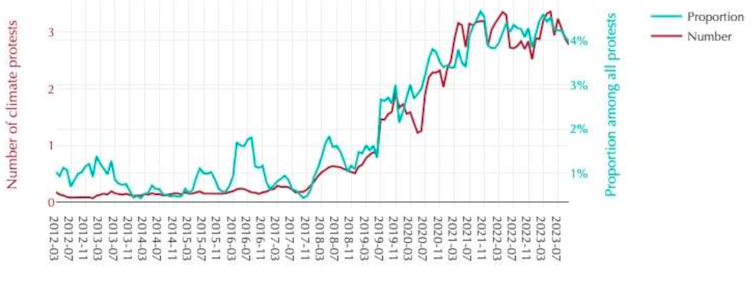
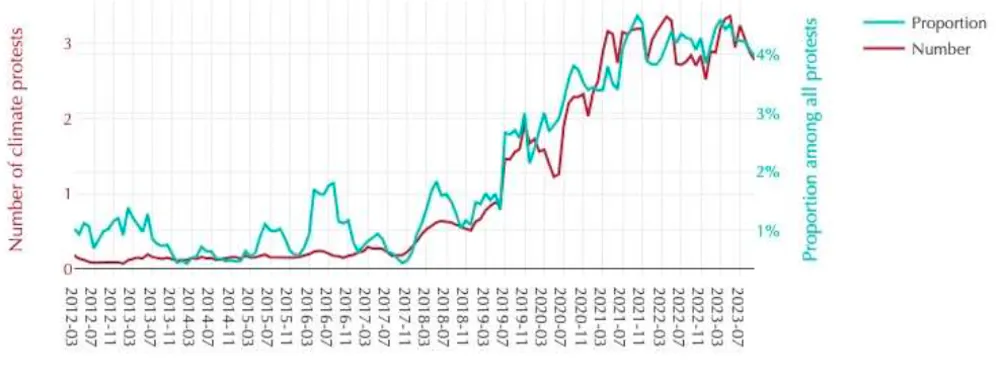
To look more closely at the global picture of climate and environmental protest – and the repression of it – we used the Armed Conflicts Location Event database. This showed us that climate protests increased dramatically in 2018-2019 and have not declined since. They make up on average about 4% of all protest in the 81 countries that had more than 1,000 protests recorded in the 2012-2023 period:
Climate protests increased sharply in the late 2010s in the 14 countries studied. (Data is smoothed over five months; number of protests is per country per month.) Berglund et al; Data: ACLED, CC BY-SA
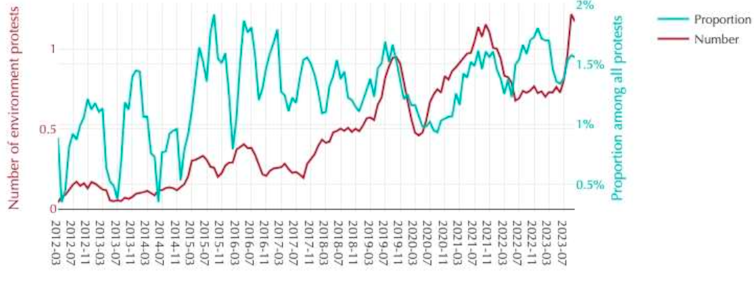
This second graph shows that environmental protest has increased more gradually:
Environmental protests in the same 14 countries. Data: ACLED, CC BY-SA
We used this data to see what kind of repression activists face. By looking for keywords in the reporting of protest events, we found that on average 3% of climate and environmental protests face police violence, and 6.3% involve arrests. But behind these averages are large differences in the nature of protest and its policing.
A combination of the presence of protest groups like Extinction Rebellion, who often actively seek arrests, and police forces that are more likely to make arrests, mean countries such as Australia and the UK have very high levels of arrest. Some 20% of Australian climate and environmental protests involve arrests, against 17% in the UK – with the highest in the world being Canada on 27%.
Meanwhile, police violence is high in countries such as Peru (6.5%) and Uganda (4.4%). France stands out as a European country with relatively high levels of police violence (3.2%) and low levels of arrests (also 3.2%).
In summary, while criminalisation and repression does not look the same across the world, there are remarkable similarities. It is increasing in a lot of countries, it involves both state and corporate actors, and it takes many forms.
This repression is taking place in a context where states are not taking adequate action on climate change. By criminalising activists, states depoliticise them. This conceals the fact these activists are ultimately right about the state of the climate and environment – and the lack of positive government action in these areas.
The Conversation is an independent, not-for-profit media outlet that works with academic experts in their fields to publish short, clear essays on hot topics.
Support the Really American channel by liking, subscribing, dropping a comment, and watching til the end!
If you can, please consider helping us keep making these videos by joining us as a member on Patreon. We engage directly with our patrons there, release exclusive content for our patrons, and can't do this without you! / reallyamericanmedia
Follow Really American -
Instagram: / reallyamericanmedia
Tiktok: / reallyamerican1
Twitter: https://x.com/ReallyAmerican1
The Qur’an, the scripture Muslims believe was received by the the Prophet Muhammad (d. 632) by divine inspiration, has a number of passages that mention Mary and the virgin birth of Jesus.
The Chapter of Mary, 19:16, says (my interpretation):
And mention in the Book Mary, when she withdrew from her family to an eastern place.
It is implied that it was her unexplained pregnancy that caused her to withdraw.
Verses 19:17-35 continue:
And once remote from them, she hid behind a screen. Then we sent to her our spirit, who took the shape of a well-formed man.
She said, “I take refuge in the All-Merciful from you, if you are pious.”
He said, “I am but an angel of your lord, come to bestow on you a son without blemish.”
She said, “Will I have a son, when no mortal has touched me, and I was not rebellious?”
He said, “So it is.” He said, “Your Lord says, it is easy for me. We will make him a sign for the people and a mercy from us. The matter has already been decreed.”
So she bore him, and withdrew with him to a remote place.
And the pangs of childbirth drove her to the trunk of a palm tree. She said, “I wish I had died before now, and had been forgotten in oblivion.”
But he called to her from beneath her, saying, “Do not be sad. For your Lord has made a stream run beneath you.”
So shake the trunk of the palm tree toward you, and ripe, fresh dates will fall to you. So eat and drink and be comforted. If you see any human being, say, “I have taken a vow to the All-Merciful to fast, and will speak to no one today.”
Then she brought him to her people, carrying him, and they said, “Mary, you have done something unheard of!”
Sister of Aaron, your father was not wicked and your mother was not rebellious.”
She gestured to him. They said, “How can we speak to a baby in its cradle?”
He said, “I am the servant of God, and he gave me scripture and made me a prophet. He made me blessed wherever I might be, and counseled me to prayer and giving charity as long as I live. And he made me obedient to my mother, nor did he make me overbearing or cruel. Peace be upon me, the day I was born, and the day I die, and the day I am raised up alive.”
That is Jesus, the son of Mary, the Word of truth about whom they dispute. It was not for God to take a son. Praised may he be. When he decrees a thing, he says to it, “Be!” And it is.
This Christmas carol will seem both familiar and unfamiliar to Christians. The Qur’an tells a more elaborate story than does the New Testament. It underlines that Mary’s pregnancy was a scandal to the Jews of Jerusalem. The angel reassures her that a virgin can give birth, since God can make anything happen.
I talk about Christianity and Islam in my recent book,
The Qur’an denies the fatherhood of God. Because it grew up in a polytheistic environment, there was always a danger that pagans would take the fatherhood of God and the sonship of Jesus literally. The Qur’an rejects this metaphor, almost uniquely among religious texts of that era.
Jesus is a sign that God can say “Be!” and, it is. He is also the Word of the Truth.
As for Mary, some Muslim scholars considered her a prophet in her own right, and Jesus is depicted as demanding respect for her.
This is one of the passages that convinced the authors at the Vatican in the 1960s, who produced the Vatican II document, that Islam has some of the divine truth.
A passage of November 1964 says
“But the plan of salvation also includes those who acknowledge the Creator, in the first place among whom are the Muslims: these profess to hold the faith of Abraham, and together with us they adore the one, merciful God, mankind’s judge on the last day.”
A passage the month before had said,
““The Church has also a high regard for the Muslims. They worship God, who is one, living and subsistent, merciful and almighty, the Creator of heaven and earth (Cf. St. Gregory VII, Letter III, 21 to Anazir [Al-Nasir], King of Mauretania PL, 148.451A.), who has spoken to men. They strive to submit themselves without reserve to the hidden decrees of God, just as Abraham submitted himself to God’s plan, to whose faith Muslims eagerly link their own. Although not acknowledging him as God, they venerate Jesus as a prophet, his Virgin Mother they also honor, and even at times devoutly invoke. Further, they await the day of judgment and the reward of God following the resurrection of the dead. For this reason they highly esteem an upright life and worship God, especially by way of prayer, alms-deeds and fasting.”
“Over the centuries many quarrels and dissensions have arisen between Christians and Muslims. The sacred Council now pleads with all to forget the past, and urges that a sincere effort be made to achieve mutual understanding; for the benefit of all men, let them together preserve and promote peace, liberty, social justice and moral values.”
“Therefore, the Church reproves, as foreign to the mind of Christ, any discrimination against people or any harassment of them on the basis of their race, color, condition in life or religion. Accordingly, following the footsteps of the holy Apostles Peter and Paul, the sacred Council earnestly begs the Christian faithful to ‘conduct themselves well among the Gentiles’ (1P 2:12) and if possible, as far as depends on them, to be at peace with all men (cf. Rm 12:18), and in that way to be true sons of the Father who is in heaven (cf. Mt 5:45).”
The Vatican II council knew what it thought of Islamophobia or irrational hatred of Muslims. It called us all to something better, to an acknowledgement that Jesus and Mary unite people of faith, rather than dividing them and that discrimination against people on the basis of their religion or race is always wrong. The Qur’an also puts Jesus under the sign of peace.






 evised.


