| ||||||||||||||||||||||||||||||||||||||||
| ||||||||||||||||||||||||||||||||||||||||
| ||||||||||||||||||||||||||||||||||||||||
Tuesday, October 22, 2024
Exposed: Elon Musk's Real Reasons for Going Full MAGA


Saturday, January 13, 2024
Manipulation of their customers, on the customers dime.

Wednesday, January 4, 2023
FOCUS: Robert Reich | Republicans Fight Over Speaker of the House – But Whoever Wins, the Party Loses

04 January 23
Live on the homepage now!
Reader Supported News
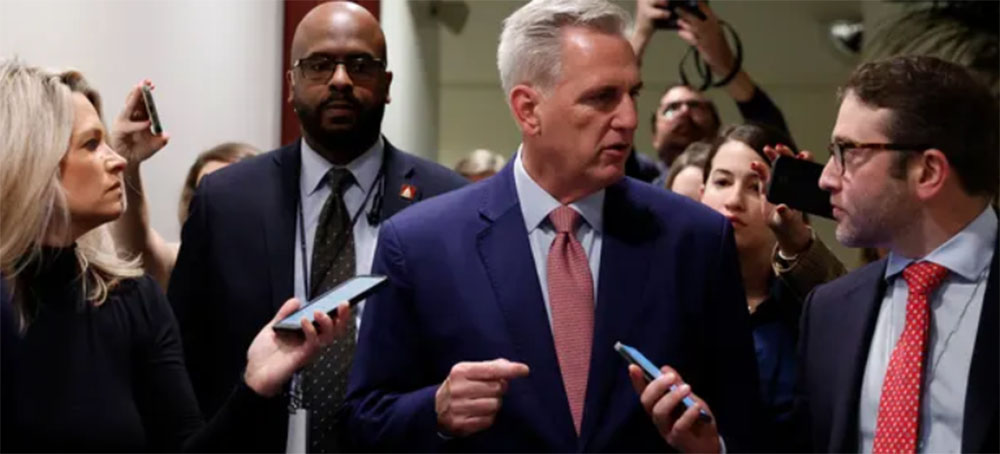
The Republican party has collapsed under its own contradictions, competing impulses and fear of the base
But it’s not particularly civil and it’s not exactly a war. It’s the mindless hostility of a political party that’s lost any legitimate reason for being.
For all practical purposes, the Republican party is over.
A half century ago, the Republican party stood for limited government. Its position was not always coherent or logical (it overlooked corporate power and resisted civil rights), but at least had a certain consistency: the party could always be relied on to seek lower taxes and oppose Democratic attempts to enlarge the scope of federal power.
This was, and still is, the position of the establishment Republican party of the two George Bushes, of its wealthy libertarian funders and of its Davos-jetting corporate executive donor base. But it has little to do with the real Republican party of today.
In the 1990s, Newt Gingrich and Fox News’s Roger Ailes ushered the Republican party into cultural conservatism – against abortion, contraception, immigration, voting rights, gay marriage, LBGTQ+ rights, and, eventually, against transgender rights, teaching America’s history of racism and, during the pandemic, even against masks.
At the same time, cultural conservatism was for police cracking down on crime (especially committed by Black people), teaching religion with public money, retailers discriminating against LBGTQ+ people, and immigration authorities hunting down and deporting undocumented residents.
Gingrich and Ailes smelled the redolent possibilities of cultural conservatism, sensed the power of evangelicals and the anger of rural white America, saw votes in a Republican base that hewed to “traditional values” and, of course, racism.
But this cultural conservatism was inconsistent with limited government – in effect, it called on the government to intrude in some of the most intimate aspects of personal life.
The party line became confused, its message garbled, its purpose unclear. It thereby created an opening for a third and far angrier phase, centering on resentment and authoritarianism.
The foundation for this third phase had been laid for decades as white Americans without college degrees, mostly hourly-wage workers, experienced a steady drop in income and security.
Not only had upward mobility been blocked, but about half their children wouldn’t live as well as they lived. The middle class was shrinking. Well-paid union jobs were disappearing.
Enter Donald Trump, the con artist with a monstrous talent for exploiting resentment in service of his ego.
Trump turned the Republican party into a white working-class cauldron of bitterness, xenophobia, racism, anti-intellectualism and anti-science paranoia, while turning himself into the leader of a near religious cult bent on destroying anything in his way – including American democracy.
A political party is nothing more than a shell – fundraising machinery, state and local apparatus and elected officials, along with a dedicated base of volunteers and activists. The base fuels a party, giving it purpose and meaning.
Today’s Republican base is fueling hate. It is the epicenter of an emerging anti-democracy movement.
What we are seeing played out today in the contest for the speakership of the House involves all of these phases – what remains of the small-government establishment, the cultural warriors and the hate-filled authoritarians – engaged in hopeless, hapless combat with each other.
They are also in combat with the aspirations and ideals of the rest of America.
The Republican party will continue in some form. It takes more than nihilistic mindlessness to destroy a party in a winner-take-all system such as we have in the United States.
But the Republican party no longer has a legitimate role to play in our system of self-government. It is over.
Follow us on facebook and twitter!
PO Box 2043 / Citrus Heights, CA 95611
Thursday, December 15, 2022
RSN: Norman Solomon and Jeff Cohen | The Ghost of Eugene McCarthy Could Haunt Biden's Path to Renomination

14 December 22
Live on the homepage now!
Reader Supported News

Don’t be so sure.
Fifty-five years ago, pundits scoffed when a Democratic senator announced that he was running against incumbent Lyndon Johnson for their party’s presidential nomination. Eugene McCarthy launched his campaign to challenge Johnson’s continual escalation of the war in Vietnam.
Joe Biden’s public approval rating is now at 42 percent, virtually identical to what it was for President Johnson when the McCarthy campaign began in November 1967. A few months later, on March 12, 1968, McCarthy received 42 percent of the votes -- a stunning result, just 7 percent behind Johnson -- in the first-in-the-nation New Hampshire primary. Senator Robert Kennedy jumped into the race four days later. And two weeks after that, Johnson shocked the country by declaring that he would not seek re-election.
It would be nice to hear from Biden the kind of statement that Johnson made: “I do not believe that I should devote an hour or a day of my time to any personal partisan causes or to any duties other than the awesome duties of this office -- the presidency of your country.” But Biden has said in recent weeks that he intends to run again.
Spinners aligned with the White House are careful to detour around the notable shortage of enthusiasm for Biden among the Democratic electorate. New polling found that 57 percent of Democrats don’t want him to be the party’s nominee.
So far, no Democrat in Congress has shown any interest in entering primaries against Biden. Yet a progressive challenger could launch a principled campaign to constructively give Biden a run for his corporate money in early primary states -- raising vital questions about crucial policies along the way.
Skeptics might point out that, unlike when McCarthy received strong support from antiwar citizens, now there is no single overriding issue like the Vietnam War. But there is a class war (by any other name) going on with great intensity in the United States -- and a wide range of Americans are feeling the countless dire consequences of inordinate corporate power and worsening economic inequality.
Of course, Biden does not want to face a primary rival who could clearly illuminate such issues. In the absence of a credible opponent, the president would be able to skate through primaries without needing to face cogent critiques of his administration’s record on an array of chronic problems -- including corporate price-gouging, skyrocketing costs of housing, voter suppression, and a bloated military budget that soaks up roughly half of all federal discretionary spending.
Given the enormity of the crises facing the United States and the world, measures that Biden has proposed are often akin to calling for garden hoses to put out roaring wildfires. Being far better than Republicans in Congress is a high jump over very low standards, while simply blaming Senators Joe Manchin and Kyrsten Sinema is more like scapegoating than explaining.
Whether in the realms of the predatory healthcare system or the exploitive treatment of workers by huge corporations or the ever-increasing stranglehold of big tech companies or many other ills, Biden has often accepted or worsened destructive priorities while rejecting remedies that would improve people’s lives instead of boost corporate profits.
“Our ideas are way more popular than Joe Biden is,” a progressive Democratic member of the New Hampshire legislature says in a TV ad that will begin to air throughout the state this week. A young voter says “Joe Biden representing the status quo in 2024 simply won't cut it.” Another New Hampshire voter warns in the ad (which was produced by our colleagues in the Don’t Run Joe campaign), “We can't afford to risk the White House for a Republican who could defeat status-quo Joe.”
But where is a prominent progressive Democrat willing to challenge status-quo Joe in the primaries? Political courage appears to be in short supply among self-identified progressives on Capitol Hill, who so far have done nothing to help get Biden out of the way and clear a path for bolder leadership. It will be up to grassroots activists to get the job done.
Norman Solomon is the national director of RootsAction.org and the executive director of the Institute for Public Accuracy. He is the author of a dozen books including "War Made Easy." His next book, "War Made Invisible: How America Hides the Human Toll of Its Military Machine," will be published in Spring 2023 by The New Press.
Jeff Cohen is co-founder of RootsAction.org, a retired journalism professor at Ithaca College, and author of “Cable News Confidential: My Misadventures in Corporate Media.” In 1986, he founded the media watch group FAIR.
Follow us on facebook and twitter!
PO Box 2043 / Citrus Heights, CA 95611
Saturday, July 2, 2022
RSN: FOCUS: Bill McKibben | The Supreme Court Tries to Overrule the Climate

01 July 22
Live on the homepage now!
Reader Supported News

A destructive decision in West Virginia v. E.P.A.
Fatefully, he also wrote: “American business and the enterprise system have been affected as much by the courts as by the executive and legislative branches of government. Under our constitutional system, especially with an activist-minded Supreme Court, the judiciary may be the most important instrument for social, economic and political change.” At the time he was writing, the “activist” court was standing up for things that most Americans wanted, such as clean air and water—and the right of women to control their own bodies. But the Supreme Court, and hence the judiciary, has come under the control of the kind of men that Powell envisioned—he may not have envisioned women on the bench, but Amy Coney Barrett is otherwise his type of judge. And, with this ruling, they have taken more or less total control of Washington’s ability to generate policy that might disrupt the status quo.
In essence, the ruling begins to strip away the power of agencies such as the E.P.A. to enforce policy: instead of allowing federal agencies to enforce, say, the Clean Air Act to clean the air, in this new dispensation, Congress would have to pass regulations that are much more explicit, as each new pollutant came to the fore. As West Virginia’s attorney general explained, “What we’re looking to do is to make sure that the right people under our constitutional system make the correct decisions . . . these agencies, these federal agencies, don’t have the ability to act solely on their own without getting a clear statement from Congress. Delegation matters.”
But, of course, the Court has also insured that “getting a clear statement from Congress” to address our deepest problems is essentially impossible. The decision in Citizens United v. F.E.C., in 2010, empowered corporations to game our political system at will. That explains, in part, why Congress has not passed a real climate bill in decades. The efforts that Democratic Administrations have made to try and control greenhouse gasses have mostly used provisions of the Clean Air Act because it is the last serious law of its kind that ever came to a President’s desk (Nixon’s, in this case).
A train of similar cases now approaches the high court—they would, for instance, make it all but impossible for the federal government to regulate tailpipe emissions or to consider the financial toll of climate change when deciding whether to approve a new pipeline. As the Times reported in a recent investigation, the plaintiffs in these cases “are supported by the same network of conservative donors who helped former President Donald J. Trump place more than 200 federal judges, many now in position to rule on the climate cases in the coming year.”
And this new jurisprudence would, in turn, make it even harder to achieve any international progress on rising temperatures. If the United States—historically, the world’s largest emitter of carbon—can’t play a serious policy role, it won’t play a serious leadership role. John Kerry, Biden’s climate envoy, who has been trying to rally the world for more aggressive climate action, is running out of cards to play.
Given the record flooding in Asia, the record heat in the Mideast, the record fires in the Southwest, and the record rainfall in Yellowstone, there’s a nihilist strain to this ruling. Be careful what you wish for: the biggest threat to corporate futures today is not a paperback about “erotic free love”; it’s an out-of-control climate that will undercut financial stability. But the conservative drive to roll back federal power has long since become more ideological than practical; the right-wing luminary Grover Norquist updated Powell’s plan for a feistier age, when he said that he wanted to shrink the federal government to a size that he could then “drown in a bathtub.” But drowning whole communities as the sea level inexorably rises?
And what about the large majority of Americans who want action on climate change, and the activist campaigners who have pushed that desire to the fore? Those activists have engaged with good faith over many years in an effort to use the latent power of the federal government to make necessary change, but now that effort seems less and less sensible. There remains an outside hope that the Build Back Better bill might still pick up fifty votes in the Senate before the fall, when Republicans could potentially regain control of Congress; the tax credits for renewable energy it contains would probably pass Supreme Court muster. But beyond that it’s hard to see exactly what the point of demanding federal climate action is now; why march on the Capitol or the White House if the Supreme Court won’t let elected leaders act even if they want to? And there’s no real way to march on the Supreme Court—it exists outside the ambit of normal politics—though rulings like this will also raise the pressure to expand the size of the Court, if and when the Democrats have the votes to do so.
You could also hope that an engaged Federal Reserve might take action—as Aaron Regunberg pointed out in a recent article, Court precedent (for whatever that’s still worth) might give the Fed some latitude. And state legislatures can act, too, though even there the Court may hem in their ability to, say, set mileage restrictions on cars—in fact, Republican attorneys general from around the country have already filed suit in the D.C. circuit court to do just that. (The D.C. circuit court contains new appointees such as Neomi Rao, who oversaw deregulation efforts in the Trump Administration before he offered her a seat on the bench.) Campaigners will keep trying to win elections, and to write policy, but it took Lewis Powell fifty years to win this fight, and it may take fifty years to win it back—and we do not have that kind of time in the fight against warming.
Wall Street may be the only other actor large enough to actually shift the momentum of our climate system. The pressure on banks, asset managers, and insurance companies will increase precisely because the Court has wrenched shut this other spigot. Convincing banks to stop funding Big Oil is probably not the most efficient way to tackle the climate crisis, but, in a country where democratic political options are effectively closed off, it may be the only path left.
You've been duped if you believe this is DEMOCRACY!
MAKE SURE YOU DON'T MISS THIS PART:
excerpt:
According to a report from Greenpeace, “Koch Family Foundations have spent $145,555,197 directly financing 90 groups that have attacked climate change science and policy solutions, from 1997-2018.”
A number of the front groups with long ties to Charles Koch filed amicus briefs in the case, pushing for the very outcome that six members of the court dutifully handed them.
The Cato Institute, a nonprofit that was actually secretly owned by Charles Koch, his late brother, David, and a handful of others for decades, told the Supreme Court this in the amicus brief that it filed together with the Mountain States Legal Foundation....
Full article - consider subscribing to this newsletter:
The Supreme Court’s EPA Decision Is One More Win for Charles Koch’s Dystopian America
By Pam Martens and Russ Martens: July 1, 2022 ~
Imagine a country that allows a private fossil fuels conglomerate (or its billionaire boss, Charles Koch, the 17th richest person in the world according to Forbes) to get away with the following:
Meet secretly with big political donors twice a year to plot a coordinated strategy to put their chosen people in public office;
Meet at his private club with a sitting Supreme Court justice who will then rule on key legislation that benefits his interests;
Fund an organization that then sluices money to the wife of the Supreme Court Justice;
Run a highly sophisticated voter registration database, data mining and get-out-the-vote operation called i360, in order to pack Congress with people who will pursue an antiregulatory agenda;
Install dozens of its lawyers and operatives into the highest offices of the federal government;
Run a sprawling, opaque trading operation that could potentially be raising the prices of the fossil fuel products it sells via the futures market;
Continue to operate major factories in Russia, ignoring sanctions and a murderous regime waging an unprovoked war on Ukraine, until a pressure campaign forced it to say it will look for an exit strategy;
Fund a sprawling network of taxpayer-subsidized front groups to deny climate change and foment hate;
Provide funding to groups involved in sending a mob to attack the seat of government of its own home country on January 6;
Fund groups that use dark money and propaganda to put lifetime justices on the highest court to pass legislation friendly to the fossil fuels conglomerate.
If this sounds like some kind of dystopian novel, welcome to the United States of Koch, circa 2022. Even the comedians at Saturday Night Live get it. SNL Weekend Update co-anchor, Colin Jost, offered this take in May:
“Is it me or does every story sound like the opening voiceover in a Mad Max movie? The year is 2022. A virus rages across the planet. Digital money has collapsed. Infants have nothing to eat. Women are forced to breed. Men are ready to die for gasoline….”
Now add this to the list, the taxpayer-funded federal agency, the Environmental Protection Agency (EPA), can no longer protect the environment and the planet from greenhouse gases, thanks to Koch front groups that maneuvered a case to the U.S. Supreme Court, even though it wasn’t ripe for review, and got precisely the decision they wanted yesterday in a 6-3 decision handed down by justices installed by groups backed with Koch money.
The case, West Virginia vs EPA, et al, was brought by two red states and coal companies.
Legal scholars believe the decision may have the broader impact of limiting the authority of other federal agencies to take regulatory action without specific congressional approval. The decision will certainly open the floodgates to more of these kinds of challenges, which is certainly a secondary win for Koch and his minions.
Justice Elena Kagan wrote the dissenting opinion on behalf of herself, Justice Sonia Sotomayor and Justice Stephen Breyer, who retired yesterday. Kagan wrote:
“Today, the Court strips the Environmental Protection Agency (EPA) of the power Congress gave it to respond to ‘the most pressing environmental challenge of our time,’ noting that “The Earth is now warmer than at any time ‘in the history of modern civilization,’ with the six warmest years on record all occurring in the last decade.”
Kagan directly challenged the majority’s view that the EPA did not have the authority to regulate greenhouse gases, writing: “Congress charged EPA with addressing those potentially catastrophic harms, including through regulation of fossil-fuel-fired power plants. Section 111 of the Clean Air Act directs EPA to regulate stationary sources of any substance that ‘causes, or contributes significantly to, air pollution’ and that ‘may reasonably be anticipated to endanger public health or welfare.’ 42 U. S. C. §7411(b)(1)(A). Carbon dioxide and other greenhouse gases fit that description…”
Kagan also explained how the Supreme Court has been doing the bidding of the fossil fuels industry going back to the Obama administration, writing: “This Court has obstructed EPA’s effort from the beginning. Right after the Obama administration issued the Clean Power Plan, the Court stayed its implementation. That action was unprecedented: Never before had the Court stayed a regulation then under review in the lower courts….”
According to a report from Greenpeace, “Koch Family Foundations have spent $145,555,197 directly financing 90 groups that have attacked climate change science and policy solutions, from 1997-2018.”
A number of the front groups with long ties to Charles Koch filed amicus briefs in the case, pushing for the very outcome that six members of the court dutifully handed them.
The Cato Institute, a nonprofit that was actually secretly owned by Charles Koch, his late brother, David, and a handful of others for decades, told the Supreme Court this in the amicus brief that it filed together with the Mountain States Legal Foundation:
“This case is illustrative of an alarming trend whereby presidents turn to implied authority, typically in long-extant statutes, to achieve what Congress fails to do.”
That sentence is particularly nauseating because Koch packed the Trump administration with his own operatives. A Koch front group, Freedom Partners, quickly provided the Trump administration with a list of regulations it wanted gutted – like U.S. participation in the Paris Climate accord (which Trump revoked on June 1, 2017 after barely four months in office) and numerous EPA rules. Freedom Partners threatened those lawmakers who didn’t get on board, writing that “Freedom Partners will hold lawmakers who oppose regulatory relief accountable for their positions.”
Why did Koch have it out for the EPA? Koch Industries has been serially charged, including a criminal conviction, with dangerously polluting the environment. On January 13, 2000, the Justice Department and the EPA announced the largest civil fine ever imposed against Koch Industries to resolve claims related to its “more than 300 oil spills from its pipelines and oil facilities in six states.” The company agreed to pay a $30 million civil penalty and spend $5 million on environmental projects. Daniel Schulman documented Koch Industries’ history of environmental abuses in his 2014 book, Sons of Wichita: How the Koch Brothers Became America’s Most Powerful and Private Dynasty.
So in the dystopian world of Koch, it’s just fine for Presidents to do the bidding of the fossil fuels industry but it’s not okay for a President or Congress to attempt to enforce the laws that regulate a dangerous, polluting industry.
Another front group widely associated with Koch is Americans for Prosperity (AFP). Koch previously attempted to distance itself from the group until a video emerged of David Koch addressing an AFP gathering and telling the audience that his brother, Charles, and he provided the funds to start AFP.
AFP also filed an amicus in the EPA case, producing this particularly vomitous passage:
“In this country, all government power must flow from its proper source: We the People. Our system of government relies on the consent of the governed, memorialized in the Constitution.”
Another Koch-linked group, the New Civil Liberties Alliance (NCLA), also filed an amicus brief in the case. The NCLA is where Jeffrey Clark went to work after leaving the Trump administration. (Clark is the environmental lawyer who worked at the Justice Department under Trump and was involved in plotting the coup attempt on January 6.) NCLA hired Clark despite the likelihood that Clark would be facing a long criminal investigation and potential conviction. NCLA named Clark the Chief of Litigation and Director of Strategy. (According to the New Yorker’s Jane Mayer, Clark now has a new job.)
The NCLA has received millions of dollars from Charles Koch related entities. The Charles G. Koch Foundation gave NCLA $1 million in each of the years 2017, 2018 and 2019. The Charles Koch Institute gave NCLA $1 million in 2020. Donors Trust, a dark money nonprofit with a multitude of ties to Charles Koch, gave NCLA more than $2 million in total from 2018 through 2020. The information comes from publicly-available 990 tax filings.
The NCLA had the audacity to write the following in its amicus brief:
“When enacting the Constitution, the people gave to Congress, and to Congress alone, the power to legislate, most centrally the power to make binding rules—those limiting their liberty. The location of this power in Congress was essential because of the fundamental principles of consent and the separation of powers. But it is not only these underlying principles that should guide this Court in barring any relocation of legislative power. Both the drafting debates and the Constitution’s very text make clear that legislative power cannot be shared or otherwise transferred.”
Let that settle in for a moment. NCLA hires a man who was engaged in an effort to overthrow the government as its Chief of Litigation and it’s lecturing the Supreme Court justices on what the framers of the Constitution had in mind.
Brian Rosner, Senior Litigation Counsel for the NCLA released this Orwellian statement yesterday on news of the Supreme Court decision going its way:
“At heart, this decision is a victory for democracy: the major decisions affecting people’s lives are to be made by the people’s representatives in Congress, not by unelected bureaucrats. Just in time for the anniversary of our nation’s freedom, the Court has gifted the American people a renewal of their democracy.”
A “renewal of their democracy,” got that, from the same Koch network that has been subverting democracy for more than four decades.
Senator Sherrod Brown (D-OH), the Chair of the Senate Banking Committee, released the following statement yesterday on the Supreme Court’s decision:
“Let’s be clear about what is at the heart of the matter – the Supreme Court has sided with corporate power and polluters over the people and the planet. Stripping the Environmental Protection Agency of its ability to regulate under the Clean Air Act hobbles the agency’s ability to protect Americans’ health. This decision will not just impact the EPA. The reasoning in this case will set us back decades in the fight against climate change and will reverberate throughout our government, making it harder to protect families and communities. This court continues to legislate from the bench in increasingly dangerous ways, and it’s up to Congress and the President to act as checks on them as the founders intended. I’ll be working with my colleagues on both sides of the aisle to ensure that today’s decision does not impede our nation’s response to the climate crisis.”
Special Coverage: Ukraine, A Historic Resistance
READ MORE
Follow us on facebook and twitter!
PO Box 2043 / Citrus Heights, CA 95611
Top News | Native Group Holds Day of Mourning After Legal Battle With Plymouth
LOTS OF POSTS IGNORED BY BLOGGER..... OR REMOVED ON THEIR WHIM! ALL ...

-
LOTS OF POSTS IGNORED BY BLOGGER..... OR REMOVED ON THEIR WHIM! ALL PO...
-
LOTS OF POSTS IGNORED BY BLOGGER..... OR REMOVED ON THEIR WHIM! ...
-
LOTS OF POSTS IGNORED BY BLOGGER..... OR REMOVED ON THEIR WHIM! A...


