
Showing posts with label CORPORATE SHILL. Show all posts

Sunday, December 18, 2022

FOCUS: Inside Hakeem Jeffries' Quiet Standoff With the Left


Reader Supported News
17 December 22

Live on the homepage now!
Reader Supported News

IS HONEST INFORMATION WORTHLESS? Why is dishonest reporting worth ten thousand times more than honest journalism? What is the value of honest reporting? What is the harm done by dishonest information? Is a modest budget for honest journalism not warranted? Are you well served? Do we make an impact? Is that small donation that keeps RSN alive well justified? Yes, you and your contribution are needed here.
Marc Ash • Founder, Reader Supported News

Sure, I'll make a donation!


Hakeem Jeffries. (photo: Bill Clark/CQ-Roll Call/Getty Images)
FOCUS: Inside Hakeem Jeffries' Quiet Standoff With the Left
Sam Brodey and Ursuala Perano, The Daily Beast
Excerpt: "On his road to becoming House Democratic leader, Rep. Hakeem Jeffries (D-NY) has had a complicated - and sometimes tortured - relationship with the left."


Hakeem Jeffries ascended to the top spot among Democrats without a challenge. That doesn’t mean every Democrat is exactly on board.

On his road to becoming House Democratic leader, Rep. Hakeem Jeffries (D-NY) has had a complicated—and sometimes tortured—relationship with the left.

In recent years, the Democrat has spearheaded efforts to protect his party’s incumbents from liberal primary challenges, clashed with progressives on issues like Israel-Palestine, and decried the “extreme left” for being “obsessed with talking trash about mainstream Democrats on Twitter.”

Progressives have long criticized Jeffries—with a Brooklyn district that is, in one place, about a mile as the crow flies from Wall Street—for his coziness with the financial industry.

When he was just a New York state assemblyman in 2011, Jeffries cosponsored a “payday loan” bill that consumer advocates said was “predatory.” When he got to Congress in 2013, he split with the majority of Democrats to vote to kill a Dodd-Frank rule against risky trades. And according to OpenSecrets, in 2022, only two House Democrats running for re-election received more contributions from the finance and real estate industry than Jeffries.

On several high-profile occasions, Jeffries and his team feuded with the House’s most visible progressive, Rep. Alexandria Ocasio-Cortez (D-NY), who is one of the few members yet to tweet or issue a statement praising Jeffries’ election to the leadership post.

READ MORE


Contribute to RSN

Follow us on facebook and twitter!

Update My Monthly Donation

PO Box 2043 / Citrus Heights, CA 95611


Monday, December 12, 2022

FOCUS: The Key to Understanding Kyrsten Sinema Is That It's Always about Kyrsten Sinema


Reader Supported News
12 December 22

Live on the homepage now!
Reader Supported News

ALARM ON DONATIONS, A STRUGGLE SO FAR — This is day 8 of the December Fundraiser and we have barely 130 total donations. Very important to get the process moving. Reader donations do this all. In Earnest.
Marc Ash • Founder, Reader Supported News

Sure, I'll make a donation!
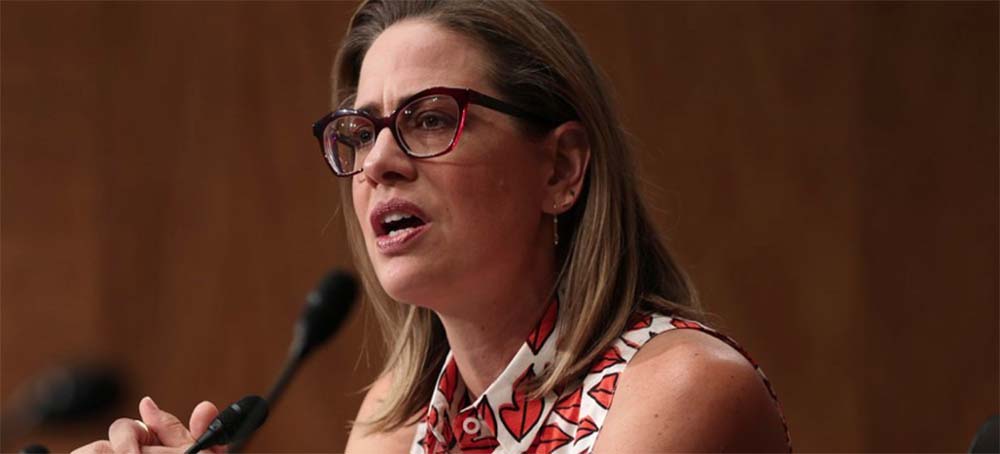
 

Sen. Kyrsten Sinema of Arizona joins a short list of Senate party switchers. (photo: Alex Wong/Getty Images)
FOCUS: The Key to Understanding Kyrsten Sinema Is That It's Always about Kyrsten Sinema
Branko Marcetic, Jacobin
Marcetic writes: "Cast as a principled rejection of partisan gridlock, Arizona senator Kyrsten Sinema’s decision to leave the Democratic Party is the latest act of shapeshifting to save her political skin. Once again, it’s all about Kyrsten Sinema."

Cast as a principled rejection of partisan gridlock, Arizona senator Kyrsten Sinema’s decision to leave the Democratic Party is the latest act of shapeshifting to save her political skin. Once again, it’s all about Kyrsten Sinema.

Kyrsten Sinema’s done it again. The Arizona senator has a habit of forcing herself into the national spotlight, often for less than inspiring reasons, and her recent announcement that she’s officially leaving the Democratic Party and becoming an independent has predictably set the proverbial discourse alight.

Sinema’s announcement has, to a point, been a long time coming. The Arizona crony capitalist, after all, made her career by presenting herself as a sensible, middle-of-the-road voice, representing the proverbial forgotten moderate American sick of the partisan game-playing in Washington ― and spent the past two years reveling in frustrating her own party’s ambitions, seemingly aping the political strategy of her “personal hero” John McCain, whose Senate seat she currently sits in.

“I have joined the growing numbers of Arizonans who reject party politics by declaring my independence from the broken partisan system in Washington,” Sinema wrote in the op-ed explaining the decision. The pressures of party politics, she explained, were empowering “the loudest, most extreme voices” of both, and made bipartisan compromise “a rarely acceptable last resort.”

It’s always been amusing that for someone who rests her political appeal on being neither left nor right, Sinema’s guiding political beacon has been closest to Jon Stewart–era Daily Show liberalism. But of course, none of this talk of extremism and partisanship has anything to do with Sinema’s decision to become an independent.

The reality is that this was the best thing Sinema could do to ensure her continued political survival. Sinema has managed the feat of holding on to Democratic support even as she’s behaved as a corporate shill and generally pissed off her own voters by using a standard bit of political blackmail: sure, you may not like the way she votes or her opposition to the Democratic agenda, but in a less-than-solidly-Democratic state like Arizona, she’s the best you were going to get. Would you rather a Republican hold the seat?

This was what drove the past two years of behavior that’s infuriated Democrats, including those from her own state, where increasingly incensed progressives — some of whom spent time and effort working to get her elected — have grown more vocal about challenging her next time she’s up for reelection. As a way of showcasing her independence, Sinema’s made a big show of often gratuitously serving as a roadblock to her party’s ambitions.

This strategy isn’t particularly novel, but it is effective, as long as voters have no inkling that your basic case — “I’m the best you’re going to get, so quit whining and just vote for me” — has little behind it. The trouble for Sinema is that Arizona has had two Democratic senators these past couple years, and that other Democrat, Mark Kelly, has just won reelection in the purple state by very different means.

While hardly a progressive, Kelly has been a loyal Democrat, voting with the president 95 percent of the time and standing fully behind the Build Back Better bill, the centerpiece of the Democratic agenda — even as he’s made a show of breaking with the administration on other, comparatively minor matters. It suggests that Sinema’s strategy of establishing herself in the public imagination as the chief Democratic obstacle to her own president’s ambitions was entirely unnecessary, an impression only given more legs by loyal Democrat Raphael Warnock’s recent reelection win in the similarly purple state of Georgia.

In other words, before this move, there was more than a good chance Sinema could fall to a Democratic primary challenge come 2024, since Kelly’s win had obliterated the rationale of the electoral blackmail that would have forced Democratic voters to hold their nose and support her. By going independent, Sinema is now embarking on a different, somewhat more aggressive bit of blackmail, making it clear to the party that she’ll happily put a Republican in office by splitting the vote in a three-way race if they run a Democratic challenger against her.

But Sinema could prove a victim of her own success. Having spent the past few years working hard to convince voters that there was little difference between her and a typical Republican, getting a Republican elected may well be a risk that Arizona progressives are now willing to take.

READ MORE


Contribute to RSN

Follow us on facebook and twitter!

Update My Monthly Donation

                                                                    PO Box 2043 / Citrus Heights, CA 95611


Friday, February 14, 2020

FOCUS: Pete Buttigieg Is Like Joe Biden Without the Black Friends


Reader Supported News
14 February 20

Is what our work at RSN has become. It’s real, it’s pervasive and most people would rather not look at it.
This is a pretty serious battle against some pretty serious people.
A budget would be a big help.
Marc Ash
Founder, Reader Supported News


If you would prefer to send a check:
Reader Supported News
PO Box 2043
Citrus Hts
CA 95611


Reader Supported News
14 February 20

It's Live on the HomePage Now:
Reader Supported News


FOCUS: Pete Buttigieg Is Like Joe Biden Without the Black Friends
‘None of Buttigieg’s South Carolina offices are in a majority black city, even though the primary importance of South Carolina is to appeal to black Democratic voters.’ (photo: Jim Bourg/Reuters)
Malaika Jabali, Guardian UK
Jabali writes: “While Pete Buttigieg might feel pretty good about effectively tying with Bernie Sanders in Iowa – the votes are still being counted – and landing in second place in New Hampshire, Democrats can count his relative success as a spectacular loss."

Buttigieg’s abysmal poll numbers with black voters aren’t a coincidence. He has made almost no effort to reach them

hile Pete Buttigieg might feel pretty good about effectively tying with Bernie Sanders in Iowa – the votes are still being counted – and landing in second place in New Hampshire, Democrats can count his relative success as a spectacular loss. The problem with the current Democratic primary system is that it doesn’t prove candidates’ viability in a general election; it just proves how good they are at winning Iowa and New Hampshire. Buttigieg is representative of this problem.


Buttigieg’s difficulty attracting black Democratic voters – who are important in March’s Super Tuesday contests – is well documented. A November Quinnipiac poll showed he had essentially zero support from black South Carolina voters. Since then, that support has grown to 2%. Buttigieg’s donor base is richer and whiter than the bases of the other Democratic candidates. And of course there are issues with his treatment of racism and inequality in South Bend, Indiana, where he served as mayor and where racial inequality is more stark than the US on average.
These failures alone don’t rule him out. Hypothetically, there’s still time for him to try to gain ground. But based on his campaign’s current engagement levels with black voters it is tough to believe he will catch up. Reports from Buttigieg’s southern campaign trail indicate that black voters haven’t really gotten to know him; he has emphasized the fact that he’s an upstart with whom black voters simply aren’t familiar. However, his campaign doesn’t seem especially committed to overcoming the problem.
This can be measured, in part, by ground game. Although Buttigieg has made some personal stops in South Carolina, he has the fewest field offices there of any Democratic frontrunner, with just four in the state. (Even Joe Biden, who has longstanding name recognition and doesn’t especially need South Carolina field offices, has more.) None of Buttigieg’s offices are in majority black cities, even though the primary importance of South Carolina is to appeal to black Democratic voters.
Instead of tackling this gap head-on, Buttigieg exorbitantly front-loaded his field presence in Iowa and New Hampshire. He had more field offices in Iowa (33) than in all other states combined (28). Iowa and New Hampshire also happen to be among the five whitest states in the country and wholly unreflective of who actually supports Democrats in general elections. Black Americans made up 25% of the Democratic party’s 2016 primary voters. They are a mere 1.7% of the population in New Hampshire and 4% in Iowa.
The implied contrast, of course, is Biden. Biden polls well with black voters, benefits from strong name recognition from the Obama years, and frequently visits South Carolina, often in the company of the African American congressman Jim Clyburn. While Biden’s political policies have often been terrible for black Americans, he is, on average, their most popular choice.
But Buttigieg straddles the worst of neoliberal worlds. He appeals to the Democratic party’s elite donors – alienating him from some working-class voters – without having done even the minimal and purely performative outreach to people of color expected of any Democratic candidate. Basically, he’s Biden without the black friends.
Most other Democratic candidates have struggled to attract black support and support among voters of color more generally, though Sanders’ popularity with people of color has markedly improved.
Yet Buttigieg’s failures are particularly problematic when you consider the other candidates. Warren, whose donor base is almost as white and affluent as Buttigieg’s, has had multiple roundtables to earn the support of progressive black women organizers, like the Black Womxn For coalition. Sanders has over twice the field staff as Buttigieg in South Carolina, including in the vastly majority black city of Orangeburg. He has also launched a number of tours across historically black colleges and universities, and he has over a dozen field offices in California.
Buttigieg, meanwhile, does not have a single field office in California, according to his campaign website, which grossly hinders his ground game with Latino voters. His campaign has touted black support where it doesn’t exist, including by falsely claiming that certain black leaders had endorsed his Douglass Plan for Black America. Further, the campaign underplayed how much the plan was buttressed by white endorsers.
Buttigieg’s success reveals both the abject uselessness of focusing on early states that don’t reflect the Democratic party’s diversity and the essential hollowness of his campaign. Like his political career, it allows him to collect accomplishments without much sense that he is particularly qualified.


Tuesday, February 11, 2020

FOCUS: Pete Buttigieg's Policy Director Has Been Traveling the County for Months to Meet With "Investors" in His Campaign


Reader Supported News
11 February 20


We fight for justice all day long, every day. What our organization is experiencing is economic injustice. What we use the money for is what we do every day. And many of you ignore that vital funding need.

This organization fights for justice.

Help.

Marc Ash
Founder, Reader Supported News


If you would prefer to send a check:
Reader Supported News
PO Box 2043
Citrus Hts
CA 95611


Reader Supported News
11 February 20

It's Live on the HomePage Now:
Reader Supported News


FOCUS: Pete Buttigieg's Policy Director Has Been Traveling the County for Months to Meet With "Investors" in His Campaign
Sonal Shah, left, during a panel discussion at the Natural History Museum, London, on March 17, 2016. (photo: John Phillips/Getty Images/Chivas)
Ryan Grim, The Intercept
Grim writes: "The presidential campaign of former South Bend Mayor Pete Buttigieg has taken the unusual step of sending its national policy director, Sonal Shah, on the road. For the past several months, she has been headlining high-dollar fundraisers across the country, according to a slew of invitations obtained from a variety of sources."

It’s common for campaigns that rely on wealthy donors to lean on surrogates and senior officials to buttress their fundraising operations, but sending the aide in charge of crafting policy on a tour of American mansions is an unusual approach and wipes out the line between policymaking and solicitation of campaign contributions. Almost all of the invitations typically tout the role of Shah, a veteran of both Google and Goldman Sachs, as the campaign’s national policy director.
The news of Shah’s intimate involvement in Buttigieg’s fundraising comes as his campaign is under fire from both Sens. Bernie Sanders and Elizabeth Warren for his reliance on wealthy donors to power his campaign (see, especially, the wine cave). Buttigieg has argued that Democrats would be fighting with one hand tied behind their backs if they refused the support of the superrich. But Buttigieg is not just a passive recipient of big money; he devotes a significant amount of time and energy to soliciting it — in part by putting his chief policy adviser in the room with high-dollar donors. 
Sanders and Warren have argued that relying on wealthy donors blunts the ability of Democrats to go directly after President Donald Trump’s corruption. On ABC’s “This Week” on Sunday, Warren argued that “the coalition of billionaires is not exactly what’s going carry us over the top.”
“Last count, he has about 40 billionaires who are contributing to his campaign, the CEOs of the large pharmaceutical industries, the insurance companies, and so forth,” Sanders told “Face the Nation,” referring to Buttigieg. “It matters enormously. That is precisely the problem with American politics.”
The Buttigieg campaign has been sensitive to the charge that he is overly reliant on big money, and has urged its small-dollar donors to give in increasingly small numbers to drive down the . average contribution amount. Shah’s months-long road trip is another indication, however, of just how significant high-dollar giving is to his campaign.
In a statement from spokesperson Sean Savett, the campaign did not directly address Shah’s close involvement in fundraising effort.
We are proud that more than 800,000 Americans have donated to our campaign and the only promise that any of them will ever get is that Pete will use their donations to defeat Donald Trump. We don’t agree with all of our supporters on every issue and what guides our policies is what’s best for America. Pete is from a town that was ravaged by corporate greed and he’s proposed a bold, progressive agenda, which includes holding bad actors accountable and paying for our plans with higher taxes on the wealthiest Americans who can afford it. The stakes in this election are clear and stark and we can’t go into this fight with one hand tied behind our backs. That’s why whether you can give $3 or $300, whether you are a Democrat, Independent or Republican, we welcome you to our campaign and won’t turn you away if you’re ready to help rid us of Donald Trump.
Shah’s background positions her well to connect with the high-net-worth individuals within the Democratic Party that are powering Buttigieg’s bid and are concerned about income inequality, climate change, health disparities, or other social inequities. While she was a top official at both Goldman Sachs and Google before joining the Obama administration — spanning the two dominant elements of the corporate wing of the party, Wall Street and Silicon Valley — she worked in the divisions of those firms publicly dedicated to doing social good. At Goldman, she designed environmental strategy. At Google, she did global development. More recently, she became founding executive director of the Beeck Center for Social Impact and Innovation.
The attempt to marshal corporate resources in the service of society is in line with the Buttigieg approach to economic policy and politics, which aims to leave the system largely untouched but divert some resources toward charitable efforts and social and technological innovation.  
The high-dollar fundraisers are often organized around lofty themes, such as the one scheduled for February 21: a “conversation about economic equity and justice” at an undisclosed Baltimore location. Shah’s co-host that evening will be Chike Aguh, billed on the invite as the campaign’s policy adviser responsible for its Douglass Plan and the “Future of Work.” The Douglass Plan is the campaign’s effort at outreach to the black community and was rolled out with claims of support from high-profile black leaders in South Carolina who had told the campaign that they did not want to be listed as endorsers
The earliest invite obtained by The Intercept dates to October 2, and there have been at least 22 additional events held since then, with Shah serving either as solo host or, occasionally, co-hosting with another Buttigieg aide. Top-level access to the events costs a maximum contribution of $2,800. 
All told, Shah has been meeting with high-level donors on at least a weekly basis throughout the fall and winter, whether for pancakes in Newton; cocktails in Tulsa, Austin, Washington, D.C., Atlanta, or Manhattan; lunch in Chicago; or video calls with Shah that investors can buy their way into. 
The Buttigieg campaign is in the habit of referring to donations as “investments.” The RSVP for many of the fundraisers goes to the email address investment@peteforamerica.com. The fundraising team’s titles similarly suggest that there is a return for money invested in the campaign. Tom Strong-Grinsell, for instance, is the campaign’s “regional investment director,” handling New York. Swati Mylavarapu, a Silicon Valley tech executive and startup investor, is the campaign’s “national investment chair.” Anthony Mercurio, a Hillary Clinton alum, is “national investment director.” (Mylavarapu and Shah joined forces for at least one San Francisco fundraiser, a January 26 event called “Chefs for Pete,” with food by chef Alice Waters.)
The link between “investing” in a campaign and the policy it advocates for is precisely the argument Sanders has made against Buttigieg. “When you have the heads of large pharmaceutical companies contributing to your campaign, you are not going to aggressively deal with the fact that, in some cases, we pay 10 times for the same exact drugs as our friends in Canada or in Europe pay. You’re not going to take on the collusion and the corruption of the drug companies who are ripping us off.”


🚨Trump $10 BILLION Amendment BACKFIRES INSTANTLY!!!

                                                                          LOTS OF POSTS IGNORED BY BLOGGER..... OR REMOVED ON THEIR WHIM! AL...