Bernie Sanders and Dick Cheney are united on something... that tells us all we need to know.
Bernie Sanders and Dick Cheney are united on something... that tells us all we need to know.
MUST WATCH!
LIZ CHENEY SAID THERE HAS NEVER BEEN A GREATER THREAT TO OUR DEMOCRACY THAN DONALD TRUMP
ENDORSING COLIN ALLRED!
 / msnbc
Follow MSNBC Show Blogs
MaddowBlog: https://www.msnbc.com/maddowblog
ReidOut Blog: https://www.msnbc.com/reidoutblog
MSNBC delivers breaking news, in-depth analysis of politics headlines, as well as commentary and informed perspectives. Find video clips and segments from The Rachel Maddow Show, Morning Joe, The Beat with Ari Melber, Deadline: White House, The ReidOut, All In, Last Word, 11th Hour, and Alex Wagner who brings her breadth of reporting experience to MSNBC primetime. Watch “Alex Wagner Tonight” Tuesday through Friday at 9pm Eastern.
Connect with MSNBC Online
Visit msnbc.com: https://www.msnbc.com/
Subscribe to the MSNBC Daily Newsletter: https://link.msnbc.com/join/5ck/msnbc...
Find MSNBC on Facebook:
 / msnbc
Follow MSNBC on Twitter:
 / msnbc
Follow MSNBC on Instagram:
 / msnbc
#dickcheney #kamalaharris #msnbc
June 29, 2024
The establishment press acted in concert to assassinate the character of the WikiLeaks founder, making it respectable to hate him, writes Jonatahn Cook.
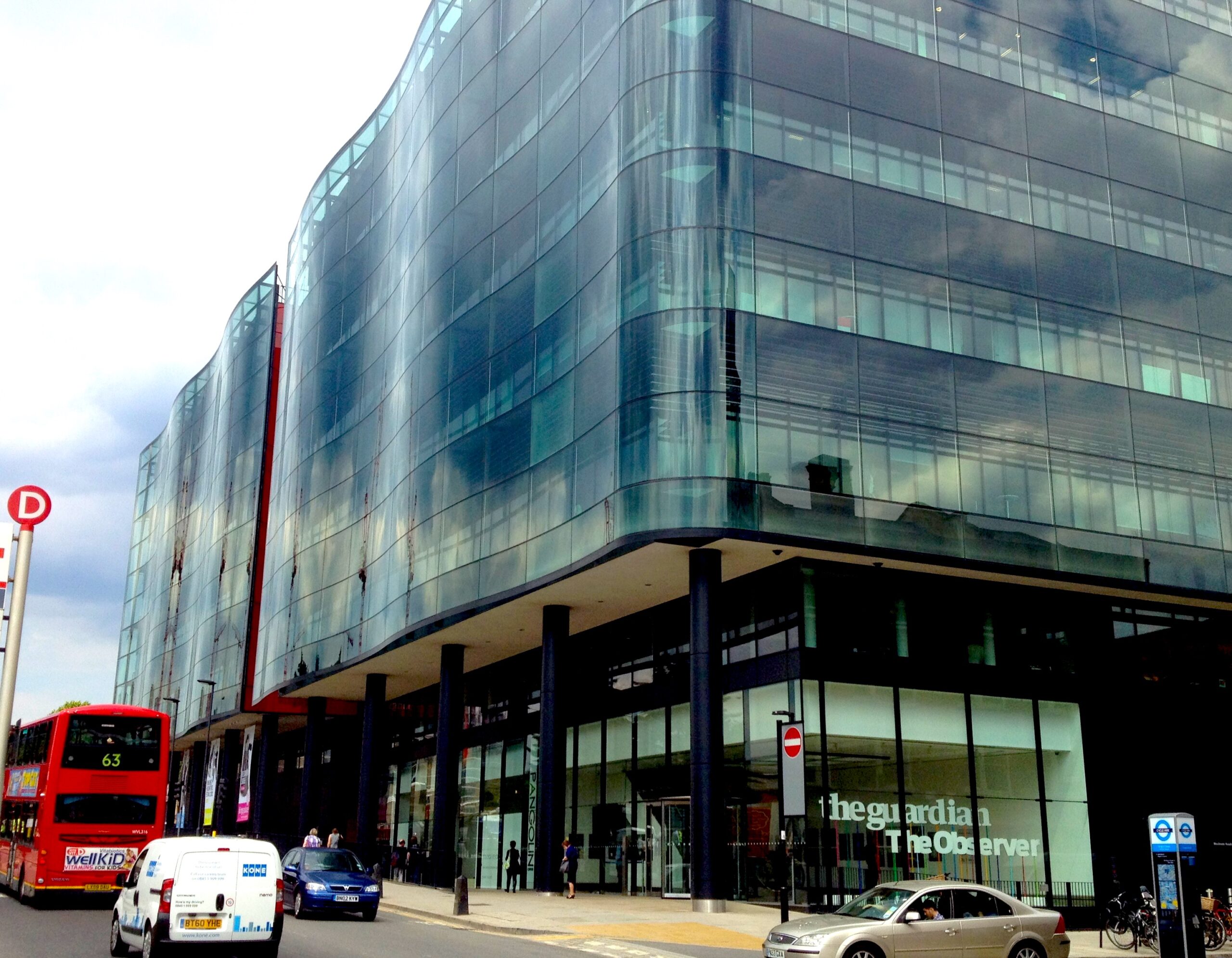
The Guardian building in London, 2012. (Bryantbob, CC BY-SA 3.0, Wikimedia Commons)
By Jonathan Cook
Declassified UK
 It is only right that we all take a moment to celebrate the victory of Julian Assange’s release from 14 years of detention, in varying forms, to be united, finally, with his wife and children — two boys who have been denied the chance to ever properly know their father.
His last five years were spent in Belmarsh high-security prison as the United States sought to extradite him to face a 175-year jail sentence for publishing details of its state crimes in Iraq, Afghanistan and elsewhere.
For seven years before that he was confined to a small room in the Ecuadorian embassy in London, after Quito awarded him political asylum to evade the clutches of a law-breaking U.S. empire determined to make an example of him.
His seizure by U.K. police from the embassy on Washington’s behalf in 2019, after a more U.S.-aligned government came to power in Ecuador, proved how clearly misguided, or malicious, had been those who accused him of “evading justice.”
Everything Assange had warned the U.S. wanted to do to him was proved correct over the next five years, as he languished in Belmarsh entirely cut off from the outside world.
No one in our political or media class appeared to notice, or could afford to admit, that events were playing out exactly as the founder of WikiLeaks had for so many years predicted they would — and for which he was, at the time, so roundly ridiculed.
Nor was that same political-media class prepared to factor in other vital context showing that the U.S. was not trying to enforce some kind of legal process, but that the extradition case against Assange was entirely about wreaking vengeance — and making an example of the WikiLeaks founder to deter others from following him in shedding light on U.S. state crimes.
That included revelations that, true to form, the C.I.A., which was exposed as a rogue foreign intelligence agency in 250,000 embassy cables published by WikiLeaks in 2010, had variously plotted to assassinate him or kidnap him from the embassy in London.
Other evidence came to light that the C.I.A. had been carrying out extensive spying operations on the embassy, recording Assange’s every move, including his meetings with his doctors and lawyers.
That fact alone should have seen the U.S. case thrown out by the British courts. But the U.K. judiciary was looking over its shoulder, towards Washington, far more than it was abiding by its own statute books.
No Watchdog
Western governments, politicians, the judiciary and the media all failed Assange. Or rather, they did what they are actually there to do: keep the rabble — that is, you and me — from knowing what they are really up to.
Their job is to build narratives suggesting that they know best, that we must trust them, that their crimes, such as those they are supporting right now in Gaza, are actually not what they look like, but are, in fact, efforts in very difficult circumstances to uphold the moral order, to protect civilisation.
For this reason, there is a special need to identify the critical role played by the media in keeping Assange locked up for so long.
The truth is, with a properly adversarial media playing the role it declares for itself, as a watchdog on power, Assange could never have been disappeared for so long. He would have been freed years ago. It was the media that kept him behind bars.
The establishment media acted as a willing tool in the demonising narrative the U.S. and British governments carefully crafted against Assange.
Even now, as he is reunited with his family, the BBC and others are peddling the same long-discredited lies.
Those include the constantly repeated claim by journalists that he faced “rape charges” in Sweden that were supposedly dropped. Here is the BBC making this error once again in its reporting this week.
In fact, Assange never faced more than a “preliminary investigation,” one the Swedish prosecutors repeatedly dropped for lack of evidence. The investigation, we now know, was revived and sustained for so long not because of Sweden but chiefly because the U.K.’s Crown Prosecution Service, then led by Sir Keir Starmer (now the leader of the Labour Party), insisted on it dragging on.
Starmer made repeated trips to Washington during this period, when the U.S. was trying to find a pretext to lock Assange away for political crimes, not sexual ones.
But as happened so often in the Assange case, all the records of those meetings were destroyed by the British authorities.
The media’s other favourite deception — still being promoted — is the claim that WikiLeaks’ releases put U.S. informants in danger.
That is utter nonsense, as any journalist who has spent even a cursory amount of time studying the background to the case knows.
More than a decade ago, the Pentagon set up a review to identify any U.S. agents killed or harmed as a result of the leaks. They did so precisely to help soften up public opinion against Assange.
And yet a team of 120 counter-intelligence officers could not find a single such case, as the head of the team, Brigadier-General Robert Carr, conceded in court in 2013.
Despite having a newsroom stuffed with hundreds of correspondents, including those claiming to specialise in defence, security and disinformation, the BBC still cannot get this basic fact about the case right.
That’s not an accident. It’s what happens when journalists allow themselves to be spoon-fed information from those they are supposedly watching over. That is what happens when journalists and intelligence officials live in a permanent, incestuous relationship.
Character Assassination
But it is not just these glaring reporting failures that kept Assange confined to his small cell in Belmarsh. It was that the entire media acted in concert in his character assassination, making it not only acceptable but respectable to hate him.
It was impossible to post on social media about the Assange case without dozens of interlocutors popping up to tell you how deeply unpleasant he was, how much of a narcissist, how he had abused his cat or smeared his walls in the embassy with faeces. None of these individuals, of course, had ever met him.
It also never occurred to such people that, even were all of this true, it would still not have excused stripping Assange of his basic legal rights, as all too clearly happened. And even more so, it could not possibly justify eroding the public-interest duty of journalists to expose state crimes.
What was ultimately at stake in the protracted extradition hearings was the U.S. government’s determination to equate investigative national-security journalism with “espionage”. Whether Assange was a narcissist had precisely no bearing on that matter.
Why were so many people persuaded Assange’s supposed character flaws were crucially important to the case? Because the establishment media — our supposed arbiters of truth — were agreed on the matter.
The smears might not have stuck so well had they been thrown only by the rightwing tabloids. But life was breathed into these claims from their endless repetition by journalists supposedly on the other side of the aisle, particularly at The Guardian.
Liberals and left-wingers were exposed to a steady flow of articles and tweets belittling Assange and his desperate, lonely struggle against the world’s sole superpower for the right not to be locked away for the rest of his life for doing journalism.
The Guardian — which had benefited by initially allying with WikiLeaks in publishing its revelations — showed him precisely zero solidarity when the U.S. establishment came knocking, determined to destroy the WikiLeaks platform, and its founder, for making those revelations possible.
For the record, so we do not forget how Assange was kept confined for so long, these are a few examples of how The Guardian made him — and not the law-breaking U.S. security state — the villain.
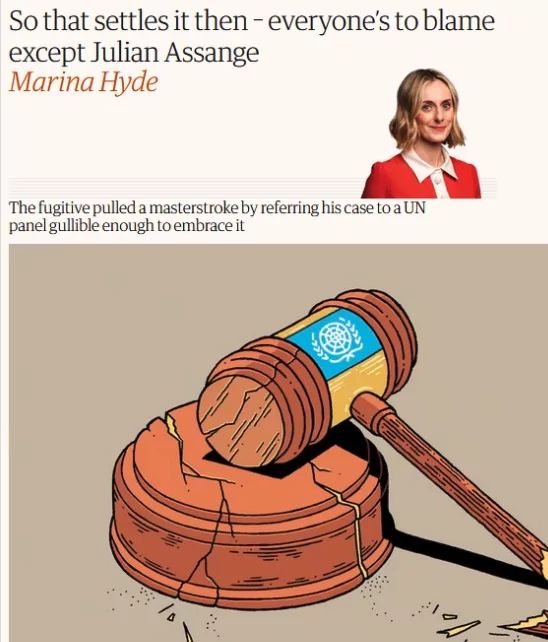
Marina Hyde in The Guardian in February 2016 — four years into his captivity in the embassy — casually dismissed as “gullible” the concerns of a United Nations panel of world-renowned legal experts that Assange was being “arbitrarily detained” because Washington had refused to issue guarantees that it would not seek his extradition for political crimes.
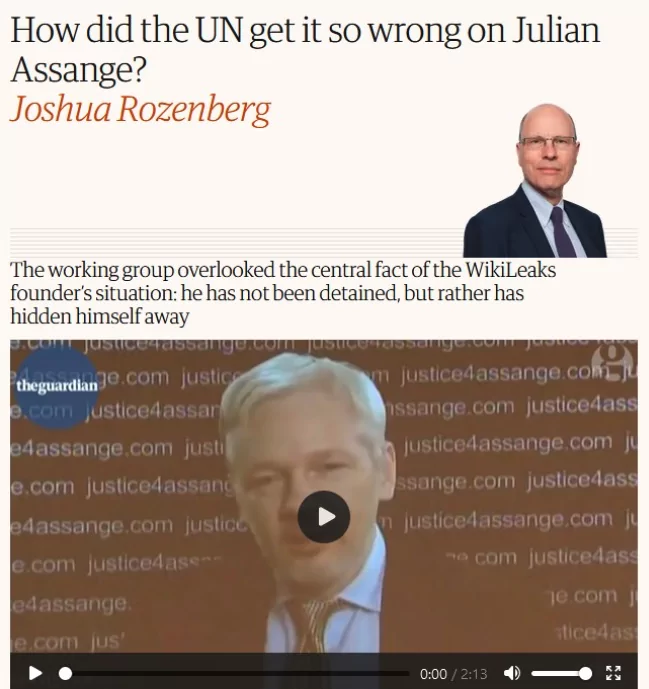
Long-time BBC legal affairs correspondent Joshua Rozenberg was given space in The Guardian on the same day to get it so wrong in claiming Assange was simply “hiding away” in the embassy, under no threat of extradition (Note: Though his analytic grasp of the case has proven feeble, the BBC allowed him to opine further this week on the Assange case).
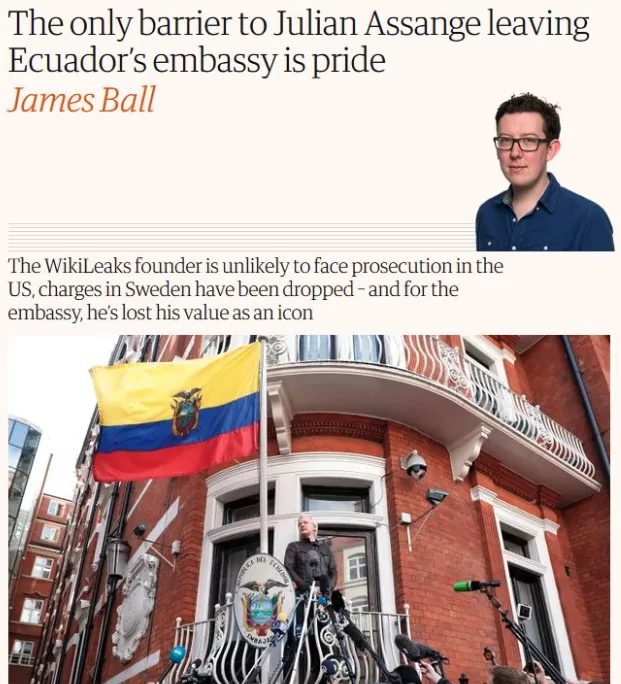
Two years later, The Guardian was still peddling the same line that, despite the U.K. spending many millions ringing the embassy with police officers to prevent Assange from “fleeing justice”, it was only “pride” that kept him detained in the embassy.
Or how about this one from Hadley Freeman, published by The Guardian in 2019, just as Assange was being disappeared for the next five years into the nearest Britain has to a gulag, on the “intense happiness” she presumed the embassy’s cleaning staff must be feeling.
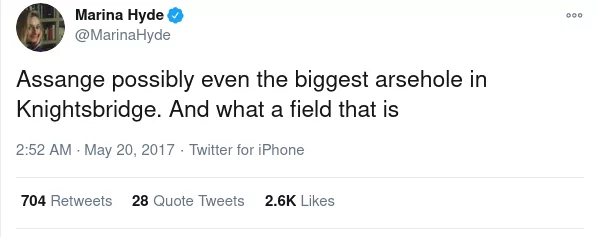
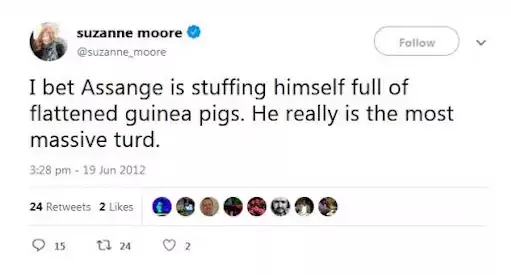
Anyone who didn’t understand quite how personally hostile so many Guardian writers were to Assange needs to examine their tweets, where they felt freer to take the gloves off. Hyde described him as “possibly even the biggest arsehole in Knightsbridge” while Suzanne Moore said he was “the most massive turd.”
The constant demeaning of Assange and the sneering at his plight was not confined to The Guardian’s opinion pages. The paper even colluded in a false report — presumably supplied by the intelligence services, but easily disproved — designed to antagonise the paper’s readers by smearing him as a stooge of Donald Trump and the Russians.
This notorious news hoax — falsely claiming that in 2018 Assange repeatedly met with a Trump aide and “unnamed Russians”, unrecorded by any of the dozens of CCTV cameras surveilling ever approach to the embassy — is still on The Guardian’s website.
This campaign of demonisation smoothed the path to Assange being dragged by British police out of the embassy in early 2019.
It also, helpfully, kept The Guardian out of the spotlight. For it was errors made by the newspaper, not Assange, that led to the supposed “crime” at the heart of the U.S. extradition case — that WikiLeaks had hurriedly released a cache of files unredacted — as I have explained in detail before.
Too Little Too Late
The establishment media that collaborated with Assange 14 years ago in publishing the revelations of U.S. and U.K. state crimes only began to tentatively change its tune in late 2022 — more than a decade too late.
That was when five of his former media partners issued a joint letter to the Biden administration saying that it should “end its prosecution of Julian Assange for publishing secrets”.
But even as he was released this week, the BBC was still continuing the drip-drip of character assassination. A proper BBC headline, were it not simply a stenographer for the British government, might read: “Tony Blair: Multi-millionaire or war criminal?”
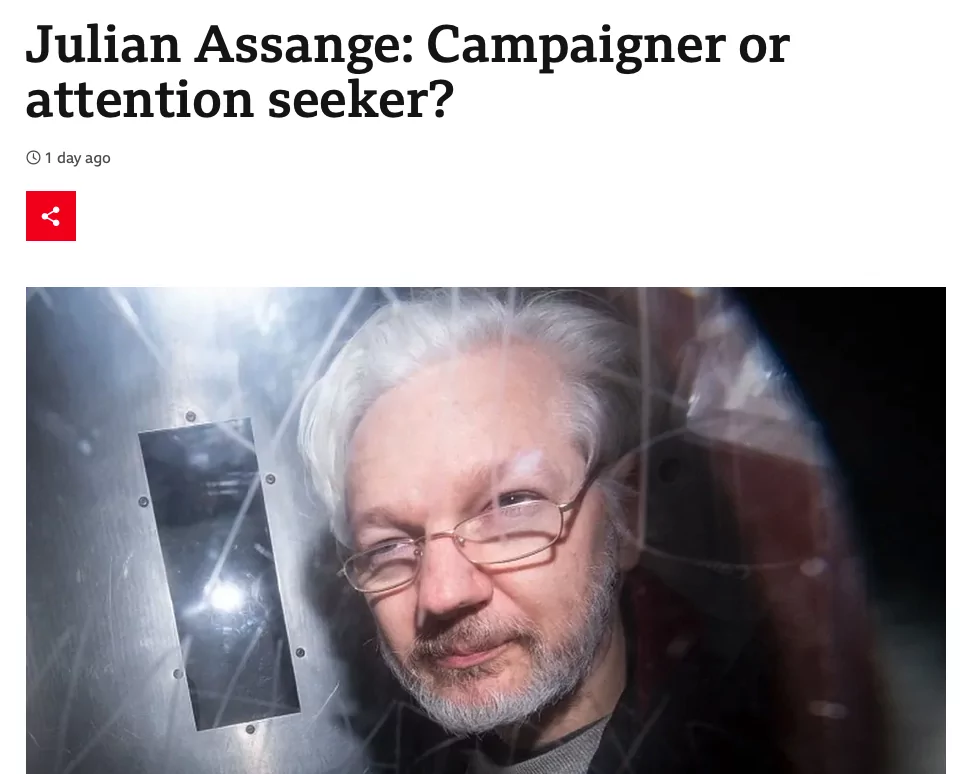
For while the establishment media has busily fixed our gaze on the supposed character flaws of Assange, it has kept our attention away from the true villains, those who committed the crimes he exposed: former U.K. Prime Minister Tony Blair, former U.S. President George W Bush and his vice president Dick Cheney and many more.
We need to recognise a pattern here. When the facts cannot be disputed, the establishment has to shoot the messenger.
In this case, it was Assange. But the same media machine was rolled out against former Labour leader Jeremy Corbyn, another thorn in the establishment’s side. And as with Assange, The Guardian and the BBC were the two outlets that were most useful in making the smears stick.
Sadly, to secure his freedom, Assange was compelled to make a deal pleading guilty to one of the charges levelled against him under the Espionage Act.
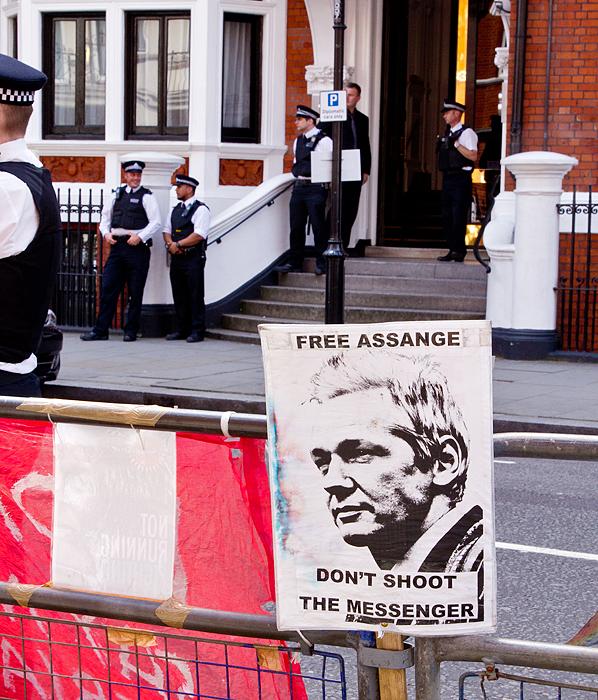
“Don’t Shoot the Messenger” poster of Julian Assange outside the Ecuadorian embassy in London, August 2012. (Chris Beckett, Flickr, CC BY-NC-ND 2.0)
Highlighting the enduring bad faith of The Guardian, the same paper that so readily ridiculed Assange’s years of detention to avoid being locked away in a U.S. super-max jail, ran an article this week, as Assange was released, stressing the “dangerous precedent” for journalism set by his plea deal.
Washington’s treatment of Assange was always designed to send a chilling message to investigative journalists that, while it is fine to expose the crimes of Official Enemies, the same standards must never be applied to the U.S. empire itself.
How is it possible that The Guardian is learning that only now, after failing to grasp that lesson earlier, when it mattered, during Assange’s long years of political persecution?
The even sadder truth is that the media’s villainous role in keeping Assange locked up will soon be erased from the record. That is because the media are the ones writing the script we tell ourselves about what is going on in the world.
They will quickly paint themselves as saints, not sinners, in this episode. And, without more Assanges to open our eyes, we will most likely believe them.
Jonathan Cook is an award-winning British journalist. He was based in Nazareth, Israel, for 20 years. He returned to the U.K. in 2021.He is the author of three books on the Israel-Palestine conflict: Blood and Religion: The Unmasking of the Jewish State (2006), Israel and the Clash of Civilisations: Iraq, Iran and the Plan to Remake the Middle East (2008) and Disappearing Palestine: Israel’s Experiments in Human Despair (2008). If you appreciate his articles, please consider offering your financial support.
This article is from Declassified UK.
The views expressed are solely those of the author and may or may not reflect those of Consortium News.
Please Donate to the
Spring Fund Drive!


This weekend, at a campaign stop in Dayton, Ohio, Trump was talking about car manufacturing factories when he suddenly took a dark turn, threatening, “now if I don’t get elected … it’s going to be a bloodbath for the country.”
At the start of the rally, there was a call for the crowd to rise for the “unfairly treated January 6 hostages.” The crowd did. Trump apologists, including Elon Musk, claimed Trump was only talking about the car industry when he referred to a bloodbath, but we know better. Trump did one of his sudden stream-of-consciousness shifts while he was discussing some (probably made-up) friend who builds the biggest car factories in the world, to the threat of a bloodbath if he loses. The tell for me was when he said, "That'll be the least of it." He was no longer talking about car factories, and he knows what he's doing. It’s the same thing he did when he told the Proud Boys to “stand back and stand by” during the 2020 presidential debates. His people understand what he's saying, while he claims deniability. Yes, Trump is everywhere on the airwaves, so much so that the tendency is to tune him out. But we can’t. It’s too important. He is, quite literally, telling us what he intends to do, and we need to keep sharing it with those around us. That’s the context as we enter a week where the theme is Trump’s success at delaying the courts and preventing his criminal cases from going to trial. Trump is a master of the delay game, the recipient of numerous lucky breaks. And I’d be less than honest if I didn’t acknowledge that it’s discouraging. But read on. Is it still possible we might see one of Trump’s criminal trials proceed before the election? Sure. We could still see the Manhattan case move forward—discussed below. The remaining three cases are tangled in procedural quagmires that make trials in them much less likely, although still not theoretically impossible. But as former Attorney General Eric Holder tweeted this past week, the cavalry isn’t coming. It’s going to be up to the voters in November if we’re going to outrun Trump. The Mar-a-Lago case Although Judge Cannon decided Trump’s “unconstitutionally vague” motion, as we discussed last week—at least in the sense that she kicked the can down the road to trial—there are other pending motions. None of them are meritorious, and virtually any other judge would have already knocked them down. That makes it particularly surprising that Judge Cannon still hasn’t ruled on the Presidential Records Act motion that was also argued last week. When she discussed the motion during the hearing it sounded like she was inclined to dismiss it, but not because it’s meritless. Instead, she seemed to think that this motion, like the vagueness one, was “premature” and the outcome would depend on disputed facts that would be hashed out during the trial. Because this is so facially wrong—our nation’s secrets, generated by the intelligence community, can never be Trump’s “personal records”—the fact that she’s pushing matters off to be decided during trial after a jury is empaneled and double jeopardy has attached is very concerning. We’ll watch to she if she issues a decision on this motion this week.
In the hearing last week, Judge Cannon also discussed, as though it was a serious thing, Trump’s motion to dismiss for selective or vindictive prosecution. To succeed, Trump would need proof that prosecutors singled him out for prosecution for discriminatory reasons despite not prosecuting others for the same conduct or that the prosecution was retaliation for his exercise of his rights. In other words, there’s not an iota of evidence to suggests Judge Cannon should do anything other than deny the motion promptly. But one option, if she is taking it seriously, is to find that Trump has established a prima facie case for it, or at least that he’s entitled to more discovery to try and do so, and to permit a wide-ranging inquiry into the government’s process here. In other words, more delay. The Manhattan DA’s case In Manhattan, both sides will be gearing up this week for their hearing a week from Monday, the once-but-no-longer date for trial to start in this case. Trump has argued that the case should be dismissed or at least delayed because the prosecution has violated its discovery obligations. The Judge has ordered both sides to provide him with a discovery timeline so he can sort out who, if anyone, is at fault, and if the prosecution sinned, what the penalty should be. He has broad discretion under New York law, up to and including dismissing the case. But it doesn’t seem, at least based on what we know so far, as though that will be the outcome here. The issue involves evidence in the possession of the U.S. Attorney’s Office for the Southern District of New York. You’ll recall this case was brought by the Manhattan DA, a state prosecutor’s office. The DA says they requested evidence from the SDNY over a year ago and turned it over to Trump in discovery. But Trump issued a subpoena to SDNY earlier this year and after several delays (which the Trump team agreed to), SDNY began providing documents earlier this month and has no given over more than 100,000 pages. As we noted last week, not all of that will be relevant to this case, and it’s not clear that anyone, and especially not the Manhattan DA, is at fault here. But we’ll learn more once the submissions are in and the Judge conducts his hearing. As of now, the trial is on hold until at least April 15. The Judge noted that he would set a new trial date, “if necessary,” after he ruled on Trump’s motion for discovery violations.
The Fulton County Case After Judge McAfee’s ruling on the disqualification motion that DA Fani Willis could stay on the case if special prosecutor Nathan Wade resigned, Willis promptly accepted Wade’s resignation. The standard under Georgia law requires proof of a financial conflict of interest for disqualification, and the defendants didn’t get there. But Judge McAfee went beyond that, concerned about an appearance of impropriety and what he called an “odor of mendacity” to require Wade to step aside. An attempt at appealing is almost certain to follow. Trump’s lawyer Steve Sadow has promised to, and it’s possible that the DA’s office might seek to as well. The question is whether the Georgia courts will permit an unusual interlocutory appeal—one that occurs before trial—or consign this issue to post-trial motions if there is a conviction. Under Georgia law, it’s up to the trial judge to issue a certificate of appealability (“COA”) within 10 days of his ruling for either party to take it to the court of appeals. And then, the court of appeals would also have to agree to hear the case before an interlocutory appeal would take place. So we’ll watch carefully this week for the parties to request a COA and for Judge McAfee’s ruling. Although not an indication for certain, he dropped a footnote in his opinion dismissing six counts in the indictment last week saying he’d issue a COA if the DA wanted to appeal. He didn’t do so when he decided the disqualification motion, so there are at least a few tea leaves to be read here. Willis was complimentary of Wade’s work when she accepted his resignation. Although Wade initially booked an interview on NBC’s Meet The Press show Sunday morning, apparently, some better angels whispered in his ear and he canceled the appearance. The Judge had already suggested that Willis’ discussion of the matter at an AME Church in Atlanta might merit a gag order against the DA’s office. At this point, no one associated with the prosecution, even formerly, should be stoking those flames. Without regard to whether Willis was treated fairly in all of this (the court permitted a wide-ranging inquiry that went well beyond her financial interests), the most important thing going forward is this prosecution and getting the case to trial, and it’s important to stay focused on that. Experienced prosecutors know that defendants engage in this sort of conduct and will push it as far as the judge will let them, in order to draw the prosecution off of its case. Now it’s time for the prosecutors on the case to get back to work.
If the courts do take up an appeal now, there is lots of potential for delay. I say potential because it’s not clear that further proceedings in the trial court would be stayed while the appeal moved forward and also because the court would have the option of moving quite quickly, especially since the side benefit of the extensive hearing the Judge conducted is that there is a full factual record and the issues were argued in court. But the deadlines set for Georgia law would permit this case to slip well past the election. If Judge McAfee authorizes a COA, any party that want to appeal has ten more days to file with the court of appeals. The opposing party(ies) get ten days to respond, arguing the appeal should not proceed. Other parties are free to file amicus briefs. The rules don’t provide for reply briefs or oral argument, but they give the court an additional 45 days to issue a ruling. We’re already at the two month mark before the court determines it will hear the appeal, if everyone takes up all the time they’re authorized to use. If the court of appeals decides to hear the case, the appealing party(ies) have ten days after that order is entered to file a notice of appeal. Then they get 20 days to file their brief after the court dockets the appeal. The other side gets 40 days from the date the appeal is docketed or 20 days after the opening brief is file, whichever is later, to respond. And then the party taking the appeal has another 20 days to reply. You see the point here. That’s about 165 days (I went to law school to avoid math, so mea culpa if I’m off by a bit here) before the case is fully briefed—not even argued or decided. And there could be a further appeal to Georgia’s supreme court. All of that to say that we’re about to see a Pandora’s box of appellate delays get opened. We’ll watch for the courts’ decisions about whether there will be an appeal, and also, importantly, about whether Judge McAfee can continue with pre-trial proceedings or whether everything will be stayed if there is one. What We Can Do As Voters Here’s something that shouldn’t be news but is: Mike Pence finally found the backbone to stand up to Trump and say he won’t vote for him. This should have been an easy call for Pence, one made years ago. Trump stood by while the mob attacked, knowing there was the possibility his vice president would be injured or even killed. But former Trump supporters, even his failed primary opponents, seem to flock to Trump like fireflies to the light. So while Pence is no hero, his change of heart is something worth talking about with Trump supporters or undecided folks in your orbit.
Pence isn’t alone in rejecting Trump. Last July, NBC reached out to 44 of Trump’s former cabinet secretaries and found that only four of them (former Acting Attorney General Matthew Whitaker; final Chief of Staff Mark Meadows; former budget chief Russell Vought; and former Acting Director of National Intelligence Richard Grenell) supported Trump’s reelection bid. And Pence isn’t the only former vice president who has rejected a return to Trump.
Pence isn’t a powerful voice for people who are already committed to voting for Joe Biden. But his decision to come out in this moment and say he doesn’t support Trump because Trump doesn’t support the conservative agenda could be powerful with voters who are undecided or even those who lean for Trump. They might be persuaded if they learn that Trump’s own vice president (along with most of his cabinet secretaries) doesn’t support him. If Pence can finally reject Trump, others in his base can too. Make this your talking point to share with those around you for the week and see where it takes you. It’s very likely that if Trump supporters don’t hear it from you, they won’t see it at all. It won’t be a focus on Fox, or OAN, or whatever news bubble they reside in. The cavalry may not be coming, but we are, voters committed to good information, and we can do this with patience and persistence. We’re in this together, Joyce |


