Showing posts with label Keir Starmer. Show all posts

Wednesday, October 9, 2024

POLITICO Nightly: What the campaign feels like in Michigan


POLITICO Newsletter Header

By Charlie Mahtesian

Supporters of Vice President Kamala Harris during a rally in Flint, Michigan.

Supporters of Vice President Kamala Harris during a rally in Flint, Michigan on Oct. 4. | Dominic Gwinn/Middle East Images/AFP via Getty Images


UP AND DOWN THE BALLOT — As hard as it might be to imagine today, there once was a time when presidential races unfolded across the entire nation, not just in a small universe of battleground states. In 1960, Richard Nixon campaigned in all 50 states after pledging in his convention speech to visit them all before Election Day. The 1976 presidential race between Gerald Ford and Jimmy Carter was fought across 30 states.

In recent decades, however, the map of competitive states has narrowed considerably, and this year it’s especially small — just seven states constitute the battlegrounds: Arizona, Georgia, Michigan, Nevada, North Carolina, Pennsylvania and Wisconsin.

At the moment, the race is exceptionally tight. Two percentage points mark the difference between Kamala Harris and Donald Trump in every one of those states, according to polling averages.

To provide better insight into the seven battleground states, over the campaign’s final 27 days Nightly will run a series of interviews with POLITICO reporters who have recently been on the ground reporting in those states. Tonight, we’ll hear from Liz Crampton, a state policy reporter who was recently in Michigan.

What issues are dominating the political debate in Michigan this year? Are they different from any of the other battleground states?

The nationalization of local politics means that the dominant conversations in Michigan are pretty similar to the conversations playing out in Pennsylvania or Arizona. In Michigan and elsewhere, it’s all about the economy. What that looks like for the state House races, the level of the ballot that I pay particularly close attention to, are discussions about whether Michiganders are better off now under Democratic leadership — or if the state legislature should return to Republican control. And it’s all in the wonky policy details.

Democrats, who surprise-flipped the state legislature in 2022, are boasting about the laws they enacted related to people’s bottom line: repealing the state pension tax comes up a lot with voters at the doors. Republicans, on the other hand, are blaming Democrats in Lansing for the nation’s high cost-of-living and inflation. Should the GOP reclaim the House next month , Republican leadership says an early order of business would be reversing a minimum wake hike ordered by the state Supreme Court, siding with the restaurant and tourism industry.

The Harris campaign is mobilizing around abortion rights and the issue is a critical element in its messaging. But in Michigan, the legislature repealed a 1931 ban that criminalized providing abortion care and in 2022 voters passed an amendment to the state’s constitution guaranteeing the right to abortion. Has that affected either party’s approach to the issue or removed its salience from the presidential race there?

Michigan Democrats can largely credit their capture of government statewide to that ballot initiative enshrining abortion rights that turned out the base en masse. And once Democrats had the gavel in the state legislature, they repealed a 1931 ban that criminalized providing abortion care. But it’s been more than two years since Roe fell, and while Democrats have had a stunning winning record due to the reproductive rights rallying cry, there are concerned whispers within Democratic circles about whether that momentum can be sustained, especially in a state like Michigan where voters may feel the issue has been taken care of by the party in charge.

You hear Democrats in the state legislature talking about how protecting reproductive rights is not just about abortion care – lawmakers are quick to rattle off other urgent needs, like requiring private insurers to cover fertility treatments like IVF. We’ll find out in a few weeks if the Democratic fury over Dobbs remains.

The Michigan Republican Party has been badly fractured in recent years. It’s been torn apart by bitter internal fights and election denialism, and is riddled with debt. Will that have an impact on Donald Trump’s campaign or his chances of winning the state?

The Michigan Republican party is in the worst shape it’s been in decades. The rise of the fringe MAGA movement split the party, which arguably hit rock bottom under the leadership of former chair Kristina Karamo, who was ousted earlier this year and replaced by former Congressman Pete Hoekstra. Republicans say that Hoekstra – who is a strong supporter of Trump but not considered as far-right as past leaders – has brought the party back onto its feet, mainly by taking administrative steps like resuming fundraising, regaining access to its website and reopening a Lansing office that closed under Karamo as a cost-cutting measure.

Michigan insiders say the party is singularly focused on helping Trump win Michigan – but just looking at the numbers, the GOP is still struggling. The latest financial report shows the party owes $184,000 in its state account and has only $384,000 on hand in its federal campaign account. And there’s the fact that Hoekstra hasn’t won over every single Michigan Republican active in the party – GOP delegates loudly booed him when he appeared onstage at the party convention this summer.

Detroit and its suburbs delivered big margins for Joe Biden in 2020. But you spent some time recently in the Downriver region, just south of the city, which isn’t as Democratic. What did you see on the ground?

Downriver is a true 50/50 region that captures the story of Trump over the past decade. It used to be a reliable Democratic pocket – and still has a strong union presence – but Republicans have eaten into that demographic in recent cycles thanks to the party’s anti-free trade populism guided by Trump. You can literally see Trump’s cultural hold in this area through the density of Trump memorabilia throughout Downriver – one house I remember installed a Trump cutout on its front door and painted “FELON 2024” on the windows. But I also spotted several houses right next door to the Trump displays with Harris-Walz memorabilia on their front lawns – the yard sign feuds are intense out there.

Democrats won the governorship in 2018, and total control of the Michigan government in 2022 for the first time in four decades. But now, however, the state is a toss-up in the presidential election. What explains these seemingly contradictory political signals?

It’s important to note that Democrats barely flipped the legislature in 2022: it came down to just a few districts where Democrats won by only several hundred votes. And Democrats only hold a two-seat majority in both chambers. Republicans point to a few strategic errors they blame for those losses, like waiting too late in the cycle to start sending mail, that they are not repeating this time around.

Yet here’s one interesting wrinkle that gives Democrats hope: there are a lot of down ballot ticket splitters. Look at the election of state Sen. Darren Camilleri in 2020: Trump won his Downriver district by eight points but voters elected the Democratic lawmaker by five points. So there’s a plausible scenario where Trump wins Michigan, but Democrats hang onto the legislature.

Welcome to POLITICO Nightly. Reach out with news, tips and ideas at nightly@politico.com . Or contact tonight’s author at cmahtesian@politico.com or on X (formerly known as Twitter) at @PoliticoCharlie .

What'd I Miss?

— Trump spoke with Putin multiple times since leaving office, Woodward book reports: Republican presidential nominee Donald Trump has spoken to Russian President Vladimir Putin “maybe as many as seven” times since leaving office in 2021, journalist Bob Woodward reports in a forthcoming book obtained by CNN. Woodward also writes that Trump, while in office, sent Putin Covid-19 testing machines for his private use during the height of the pandemic. The reporting, which the Trump campaign vehemently denied, quickly reignited allegations of an overly cozy relationship between the two leaders that Trump has for years worked to downplay and dismiss.

— Biden postpones Germany, Angola trip as Milton barrels toward Florida: President Joe Biden postponed his scheduled trip this week to Germany and Angola , opting to remain in the U.S. for the federal response to Hurricane Milton, the White House announced this morning. Biden had planned to depart on Thursday for a two-day trip to Germany that was to include meetings with Chancellor Olaf Scholz in Berlin and a summit with other international leaders, including Ukrainian President Volodymyr Zelenskyy, on Russia’s war in Ukraine. The president’s subsequent visit to Luanda, Angola, on Monday was also going to mark the fulfillment of his pledge to visit Africa before leaving office.

— Disinformation chaos hammers FEMA: Misinformation is beginning to take a toll on hurricane responders and survivors alike , the head of the Federal Emergency Management Agency said today as another massive storm headed for the Southeast. FEMA Administrator Deanne Criswell said the swirl of false conspiracy theories around Hurricane Helene is dissuading survivors from seeking help and hurting morale among responders.

Nightly Road to 2024

NO REGRETS — Kamala Harris has had to grapple with how much daylight to put between her and President Joe Biden — something that came up again during her high-profile appearance on “The View” today. Asked whether there is anything she would have done differently than Biden over the past four years, Harris demurred. “There is not a thing that comes to mind in terms of — and I’ve been a part of most of the decisions that have had impact,” she said, going on to talk about the administration’s work capping the cost of insulin at $35 for Medicare recipients.

UNCOMMITTED TO TRUMP — Uncommitted, the national group of Arab Americans, Muslim Americans and Palestinian rights activists that emerged from primary-season voters protesting President Biden’s Middle East policy, took a big step today toward encouraging supporters to vote for Vice President Kamala Harris , writes the New York Times.

In a video detailing the plans and suggestions of Trump advisers to expel or displace Palestinians from the West Bank and Gaza, Lexi Zeidan, a Dearborn, Mich., resident and co-founder of the group, stopped short of endorsing Ms. Harris. But she concluded, “We have to orient less toward who is the better candidate and more toward what is the better antiwar approach in building our collective power.”

The message, posted on all major social media platforms, was a marked shift for the group, which has made significant demands of Ms. Harris with little result. But in the video, Ms. Zeidan, a Palestinian American, bluntly said a second term for former President Donald J. Trump would be worse than a Harris victory. She detailed how Mr. Trump tilted U.S. foreign policy strongly toward the Israeli government in his first term and floated plans that “effectively dismantled any pathway to Palestinian self-determination.”

AROUND THE WORLD
UK Prime Minister Keir Starmer speaks during the United Nations General Assembly.

UK Prime Minister Keir Starmer speaks during the United Nations General Assembly on September 26. | Michael M. Santiago/Getty ImagesUK Prime Minister Keir Starmer speaks during the United Nations General Assembly.


DANGER ZONE Keir Starmer has made a big play as he seeks to get a grip on his troubled time in Downing Street — but he’s by no means escaped the danger zone.

Starmer entered No. 10 in July in a position of unusual strength after securing Labour’s biggest election win since 1997. But it didn’t take long after Labour entered office for cracks to appear, with stories emerging of political allies being preferred for civil service jobs, Starmer and other ministers accepting freebies from donors and lobbyists, and discontent among government special advisers.

Starmer attempted to regain control of the situation Sunday in announcing the exit of Sue Gray, who as his chief of staff was central in guiding his transition to power, and a reshuffle of the advisers in his top team. Gray was the best-known of all Starmer’s backroom operatives, following her long service as a senior mandarin, which included leading an inquiry into the “partygate” scandal that contributed to Boris Johnson’s ousting.

ISIS RETURNS — ISIS has resumed its efforts to export terrorism to Britain , the head of the U.K.’s domestic spy agency has said, as he warned it is the threat that “concerns me most.”

Ken McCallum, the director general of security service MI5, gave the U.K.’s first threat update since 2022 today, offering a wide-ranging assessment of threats from the Middle East, Russia — and much closer to home. He warned that there is now an increased threat of terrorism from al Qaeda “and in particular” from ISIS, also known as Islamic State and Daesh. The group burst into the international consciousness in 2014, when its militants took over large parts of northwestern Iraq and eastern Syria.

Nightly Number

145 mph

The top wind speed of Hurricane Milton as of this morning while it moved toward the state, about 500 miles out .

RADAR SWEEP

SAND STORIES — Every year, millions of people pack into cars and even onto planes to visit Santa Monica beach, one of the most iconic in the world. The scenic, sandy coastline, in the midst of Los Angeles, has turned into a favorite destination. But it didn’t always look like that . In fact, sandy beaches up and down Los Angeles were once essentially nonexistent, as large cliffs dropped off into rocky, unwelcoming beach. But as the city experienced a population boom, municipal officials took matters into their own hands, and between 1939 and 1957 dumped 13.4 million cubic meters of sediment into Santa Monica, building the beach we know today essentially from scratch. Lucy Sherriff reports on the project for the BBC.

Parting Image
On this date in 1981: President Ronald Reagan, behind podium, shakes hands with former President Richard Nixon as former presidents Gerald Ford, left, and Jimmy Carter look on at the White House. The three former presidents departed for Egypt to attend Anwar Sadat's funeral.

On this date in 1981: President Ronald Reagan, behind podium, shakes hands with former President Richard Nixon as former presidents Gerald Ford, left, and Jimmy Carter look on at the White House. The three former presidents departed for Egypt to attend Anwar Sadat's funeral. | APOn this date in 1981: President Ronald Reagan, behind podium, shakes hands with former President Richard Nixon as former presidents Gerald Ford, left, and Jimmy Carter look on at the White House. The three former presidents departed for Egypt to attend Anwar Sadat's funeral.


Did someone forward this email to you?  Sign up here .


Follow us on Twitter

Charlie Mahtesian @PoliticoCharlie

Calder McHugh @calder_mchugh


Follow us

Follow us on FacebookFollow us on TwitterFollow us on InstagramListen on Apple Podcast
 

 POLITICO, LLC 1000 Wilson Blvd. Arlington, VA, 22209, USA

Sunday, June 30, 2024

The Media Kept Assange Behind Bars


The Media Kept Assange Behind Bars

June 29, 2024


The establishment press acted in concert to assassinate the character of the WikiLeaks founder, making it respectable to hate him, writes Jonatahn Cook. 
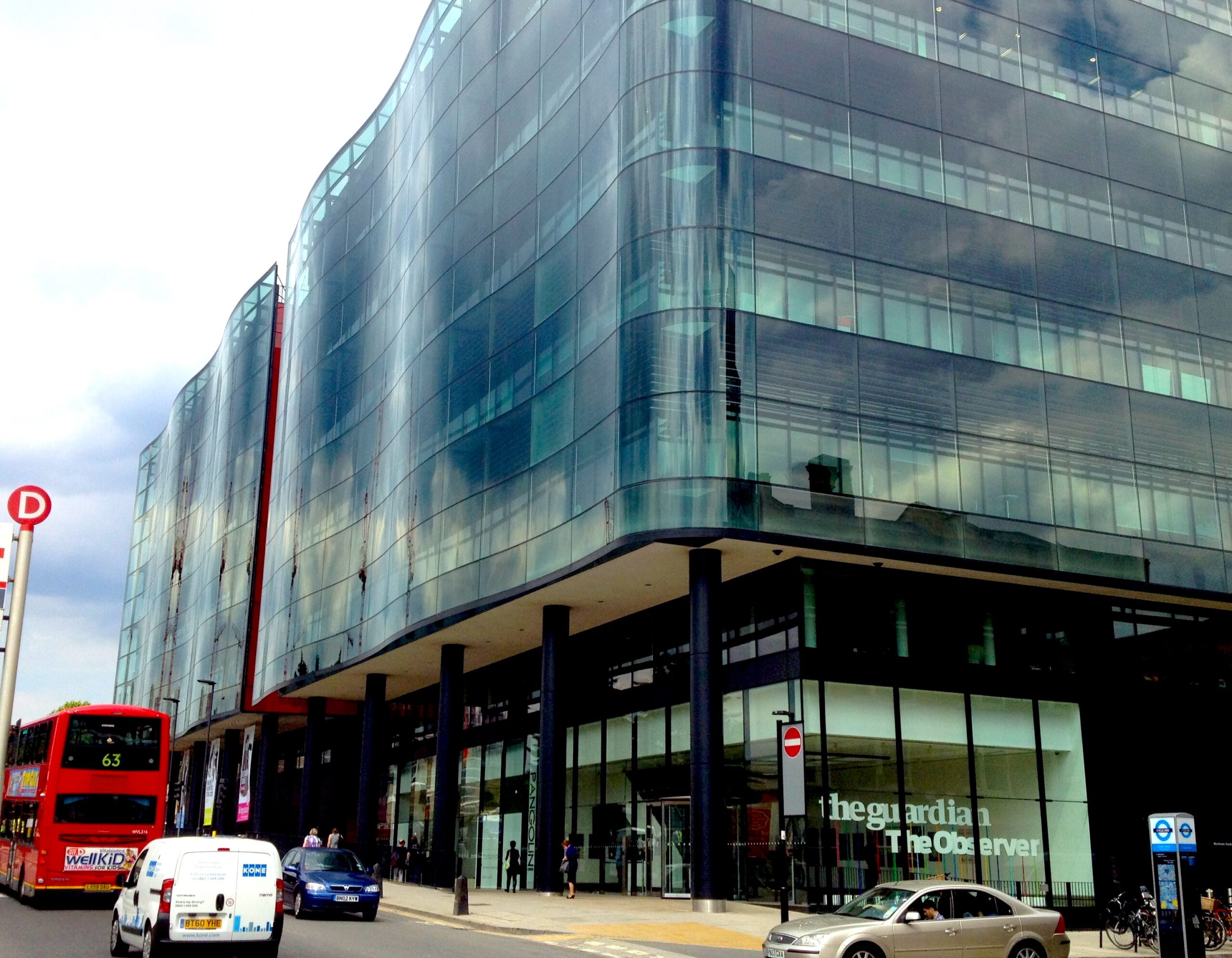
The Guardian building in London, 2012. (Bryantbob, CC BY-SA 3.0, Wikimedia Commons)

By Jonathan Cook
Declassified UK

It is only right that we all take a moment to celebrate the victory of Julian Assange’s release from 14 years of detention, in varying forms, to be united, finally, with his wife and children — two boys who have been denied the chance to ever properly know their father. 

His last five years were spent in Belmarsh high-security prison as the United States sought to extradite him to face a 175-year jail sentence for publishing details of its state crimes in Iraq, Afghanistan and elsewhere.

For seven years before that he was confined to a small room in the Ecuadorian embassy in London, after Quito awarded him political asylum to evade the clutches of a law-breaking U.S. empire determined to make an example of him.

His seizure by U.K. police from the embassy on Washington’s behalf in 2019, after a more U.S.-aligned government came to power in Ecuador, proved how clearly misguided, or malicious, had been those who accused him of “evading justice.”

Everything Assange had warned the U.S. wanted to do to him was proved correct over the next five years, as he languished in Belmarsh entirely cut off from the outside world. 

No one in our political or media class appeared to notice, or could afford to admit, that events were playing out exactly as the founder of WikiLeaks had for so many years predicted they would — and for which he was, at the time, so roundly ridiculed.

Nor was that same political-media class prepared to factor in other vital context showing that the U.S. was not trying to enforce some kind of legal process, but that the extradition case against Assange was entirely about wreaking vengeance — and making an example of the WikiLeaks founder to deter others from following him in shedding light on U.S. state crimes.

That included revelations that, true to form, the C.I.A., which was exposed as a rogue foreign intelligence agency in 250,000 embassy cables published by WikiLeaks in 2010, had variously plotted to assassinate him or kidnap him from the embassy in London. 

Other evidence came to light that the C.I.A. had been carrying out extensive spying operations on the embassy, recording Assange’s every move, including his meetings with his doctors and lawyers. 

That fact alone should have seen the U.S. case thrown out by the British courts. But the U.K. judiciary was looking over its shoulder, towards Washington, far more than it was abiding by its own statute books.

No Watchdog

Western governments, politicians, the judiciary and the media all failed Assange. Or rather, they did what they are actually there to do: keep the rabble — that is, you and me — from knowing what they are really up to. 

Their job is to build narratives suggesting that they know best, that we must trust them, that their crimes, such as those they are supporting right now in Gaza, are actually not what they look like, but are, in fact, efforts in very difficult circumstances to uphold the moral order, to protect civilisation. 

For this reason, there is a special need to identify the critical role played by the media in keeping Assange locked up for so long.

The truth is, with a properly adversarial media playing the role it declares for itself, as a watchdog on power, Assange could never have been disappeared for so long. He would have been freed years ago. It was the media that kept him behind bars. 

The establishment media acted as a willing tool in the demonising narrative the U.S. and British governments carefully crafted against Assange.

Even now, as he is reunited with his family, the BBC and others are peddling the same long-discredited lies. 

Those include the constantly repeated claim by journalists that he faced “rape charges” in Sweden that were supposedly dropped. Here is the BBC making this error once again in its reporting this week. 

In fact, Assange never faced more than a “preliminary investigation,” one the Swedish prosecutors repeatedly dropped for lack of evidence. The investigation, we now know, was revived and sustained for so long not because of Sweden but chiefly because the U.K.’s Crown Prosecution Service, then led by Sir Keir Starmer (now the leader of the Labour Party), insisted on it dragging on. 

Starmer made repeated trips to Washington during this period, when the U.S. was trying to find a pretext to lock Assange away for political crimes, not sexual ones. 

But as happened so often in the Assange case, all the records of those meetings were destroyed by the British authorities. 

The media’s other favourite deception — still being promoted — is the claim that WikiLeaks’ releases put U.S. informants in danger. 

That is utter nonsense, as any journalist who has spent even a cursory amount of time studying the background to the case knows. 

More than a decade ago, the Pentagon set up a review to identify any U.S. agents killed or harmed as a result of the leaks. They did so precisely to help soften up public opinion against Assange. 

And yet a team of 120 counter-intelligence officers could not find a single such case, as the head of the team, Brigadier-General Robert Carr, conceded in court in 2013.

Despite having a newsroom stuffed with hundreds of correspondents, including those claiming to specialise in defence, security and disinformation, the BBC still cannot get this basic fact about the case right. 

That’s not an accident. It’s what happens when journalists allow themselves to be spoon-fed information from those they are supposedly watching over. That is what happens when journalists and intelligence officials live in a permanent, incestuous relationship. 

Character Assassination

But it is not just these glaring reporting failures that kept Assange confined to his small cell in Belmarsh. It was that the entire media acted in concert in his character assassination, making it not only acceptable but respectable to hate him.

It was impossible to post on social media about the Assange case without dozens of interlocutors popping up to tell you how deeply unpleasant he was, how much of a narcissist, how he had abused his cat or smeared his walls in the embassy with faeces. None of these individuals, of course, had ever met him.

It also never occurred to such people that, even were all of this true, it would still not have excused stripping Assange of his basic legal rights, as all too clearly happened. And even more so, it could not possibly justify eroding the public-interest duty of journalists to expose state crimes.

What was ultimately at stake in the protracted extradition hearings was the U.S. government’s determination to equate investigative national-security journalism with “espionage”. Whether Assange was a narcissist had precisely no bearing on that matter.

Why were so many people persuaded Assange’s supposed character flaws were crucially important to the case? Because the establishment media — our supposed arbiters of truth — were agreed on the matter.

The smears might not have stuck so well had they been thrown only by the rightwing tabloids. But life was breathed into these claims from their endless repetition by journalists supposedly on the other side of the aisle, particularly at The Guardian

Liberals and left-wingers were exposed to a steady flow of articles and tweets belittling Assange and his desperate, lonely struggle against the world’s sole superpower for the right not to be locked away for the rest of his life for doing journalism. 

The Guardian — which had benefited by initially allying with WikiLeaks in publishing its revelations — showed him precisely zero solidarity when the U.S. establishment came knocking, determined to destroy the WikiLeaks platform, and its founder, for making those revelations possible.

For the record, so we do not forget how Assange was kept confined for so long, these are a few examples of how The Guardian made him — and not the law-breaking U.S. security state — the villain.

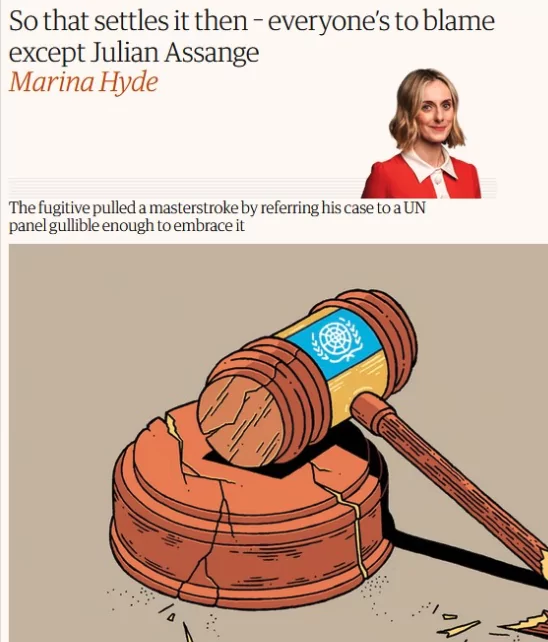
Marina Hyde in The Guardian in February 2016 — four years into his captivity in the embassy — casually dismissed as “gullible” the concerns of a United Nations panel of world-renowned legal experts that Assange was being “arbitrarily detained” because Washington had refused to issue guarantees that it would not seek his extradition for political crimes.
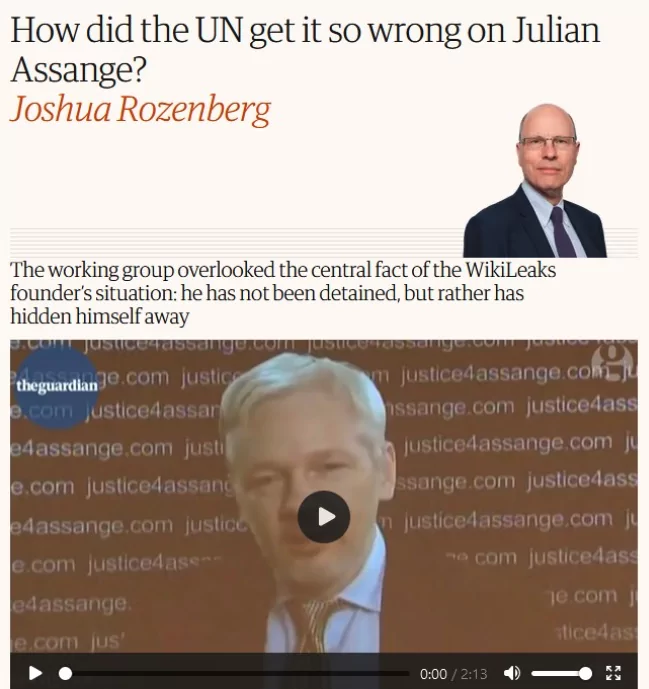
Long-time BBC legal affairs correspondent Joshua Rozenberg was given space in The Guardian on the same day to get it so wrong in claiming Assange was simply “hiding away” in the embassy, under no threat of extradition (Note: Though his analytic grasp of the case has proven feeble, the BBC allowed him to opine further this week on the Assange case).
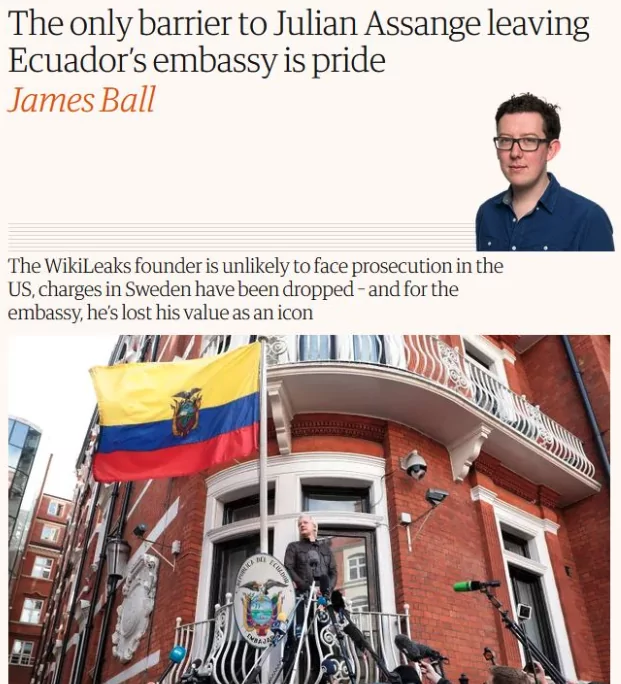
Two years later, The Guardian was still peddling the same line that, despite the U.K. spending many millions ringing the embassy with police officers to prevent Assange from “fleeing justice”, it was only “pride” that kept him detained in the embassy.
Or how about this one from Hadley Freeman, published by The Guardian in 2019, just as Assange was being disappeared for the next five years into the nearest Britain has to a gulag, on the “intense happiness” she presumed the embassy’s cleaning staff must be feeling. 

Anyone who didn’t understand quite how personally hostile so many Guardian writers were to Assange needs to examine their tweets, where they felt freer to take the gloves off. Hyde described him as “possibly even the biggest arsehole in Knightsbridge” while Suzanne Moore said he was “the most massive turd.”
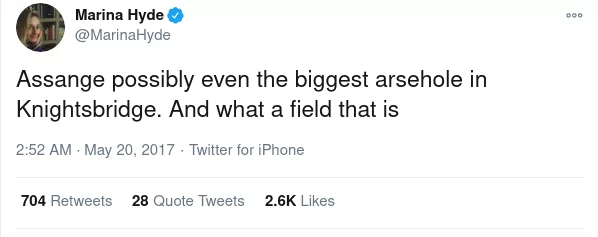
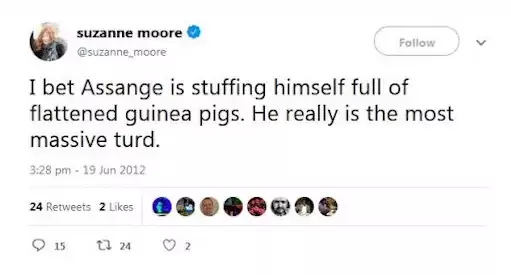
 

The constant demeaning of Assange and the sneering at his plight was not confined to The Guardian’s opinion pages. The paper even colluded in a false report — presumably supplied by the intelligence services, but easily disproved — designed to antagonise the paper’s readers by smearing him as a stooge of Donald Trump and the Russians. 

This notorious news hoax — falsely claiming that in 2018 Assange repeatedly met with a Trump aide and “unnamed Russians”, unrecorded by any of the dozens of CCTV cameras surveilling ever approach to the embassy — is still on The Guardian’s website. 

This campaign of demonisation smoothed the path to Assange being dragged by British police out of the embassy in early 2019.

It also, helpfully, kept The Guardian out of the spotlight. For it was errors made by the newspaper, not Assange, that led to the supposed “crime” at the heart of the U.S. extradition case — that WikiLeaks had hurriedly released a cache of files unredacted — as I have explained in detail before. 

Too Little Too Late

The establishment media that collaborated with Assange 14 years ago in publishing the revelations of U.S. and U.K. state crimes only began to tentatively change its tune in late 2022 — more than a decade too late.

That was when five of his former media partners issued a joint letter to the Biden administration saying that it should “end its prosecution of Julian Assange for publishing secrets”.

But even as he was released this week, the BBC was still continuing the drip-drip of character assassination. A proper BBC headline, were it not simply a stenographer for the British government, might read: “Tony Blair: Multi-millionaire or war criminal?” 
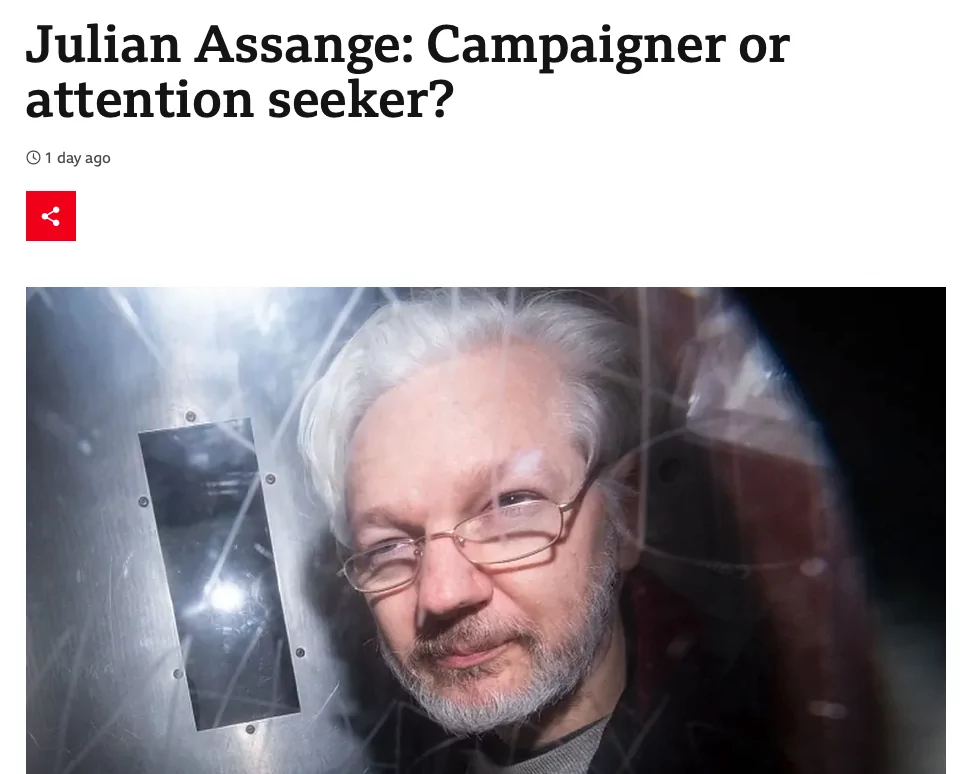
For while the establishment media has busily fixed our gaze on the supposed character flaws of Assange, it has kept our attention away from the true villains, those who committed the crimes he exposed: former U.K. Prime Minister Tony Blair, former U.S. President George W Bush and his vice president Dick Cheney and many more. 

We need to recognise a pattern here. When the facts cannot be disputed, the establishment has to shoot the messenger. 

In this case, it was Assange. But the same media machine was rolled out against former Labour leader Jeremy Corbyn, another thorn in the establishment’s side. And as with Assange, The Guardian and the BBC were the two outlets that were most useful in making the smears stick.

Sadly, to secure his freedom, Assange was compelled to make a deal pleading guilty to one of the charges levelled against him under the Espionage Act. 
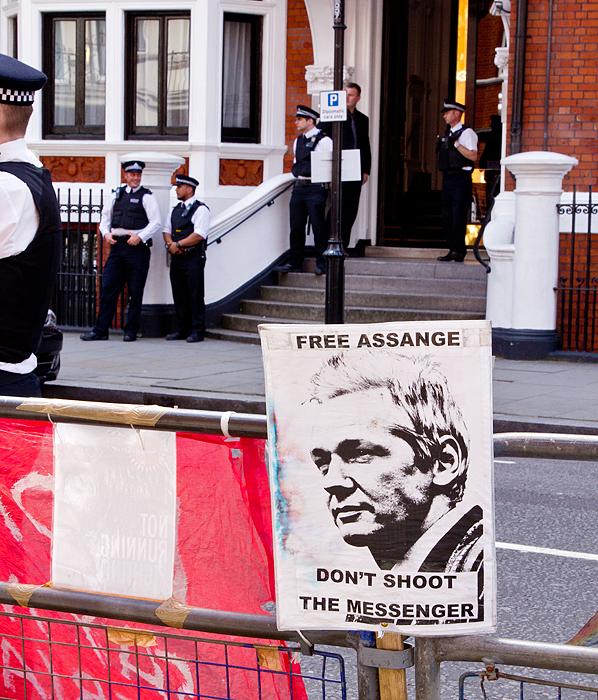
“Don’t Shoot the Messenger” poster of Julian Assange outside the Ecuadorian embassy in London, August 2012. (Chris Beckett, Flickr, CC BY-NC-ND 2.0)

Highlighting the enduring bad faith of The Guardian, the same paper that so readily ridiculed Assange’s years of detention to avoid being locked away in a U.S. super-max jail, ran an article this week, as Assange was released, stressing the “dangerous precedent” for journalism set by his plea deal.

Washington’s treatment of Assange was always designed to send a chilling message to investigative journalists that, while it is fine to expose the crimes of Official Enemies, the same standards must never be applied to the U.S. empire itself.

How is it possible that The Guardian is learning that only now, after failing to grasp that lesson earlier, when it mattered, during Assange’s long years of political persecution? 

The even sadder truth is that the media’s villainous role in keeping Assange locked up will soon be erased from the record. That is because the media are the ones writing the script we tell ourselves about what is going on in the world.

They will quickly paint themselves as saints, not sinners, in this episode. And, without more Assanges to open our eyes, we will most likely believe them.

Jonathan Cook is an award-winning British journalist. He was based in Nazareth, Israel, for 20 years. He returned to the U.K. in 2021.He is the author of three books on the Israel-Palestine conflict: Blood and Religion: The Unmasking of the Jewish State (2006), Israel and the Clash of Civilisations: Iraq, Iran and the Plan to Remake the Middle East (2008) and Disappearing Palestine: Israel’s Experiments in Human Despair (2008). If you appreciate his articles, please consider offering your financial support

This article is from Declassified UK.  

The views expressed are solely those of the author and may or may not reflect those of Consortium News.

Please Donate to the
Spring Fund Drive!


 CONSORTIUM NEWS


NORTHCOM's Shock Drone Admission, Nuclear Talk, and Trump's Latest Threat – 8/17/26

                                                                                    LOTS OF POSTS IGNORED BY BLOGGER..... OR REMOVED ON THEI...