****CLIMATE CHANGE THREATENS US ALL!
THIS HIGHLIGHTS THE IMPORTANCE OF ADDRESSING CLIMATE CHANGE TO
REDUCE OUR RISKS! ****
|


|
****CLIMATE CHANGE THREATENS US ALL!
THIS HIGHLIGHTS THE IMPORTANCE OF ADDRESSING CLIMATE CHANGE TO
REDUCE OUR RISKS! ****
|
|
|
|

16 November 22
Live on the homepage now!
Reader Supported News
Hudson writes,
The report details the way the Emirates takes advantage of the US electoral system, which is peculiarly open to dark-money campaign contributions, to push policies that favor it in Washington.
There are allegations that the Emirates worked behind the scenes to install Donald Trump in the presidency. Trump went on to offer Abu Dhabi access to tens of billions of dollars worth of high-tech US weapons.
The Emirates has also widely cultivated retired US military personnel, which is a problem since these individuals can at any time be recalled to active service and so are not supposed to have shadowy foreign ties.
The Intercept did an exposé on UAE ambassador Yousef Al Otaiba that alleged that he had plied US contacts with alcohol, high-life partying, and women.
The National Intelligence Council (NIC) is a panel of intelligence officials and academics that tries to bridge the intelligence community and the policy-making world. Contrary to what is popularly assumed, intelligence agencies typically do not make policy but rather do as the executive branch orders them. Moreover, sometimes intelligence agencies cannot get a hearing with policy-makers, and so the NIC is a conduit to the latter.
Hudson notes that it is highly unusual for such a report to be produced concerning a country friendly to the US. It should, however, be noted that the Emirates has often proven to be a fickle friend. It is not an ally, since the US and the UAE have no treaty obligation to defend one another, unlike NATO. UAE banks have been accused of laundering Iranian money, enabling Tehran to skirt US sanctions. The UAE has also pursued adventures such as the Yemen War, which the Biden administration opposes. The UAE recently voted to cut OPEC quotas, putting up the price of gasoline, after President Biden had asked them to pump more oil.
Informed Comment reported on some of these Emirati influence operations in May 2018, concluding that the Emirates sought to put Trump in the presidency in 2016. I wrote that:
I added,
I concluded,
I once observed that since Americans put their politicians up for sale, they should not be surprised when someone buys them.
READ MORE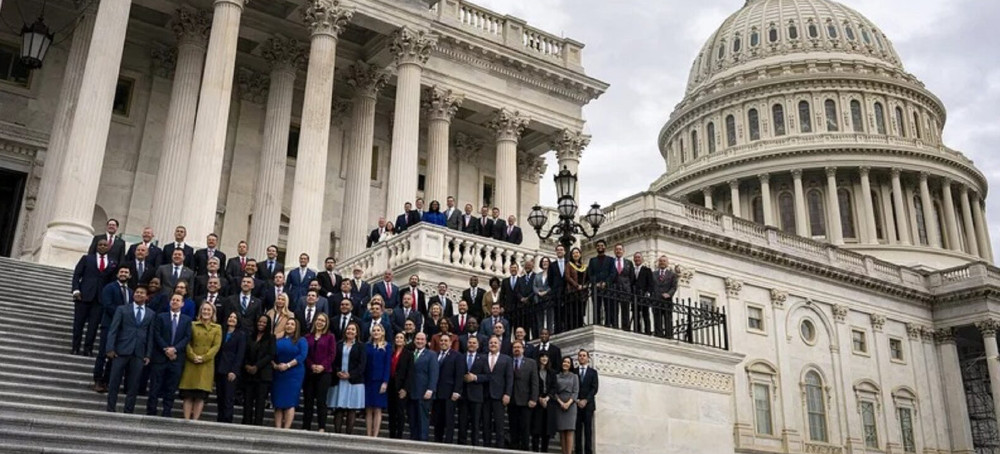 Representatives-elect during a group photograph outside the U.S. Capitol in Washington, D.C., on Tuesday. (photo: Al Drago/Bloomberg)
That was one of the least-expected outcomes of this election, but abortion rights were clearly a huge motivator and voters rejected extreme, Trump-backed election-denying candidates up and down the ballot.
That likely made the difference between the slim majority Republicans are likely to attain and something much larger. And yet the former president, who has fomented distrust in U.S. elections with baseless conspiracies and who inspired the deadly Jan. 6 riot at the Capitol in an attempt to hold onto the presidency, announced another run for president Tuesday night.
As it stands:
Votes are still being scrutinized and tallied, as Republicans continue to sit just one House seat shy of a majority, according to calls from the Associated Press. NPR follows AP's calls and guidance.
Republicans getting over the top appears inevitable with nine races not yet called, and them leading in four. AP could call the House some time Wednesday, depending on where newly reported vote comes in.
Republicans at this point would only be able to lose three votes to pass legislation out of the House starting in January. That could be a major headache for Rep. Kevin McCarthy, R-Calif. — or whomever becomes the Republican speaker.
It's also still possible that that number shrinks or expands slightly, depending on what happens, particularly in several California races. Democrats are hoping for a turnaround in California's 22nd and 27th districts. Republicans still have a shot to flip the 47th district, where Democrat Katie Porter's lead has shrunk to less than 2 points, and the 13th, which also remains very close.
Reported vote continues to trickle in slowly in California, which has been commonplace in every recent election. The state takes longer to count its mail votes.
The other three uncalled races are in Colorado, Maine and Alaska. Maine and Alaska have headed to ranked-choice voting tabulations because no one got 50% of the vote. Maine's 2nd congressional district is expected to be decided Wednesday. Alaska will conduct its retabulation Nov. 23.
Here's where things stand, by the numbers (as of Wednesday, 12:42 p.m. ET):
What's left
Here's the list of uncalled races and who leads in them (as of 9:50 p.m. ET):
Sending a message
Democrats picked up a seat this week in the 3rd Congressional District in Washington state, a district that had been held by a Republican, Jamie Herrera Beutler. But she voted for former President Trump's impeachment and was ousted by the right in the primary.
There's an irony in the fact that she was ousted because she voted to impeach Trump and, now, a Democrat has taken over that seat. It's indicative of the broader message in this election.
Note: Please keep in mind that these numbers are fluid and will change as votes continue to roll in. See the latest results here.
The Senate: Democrats 48, Independents 2, Republicans 49, Uncalled 2
(The two independents caucus with the Democrats.)
With their wins the last two days in Arizona and Nevada, as well as their flip of the Pennsylvania seat, Democrats will retain the Senate.
It's a remarkable accomplishment for Democrats with a president whose approval rating has been below 50% for more than a year.
But base energy over the issue of abortion and a slew of Trump-backed candidates, who failed in purple states, proved to thwart a potential Republican Senate takeover.
What's left
Alaska: This has been added to the Republican total even though the race is not settled yet, because both leading candidates are Republicans, so this will stay in GOP hands. The question is at this point: which Republican. Incumbent Lisa Murkowski (R) trails Kelly Tshibaka (R) by less than 2 percentage points, or just under 3,000 votes, with 80% in. If neither candidate gets above 50%, this goes to a ranked-choice re-tabulation Nov. 23. Murkowski would likely be favored to win that.
Georgia: Incumbent Raphael Warnock (D) and Republican challenger Herschel Walker (R) are headed to a runoff because neither surpassed 50% on the ballot. Warnock missed the threshold by just under 23,000 votes. Democrats have the chance to expand their Senate majority with a win there.
What happened since Friday
Nevada: Democratic incumbent Catherine Cortez Masto took the lead after a batch of votes Saturday night were reported in Clark County. Shortly thereafter, she was declared the winner, clinching Senate control for Democrats. There is still vote to count in Nevada, which we will monitor, including 15,000 provisional votes from Clark County, which could also help Cortez Masto extend her lead.
Arizona: Democratic incumbent Mark Kelly's lead expanded by about 8,000 votes with the Friday night batch of about 80,000 votes out of Maricopa County. The race was called in his favor quickly after that, though vote counting continues there, and there is a closely watched governor's race, where Democrat Katie Hobbs currently leads Trump-backed Kari Lake, who has made unfounded allegations of fraud in the election.
READ MORE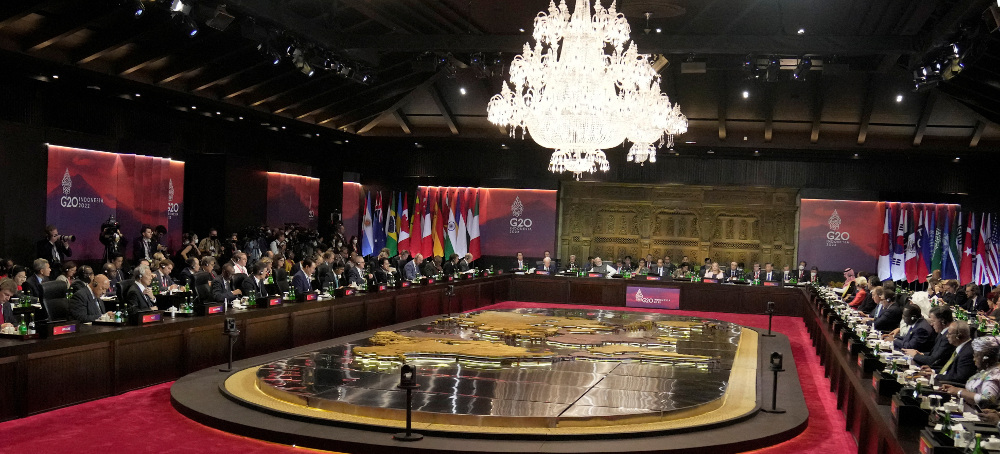 The G20 leaders summit in Nusa Dua, Bali, Indonesia, Tuesday, Nov. 15, 2022. (photo: Dita Alangkara/Reuters)
International law must be upheld, the communique says, adding the threat of the use of nuclear weapons was inadmissible.
The final communique, approved on Wednesday after a two-day summit in Indonesia, said the majority of members strongly condemned the war in Ukraine, but noted there were other views.
It was noteworthy in highlighting the invasion given the divisions among the group, which includes not only Russia itself but also countries such as China and India that have significant trade ties with Moscow and have stopped short of outright criticism of the war.
The statement acknowledged “there were other views and different assessments” and said the G-20 is “not the forum to resolve security issues”.
International law must be upheld, the communique said, also condemning the threat of the use of nuclear weapons. It welcomed the Black Sea grain initiative as the war has prevented much-needed grain heading to world markets.
“Many members… expressed concern about the damage caused by the conflict on critical health infrastructure, as well as casualties in health care workers, which have disproportionately affected the most vulnerable, women and children,” said the declaration.
The war on Ukraine was hurting the global economy, it added. The communique also said members’ central banks would continue to calibrate the pace of monetary policy tightening.
‘Terrorist state’
Russian Foreign Minister Sergey Lavrov, who headed the Russian delegation to the summit in the absence of President Vladimir Putin, earlier in the week condemned “politicisation” of the G20 meeting.
UN Secretary-General Antonio Guterres, also in Bali for the summit, warned it was “absolutely essential to avoid escalating the war in Ukraine”.
His comments came after an explosion in Poland, a NATO member, which immediately sparked concerns the alliance might be drawn directly into Russia’s nearly nine-month war against Western-backed Ukraine.
Confusion surrounded the incident as to which side fired a missile into Poland that killed two people.
The blast was an attempt to spark a direct clash between Russia and NATO, the head of the permanent mission of Russia to the United Nations said on Wednesday.
“There is an attempt to provoke a direct military clash between NATO and Russia, with all the consequences for the world,” Dmitry Polyansky said on his Telegram channel.
Ukrainian President Volodymyr Zelenskyy told G20 leaders on Wednesday there was a “terrorist state” among them.
Speaking by video link, Zelenskyy called the strike on Poland “a true statement brought by Russia for the G20 summit”.
Poland has said there is no clear evidence on who launched the missile. The Associated Press quoted unnamed US officials as saying the missile may have been fired by Ukraine forces in an attempt to shoot down a Russian missile.
‘Rise of billionaire wealth’
G20 leaders also agreed to pursue efforts to limit the rise in global temperatures to 1.5 degrees C (2.7 degrees F), including speeding up efforts to “phase down” the unabated use of coal.
“This will require meaningful and effective actions and commitment by all countries,” the declaration said.
International charity Oxfam denounced the G20 leaders for failing to address rising global poverty, noting the grouping represents two-thirds of the world’s population and four-fifths of the world’s economic power.
“In the midst of a debt, austerity and inequality crisis we expected far more from the world’s largest economies, especially given the meteoric rise of billionaire wealth in their backyards,” said Oxfam’s G20 lead Joern Kalinski.
“The world needs concrete action to avert economic disaster for poor people and countries, but all we were left with was a recycled assurances, a simmering debt crisis and vaccine and health steps as useful as putting a band aid on a broken leg.”
READ MORE People protest outside the U.S. Court of Appeals for the Eleventh Circuit during a protest against the Supreme Court's ruling in the Dobbs v Jackson Women's Health Organization on June 25, 2022, in Atlanta, Georgia. (photo: Elijah Nouvelage/Getty)
The state's law, which prohibited most abortions once there was a "detectable human heartbeat," had been in effect since July.
Fulton County Superior Court Judge Robert McBurney’s ruling took effect immediately statewide, though the state attorney general’s office said it planned to appeal. The ban had been in effect since July.
It prohibited most abortions once a “detectable human heartbeat” was present. Cardiac activity can be detected by ultrasound in cells within an embryo that will eventually become the heart as early as six weeks into a pregnancy. That means most abortions in Georgia were effectively banned at a point before many women knew they were pregnant.
McBurney’s ruling came in a lawsuit filed in July by doctors and advocacy groups that sought to strike down the ban on multiple grounds, including that it violates the Georgia Constitution’s right to privacy and liberty by forcing pregnancy and childbirth on women in the state. McBurney did not rule on that claim.
Instead, his decision agreed with a different argument made in the lawsuit — that the ban was invalid because it violated the U.S. Constitution and U.S. Supreme Court precedent at the time it became law.
Kara Richardson, a spokesperson for Georgia Attorney General Chris Carr, said in an email that the office intends to pursue an “immediate appeal.”
Georgia’s law was passed by state lawmakers and signed by Republican Gov. Brian Kemp in 2019 but had been blocked from taking effect until the Supreme Court overturned Roe v. Wade, which had protected the right to an abortion for nearly 50 years.
The 11th U.S. Circuit Court of Appeals allowed Georgia to begin enforcing its abortion law just over three weeks after the high court’s decision in June.
Abortion clinics in the state remained open, but providers said they were turning many women away because cardiac activity had been detected. Those women could then either travel to another state for an abortion or continue with their pregnancies.
During a two-day trial in October, abortion providers told McBurney the ban was causing distress to women denied the procedure and confusion among doctors.
McBurney wrote in his ruling that when the law was enacted, “everywhere in America, including Georgia, it was unequivocally unconstitutional for governments — federal, state, or local — to ban abortions before viability.”
He wrote that the state’s law “did not become the law of Georgia when it was enacted and it is not the law of Georgia now.”
The state had argued that the Roe decision itself was wrong and the Supreme Court ruling wiped it out of existence.
McBurney did leave the door open for the state Legislature to revisit the ban.
Now that the Supreme Court has overturned Roe v. Wade, the prohibition on abortions provided for in the 2019 law “may someday become the law of Georgia,” he wrote.
But, he wrote, that can happen only after the General Assembly “determines in the sharp glare of public attention that will undoubtedly and properly attend such an important and consequential debate whether the rights of unborn children justify such a restriction on women’s right to bodily autonomy and privacy.”
Georgia’s ban included exceptions for rape and incest, as long as a police report was filed, and allowed for later abortions when the mother’s life was at risk or a serious medical condition rendered a fetus unviable.
At the October trial, witnesses for the state disputed the claim that the law was unclear about when doctors could intervene to perform a later abortion. They also argued that abortions themselves could harm women.
Abortion was a central issue in Georgia’s U.S. Senate contest between Democrat Raphael Warnock and Republican Herschel Walker, which is now headed to a runoff in December. Two women accused Walker, who opposes abortion, of paying for them to have the procedure. Walker vehemently denied that.
READ MORE Ajay Kumar stands on a balcony in California, June 1, 2022. (photo: Stuart Harmon/The Intercept)
In an exclusive video, a hunger striker is force-fed in ICE detention — lifting the veil of secrecy on a practice condemned by medical ethicists.
So he began a protest. In July 2019, along with three other Indian asylum-seekers, Kumar undertook a hunger strike, demanding release from ICE detention. The agency responded by transferring him to the El Paso Service Processing Center in Texas, an ICE jail operated by the firm Global Precision Systems.
With Kumar more than a month into the hunger strike, the government, using Justice Department lawyers, sought a judge’s order to force-feed him and the other three men. With the judge’s approval, contractors working at the detention center on ICE’s behalf began the process of involuntarily feeding Kumar in August 2019, 37 days since his last meal. The process was captured on video.
“I asked them to give me my freedom. If they had granted it at that time, there would have been no need for all of this,” Kumar said. “This is not humanity. This is totally against humanity.”
Historically, the federal government’s force-feeding procedures have been mired in secrecy, with even the court orders to carry it out frequently issued under seal. Video, court records, and medical records reviewed by The Intercept in the case of the El Paso detention center provide a firsthand look at how the procedure is approved and executed — including the first publicly released video of force-feeding done under the auspices of the federal government. National and international medical organizations consider force-feeding hunger strikers a transgression of medical ethics; the process has been criticized as torture by international human rights organizations.
The video, nearly one hour long, shows five detention guards in riot gear, employed by Global Precision Systems, introduce themselves to the camera in preparation for their “calculated use of force” on Kumar. The guards enter the facility infirmary, where medical personnel explain the procedure to the asylum-seeker through a translator and begin their attempts to insert a nasogastric tube. Medical officials failed to correctly insert the tube two times before successfully beginning the force-feeding.
According to ICE’s Performance-Based National Detention Standards, whenever there is a “calculated use of force,” staff are required to use a handheld camera to record the incident. The Intercept, with Kumar’s consent, requested the video through the Freedom of Information Act. After ICE refused to turn over the footage, The Intercept filed a lawsuit and ICE subsequently agreed to turn over the footage, but the agency redacted the faces and names of everyone who appears in it, aside from Kumar. (ICE declined to comment for this story and Global Precision Systems did not respond to a request for comment.)
Kumar watched the video for the first time with The Intercept, which also showed the footage to four experts from universities and advocacy organizations, who work on medicine and immigration detention.
“The process of watching this hourlong video was excruciating, knowing what Ajay was going through,” said Joanna Naples-Mitchell, research adviser for the U.S. at Physicians for Human Rights. “That was, perhaps, the most chilling thing about it: this kind of quiet, pernicious nature of the violence that was present throughout this video — and having these officers standing around him, and just this tremendous power imbalance and asymmetry between him and them.”
Kumar fled from India after receiving threats related to his political activism. The threats were very real: Later, as Kumar was in ICE detention, his father was killed in India, his immigration attorney said in court. From India, Kumar took a plane to Ethiopia and then another flight to Brazil and traveled north by car, bus, and foot, before ending up at the California border, according to records from an interview he gave to the U.S. border guards. After making his intention to declare asylum known, Kumar was placed in ICE custody and taken to the Otero County Processing Center in New Mexico — another privately run facility, in this case operated by Management and Training Corporation. (Management and Training Corporation did not provide a comment for this story.)
Asylum-seekers, when placed in ICE custody, are fighting civil immigration cases. Their legal right to request asylum, however, does not preclude detention. They are frequently placed in immigration detention centers. They sometimes stay under lock and key until their cases conclude, but in other instances they can argue for release to pursue their claim from the outside. Despite being placed in detention facilities while awaiting civil — not criminal — cases, conditions for asylum-seekers are identical to jails and prisons.
For Kumar, days passed, then weeks, without any indication of when he would be released from detention. The conditions and treatment, he said, were abysmal. It was “the worst experience I had over there, the worst,” he told The Intercept. “I did not expect that these people would treat us like this.” Kumar said he would speak up for himself and others. The complaints Kumar said he lodged included a request for the staff to respect Hindi detainees’ religious observations, including a request that their food not be cross-contaminated with beef, which is prohibited in the Hindu religion. In response, he said, Otero correctional staff would send him to solitary confinement. (In some cases, records indicate he was segregated for “insolence.” In one case, the documents say the segregation order was related to claims of a hunger strike.)
Advocates for migrants have lodged a raft of complaints against the Otero County Processing Center, including over its use of solitary confinement. In 2021, Advocate Visitors with Immigrants in Detention, or AVID, and Innovation Law Lab, released a report co-written by Nathan Craig, a professor at New Mexico State University who has worked on Kumar’s case, that drew on more than 200 complaints of alleged abuse at the facility. They included claims of unsanitary conditions, inadequate medical care, harassment by staff, and prolonged use of solitary confinement. Recently, the Department of Homeland Security’s Office for Civil Rights and Civil Liberties wrote a recommendations memo to ICE highlighting concerns and best practices to be improved in terms of detainee treatment.
“The private contractors’ aim is to cut costs and try to extract profit out of this situation. These lead to dangerously bad conditions,” Craig said. “There’s poor sanitation, poor medical care. The conditions are very unpleasant, partly by design, partly by the extraction of profit.”
Even as he fought for better conditions, Kumar requested to be released on bond. ICE, though, kept him confined. He decided something drastic needed to be done: After nearly a year in ICE detention, Kumar ate his last meal on July 8, 2019, and began his hunger strike.
“For the first few days my body was demanding food all the time, all the time. But after 10 to 12 days, my hunger stopped permanently,” Kumar said. “And as the days passed, the weakness increased gradually.”
Other men in the facility also began hunger strikes. Kumar said they were all threatened with force-feeding: “The guards who were there before the transfer were threatening me: ‘Now you will go to El Paso and tubes will be inserted inside you. You will be force-fed.’”
The El Paso Service Processing Center is a hub of federal government force-feeding. Kumar was far from the first detainee to be force-fed there. A report from the American Civil Liberties Union and Physicians for Human Rights shows that as early as 2016, there was a court order for a forced hydration in the facility.
Additional ICE records reviewed by The Intercept show that, in 2018, there were a total of 25 hunger strikes, six of which were met by “involuntary administration of fluids.” One ICE detainee was flown from New Jersey to El Paso to be force-fed in November 2018. In early 2019, the Associated Press reported that nine men were simultaneously being force-fed at the facility. That year there were 40 hunger strikes in the facility, according to an ICE facility report, with Kumar’s case brining the reported total to 13 known force-feedings.
The practice of force-feeding incarcerated hunger strikers is widespread in federal facilities, spanning Democratic and Republican administrations alike. While the Pentagon’s force-feedings of Guantánamo Bay detainees by the Department of Defense made global headlines in 2013, other government agencies — both at the federal and state levels — also engage in the practice, albeit with less fanfare.
As in Kumar’s case, the Department of Homeland Security force-feeds detainees at several immigration jails. The Justice Department’s Bureau of Prisons has also conducted force-feedings, which typically require an order by a judge. Though contractors running and working at detention facilities do not typically initiate the court proceedings that result in judicial orders for force-feedings — in Kumar’s case, the government was itself the sole petitioner — contractors do, as in Kumar’s case, sometimes carry out the procedure.
Though advocates, journalists, and lawyers have continually fought to get videos of federal force-feedings, none had been made public. In 2014, a judge ordered the release of the Guantánamo Bay videos, but after the Obama administration appealed, a panel of three federal judges overturned the previous ruling.
What is likely the first video of a force-feeding being carried out by authorities was published in 2016 by Wisconsin Watch, a nonprofit investigative news organization. The state government in Wisconsin carried out the procedure: The video shows a person incarcerated at Waupun Correctional Institution, a state prison, being force-fed by Department of Corrections staff. The man, Cesar DeLeon, was on hunger strike to protest prolonged solitary confinement.
The practice has been condemned by medical experts and ethicists. The American Medical Association says force-feeding violates the “core ethical values of the medical profession.” The World Medical Association and the International Committee of the Red Cross have also condemned the practice. And, before Kumar ever arrived in El Paso, the United Nations said that ICE’s force-feeding of previous detainees could be violating the U.N. Convention Against Torture.
“If someone has capacity — they’re legally competent to make their own medical decisions — you cannot force-feed them,” said Dr. Matt Wynia, director of the Center for Bioethics and Humanities at the University of Colorado and the former head of the American Medical Association’s Institute for Ethics. “It’s a law enforcement intervention, and doctors do not have a place to use their skills and knowledge to be agents of the state for purposes of law enforcement, or for purposes of maintaining control of the prison population, or to try and break the hunger strike.”
Last year, the ACLU and Physicians for Human Rights released a report about hunger strikers and ICE’s response in immigration detention. The authors, Eunice Cho of the ACLU and Naples-Mitchell of Physicians for Human Rights, relied on over 10,000 pages of documents, studying the cases of nearly 1,400 people.
“Although some detained people, on occasion, are able to bring outside attention to their hunger strikes,” the report reads, “very little is known of ICE’s systemic response to hunger striking detainees.”
The report found that ICE began seeking and executing judicial orders for involuntary medical procedures since 2012, including a previously unknown force-feeding case from 2016 under the Obama administration. It also found that in many cases, ICE failed to consider alternatives to force-feeding, including addressing the conditions the hunger strikes were protesting. In multiple cases, the report found, documents and internal emails revealed ICE officials attempted to hide or manipulate information about in-custody hunger strikes in order to avoid public pressure.
“We have to remember how coercive and how abusive the detention system actually is in the first place,” said Cho, a senior staff attorney at the ACLU National Prison Project. “In the context of that, it may be that people have tried to do everything else possible, but it sometimes becomes an option of last resort because there is simply nothing else to do in terms of controlling one’s own bodily autonomy.”
Force-feedings have taken place at other jails, not just the El Paso facility. In 2020, immigrants detained at two separate Louisiana detention centers were subjected to force-feeding. Just this year, in February, ICE force-fed a Yemeni man detained in Arizona. That process went so badly that “one of the guards in the room thought the man was having a stroke,” according to a report from the Daily Beast.
“This is a practice that has clearly been accepted by multiple administrations, regardless of political party,” said Naples-Mitchell from Physicians for Human Rights. “It’s routinized within ICE policies and practices. And even though it’s clearly accepted, there’s also this veil of secrecy around how often it’s being used.”
About a week after he had started the hunger strike, the transfer order that guards had threatened him with was issued; Kumar was taken to the El Paso Service Processing Center. Government lawyers then sought a court order from a federal district judge for ICE to force-feed him. Kumar had lost just over 20 pounds during the hunger strike, dropping from 139 pounds to 118.
After the federal judge’s order came, a social worker concluded Kumar was “fully competent” to make decisions over his own medical care, according to court records reviewed by The Intercept.
On August 14 at 3:45 p.m., the U.S. government began the process of force-feeding Kumar. The video obtained by The Intercept shows the infirmary, where the three other hunger strikers are seen in the beds, also with their faces blurred, watching Kumar be force-fed.
“If they wanted, they could have taken me to another room,” Kumar said. He alleged that officials force-fed him in front of the others to encourage them to break their own strikes after watching him undergo the procedure. (A news report suggests that one of those three men was taken to the hospital the following day and diagnosed with ileus, a lack of muscle contractions of the intestines that can lead to a life-threatening blockage. That man was later returned to ICE custody and force-fed.)
“Our responsibilities are to pin the detainee, control the head, and if a weapon is produced, secure the weapon,” says one of the correctional officers dressed in riot gear, whose face was blurred in ICE’s video.
As correctional officers began to tighten the restraints on Kumar, someone behind the camera instructs the lead security officer to remove the restraints and use their hands.
“He was obviously so weak and so thin,” said Dr. Parveen Parmar, an associate professor of clinical emergency medicine at the University of Southern California, who reviewed the video. In 2019, Parmar filed an affidavit after reviewing hundreds of Kumar’s medical records during the court process to force-feed him. “As a physician, it was really viscerally hard to watch the use of force,” she told The Intercept. “I can clearly state it was medically unnecessary.”
Michelle Iglesias, a doctor with whom ICE contracts, oversaw Kumar’s force-feeding to verify the tube’s placement, according to medical records and court testimony reviewed by The Intercept. When Kumar’s attorneys attempted to stop the procedure from continuing, Iglesias defended the practice in federal court, though the doctor did concede that that force-feeding violates medical standards “in the private world.” The doctor suggested that “because this is a detainee in custody,” there is “a different policy.” (Iglesias declined to comment.)
Experts that spoke with The Intercept rejected Iglesias’s argument. “In medicine, we fight against that pretty regularly, for, I think, obvious reasons,” said Wynia, the former American Medical Association ethicist. “In our history, we have seen that is a very dark path to go down, where doctors are using their medical knowledge and skills to serve the interests of the state and of the court system.”
Private prison firms running ICE detention centers sometimes require doctors to declare that they are aligned with ICE’s mission. In a 2019 posting for a $400,000-a-year job as lead physician at an ICE facility in Louisiana, unrelated to the Texas facility, the private prison firm GEO Group said candidates must be “philosophically committed to the objectives of the facility.”
In the video, before the force-feeding begins, a woman who identifies herself as a “doctor” is present to oversee the procedure. Kumar identified her to The Intercept as Iglesias.

Kumar is given one last chance to avert the force-feeding. In the video, the doctor tells a translator to deliver a message to Kumar: “Up until this point, he still has the opportunity to drink the protein supplement, as opposed to using the tube in his nose.”
Kumar refuses, saying through the translator: “You guys know the only thing I want: my freedom.” The guards dressed in riot gear then hold Kumar down.
In the video, two nurses wearing U.S. Public Health Service uniforms perform the force-feeding. Health care in the facility is overseen by ICE’s Health Service Corps, which includes Public Health Service employees, but in ICE’s sprawling network of detention centers, the ground-level providers can also be contracted private providers. At times, medical personnel from multiple organizations are in the same facility.
In the video, one nurse begins inserting the tube through his left nostril, having Kumar sip water to facilitate the insertion. Kumar complies with instructions.
“At first I got scared seeing that tube — the tube that was almost as thick as my pinky finger, which they were going to put in my nose,” Kumar later said. The tube was about 6 millimeters thick, according to notes written by a nurse involved in the procedure. By comparison, the tubes used to force-feed Guantánamo detainees were between 3.3 and 4 millimeters, according to Guantánamo force-feeding documents obtained by Al Jazeera in 2013.
As the tube is inserted, Kumar is in visible pain, his back arching as the officers hold him in position.
“Right then, my mind stopped working,” Kumar said. “I was only thinking that I wish this tube would flip and go into my brain and the story ended there. I felt as if it was going through the throat, tearing the flesh. And blood started coming from the mouth and nose.”
Kumar is then guided to a wheelchair and taken for an X-ray to verify the tube’s correct placement, though he has trouble standing up. The insertion was found to be “unsuccessful,” according to the medical notes and video. The doctor overseeing the procedure later testified in court that the tube had coiled in Kumar’s esophagus. Kumar then returns to the bed, where a nurse removes the tube.
“When they dragged the tube out, it seemed like everything in the stomach was going to come out along with the tube,” Kumar said. “It was just as painful as inserting the tube.”
A nurse and then a doctor asks if Kumar would like to break his hunger strike and drink the protein supplement. He refuses.
A second nurse begins to perform the same procedure, inserting the tube.
“As soon as they started the second time, it was more painful than the first time, because my nose was already injured and the tube was going inside, tearing it again,” Kumar said. “So the second time was more painful than the first.”
Once again, the X-ray showed the tube coiled in his esophagus, according to the doctor’s court testimony. After nurses remove the tube for the second time, Kumar can be seen on the video bending over a container.
“When they took it out, I had a lot of blood in my throat, which is why I had to vomit, and they brought the trash can for me to spit out the blood,” Kumar said.
It wasn’t until the third attempt — in his right nostril this time, since, according to Kumar, the doctors told him his left nostril was too swollen from the previous attempts — that the second nurse was able to reach his stomach with the tube.
“If you use a thinner, more flexible tube, you’re lubricating adequately, or providing adequate anesthesia, you’re much more likely to get it right the first time and not result in having to do it three different times,” said Parmar, the University of Southern California professor. “It’s incredibly painful. I’m not surprised he was vomiting blood because it’s traumatic. It is traumatic to the nares and to the esophagus when you put in the tube, particularly multiple times — particularly if it’s a larger, more rigid tube.”
One of the nurses then begins the drip of nutritional shake through the tube.
“The other thing that was very disturbing was the fact that this was happening in full view of other people who had also participated in a hunger strike,” said Cho, the ACLU attorney, who reviewed the video. “It does not seem like an accident that ICE intended to show in full view this remarkably invasive and torturous medical procedure to other people who are also participating in this hunger strike with him. It was, frankly, very disturbing.”
As ICE was trying to quietly continue force-feeding Kumar and the three other Indian asylum-seekers through sealed court filings and closed proceedings, public pressure began to mount. On September 5, with his health condition improving, ICE paused Kumar’s force-feeding and removed the tube, according to court records.
Kumar, though, kept up his hunger strike and his health declined. Once again, ICE and U.S. Attorneys sought a judge’s approval to reinsert the tube and commence force-feeding.
“We tried to work with Ajay and other men to have the opportunity of some legal representation to oppose this order, because the hunger strike is a protest, it’s not a medical condition — it is a political protest,” said Craig, the New Mexico-based professor and immigration advocate. “The orders are temporary. So, if they want to continue force feeding this person, they have to return to the court a second time.”
During the court battles between Kumar’s attorneys and the government, Parmar filed a court affidavit after reviewing nearly 500 pages of records. In the affidavit, she reported that his health was declining and warned that the medical care he was receiving in ICE custody was “putting his life at risk.”
“I was so disturbed by the instability of his vital signs and how clearly he was getting progressively much more ill. I was very concerned he was going to lose his life,” Parmar told The Intercept. “He wasn’t getting a basic standard of care for somebody as ill as he was. This just wasn’t the setting for somebody this ill.”
The federal judge, though, once again approved the procedure on September 12. Kumar was taken to a hospital, where medical personnel inserted another tube — this time a much thinner one — and began to force-feed him.
After continued protests and complaints by Kumar, his attorneys, and migrant advocates, ICE reached a deal with Kumar a week later and finally released him on September 26. Kumar’s hunger strike had lasted 76 days. In total, he lost 45 pounds.
In the first few months after his release, Kumar had recurring nightmares about solitary confinement, the hunger strike, and being subjected to force-feeding.
“I asked them just for freedom, from the first day until the date they released me,” Kumar told The Intercept. “I didn’t have any other demand.”
READ MORE Tributes to slain Palestinian American journalist Shireen Abu Akleh at a protest and vigil in London on May 12. (photo: Guy Smallman/Getty)
Abu Akleh’s family have been calling for accountability since the journalist was killed by Israeli forces in May.
In a statement released on Tuesday, the family said the US decision, first reported on Monday, was necessary considering Abu Akleh’s citizenship and the fact that she was killed “by a foreign military”.
Israeli forces shot and killed Abu Akleh, 51, in the northern occupied West Bank town of Jenin where she was reporting on an Israeli raid.
Video footage, several witnesses and multiple investigations by independent media outlets showed there were no armed Palestinians in the area where Abu Akleh and other journalists were standing before Israeli soldiers started firing at them, despite initial Israeli claims that Abu Akleh may have been shot in crossfire between Israeli soldiers and Palestinian fighters.
Israel eventually admitted in September that one of its soldiers likely killed Abu Akleh, but said that no criminal investigation would be conducted.
The US had initially resisted attempts to start an investigation into Abu Akleh’s killing, arguing that Israel was able to conduct its own investigation.
But the US Department of Justice has now informed its counterpart in Israel that the FBI is opening a probe into the incident, according to a report by Axios on Monday.
Details about the investigation are unclear and a justice department spokesperson declined to comment.
The Israeli government has responded by criticising the US and insisting it will not cooperate with the investigation.
“The decision taken by the US Justice Department to conduct an investigation into the tragic passing of Shireen Abu Akleh, is a mistake,” said Benny Gantz, Israel’s outgoing defence minister.
Israel is set for a new government after former PM Benjamin Netanyahu was given the mandate to form a government after his coalition won elections held on November 1.
Accountability
In their statement, Abu Akleh’s family said they were “ready to support” the investigation, and added that they hoped it would be “truly independent” and “[follow] the evidence where it leads … toward accountability”.
The family have conducted an international campaign over the six months since the killing of the veteran reporter, who was one of the biggest names in Arab journalism.
That campaign has involved meetings with US government officials, an official complaint at the International Criminal Court, and a meeting with Pope Francis in the Vatican.
Speaking to Al Jazeera on Monday, Bruce Fein, a constitutional lawyer and former justice department official, said the decision to launch an FBI investigation indicates that the US has “credible evidence” to believe an assassination was committed.
Fein added that the US could put pressure on Israel in various ways to get it to cooperate, including military aid and regional geopolitics.
“Those kinds of levers can change the minds of the Israelis,” Fein said.
READ MORE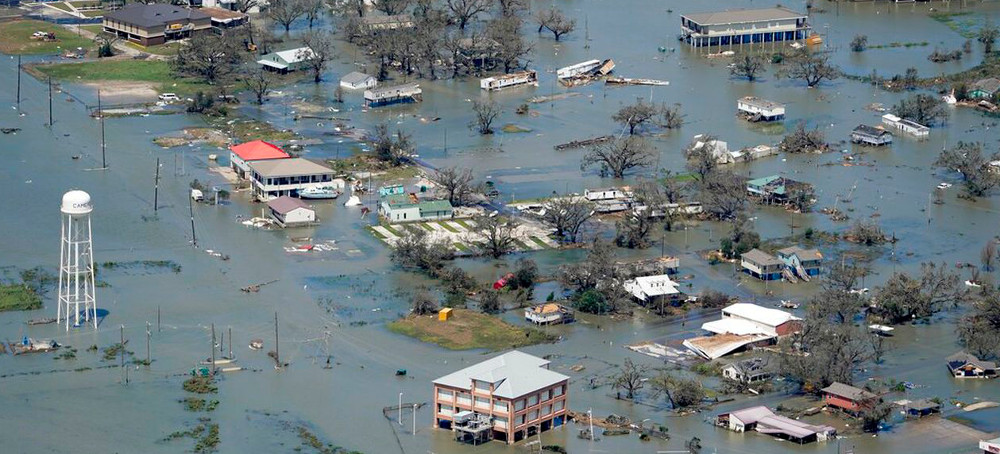 Buildings and homes are flooded in the aftermath of Hurricane Laura near Lake Charles, Louisiana, in August 2020. (photo: David J Phillip/AP)
California, Mississippi, Oklahoma, Iowa and Tennessee suffered most disasters, with over 300m people living in those counties
Some endured as many as 12 federally declared disasters over those 11 years. More than 300 million people – 93% of the population – live in these counties.
Rebuild by Design, which published the report, is a non-profit that researches ways to prepare for and adapt to climate change. It was started by the Department of Housing and Urban Development in the wake of Hurricane Sandy, the catastrophic storm that slammed the eastern US just over 10 years ago, causing $62.5bn in damage.
Researchers had access to data from contractors who work closely with the Federal Emergency Management Agency (Fema), allowing them to analyze disasters and payouts down to the county level. They also looked at who is most vulnerable and compared how long people in different places are left without power after extreme weather.
California, Mississippi, Oklahoma, Iowa and Tennessee had the most disasters, at least 20 each, including severe storms, wildfire, flooding and landslides. But Louisiana, New York, New Jersey, North Dakota and Vermont received the most disaster funding per person.
Amy Chester, managing director of Rebuild by Design and co-author of the report, said she was surprised to see some states getting more money to rebuild than others. That is partly because cost of living differs among states. So does the monetary value of what gets damaged or destroyed.
“Disaster funding is oftentimes skewed toward communities that are more affluent and have the most resources,” said Robert Bullard, an environmental and climate justice professor at Texas Southern University, who was not part of the team that wrote the report.
Bullard wrote a book, The Wrong Complexion for Protection in 2012 with another environmental and climate justice expert, Beverly Wright, about how federal responses to disasters often exclude black communities.
The new report seems to support that. People who are most vulnerable to the effects of extreme weather events are not receiving much of the money, the report said. Those areas of the country also endure the longest electric outages.
“When disasters hit … funding doesn’t get to the places of greatest need,” Bullard said.
Another reason for the unevenness of funds could be that heatwaves are excluded from federal disaster law and don’t trigger government aid. If they did, states in the south-west like Arizona and Nevada might rank higher on spending per person.
Rob Jackson, a climate scientist at Stanford University, said the report was prepared by policy advocates, not scientists, and oversteps in attributing every weather disaster to climate change.
Climate change has turbocharged the climate and made some hurricanes stronger and disaster more frequent, Jackson, said, adding: “I don’t think it’s appropriate to call every disaster we’ve experienced in the last 40 years a climate disaster.”
Jackson said the collection could still have value: “I do think there is a service to highlighting that weather disasters affect essentially all Americans now, no matter where we live.”
The annual costs of disasters has soared, Jackson said, to more than $100bn in 2020. The National Centers for Environmental Information tallied more than $150bn for 2021.
The federal government provided counties $91bn to recover after extreme events over the 11 years, the researchers found. That only includes spending from two programs run by Fema and the Department of Housing and Urban Development, not individual assistance or insurance payouts from the agency. Nor does it include help from other agencies like the Small Business Administration or the US army corps of engineers.
Chester said that if all these federal disaster relief programs were included, the total would be far higher. The National Centers for Environmental Information estimate more than $1tn was spent on weather and climate events between 2011 and 2021.
The report recommends the federal government shift to preventing disasters rather than waiting for events to happen. It cites the National Institute of Building Sciences which says that every dollar invested in mitigating natural disaster by building levees or doing prescribed burns saves the country $6.
“The key takeaway for us is that our government continues to invest in places that have already suffered instead of investing in the areas with the highest social and physical vulnerability,” Chester said.
Follow us on facebook and twitter!
PO Box 2043 / Citrus Heights, CA 95611


