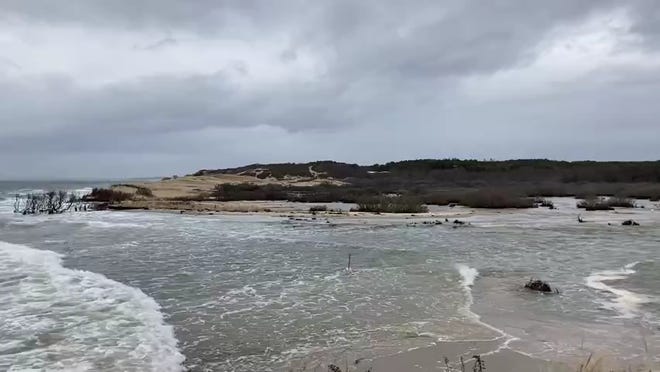
Holtec International, the company decommissioning Plymouth's Pilgrim Nuclear Power Station, has agreed not to release radioactive water from the plant into Cape Cod Bay until a third-party environmental expert weighs in.
Kris SinghPhD, president and CEO of Holtec, affirmed the company’s position in a Monday letter to Sen. Ed Markey, D-Mass., to withhold the discharge of one million gallons of water that was used to cool reactors and spent fuel rods when the plant was online.
This letter comes after a May 6 congressional subcommittee hearing held at Plymouth Town Hall by Markey, U.S. Rep. William Keating, D-Mass., and other state and local officials in response to Holtec’s plans to discharge the water.
Singh agreed at the hearing to withhold the discharge of the water until getting approval from governmental officials to do so. In his letter three days later, he also agreed to halt the entire decommissioning process if necessary until an expert weighs in.
“… we will voluntarily refrain from releasing processed water to the bay even if lawfully permitted by the Authorities (EPA and NRC) until the processed water discharge is confirmed by your expert’s determination to contain radiological levels low enough to ensure that the local marine life remains protected,” Singh wrote.
“The people have spoken, and Holtec International has finally listened,” Markey said in a statement in response to Singh’s letter. “It was a powerful victory in Friday’s hearing when Holtec International’s President Dr. Kris Singh committed to engaging with my office, the state of Massachusetts, union leaders, and local stakeholders in any decision-making around nuclear decommissioning.”
Antinuclear activists still have questions about Pilgrim
Despite those promises from Holtec, antinuclear activists on the Cape still have concerns.
Diane Turco, director of the nuclear watchdog group Cape Downwinders, said that after reading Singh's letter, she is hopeful that the expert — who must pass muster with Markey — is a step in the right direction, but she also fears that Holtec will essentially take the contaminated water at the plant hostage in the meantime.
"What Singh is saying is either they dump it or they do nothing," Turco said. "He tried to appear conciliatory (at the hearing) but he was really manipulating the situation. They're going to stop decommissioning and keep that water there until the decommissioning fund runs out, and then leave. And it'll be our problem."
Turco thinks there can be no opinion that deems the radioactive levels in the water safe enough for the bay.
The National Academy of Sciences determined there is no safe dose of radiation, she said, and the Environmental Protection Agency has said the goal for maximum levels of radiation in drinking water is zero.
"It's all about the money," Turco said, about the cost of removing the contaminated water from the power plant property.
Holtec's plans to take Pilgrim fuel rods to New Mexico
In his Monday letter to Markey, Singh noted his disappointment that Markey and Keating were reluctant at the May 6 hearing to speak about Holtec's plans for transferring Pilgrim's spent nuclear fuel to an underground storage facility in Lea and Eddy counties in southeast New Mexico.
Holtec, partnering with the Eddy-Lea Energy Alliance, proposed plans for HI-STORE CISF, a "consolidated interim storage facility," the first subterranean used fuel storage facility for U.S. nuclear plants.
Holtec applied for a license for the facility in 2017, which is projected to hold up to 10,000 dry storage casks in a rectangular area of 110 acres. The entire HI-STORE facility is estimated to take up 288 of the 1,045 acres owned by the Eddy-Lea Energy Alliance.
HI-STORE was proposed to be a temporary storage option for spent nuclear fuel, but as plans for a permanent repository in Yucca Mountain, Nevada, were halted by the Obama administration after a statewide outcry, critics fear the once-temporary site in New Mexico will become permanent.
This facility will have "zero environmental impact" on the proposed host site, according to Singh's Monday letter, due largely to an absence of pollution emitted by the facility and the proposed building's remote location.
Turco, who said Cape Downwinders has worked closely in the past with antinuclear activists in New Mexico, thinks Singh is purposefully misleading Markey with these claims.
The issues raised at the hearing concerned the plant's water discharging plans, whereas this facility in New Mexico would hold Pilgrim's spent fuel assemblies, not the water.
"It's another red herring from them," she said. "I mean, the wholestate (New Mexico) is against it."
In March of 2021, New Mexico Attorney General Hector Balderas filed a lawsuit against the U.S. Nuclear Regulatory Commission (NRC) on behalf of the state, alleging the NRC overstepped its jurisdiction in licensing the storage facility.
The original complaint cited in particular the costs of emergency preparedness and infrastructure improvements in the communities bordering the proposed railways shipping the spent fuel, as well as possible health risks associated with living near spent nuclear waste.
New Mexico state Sen. Jeff Steinborn, D-Las Cruces, took a stand against Holtec's plans for Lea and Eddy counties. In Jan. 2022, he filed Senate Bill 54 that would prohibit storing spent nuclear fuel and high-level waste in the state, citing public health and safety concerns.
"We're very concerned about transporting our waste to another community," Turco said. "We don't want it to go to New Mexico. We stand in solidarity with those folks."
'Joyful solidarity': Diane Turco's 40 years of Cape Cod activism
Sarah Carlon Cape Cod Times
Published May 9, 2022
It’s the late 1980s, and Diane Turco is back on trial in Connecticut for protesting the launch of a nuclear missile-wielding submarine at the Naval Submarine Base New London.
She couldn’t find a babysitter. Her 2-year-old son Justin is with her, and is doing what babies are prone to do — crying, and crying loudly.
“Will someone get that baby out of my courtroom?” Turco remembered the judge eventually demanding.
Turco held her son up high so the judge could see him.
“This is why I’m here,” she said. “It’s for my children, and for all other children, too.”
Turco, a Harwich resident, teacher, mother and activist, is no stranger to courtrooms.
She was inspired to begin her career of organizing after she heard a talk given by Dr. Helen Caldicott, an anti-nuclear advocate, in the early 1980s.
Early anti-nuclear efforts
The Nuclear Freeze Movement, a grass-roots effort in the 1980s for the governments of the U.S.S.R and the United States to agree to stop the testing, production and employment of nuclear weapons was just beginning.
Turco's daughter had just been born, she said, and she couldn’t stand the thought of living passively in the shadow of the then-operational Pilgrim Nuclear Power Plant.
“The highlight of Caldicott’s talk was that with the discovery of the atom bomb, it chipped away at the world, and it was up to us, it was kind of like mostly mothers, too, to stop the madness,” Turco said. “It’s a personal obligation to end nuclear weapons and nuclear power.”
The Pilgrim plant, which went online in 1972, is in the Manomet area of Plymouth, on Cape Cod Bay. It was built and operated by Boston Edison Co. until 1999, when it changed hands to Louisiana-based Entergy Corp.
In 2015, Entergy announced that the plant would be closed by June 1, 2019. The plant was then sold to Holtec International LLC in 2019 for decommissioning.
More:Cape town leaders oppose radioactive water release in Cape Cod Bay, in letters filed at hearing
When 35 Cape Codders helped block entrance to a weapons conference
After Caldicott’s talk, Turco cut her protesting teeth at a missile makers conference in Boston.
“There was a flyer that said more bombs for your buck,” she said. “And we thought, this is just horrible.”
Thirty-five activists from the Cape traveled to Boston on the day of the conference and blocked the entrance to the building. Everyone involved was arrested, including the band the protestors had hired for the occasion.
“I was a young mom, and we went down (to the city) with other mothers, and fathers and grandmothers,” Turco remembered. “But we were arrested and thrown into the police van, one woman was even injured (being) thrown into the van. And then we were in jail.”
Turco remembered the impression left on her by the experience, noting the bravery and intensity of people willing to block a weapons manufacturing conference.
“It was just these wonderful, lively people, and I don’t know, maybe it was the juxtaposition of the police dragging us, they were on their horses and it was kind of scary,” she said. “But I got to spend time with these really lovely people. I think about 150 people (who) were arrested that day, but 35 of us were from the Cape.”
She said when the protestors got in front of the judge, he let them off with a warning.
As the protestors were leaving the courthouse, however, the band hired for the protest began playing the spiritual “Down by the Riverside.”
“As we go around the building, we get to the bottom floor, we’re holding hands and dancing to the music," she said, "and the judge and court officers are upstairs tapping along, it was so cool.”
It was this missile makers conference that kicked off a more than 40-year career of organizing on the Cape and beyond for Turco, from issues of nuclear energy to anti-war efforts.
More:Cape activists continue to be inspired by King's example
The Harwich teacher can’t remember how many times she’s been arrested for the causes she’s passionate about.
'An act of faith'
“It’s an act of faith in our system when you stand up to it,” she said. “There’s definitely joyful solidarity when you are part of a protest.”
Turco has worked with many organizations across the country in the pursuit of a nuclear- and war-free future, including Cape Codders for Peace and Justice, Occupy-Cape Cod Hyannis and Cape Downwinders, a nuclear watchdog and advocacy group, where she is the director.
More:Hundreds of Pilgrim opponents question NRC
Mary Lampert, director of Pilgrim Watch, a public interest and safety group that focuses on the Pilgrim Nuclear Power Station, first met Turco at a 1988 New Year's Eve protest at the Pilgrim plant.
The plant had been offline since 1986 due to several mechanical difficulties, and despite pushback from local organizers and government officials including Gov. Michael Dukakis, Attorney General James Shannon and U.S. Sen. Edward Kennedy, the Nuclear Regulatory Commission (NRC) gave the plant the green light to reopen.
As operations began on that New Year's Eve, activists from across southeastern Massachusetts, including Turco and Lampert, gathered to rally against the reopening.
Lampert remembers herself, Turco and other women at the protest donning fur coats and pearls for the occasion. They were arrested for trespassing.
“When we were taken to jail, the warden was looking at us like, who are these ladies in their fur coats?” Lampert said.
She also talked of Turco’s importance to Pilgrim Watch and the anti-nuclear movement on the whole, as her organization focuses mainly on fact compilation rather than direct community outreach.
“If you’re community organizing, you need to have the facts, which is my and my husband’s specialty,” she said. “That’s where Diane comes in. If it’s not out in the public in a public-friendly manner, what good does it do?”
More:Activists mourn loss of 'quietest leader'
'Best organizer I've ever met'
“She’s the best organizer I’ve ever met, and that’s after working on these issues for many years,” Susan Carpenter, fellow Cape Downwinder and co-defendant in the infamous 2014 Grandmother’s Trial, said of Turco. “The way she thinks, she can get pictures in her head on what needs to get done and how to do it.”
Carpenter, Turco, and two other women, Mary Conathan and Sarah Thacher, all members of Cape Downwinders, stood trial in 2014 for trespassing on the Pilgrim Power Plant after a 2012 Mother’s Day protest. The women said they wanted to plant flowers on the property.
They took advantage of the moment. Caldicott testified on their behalf, citing the Fukushima-level threat the plant posed to Massachusetts, as well as the inherent dangers of nuclear energy.
The women were found guilty of trespassing, but weren’t sentenced to jail time.
“I was not comfortable, I’ve never been comfortable with public speaking, and I had a 30-year career in real estate at this point,” Mary Conathan said. “But we felt it so strongly. I look back and think it helped eventually close the plant.”
Conathan, who lived in Chatham at the time, said she watched a "60 Minutes" episode about the Fukushima nuclear disaster in Japan and started researching nuclear energy.
Her sister had just gotten involved with the Cape Downwinders and told her about the shelter-in-place order for the Cape in the event of a disaster at Pilgrim.
Chatham empty-nester joins cause
“I remember thinking, you’re kidding me,” she said. “So I called Diane and said, 'You know, my kids are out of the house,' I hadn’t remarried at that point, so I said I could give my time. She said that there was an event that weekend, and that was the beginning.”
The weekend event Turco mentioned was the 2012 Mother’s Day protest, and she remembers the moment she stepped over the no-trespassing line.
“I walked across the line, my sister looked at me and said are you sure, and I said 'Yes,' ” Conathan said.
“I basically hung out at Diane’s side,” she said. “I admire her to no end. She’s sacrificed for years for this. She’s the moving force, she’s the organizer, she’s the voice. I can’t tell you how fond I am of her.”
Conathan was with Turco when the two, along with Doug Long of Orleans, were arrested for a sit-in at Gov. Charlie Baker’s Boston office in 2016, urging him to close the plant.
“All of a sudden three of us were left,” Conathan said of the September 2016 sit-in. “They said, 'You know, if you don’t leave now we’re calling the police.' Diane looked at me and said, 'You can leave,' and I said, 'I’m not leaving you here.' ”
Conathan remembered being handcuffed and escorted out a back exit to avoid press attention and transported through Boston to jail.
“You know, I had never even had a rolling motor vehicle infraction at this point,” she said. “Diane has done this over and over and has found not only a calling, but a need for this work. She’s wonderful.”
More:Pilgrim opponents: 'We're sitting on a time bomb'
Turco’s organizing efforts don’t just stop with nuclear energy, however. Carpenter met her through Occupy-Cape Cod Hyannis, a movement that protested bank foreclosures on Cape homes. It was this meeting that convinced Carpenter to get involved with Cape Downwinders.
A voice against foreclosures
“At these meetings, they’d ask people to do things that no one raised their hand for, but Diane always did,” she said. “She’s just an impressive person.”
“We (Occupy-Cape Cod Hyannis) were a real grassroots, community-based push back against the capitalist system that kills their own,” Turco said. “The poor communities of Hyannis were the target of Bank of America, and that’s the truth.”
Turco was also one of the first to protest against the war in Afghanistan after the Sept. 11 terrorist attacks, an opinion that virtually no one in the country shared.
“I remember this one time there were just two of us standing in the town center in Harwich,” Turco said of her early antiwar efforts in 2002. “I held a sign that said ‘Today I weep for my country’ and a black veil like I was in mourning, because you know, I was.”
Her daughter Emily Turco, a third-grade teacher in Windsor, Conn., remembered a childhood full of protests, parades, marching and activism.
More:Anti-nuke activist and deputy police chief share award
“She’s such a great role model in her activism. I just remember her always making phone calls and connecting with people,” she said. “Never a dull moment, there was never a lull with so many issues going on.”
A mom's example
One of Emily Turco’s first memories of protesting was an antiwar rally outside then-Rep. William Delahunt’s Hyannis office with her mother. Diane would later stage another sit-in at Delahunt’s Boston office in 2008, which she was arrested for as well.
Emily Turco said her mother also organized several bus trips from the Cape to Washington D.C. for antiwar protests, and remembered tagging along with her mother for one trip in 2004.
Amazingly, to Emily Turco, who is a mother herself now, Diane Turco also made time for her family alongside her activism work.
“She made plenty of time for us when we were growing up, too,” she said. “I don’t know how she did it.”
Regardless, the exposure to activism had a positive effect on Emily Turco, who credits her mother with her interest in animal rights issues.
“Seeing her care so deeply, whether it be antiwar or anti-nuclear, left an impression, and it’s an incredible amount of work,” Emily Turco said. “She’s a leader. She inspires me.”
“I’ve been very fortunate that my husband Tom, and our children Justin and Emily fully supported me. They never complained when I was away,” Turco said.
While organizing against war and nuclear energy certainly feels like a full-time gig for Turco, during her 41 years of activism she was also a full-time special education teacher in Sandwich, Chatham and Harwich.
In 2015, Turco was awarded the Kathleen Roberts Creative Leadership Award from the Massachusetts Teachers Association.
Back in a Plymouth courtroom today
An injustice anywhere is an injustice everywhere for Turco, who credits her activist ethos to Martin Luther King Jr.'s 1963 “Letter from a Birmingham Jail.”
“That letter and the civil rights movement impacted how I interpreted citizenship,” she said in an email. "Particularly this part: 'Nonviolent direct action seeks to create such a crisis and establish such creative tension that a community that has consistently refused to negotiate is forced to confront the issue. It seeks so to dramatize the issue that it can no longer be ignored.'"
Turco is scheduled to be back in the Plymouth courthouse today on trespassing charges in relation to a 2018 incident at the plant.
She is looking forward to the trial, and hopes she can use it as an opportunity to get the word out about the dangers the power plant still poses to the Cape and the South Shore.
“The nuclear industry is killing our own, just like the tobacco industry did," she said. "They insist it’s safe and clean when it’s not. But I’m feeling positive about the trial. It’s about public health and the safety of the beautiful land of Cape Cod. That’s what it’s all about, to me.”
Cape town leaders oppose radioactive water release in Cape Cod Bay, in letters filed at hearing
Emergency legislation filed in January subject of April 12 joint judiciary committee hearing
Sarah Carlon Cape Cod Times
Published April 18, 2022
CONTINUED:
“The Massachusetts seafood industry generates over $800 million annually, and that is just ex-vessel, meaning for every dollar of that, there is another three or four dollars in retail profit,” Casoni said. “As a commercial fishing organization, it gives us great concern for the larger picture here.”
James Lampert, a lawyer and member of Pilgrim Watch, agreed with Turco and Casoni. He said Holtec has two other options when it comes to discharging the contaminated water: transporting it via truck to a US Ecology site in Idaho, similar to how the now-decommissioned Vermont Yankee plant dealt with its water waste, or evaporating the water at the plant itself.
“Holtec does not need to dump this water into the bay, they have at least two other options,” Lampert said. “But both options cost more than pumping it into the bay, but Holtec can afford it.”
Lampert did recommend, however, a change in the language of the bill. In his opinion many other businesses which also use radioactive materials and discharge them safely will see the legislation as being too broad.
“We should amend the bill to ‘intentionally’ discharging radioactive waste into a protected ocean sanctuary,” Lampert said. “That would address the real problem the commonwealth is facing.”
Here's what the bill says
“No person shall directly or indirectly deposit, dispose of, or discharge, any solid or liquid radioactive material directly or indirectly: (i) in any coastal or inland waters as defined in section 1 of Chapter 131, (ii) within the rise and fall of the tide waters, or (iii) on any land owned by any other person,” the bipartisan bill reads.
If passed, the legislation would make radioactive dumping an offense punishable by a fine no more than $10,000 for the first violation and no more than $25,000 for each subsequent violation. The bill would also make whomever discharges radioactive materials liable to the commonwealth for any “damages or losses incurred” by the dumping, and to any individual who has sustained damage or loss due to the dumping on their property.
Holtec’s response
Patrick O’Brien, a spokesman for Holtec, echoed Lampert’s point, in a Friday email, that the bill will not just impact the plant, but other businesses that discharge radioactive materials.
“The bill aimed to prevent liquid effluent (water discharge) releases, treated water within state and federal limits, is one that will potentially apply not only on Pilgrim, but will also affect municipal wastewater treatment facilities, like the Town of Plymouth who discharges into the bay, agriculture, medical facilities and septic systems, as all of those release low-level radioactive materials into the sanitary sewer or waterways in the Commonwealth of Massachusetts,” O'Brien said.
Cape town leaders oppose radioactive water release in Cape Cod Bay, in letters filed at hearing
Emergency legislation filed iaSarn January subject of April 12 joint judiciary committee hearing
Sarah Carlon Cape Cod Times
Published April 18, 2022
Lawmakers, environmentalists and Cape officials are rallying behind legislation that would permanently put the plug into a plan to dump one million gallons of treated radioactive wastewater from the now-closed Pilgrim Nuclear Power Station into Cape Cod Bay.
The bill was filed in response to a 2021 proposal by Holtec International— the company that bought the Plymouth plant from Entergy Corporation in 2019 to take over its decommissioning — to the Nuclear Regulatory Commission (NRC) to discharge the water.
On Tuesday, the Legislature's Joint Committee on the Judiciary heard testimony on the emergency legislation filed in January by state Sens. Susan Moran, D-Falmouth, and Julian Cyr, D-Truro. Sen. Patrick O’Connor, R-Weymouth, and Reps. Timothy Whelan, R-Brewster, Sarah Peake, D-Provincetown, and Patrick Joseph Kearney, D-Scituate, have since joined as co-sponsors.
The measure would prohibit the discharge of any solid or liquid radioactive material, directly or indirectly, into coastal or inland waters.
Tuesday’s testimony
In support of the bill, lawmakers heard people and groups from across the Cape and the South Shore, including Cape Downwinders, a nuclear watchdog group; Pilgrim Watch, a group focused on providing information and resources regarding the Pilgrim plant’s decommissioning; the Herring Pond Wampanoag and the Massachusetts Lobstermen’s Association.
Much of the testimony centered on fears about the environmental and health safety of the bay’s ecosystem and surrounding communities, the impact on South Shore and Cape real estate as well as the potentially devastating impact on Massachusetts’ fishing and seafood industries.
“This discharge as proposed could impact the commonwealth’s coast, particularly the southeast and Cape,” Moran said. “It will harm the commercial success of the shellfishing industry as well as our tourism economy, while making the coast increasingly vulnerable in the face of challenges relating to climate change.”
Moran said she had submitted written testimony as well, including letters from the select boards of Barnstable, Bourne, Dennis, Duxbury, Eastham, Mashpee, Orleans, Plymouth and Sandwich “strongly opposing" Holtec’s water discharge plan.
There’s also ambiguity as to whether the state can regulate the discharge of the water, she said.
According to Moran, the National Pollutant Discharge Elimination System is the state’s water discharge permit for the plant. While it regulates a number of pollutants, it does not regulate nuclear material.
Holding a water discharge permit from the state, then, could be approval enough even if toxic waste was in the water being discharged. While the NRC oversees radioactive waste, it is unlikely to intervene where the amount of radioactivity falls below federal standards, Moran said.
The bill, according to Moran, eliminates the ambiguity by prohibiting any discharge of radioactive waste into coastal waters, and provides a hefty fine for those who violate it.
“We cannot sit idly by and point fingers at who’s responsible, which permit gives authority,” she said. “We, as legislators, need to take the lead and say no.”
The fight against dumping started early
Protest against the proposal turned to alarm when U.S. Rep. William Keating told the Times that Holtec reported to the NRC not long after it put forth its proposal that it planned to begin discharging radioactive water within the first three months of 2022.
Swift backlash ensued, not just from South Shore and Cape communities but lawmakers as well—U.S. Sens. Edward Markey and Elizabeth Warren, and Keating and U.S. Rep. Seth Moulton, co-signed a letter in January urging Holtec to forgo discharging the nuclear wastewater.
For its part, Holtec, through a spokesman, said the company is committed to not discharging any treated wastewater for the rest of 2022, and is investigating alternatives. The spokesman said he expects by the third or fourth quarter of 2022 the company will announce its decision.
The water is mainly from the spent fuel pool and the reactor vessels, and acted as a place to cool the fuel rods and the insides of the reactors when the plant was in operation.
Known as "overboarding," discharging radioactive water is considered routine practice within the nuclear power industry. The water is filtered to reduce radioactivity to a level acceptable to regulators, and then can be released. It has been used at Pilgrim in the past, plant operators say.
There were objections to Holtec’s takeover of the plant’s decommission. When Entergy was in discussion with Holtec in 2019, some officials, including Keating, objected to the company, citing concerns over the $1.03 billion decommissioning trust being handed to a private company that had never decommissioned a nuclear power plant before.
Massachusetts Attorney General Maura Healey filed two petitions against the sale of the plant to Holtec, one in September 2019 and one in January 2020. By June 2020, however, the parties reached a settlement, which required Holtec to abide by stricter financial and environmental standards than federally recommended.
That settlement is partly why there was a significant outcry when it was reported that Holtec had received approval from the NRC to begin discharging the radioactive water, potentially going against the stringent radiological cleanup requirements outlined in the settlement.
An April 10 protest in Plymouth drew hundreds.
Community testimony on Tuesday
“Holtec claims that they will treat and clean the water but dismisses the reality that a dangerous radioactive nucleotide tritium cannot be separate from the water they prepare to dump,” Diane Turco, director of Cape Downwinders, told lawmakers. “There is no ‘safe’ dose (of radiation) besides zero that would not cause harm.”
Radioactive materials in the water, particularly tritium, will bind with sediments and grasses in the ecosystem and compound as it moves up the food chain, Turco said, resulting in higher and higher concentrations of potentially harmful radiation with consumption of seafood caught in the waters of the bay, she said.