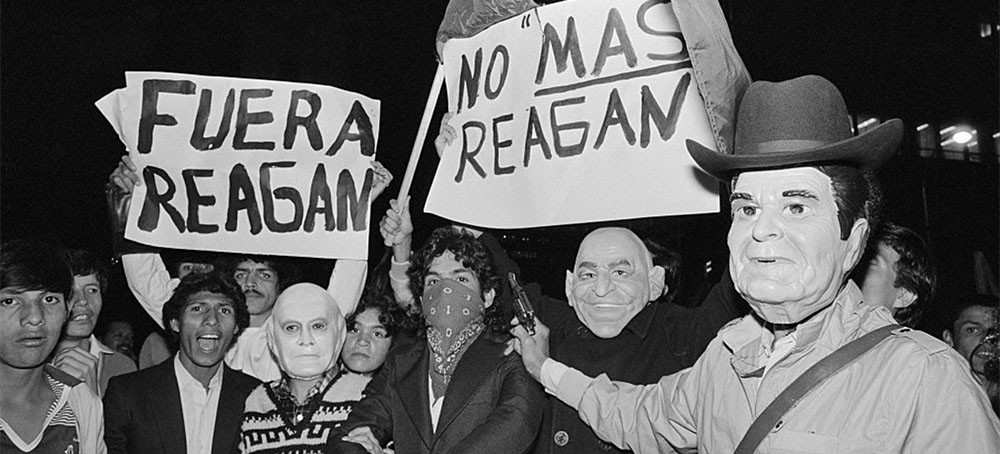
Following the Vietnam War, global progressive movements sought to refashion the world in the interests of the majority. The failure of this project, and the subsequent triumph of liberal interventionism, explains the arrogance of the US foreign policy elite.
One of the more fascinating things to emerge from the Ukraine crisis — which, at the time of writing, appears terrifyingly on the precipice of war — is the miraculous restoration of the Biden administration’s confidence in American democracy. Gone is the gnawing fear of “a dagger at the throat” of the republic, as the president had put it on January 6. Instead, we’re treated to praise of “the power, resilience, and universal appeal of our shared democratic values.” These, Biden confidently suggested on February 15, can be counted on to “prevail.”
Such confidence — in both the durability of the American system and its universal appeal — is, of course, essential. Without it, how can the United States courageously defend what secretary of state Antony Blinken has called “the basic principles that sustain [global] peace and security”?
Undoubtably, the prospect of Russian military forces in Kyiv is unthinkable. However, one need not believe that the world should simply acquiesce to Russian demands to be startled by the hubris of American diplomats running to the ramparts of “freedom” and “national sovereignty” so swiftly and with such self-assurance.
Given the disastrous course of the United States’ “war on terror” and its attendant neocolonial projects in Iraq and Afghanistan, how is it that the US government can so confidently proclaim its right and ability to shape the world? Didn’t American planes just leave Kabul in disgrace mere months ago? Did this not mandate some period of reflection — one that might, perhaps, recommend a slightly humbler approach to the crisis in Eastern Europe? These are, as a European war once again threatens the world, important questions.
“Lessons of Vietnam”
To answer them one needs to pull back the camera, move away from Eastern Europe, past the ignominious withdrawal from Afghanistan, before the destruction of Iraq, before even the first Gulf War, and refocus instead on that infamous, helicopter-topped roof in Saigon and the era surrounding it. For, unlike in recent decades, the disastrous US war in Vietnam was something the world, and many in the American public, were unwilling to forget without a reckoning.
Indeed, for a time, the “lessons” of Vietnam appeared to provide opportunities for progressive forces to dismantle, or at least trim down, the US national security state and undermine the assumptions of American exceptionalism that undergirded it. Even more significantly, it seemed to many in the Global South that America’s sins in Indochina might allow even more far-reaching reforms, fundamentally readjusting a global economic system structured to keep much of the “Third World” in poverty.
Given that no such era of accounting has truly followed the wars in Iraq and Afghanistan, this earlier period, running roughly from the late 1960s to the early 1980s, looks even more remarkable now. Understanding why it came to an end, and in what way, is critical to understanding the present.
That the US war in Vietnam was a disaster was apparent long before that final helicopter lifted off in 1975. Some were so confident in catastrophe that they projected it decades beforehand. Graham Greene’s The Quiet American, for example, was already predicting a handover of the imperial torch from France to the United States, and American failure, in 1955.
Meanwhile, if one of the war’s key architects — Secretary of Defense Robert McNamara — is to be believed, even those who launched the Vietnam “surge” in 1964 (to borrow the contemporary term) felt deep down that it was doomed. Public optimism and private desperation were the order of the day in Lyndon Johnson’s White House.
Beyond these early confrontations with fate, by early 1968 it had become clear to most Americans that the war in Vietnam was a mistake — one, if not doomed to outright failure, was certainly set for some unhappy conclusion. Neither candidate in the 1968 presidential election campaigned on a pledge of victory in Vietnam: both Richard M. Nixon and Hubert Humphrey promised vague forms of peace — “with honor” as Nixon put it. Each was clearly offering something less than the “flag planted on Mount Suribachi” surrender to which Americans were accustomed. Walter Cronkite famously declared the war a “stalemate” in February — by which point near thirty thousand Americans and hundreds of thousands of Vietnamese lives had been lost.
There was also a clear perception by the political class of what the war had cost the United States abroad: nothing other than the very credibility which, in pursuing conflict in Indochina, it had sought to preserve. Candidate Nixon had summed up the situation in a 1967 speech: “Twenty years ago . . . we were respected throughout the world. Today, hardly a day goes by when our flag is not spit upon, a library burned, an embassy stoned.”
Nixon thus entered office a card-carrying member of the “lessons of Vietnam” club. The war had to continue, he believed, for an immediate, ugly withdrawal would be bad for the United States and — more importantly — for the new president’s chances at reelection.
This, however, didn’t mean that policy couldn’t be adjusted to avoid any repeats. Hence the Nixon Doctrine, a 1969 announcement that the global order outside Europe and Japan would no longer be a direct American responsibility. The United States might bankroll those willing to fight communism and other threats, but would never again commit its own troops.
The End of American Hegemony?
Dumped along with US military intervention was an earlier American commitment to modernization and development. Such programs, like John F. Kennedy’s Alliance for Progress in Latin America, were intended to bring US cash and expertise to bear on slow economic growth rates in the decolonizing world. Hardly altruistic — battling the Soviet Union in the Cold War seemed to require the US to find and “modernize” clients in the Global South — development goals and military intervention had merged into a neocolonial nightmare in South Vietnam, not to be repeated.
To many in the Global South, however, the idea that the United States had ever been doing more than advancing its own interests was somewhat ridiculous. Policymakers, intellectuals, activists, and others from across Latin America, Africa, and Asia had been articulating such a critique for decades. Vietnam merely revealed what they had already been saying: the US-led “free world” was no more than European imperialism in another form.
Key to this was “dependency theory,” an analysis of global economic patterns that originated in the thought of two economists, the Argentine Raul Prebisch and the West German Hans Singer. Though it takes many forms, dependency theory, at root, points out that trade between industrial and nonindustrial economies is unfair over the long term. While the price of finished industrial goods remains robust, the value of commodities or raw materials — the staple product of the nonindustrial nations of the Global South — inevitably declines.
Thus, US-backed international trade institutions, which operated on the assumption that all states trade on fundamentally equal terms, were hiding the deep imbalance between Global North and South, one deliberately cultivated by imperial systems over the previous four centuries. This, combined with the overwhelming dominance of US and European capital, revealed the US-led international economic system as one that, far from offering membership on equal terms, was perpetuating existing hierarchies of wealth and power.
This critique, advanced with more force each year in the United Nations General Assembly, landed at the precise moment that the United States appeared to be unravelling under the pressures of Vietnam, conservative revanchism over the results of the Civil Rights Movement, and revelations of presidential malfeasance. Despite their promises to learn the lessons of Vietnam, Nixon and Henry Kissinger continued the war, further wrenching the nation.
As it continued, so did the blows to Americans’ confidence in their system, their government, and their nation’s role in the world. Out came the “Pentagon Papers,” which revealed in plain text that American leaders from the president on down had been lying about Vietnam since the mid-1950s. Every assertion that the war was almost over, that South Vietnam was almost ready to stand on its own feet, was contrary to the evidence on the ground, and everyone in the executive branch knew it. The Watergate scandal merely confirmed the depths to which American politicians were willing to sink to maintain power and influence.
Suddenly it seemed that the critics had traction. Congress soon wrestled back some of the power to make war through the 1973 War Powers Act. The Church and Pike committees explored and revealed the misdeeds of American intelligence services. In New York, an increasingly anti-American United Nations General Assembly passed resolution after resolution condemning the American-led world order. This culminated in 1974 with the Declaration for the Establishment of a New International Economic Order, a plan for a global system of developmental capitalism based in a recognition of the sovereignty of nations in the Global South.
The Right in Resurgence
“We are a minority,” lamented future UN ambassador and senator Daniel Patrick Moynihan in 1975. “We are outvoted.” The success of the 1973 OPEC oil embargo against the United States, and the possibility of Third World states organizing similar commodity cartels, gave such proposals a hint of real teeth. It was, for a time, dangerous to speak incautiously before a global audience about the universal appeal of American institutions.
Such was the moment, in fact, that in the 1976 presidential election, both major party candidates — Republican Gerald Ford and Democrat Jimmy Carter — ran on foreign policies that called, in varying degrees, for restraint, absorbing the lessons of Vietnam and even acknowledging the Global South’s critique of world capitalism.
Carter especially wanted to see the United States make efforts to accommodate its critics in the UN; perhaps, given what had happened in Southeast Asia, it was time for the United States to adjust its approach to international affairs, to take criticism from the outside seriously. Shockingly enough, it was Carter who won, promptly appointing Andrew Young, the Civil Rights Movement veteran, UN ambassador while seriously exploring a global commodity agreement, the Common Fund, to stabilize the terms of world trade.
Yet just as quickly, the moment passed. The national security state endured. American exceptionalism revived. By the end of his term, Carter himself rediscovered military intervention, committing to covert action in Africa and Afghanistan. Essential to this process was a successful campaign by the US right to vilify the nation’s critics in the Global South as something akin to the “undeserving poor” — a vast region of hostile, illegitimate, and illiberal regimes looking to shake down the developed world.
Beginning with Moynihan’s time as UN ambassador — “giving them hell at the UN,” as Time magazine called it — and continuing after Ronald Reagan’s election in 1980, Americans recommitted themselves to exceptionalism. The Soviet Union, UN critics, the domestic left, and anti-internationalist right — anyone who attempted to critique the United States — revealed themselves as cowards or crooks — the “blame America first” crowd, as UN ambassador Jeane Kirkpatrick labeled them in 1984.
By this point, US policymakers and international financial institution bureaucrats were once again comfortable speaking of the universal applicability of US models — encouraging the Global South to pick itself up by its bootstraps, cut government spending, and open itself to outside trade and capital. Such “structural adjustment” programs — combined with falling commodity prices — blunted the radical edge of the Third World movement in the United Nations.
When communism collapsed in Eastern Europe and the Soviet Union later that decade, there was nobody left, at home or abroad, to mount any serious challenge, or indeed even question the new neoliberal economic orthodoxy that swept the world.
Few too were left to question the eastward expansion of NATO during the 1990s. It is the victory of the right wing of America’s foreign policy establishment that explains its dogmatic support for liberal interventionism. Ironically, the United States and Russia now agree on much more than they ever did during the Cold War. Neither questions the prevailing neoliberal order and its distribution of wealth. Russian influence over Ukraine, something taken for granted in the twentieth century, is the new sticking point. It’s not only Russian history that provides the answer as to why.
Two million Californians experienced rolling blackouts Friday night after officials declared a Stage 3 energy emergency due to a statewide heat wave. The last time California was in a Stage 3 emergency was in 2001. At that time, the state was in the middle of a very different type of energy crisis – and the governor lost his job over it. The current power outages are the latest example of how climate change and the extreme weather it triggers take a profound toll on electrical grids.
If you think the contents of this news letter are critical for the dignified living and survival of humanity and other species on earth, please forward it to your friends and spread the word. It's time for humanity to come together as one family! You can subscribe to our news letter here http://www.countercurrents.org/news-letter/.
Two million Californians experienced rolling blackouts Friday night after officials declared a Stage 3 energy emergency due to a statewide heat wave. The last time California was in a Stage 3 emergency was in 2001. At that time, the state was in the middle of a very different type of energy crisis – and the governor lost his job over it. The current power outages are the latest example of how climate change and the extreme weather it triggers take a profound toll on electrical grids.
Two million Californians experienced rolling blackouts Friday night after officials declared a Stage 3 energy emergency due to a statewide heat wave. The last time California was in a Stage 3 emergency was in 2001. At that time, the state was in the middle of a very different type of energy crisis – and the governor lost his job over it.
The current power outages are the latest example of how climate change and the extreme weather it triggers take a profound toll on electrical grids.
Just days ago, millions of people lost power in U.S. Midwest after a wall of lightning, hail and deadly winds tore a path of ruin from central Iowa to Chicago.
Before that, Tropical Storm Isaias darkened homes from the Carolinas to Connecticut.
An AP report from San Francisco said:
California’s utilities on Saturday night were bringing back power to thousands of customers across the state, according to the authority that operates the power grid.
The California Independent System Operator (California ISO), which runs the state’s grid, said in a statement that the brief rolling blackouts throughout the state were caused by the failure of a power plant and the loss of wind power.
California ISO said it ordered the end of rolling blackouts about 6:48 p.m., when wind power increased.
The restoration of service by the utilities come as a heat wave baking California in triple-digit temperatures continued to strain the electrical system.
California ISO ordered the first rolling outages in nearly 20 years on Friday when it directed utilities around the state to shed their power loads.
The state’s three biggest utilities — Pacific Gas & Electric, Southern California Edison and San Diego Gas and Electric — turned off power to more than 410,000 homes and businesses for about an hour at a time until the emergency declaration ended 3 1/2 hours later.
The move came as temperatures around the state hit triple digits in many areas, and air conditioning use soared.
The power grid is mostly stressed during the late afternoon and early evening because of higher demand and solar energy production falling. The state tried to prepare for the expected rise in electricity use by urging conservation and trying to buy more power. But a high-pressure system building over Western states meant there was less available.
Raw sewage into a waterway
A power outage caused a pump to fail at a wastewater treatment plant in Oakland, resulting in a sewer backup and the release of some 50,000 gallons of raw sewage into a waterway, the East Bay Municipal Utility District said.
The district said the outage began around 5 p.m. Friday, more than an hour before the rolling outages occurred, and sewage began to spill early Saturday. The agency said the sudden outage affected its ability to connect to backup power at the plant and during that time, workers were dealing with flooding while trying to restore power.
The state remained gripped by the heat wave Saturday, with several records either tied or broken, according to the National Weather Service.
The last time the state ordered rolling outages was during an energy crisis in 2001. Blackouts occurred several times from January to May, including one that affected more than 1.5 million customers. The cause was a combination of energy shortages and market manipulation by energy wholesalers, infamously including Enron Corp. that drove up prices by withholding supplies. During the electricity crisis of 2000 and 2001, hundreds of thousands of homes and businesses took turns going dark, power prices surged to a record and the state’s largest utility was forced into bankruptcy.
Counties up and down the state reported scattered outages, although the city of Los Angeles, which has its own power generating system, was not affected.
The heat wave brought brutally high temperatures, increased wildfire danger and fears of coronavirus spread as people flock to beaches and parks for relief.
A thunderstorm rolling from the Central Coast to inland Southern California also brought dry lightning that sparked several small blazes, wind and flash flooding in the high desert.
Records were set in Lake Elsinore, where the mercury hit 114; Riverside at 109 and Gilroy at 108, according to the National Weather Service. The high in Borrego Springs, in the desert northeast of San Diego, was 118. Coastal cities such as San Francisco and Los Angeles sweltered in 86 and 98 degrees, respectively.
Several cities opened cooling centers, but with limited capacity because of social distancing requirements.
San Francisco’s Department of Emergency Management issued simultaneous tweets urging residents to prepare for power outages and to protect themselves from the coronavirus during the heat wave.
The scorching temperatures are a concern for firefighters battling blazes that have destroyed several homes and erupted near rural and urban foothill neighborhoods, driving through tinder-dry brush.
In addition to the possibility of heat stroke and other hot-weather illnesses, health officers were concerned that people will pack beaches, lakes and other recreation areas without following mask and social distancing orders — a major concern in the state that has seen more than 613,000 coronavirus cases.
Hottest two weeks in 70 years
Other media reports said:
For California, the problem is heat. An unrelenting high-pressure system is pushing temperatures upward, leaving the region facing what is expected to be its hottest two weeks in 70 years. That is driving up power demand to extreme levels, making it hard for generating plants to keep pace.
The California ISO had announced late Saturday afternoon that blackouts were not needed. Then the system unexpectedly lost generation, and it become clear it could not meet demand, said Anne Gonzales, a spokeswoman for the California ISO said in an interview.
The grid operator said it the emergency was declared at 6:28 p.m. local time following an unexpected loss of a 470-megawatt power plant, and 1,000 megawatt of wind power. The order ended 20 minutes later as wind resources increased, it added.
The state’s largest utility, PG&E Corp., said about 220,000 customers in portions of the Central Coast and Central Valley, including Monterey, Santa Cruz and San Joaquin counties were affected. Edison International’s Southern California Edison utility said about 70,000 customers were impacted in the short-lived event.
“At 6:28 p.m., we dropped load, we de-energized about 70,000 customers, then we were directed by CAISO to restore them by 6:44 p.m.,” Southern California Edison spokesman Robert Villegas said in a phone interview.
Sempra Energy’s San Diego Gas & Electric utility said shutoffs were “widespread” across its territory in San Diego and southern Orange counties, though customers who had their power cut on Friday night were not impacted Saturday. Power was fully restored as of 6:55 p.m., it said.
On Friday, the state’s grid operator ordered blackouts after a 500-megawatt generator tripped offline unexpectedly while a 750-megawatt unit was already down. If both had been in service, grid operators would not have had to call for outages, Gonzales said.
Widespread Heat,world’s second-hottest July
Regions around the world have been grappling with extreme heat, including parts of Europe and the eastern U.S., where temperatures last month were expected to set records for New York and Boston.
Last month was tied for the world’s second-hottest July on record and the hottest ever in the northern hemisphere, according to the National Oceanic and Atmospheric Administration. But few authorities, if any, resorted to rotating outages.
In addition to mass blackouts to protect the grid, a prolonged hot spell could trigger scattered outages as aging utility equipment fails in the heat. Transformers – the metal cylinders sitting atop power poles – can break down and even catch fire if they cannot cool off at night. During a 10-day heatwave in 2006, California utilities lost more than 1,500 of the devices, with each knocking out one neighborhood in the process.
California ISO spokeswoman Anne Gonzales said: “We’re dealing with weather, clouds, wildfires … these are quickly evolving situations, quickly changing.”
A Bloomberg report on August 15, 2020 said:
As many as two million Californians were plunged into darkness over the course of four hours late Friday in the first rolling blackouts to hit the state since the 2001 energy crisis.
And that was only Day One.
It started at about 6:30 p.m. local time on Friday, when California’s grid operator determined through a complex calculation that the state’s power reserves had fallen below a critical threshold and called a Stage 3 grid emergency, which triggers what it describes as “load interruption.”
Electricity prices have already hit two-year highs as weather forecasters called for extreme temperatures. Spot power prices surged past $1,000 a megawatt-hour across California on Friday evening. Natural gas prices in Southern California more than doubled on the increased need for the fuel for power production, according to report from BloombergNEF.
Grid operators will continue to monitor the situation throughout the weekend and into next week, Gonzales said. The odds of rolling outages on Saturday and Sunday might prove lower as demand is typically weaker outside of work hours. Asked whether the California ISO will need to call for additional power shutoffs, she said: “We don’t expect one, but we are prepared for one.”
Another media report said:
An excessive heat watch reaches from Oregon to Arizona, covering a large part of central and coastal California, according to the National Weather Service.
Jim Rouiller, lead meteorologist with the Energy Weather Group, said: “All the major urban centers in California are going to have intense heat wave conditions unabated right through the weekend into next week.”
The heat is being pushed along by the Sonoran High, a dome of high pressure across the Southwest that is keeping temperatures hot and preventing the cooling effects of the regional monsoon to take hold, Rouiller said.
More than 76% of the 11 western states is abnormally dry and drought covers more than 62% of the region, according to the U.S. Drought Monitor.
Several newspapers have struck a hyper-nationalist tone while covering Prime Minister Narendra Modi’s address to the nation on the
occasion of the 74th Independence Day. The highlights of his speech, in the media’s coverage, were his “fitting” reply to “trickster” (chalbaaz) China and warning to Pakistan.
It is true that the ideology of extremely inhumanistic Brahminism(Manuvad) cannot be compared with an ideology like Communism. But after watching the current situation, doesn’t it seem that India has become the Animal Farm of Hindutva? The answer depends on which way you choose to see yourself, what government wants you to see or what the data shows.
Dyed-in-the-wool patriots know that the United States of America is God’s gift to the world. Policymakers have risen the story to doctrinal status. It’s referred to as American
Exceptionalism, and it basically means if we say it or do it, it’s ok.
Dyed-in-the-wool patriots know that the United States of America is God’s gift to the world. Policymakers have risen the story to doctrinal status. It’s referred to as American Exceptionalism, and it basically means if we say it or do it, it’s ok.
It’s a nice thing to be backed up with this doctrine when you have ambitious plans for the rest of the world. And nobody else has it. Only the United States of America. In fact, the rest of the world can’t even imagine having a doctrine like it, but it doesn’t doubt that we act like we have it.
Is there a plausible explanation for this widely asserted doctrine? In other words, taken seriously as an idea, what, in the American historical experience, as distinguished from that of other states, could account for this difference?*
The argument in support begins with the country’s founding documents and the beautiful ideals expressed in them. Much effort has been put into the manufacture of a steady, upward national trajectory from these revolutionary ideals, thereby idealizing the present as well.
The explanatory power in this case is limited in that it can only account for things that do not contradict the story it is attempting to prove. This is bound to be unsatisfying for anyone investigating the links from past to present who finds a great deal of contradiction. An opposing view to the utilitarian version that is sold to Americans can be argued from the same standpoint, that of American Exceptionalism, to yield a non-utilitarian version with historical relevance.
What makes us exceptional, and what has it led to? The United States is the only western country where slavery was legal from the day it was founded. The U.S. republic was founded in 1776, with legal slavery. As just one alternate example, the French republic was founded in 1789, the same historical era as the U.S., but without legal slavery. After more than 200 years of evolution, the two states are quite different. In two areas of public policy, France has federal universal health care, a legal communist party, the Parti Communist Francaise, and a large, and at least until the 1990’s, communist industrial union, the Confédération Générale du Travail.*
As an example of how slavery, as a historical experience, may affect the evolution of a state, we can cite the absence of universal medical care in the United States.*
In slavery, the slave is the property of the owner and the maintenance of the slave, as property, is the responsibility of the owner and, specifically, not the state. In the evolution of such a state away from slavery, where the slave evolves into an employee and the slave owner into an employer, the slave owner’s provision of medical care to slaves would naturally evolve into the employer providing medical care as a fringe benefit to employees. In such a state, evolved from slavery, it would be alien for the state to provide universal medical care to its citizens.*
Another U.S. historical experience which can be traced to its evolution from slavery is the violent U.S. reaction to communism. The slave era analogue would be the slave owner’s violent reaction to the pre-Civil War abolition movement.*
Going on, the slave owner had to be deeply suspicious of the slave because of the natural resistance toward being a captive. Escape was always a possibility. Group activity was especially suspicious as it might signal rebellion. Slaves either accepted their complete subordination to the master or were dealt harsh punishment. Since they were worth more alive than dead, beatings had to be administered with cost in mind.
With the end of legal slavery, the legal control and punishment of the former slave population was passed onto local, state, and federal enforcement agencies. The evolution of this is an outsized criminal system (by far the world’s largest) notoriously known for incarcerating a strikingly large number of black prisoners. In a bizarre echo of the past, it is economically more sound to keep these prisoners alive than to execute them.
The slavery experience was not one of shared economic interest. To a black under slavery, there was no economic interest outside of the tightly controlled owner/slave relationship. The owner’s economy was the slave’s economy. Any question of “economic interest” belonged strictly to the owner.
In transitioning from an owner/slave relationship to an employer/employee relationship, the employer takes on the role of the owner in regard to the economic interest of the employee. Is it inexplicable why so many people vote against their economic interest? Not if it’s seen as today’s capitalists enjoying the same mastery over the economic system that former slave owners once enjoyed. The modern wage earner in the U.S. has been conditioned to accept the pay grade and to let economics run as a matter of course. Today’s wage earner has no economic interest…not that they can see.
By having chosen as a starting point the same year, 1776, but instead of building from a set of professed ideals incorporated in founding documents we build out from the corporeal reality of a slave nation, a different trajectory emerges and American Exceptionalism is turned on its head.
What country would dare birth itself in language unsoothing to the ear? Better to watch what it does. And by choosing another year, 1945, a chance emerges.
In that year, the United States again marks itself as the exception among nations in that it becomes the only country to ever drop atomic bombs on cities full of people. Hiroshima and Nagasaki provided the experimental proof of what the blasts’ initial heat output — hotter than the surface of the sun — could do to a city and its inhabitants, while the Soviet Union learned the lengths a country could go to when it no longer felt obliged to have “a decent respect to the opinions of mankind”. Winston Churchill was so moved by the weapon’s tangible display that he suggested dropping one on the Kremlin.
How has this exceptional national experience affected the evolution of the United States in its foreign policy, and how does it differ from countries that have never dropped atomic bombs on cities?
As a result of their defeat, Japan adopted a pacifist constitution and Germany enacted very liberal asylum laws. The United States went on to develop more atomic bombs. It is a matter of U.S. state policy to keep the nuclear threat alive in all disputes. No other nuclear capable state threatens their offensive use.
As a result of its established military superiority, the United States expanded its base footprint. Today it has overseas military bases in every country that it commands, around 800 in 80 countries, comprising 90-95% of the world’s foreign military bases. Put another way, the U.S. total of overseas bases is 9-19 times more than all the rest of the world’s countries combined.
The Soviet Union, the country that played the greatest role in the defeat of Nazi Germany, didn’t make it into the 21st century. With no more rivals in sight, the United States pushed the NATO bloc steadily east toward Russia. Now, with a real chance at world domination, peaceful coexistence and cooperation was not an option. Throughout all the post WW2 years, the foreign invasions and interventions never ceased, from Korea and Vietnam to Iraq, Libya and Syria.
The U.S. is no longer restrained by international laws and conventions or, for that matter, even U.S. law. Having put idealistic notions aside, the world is what the United States says it is. Indefinite detention is what it says it is. Torture is what it says it is. And planning, initiating, and waging a war of aggression against a sovereign nation is what it says it is.
The Declaration of Independence held certain truths to be self-evident. Truth, as a concept, is an intellectual tool useful in winning arguments, and this is how it is used in the Declaration.
As seen from the perspective of a state evolved from strict power concepts, truth is the weapon of the weak. This explains why purveyors of American Exceptionalism have no need to resort to it.
(Note) *These five paragraphs are taken from a private communication with Otto Hinckelmann (otto5.com) that provided the concept for the essay. The author’s contribution is one of embellishment.
James Rothenberg writes on U.S. social and foreign policy.
In view of the prevalent political deadlock, growth-oriented economic development, or growth-without-development – which is simultaneously stagnating and misleading due to inflated GDP growth estimate by the Government – and the absence of the rule of law and accountability of the government, especially since 2007, Bangladesh finds itself in a political cul-de-sac. Why so?
In the words of JL Nehru, “Kashmir is not commodity for sale or to be bartered. It has an individual existence and its people must be the final arbiters of their future”.
When The PM’s Rama Is Different From That Of RSS/BJP
Prime Minister Narendra Modi, not just in his personal capacity, but in his capacity as the Prime Minister of 130 crore Indians quite unexpectedly re-defined Rama totally in a different way than how the RSS/BJP have shown him to us for the last thirty years since 1989. He did that at Ayodhya and at the Ramajanma Bhoomi temple Bhoomi poojan on 5 October 2020. Hence it has great historical significance .
lockdown kicked in March, Bangalore and most other cities in India witnessed an exodus of migrant workers returning to their homes in northern and eastern India, by every conceivable means including by cycle and by walking, with women carrying their small children. But there were some people who could not even leave, because they were not migrant labourers but the traditional, partly itinerant folk artists from Rajasthan, who are found in most cities, enlivening the weddings and other festive occasions with their dhols (traditional drums), their puppet shows, stilt walking.
Anti-Racist Uprising In Minneapolis Infiltrated By Extreme-Right Hooligans
The city of Minneapolis is where it all began. It is where the last drop fell on the surface of a proverbial overflowing lake, causing the dam to burst, consequently starting to destroy the foundations of
the empire.
George Floyd murder site
Text and photos: Andre Vltchek
(Reportage from Minneapolis)
The city of Minneapolis is where it all began. It is where the last drop fell on the surface of a proverbial overflowing lake, causing the dam to burst, consequently starting to destroy the foundations of the empire.
A death of just one single man can, under certain dreadful circumstances, put into motion the entire avalanche of events. It can smash the whole regime into pieces. It can fully rewrite history, and even change the identity of a nation. It can… although it not always does.
George Floyd’s death became a spark. The city of Minneapolis is where the murder occurred, and where the ethnic minorities rose in rage.
But it is also where white extreme right-wing criminals, and some even say, entire regime, perpetrated the uprising, kidnapped what could have become a true revolution and began choking legitimate rebellion by a stained duvet of nihilism and confusion.
Here, we will not speculate. We will not point fingers at “deep state” or some multi-billionaire families, and to what extent they have been involved. Let others do this if they know details. But this time, I simply came to listen. And to pass to the world what I discovered first hand and what I was told.
This time I simply went to Franklin Avenue and Lake Street, both in Minneapolis.
I spoke to Native American people there. To those who joined forces with the African-American community during those dangerous days after May 25, 2020. To people who dared to defend their neighborhoods against brutality against white gangs, which came to loot, infiltrate, and derail the most powerful uprising in the United States in modern history.
*
Anti-racist art at Lake Street, Minneapolis
Bob Rice is a Native American owner of Pow Wow Grounds, a local entrepreneur, and a ‘community protection organizer.’ His legendary café is located on Franklin Avenue. During the COVID-19 pandemic, it has been reduced, for the time being, to a takeaway business, but even as such, it is enormously popular among the Native Americans, as well as others.
At the back of the cafe is huge storage, full of food. Everyone hungry, in need of help, can simply come here and take whatever he or she needs.
We grab some freshly brewed coffee from the shop and take it out to the public benches outside.
Bob Rice then begins his story:
“There has been police brutality for a very long time, against people of color. Not only talking about Minneapolis but in all these other places, since the 1991 Rodney King incident. Things were boiling and building up – leading to a big blow up.”
“And all this discrimination did not start here; it came centuries ago from Europe.”
“After the George Floyd murder, I wanted to show solidarity. Native Americans were experiencing an even higher degree of persecution than Black people. We had to stand together. I went down to the site of the murder of George Floyd, in order to support protests.”
For a while, we talked about the mass media in the United States, an official and even some ‘independent one,’ and how it quickly and violently turned against the left, as well as against those who have been daring to expose endemic racism in the United States.
But soon, we returned to the events that took place here, in May and June.
“I noticed the presence of strange elements right from the start. I was watching guys breaking windows. At about 6 am, the morning after, I traveled down to South Minneapolis. There were piles of rocks in front of the rioters. Flash hand grenades. I kept on moving around the areas and kept on seeing rocks. I noticed the Minneapolis Umbrella Man, dressed all in black, with mask and black umbrella and black hammer smashing things – at the end being stopped by black guys. People were walking out of the store with car parts, and I thought, “why stealing those things”? These guys didn’t seem to be as part of the protest. I started moving and going away from the area, thinking that these guys would burn down stores and places soon. I even called up my insurance company the following morning to see if my policy covers civil unrest. That night they burned a lot of stores – auto stores, liquor stores, all types of businesses. I thought that if we do not do something ourselves to protect our neighborhoods, they will burn down all of our areas, too.”
“From what I saw, I couldn’t tell you who these guys were, but they were not from here.
So, we put up our protection zone calling out people on Facebook. We became the Headquarters of protection of Native American businesses and nonprofit organizations, as well as banks, shops, investment properties, etc. all belonging to the Native American community around here.
I noticed there were Caucasian people, driving cars very slowly with no license plates, yelling racial slurs out of the windows. We formed a human shield, chain, along Franklin Avenue, to protect ourselves and our people.
At a high point, about 300 people were protecting the area all night long for about eight days in a row. It had to be done, because here we had people from all over, including Wisconsin, descending on us – we had white supremacist group Proud Boys here. They arrived wearing masks. We had young white kids – 16 and 17 years old – coming from Wisconsin, looting liquor stores. We caught them. Obviously, they came out here because they thought it was an exciting thing to do. They didn’t even know where they were – this area is very dangerous with drug dealing and gang violence at night. Lucky, they got caught by us.”
And the coverage? I wanted to know whether these events, in the heart of Native American neighborhoods, were described in depth by media reports.
Bob Rice replied readily:
There was no media reporting on these matters – mass media blamed everything on the Black Lives Matter movement.
When liquor stores and tobacco shops were on fire, no police or fire trucks were around. Then the National Guard took over – using tear gas.
Mr. Rice sighed, still in disbelief:
Just incredible how our so-called President has done all the mess going and even made it worse!”
*
Robert Pilot, Native Roots Radio host, drove me for days all around the cities of Minneapolis and St. Paul, explaining what really took place on both Franklin Avenue and Lake Street.
But before, we visited provisory, impromptu monument, where the murder of George Floyd took place. There were flowers, graffiti, works of art; there was grief, and there was solidarity. Native American people clearly supported the plight of the African-Americans.
The area was safe; it was well organized. People of all races came here to pay tribute to the murdered man, and centuries of atrocious history of the United States.
As we drove, Robert Pilot explained:
“Native American neighborhoods armed themselves after the Floyd murder. But not only that: economic hardships ensued after the murder; food banks have come up. The Pow Wow Grounds used to be a food distribution deport but ended up becoming a food bank for anyone to donate and get what they need.
Protesters were everywhere; the young generation got fed up. So different from other murders. The last straw was the murder of George Floyd. Four years earlier, in 2016, Philando Castile, an African American man, got murdered by police. He had worked in a school cafeteria. His murder was broadcast live on Facebook. It was a buildup. 10,000 people protested on 38th Street and Chicago in Minneapolis – the site of the murder of George Floyd. Combination of racial and overall frustration.”
We drove by burned stores, services, gas stations. Everything was resembling a war zone, and in a way, it was.
After looting on Lake Street, Minneapolis
If you are there, things are extremely raw, emotional. It is not like analyzing things from a distance from the comfort of one’s home.
Robert continued explaining, as we drove by block after block of the Middle East-style combat destruction:
“There is a small percentage of African American people as compared to White Americans. We need allies, too. We have to support each other. Signs everywhere in my neighborhood, ‘Black Lives Matter.’”
“Some young white people have woken up. They see the truth. The opinion of the masses is moving to the left; they are feeling fed up with what is happening around them and what it is that the country is doing to the world because of oil.
What is interesting is that there is a protest every single day, which is something new and mind-blowing. The media is misreporting, minimizing the enormity and magnitude of protests, CNN, MSNBC, etc.”
Robert Pilot is not only a radio host, but he is also a teacher:
“White teachers are still teaching history; they are teaching it to black and Native American kids! Political standing of my students – a few are engaged, but definitely not all. Perhaps 10 percent of people are engaged and doing the work for 90 percent.
The white guilt now and then… But many of us feel: You should stand behind us and with us but not in front of us. Revolution is happening in that sense. Everything is changing since protests are happening.”
Not everyone likes the changes; definitely not everyone. The establishment is fighting back, trying to survive, in its existing, horrid form.
Robert Pilot concludes:
“Generally, Black and Native Americans are together, supportive of each other.
It is symbolic that the Native American movement started on Franklin Avenue, where protests began in 1968. We would never burn down our own stores like grocery stores and hospitals. Why should we?
But we had to mobilize and stop members of the KKK and Proud Boys type of guys.”
*
We drive some 100 miles north, in order to meet Ms. Emma Needham – a young Native American activist. Emma was kind enough to bring traditional medicine from her area. We met halfway at the Sand Prairie Wildlife Management Area.
Before our encounter, along the highway, we are surrounded by true ‘Americana’: endless open spaces, half-empty highways, more than 100 car-long cargo train pulled by two monstrous engines, while pushed by yet another one. We pass by St. Cloud Correctional Facility – an ancient-looking prison that bears the resemblance of some massive medieval English mansion surrounded by an elaborate system of barbed wires and watchtowers.
In one of the towns along the road, there is a big makeshift market selling posters, T-shirts, and other memorabilia, all related to the current President. It is called Trump Shop. Big banners are shouting at passing cars: “Trump, Make America Great Again,” “Trump 2020 – No More Bullshit,” and “God, Guns & Guts Made America. Let’s Keep All Three”.
Emma is a storyteller, a writer. She is an intelligent, outspoken, sincere, and passionate person:
“Where we were, we did not see a lot of white men with masks attacking, but what we did see were two young white kids, around 16, from Wisconsin, looting a liquor store which was run by Native Americans.”
“I stayed over Friday and Saturday nights around the Indian American Cultural Center in Minneapolis. On Friday night, within half a mile to a mile in all directors, we could see and hear the riots and looting. There were gunshots, helicopters hovering all around us. But nobody came to rescue us.”
“On Saturday night, we could see white people on Jeeps, waving flags, cruising around the neighborhood. “The white kids from Wisconsin were there, it appeared to me, opportunistic grabbing whatever was available.”
“Majority of those who came to protest and loot were outsiders, not from the neighborhoods. It does not make sense for people in Minneapolis to burn down and loot stores they rely on.”
I wanted to know whether the Native Americans and African-Americans were helping each other in that difficult hour?
Emma did not hesitate:
“There was big solidarity between Black people and Native American people; there was empathy.”
“It has been lifelong degradation for many of us growing up poor and severely marginalized in reservations, but we had never seen anything like this, so close to what resembled a war.
Those of us who were down in North Minneapolis those nights – Friday and Saturday – could not find words to describe what was happening. But we had a strong sense that what has been happening to us, Native Americans was happening to Black Americans, too – 400 years of surviving in a system of oppression. Enough is enough! Shared horrors – same for both groups!”
I asked whether everything changed, and this is a new beginning for the nation? As many, Emma did not sound overly optimistic:
“A black American female artist once said, ‘I love my white friends, but I don’t trust you because I know when the time comes, you need to choose your skin color. You count on the freedom and safety which you have. Whether you make that conscious decision or not, it will be there for you.’”
*
On my behalf, Robert Pilot asked Brett Buckner, his fellow radio host, and an African American activist, whether he could confirm that the majority of rioters were whites and not from the community. He replied:
“I would say so. Based on police reports and accounts from the community members, most of the damage was done by outsiders. Unfortunately, their actions will cause our community pain for years and even decades to come.”
*
Before I finished writing this report, “Umbrella man” got ‘identified.’
On July 29, 2020, Daily Mail wrote:
“Masked “Umbrella Man” who was seen smashing windows of Minneapolis AutoZone that was later burned to the ground during George Floyd protests is identified as ‘Hells Angels gang member with ties to white supremacist group’… The Star Tribune reported the 32-year-old man has links to Aryan Cowboy Brotherhood, a white supremacist gang based in Minnesota and Kentucky.”
He was one of many, but the most notorious one. Looking at his photos when in action, he was bearing a striking resemblance to ‘ninja’ looking rioters – right-wing hooligans – who were unleashed in order to bring chaos to Hong Kong, people who have been supported and financed by Western governments. I know, because I work in Hong Kong, since the beginning of the riots. Coincidence? And if not: who really ‘inspired’ whom?
*
Trump Shop in the sticks
Before I left Minneapolis, Robert Pilot and his wife Wendy interviewed me on their Native Roots Radio. What was supposed to be just 30 minutes appearance ended up being a one-hour event.
They showed me their city and their state, sharing sincere feelings and hopes, unveiling suffering of both African American and Native American communities.
This time, I traveled to the United States in order to listen. But I was also asked to talk, and so I did.
During the interview, I took them to several parts of the world, where black people still suffer enormously, due to Western imperialism and corporate greed. The world where Native people of Latin America, Canada, as well as other parts of the Planet, are brutally humiliated, robbed of everything, even murdered by millions.
We were complimenting each other. Our knowledge was.
I am glad I came to Minnesota. I am thankful that I could witness history in the making.
I am also delighted that I observed solidarity between the African American and Native American people. For centuries, both went through hell, through agony. Now, they were awakening.
Minnesota is where the latest and very important chapter of American history began. But I also went to Washington, D.C., Baltimore, New York City, Massachusetts. I witnessed protests, anger, despair. But there was also hope. Hope, despite tear gas and riot police, lockdowns, despite mismanaged COVID-19 and increasing poverty rates. Something was ending, something unsavory and brutal. Whether this could be considered a new beginning was still too early to tell.
In Minnesota, I chose to see events through the eyes of Native Americans, people who were here ‘forever,’ to whom this land used to belong. People who were exterminated by the “new America,” by European migrants, in a genocide that claimed roughly 90% of the native lives. These were people who were robbed of their culture and their riches. I am glad; I am proud that I chose this angle.
True peace, true reconciliation can only come after history as well as reality are fully understood, never through denial.
Now, both African Americans and Native Americans are speaking, and the world is listening. It has to listen. At least this is already progress. These two groups are forming a powerful alliance of victims. But also, an alliance of those who are determined to make sure that history never repeats itself.
The Nazi regime in Germany has established the Sondergericht (summary courts or special courts) and Volksgerichtshof (special people’s court) outside the constitutional framework. The objectives of these totalitarian courts were to destroy internal opposition to Adolf Hitler’s mission in dominating and establishing absolute control over German state, government, culture and society. The legal systems were destroyed and reconstructed to support in the making of the Third Reich. The more special courts were established and given arbitrary powers to intimidate general public, execute and imprison the political opposition to Nazis. From 1933 to 1945, within 12 years, twelve thousand Germans were
executed and more than sixty six hundred thousand Germans were put into prison. These are manipulated and reduced official figures but the realities were far worse.
How Not To Write Obituaries : Kancha Ilaiah Sets A Negative Example