Cuomo's Career is Over6.25.25Happy Tuesday! Welcome back to Common Sense—your no-BS guide to politics, chaos, and whatever else caught fire today. Trump’s ceasefire didn’t last…Trump walked himself onto the world stage Monday night and declared, “the war is done”—apparently mistaking a 48-hour pause in airstrikes for a peace deal. In reality, Iran launched missiles at Beersheba, killing around five civilians—prompting immediate Israeli defense alerts. Israel responded within hours, targeting Iranian radar and nuclear installations in Tehran. Both sides accused each other of violating the truce. At the NATO summit, Zelensky met with Trump behind closed doors, likely pushing for more air defense systems since Ukraine’s power grid keeps getting pounded. When discussing ending the war, Trump said "it's more difficult than people wouldn't have any idea…Vladimir Putin has been more difficult. Frankly, I had some problems with Zelenskyy. You may have read about him, and it's been more difficult than other wars." Common Sense takeaway: If this is peace, what does war look like?
Zohran wins NYC mayoral primary…Zohran Mamdani, a 33‑year‑old Democratic socialist and Queens assemblyman, crushed Andrew Cuomo in the Democratic mayoral primary—winning ~43.5% to Cuomo’s ~36.4% in first‑round votes. Cuomo, the former governor, spent a ton on ads and name recognition. Mamdani, on the other hand, knocked on 1.5 million doors, mobilized a multiracial, multi‑generational coalition, and emphasized economic instability—rent freezes, 200,000 affordable units, and free buses and childcare. MAGA pundits are screaming labels like “Muslim communist,” because of course they are. Common Sense takeaway: A socialist just crushed an establishment guy—and that’s a signal. NYC voters are done with centrist attitudes and platitudes. They want affordability, not self-serving career politicians. If Mamdani wins in November, this could be the blueprint for national progressive insurgencies.
Markets somewhat rebound…Wall Street did its usual thing: panic and then reverse course. Stocks rebounded on news of a “ceasefire,” even though nobody knows how long it’ll last. Oil dipped below $70/barrel, crypto bros are still riding high with Bitcoin holding above $107K, and the Fed is talking about a possible rate cut in September if inflation keeps cooling and nothing else explodes. Tesla’s car sales in Europe fell off a cliff — down 37.1% this year. Turns out Europeans aren’t rushing to buy tech from the guy who spends his weekends cosplaying as a free speech martyr on Twitter. Common Sense takeaway: The economy’s not booming, it’s just relieved we didn’t nuke anyone today! Heatwaves take over the world…It’s not even July and temperatures are already breaking records across the country. Montreal, Boston, and parts of Europe are all sweltering through heatwaves that scientists say are “unprecedented” but not unpredictable, given how fast our climate is warming. Of course, Republicans are pretending it’s not a big deal. “It’s just summer,” they say as ER visits spike, power grids strain, and wildfires ignite across dry terrain. No plans, no policies—just lies per usual. Common Sense takeaway: It’s not global warming. It’s just the Earth slowly evicting us. Today’s BuzzSean “Diddy” Combs’ trial is entering closing arguments this week. He faces a slew of charges that range from disturbing to jaw-dropping. Diddy marks yet another celebrity fall from grace in a year that’s been stacked with them. Still wild that we’re living in a world where Diddy’s legal team and Trump’s criminal defense attorneys have both worked overtime in the court room.
That’s all for today. Thanks for reading. Check back tomorrow for the next edition of Common Sense. |
Wednesday, June 25, 2025
Cuomo's Career is Over


Saturday, June 22, 2024
Death toll from global heat wave climbs as 1,000 die from extreme heat in Mecca
Death toll from global heat wave climbs as 1,000 die from extreme heat in Mecca
Deadly heat waves are affecting hundreds of millions of people around the world. For the past week, much of the Eastern United States has seen temperatures far higher than average for this time of year, with the heat index reaching over 100 degrees Fahrenheit (37.7 degrees Celsius) in some places and the National Weather Service predicting major and extreme heat risk for tens of millions of people over the next week.
The US heat wave, the result of a “heat dome,” is predicted to shift from the Midwest and Northeast to the Southern and Southwest US by the middle of next week after having originated in Mexico at the beginning of June.
Excessive heat in Mexico has claimed the lives of at least 125 people this year, as the country is being hit with the first named tropical storm of the year, predicted to be one of the most active hurricane seasons in recorded history. The heat has been so intense that howler monkeys were reported to be falling dead out of their trees.
This past week has also seen intense heat in the Mediterranean region that took several lives. Multiple tourists, including British journalist Michael Mosley, have died from the heat in recent weeks, and Greek authorities were forced to shut down the Acropolis to tourists, close schools and station medics across Athens as temperatures soared to up to 112 degrees Fahrenheit (44.5 Celsius).
According to meteorologist Panos Giannopoulos, heat waves are occurring earlier in the year. Speaking to Greek TV channel ERT, he said, “We never had a heatwave before June 19. We have had several in the 21st century, but none before June 15.
Similar temperatures stuck Italy and Turkey. Temperatures in Italy reached above 104 degrees Fahrenheit (40 Celsius), about 10 degrees Celsius above normal, according to Antonio Sanò, founder of the weather website ilmeteo.it.
Meanwhile, Turkey has seen temperatures 8-12 degrees Celsius above normal, with highs similar to Italy and Greece.
The research non-profit Climate Central estimates that the extreme heat has been made five times more likely to occur due to climate change, and the United Nations’ World Meteorological Organization published a report earlier this year that found heatwave-related deaths have increased in Europe by 30 percent over the past 20 years.
India and Pakistan, as well as broader parts of Southeast Asia, have also suffered through deadly heat. For more than a month, India has seen temperatures in excess of 100 degrees Fahrenheit and the capital New Delhi, home to nearly 34 million people, recorded its highest night temperature in 55 years at 95 degrees Fahrenheit (35.2 Celsius). Adjusted for the heat index, temperatures at night are estimated to feel well above 100 degrees.
The extreme heat has claimed the lives of at least 100 people and caused heat stroke in 40,000 over the past three and a half months. These numbers are likely an undercount as heat-related deaths with illnesses are not often recorded properly. Dileep Mavalankar, former head of the Indian Institute of Public Health in Gandhinagar, told the Associated Press that, “We don’t classify and measure deaths as much as we should and that is one reason why heat-related deaths are difficult to count.”
Research by World Weather Attribution estimates that the beginning of the heat wave in April was 45 times more likely due to climate change, and India’s weather agency believes the heat wave is among the longest in the country’s history.
The most severe impacts of the global heat wave have been in Saudi Arabia, where an estimated 1,000 people have died from the searing heat during the Islamic Hajj pilgrimage to Mecca. The Hajj is one of the most important religious events in Islam, drawing millions of people every year on a pilgrimage to the Kaaba, the “House of Allah.” Temperatures in Mecca reached 125 degrees Fahrenheit (51.8 Celsius) this week.
This year the Saudi government issued 1.8 million permits for the Hajj, a procedure designed to control the number of pilgrims. However, many people who are unable to afford a permit go anyway. Saudi officials reported removing hundreds of thousands of unregistered pilgrims from Mecca earlier this month.
Without a permit, unregistered pilgrims are unable to access air-conditioned areas and other safety systems established for the high heat. On Thursday morning, CBS News reported that an Arab diplomat said 630 of 658 people who died were unregistered. As of this writing, 10 countries have confirmed a total of 1,081 deaths.
This year’s extreme heat can be partially ascribed to El Niño, the warm period of the El Niño Southern Oscillation, or ENSO, that occurs in the Pacific ocean.
ENSO fluctuates between the warm El Niño and the cool La Niña, as ocean convection currents bring warmer or cooler water to the surface. This fluctuation, between about half a degree Celsius either side of average, fuels global conditions for wetter, drier, cooler, or warmer climates around the world.
The current El Niño, which began last spring/summer, is one of the strongest on record and has been associated with severe droughts in Mexico, Colombia, South Africa and India.
But the El Niño event cannot be solely blamed for the current global heat waves. The underlying cause is climate change.
Data from the National Oceanic and Atmospheric Administration (NOAA) shows that average global temperatures have risen steadily since the 1950s, and that the extremes associated with ENSO have risen with them.
The climatic changes from ENSO are gaining more energy and impact from a warming climate that is altering its behavior. As the world warms, the impacts of ENSO will strengthen as well.
If the ENSO cycle is like a swing, climate change is like a person behind the swing pushing it towards more extreme events. La Niña is associated with stronger hurricane seasons and this year is predicted to be one of the most prolific in history. And while La Niña is a relative cooling event in the tropics, it can cause warmer temperatures in parts of North America and Asia.
The current heat wave comes as El Niño weakens and shifts into a La Niña cycle, bringing with it a relative cooling to the planet. But this will not offset the impacts of climate change.
The 2021 heat dome, which killed upwards of 1,600 people in Canada and the US, occurred in the middle of a three-year-long La Niña. That period saw some the worst natural disasters in recent years, with two of the most active hurricane seasons in US history, historic flooding in Australia, and severe heat waves and forest fires in Chile and Argentina.
As the earth continues to warm, such natural disasters will only increase in frequency and severity. The rising death toll from the current heat wave is a product of the warming climate and the failure of world governments to effectively combat climate change and provide adequate social services to those most at risk from extreme heat events.
Originally published in WSWS.ORG
Friday, June 14, 2024
Informed Comment daily updates (06/14/2024)
Israel joins ISIL, Taliban, Sudan on UN Blacklist of Violators of Children, Killing or Maiming 20,000 last Year Ann Arbor (Informed Comment) – The United Nations has added Israel to its blacklist of nations that commit harms against children. It joins Russia, DR Congo, South Sudan, Somalia, Sudan, Syria, Yemen, and Myanmar. Non-state actors in this category include ISIL, the Taliban, and the Lord’s Resistance Army. Hamas and the Palestinian Islamic Jihad have […] |
Gaza war: with both Sides playing Politics, don’t expect a Ceasefire any time Soon By Paul Rogers, University of Bradford | – (The Conversation) – When the UN security council voted in favour of a resolution backing the latest ceasefire deal for Gaza on June 10, the only member state to abstain was Russia. It did so, it said, because of insufficient assurances that Israel would abide by the […] |
Losing our Cool: Climate Emergency’s Heat Waves Threaten America ( Tomdispatch.com ) – The odds are that the entire continental United States will swelter through a hotter-than-normal summer this year. And no surprise there. It seems as if that’s been the forecast every spring for years now. But this summer promises to eclipse even the summer of 2023, which, in the Northern Hemisphere, was […] |
Old posts you may have missed
Israel joins ISIL, Taliban, Sudan on UN Blacklist of Violators of Children, Killing or Maiming 20,000 last Year
Israel joins ISIL, Taliban, Sudan on UN Blacklist of Violators of Children, Killing or Maiming 20,000 last YearAnn Arbor (Informed Comment) – The United Nations has added Israel to its blacklist of nations that commit harms against children. It joins Russia, DR Congo, South Sudan, Somalia, Sudan, Syria, Yemen, and Myanmar. Non-state actors in this category include ISIL, the Taliban, and the Lord’s Resistance Army. Hamas and the Palestinian Islamic Jihad have […] |
Gaza war: with both Sides playing Politics, don’t expect a Ceasefire any time SoonBy Paul Rogers, University of Bradford | – (The Conversation) – When the UN security council voted in favour of a resolution backing the latest ceasefire deal for Gaza on June 10, the only member state to abstain was Russia. It did so, it said, because of insufficient assurances that Israel would abide by the […] |
Losing our Cool: Climate Emergency’s Heat Waves Threaten America( Tomdispatch.com ) – The odds are that the entire continental United States will swelter through a hotter-than-normal summer this year. And no surprise there. It seems as if that’s been the forecast every spring for years now. But this summer promises to eclipse even the summer of 2023, which, in the Northern Hemisphere, was […] |
Old posts you may have missed
Losing our Cool: Climate Emergency’s Heat Waves Threaten America

Losing our Cool: Climate Emergency’s Heat Waves Threaten America
( Tomdispatch.com ) – The odds are that the entire continental United States will swelter through a hotter-than-normal summer this year. And no surprise there. It seems as if that’s been the forecast every spring for years now. But this summer promises to eclipse even the summer of 2023, which, in the Northern Hemisphere, was the hottest since at least the year 1 AD, according to tree-ring analysis. You read that correctly: this summer may be hotter than any summer in the last 2,024 years (and undoubtedly many tens of thousands before that, since tree rings can take the data back only so far).
The world’s hot future has already arrived in parts of the Global South, thanks largely to past greenhouse gas emissions mainly from the Global North. On May 29th, in Delhi, India, residents suffered under record-melting 127-degree heat. Earlier in May, deadly heat descended on Southeast Asia. The heat index (the “feels like” temperature that takes humidity into account) exceeded 125 degrees in both Manila and Bangkok this spring, thereby “rewriting climatic history,” according to experts.
And here’s the simple truth: when it comes to a sweltering planet, that’s only the start and no one is safe anymore. Last year, 3.8 billion people globally suffered dangerous heat for at least a short period of time and that number will only continue to rise. In fact, heat deaths are forecast to skyrocket by a staggering 370% over the next 25 years.
In so many places experiencing extreme heat, air conditioning will become nothing short of a protective survival tool, but (all too sadly) it’s also a prodigious generator of — yes, of course! — greenhouse gases. The climate impact of air conditioning and refrigeration, which together already account for more than 10% of global greenhouse gas emissions from all sources, is expected to double in the next 25 years. If that happens, the world’s nations will be thrown even further off track when it comes to fulfilling their pledges to meet U.N. climate goals.
The question is: Can we somehow work ourselves free of such a dependence on industrial cooling, or have we already passed the point of no return?
For an AC Critic, Life’s Complicated These Days
Between 2005 and 2015, I wrote a lot of pieces (as well as a book) about air conditioning and talked a lot about it, too. I’ve long focused on how a technology designed to keep us comfortable in hot weather simultaneously ensures even hotter future summers. Consider it the feedback loop from hell in which the greenhouse gas emissions air conditioning releases ensure that even more cooling will be required as time passes, dragging humanity into yet another intensifying feedback loop of heat. The question of how to break that cycle has always been a vexing one and will only become more so as the cycle spins ever faster.
I’ve always made it a point to emphasize the life-saving role that air conditioning plays during severe heat waves, stressing that what I want to see eliminated is the routine overcooling that occurs at other times. Consider the widespread American practice of keeping windows closed year-round and simply switching the thermostat from “heat” to “cool” in the spring and back to “heat” in the fall. That not only wastes energy and increases emissions, but also squanders opportunities to enjoy comfortably warm stretches of summertime and comfortably cool stretches of winter that commonly occur in much of the country. Sadly, though, if those grim climate forecasts prove correct (and unless global emissions are reduced dramatically and fast, there’s no doubt they will be), such temperate summer interludes will become rarer and shorter in the years ahead, and Americans will become even more dependent on indoor cooling.
I’m not going to stop defending open windows or critiquing air conditioning just because the world’s getting hotter, but I’ll need to stress more than ever that the harms aggravated by air conditioning extend well beyond global warming. For example, as I’ve frequently pointed out, in many towns and suburbs, the overuse of air conditioning has quelled community spirit. Front porches, yards, sidewalks, playgrounds, and parks that abounded with human life on pleasant 80-degree evenings before the era of ubiquitous air conditioning are now largely deserted for much of the summer.
Together, air conditioning and digital technology — an addictive tag team if there ever was one — have played a crucial role in luring American children and adults indoors for an estimated 90% or more of our existence. Social life in countless neighborhoods and communities has been transformed, and not for the better. At the same time, increasing alienation from the non-human natural world, often described as “nature deficit disorder,” has become a topic of deep concern. As the outdoors grows ever hotter while the indoors remains comfy, it’s likely that collective social life and an appreciation of nature will shrink even further.
Can that process be reversed? I don’t know.
In yet another unfortunate feedback loop, air conditioning reduces the body’s physiological heat tolerance, creating the need for yet more cooling. It also affects our mental tolerance for heat. The “adaptive model of comfort,” a result of extensive research, shows that the temperature range in which we feel comfortable isn’t fixed but slides higher or lower depending on the temperatures our bodies have experienced in recent days or weeks. If we’re amply exposed to warming weather in spring and summer, our brains acclimatize. Conversely, if we avoid exposure to heat by staying in a controlled environment most of the time, we don’t build up heat tolerance, either mental or physical.
In today’s context, the message couldn’t be clearer: if you spend time outdoors when temperatures are in the 80s, you’ll be better prepared to experience the outdoors when they rise into the 90s or maybe even hit 100. But as we venture into a much hotter future, it will be physiologically impossible to develop a tolerance for 115 degrees, let alone the 127 degrees that struck Delhi in May, no matter how much time we’ve spent in the heat beforehand.
Running Out of Options?
Priti Gulati Cox and I live without air conditioning by choice. She grew up in South India without air-conditioning, while I spent my childhood in North Georgia, also AC-less. As it happens, we both have an aversion to the indoor climate it produces — at times chilly, at times stuffy, always dry, dead-still, and silent. But as the years pass, temperatures in Salina, Kansas, our home, will undoubtedly rise into the red zone ever more often. And we’ll find ourselves resorting to air conditioning, however remorsefully, as killer heat domes park themselves over Kansas.
Priti and I have long depended on fans — ceiling, pedestal, desktop, you name it — to get through summers in relative comfort. But even today, and certainly in our greenhouse future, the weather in many parts of the United States will get so hot and dry that fans can’t keep the human body cool enough and may, in fact, become a mortal threat by ensuring that the body will heat yet more. In normal conditions, fans cool the body in a couple of ways: by flooding us with air at a lower temperature and by evaporating sweat from our skin, in both cases transferring heat away from us. But ominously enough, recent research shows that when the temperature exceeds 95 degrees, the fan’s breeze can’t absorb heat from your skin. And if it’s really hot, it will, in fact, transfer heat to you, potentially preparing the conditions for a possible heat stroke.
Here, research comes to the rescue, showing that, in a typical heat emergency, fan use accompanied by the repeated light spraying of water on your bare arms, legs, and face can keep the body temperatures down to safe levels during all but the most extreme, low-humidity heat waves (think Phoenix last summer). But what about the future, when frequent hot spells will routinely exceed the intensity of today’s deadliest heat waves? I’m afraid that then, we AC critics will have to abandon our stock argument. “Just turn on a fan and you’ll be fine!” won’t work anymore.
In dealing with summer heat, Priti and I are also lucky to live in a small city, in our own house, surrounded by some large shade trees. And we have a basement where we can take refuge during triple-digit Kansas heat waves. In other words, dealing with heat and humidity is easier for us than for residents of apartment buildings, especially ones surrounded by the concrete-rich, vegetation-poor landscapes characteristic of urban heat islands. So, consider this a crisis of environmental injustice. For people who live in such situations and also can afford neither air conditioning, nor the electricity needed to run it, summer heat will prove an ever-greater threat as time passes. Under such circumstances, everyone (I assume) can agree that air conditioning must be considered a human right and be provided accordingly.
Shaping the Twentieth Century, Baking the Twenty-First
When portraying air conditioning at its peak of absurdity, my favorite punching bag is the business world. Too often, employers seem to believe that workers, like computer chips, labor most efficiently when well chilled. They don’t. Furthermore, both surveys and anecdotal reports show that the most frequent complaint raised by white-collar employees is that the workplace is too cold in summertime. Carrying a sweater to the office in July or even keeping a space heater under the desk has become a distinctly American tradition.
In the coming decades, however, the summer problem of overcooled office blocks will be behind us. By then, those hulking, glass-clad relics will need all the cooling power their systems can muster just to remain habitable. Or, more likely, they’ll just be abandoned.
I’ve often argued that air conditioning’s role in molding America’s built environment and society in general is underappreciated. An exception was a 1999 survey in which members of the Society for American City and Regional Planning History were asked to rank “the top ten influences on the American metropolis of the past 50 years.” Air conditioning made the list at number nine. More importantly, through its key role in the massive post-World War II population movement from Rustbelt to Sunbelt, air conditioning helped drive six more of those top-ten influences: the de-industrialization of northern cities; Sunbelt-style urban sprawl; enclosed shopping malls; downtown redevelopment; the Levittown-style suburban tract house (which, without air conditioning, could have functioned only as what Fortune magazine characterized in 1953 as a “TV-equipped hotbox”); and the dominance of the automobile. (Imagine hundreds of thousands of sweat-soaked commuters stuck, windows down, under the August sun, in one of Atlanta’s or Dallas’s legendary traffic jams.)
None of those hand-me-downs from the last century, including air conditioning, is consistent with the sweeping climate-mitigation policies that will need to be put in place in the coming decades. Given climate policy’s three-legged stool (mitigation, adaptation, and justice), the utter failure so far to mitigate has created a much greater need for the other two legs: adaptation to a rapidly heating earth and restorative justice for those being hit hardest by climate change.
And like it or not, air conditioning, a deeply negative influence on climate mitigation, is now also coming into its own as an essential aspect of climate adaptation and climate justice. Its full Jekyll-and-Hyde persona makes a cameo appearance in the opening chapter of Kim Stanley Robinson’s 2020 climate sci-fi novel The Ministry for the Future. That chapter (all too redolent of the real world four years later) is set in a small northern Indian city sometime in the near future. Residents are suffering under an apocalyptic wave of heat and humidity, and death is everywhere.
An American aid worker on a short-term assignment there has gotten his hands on a clattery old window air conditioner and a generator to run it. In his workplace, a clinic, he sets up a community cooling center of sorts, gathering dozens of people into the small space out of the blazing afternoon heat. Most of them, but tragically not all, manage to survive the night thanks to air conditioning. In the morning, though, three young men break in to steal that AC unit and generator. One of them tells the American, “We need this more than you do,” while another aims a gun at him and says, “You did this.” And they dash off.
As their words imply, climate mitigation, adaptation, and especially justice — all three — will be ever more desperately needed in the coming years. The Global South is demanding that the North pay for the ever more obvious damages that climate change has already brought to bear on that part of the planet. The North should pay that tab because, as that character said, we did this. Unfortunately, even if such payments were made (and that’s doubtful indeed), they will undoubtedly be as effective as pouring a teacup of water on a wildfire, unless the North also ceases its reckless production of planet-scorching greenhouse gas emissions. If instead we just carry on with business as usual, there soon will be no cool refuge anywhere, for just about anyone.
Via Tomdispatch.com
About the Author

Saturday, August 13, 2022
RSN: David Rohde | Exhibit A of Trump's Recklessness

13 August 22
Live on the homepage now!
Reader Supported News

ALSO SEE: Read the FBI's Search Warrant for Donald Trump's Mar-a-Lago Property
The classified documents recovered by federal agents at the former President’s Mar-a-Lago estate add to the picture of his out-of-control behavior after he lost the 2020 election.
The search warrant unsealed by the judge sought “all physical documents and records constituting evidence, contraband, fruits of crime, or other items illegally possessed” in violation of three criminal statutes, including the Espionage Act, which prohibits “gathering, transmitting, or losing” information relating to the national defense, and carries a penalty of up to ten years in prison. All three of the potential offenses cited in the warrant are felony crimes. On Thursday, the Washington Post reported that some of the documents pertained to nuclear weapons, an account the former President dismissed as a “hoax.” But the events of the past week raise the possibility that officials have finally found misconduct by Trump for which he can be held legally accountable.
A former Trump staffer said on Friday that Trump had the power as President to declassify top-secret information, and he could mount a defense in court that he did so before removing the documents from the White House. But senior officials who have been investigated, in the past, for improperly handling classified information—including David Petraeus, a C.I.A director during the Obama Administration, and Sandy Berger, a national-security adviser during the Clinton Administration—eventually pleaded guilty to misdemeanor charges for unlawfully removing secret documents.
The political implications for Trump remain to be seen. Trump’s base, of course, will believe that the Justice Department and the F.B.I. are falsely accusing him. But, for everyone else, a sense of exhaustion with Trump’s antics feels inevitable. The credit goes to an unlikely figure—Attorney General Merrick Garland. In an unexpected news conference on Thursday, Garland announced that he was asking for the warrant to be unsealed. It was a way of puncturing Trump’s bluster about the raid. Garland also defended the men and women of the Justice Department and the F.B.I. “I will not stand by silently when their integrity is unfairly attacked,” he said. Garland was measured in his tone. He was balanced and fair. He did not smear Trump, nor did he publicly accuse him of any crimes. It remains unclear if Trump will be prosecuted. But Garland stood up for the rule of law and also respected the rule of law.
In the days ahead, Trump—as he has done so effectively in the past—will deflect and dissemble. One of his initial defenses on Friday was to falsely claim in social-media posts that President Barack Obama had taken tens of millions of government documents after leaving office: “What are they going to do with the 33 million pages of documents, many of which are classified, that President Obama took to Chicago?” A statement from the National Archives and Records Administration refuted Trump’s assertion. The archives said that roughly thirty million pages of unclassified records from Obama’s eight years in office were transferred to a National Archives facility in the Chicago area and that they continue to be maintained by the agency. “Former President Obama has no control over where and how NARA stores the Presidential records of his Administration,” the agency said.
The exposure of Trump’s lies is not new. During his four years in office, Trump was regularly shown to make false claims, exaggerate achievements, and smear enemies. But he was also careful to avoid crossing certain legal thresholds and to generally obey the advice of his lawyers. The Mueller report, for example, revealed that Trump was saved from patently obvious obstruction of justice when top aides—particularly White House counsel Don McGahn—declined to carry out his orders or managed to restrain him. When Trump withheld four hundred million dollars in aid from Ukraine as leverage to demand an investigation of his likely Democratic opponent, he kept his language vague in phone calls with President Volodymyr Zelensky, which helped him deny wrongdoing.
The classified documents collected by the F.B.I. agents at Mar-a-Lago, as well as the work of the January 6th committee, show that Trump was increasingly reckless at the end of his Presidency. Former Trump Administration officials have testified that the President’s behavior changed after he lost the election to Joe Biden in November, 2020. Warnings from White House lawyers that had previously reined Trump in were no longer effective. Whatever guardrails remained were cast aside.
For Americans who wish to look, their worst fears about Donald Trump are being confirmed. He recklessly handled some of the country’s most important secrets, including, apparently, information related to nuclear weapons. Tens of millions of Americans, undoubtedly, will continue to believe his conspiracy theories. But the steady compilation of facts by the January 6th committee, the Justice Department, and the F.B.I. is creating a post-November, 2020, record of negligence that exceeds Trump’s actions earlier in his tenure. The Mar-a-Lago search warrant showed that Trump has grown more rash, thoughtless, and heedless—and more unfit than ever for the Presidency.
NUCLEAR DOCUMENTS cannot be declassified according to this.
On Twitter, Wellerstein pointed out that the AEC doesn’t contain provisions for a president to declassify Restricted Data. “It’s a different category of law and classification altogether,” he said. “But this is real bleeding-edge of presidential powers and classification law. I have certainly never seen it discussed in the long history of nuclear secrecy in the USA.”
There were cases of documents that were removed from the White House illegally.
Due to NATIONAL SECURITY, we will never know the full extent of the inventory.
Did it include lists of undercover agents?
We witnessed Daffy Don revealing an undercover asset to the Russians publicly.
That's how DUMB he is!
Daffy Don acknowledged that he removed the contents when he wrongly accused President Obama of doing the same - which was not true.
The question that should remain is why these records were left in the gaudy palace for so long especially when there was public access.
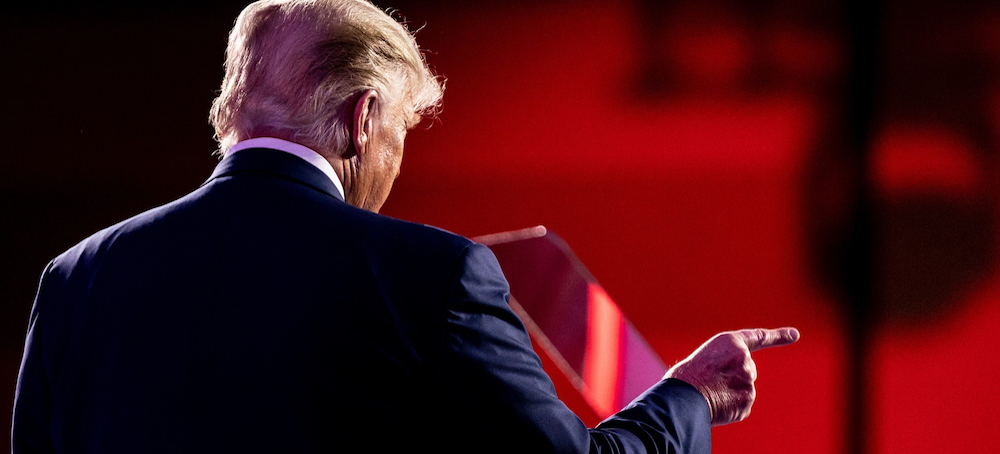 Donald Trump. (photo: Erin Schaff/NYT/Redux)
“It was all declassified,” Mr. Trump asserted in a statement.
The claim echoed an assertion in May by Kash Patel, a former Trump administration official and a major supporter of Mr. Trump, after the National Archives found materials marked classified in boxes of documents it removed from Mr. Trump’s Mar-a-Lago club and estate. He asserted that Mr. Trump had deemed those files declassified shortly before leaving office, but that the markings had not been removed from them.
Mr. Trump has offered no details, but if he is saying he made a blanket, oral invocation that all the files he took to Mar-a-Lago were unclassified, without making any formal, written record, that would be difficult to prove or disprove. Even if there is no evidence that Mr. Trump followed normal procedures for declassifying certain types of information, his lawyers could argue that he was not constitutionally bound to obey such rules.
NUCLEAR DOCUMENTS cannot be declassified according to this.
On Twitter, Wellerstein pointed out that the AEC doesn’t contain provisions for a president to declassify Restricted Data. “It’s a different category of law and classification altogether,” he said. “But this is real bleeding-edge of presidential powers and classification law. I have certainly never seen it discussed in the long history of nuclear secrecy in the USA.”
 Eddie Gallagher. (photo: Reuters)
A sign of the forever wars coming home, Eddie Gallagher trained officers from the Tallahassee Police Department.
The police department in Tallahassee, Florida, found a surprising answer to that question. Retired Navy SEAL Eddie Gallagher, accused by his fellow operators of intentionally shooting civilians and murdering a prisoner in Iraq, shared a photo and video on Instagram last week in which he described working with Tallahassee police officers in close-quarters combat and other lethal skills. He posted a picture of himself flanked by the rifle-bearing officers in Florida, with his caption describing an “awesome day of training” with “an extraordinary group of men who were ready to train and take on new concepts of shooting and CQB to add to their tool box. It was truly an honor!”
After Gallagher’s picture was spotted and shared by journalist Wesley Morgan, the Tallahassee Police Department stumbled forward with a believe-it-or-not statement that its officers were merely practicing at a private facility operated by a company called Stronghold SOF Solutions, which Gallagher is affiliated with. Gallagher happened to be at the facility and offered his “input” to the officers, according to the TPD. The department did not provide an explanation of how or why its officers assembled for a group photo with Gallagher, whose current business endeavors include private instruction on weapons and tactics.
Gallagher, imprisoned before his court-martial in 2019, is a free man because a military jury controversially declared him not guilty of premeditated murder, and his conviction on just one minor count — of posing in a picture with a dead prisoner — was essentially overturned when former President Donald Trump granted him clemency. Not long after the trial and grant of clemency, the New York Times released a trove of evidence from Gallagher’s fellow operators that laid out their damning case against him.
The core problem here is not Gallagher or the Tallahassee Police Department. The conduct of each is consistent with a decadeslong meshing of the military and policing — a violent disaster in America. The process, explored in Radley Balko’s “Rise of the Warrior Cop,” began in the 1960s, was stepped up during the so-called war on drugs, and reached terminal velocity after 9/11, when vast amounts of funding and weapons were poured into local law enforcement agencies, which deployed these resources mainly against minority and poor communities. One of the most notorious signatures of this destructive process is the Pentagon’s 1033 program, which since 1990 has distributed more than $7.4 billion in military weapons — including armored vehicles, grenade launchers, and sniper rifles — to police departments across the country.
This deluge of military hardware among civilian populations is harmful enough, creating mini-armies inside American communities that are desperate for better schools and social services. But what’s been just as harmful, if not worse, is the military mindset instilled in police ranks after 9/11. As Arthur Rizer, a former police officer and military veteran, wrote recently, “We have for years told American police officers to regard every civilian encounter as potentially deadly, and that they must always be prepared to win that death match. … It was always obvious to me that military tactics, training and weaponry had little place in civilian policing.”
And that’s where “trainers” like Gallagher come into play.
On Killing
One of the most prominent and controversial police trainers these days is Dave Grossman, a retired military officer who catapulted onto the lecture circuit after writing a book titled “On Killing.” Our paths crossed in the early days of the 9/11 era, when I was working on a magazine story and attended a talk he delivered in 2002 to a military audience whom he saluted at the end. It was a boilerplate speech for him, delivered hundreds if not thousands of times since, in which he talked about the ways in which soldiers should be trained to kill so they do not hesitate to pull the trigger and do not feel guilty about it afterward. Even in the military community, his theories were controversial and disputed by academics who believed that Grossman did not fully understand the dynamics or history of killing in wartime.
Grossman was primarily speaking to military audiences in those days — there was a lot of demand for people like him as the Pentagon was beefing up its ranks and starting its catastrophic wars in Afghanistan, Iraq, and elsewhere. After a while, as fewer U.S. soldiers were deployed overseas, he transitioned to speaking to a broader range of civilian groups, especially police departments, even though his base of experience is in combat psychology. His policing lectures are grafted from his military talks, emphasizing the danger of the job and the need for split-second aggression — even though policing is hardly the most dangerous profession in America. (Loggers, roofers, farmers, and sanitation engineers, among other workers, have higher on-the-job fatalities.) In a 2020 story on Grossman, the writer Justin Peters noted that “there is a cottage industry of trainers and consultants who encourage police to see their beats as a battlefield” and described Grossman as likening America to “a terrifying place where police are both the primary targets of and defenders against super-predation.”
Grossman, like Gallagher, is just a symptom of the problem.
In an encouraging development, Grossman’s lectures to police audiences are getting criticized more frequently than before. Last year, the Michigan Association of Chiefs of Police canceled a talk by him after justice advocates noted that his observations on police killings have included a remark that law enforcement officers can have the best sex of their lives after an on-the-job shooting. (A spokesperson for Grossman, asked for comment, told The Intercept via email, “The human body processes stress and a deadly force encounter many different ways. This is one way of MANY that humans react to and process what they just went through.”) A recent story by the Washington Post noted that the sorts of workshops conducted by Grossman and others were cited in a lawsuit over a police killing in Spokane Valley, Washington.
Yet Grossman, like Gallagher, is just a symptom of the problem. Even as the Tallahassee Police Department was trying to back away from its connection to an accused war criminal who has become a right-wing rock star in the fashion of Kyle Rittenhouse, local journalists unearthed a recruitment video from the department that highlighted an array of military-grade equipment and tactics used by its officers. The video showed off an armored personnel carrier, a camouflage-covered sniper, a squad of riot police marching in a V formation, and an armored bulldozer called the “Rook.” But don’t blame the TPD for being over-the-top: The gear in its video is standard in police departments across the country.
The fundamental problem, which was generations in the making and will perhaps be generations in the solving, is the internalization of a military force and a military ideology that were ostensibly built for external purposes. This is the forever wars coming home. The problem is not just that military spending since 9/11 has helped impoverish America while destroying foreign countries in illegal wars that cost trillions of dollars and left a million or more people dead (mostly foreigners, but plenty of Americans too). History has shown that the aftermath of foreign wars is not what you might expect. “War is not neatly contained in the space and time legitimated by the state,” noted Kathleen Belew in “Bring the War Home: The White Power Movement and Paramilitary America.” She added, “It reverberates in other terrains and lasts long past armistice. It comes home in ways bloody and unexpected.”
And we have just seen one of those ways: Eddie Gallagher giving shooting tips to cops.
 President George W. Bush waves as he watches his inaugural parade pass by the White House viewing stand in Washington, Saturday afternoon, Jan. 20, 2001. With him are his wife and first lady Laura Bush and his father, former President George H.W. Bush. (photo: Stephan Savoia/AP)
About 63% of Americans support using the popular vote, compared to 35% who would rather keep the electoral college system.
Approval for the popular vote is up from January 2021, when 55% of Americans said they back the change; 43% supported keeping the electoral college at that time.
Opinions on the systems varied sharply according to political party affiliation. 80% of Democrats approve of moving to a popular vote system, while 42% of Republicans support the move. Though, many more Republicans support using the popular vote system now than after the 2016 election, when support was at 27%.
There is also an age divide: 7 out of 10 Americans from ages 18 to 29 support using the popular vote, compared to 56% in Americans over 65 years old.
There have been five presidents who won the electoral vote, but not the popular vote — John Quincy Adams, Rutherford B. Hayes, Benjamin Harrison, George W. Bush and Donald Trump.
There are 538 electors, one for each U.S. senator and U.S. representative, plus three for Washington, D.C., which gets three electoral votes in the presidential election even though it has no voting representation in Congress.
The number of electors has changed through history as the number of elected members of Congress has changed with the country's expansion and population growth.
How electors get picked varies by state, but in general state parties file slates of names for who the electors will be. They include people with ties to those state parties, like current and former party officials, state lawmakers and party activists. They're selected either at state party conventions or by party central committees.
The Pew survey was conducted from June 27 to July 4 of this year.
Lots of SMALL DONORS matter!
Support candidates who support Americans!
Volunteer, knock on doors, make phone calls and WE can make a difference!
FROM ROBERT REICH:
Follow the money! Small donors, big donors, and the midterms
Big donors are giving more to Republicans. More small donors are giving to Democrats. Where will this lead?
Notably, the Inflation Reduction Act didn’t attract a single Republican vote in the Senate. (And at least one Democratic senator — Kyrsten Sinema — made sure its tax provisions wouldn’t raise tax rates on rich individuals.) Why?
We talk a lot about money in politics, but there’s a huge and growing difference between the big money (campaign donations of $1 million or more), most of it pouring into Republican coffers and small money (individual donations of $200 or less), mainly pouring into the Democrats. (Corporations have been giving to both sides, in roughly equal measure.)
The significance of this difference is growing.
With the midterms elections looming, the gap between the two sources is larger than ever. Democrats are far outpacing Republicans in small-dollar donations. The most recent reports (through June 30) show, for example, that:
— In Georgia, incumbent Senator Raphael Warnock has raised $14 million in small donations; Republican senate candidate Herschel Walker has raised only about $8 million in small donations.
— In Florida, Val Demings, the Democratic challenger to Senator Marco Rubio, has raised more than $24 million in small donations; Rubio himself has reported $12.7 million in small donations.
— In Arizona, Democratic Senator Mark Kelly's re-election campaign has raised nearly $23 million from small-dollar donors. His GOP challenger, Blake Masters, less than $2 million from small donors.
But the GOP’s big money donors are making up the difference.
— Billionaire Peter Thiel has so far poured over $25 million into the races of Blake Masters in Arizona and J.D. Vance in Ohio.
— Kenneth C. Griffin, the CEO of giant hedge fund Citadel, is bankrolling Republican super PACs to the tune of nearly $50 million.
— Stephen A. Schwarzman, chairman of giant hedge fund Blackstone, has so far contributed a combined $20 million to the main House and Senate Republican super PAC.
— Banking heir Timothy Mellon (descendant of the robber baron Andrew Mellon) has so far contributed $10 million to the main House GOP super PAC.
— Ditto billionaire Patrick R. Ryan.
— Miriam Adelson (whose husband, Sheldon Adelson, was one of the GOP’s most generous contributors until his death last year) just made her first $5 million donation. The list goes on.
Small donors are ramping up their giving to Democrats because they’re aware of how nuts the Republican Party has become on issues ranging from abortion to democracy. Trump has pulled into the GOP white supremacists, Christian nationalists, QAnon paranoids, xenophobic cultists, antisemites, misogynists, and rightwing militias. Plus a StarWars cantina of grifters, crackpots, and thugs who — as the January 6 attack showed — pose a clear and present danger to American democracy.
Big donors are ramping up their giving to Republicans because they now have so much money that any Democratic-led tax increase on them (or Republican-led tax cut for them) will invariably have large financial consequences. The Inflation Reduction Act reveals just how much damage Democrats could do to the bottom lines of the rich.
Many big donor billionaires (e.g., Peter Thiel) are trying to justify their donations as “libertarian,” but they know damn well the current Republican Party has nothing to do with personal freedom. It’s busy intruding on reproductive rights, pushing book bans in libraries and classrooms, barring young transgender people from playing on certain sports teams or using certain bathrooms, refusing to allow teachers to talk about aspects of American history they don’t want young people to know, and actively suppressing votes. Liberty my foot.
No, the billionaires aren’t libertarian. They want only one thing: more tax cuts.
The extraordinary growth of small donors to Democrats is all about justifiable fears of what Republicans will do with more power. The growth in big dollars to Republicans is all about greed.
 Members of the United We Dream organization participate in a demonstration outside of the U.S. District Courthouse in Houston, Texas. (photo: Brandon Bell/Getty Images)
This is a rush transcript. Copy may not be in its final form.
AMY GOODMAN: This is Democracy Now!, democracynow.org, The War and Peace Report. I’m Amy Goodman.
Here in New York City, more than a hundred asylum seekers arrived on buses from Texas early Wednesday morning at Port Authority, the bus terminal near Times Square. Another bus arrived Sunday with no advance notice from Texas officials. This is a Venezuelan-born migrant named Edwin Enrique Jimenez Guaido.
EDWIN ENRIQUE JIMENEZ GUAIDO: [translated] It’s been six years already, six years since I left my country, first to Colombia, next to Ecuador. And in February, I decided to come here, through the Darién Reserve, Panama, Costa Rica.
AMY GOODMAN: This comes as Texas Governor Greg Abbott announced he’s sending asylum seekers to so-called liberal cities. On Friday, he said he chose New York City to be a designated, quote, “drop-off location,” along with Washington, D.C., as part of his opposition to what he calls President Biden’s so-called open border policies.
People on the buses said they were told to sign a consent waiver. CNN reports the waiver includes a line that absolves Texas officials from liability, quote, “arising out of or in any way relating to any injuries and damages that may occur during the agreed transport to locations outside of Texas,” unquote. At least eight people who got off the buses needed emergency medical attention, according to the New York Mayor’s Office of Immigrant Affairs.
On Tuesday, New York City’s Immigration Commissioner Manuel Castro and Social Services Commissioner Gary Jenkins addressed a City Council hearing on the influx of asylum seekers into at least 11 shelters.
MANUEL CASTRO: What is new now is the systematic diversion of asylum seekers and immigrants to New York City by external forces, including by the disgusting, cruel and cowardly actions of Texas Governor Greg Abbott.
GARY JENKINS: We will be tapping into our nonprofit providers to ensure asylum seekers have access to wraparound services, including legal support, healthcare and education.
AMY GOODMAN: There are now reports from legal service advocates that some families who could not provide proof of their relationships were separated or had to leave the shelters.
Asylum seekers are also being met by a welcoming effort that includes members of the South Bronx Mutual Aid collective, legal services and the New York Immigration Coalition, whose executive director, Murad Awawdeh, joins us now for more.
Welcome to Democracy Now!, Murad. Explain exactly what’s happening and what’s happened at Port Authority.
MURAD AWAWDEH: Thank you so much for having me, Amy, on your show today. I’ve been a huge fan. And, you know, I wish we were meeting on better terms.
But what we’re seeing happening right now is Governor Abbott using asylum seekers as political pawns to merely help increase his polling numbers down in Texas.
Folks who are seeking asylum at the southern border have a legal right to do so. We have seen people who are traveling upwards of 3,000 miles on foot to get to the southern border, then present themselves and seek asylum at the southern border, be treated so horribly by the state of Texas, and then busing them over 2,000 miles away to New York City. Yesterday morning, most folks who showed up, many of them were asking why they were sent to New York City. One man was trying to — you know, urgently wanting to speak to his wife and children, who were actually in San Antonio, Texas. So he wanted to go to San Antonio, Texas, after Texas had just dropped him off here in New York City. Folks are arriving on the bus sick. They’re arriving extremely hungry and thirsty. They’re not being given food, and at most times without their identity documents.
So, there’s a huge effort that’s happening right now to welcome them with dignity here in New York City and make sure that we are showing not just Governor Abbott how it should be done, but really seeing each other as humans in this moment.
AMY GOODMAN: So, how — do you understand how it’s happening? New York City officials are saying some 4,000 asylum seekers and migrants have traveled to New York in recent months, either by choice or because they were sent here by Texas state officials. So, how do they decide who — do they just shove them on a bus?
MURAD AWAWDEH: That’s what it seems like, Amy. I think that there is — the governor of Texas is definitely misleading, and Texas officials are definitely misleading the asylum seekers. You know, many of the folks who came here yesterday morning, who got off the three buses that showed up, were asking, “Well, how do I get to North Carolina now?” or “How do I get to Wisconsin?” or Oregon or Louisiana? Folks are being coerced into signing this waiver, to then be sent up to New York City without any support, without any care.
Last Friday, we saw one young girl get off the bus who wasn’t feeling well. She received emergency care, and turned out she needed insulin because she’s diabetic. On Sunday morning, there was one young man who came off the bus and needed treatment because he was having chest pain. We’re seeing people being put into really inhumane conditions, not just on the bus but even before the bus. And then, when they get to New York City, we’re providing them with care.
So, I think that the bigger piece here is Governor Abbott’s lack of empathy, lack of compassion, lack of humanity, and really trying to rile up his base of folks who have historically been anti-immigrant.
AMY GOODMAN: So, can you explain what’s happening with some immigrants’ families who come here? Maybe some don’t have proper papers, and they are threatened with being separated — I mean, we saw this, of course, under President Trump — but separated if they want to go into the shelters, and so they are living on the streets so that they don’t get separated?
MURAD AWAWDEH: So, what’s happening is, just to clarify, a few months ago, about two months ago, organizations like the New York Immigration Coalition, like Catholic Charities, started to receive these notices called “notice to appear.” They’re immigration hearing notices that were addressed to the organizations, with an additional name. And after receiving a few of them, we were like, “Why are we receiving so many of them? And we’re not representing these folks.” And then shortly thereafter, we started receiving people to our doors asking for shelter and care, as well as services. We provided them with the services as they showed up to the New York Immigration Coalition, but we don’t provide housing. So we worked with — you know, we have a services arm that really did connect folks to emergency shelter.
But what we are seeing, to answer your question directly, is that when people are released from ICE or from detention or from Border Patrol, rarely are they ever given back their identity documents. Some folks are lucky enough to get copies of their identity documents given back to them, but they are not given their identity documents. And in New York City, the city shelter system needs to — wants folks to prove that they are a family unit. So, what we have witnessed, because folks have come back to us once we’ve sent them to the intake facility, is that they say, “Because we don’t have our papers, they want my husband” — and, you know, it’s a husband, wife and children — “they want him to go stay in the men’s shelter, and me and my kids to stay in the women’s shelter, the family shelter.” So, we haven’t heard of folks getting kicked out of the shelter system.
I think that we have seen, for the past two decades at least, that we’ve had a housing and homelessness crisis in the city. And I think there were, you know, ill-mannered rationale given at times, saying that with the recent increase of asylum seekers in New York City, that that is what was putting the shelter system at capacity. And I don’t believe that that’s true. But the city has a mandate to shelter everyone. And I think that they had a number of missteps in the beginning, but are moving in the right direction to stand up — expanding emergency shelter and creating a welcoming center in this moment.
AMY GOODMAN: So, what are you saying now, finally — what is the New York Immigration Coalition saying to Mayor Adams here in New York, the governor of Texas, Greg Abbott, and federally, to the federal government, about what needs to happen?
MURAD AWAWDEH: Yeah, absolutely. I think that under the Trump administration, we saw the asylum system completely gutted, and the Biden administration hasn’t done very much to restore it. They just announced the other day, without a plan, how they are going to rescind “Remain in Mexico,” which was one of Trump and Stephen Miller’s tactics to gut our asylum process. So, we’re excited that they announced that they’re going to rescind it, but that only came after the Supreme Court said that they can.
So, what we would like for the federal government to do in this moment is to ensure that there is proper care given to folks who are entering into the U.S., allowing folks into the U.S., as well as making sure that they have the supports that they need when they arrive.
At the state level, we’d love to — you know, we’ve been coordinating with Governor Hochul’s office and the Port Authority. We’d love to see the state step up and provide legal services funding, as well as services funding.
And at the city level, you know, we have to — bureaucracy is slow, and we need to really make sure we’re able to move quickly. And we were excited to hear that they announced that they were going to open up the welcome center last week, but we really need to work quicker to ensure that that center gets opened and that we’re providing coordinated services, and that community-based organizations who are doing this work and organizations who are doing this work without any support are getting the support that they need to welcome and allow folks who are coming and seeking asylum here in New York City to not only just survive, but to be able to thrive in our city and our state.
AMY GOODMAN: Murad Awawdeh, we want to thank you for being with us, executive director of the New York Immigration Coalition.
Coming up, we’re going to look at the growing housing crisis in the United States as rents soar and cities crack down on the unhoused. Stay with us.
If you want to stop immigrants, address the US/CIA foreign policies that created the violence, gangs, environmental degradation, mass killings, corruption, income inequality and put in place THUGS.
You got your cheap coffee, bananas and sugar by oppressing these people and supporting the multinational corporations and wealthy elites.
PEOPLE do not willingly leave their homes, their communities and familiar surroundings until the US/CIA made their nations unihabitable.
Don't blame IMMIGRANTS!
IMMIGRANT communities have lower crime rates than WHITE AMERICANS because they came here for what the nation offers and they're willing to WORK.
The US/CIA put War Criminals like Elliot Abrams in charge and he ignored the massacres of innocents by those the US/CIA trained at the SCHOOL OF THE AMERICAS.
https://jacobin.com/2019/02/the-tragic-life-of-the-war-criminal-elliott-abrams
SANCTUARY CITIES ARE SAFER THAN LILY WHITE AMERICAN CITIES:
FACTCHECK POSTS
No Evidence Sanctuary Cities ‘Breed Crime’
https://www.factcheck.org/2017/02/no-evidence-sanctuary-cities-breed-crime/
FROM 2022:
Sanctuary city policies linked to lower crime rates in recent years
https://phys.org/news/2022-02-sanctuary-city-policies-linked-crime.html
Facts still matter: Data shows sanctuary cities keep communities safer
https://thehill.com/opinion/immigration/481851-facts-still-matter-data-shows-sanctuary-cities-keep-communities-safer/
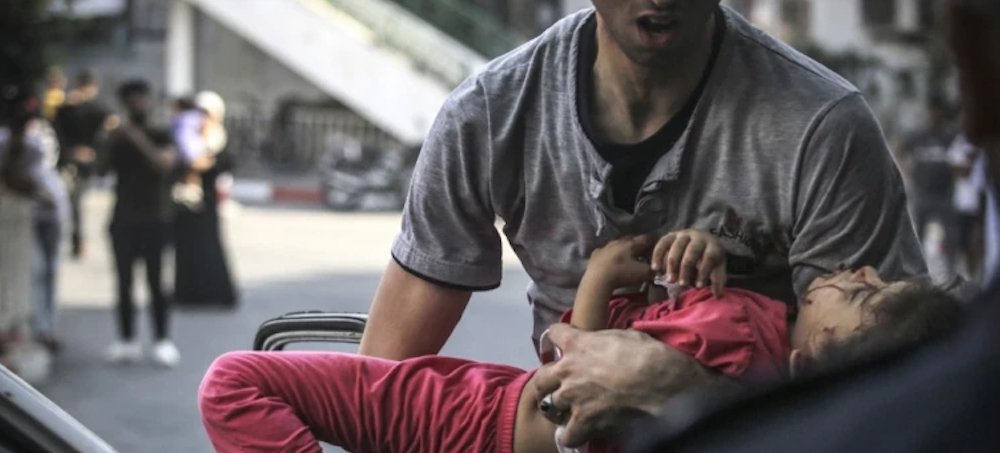 A wounded Palestinian child is carried to a hospital following an Israeli air raid on the Gaza Strip on Friday. (photo: Anas Baba/AFP)
Since 2008, Israel has waged four wars on Palestinian territory killing nearly 4,000 people, many of them children.
His death brought the total number of Palestinians killed during the three-day assault to 49, including 17 children, according to Gaza’s health ministry.
The body of Anas Inshasi, 22, was wrapped in the black-and-white flag of the Palestinian Islamic Jihad. Mourners said he was wounded by an Israeli air sraid while firing mortar rounds towards Israel.
Israel launched a wave of air raids last Friday after detaining an Islamic Jihad leader in the occupied West Bank earlier that week.
Islamic Jihad began firing rockets at Israel hours after the initial wave of attacks. The violence ended with an Egyptian-brokered ceasefire on Sunday.
In the three days, Israel killed two top Islamic Jihad commanders in Gaza, and the armed group said it lost a total of 12 fighters.
Many Palestinian civilians were among those killed and wounded by Israeli attacks, including 17 children – after an 11-year-old girl died of her wounds on Thursday. Two children are being treated in the intensive care unit of a Palestinian hospital in Jerusalem.
 Firefighters battling a wildfire near Landiras, in southwestern France. (photo: SDIS 33/AP)
Almost half of Europe is experiencing a historic drought, threatening new ecological and economic pain for a continent already grappling with the effects of Russia’s war in Ukraine.
Europe’s heat waves and historic drought are threatening new ecological and economic pain for a continent already grappling with the effects of Russia’s war in Ukraine.
On Friday, nations across Europe sent teams of firefighters to tackle a "monster" wildfire in France, the crucial Rhine in Germany was threatening to fall so low that it could become difficult to transport vital goods on the river, while Britain was sweltering through its latest "extreme heat" spell.
Temperatures have once again approached 100 degrees Fahrenheit in the United Kingdom and France this week. A drought was officially declared early Friday in several parts of England, leaving millions facing restrictions on the use of water — much of its famously “green and pleasant” countryside has already gone brown.
Some parts of western, central and southern Europe have gone without rainfall for almost two months, leaving almost half the continent facing drought in a cycle of hot weather experts say is a direct result of climate change.
Ed Hawkins, a professor of climate science at Reading University in southeast England, told NBC News: "In the U.K., we’ve had a nine month period of extremely light rainfall — that’s a very long time to go without rain, even in our unpredictable climate.
"We can now expect to see drier summers and lack of rainfall mirroring southern Europe in the U.K., although southern Europe is going to get hotter as well."
Already some 10,000 people have been evacuated from areas near the forest fires still raging in the Gironde region in western France. More than 26 square miles of pine forest have burned since Tuesday, with at least 16 houses destroyed amid the worst French drought in recorded history.
“It’s an ogre, a monster,” Gregory Allione from the French firefighters body FNSPF said, according to Reuters.
Some problems, such as drought, have been building through months of low rainfall and hot weather — at the height of the summer, water levels of rivers such as the Rhine, Po and Danube are falling to critical levels.
On the Rhine, a major artery for trade and energy supplies, water levels are expected to reach the point this weekend where it’s potentially unsafe for boats to sail, threatening to choke off a key point in global shipping.
Authorities predict that levels at Kaub will soon dip below 40 centimeters (16 inches), seen as a benchmark, and keep falling over the weekend.
Many large ships could struggle to safely pass the river at that spot carrying anything like their usual load, leaving German power stations short of coal and other goods struggling for transport.
The Po, Italy's longest river, has also dried up. Authorities declared a state of emergency last month for areas surrounding the Po, which accounts for roughly a third of the country's agricultural production.
The source of the Thames, the river seen in so many postcard images of London, has also dried up, experts said.
The crisis is being keenly felt in both the human and the animal kingdoms.
A river in Lux, in eastern France near the city of Dijon, normally sees 2,100 gallons flow along it every second but has run dry. Fish cannot survive.
"It’s heartbreaking ... They are trapped upstream and downstream, there’s no water coming in, so the oxygen level will keep decreasing as the [water] volume will go down," Jean-Philippe Couasné, chief technician at the local Federation for Fishing and Protection of the Aquatic Environment, told The Associated Press.
"These are species that will gradually disappear."
Poland’s World Wildlife Fund office has called on the government to declare an emergency and send in the army to help clear away fish and other animals that are washing up dead on the shores of the Oder river near the border with Germany.
The German state of Brandenburg said Friday that the release of a toxic chemical may have been to blame for the fish deaths, exacerbated by low water levels.
While Spain and Portugal are used to long periods of hot, dry weather, farmers there are suffering: In Andalucia, a large region of southern Spain, avocado farmers have sacrificed hundreds of trees to save others from wilting.
There are long-terms effects too. Corn production across the European Union is expected to be 12.5 million tons below last year and sunflower production is projected to be 1.6 million tons lower, according to a report from S…P Global Commodity Insights.
"In Europe, we see the effect of climate change in the increase of frequency and intensity of heat waves," said Kimberly Nicholas, a professor and climate expert at Lund University in Sweden.
She said that although the long-term causes of drought were less clear, in two-thirds of cases, human-caused climate change increased "the frequency and intensity of droughts."
Nicholas said that nothing can be done now in this current period of extreme temperatures to prevent the mass death of fish and marine wildlife trapped in increasingly shallow waters. "It’s much harder to help animals in crisis than to prevent the crisis in the first place."
"Climate crisis and war are bad for life on earth, and they’re bad for food production," she said of fears that the drought affecting agricultural land might contribute to a global food crisis already spiraling due to the Russian invasion of Ukraine. "Of course, the combination is especially difficult," she added.
Special Coverage: Ukraine, A Historic Resistance
READ MORE
Follow us on facebook and twitter!
PO Box 2043 / Citrus Heights, CA 95611

-
LOTS OF POSTS IGNORED BY BLOGGER..... OR REMOVED ON THEIR WHIM! ALL PO...
-
LOTS OF POSTS IGNORED BY BLOGGER..... OR REMOVED ON THEIR WHIM! ...
-
LOTS OF POSTS IGNORED BY BLOGGER..... OR REMOVED ON THEIR WHIM! A...


