Showing posts with label 2024. Show all posts

Tuesday, November 15, 2022

POLITICO NIGHTLY: How Donald Trump torpedoed his own party


View in browser
 
POLITICO Nightly logo

BY CHARLIE MAHTESIAN

Presented by LiveWire Electric Motorcycles

Former President Donald Trump mingles with supporters during an election night event at Mar-a-Lago.

Former President Donald Trump mingles with supporters during an election night event at Mar-a-Lago. | Joe Raedle/Getty Images

DEAD WEIGHT — Imagine you knew the results of the 2022 exit polls in advance of last week’s election. That the Republican Party would be trusted more to handle crime (52 percent to 43 percent), immigration (51-45) and foreign policy (51-45). That inflation would rate as the most important issue among voters, and that the GOP would be the party trusted more by voters to handle it — by a double-digit margin (54-42).

Further, imagine those same exit polls revealed that voters said Republicans should control the House, by a 50-47 margin. That President Joe Biden’s job approval rating would be underwater (44-55) and his favorability rating would be even worse.

Between those numbers and the historical precedent of the party out of power picking up seats in midterm elections, it would have seemed like the GOP was poised for a runaway victory. Instead, Democrats have held the Senate and control of the House remains up in the air , almost one week after Election Day.

Abortion rights played an important role in altering the dynamics of the 2022 election. But the exit polls and the still-unfolding House and Senate map increasingly tell the story of an election where Donald Trump torpedoed his party — and, on the eve of his widely expected announcement of another presidential run , he might do the same again in 2024. The more races are called, the more obvious it becomes.

There is Nevada, home to three of the nation’s tightest House races and one of its most competitive Senate contests. When the Senate race was finally called this weekend, all four remained in Democratic hands. Despite an October rally for the GOP ticket, Trump did these candidates few favors — 29 percent of Nevada voters said their vote was in opposition to the former president.

Nevada Republicans did post one important victory, ousting Democratic Gov. Steve Sisolak. But even in that case, Trump was more hindrance than asset. According to a New York Times account , after Republican Joe Lombardo declined to call Trump a ‘great’ president and backed off Trump’s false claim of a stolen election, Republican National Committee Chair Ronna McDaniel had to convince the former president not to pull his endorsement of Lombardo.

In Illinois, Michigan and Pennsylvania, it was a similar story. Between the three states, there were 11 House races rated as either Lean Democratic or Toss-Up by POLITICO . Every one of them ended up in Democratic hands as Trump-endorsed, hard-line candidates for governor helped drag their tickets to defeat.

Trump’s invisible hand, in fact, left fingerprints all over the House map. Two GOP-held House seats flipped this year after Trump helped oust their previously ensconced incumbents as a payback for their impeachment vote. Maryland missed a rare chance to add a second Republican seat — Democratic Rep. David Trone narrowly defeated Republican Neil Parrott, a victim of the undertow of a governor’s race where Trump-endorsed Republican Dan Cox lost in a landslide. New England’s chance of reviving the GOP brand fell short after a handful of top GOP House contenders fell short. In New Hampshire, where two of them failed and Sen. Maggie Hassan won reelection, roughly one-third of voters (32 percent) said they voted to oppose Trump.

In swing state after swing state, this was a midterm election that Trump changed from a referendum on an unpopular Biden into a choice between the two. It was most obvious in the razor-close races that determined control of the Senate, where Democratic incumbents were in serious danger of being dragged down by Biden’s weak approval ratings.

In Pennsylvania, Democrats also flipped a GOP-held Senate seat, despite Biden’s approval rating being underwater there at 46-53. Trump, it turns out, was even more unpopular. The exit polls put Trump’s favorability rating at 40-58. Just over a quarter of the electorate (26 percent) said their vote was to oppose Trump — and 91 percent of them voted for Democratic Senate nominee John Fetterman over Republican Mehmet Oz.

In Arizona, 38 percent said they voted to oppose Biden. But 35 percent voted to oppose Trump. In Wisconsin, it was dead even at 30 percent.

Trump wasn’t electoral poison across the map. Most of the GOP incumbents he backed in the House and Senate won (many, of course, weren’t in competitive races). Two of his endorsees for open Senate seats — J. D. Vance in Ohio and Ted Budd in North Carolina — won.

It’s a good time for the GOP to do something the party stopped doing while Trump was in the White House: a thorough autopsy of the election results and Trump’s role in influencing them. They’ll likely find that some of the party’s biggest winners last week — among them Govs. Mike DeWine, Brian Kemp and Ron DeSantis, as well as South Dakota Sen. John Thune — either are, or have been, at odds with Trump. And they’ll likely find that a Senate majority was well within their grasp. So was a bigger House majority.

Welcome to POLITICO Nightly. Reach out with news, tips and ideas at nightly@politico.com . Or contact tonight’s author at cmahtesian@politico.com or on Twitter at @PoliticoCharlie .

A message from LiveWire Electric Motorcycles:

Support American Electric Motorcycles. Learn more.

 
WHAT'D I MISS?

— Supreme Court allows Jan. 6 committee to access Arizona GOP chair’s phone records: The Supreme Court has cleared the way for the House’s Jan. 6 select committee to obtain the phone records of Arizona GOP Chair Kelli Ward , a key ally during Trump’s effort to subvert the 2020 election. The justices, with noted opposition from Clarence Thomas and Samuel Alito, today denied Ward’s emergency motion to block the panel from enforcing a subpoena against T-Mobile to obtain Ward’s records.

— University of California academic workers go on strike for higher wages in largest walkout in U.S. higher education: University of California academic workers walked off the job today across the 10-campus system , seeking higher wages and better benefits in what organizers are calling the largest strike in the history of U.S. higher education. Bargaining units for nearly 50,000 teaching assistants, researchers and other scholars failed to reach a contract that met union demands amid soaring housing costs and inflation for people who provide much of the instruction for undergraduates in the system.

— Club for Growth steps on Trump relaunch with polls showing DeSantis beating him: The conservative Club for Growth is sending a warning shot at Trump on the eve of his expected 2024 campaign launch — and indicating it might back his chief potential rival, Florida Gov. Ron DeSantis. The anti-tax organization, which was once a staunch Trump ally but over the last year has broken with him, today provided POLITICO with a polling memo showing the former president trailing DeSantis by double digits in one-on-one matchups in Iowa and New Hampshire, the first two states on the GOP nominating calendar. The surveys also show DeSantis leading Trump by wide margins in Florida, their shared home state, and Georgia, which is holding a Dec. 6 runoff for one of its Senate seats.

— Justice Department accuses Trump of ‘shell game’ with Mar-a-Lago documents: Trump mischaracterized White House documents he retained after leaving office as “personal,” the Justice Department argued in a newly unsealed court filing, accusing Trump of engaging in a “shell game” to shield documents from criminal investigators. In the filing, unsealed today by U.S. District Court Judge Aileen Cannon, prosecutors contended Trump has sought to restrict investigators’ access to materials — seized by the FBI in August from his Mar-a-Lago estate — by inappropriately claiming they’re his personal property. Federal law permits presidents to declare some records as “personal” so long as they have no decision-making value to future administrations.


GO INSIDE THE MILKEN INSTITUTE FUTURE OF HEALTH SUMMIT: POLITICO is featuring a special edition of our “Future Pulse” newsletter at the 2022 Milken Institute Future of Health Summit from Dec. 6 to 8. The newsletter takes readers inside one of the most influential gatherings of health industry leaders and innovators solving the biggest global health issues to ensure a healthier, more resilient future for all. SUBSCRIBE TODAY TO RECEIVE EXCLUSIVE COVERAGE .


AROUND THE WORLD

Chief of Staff of Ethiopian Armed Forces Field Marshall Birhanu Jula, left, and Head of the Tigray Forces Lieutenant General Tadesse Werede, right, exchange signed copies of an agreement, at Ethiopian peace talks in Nairobi, Kenya.

Chief of Staff of Ethiopian Armed Forces Field Marshall Birhanu Jula, left, and Head of the Tigray Forces Lieutenant General Tadesse Werede, right, exchange signed copies of an agreement, at Ethiopian peace talks in Nairobi, Kenya. | AP Photo/Brian Inganga

PEACE PACT — After two years, the war in Ethiopia’s Tigray region is coming to an end following peace talks in Nairobi, Kenya, and a truce struck earlier this month. On Saturday, military leaders from both sides agreed to a peace roadmap that includes “unhindered humanitarian access to the region” and a joint disarmament committee, the Associated Press reports:

“Both parties have agreed to protect civilians and facilitate the delivery of humanitarian aid to the region of more than 5 million people, according to a copy of the agreement seen by The Associated Press.

“The agreement states that disarmament will be ‘done concurrently with the withdrawal of foreign and non-(Ethiopian military) forces’ from Tigray.

“The lead negotiator for Ethiopia, Redwan Hussein, told the AP that Saturday’s signing event created a conducive environment for ongoing peace efforts, noting that the next meeting of military leaders will ‘most likely’ be held in Tigray in mid-December before a final meeting in Addis Ababa, the Ethiopian capital, in January.

“The Tigray conflict began in November 2020, less than a year after Ethiopian Prime Minister Abiy Ahmed was awarded the Nobel Peace Prize for making peace with Eritrea, which borders the Tigray region and whose fighters have been fighting alongside Ethiopian federal troops in Tigray.

“The war in Africa’s second-most populous country, which marked two years on Nov. 4, has seen abuses documented on both sides, with millions of people displaced and many near famine.”

ADULTS IN THE ROOM — Giorgia Meloni’s new Italian government has only been in power a few weeks, and already the grown-ups have had to step in, writes Hannah Roberts .

As a dispute between Italy and France over taking in migrants escalated , President Sergio Mattarella, Italy’s head of state, personally intervened, holding a phone call with President Emmanuel Macron this morning.

The Italian and French presidents’ offices said in a joint statement that the two leaders agreed on the “great importance” of relations between the two countries and on the need for full cooperation, both in the bilateral sphere and within the European Union.

Italy’s president has a largely ceremonial role, with constitutional powers to step in when a government collapses. However, Mattarella, who has a good relationship with Macron and helped deliver a treaty of cooperation between Italy and France last year, took the unusual step of publicly stepping in to smooth over the row between Meloni, the prime minister, and Macron’s government.

Europe has not resolved the migration issue and both sides are under pressure on that front domestically — Macron from the far right and Meloni from her coalition partner Matteo Salvini, leader of the League.


A message from LiveWire Electric Motorcycles:

 
NIGHTLY NUMBER

20

The number of House seats that remain uncalled . Republicans would have to win six of those seats for a House majority, while Democrats would need 15 — a prospect that looks increasingly unlikely. “I think it’s going to be very close, but I don’t think we’re going to make it,” Biden told reporters at the G-20 summit in Indonesia today.

RADAR SWEEP

CELEBRITY SKIN IN THE GAME — After Beto O’Rourke lost statewide in Texas again, it’s become abundantly clear that Democrats have a thin bench in the state. One possible solution? Look to the celebrities . Some seem more viable (Eva Longoria, Matthew McConnaughey), while others could be absurd (Megan Thee Stallion), but no idea should be too crazy for Democrats in Texas, according to Dan Solomon in Texas Monthly.


POLITICO APP USERS: UPGRADE YOUR APP BY DECEMBER 19! We recently upgraded the POLITICO app with a fresh look and improved features for easier access to POLITICO's scoops and groundbreaking reporting. Starting December 19, users will no longer have access to the previous version of the app. Update your app today to stay on top of essential political news, insights, and analysis from the best journalists in the business. UPDATE iOS APP – UPDATE ANDROID APP .


PARTING WORDS

An illustration shows potential 2024 Democratic candidates lining up eagerly while Joe Biden lags behind.

Illustration by Alex Fine for POLITICO; Headshots: AP, Getty

THE ART OF (INTRAPARTY) WAR — Democrats defied history and escaped a midterm beating. Yet as 2024 looms, many Democrats are still feeling anxious about their standing as they pore over the exit poll data, writes Bill Scher .

Fifty-one percent of respondents said the Democratic Party is “too extreme” (1 point less than the GOP). Majorities prefer Republicans to deal with inflation, crime and immigration. And not only was Biden’s job approval number a limp 44 percent, a whopping 67 percent of respondents don’t want him to run again. That includes nearly half of the Democrats polled.

A chipper Biden said after the midterms that he intends to stand for reelection. Yet many Democratic lawmakers also appear to side with the skittish wing of the party’s rank-and-file, according to POLITICO’s Jonathan Martin, who reported that their “dread about 2024 extends from the specter of nominating an octogenarian with dismal approval ratings to the equally delicate dilemma of whether to nominate his more unpopular vice president or pass over the first Black woman in the job.”

Amid growing Democratic nervousness about 2024 — particularly as Trump appears to prepare for another White House bid — ambitious, impatient Democrats may see an opportunity to challenge a vulnerable president from their own party.

But if they want to throw Biden from the train, and not just see Vice President Kamala Harris take over as conductor, they can’t copy a prior template of success. They will have to find a way to do what hasn’t been done in the modern era of presidential primaries. Only Ronald Reagan in 1976 and Ted Kennedy in 1980 won any primary contests against an incumbent president, before ultimately falling short.

Read Scher’s lessons from the past for shaping a plausible insurgent strategy , as well as some Democrats who he thinks might have the juice to pull it off.

Did someone forward this email to you?  Sign up here .

A message from LiveWire Electric Motorcycles:

As the first all-electric motorcycle company listed on the NYSE, we believe American EV motorcycle buyers deserve a tax credit, just like EV car buyers. Reinstate the federal tax credits for American electric motorcycles.


Follow us on Twitter

Charlie Mahtesian @PoliticoCharlie

Calder McHugh @calder_mchugh

Naomi Andu @naomiandu


FOLLOW US

Follow us on FacebookFollow us on TwitterFollow us on InstagramListen on Apple Podcast


 POLITICO, LLC 1000 Wilson Blvd. Arlington, VA, 22209, USA


Saturday, August 6, 2022

RSN: FOCUS: Jeremy Stahl | Hear Me Out: Trump Won't Run Again



Reader Supported News
06 August 22

Live on the homepage now!
Reader Supported News
PLEASE DON’T WAIT FOR, “CONDITION DIRE” — The single biggest factor extending the length of these fundraising drives: Waiting until the situation is dire to chip in. If you can afford a donation, put it in the hat early. Sincere thanks to all.
Marc Ash • Founder, Reader Supported News

Sure, I'll make a donation!


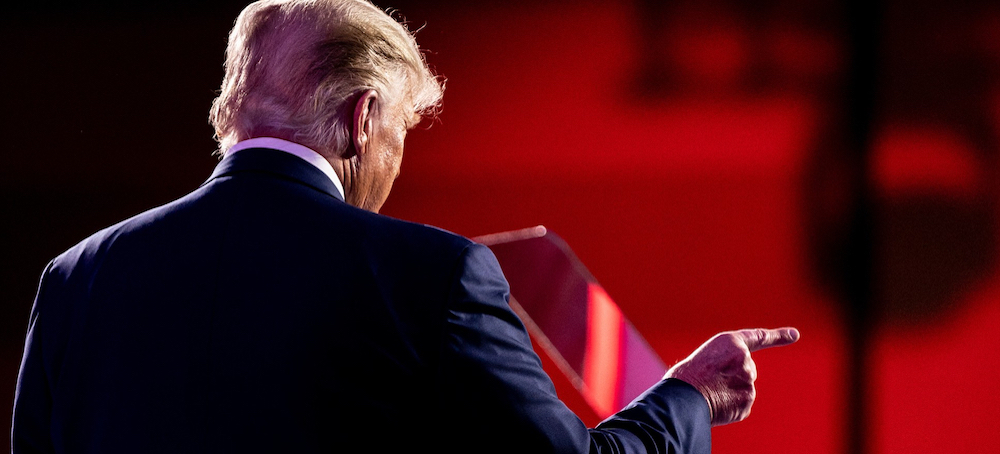
Donald Trump. (photo: Erin Schaff/NYT/Redux)
FOCUS: Jeremy Stahl | Hear Me Out: Trump Won't Run Again
Jeremy Stahl, Slate
Stahl writes: "I don't think he'd win the 2024 Republican nomination, and I think he knows it."


I don’t think he’d win the 2024 Republican nomination, and I think he knows it.

After the 2016 election, I was hanging out with a group of friends discussing how badly the press had screwed up its predictions about Donald Trump’s chances at victory—seeing as how he had just won the presidency, despite the apparent odds.

One attendee, a fellow political journalist, came up with a particularly evocative metaphor for the situation. “It’s like we were weather reporters who told viewers that it was a sunny day to go to the beach, and instead there was a Category 4 hurricane,” he said.

To a certain extent, members of the national media have been trying to make up for this mistake for more than five years, seemingly vowing to themselves to never again underestimate this era’s “Teflon Don.” The notion among the media that Trump was bulletproof only grew as he seemed to escape accountability following a series of presidential scandals that included a calamitous initial version of his Muslim ban, the illegal and monstrous family separation policy, an obstruction of justice criminal probe, an impeachment over his blackmailing of Ukraine, and ultimately a second impeachment for inciting an insurrection on Jan. 6, 2021.

At every seemingly disastrous turn of his candidacy—and then his presidency—the media would speculate breathlessly on whether this was it, the breaking point of Trump’s political career, and then, it never was.

Famously, this dynamic—Trump seeming to have finally crossed some horrifying line to the point where he had to be held accountable, but ultimately facing no real consequences—was encapsulated on Twitter in October 2016, by the writer Jesse Farrar:

Well, I’d like to see ol Donny Trump wriggle his way out of THIS jam!

*Trump wriggles his way out of the jam easily*

Ah! Well. Nevertheless,

These days, it seems, no national reporter wants to be seen, once again, predicting ol’ Donny won’t be able to wriggle his way out of THIS jam. Those jams currently include continued unpopularity among the general electorate, falling support in the Republican Party, rising potential rivals in that party, public hearings that have exposed his extraordinary level of responsibility for the mob violence on Jan. 6, a civil case set to go to trial next year over an allegation that Trump committed rape, a civil investigation in New York that is pursuing allegations of fraudulent business practices against the Trump Organization, and a series of state and federal criminal investigations over Trump’s actions surrounding Jan. 6.

The point is that it should be easy to view Trump as an incredibly weakened figure who has better odds of ending up in an orange jumpsuit or losing his fortune in a lawsuit than returning to the White House. However, almost nobody in the national media seems to report it that way.

As a whole, I think the press corps is overcompensating for the trauma of our admittedly terrible 2016 prognostications by defaulting to what I call “ah, well, nevertheless” syndrome. Under the logic of “ah, well, nevertheless” syndrome, Trump’s wriggled out of so many prior jams that one would look foolish to predict he won’t wriggle out of his current ones. No political reporter wants that, especially when it comes to Trump.

I would argue, though, that Trump’s invincibility should have been viewed as broken once and for all following the 2020 election, which he lost decisively enough. It’s true Trump came close to winning in a handful of states—Georgia, Pennsylvania, Arizona, Wisconsin, and Michigan—three or four of which would have secured him the Electoral College and the presidency. He lost all five, though, and Hillary Clinton actually came closer than Trump to flipping the three states she needed to capture the presidency in 2016, by more than 25,000 votes.* (She too lost the presidency by a fairly decisive margin, which is why she conceded, like a sane person.)

More to the point, Trump became only the fourth elected incumbent in more than 125 years to lose the presidency, joining such illustrious company as George H.W. Bush, Jimmy Carter, and Herbert Hoover. Indeed, Trump’s 4.4 percent margin of defeat was up there with men whom political watchers still consider to be historic failures. Trump lost the popular vote by a greater margin than Hubert Humphrey, Mitt Romney, Gerald Ford, and John Kerry. In terms of the share of the popular vote won, Trump did just 1.2 points better than Michael Dukakis, a man whose political career is synonymous with “loser.”

While, after the election, Trump mounted a weekslong attempt to remain in power through false claims of fraud, that effort was laughed out of court in nearly every single case he and his allies brought. In the end, he sparked an insurrection that (admittedly, only briefly) turned the nation against him further, and then became the first president in history to be impeached twice by the House of Representatives. While Trump was not convicted, with the Senate falling short by 10 votes after he had already been removed from office by the voters, more senators from his own party voted to convict him in that second impeachment than any other president in history. Now he faces a series of state and federal criminal probes for his actions that led to that impeachment, which are by all reported accounts heating up dramatically.

Still, reports that Trump says he has “decided” to run again in 2024 are treated as breaking news, even as he’s been saying the same thing for more than a year. Indeed, he’s been telling this to anyone who will listen—and has been since he was dragged out of office literally thrashing and screaming 18 months ago. (That includes, ghoulishly, a group of first responders at an event commemorating the 20th anniversary of 9/11, where he said, “For me, it’s an easy question. … I know what I’m going to do. … I think you’re going to be happy, let me put it that way. I think you’re going to be very happy.”)

Personally, I don’t think Donald Trump is going to win the presidency in 2024. I don’t even think he’s going to win the Republican nomination. In fact, I don’t think he’s going to run for president, not really. Maybe I’ll deeply regret writing this once Trump returns to power and locks up members of the press in defamation gulags at Gitmo, or maybe this will just be the kind of embarrassing headline that haunts me the rest of my professional life. But—as far as I see it—Donald Trump’s career as a realistic candidate for major office is over.

There are a several reasons I’m willing to break free from my own severe bout of “ah, well, nevertheless” syndrome to say this.

First, I take seriously the civil and criminal probes Trump is facing between now and the time our next president is elected. Two weeks ago, it was revealed that Fulton County District Attorney Fani Willis sent “target letters” to people involved in Trump’s efforts to overturn the election, signaling to the recipients that they are potentially facing indictment. Last week, there was news that a DOJ grand jury is looking at Trump’s actions related to a scheme to use “false electors” to overturn the election on Jan. 6. This week, we learned Trump’s own former White House counsel Pat A. Cipollone has been subpoenaed by a federal grand jury investigating Trump’s actions surrounding Jan. 6.

Even if Trump doesn’t go on trial for crimes related to Jan. 6, his associates are facing possible criminal culpability and direct scrutiny that could land them in jail or cause them to testify against the former president in other forums, keeping the president’s misdeeds in the news indefinitely. Trump and his children are also facing depositions in a civil probe in New York that will drag them further into the legal morass. Last month, meanwhile, a February date was set for a likely explosive defamation trial involving E. Jean Carroll’s allegation that Trump raped her, an event that could make the coverage around the Depp-Heard trial look like a small story.

Of course, it’s been reported that one reason Trump is considering running is to help escape his legal woes. A wise lawyer would tell him that won’t work. It also has the potential to backfire: Trials are strictly run things with rules enforced by judges with the power to hold people in contempt of court, lock them up, and fine them almost infinitely. If Trump uses a presidential campaign as a way to attack prosecutors or judges involved in criminal or civil cases against him, there’s nothing stopping a judge from placing a firm gag order around what the candidate can say publicly about the trial so as not to taint the jury pool—or even revoking bail if Trump faces criminal charges and disobeys such a gag order. This should be a major motivation against running.

But my second reason for thinking Trump won’t run is that there are numerous financial incentives in the other direction—including one big one tied to Trump’s legal woes. That is: The Republican National Committee continues to pay his sizable legal fees and has said it will only do so if he is not a candidate for president, as it “has to stay neutral” in any contested Republican primary. You see, paying for a candidate’s legal bills would break that neutrality. And there’s another financial incentive for Trump to hold off on declaring his candidacy, which is that if he becomes an official candidate for president, he loses control of all but $5,000 of the more than $100 million war chest he has stockpiled in the Save America PAC.

The third reason I doubt a Trump candidacy will actually materialize is that even as he remains the most popular figure in the Republican Party, there are many, many signs GOP voters are already starting to want something different in 2024. According to a recent NYT-Siena poll, Trump’s national polling share of the total vote in a widely contested primary is under 50 percent, with his closest rival, Florida Gov. Ron DeSantis, rising up to 25 percent. Another recent Suffolk University–USA Today poll found DeSantis actually leads Trump when GOP voters’ first and second choices are combined. So, if the Republican field were to narrow quickly enough—unlike what happened during the 2016 Republican primary—DeSantis would currently have the advantage over Trump. Perhaps more importantly, there have been a number of state polls showing DeSantis ahead of Trump, including in the home state of both men—the critical early primary state Florida—as well as in the first-in-the-nation-primary state of New Hampshire.

Further signals that GOP primary voters—and the party elites—will crave something new in 2024 abound. They include: a recent set of focus group surveys published in the Atlantic showing Trump voters cooling to a 2024 candidacy; editorials by the very conservative editorial boards of two Rupert Murdoch–controlled newspapers in recent days beseeching the party to move on from Trump in the wake of continued Jan. 6 revelations; numerous reports that GOP megadonors have stopped giving money to Trump and are turning to other candidates, with a focus on DeSantis; and a set of embarrassing primary defeats for Trump-endorsed candidates in key swing states.

My final reason for not believing Trump will mount a serious candidacy for the presidency in 2024? I think that deep down Trump knows he lost in 2020 and that there are decent odds he will lose again in 2024. Being tarnished as a two-time loser would be too devastating to his psyche to risk it.

Admittedly, I do not have any personal insight into Trump World. I’m not the only one, though, who has made this argument. In November, former Trump national security adviser John Bolton made a firm prediction that Trump would not run in 2024. “He knows deep inside, although he will never admit it, he did lose in 2020 and very much fears losing in 2024, because if he hates anything in the world, he hates being called a loser,” Bolton said. “He will talk about running incessantly until the very last moment because if he were ever to say he was not going to be a candidate, it would turn the spotlight off, and he doesn’t like that either.”

Another Trump adviser, former White House chief of staff John Kelly, also gave a rendition of this calculus last year, predicting, “He’ll continue talking about it. He may even declare, but he will not run. And the reason is he simply cannot be seen as a loser.”

This is my view as well. He may say out loud, “I am a candidate for president,” at some point, but if he does I bet he will find an excuse to pull the plug on such a “candidacy” before the start of the primaries in early 2024 because of his fear of being branded a loser. As the Washington Post’s Philip Bump cleverly put it, Trump does not want to be seen as “the Buffalo Bills of the presidential popular vote.”

The rebuttal to this from others who watch politics for a living is pretty straightforward and compelling: Trump denied the reality that he lost the last election; won’t he just declare himself the winner of the next one no matter what happens and say he was cheated because of “fraud” even if he loses? Yes, Trump can do that—and, if I’m proved wrong and he runs and loses, he certainly will. But such claims will be a lot harder to make if he runs in the Republican primary and loses a GOP nomination. If that were to happen, yes, Trump would claim fraud and likely tear the GOP apart at the seams. But doing so would utterly wreck his cherished place as a hero of Republican voters, and is that something he really wants to risk as a cherry on top of the label of becoming the first former president in modern primary history to seek and lose his party’s nomination for the White House?

To me, Trump will be a politically crippled figure heading into the 2024 primary. At his most dangerous, he will be a political albatross hanging around the neck of the Republican Party, tearing it apart.

Perhaps history will repeat itself. Trump will run again, crush a split Republican field as he did in 2016, and claim the White House, or maybe lose but still bring us to the brink of another coup. Maybe, though, others in the media will also begin to shed their “ah, well, nevertheless” syndromes as Trump continues to look weaker and weaker and his legal woes mount and mount. We should have our answers soon enough.


READ MORE

Special Coverage: Ukraine, A Historic Resistance
READ MORE


Contribute to RSN

Follow us on facebook and twitter!

Update My Monthly Donation

PO Box 2043 / Citrus Heights, CA 95611


Tuesday Afternoon Updates – Error 404: President Not Found

                                                                                                                                            ...