Showing posts with label BROOKLYN. Show all posts

Monday, July 6, 2020

Trump accidentally tells the truth about his dumpster fire of a presidency


  • Trump accidentally tells the truth about his dumpster fire of a presidency

  • Oh my God, can you even imagine?
    TRUMP: “We built the greatest economy in the history of the world, and we’re now doing it again, and I think we’ll do even better the second time than we did the first time, unless somebody comes along and says, ‘Let’s raise taxes on everybody.’ And they’re raising taxes not only on corporations — they’ll just go to another country, and they’ll do just fine — but they’re raising taxes on people and middle-income people and they’re losing jobs, so you can’t allow that to happen. That will be — all of this incredible job that we’ve done will go down like that. It will be a terrible, terrible sight. It might even be a 1929 situation. So you’ll have a chance at the greatest numbers in history. We’re almost there. We’re almost back to where we were from the standpoint of the stock market. Think of that. But you’ll have a crash like you’ve never seen before. If you put the wrong person in office, you’ll see things that you would not have believed are possible. They want to raise taxes, they want to raise regulations. A big part of what we’ve done is by cutting regulation. We’ve cut regulation more than any president in the history of our country.”
    So how does one de-nuttify this much squirrel shit?
    First and most obvious, “If you put the wrong person in office, you’ll see things that you would not have believed are possible.”
    Uh, yeah. We know. Like I never thought I’d see an American president tear gas peaceful protesters so he could stand in front of a church with a Bible. Pure insanity. I never thought I’d see a president botch a crisis response so badly that the United States of America would become the joke of the planet. And I’ve got hard drives full of similar examples.
    Secondly, not all regulations are bad, and they don’t necessarily hurt the economy. What they do is irritate the people who are forced to comply with them — people like Donald John Trump.
    When President Trump took office in 2017, his team stopped work on new federal regulations that would have forced the health care industry to prepare for an airborne infectious disease pandemic such as COVID-19. That decision is documented in federal records reviewed by NPR.
    "If that rule had gone into effect, then every hospital, every nursing home would essentially have to have a plan where they made sure they had enough respirators and they were prepared for this sort of pandemic," said David Michaels, who was head of the Occupational Safety and Health Administration until January 2017.
    But by all means, run as the small-government candidate during a health crisis that screams for big-government solutions.
    Also, Trump did not build the greatest economy in the history of the world … or the country. Not even close. He didn’t even build the greatest economy in the history of the 21st century. That honor goes to Barack Obama. And the stock market has been propped up by financial illiterates (like Trump himself) and Wall Street shills who have banked on a V-shaped recovery forming as the coronavirus magically disappears. Not gonna happen. 
    Finally, with the economy already in tatters, Trump has been forced to dig deep for his scare tactics. Oh, no, we might have a second Great Depression! Unlike … whatever this is. And what will happen after that? The Nazis will return? White supremacy will resurge? The president will start throwing racial minorities in internment camps?
    Impossible.
  • Neo-Nazi neighbor guns down Oklahoma woman for swiping his swastika banner

  • Alexander John Feaster liked to hang Nazi banners on his home in Hunter, Oklahoma, and shot a woman who tried to steal it.
Alexander John Feaster wasn’t terribly popular with his neighbors in Hunter, Oklahoma. An unrepentant neo-Nazi, he liked to decorate his home with bright red swastika banners, and would go out on the town dressed in full Nazi regalia, including the red armband.
Now he’s under arrest for shooting a 26-year-old woman who swiped one of those banners  last weekend on a late-night dare. Feaster allegedly shot her four times with a rifle as she fled after having dropped the banner in his driveway.
After police arrested Feaster, they found a cache of 14 weapons and abundant ammunition in his home. Garfield County Sheriff Jody Helm told reporters the weapons were being examined with the help of the Oklahoma State Bureau of Investigation.
FeasterMug.png
Alexander John Feaster
The woman had been attending a party across the street from Feaster’s home, and stole the flag at around 3 AM Sunday, June 28, but dropped it in the driveway because someone saw Feaster come out with a weapon in his hand.
“On the way back someone hollered gun,” Helm said. “She dropped the flag at the end of the driveway and shots were fired.”
The woman is reported to be in good condition at a local hospital.
“No one likes the flags hanging over there but there’s not much you can do about it,” a neighbor told News 9. “But I’m not going to judge anyone for trying to go take them down either.”
Another neighbor told KFOR-TV: “Nobody wants to look at them is the problem.”
A woman who was a friend of the victim and comforted her while aid arrived told the Enid News: "I feel like these flags are a disaster waiting to happen.”
Gail Harrison Welch has reportedly been an election commissioner in Mississippi for 20 years, in  Jones County’s first district. This November’s historic elections will include votes cast on people like Mrs. Welch and her position as a commissioner. On Monday, Welch reportedly went to her social media account on Facebook and made quite the comment about getting out the vote—for white people. Her comment which was screenshot and passed around by many—a response to one of her friend’s posts—read: “[redacted name] I’m a [sic] Election Commissioner in Jones county. I’m concerned about voter registration in Mississippi. The blacks are having lots (of) events for voter registration. People in Mississippi have to get involved too. Thank you fir [sic] all you do.”
Needless to say, when these comments came to light, from an elected official in charge of overseeing the state’s voting, many people were furious. According to the Clarion Ledger, Mrs. Welch’s defense of this blatant bit of racism  was that "We've always in the past had whites really participating in registering to vote. So many people don't seem to be concerned about (voting)," and that she hadn’t realized her message wasn’t private, and that "This was an error on my part." Maybe most importantly, after this defense, which is a reiteration of her racism, she explained that "I was just trying to strike a match under people and get them to vote—to get everybody to vote. This was not intended to be anything." Once again, she was trying to “strike a match under” white people. Just a reminder. So we are all clear here.
Mississippi already has a Jim Crow-era amendment to its Constitution that was literally created in order "to secure to the State of Mississippi 'white supremacy.'" And while its repeal may be imminent, white officials have been working to make sure that its desired effect still remains. Mrs. Gail’s opinion isn’t new. Instead of her standing up and yelling it at some VFW Hall in the 1950s or 1960s, she posted it on social media. Sen. Juan Barnett gave a very diplomatic statement to the Ledger, saying "I don't know if she is racist or not. But it's the just undertone and stuff of what people say that gives the illusion that that's what you are, based on what was said."
WDAM7 reports that the Jones County Circuit Clerk’s offie and the Board of Supervisors have been receiving tons of calls complaining about Welch’s comments, but that they lack the authority to do anything about it. Jones County Circuit Clerk Concetta Brooks told the news outlet that she has “no authority over her, no legal authority, no statutory, no law, anything that gives me the authority to reprimand her in any way.” The Board of Supervisors said they do not share Wlech’s opinions but explained that she is an elected official who does not report to them. WDAM also reached out Mississippi Secretary of State Michael Watson’s office, only to get a long reply saying that while they found Welch and other elections’ officials statements and actions “derogatory,” they had no legal authority.
You can see how a conservative living in Mississippi might feel frightened that white people don’t seem engaged with the electoral process. Mississippi is a state where almost half of its population is Black and yet, the status quo in Mississippi has meant anything but representing the interests of any of its Black citizens. Republican officials and other racists have historically depended on generations of white supremacy, poverty, incarceration, and state sanctioned violence against people of color, to control a state in the face of its citizens’ best interests. 
GailWelch
This is the great irony of racism and White Supremacy. White officials and (mostly) Republican operatives trying to “strike a match,” are cheerleading racism and bigotry and fear in the hopes of getting white folks to vote against their best interests. Since 1954, when there was considerably more shared prosperity for white folks in places like Mississippi, groups like the Citizen’s Council, a white supremacist group, have come into and out of fashion, their sole purpose to unify white citizens in a fight against integration and a more true democratic society.
The status quo in the country, the one that has always benefited only white folks, has failed not only Black people and Latino people, and women, and the LGBTQ communities across the country, it has failed most everybody—even the frightened and bigoted white people who desperately try to support it.
ICYMI: Here are the top stories of the week so far:
The Daily Kos Recommended email includes our most read and widely shared stories from Daily Kos staff and our community.

Want to write your own stories? Log in or sign up to post articles and comments on Daily Kos, the nation's largest progressive community.

Follow Daily Kos on FacebookTwitter, and Instagram.

Thanks for all you do,
The Daily Kos team


Monday, June 22, 2020

REVEALED SICK-CALL REQUESTS FROM A FEDERAL JAIL SHOW PEOPLE DESPERATE FOR MEDICAL ATTENTION AMID THE PANDEMIC — AND WAITING WEEKS TO GET IT


Nick Pinto looks into pandemic medical neglect in federal prisons.
—Erika
A federal judge last week denied a request by people held in a federal jail in Brooklyn to order officials to improve their efforts to prevent a coronavirus outbreak in the facility.
The incarcerated people had alleged a level of medical neglect at the Metropolitan Detention Center in Brooklyn that rose to the degree of unconstitutional cruel and unusual punishment. They sought a temporary injunction ordering jail officials to improve medical care and disease prevention at the jail, as well as appointing a special master empowered to oversee those changes.
Judge Rachel Kovner ruled against this request, finding that the people held at MDC Brooklyn had failed to show that jail officials had displayed “deliberate indifference to a substantial risk of serious harm,” the legal standard for a constitutional violation in this sort of case. Kovner acknowledged deficiencies in medical care at the jail but concluded that “the facility’s aggressive response to a public health emergency with no preexisting playbook belies the suggestion that these apparent deficiencies are the product of deliberate indifference on the part of prison officials.”
“Petitioners have not established a clear or substantial likelihood that prison officials have violated the Eighth Amendment through deliberate indifference to substantial risks of serious harm at the MDC,” Kovner wrote. “They are therefore not entitled to the extraordinary relief they seek: a preliminary injunction at the outset of this case that would release hundreds of prisoners and subject many aspects of the facility’s operations to judicial control.”
Kovner did find that the Bureau of Prisons had spoliated evidence — that is, knowingly destroyed evidence relevant to the lawsuit — when it persisted in an evidently longstanding practice of shredding the requests for medical care submitted on paper slips by people held at the jail. Homer Venters, an expert in correctional medical care who inspected the jail on behalf of the incarcerated people bringing the lawsuit, had pointed to this destruction of medical records as part of a systemic effort on the part of jail officials to track the incidence of Covid-19 among the patients in their custody, calling it “especially egregious and intentionally designed to avoid knowing the extent of the outbreak and providing the necessary care.”
“The fact that the MDC engaged in the destruction of evidence during the litigation is unprecedented finding against a BOP facility,” lawyers for the incarcerated people wrote in a statement on the ruling, “one that should stand as a reminder to other prison officials that they are not above the rules.”


LINK

SEE ALSO:


Serving a sentence should not be a LIFE sentence.
We have a major problem in this nation.

This is ALABAMA:

FOCUS: Punishment by Pandemic
READERSUPPORTEDNEWS.ORG
FOCUS: Punishment by Pandemic


LINK


Sunday, June 7, 2020

The DEA Has Been Given Permission To Investigate People Protesting George Floyd’s Death,


Trump's attorney general, William Barr, has co-opted the Drug Enforcement Administration into infiltrating the Black Lives Matter protests.1
Barr has told the DEA to "conduct covert surveillance" on people participating in the protests—an abuse of power far outside the agency's mandate.
Barr is using the DEA as an intimidation tactic against the people on the front lines fighting for civil rights, and it's just another example of how the Trump administration can't be trusted with widespread surveillance powers without using them against citizens. Demand Progress is working to end Trump's surveillance powers under the Patriot Act and protect our rights to protest freely.

Barr's use of the DEA harkens back to the FBI's misconduct during the civil rights movement in the 1960s and 1970s, when agents infiltrated groups to spread misinformation and gather data that could be used to weaken the cause.2
Trump and Barr want to collect information that can be used against the protesters who are fighting right now against police brutality and racial injustice, in order to scare people into not participating.
This isn't all that the government is doing to put down the protests. Police are using facial recognition technology and stingray cell phone locators to track protesters.3
And the Trump Administration is pushing Congress right now to reauthorize a section of the Patriot Act with language that would allow the administration to collect web browser history without a warrant.4 The prospect is terrifying—the government can collect political beliefs, financial issues, and other material that it can use to scare dissidents into staying quiet.
Our freedom to protest is paramount to preserving our democracy, and we can't let Trump's abuse of power continue at this critical moment.
For our democracy,
Robert Cruickshank,
Demand Progress

Sources:
1. BuzzFeed News, "The DEA Has Been Given Permission To Investigate People Protesting George Floyd’s Death," June 3, 2020
2. The Daily Beast, "The FBI’s War on Civil Rights Leaders," June 3, 2020
3. Marketplace, "Police can track protesters even after the demonstrations end," June 2, 2020
4. The Hill, "House to consider amendment blocking warrantless web browsing surveillance," May 22, 2020


Image may contain: 1 person, suit, text that says 'IF I RESIGNED RIGHT NOW WOULD IT MAKE imolip.com YOU ALL HAPPY?'


LINK


LINK

HISTORY REPEATING ITSELF!
LINK


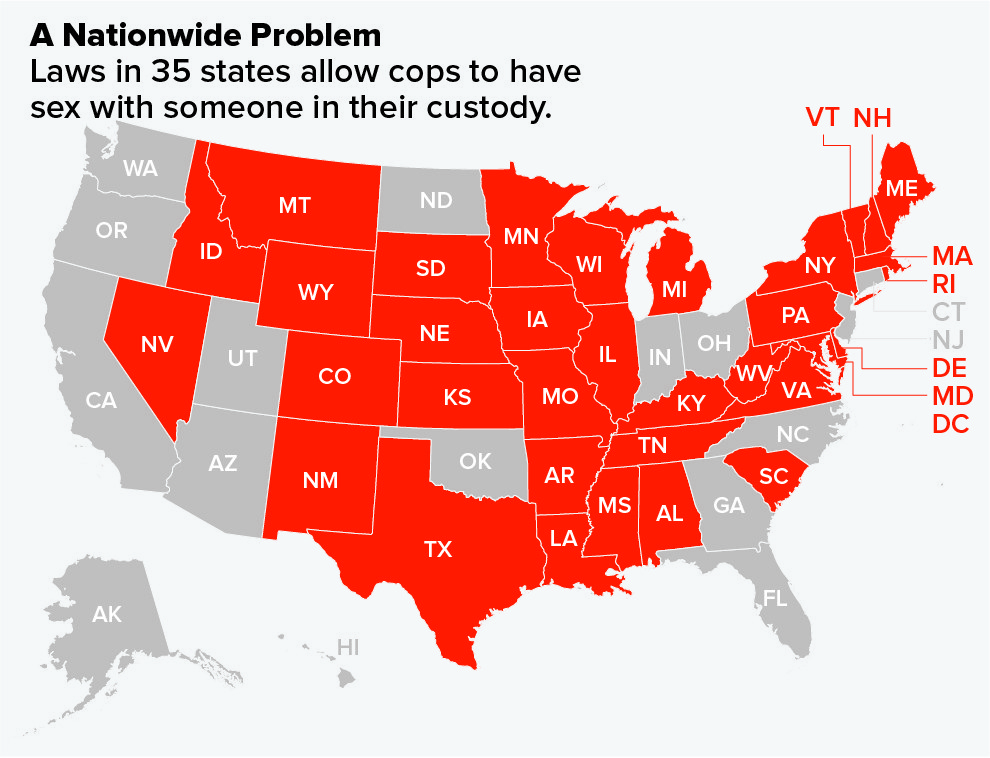
Laws in most states allow police to have sex with people in their custody. That needs to change!!

Anna was sitting in the parked car with two friends when a charcoal gray van pulled up and flashlight beams momentarily blinded her. The 18-year-old had grown up in south Brooklyn and spent many Friday nights like this driving around the city with friends, looking for places to hang out away from home. On this night, though, September 15, 2017, sometime between 7:30 p.m. and 8 p.m., she crossed paths with the cops.
There were two of them, both plainclothes detectives over 6 feet tall and powerfully built, flashing their badges and asking questions. There was weed in the front cupholder, and soon the detectives ordered the three occupants out of the car. As Anna later recalled, the detectives handcuffed her and told her friends, both young men, they were free to go. Then, she said they led her — a slender woman just over 5 feet tall — into the back of the unmarked police van with tinted windows.
Inside, Anna said the detectives took turns raping her in the backseat as the van cruised the dark streets and as she sat handcuffed, crying and repeatedly telling them “No.” Between assaults, she said, the van pulled over so the cops could switch drivers. Less than an hour later, a few minutes’ drive from where it all began, the detectives dropped Anna off on the side of the road, a quarter-mile from a police station, surveillance footage shows. She stood on the sidewalk, her arms wrapped around her chest, looking up and down the dimly lit street and pacing slowly before borrowing a cell phone from a passerby to call a friend.
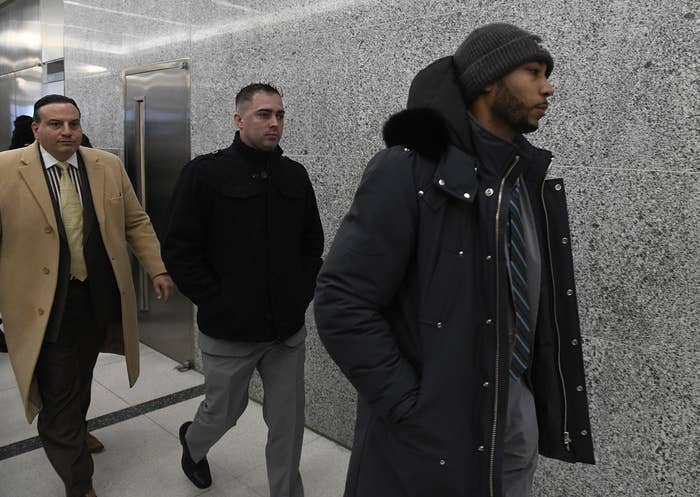
The cops made no arrest, issued no citation, filed no paperwork about the stop. Hours later, Anna and her mother went to a hospital, where Anna told nurses two detectives had sexually assaulted her, according to hospital records. Semen collected in Anna’s rape kit matched the DNA of detectives Eddie Martins, 37, and Richard Hall, 33, of the Brooklyn South narcotics unit. Both have since resigned from the force and been charged with rape.

Barry Williams
Former NYPD Detectives Eddie Martins (center) and Richard Hall (right) leaving Kings County Supreme Court in January.

Anna assumed it was a simple case: Two cops had sex with a woman in their custody in the middle of their shift.
When a Facebook friend questioned whether there was enough evidence to dispute the officers’ claim that the sex was consensual, Anna wrote back, “Listen man it doesn't fucking matter they’re on duty police officers its a fucking violation these are the people we call for help not to get fucked.”
But Anna didn’t know that in New York, there is no law specifically stating that it is illegal for police officers or sheriff’s deputies in the field to have sex with someone in their custody. It is one of 35 states where armed law enforcement officers can evade sexual assault charges by claiming that such an encounter — from groping to intercourse — was consensual, according to a BuzzFeed News review of every state legal code.

“Our laws regarding sexual consent must be brought into line with basic common sense, empathy, and human decency.”

In recent years, some states have closed this loophole, applying to cops the same rules already in place nationwide for probation officers and prison and jail guards. Oregon did so in 2005, Alaska in 2013, and Arizona in 2015. Most have not, partly because few people realize the loophole exists, and partly because it has been politically unpopular to push laws that target cops and anger their powerful unions.
Of at least 158 law enforcement officers charged since 2006 with sexual assault, sexual battery, or unlawful sexual contact with somebody under their control, at least 26 have been acquitted or had charges dropped based on the consent defense, according to my review of a Buffalo News database of more than 700 law enforcement officers accused of sexual misconduct.
In most of the states that do not explicitly outlaw sex between on-duty cops and detainees, including New York, an officer can claim consent and face only a misdemeanor “official misconduct” charge, which carries a maximum one-year sentence.
“Cultural shifts happen, but what we need to see is a policy shift,” said Terra Burns, an advocate in Alaska who has worked to expand police sexual assault laws. “There’s a long entrenched history of institutionalized rape culture that has to change.”

BuzzFeed News
Anna’s case has brought new attention to this legal loophole. On October 26, 2017, New York City Council member Mark Treyger announced that the teen’s story had inspired him to propose a bill to make it illegal for police officers to have sex with anyone in their custody. “Our laws regarding sexual consent must be brought into line with basic common sense, empathy, and human decency,” he wrote in a post on Medium, calling on state lawmakers to pass similar legislation. New York City’s two biggest police unions both declined to state whether or not they support the proposal.
Anna hadn’t considered that her story had the potential to spur changes to the law. Her aim when she went public about her case was simply “to encourage other victims to come forward,” she told me after a recent court appearance. “Police aren’t supposed to be doing this.” Seeing her story “blowing up,” as she put it, has left her optimistic that more officers will be held accountable for sexual abuse. She believes that people are listening to her and will listen to others who have similar allegations. “All it took was one voice.”
Anna’s last name hasn’t been made public, which is usually the case for the alleged victim in a rape case. In court documents she is referred to as “Anna Doe,” but on Facebook, Twitter, and Instagram she goes by the screenname she’s used since middle school: Anna Chambers. The daughter of Russian immigrants, Anna attended a racially diverse public high school, owns an impressive collection of Air Jordans, and wants to become a paralegal one day. She has tried to maintain her routine as the case has gone on, clinging to the normalcy she can find in this abnormal period. She still goes to the occasional house party or music show, still posts bedroom mirror selfies, still lives her life. On October 5, two weeks after she reported that she was raped, she was ticketed for weed possession.
The same day, the New York Times exposed Harvey Weinstein’s history of sexual misconduct, triggering scrutiny of powerful men who abuse their authority across a wide range of industries — Hollywood, media, politics, restaurants, hotels, sports, finance, factory work, housing. As the accuser in the first high-profile police sexual assault case since then, Anna stands at the intersection of two cultural shifts: the rising credibility of women who report sex crimes in the #MeToo era, and the falling credibility of police in an era flooded with videos of cops doing wrong.

Anna stands at the intersection of two cultural shifts: the rising credibility of women, and the falling credibility of police.

She has not shied from the moment. She has rallied support online, and now has around 7,000 followers on Twitter and 12,000 on her private Instagram account. “Thank you,” she replied to one well-wisher. “Who knows how many other girls they’ve done it to.”
Policing is a male-dominated field — Department of Justice statistics show that more than 80% of officers are men — where abuse is more rampant than statistics indicate because victims are less likely to report officer misconduct. “Police abuse of authority is often concealed,” said Norm Stamper, a former Seattle police chief. “Victims fear coming forward for fear of retaliation.” Officers who rape have plenty of weapons at their disposal: the threat of arrest, the access to a victim’s personal records, and the aura of immunity that comes from carrying a badge. The most sweeping investigation into the scope of police sexual misconduct, by the Associated Press in 2015, counted 990 law enforcement officers who lost their job for sexual misconduct between 2009 and 2014.
“Part of the reason the problem’s so bad in policing is there are people who are drawn to the job for the gun and the badge and the authority,” said Penny Harrington, a former Portland, Oregon, police chief. “And everybody else just keeps their mouth shut.”
Anna began telling her story publicly three days after her encounter with Martins and Hall, tweeting on September 18 — when only her parents, her friends, hospital nurses, and police knew about it — “These crooked ass cops i swear i never want to see one again. What if someone did that to your daughter.” On September 30, two days after the New York Post first reported on her allegations, which were laid out in a court document, she tweeted a photo of a New York Daily News article bearing her photo alongside the headline “Cop Savages.” “This is nuts,” she wrote.
In the months since, she has continued to chronicle her case on social media, posting links to news articles on Twitter and Facebook, sharing photos and videos of her trips to court on Instagram, retweeting the comments of others, and providing her own thoughts on the legal process in the efficient, blunt language of the internet.

“Tryna smear someone who got raped. Be proud of yourselves NYPD this is how you guys work?”

October 22, the day defense lawyers disputed her account: “Tryna smear someone who got raped. Be proud of yourselves NYPD this is how you guys work?”
October 27, the day the Brooklyn District Attorney’s Office filed charges of rape, kidnapping, bribery, and official misconduct against Martins and Hall, who face up to 25 years in prison: “GODBLESSSSSS”
November 6, the day Martins and Hall resigned from the NYPD: “Their bail should be revoked since they aren’t ‘cops’ anymore.”
Her lawyer, Michael David, offered to represent Anna after learning that one of his longtime clients was a relative of hers. It’s the biggest case he’s ever handled, and his initial instinct was to rein in her social media activity to protect her from posting something that could be used against her in court.
But she had no interest in being a silent observer, especially at a time when so many women were speaking up about their experiences with sexual assault and harassment. “Usually an attorney tells their client to stay off social media, but in her case it was just the opposite,” David said. “I didn’t tell her to tone it down. It got her attention. It got her media pressure.”

Barry Williams
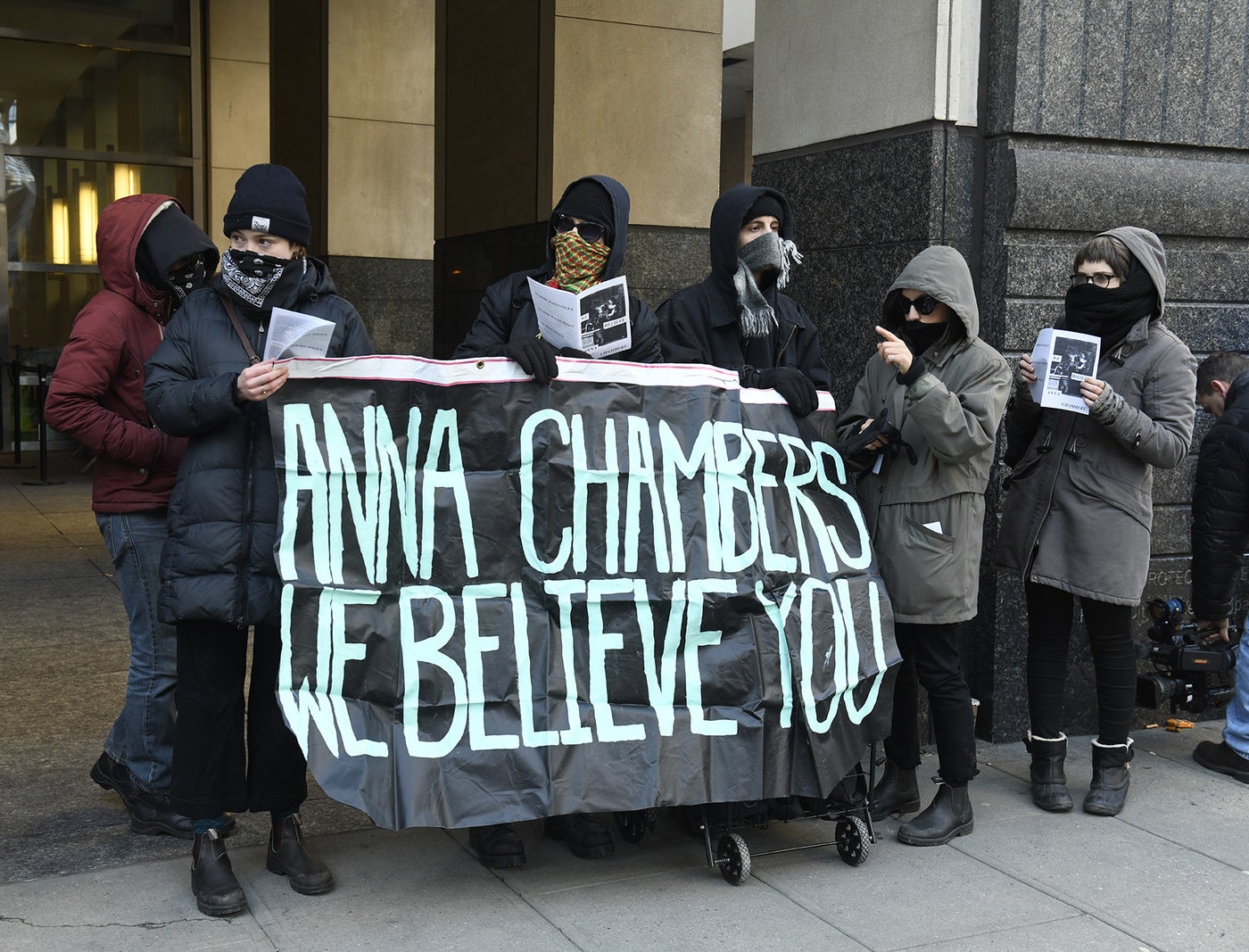
Supporters of Anna Chambers outside Kings County Supreme Court in Brooklyn.

With Anna’s approval, David shared the details of her allegations in interviews with several news outlets: the detectives ordering her to take off her bra to show she wasn’t hiding drugs, telling her friends not to follow the van, making their intentions clear once they were on the road, then forcing themselves on her.
By mid-October, Anna’s name had become a hashtag. The first rally in her honor was on October 17, when about two dozen supporters marched through southern Brooklyn chanting her name and carrying signs that said, “We believe you.” On October 28, Funkmaster Flex, perhaps the most famous hip-hop radio DJ in the world, used the entirety of his five-hour Saturday night show to bring attention to her case, urging listeners to call in if they had any information about Martins and Hall.
A month later, more than 50 supporters gathered in Washington Square Park in Manhattan for another rally. “I obviously am not allowed to attend, but guys I really fucking truly appreciate this so much,” Anna wrote on the Facebook page for the event, adding in a later post, “Please send all pics/videos you guys may have.” Weeks later, on the morning of a court hearing for the case, a banner was hung from the Manhattan Bridge: “Martins & Hall aren’t the only rapists / Abolish police.”

“It’s the first time I’ve felt hope in years,” she said. “All of a sudden women are being heard.”

Across the country, police departments are being pushed to confront longtime patterns of abuse. In October, a retired Anchorage, Alaska, Police Department captain wrote a newspaper column detailing the “incessant” sexual harassment she experienced from fellow cops during her career. At a Chicago Police Board meeting in January, a woman shared her experience of getting raped by a cop during her teenage years in the 1980s. Some activists have begun using the hashtag “#policetoo.” In the five weeks following the Weinstein news, at least three police chiefs were fired for sexual misconduct. Since October, at least 21 cops in seven states have resigned or been terminated because of sexual misconduct allegations.
While there have been high-profile cases of police sexual assault in recent years, the culture of misogyny and invulnerability in most police departments remains, said Harrington, the former police chief in Portland. But she believes a reckoning is coming to law enforcement. “It’s the first time I’ve felt hope in years,” she said. “All of a sudden women are being heard.”
And yet, New York's law means that a trial will pit the word of two ex-cops against the word of a teenager.
The legal process requires Anna to recall the events repeatedly, in detail. In the past five months, she has given statements to a series of NYPD investigators, to her lawyer, to prosecutors, to a grand jury, and to attorneys representing the city for her lawsuit against the department.
“It’s painful,” she said. “I didn’t know what to expect. I still really don’t.” To Anna, some of those sessions, especially with city attorneys, felt more like interrogations. She hadn’t thought much about the court system before all this. She didn’t know how much of her life was now open for questioning. She hadn’t seen any need to clean up her social media accounts, and didn’t know her old posts could be used as evidence that she was lying. She’d put up photos of herself in bikinis. She’d gone to a porn convention when she was 17. She’d posted on Facebook a link to a website about sex when she was 13. She has never hidden that she enjoys smoking weed. Sometimes she makes dirty jokes.
“Who gives a fuck about what I post,” she tweeted after learning that defense attorneys were citing photos, videos, and comments from her social media history in an effort to persuade the DA’s Office to drop the charges.
Defendants Martins and Hall haven’t told their side. The gist of their defense at this point: “There was no nonconsensual sexual encounter,” said Martins’ lawyer, Mark Bederow, a former assistant district attorney in Manhattan who has worked criminal defense since 2004. He denied that Anna was handcuffed and that the men used physical force on her. While defense lawyers won’t say what, according to the cops, happened inside the van, their public statements and the evidence they have presented so far point to their only possible legal strategy: Painting Anna as a temptress who came onto them.
This has been the most common defense used by cops acquitted in sexual assault cases. In 2007, former Irvine, California, police officer David Alex Park was acquitted of sexual assault after claiming that the woman initiated sex to avoid getting a ticket. In 2016, before Arizona’s recently passed consent law went into effect, former Phoenix police officer Timothy Morris was acquitted of sexual assault even though he admitted to having oral sex with a handcuffed woman in his patrol car, claiming she had seduced him.
Lawyers for Martins and Hall have canvassed Anna’s social media footprint. They’ve flagged items posted since the incident: a tweet about the “paparazzi” she found waiting for her outside the courthouse; captions dubbing herself “50mily,” a possible reference to her $50 million lawsuit against the department; tweets with any sort of sexual reference; comments on her pages posted by others claiming to have evidence that she is lying, including one to which she replied, “I hope ya mommy gets gang raped.”
The effort to damage Anna Chambers’ credibility became known to the public in October when the New York Post obtained a letter the defense lawyers had sent to prosecutors, referencing “provocative photos” and arguing that the DA’s office should “further investigate Chambers’ dubious claims.” The lawyers suggested that the life she presented on social media was evidence that she had not undergone the trauma of a sexual assault. “This behavior is unprecedented for a depressed victim of a vicious rape,” the letter said.
In December, Anna gave her deposition for the lawsuit. In the conference room of a private law firm, she and her lawyer sat across the table from attorneys representing New York City. The questioning and answering spanned 12 hours over three days, and when the transcript was typed up it ran for 740 pages. Hours were spent going over her social media posts, a painstaking accounting going back to her middle school years. Another chunk was devoted to her sexual history. Another covered her gynecological exams. During a round of questioning about a set of Facebook comments, she broke into tears.
The trial is likely many months away. At some point, a judge will determine how much of Anna’s personal and social media life defense lawyers may present at trial. At some point beyond that, she will take the witness stand and be cross-examined by the lawyers who have called her a liar.
Lawyers for Martins and Hall continue to call on the DA’s Office to drop the charges, accusing prosecutors of ignoring evidence that reveals Anna’s “willingness to lie” and of rushing the case forward to satisfy Anna’s supporters who want to see the men held accountable. Of the evidence the defense has pulled from her social media history to undermine her, Anna said, “None of that should matter.” It only matters because of the loophole.
In another letter challenging Anna’s credibility, filed in January, defense attorneys pointed out various inconsistencies among her statements, including over which detective told her to take off her bra, which pocket her cell phone was in, the reason she took time away from high school, and why she told city attorneys she’d dressed up as the Disney princess Jasmine for Halloween when her social media posts showed her in an orange inmate costume, a set of handcuffs dangling from her belt. A judge plans to rule by April 5 on which, if any, portions of the deposition transcript are admissible for trial.
Meanwhile, Anna, who is now 19, still lives in a neighborhood policed by former colleagues of the men she accused. “I see police cars park on my block all the time,” she told me. “I feel like I’m being watched.” She has felt that way since that night at the hospital, when she counted nine cops, of various ranks and roles, passing through the hallway as the investigation into her case began. She spends most days in her room on social media, she said. Those who follow her on Instagram can see the live videos she often posts from her bedroom, rapping to songs or talking to friends or putting on lip gloss while she scrolls through her phone. She responds to the comments, which mostly show love, sometimes spew hate, and every now and then offer advice on her case or encourage her to run for political office. She seems at ease, though not relaxed. She still lives her life, but it is now a life that carries the weight of that September night, and all that has followed. She seems to understand the long road she’s facing, and how lonely it can be. On the first day of 2018, she tweeted a link to a news article about her case, with the note, “Lets not forget.”
And many haven’t. On January 18, the morning of Anna’s latest hearing, about a dozen supporters stood outside the courthouse holding two signs: “Anna Chambers We Believe You” and “Let’s Smash This Rapist Cop State.” Passersby stopped and asked about the case. Staffers talked about it in elevators. Photographers and television cameras gathered in the hallway outside the courtroom. Anna walked past them without looking, her hands in the pockets of her green bomber jacket, her eyes behind reflective sunglasses, her two lawyers flanking her. The gallery was already half full by the time she entered, and she found a seat in a middle row. When Martins and Hall arrived a few minutes later, the only open spot left was just across the aisle. That night, Anna posted on Instagram a photo of herself leaving the courtroom, writing in the caption, “Its disgusting seeing these monsters 12 ft away from me.” ●

CORRECTION

Anna tweeted a photo of a New York Daily News article about her case on Sept. 30. An earlier version of this story misidentified the newspaper.

CORRECTION

Ohio's law bars sex in custody between police and detainees, and DC's does not. An earlier version of the map in this story had the colors reversed.
LINK


LINK


WBUR TODAY: The Kraft-Macklemore clash

                                                     LOTS OF POSTS IGNORED BY BLOGGER..... OR REMOVED ON THEIR WHIM! ALL POSTS ARE AVAILABLE...