
25 April 23
Live on the homepage now!
Reader Supported News
YES WE “DESERVE” A LITTLE BIT OF SUPPORT — Why? Because we show up every day, we never back down, we never forget who sustains us, we never forget who oppresses us. Get behind this organization. We need you and we are proud of it. This is where we make our stand, make it with us.
Marc Ash • Founder, Reader Supported News
Sure, I'll make a donation!

David A. Graham | Tucker's Successor Will Be Worse
David A. Graham, The Atlantic
Graham writes: "Tucker Carlson's rise to become the defining conservative-media personality of the Donald Trump period was a surprise. His abrupt departure from Fox News, announced this morning, is even more shocking."
The history of Fox News shows that the network and its issues are larger than any one anchor.
Tucker Carlson’s rise to become the defining conservative-media personality of the Donald Trump period was a surprise. His abrupt departure from Fox News, announced this morning, is even more shocking.
“FOX News Media and Tucker Carlson have agreed to part ways,” the company said in a terse statement. “We thank him for his service to the network as a host and prior to that as a contributor.”
Carlson transformed himself from a bow-tie-clad smart aleck playing the role of liberals’ favorite conservative into a MAGA hero, able to channel the grievances of the Trump coalition despite his patrician upbringing and reputation—or perhaps, like Trump, because of it. In the process he became Fox’s biggest star, talked about as a potential presidential candidate. Carlson was a font of dangerous rhetoric and preposterous lies, and Fox’s viewers absolutely loved it.
The reasons for Carlson’s departure, and the steps he might take next, are still unclear. But Fox will probably be fine without Carlson, and anyone who hopes that his disappearance from the air will improve the political discourse in this country is too optimistic. When prior bogeymen for the left—people such as Bill O’Reilly and Glenn Beck—have been pushed out of Fox, the network has always found a new figure to replace them, while the hosts themselves have struggled to match their past success. There will be a new Tucker Carlson, and it’s a good bet he or she will be even worse.
The exit comes at a time of flux for Fox. Its founder, Rupert Murdoch, is 92 and has faced recent health struggles. Fox just settled a lawsuit with Dominion Voting Systems over election-related lies for almost $800 million, and faces several more. The discovery process that led up to the settlement was embarrassing for Fox and for Carlson. Internal messages showed that Carlson and his colleagues knew that many of the claims they made about election fraud after the 2020 election were nonsense. They also showed Carlson furious over Fox journalists accurately reporting facts, which he worried would hurt ratings, and saying that he hated Trump. (This revelation didn’t prevent him from conducting an obsequious interview with the former president earlier this month.)
When the settlement was announced last week, I argued that no matter the hefty bill, it was just the cost of doing business for Fox. The network settled the suit, but airing the lies achieved its goal of vanquishing smaller, upstart conservative rivals. Fox is and remains larger than even its most important figures.
Carlson will not go away, but recent history suggests that he’ll have a hard time maintaining his current profile. Before Carlson, there was Bill O’Reilly, who was the leading conservative figure of his era and equally reviled by progressives. When O’Reilly was finally forced out of Fox in 2017 over sexual-misconduct claims, many critics hoped it would improve the state of the country and the press. Instead, it cleared the way for Carlson. O’Reilly has kept writing best-selling books but has become a more marginal figure in politics.
This pattern has repeated itself over the years. After O’Reilly, the long-time star Sean Hannity became Fox’s marquee name. His influence was such that he was sometimes referred to as Trump’s real chief of staff. But Hannity was unable to sustain his success, and though he remains at Fox, he was eventually eclipsed by Carlson.
A second-tier Fox star of the Obama years was Glenn Beck, a shouty and excitable host whose rise seemed to threaten O’Reilly’s seat on the throne. He was pushed out in 2011, and though Beck’s career has continued since, his plan to challenge Fox’s supremacy with The Blaze came up short, and he’s never matched the relevance he had on Fox.
The original mastermind of Fox News was Roger Ailes, the veteran TV executive and former Richard Nixon aide who recognized the market for an avowedly right-wing channel. When Ailes was forced out in 2016 (also related to sexual misconduct), many liberals hoped that it would doom the channel. But Fox is still Fox—the leader in ratings and the center of conservatism.
More details about why Carlson is leaving will surely emerge soon. Though he was connected to the Dominion lawsuit, as well as to other defamation cases against the company, a more serious offender was Maria Bartiromo, who remains at Fox (at least for now). Carlson is also implicated in a lawsuit by Abby Grossberg, a former Fox producer who has claimed that she experienced an appalling work environment while working on Carlson’s show. The Washington Post reported that Carlson’s messages criticizing Fox’s top leadership “played a role in his departure,” and his political ambitions and his penchant for dishing to reporters could easily have created tensions with bosses.
Any rising conservative TV star would love to grab for the crown Carlson has doffed, or that’s been taken from him. The audience, influence, and money involved make it irresistible, but his career arc illustrates the hazards. To remain on top at Fox, hosts have to be ready to continually ratchet up their rhetoric, because the network’s business model depends on continual audience outrage. But audiences eventually become inured and require new and more extreme input. Providing that is a challenging and soul-leaching job—and someone will be delighted to have it.
READ MORE
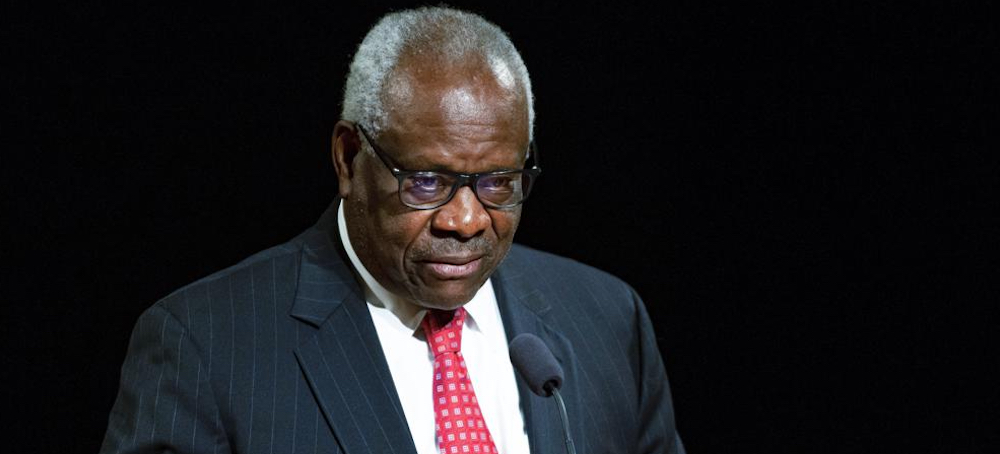 Clarence Thomas. (photo: Robert Franklin/AP)
Clarence Thomas Didn't Recuse Himself From a 2004 Appeal Tied to Harlan Crow's Family Business
Lauren Steussy, Business Insider
Steussy writes: "Justice Clarence Thomas didn't recuse himself from a 2004 appeals case, even though the company being sued was part of the real estate empire run by Harlan Crow, the GOP mega-donor who has showered Thomas with lavish trips starting in 1997 and more recently bought Thomas' childhood home, according to Bloomberg."
Justice Clarence Thomas didn't recuse himself from a 2004 appeals case, even though the company being sued was part of the real estate empire run by Harlan Crow, the GOP mega-donor who has showered Thomas with lavish trips starting in 1997 and more recently bought Thomas' childhood home, according to Bloomberg.
Thomas previously told Bloomberg that it was OK for him to accept gifts from Harlan Crow because the GOP mega-donor did not have "business before the court."
But the 2004 appeal ties the Crow family name to a case that did come before the Supreme Court: In January 2005, the court denied the appeal petition, a $25 million copyright claim brought by an architecture firm against Trammell Crow Residential Co., a development company that's part of the real estate empire built by Crow's father. The Supreme Court's decision ultimately benefitted Trammell Crow Residential.
Thomas is facing heavy scrutiny following a series of ProPublica reports earlier this month that said he sold his childhood home to Crow and didn't disclose the sale, and that he's been accepting pricey vacations from Crow — without disclosing them — for over 20 years.
Crow's office did not respond to Insider's request for comment, but in a statement to Bloomberg, a spokesperson noted that Crow Holdings — the company that manages the Crow family capital and which Harlan Crow was the CEO of at the time of the appeal — operated independently of Trammell Crow Residential, its multifamily development platform.
Harlan Crow was CEO of Crow Holdings from 1988 to 2017, and remains chair of its board, per Bloomberg and The Real Deal.
"At the time of this case, Trammell Crow Residential operated completely independently of Crow Holdings with a separate management team and its own independent operations," the statement to Bloomberg said. "Crow Holdings had a minority interest in the parties involved in this case and therefore no control of any of these entities. Neither Harlan Crow nor Crow Holdings had knowledge of or involvement in this case, and a search of Crow Holding's legal records reveals no involvement in this case. Harlan Crow has never discussed this or any other case with any justice."
Thomas did not respond to Insider's request for comment via the Supreme Court's media email address.
It's not known whether Thomas would have made the connection between Trammell Crow Residential and Harlan Crow, who, at the time, had already begun to give Thomas gifts and trips, according to a 2004 Los Angeles Times report.
But Thomas should have been "hypervigilant to the prospect of a Crow interest showing up on the Court's docket," given their friendship, Stephen Gillers, a judicial ethics expert at New York University School of Law, told Bloomberg.
The case, however, wouldn't have violated any Supreme Court code of conduct — there is no such thing. Justices are obliged to recuse themselves from cases directly involving a family member, or if they stand to be impacted financially by the outcome, per Bloomberg.
But one legal ethics expert previously told Insider that Thomas' recently-unearthed conduct could push the court to adopt a code of conduct, or at least use the code applied to other federal judges.
"I think it's quite likely we get some movement in one of those ways," Clare Pastore, a professor of the practice of law at USC Gould School of Law, told Insider. "That would be a good step in the right direction."
READ MORE
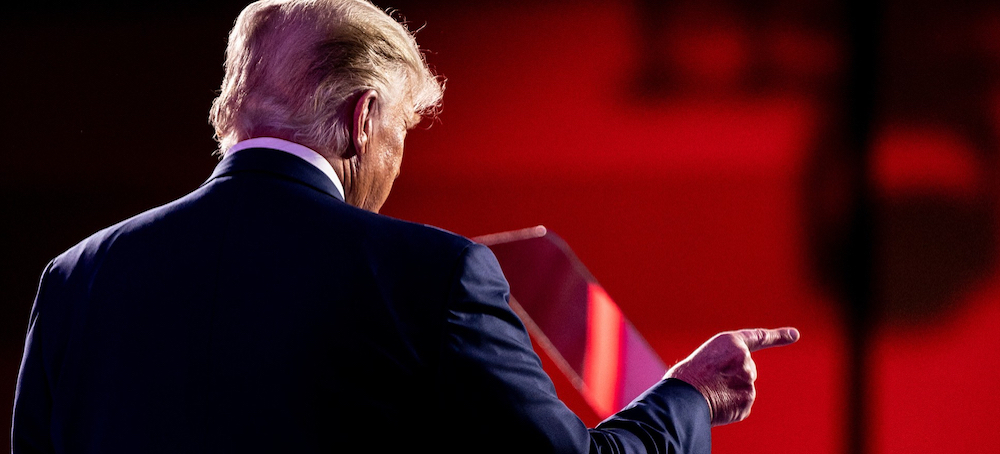 Donald Trump. (photo: Erin Schaff/NYT/Redux)
Atlanta Prosecutor Sets Timetable for Charging Decisions in Trump Investigation
Richard Fausset and Danny Hakim, The New York Times
Excerpt: "The prosecutor leading the investigation of former President Donald J. Trump and his allies in Georgia said on Monday that she is aiming to announce any indictments by mid-July at the earliest, according to a letter she sent to a top local law enforcement official."
In a letter on Monday, the prosecutor said she would announce any indictments from her investigation into Donald J. Trump and his allies between July 11 and Sept. 1.
The prosecutor leading the investigation of former President Donald J. Trump and his allies in Georgia said on Monday that she is aiming to announce any indictments by mid-July at the earliest, according to a letter she sent to a top local law enforcement official.
In her letter, Fani T. Willis, the district attorney in Fulton County, Ga., said that any charges would come during the court term that runs from July 11 to Sept. 1.
In January, Ms. Willis said that charging decisions in the investigation were “imminent.” But her timetable has been delayed, in part because a number of witnesses have sought to cooperate as the investigation has neared an end. Local law enforcement also needs time to prepare for potential security threats, a point that Ms. Willis emphasized in the letter.
Further complicating matters, Ms. Willis’s office filed a motion last week seeking the removal of a lawyer who is representing 10 Republicans who were part of a bogus slate of electors who sought to help Mr. Trump stay in power even after he lost the 2020 election in Georgia.
“In the near future, I will announce charging decisions resulting from the investigation my office has been conducting into possible criminal interference in the administration of Georgia’s 2020 General Election,” Ms. Willis wrote in the letter, which was sent to the sheriff of Fulton County, Patrick Labat, and was first reported by The Atlanta Journal-Constitution. “I am providing this letter to bring to your attention the need for heightened security and preparedness in coming months due to this pending announcement.”
Ms. Willis’s office has spent more than two years investigating whether the former president and his allies illegally meddled in Georgia’s 2020 election, which Mr. Trump narrowly lost to President Biden.
A special grand jury that heard evidence in the case for roughly seven months recommended more than a dozen people for indictments, and its forewoman strongly hinted in an interview with The New York Times in February that Mr. Trump was among them.
Ultimately, it will be up to Ms. Willis to decide which charges to seek before a regular grand jury. Her letter, which was copied to a number of local officials, expressed grave concerns about courthouse security after her decisions are announced.
“Open-source intelligence has indicated the announcement of the decisions in this case may provoke a significant public reaction,” Ms. Willis wrote. “We have seen in recent years that some may go outside of public expressions of opinion that are protected by the First Amendment to engage in acts of violence that will endanger the safety of our community. As leaders, it is incumbent upon us to prepare.”
Security has been a concern of Ms. Willis’s for some time, and she has had some members of her staff outfitted with bulletproof vests. She wrote to the Atlanta field office of the Federal Bureau of Investigation in early 2022, a few months before the special grand jury began meeting to consider evidence and hear testimony in the case.
In that letter, Ms. Willis asked that the F.B.I. conduct a risk assessment of the county courthouse in downtown Atlanta and “provide protective resources to include intelligence and federal agents.”
Ms. Willis also noted in the F.B.I. letter that Mr. Trump, at a rally in Conroe, Texas, had called the prosecutors investigating him “vicious, horrible people,” and said he hoped “we are going to have in this country the biggest protests we have ever had in Washington, D.C., in New York, in Atlanta and elsewhere because our country and our elections are corrupt.”
Ms. Willis wrote that Mr. Trump had said at the same event that if re-elected, he might pardon people convicted of crimes related to the Jan. 6, 2021, riot at the United States Capitol. Armed pro-Trump protesters appeared around the Georgia State Capitol building a number of times in the weeks after the 2020 election, as Mr. Trump and his allies pushed false accusations of electoral fraud. On at least one occasion, armed counterprotesters were also in the streets.
On Jan. 6, 2021, Secretary of State Brad Raffensperger of Georgia and his staff evacuated their offices at the State Capitol over concerns about a group of pro-Trump protesters, some armed with long guns, who were massing outside. Mr. Trump had previously called Mr. Raffensperger an “enemy of the people” for what Mr. Trump characterized as his mishandling of the Georgia election process.
“We must work together to keep the public safe and ensure that we do not have a tragedy in Atlanta similar to what happened at the United States Capitol on Jan. 6, 2021,” Ms. Willis wrote to the F.B.I.
Last month, Mr. Trump’s legal team in Georgia filed a motion seeking to quash the final report of the special grand jury. Portions of that report, which remain sealed, recommend indictments for people who have not been specified. The motion also asks that Ms. Willis’s office be disqualified from the case.
In a statement on Monday, the lawyers reiterated that they believed that the investigation so far has been a “deeply flawed legal process.”
READ MORE
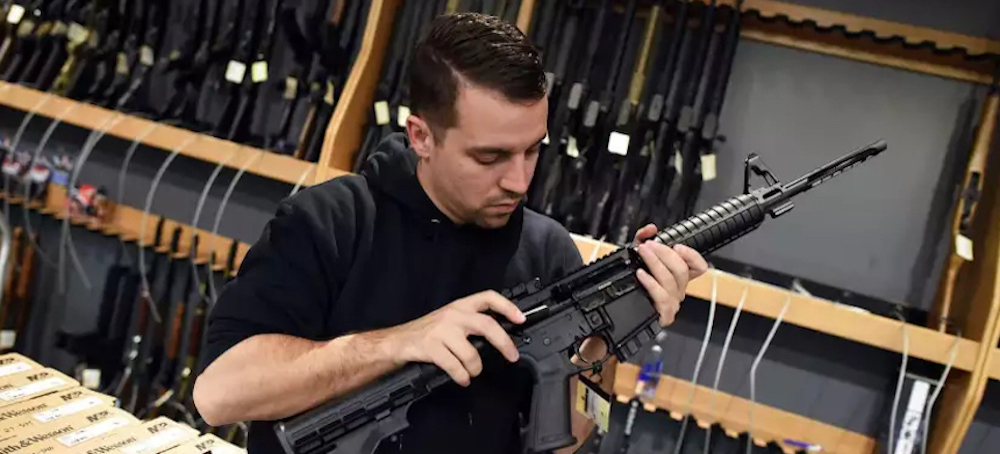 An employee checks the chamber of an assault-style rifle at a shooting range. (photo: Jewel Samad/AFP)
Republicans 'Glorify Political Violence' by Embracing Extreme Gun Culture
Adam Gabbatt, Guardian UK
Gabbatt writes: "Republicans in Idaho have been criticized for 'glorifying political violence' after the party hosted Kyle Rittenhouse, the American who shot and killed two people at an anti-racism protest and injured another, as a celebrity guest at a fundraiser."
Kyle Rittenhouse, who shot and killed two people at an anti-racism protest, was guest of honor at Idaho Republican party fundraiser
Republicans in Idaho have been criticized for “glorifying political violence” after the party hosted Kyle Rittenhouse, the American who shot and killed two people at an anti-racism protest and injured another, as a celebrity guest at a fundraiser.
The 20-year-old was the guest of honor at a Bonneville county Republican party event, in Idaho Falls, Idaho, on 15 April, where an AR-15 style rifle signed by Rittenhouse was auctioned off as part of a fundraiser and people could buy tickets to “Trigger time”: a Rittenhouse-hosted shooting event at a gun range.
The event, amid a prolonged spate of mass shootings – many conducted with AR-15s – suggests a further embrace by Republicans of the most extreme elements of the gun lobby in the US, despite polls showing a majority of Americans, across party affiliation, supporting some gun control laws.
Rittenhouse was 17 years old when he traveled to Kenosha, Wisconsin, from his home in Illinois, armed with an assault-style rifle, in August 2020. Black Lives Matter protests had been taking place in the city after Jacob Blake, an unarmed Black man, was shot seven times in the back by a white police officer, leaving Blake partially paralyzed.
Rittenhouse joined other armed men acting as a self-described militia and roamed the city, before killing Joseph Rosenbaum, 36, and Anthony Huber, 26, and wounding Gaige Grosskreutz, 27.
In a speech to the Bonneville county Republicans, Rittenhouse complained that he faces “ridicule on a daily basis” since he killed Rosenbaum and Huber. He was found not guilty of homicide in November 2021.
The now 20-year-old Rittenhouse, who told the crowd in Idaho that the government was seeking to “take our guns” and “take the rest of our freedoms”, has become a darling of the far right since the shooting, appearing on Fox News and other rightwing media.
The embrace and lauding of someone like Rittenhouse is dangerous, said Stephen Piggott, a researcher at Western States Center who focuses on white nationalist, paramilitary and anti-democracy groups.
“Elected officials and media personalities should really be denouncing political violence, not embracing it,” Piggott said.
“For a GOP [group] to not only host and organize a fundraiser with him, and a shooting range event, call that event Trigger Time, I think really is the very epitome of glorifying political violence.”
Rittenhouse addressed the crowd in Bonneville county, where he said stricter gun control laws would not “lower the unfortunate school shootings”. He complained that he was facing two lawsuits, one from the family of one of the men he killed and another from Grosskreutz.
“I’m being sued by the estate of Anthony Huber,” Rittenhouse said.
“He was the guy who attacked me with a skateboard and I was forced to defend my life from him.”
Rebecca Casper, the mayor of Idaho Falls, said Rittenhouse “does not represent the majority of the people in Idaho Falls”.
“Make no mistake, this unfortunate, distasteful and insensitive event was in no way supported by the City of Idaho Falls,” Casper said. “We are an inclusive and welcoming community and we join with so many others in voicing our dismay over such an insensitive and patently offensive event.”
Rittenhouse’s appearance comes as the GOP and rightwing media have increasingly embraced rhetoric previously confined to fringe extremist groups, Piggott said, sparking fear and potentially increasing violence.
“The rhetoric that I’ve seen from elected officials, from media personalities, especially when it talks about things like urban crime is practically indistinguishable from what I’m seeing from white nationalists talking about the same subject,” he said.
“We’re at a point now where elected officials and media personalities are almost doing the work for white nationalists, especially when talking about crime.”
Rittenhouse’s appearance comes amid a series of high-profile shootings in the US. According to the Gun Violence Archive there have been 167 mass shootings – defined as incidents where four people were shot or killed – in the US through 21 April.
Six people, including three nine-year-old students, were murdered at a school shooting in Nashville on 27 March, while a gunman shot and killed five people at a bank in Louisville, Kentucky, on 10 April. AR-15-style weapons were used in both mass shootings.
On 13 April Ralph Yarl, a 16-year-old Black boy, was shot twice by a white man after ringing the doorbell at the wrong house. Two days later a 20-year-old woman was shot and killed in New York state when she and some friends turned into the wrong driveway while looking for a house.
“[Commentators] on the right have spent the last few years warning their viewers that vigilante justice might be necessary to keep their families safe – and Kyle Rittenhouse is the poster child for that inflammatory talking point,” said Matt Gertz a senior fellow at Media Matters for America, a watchdog group that monitors rightwing media.
Meanwhile there have also been spikes in hate crimes and incidents in the US. Violence against trans people and gender non-conforming people has risen in recent years, as have hate crimes against people based on their race, ethnicity or ancestry.
Piggott said rhetoric against those communities could have contributed to the violence. He pointed to a Florida Republican recently describing transgender people as “demons” and “mutants”, and Paul Gosar, a Republican US representative, referring to an “invasion of illegal aliens”, as examples.
“When you’re using that type of rhetoric, that’s either violent or dehumanizing or both, I think it sends a green light that violence against those communities is acceptable,” Piggott said.
The Bonneville county Republican party did not respond to a request for comment, and it seems unlikely that this will be Rittenhouse’s last invitation to a rightwing event.
So far this year alone Rittenhouse has appeared on Donald Trump Jr’s podcast, and been interviewed by Sebastien Gorka, a former Trump administration official, on his America First show.
A planned appearance at an “anti-censorship” rally at a Texas brewery in January was canceled, however. The brewery’s owner pulled the event after multiple customers complained.
READ MORE
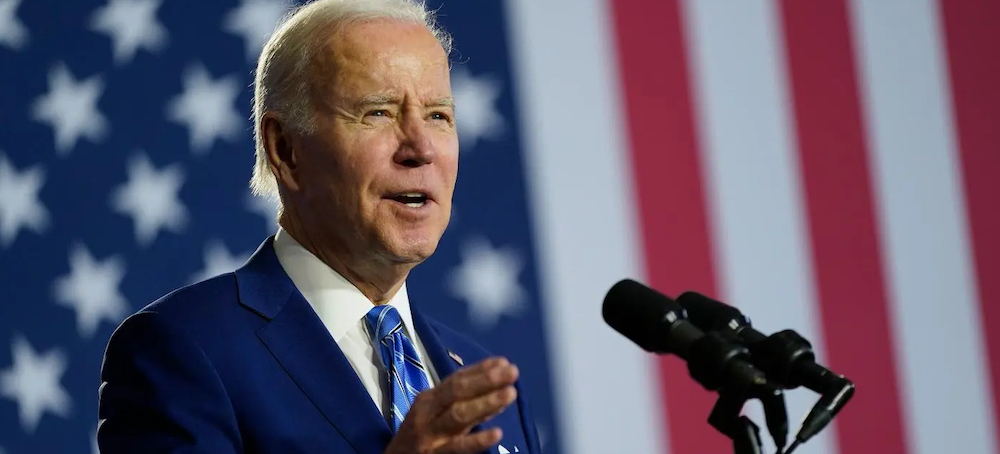 President Joe Biden. (photo: Patrick Semansky/AP)
Biden Announces He Is Running for Reelection in 2024
Toluse Olorunnipa, Tyler Pager and Michael Scherer, The Wahington Post
Excerpt: "President Biden officially announced his bid for reelection Tuesday morning, saying in a solemn launch video that he wants to 'finish the job' he started when the country was racked by a deadly pandemic, a reeling economy and a teetering democracy."
President formalizes his intent to seek another term, setting the stage for a tumultuous election
President Biden officially announced his bid for reelection Tuesday morning, saying in a solemn launch video that he wants to “finish the job” he started when the country was racked by a deadly pandemic, a reeling economy and a teetering democracy.
Claiming that his presidency has pulled the country back from the brink on all those fronts, Biden underlined his ambition to turn what he had once pitched as a transitional presidency into something far more transformational.
“The question we are facing is whether in the years ahead we have more freedom or less freedom, more rights or fewer,” Biden said in the video. “I know what I want the answer to be. This is not a time to be complacent. That’s why I’m running for reelection.”
For Biden, 80, the announcement marks a pivotal moment in a political career that has spanned a half-century. The decision may defy the wishes of some Democratic voters clamoring for a different standard-bearer — one who is younger, more progressive and more reflective of the party’s diversity — while also underscoring Biden’s strength among party leaders, including those who believe he has the best chance of defeating Donald Trump or another Republican.
The 2024 race is expected to be the final campaign of a figure who has run seven races for the U.S. Senate and sought the presidency or vice presidency four times. It will shape the legacy of a man who rose from a county council in Delaware to become one of the youngest U.S. senators in history, a partner to the country’s first Black president — and ultimately the 46th president as a pandemic swept the country.
Biden’s announcement moves the United States one step closer to a likely tumultuous 2024 presidential campaign, as former president Donald Trump pushes for a rematch with Biden after more than two years of falsely claiming that he was the true winner in 2020. Trump has already announced his own candidacy and begun exchanging barbs with other Republican hopefuls.
As for Biden, polls suggest that few Democrats are enthusiastic about the notion of his running again, but many believe he may be their best bet for keeping the White House.
Even with Tuesday’s announcement, Biden is expected to hold few explicitly campaign-style events in the near future, as his aides hope that he can remain above the political fray during a hard-fought GOP primary. But he may face rocky political terrain in the coming months as he heads into a bitter fight with Republicans over the government’s debt limit, as the Justice Department wraps up a criminal investigation of his son Hunter and as the president himself confronts a probe into classified documents found among his personal belongings.
Biden also has not run a robust national campaign in years, since much of his campaigning in 2020 was curtailed by the covid pandemic, which sharply limited his travel and appearances with crowds.
Republicans are already comparing Biden to former president Jimmy Carter, who was ousted after one term amid high inflation, global turbulence and a sense of economic trepidation. Biden’s allies, in contrast, have tried to characterize him as the most effective president since Franklin D. Roosevelt, citing Biden’s success in pushing through legislation on climate change, economic relief, prescription drugs, infrastructure and other matters, as well as his ability to rally a global coalition against Russia’s invasion of Ukraine.
Despite these accomplishments, polls suggest Biden could face a tough battle in his bid for a second term. Most Americans say the country is on the wrong track, and few believe their fortunes have improved during his presidency. Biden’s aides and allies contend that those numbers will improve as Americans begin to see his policies being implemented, with factories opening and drug prices falling, but Republicans argue that they reflect his failure to improve the economy or reduce crime.
The president could benefit from contrasting his approach with a Republican field that has been remade in Trump’s combative image, said Biden aides, some of whom spoke on the condition of anonymity to discuss internal strategy.
“Every generation of Americans has faced a moment when they’ve had to defend democracy, stand up for our personal freedoms, and stand up for our right to vote and our civil rights,” Biden said in his launch video, which began with scenes from the Jan. 6, 2021, insurrection. “This is ours. Let’s finish the job.”
Ronna McDaniel, who chairs the Republican National Committee, was quick to fire back. “Biden is so out of touch that after creating crisis after crisis, he thinks he deserves another four years," McDaniel said in a statement after Biden’s video was released. “If voters let Biden ‘finish the job,’ inflation will continue to skyrocket, crime rates will rise, more fentanyl will cross our open borders, children will continue to be left behind and American families will be worse off.”
Biden’s central campaign themes have been on display for months as he has traveled the country touting his economic accomplishments and blasting the Republicans who took control of the House in January. They often amount to an argument that he gets things done for ordinary Americans, while “MAGA Republicans” are extremists who veer toward authoritarianism.
“President Biden inherited the deepest crises in generations, and he turned them around to deliver unprecedented job growth, the biggest infrastructure investments in 70 years, Medicare’s new power to negotiate lower drug costs, and the biggest manufacturing resurgence in modern history,” said White House spokesman Andrew Bates.
In an immediate example of the split screen that Democrats hope plays in their favor, Tuesday marks the beginning of Trump’s civil trial for rape and defamation allegations. If Trump emerges as the Republican nominee, he may find himself appearing as a defendant in several criminal trials as well while campaigning for president.
Even before his announcement, Biden’s events have resembled modest campaign events, with union workers in bright-colored vests forming a blue-collar backdrop. His speeches typically include recitations of the positive economic data points of his presidency — record job growth, expanded manufacturing and new small businesses — as well as populist messaging about the futility of trickle-down economics.
“The middle class built this country,” he often says. “And unions built the middle class!”
Aides say the president plans to emphasize those messages while increasing his travel around the country in the coming months as his campaign builds up.
Democrats believe the president’s path to reelection likely runs through the same narrow set of competitive states where he bested Trump in 2020 — Michigan, Wisconsin, Arizona, Nevada, New Hampshire, Georgia and Pennsylvania. While Democratic strategists say the Supreme Court’s recent decision overturning abortion rights has buoyed their prospects, they recognize that they face serious struggles in attracting rural voters and those without college degrees.
To win in 2024, Biden will need to maintain unified support from a diverse coalition of Democratic voters, including some liberals who have at times been disappointed by his centrist positions, party strategists said. He will also need to win over moderates who have voted for Republicans in the past, including suburban women and college-educated voters who were turned off by Trump’s presidency.
As Biden barnstorms the country, he is expected to deliver increasingly sharp barbs at his Republican detractors, targeting not only congressional lawmakers but also the party’s presidential candidates as they compete for votes in a primary dominated by the GOP’s base voters. He is also expected to warn of the dangers of a return of Trump, who continues to lead in polls of Republican voters.
For their part, Republicans hope to use their narrow House majority to frustrate Biden’s campaign and tarnish his brand as a drama-free elder statesman, wagering he will pay a price for any dysfunction in Washington. “Biden’s advantage is that he’s viewed more favorably than Donald Trump. His brand is less toxic,” said Bryan Lanza, a GOP strategist who advised Trump’s 2016 campaign. “If Republicans are going to dislodge him from the White House, they have to go after that brand.”
Lanza said Republicans are also likely to highlight Biden’s age and his failure to unite the country after promising to do so.
Like his predecessors, Biden will have to balance his role as president and as a candidate. Already his official presidential trips have often taken him to political swing states. White House officials are expected to play a central role in crafting his message and countering attacks on his agenda, but they must tread carefully due to the Hatch Act, which prevents federal employees from using their taxpayer-funded positions to engage in campaigning.
Partisan battles — including over the debt limit, immigration, government spending, mass shootings and crime — are likely to take on an even more political tone as Republicans seek to highlight controversies in the Biden administration.
Aides said Biden delayed his announcement of a reelection bid, which was initially expected earlier in the year, in part because he wanted to continue governing without having his actions viewed through a strictly partisan lens. But the timing also reflected delays in making major decisions about his campaign, including selecting his campaign leadership.
Biden announced that Julie Chavez Rodriguez, a senior adviser in the White House, will manage the campaign, and Quentin Fulks, who oversaw Sen. Raphael G. Warnock’s reelection campaign in Georgia, will serve as principal deputy campaign manager.
The president also announced a slate of national co-chairs for the campaign: Michigan Gov. Gretchen Whitmer (D), Sens. Christopher A. Coons (D-Del.) and Tammy Duckworth (D-Ill.), Reps. Lisa Blunt Rochester (D-Del.), James E. Clyburn (D-S.C.) and Veronica Escobar (D-Tex.), and Jeffrey Katzenberg, a Hollywood mogul and major Democratic donor.
Even as the campaign structure emerges, much of the political nerve center around the president will be operating out of the White House, officials said, where the president’s 2020 campaign manager, Jen O’Malley Dillon, and several long-standing aides continue to work in official positions.
Polls and interviews with voters show that Biden faces a significant challenge in persuading Americans to give him four more years.
Across eight national polls in 2022 and 2023, an average of 38 percent of Democrats said they wanted Biden to be the party’s presidential nominee in 2024, while 57 percent wanted to nominate someone else. During Trump’s first term, an average of 73 percent of Republicans wanted the GOP to renominate him, and an average of 75 percent of Democrats wanted to renominate Barack Obama during his first presidential term.
Voters tell pollsters that Biden’s advanced age is a main concern. Biden, who would be 82 at the beginning of a second term and 86 at its conclusion, is in uncharted territory in asking Americans to give him another four years in office. The previous oldest president was Ronald Reagan, who left office at 77.
Trump is 76 and would be 82 at the end of a second term.
In 2020, Biden promised to be a “bridge” to the next generation of political leaders, which some Democrats interpreted as a sign that he would step down after one term. With Tuesday’s announcement, he has made clear that he plans to sit atop an increasingly young and diverse party for another six years — meaning that leaders such as Whitmer, the Michigan governor, and Maryland Gov. Wes Moore must wait that much longer.
Biden’s age could also turn an even brighter spotlight on Vice President Harris, who has struggled to gain political traction during her time as Biden’s second-in-command.
In subtle and direct ways, Republicans have tried to capitalize on the issue by presenting Biden as feeble and highlighting his verbal or physical missteps. “America is not past our prime. It’s just that our politicians are past theirs,” former United Nations ambassador Nikki Haley said in February when announcing her own bid for the Republican presidential nomination.
Still, Republicans face their own challenges. Trump, who leads the GOP field by a wide margin, is bitterly disliked by much of the electorate, and he has already begun lashing out at other Republicans weighing presidential runs, notably Florida Gov. Ron DeSantis.
And Biden has won support from Democrats with his legislative success, said Joel Payne, a Democratic strategist.
“If you had your druthers, would you prefer the candidate of your choice to not be in direct competition with actuarial charts? Sure,” Payne said. “But the package that Joe Biden is in is the package that he’s in. And I actually don’t think it’s a new piece of data. It’s not like voters elected a young man and then three years later he’s old, right?”
Biden, who often says “watch me,” in response to questions about his age, plans to continue traveling the country and holding events to allow voters to see him in action. White House officials have also pointed to Biden’s travel schedule — which at times has been more busy than previous, younger presidents — as evidence of his vitality.
Trump, 76, has also faced questions over his age and mental acuity — raising the prospect of a battle between two senior citizens over their physical and mental capacity to lead the country.
Some analysts said Biden is benefiting from Democrats’ uncertainty about who, if anyone, would have a better chance of keeping Trump from a second term.
“In the absence of a clearly established successor who could guarantee a Democratic victory, the president sees himself as the main barrier between Donald Trump and the White House, notwithstanding polling numbers that suggest his own weakness,” said Russell Riley, a presidential historian at the University of Virginia’s Miller Center. “If President Biden does get reelected, he automatically enters the conversation about the most consequential presidents.”
READ MORE
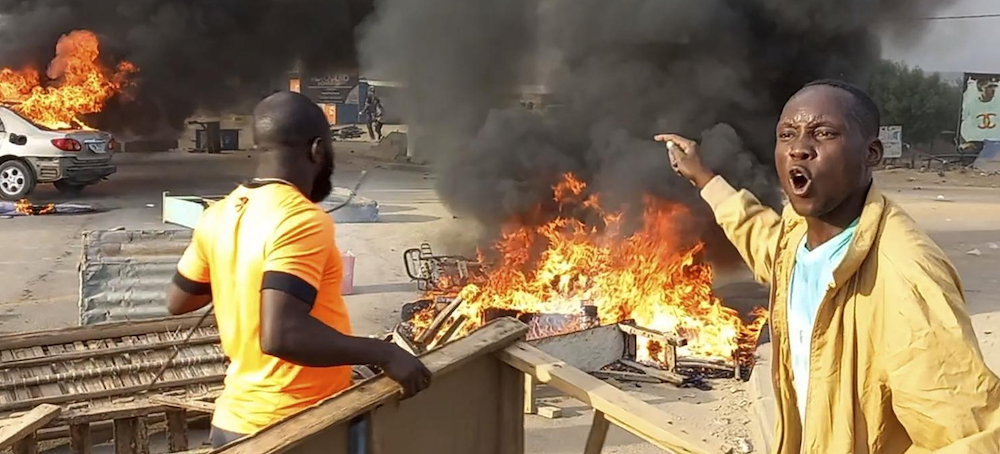 Anti-government demonstrators set a barricade on fire during clashes in N'Djamena, Chad, Oct. 20, 2022. (photo: AP)
As Russians Plot Against Chad, Concerns Mount Over Important US Ally
Rachel Chason, The Washington Post
Chason writes: "Western officials are increasingly concerned about the stability of Chad, a Central African country that has been one of the United States' most important security partners in a region confronted by widening Russian influence and several Islamic insurgencies."
But critics say the Biden administration is making a mistake by giving Chad a pass over violence and repression at home
Western officials are increasingly concerned about the stability of Chad, a Central African country that has been one of the United States’ most important security partners in a region confronted by widening Russian influence and several Islamic insurgencies.
The threats Chad is facing are underscored by several leaked U.S. intelligence documents, which describe an effort by Russia’s paramilitary Wagner Group in February to recruit Chadian rebels and establish a training site for 300 fighters in the neighboring Central African Republic as part of an “evolving plot to topple the Chadian government.” The previously unreported documents detail a discussion early that month between Wagner’s leader, Yevgeniy Prigozhin, and his associates about the timeline and facility for training an initial group of rebels in Avakaba, close to the Chadian border, and the route that Wagner would use to transport them.
These security concerns have contributed to a muted response from the United States and some other Western governments to Chad’s increasing repression at home, critics say, most notably the killing of scores of largely peaceful protesters by security forces in October. At the time, Chadian officials said that 50 people had died, but the Chadian Human Rights Commission has subsequently reported that at least 128 people were killed, and some human rights advocates now believe the number was much higher.
The debate over how far the United States can push Chad and whether this could jeopardize security interests in Africa exemplifies the challenges facing Western foreign policymakers who seek to support allied governments and also advance democratic values. Analysts say that Russia’s campaign to project greater influence in Africa has raised the stakes.
In a sharply worded letter to Secretary of State Antony Blinken last month, Sen. Robert Menendez (D-N.J.), chairman of the Senate Foreign Relations Committee, wrote that he was “extremely concerned by the lack of clear, public U.S. response” to the October killings in addition to continued U.S. support for Chad’s military. The risk, Menendez wrote in the letter, which has not previously been reported, is “creating a perception … that the United States is willing to partner with regimes that do not respect democracy and human rights as long as such regimes agree to cooperate on countering terrorism and opposing malign Russian influence.”
Michelle Gavin, an Africa expert at the Council on Foreign Relations, said that U.S. foreign policy needs to do a better job of recognizing that efforts to promote security and democracy are linked. Chad’s repression of its own citizens is a sign of the government’s internal weakness and raises the question of how good a security partner it can be, she said.
“We have fundamentally failed to reckon with the stability of the Chadian state,” she said. “It feels like at any moment, all of the eggs that we have placed in this basket could fall out the bottom.”
Plot to topple Chad’s government
Rebellion is woven into the history of Chad, a sprawling nation of 16 million that is home to dozens of ethnic groups vying for power. President Idriss Déby, who was fatally wounded on the battlefield in 2021, tamped down multiple rebellions during his 30-year reign, sometimes with the support of Chad’s former colonizer, France. Chad has been led by Déby’s son Gen. Mahamat Idriss Déby Itno since 2021.
What has changed is Russia’s involvement, which has expanded in Africa as France’s popularity has fallen. A Western diplomat in Chad, who like other diplomats spoke on the condition of anonymity to discuss sensitive foreign policy issues, said that Chad faces the possibility of an internal coup in addition to threats from rebels based just over its borders in Libya, Sudan and the Central African Republic. The Wagner paramilitary group has ties with armed forces or militias in each of these countries.
“They have thousands of reasons to be worried,” said another Western diplomat, referring to threats against the Chadian government from outside and inside the country. Western officials, he said, are closely watching developments and “increasingly concerned.”
The leaked U.S. intelligence documents say the efforts to foment a rebellion in Chad are part of a broader push by Prigozhin to create a “unified ‘confederation’ of African states” across the breadth of the continent, including Burkina Faso, Chad, Eritrea, Guinea, Mali, Niger and Sudan. “During the last year, Prigozhin has accelerated Vagner operations in Africa, shifting his approach from taking advantage of security vacuums to intentionally facilitating instability,” one document says.
Press Enter to skip to end of carousel
The Discord Leaks
The documents are part of a trove of images of classified files posted on Discord, a group chat service popular with gamers, allegedly by a member of the Massachusetts Air National Guard.
Chadian intelligence believed that two Chadian nationals traveled in late February to Bangui, the capital of the Central African Republic, at Wagner’s invitation to help recruit fighters from Chad and the Central African Republic in a Wagner-funded plot “to destabilize the Chadian regime,” according to the documents.
The two Chadian nationals, who are named in the documents, stayed at the Ledger Plaza Bangui Hotel, where they were reportedly received by Defense Minister Rameaux Claude Bireau of the Central African Republic, which has been engaged with Wagner since 2018. As part of this effort, the two Chadian nationals were working with the CAR government to persuade rebels specifically of southern Chadian origin to work alongside Wagner, the documents say.
Contacted for comment, Prigozhin replied with obscenities and said the reports about his involvement with a planned rebellion in Chad were “nonsense.”
Chadian Communications Minister Aziz Mahamat Saleh did not specifically address the U.S. intelligence information but said in an interview in N’Djamena this month that the government is aware that “many young people” from Chad have joined Wagner in the Central African Republic.
Saleh said his country does not have problems with Russia but cannot accept apparent efforts by Wagner to interfere with Chad’s internal politics. He said that Wagner has turned up in other African countries when their governments needed help holding on to power, which he said will not be the case in Chad. “We can defend ourselves,” he said.
The Central African Republic’s communications minister did not respond to requests for comment.
In February, the Wall Street Journal reported that the United States shared intelligence with authorities in Chad indicating that Wagner was potentially planning to assassinate Déby.
A senior State Department official said the United States “is committed to a democratic transition in Chad” and is continuing to press for the release of 150 political prisoners who are in custody. Although Chad has been an “important partner” in counter-terrorism operations in the Sahel and the Lake Chad Basin, the official said, that “has no bearing on U.S. views on the longstanding need for democratic reform in Chad.”
A spokesman for U.S. Africa Command, which oversees military operations on the continent, said Chad has been “a very willing and capable partner in fighting terrorism” and understands the dangers that Wagner poses to African countries.
Chad’s bloodiest day
Tensions were already running high when thousands of pro-democracy protesters took to the streets in N’Djamena on Oct. 20 to oppose a government plan to extend its hold on power for another two years. Security forces responded by firing tear gas and live ammunition at protesters, chasing them into homes and arresting hundreds. It was the bloodiest day in Chad in decades.
A young doctor remembers hearing the crack of gunshots followed by screaming. Then dozens of wounded young men and women began streaming into the hospital in N’Djamena, he recalled. The doctor, who spoke on the condition of anonymity because of fear of retribution, said he saw at least 10 dead bodies in the emergency room. There were so many wounded, he said, that the hospital was “completely overwhelmed.”
“It was completely horrible,” he said, “and now everyone fears talking about that day because we do not want to be arrested.”
Delphine Djiraibe, a Chadian human rights lawyer who shielded young protesters at her house in N’Djamena, said there were so many dead bodies at the morgue that they rotted before their families could collect them and give proper burials.
“People are living with fear. We don’t know what will happen in the next minute,” she said. “And the international community has been too quiet.”
That day marked a turning point, another Western diplomat said, noting that any hope that Déby might be more open to democracy than his father had been dashed. “All of us are losing trust and hope,” he said.
Saleh, the communications minister, said that the government is committed to holding elections in 2024 and is focused on making Chad a more inclusive country, pointing to a recent decision by the president to pardon more than 300 rebels.
But a Western diplomat added that a decision by Chad’s government to expel the outspoken German ambassador this month — citing his “discourteous attitude” — sent a clear message to the rest of the diplomatic community: “If you criticize them, you are out.”
Silence over security force killings
On that tragic day in October, the U.S. Embassy in N’Djamena posted a picture of Ambassador Alexander Laskaris kneeling on a bloodstained sidewalk, and the State Department urged “all parties to deescalate the situation and exercise restraint.”
In the months since, the U.S. government has been largely silent about the killings. Menendez noted in the letter to Blinken that the United States has not imposed travel restrictions or sanctions on those responsible for the violence, as was done following a 2009 massacre by security forces in Guinea. The Biden administration has never condemned Déby’s seizure of power a “coup,” the letter noted, and invited him to Washington for the “Africa summit” last year.
Menendez has frozen some funding for security cooperation, which a U.S. official in Chad said has meant that training and equipment for Chadian soldiers deployed with the United Nations have been frozen. But the senator said in the letter that other assistance has continued to flow to Chad’s military.
Remadji Hoinathy, a researcher with the Institute for Security Studies in N’Djamena, said that Chad and the West are playing a high-stakes “bargaining game.” Chad’s bet, Hoinathy said, is simple: “Don’t talk about my human rights abuses, and I will support you.”
Cameron Hudson, a senior associate at the Center for Strategic and International Studies, said the Biden administration has struggled to achieve a clear policy on the Sahel region of Africa, in part because there has not been an active discussion about how to balance both promotion of security partnerships and democracy.
“We have to do both at the same time,” he said. “We need to be able to walk and chew gum.”
READ MORE
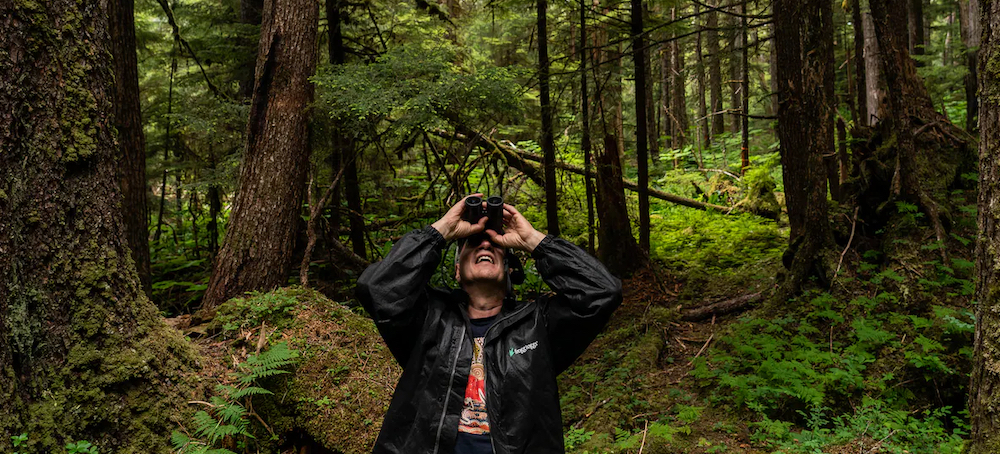 Conservation biologist Dominick A. DellaSala looks for birds among old-growth trees in Alaska's Tongass National Forest in 2021. (photo: Salwan Georges/WP)
US Has Inventoried Old-Growth Forests. Will Protection Be Next?
Anna Phillips, The Washington Post
Phillips writes: "In a first-ever finding that could increase protections for remaining U.S. forests, the federal government estimated Thursday that more than 100 million acres of old-growth and mature timberlands are still standing on public lands, despite decades of commercial logging, wildfires and climate threats."
The report is the federal government’s first estimate of America’s oldest trees. Environmentalists hope it is a step for protecting them from logging.
In a first-ever finding that could increase protections for remaining U.S. forests, the federal government estimated Thursday that more than 100 million acres of old-growth and mature timberlands are still standing on public lands, despite decades of commercial logging, wildfires and climate threats.
The findings, the result of a year-long review ordered last year by President Biden, are likely to inflame tensions with the timber industry over which forests — especially those in the western United States — should remain unlogged. But they are energizing many conservation activists, including those who argue that old-growth forests are vital for storing carbon dioxide that contributes to climate change.
“It’s extremely encouraging that the Biden administration is recognizing the value of mature and old-growth trees,” said Blaine Miller-McFeeley, senior legislative representative at Earthjustice. He said the environmental law group supports rules “that will protect and restore climate forests for future generations from the threats they face today, including unnecessary logging.”
The report by the U.S. Forest Service and the Bureau of Land Management is the result of an order Biden issued last year to protect older forests from wildfire, climate change and other threats. While the order itself was controversial — environmentalists and the timber industry disagree over what counts as an “old” tree — the findings are likely to fuel debate over which forests deserve more protection.
The report found that more than 32 million acres of old-growth forests remain on public lands in the United States, representing about 18 percent of all forested land managed by the two agencies. The ages and sizes of these trees vary by species and region, but most are well over 100 years old. Scientists and environmentalists view these trees as vitally important to fighting climate change because they store vast amounts of carbon in their trunks, branches and roots. The study also concluded that there are around 80 million acres of mature forest — about 45 percent of the agencies’ forested land.
The agencies’ work suggests a much higher estimate of old-growth and mature forest than previous scientific studies have shown, a departure the report’s authors attributed to their inclusion of parts of Alaska, which other studies excluded, as well as “differing goals and methodologies.” Other research cited in the federal government’s report estimated the country’s remaining old forests to be between 53 million and 59 million acres.
Another difference that could contribute to the varying figures: the agencies’ decision to include 23 million acres of older trees in pinyon-juniper forests, which cover hot, arid land in Western states. Unlike California’s towering redwoods and the red cedars of Alaska’s Tongass National Forest, these trees built to survive in the high desert are often left out of discussions of iconic old growth.
Environmental groups praised the report’s release and said they hoped it would lead the Biden administration to enact new protections for the oldest and largest trees.
Steve Pedery, conservation director of the nonprofit Oregon Wild, said conservation groups have been pushing the two agencies to map and protect the country’s oldest forests since the 1970s. “Looking ahead, what is key now is how the Forest Service and the BLM use these maps and inventory,” he said, “and whether or not they will adopt strong permanent rules to protect these forests.”
Yet safeguarding older trees is likely to be hugely controversial.
There is no scientific consensus on how to define old-growth and mature trees — and logging companies are likely to push back against any new limits on their access to the most valuable timber.
The Federal Forest Resource Coalition, a timber industry group, released a statement Thursday describing the report as “lots of data that doesn’t help the Forest Service do what needs to be done: manage unreserved forestlands to reduce fire danger, create wildlife habitat, and provide jobs in economically distressed rural areas.”
“America has no shortage of public forestland, most of which is lightly managed, if it’s managed at all,” said Bill Imbergamo, the group’s executive director. “Today’s inventory shows we’re not running out of mature trees.”
The report also notes the growing danger that climate change-fueled wildfires pose to older forests. But the government’s plans to protect trees from fire often call for chain saws — an intervention known as thinning that is supposed to restore forests to a time when natural fire cycles regularly cleared away underbrush and small saplings.
Experts said any new protections would have to achieve a delicate balance between protecting large trees and allowing agency land managers to use techniques that keep ecosystems healthy. While many forestry experts support targeted thinning of overgrown forests, some conservationists have accused loggers of using the projects as cover to cut large, old trees.
Biden’s executive order calls for the agencies’ next step to be crafting policies that protect old-growth and mature trees from wildfire and other threats. The Interior Department published a proposed rule last month to “promote ecosystem resilience on public lands" that would elevate conservation to a formal use of public lands, possibly equal to mining, grazing and oil and gas projects. On Thursday, the Forest Service announced that it is asking for public comment on how the agency should manage forests before issuing any proposed regulations.
Earlier this year, the Biden administration banned logging in much of the Tongass, restoring protections that were rolled back under the Trump administration. The Forest Service also canceled a planned timber sale in Oregon’s Willamette National Forest that conservation groups said would have largely felled trees ranging in age from 80 to 150 years old.
READ MORE
Contribute to RSN
Follow us on facebook and twitter!
Update My Monthly Donation
PO Box 2043 / Citrus Heights, CA 95611


