|




|
|
|

24 July 22
Live on the homepage now!
Reader Supported News
“I certainly hope she’ll do so voluntarily,” Liz Cheney said of Thomas providing testimony. “But the committee is fully prepared to contemplate a subpoena if she does not.”
During a Sunday morning TV appearance on CNN’s State of the Union show, Rep. Liz Cheney (R-WY) told host Jake Tapper that the committee continues to negotiate with the well-connected conspiracy theorist’s lawyer in an attempt to get her to testify about her role in the insurrection.
Cheney said “the committee is engaged with her counsel” and have been trying to get her to appear for weeks.
“I certainly hope she’ll do so voluntarily,” she said. “But the committee is fully prepared to contemplate a subpoena if she does not.”
Her lawyer did not respond to a request for comment Sunday morning.
The committee sent her an interview request in a June 16 letter but that was outright rejected by her lawyer in a formal reply on June 28 signed by her lawyer, Mark R. Paoletta. In the response letter, Paoletta told the committee “there is no story to uncover here” and questioned the committee’s mission by waving around his own credentials as the former top investigative lawyer with the House Energy and Commerce Committee, where he worked on nearly 200 investigative hearings over a decade.
Thomas, a long-time conservative activist, has come under scrutiny over the way she personally pressed Arizona legislators to keep former President Donald Trump in power.
Thomas emailed about the coup plot with John Eastman, the kooky conservative lawyer who developed the dubious plan to reverse Joe Biden’s presidential victory by having Trump loyalists in Congress simply refuse to certify the electoral college votes. And she also texted with Trump’s White House chief of staff, Mark Meadows, about her deranged belief that the “Biden crime family & ballot fraud co-conspirators…are being arrested and…will be living in barges off GITMO to face military tribunals for sedition.”
Given Thomas’ proximity to some of the nation’s most powerful politicians, the Jan. 6 Committee investigating the insurrection wants to further probe her communications. They could develop a clearer picture of the way the wife of a Supreme Court justice—an unelected government official who has lifetime tenure—engaged in what’s tantamount to a seditious conspiracy.
Serving Thomas was a subpoena would be a marked escalation. Although it would treat her like any other U.S. citizen, her refusal to show up and testify risks facing arrest and jail time—an odd situation for the wife of a Supreme Court justice.
The committee has already interviewed more than 1,000 witnesses who worked in the Trump administration, his election overturning campaign, and the many groups with fascist ties who plotted to keep Trump in power.
The few who have resisted—including Meadows, MAGA social media manager Dan Scavino, former White House adviser Peter Navarro, and political strategist Steve Bannon—have been either held in contempt of Congress or now face time behind bars. On Friday, a jury convicted Bannon, who awaits a mandatory minimum sentence of a month or more in prison. Navarro was indicted last month.
Cheney on CNN acknowledged that her role as co-chair of the Jan. 6 Committee—and her willingness to totally break from fellow Republicans who remain loyal Trumpists—could cost her reelection in Wyoming this year. But she called the historic congressional investigation “the single most important thing I’ve done professionally.”
“I believe that our nation stands on the edge of an abyss. We have to think very seriously about the dangers we face… and we’ve got to elect serious candidates,” she said.
She also said she has yet to decide whether she will run for president next year to stop Trump from making a comeback.
“At this point, I've not made a decision about 2024. And I’m really very focused on the substance of what we have to do on the select committee,” she said.
 Artillery strikes have allowed Kyiv's forces to advance towards Kherson. (photo: Getty Images)
ALSO SEE: Ukraine Intensifies Attacks on Russian Positions in South
Ukraine's President Volodymyr Zelensky says his forces are advancing "step by step" into the occupied southern region of Kherson.
On Saturday, UK defence officials reported heavy fighting near Kherson.
The Ukrainian advance meant that Russian supply lines west of the river were "increasingly at risk", according to their assessment.
Earlier this month, Ukraine's Deputy Prime Minster Iryna Vereshchuk urged Kherson residents to evacuate the city as soon as possible to avoid becoming trapped in the city during a counteroffensive in southern Ukraine.
"It is necessary to do so for the Armed Forces of Ukraine not to endanger the civilian population during offensive operations," she told state TV.
Serhiy Khlan, an adviser to Kherson's government, told Ukrainian television the region would "definitely be liberated by September", AFP report.
Kyiv's forces have been targeting river crossings in the region in an effort to stretch Russia's supply lines. On Saturday, an artillery strike hit the Daryivskyi bridge across the Inhulets river, a tributary of the Dnipro.
And on Tuesday, they targeted the Antonivskyi Bridge over the Dnipro itself with US-supplied artillery.
Speaking to the state backed Tass news agency, the deputy head of the Russian-backed administration in Kherson admitted that if the strikes continued the bridge could collapse.
UK officials have described the Antonivskyi Bridge as a "key vulnerability" for Russian forces and on Saturday said if "crossings were denied, and Russian forces in occupied Kherson cut off, it would be a significant military and political setback for Russia".
Mr Khlan said "every bridge is a weak point for logistics and our armed forces are skilfully destroying the enemy system".
Meanwhile, a senior defence adviser to Mr Zelensky claimed that around 1,000 Russian troops in the region have been encircled by Ukrainian forces.
Oleksiy Arestovych said the Russians had been caught in a "tactical encirclement" near the village of Vysokopillya in Kherson oblast. The BBC has not independently verified this claim.
Tass reported that plans in Kherson to hold a referendum on joining Russia have moved forward, with authorities there forming an election committee. The US has accused Russia of preparing to annex parts of Ukraine.
Russia captured Kherson with relatively little resistance early in the war, and the failure of Ukraine's security service (SBU) to destroy crossing points over the Dnipro before fleeing the city is believed to have led to Mr Zelensky's dismissal of the agency's director Ivan Bakanov on Monday.

 The radio host Alex Jones, above, and Ted Anderson, a gold and silver dealer, built a lucrative operation through Mr. Anderson's radio network. (photo: Victor J. Blue/NYT)
The Genesis Communications Network built a lucrative business alongside the radio host, whose show the company has syndicated for more than two decades.
Together, they ended up shaping today’s misinformation economy.
The two built a lucrative operation out of a tangled system of niche advertisers, fund-raising drives and promotion of media subscriptions, dietary supplements and survivalist merchandise. Mr. Jones became a conspiracy theory heavyweight, while Mr. Anderson’s company, the Genesis Communications Network, thrived. Their moneymaking blueprint was reproduced by numerous other misinformation peddlers.
Mr. Jones eventually drifted from his dependence on Genesis, as he expanded beyond radio and attracted a large following online. Yet they were closely tied together again in lawsuits accusing them of fueling a bogus narrative about the 2012 shooting at Sandy Hook Elementary School.
Mr. Jones was found liable by default in those cases. Last month, the plaintiffs’ lawyers dropped Genesis as a defendant. Christopher Mattei, one of the lawyers, said in a statement that having Genesis involved at trial would have distracted from the main target: Mr. Jones and his media organization.
The move freed Genesis, which says on its website that it “has established itself as the largest independently owned and operated talk radio network in the country,” from the steep penalties that most likely await Mr. Jones. But the cases, soon headed before juries to determine damages, continue to shed light on the economics that help to drive misleading and false claims across the media landscape.
The proliferation of falsehoods and misleading content, especially heading into the midterm elections this fall, is often blamed on credulous audiences and a widening partisan divide. Misinformation can also be hugely profitable, not just for the boldface names like Mr. Jones, but also for the companies that host websites, serve ads or syndicate content in the background.
“Misinformation exists for ideological reasons, but there is always a link to very commercial interests — they always find each other,” said Hilde Van den Bulck, a Drexel University media professor who has studied Mr. Jones. “It’s a little world full of networks of people who find ways to help each other out.”
Mr. Jones and Mr. Anderson did not respond to requests for comment for this article.
Genesis originated in the late 1990s as a marketing ploy, operating “hand-in-hand” with Midas Resources, Mr. Anderson’s bullion business, he has said. He told the media watchdog FAIR in 2011: “Midas Resources needs customers, Genesis Communications Network needs sponsors.”
Alex Jones and his doom-and-gloom worldview fit neatly into the equation.
Genesis began syndicating Mr. Jones around the time he was fired by an Austin station in 1999, the host said this year on Infowars, a website he operates. It was a complementary, if sometimes jarring partnership — “sort of a marriage made in hell,” Ms. Van den Bulck said.
Archived footage shows Mr. Jones, pugnacious and prone to pontificating, broadcasting dire claims about the dollar’s inevitable demise before introducing Mr. Anderson, bespectacled and generally mild, to deliver extended pitches for safe haven metals like gold. Sometimes, Mr. Jones would interrupt the pitches with rants, like the time in 2013 when he cut off Mr. Anderson more than 20 times in 30 seconds to yell “racist.”
Genesis’s roster has also included a gay comedian; a former lawyer for the A.C.L.U.; the Hollywood actor Stephen Baldwin; the long-running call-in psychologist Dr. Joy Browne; a home improvement expert known as the “Cajun Contractor”; and a group of self-described “normal guys with normal views” talking about sports.
But eventually, the network developed a reputation for a certain type of programming, promoting its “conspiracy” content on its website and telling the MinnPost in 2011 that its advertisers “specialize in preparedness and survival.”
Several shows were headed by firearms aficionados. There was a Christian rocker who opposed gay rights and a politician who embraced unfounded theories about crisis actors and President Obama’s nationality. One program promoted lessons on how to “store food, learn the importance of precious metals, or even survive a gunfight.” Jason Lewis, a Republican politician in Minnesota who faced blowback during the 2018 election season after his misogynistic on-air remarks resurfaced, had a syndication deal with Genesis and a campaign office at Genesis’ address.
The ties between Mr. Jones and Genesis began loosening about a decade ago, when Mr. Jones reached a deal to have Genesis handle only about one-third of his syndication deals. Now, about 30 stations include Mr. Jones on their schedules, according to a review by Dan Friesen, one of the hosts of the podcast Knowledge Fight, which he and a friend created to analyze and chronicle Mr. Jones’s career. Of those, more than a third relegated him to late night and early morning. Several stations replaced Mr. Jones with conservative hosts such as Sean Hannity or Dan Bongino.
Mr. Jones’s relationship to Mr. Anderson continued to dim after 2015, when the Minnesota Commerce Department shut down Midas. The agency described Midas and Mr. Anderson as “incompetent” and ordered the company to pay restitution to customers after having “regularly misappropriated money.”
Now, the Midas website redirects to a multilevel marketing company selling the same supplements that populate Genesis’ online shop. The founder of the supplement company has a show syndicated by Genesis and has also appeared on Mr. Jones’s show.
But Mr. Jones has his own business hawking Infowars-branded supplements, as well as products such as Infowars masks alongside bumper stickers declaring Covid-19 to be a hoax. One of his lawyers estimated that the conspiracy theorist generated $56 million in revenue last year.
“The inability to have that sort of symbiotic connection between the gold sales on the radio affiliates really hurt their connectedness,” Mr. Friesen said of Mr. Jones and his former benefactor. “At that point, Alex had a bit more of a need to diversify how he was funding things, and Ted took kind of a back seat.”
But in 2018, the families of several Sandy Hook victims sued Mr. Jones and named Genesis as a defendant as well. The families’ lawyers cited Mr. Anderson’s frequent appearances on Mr. Jones’s shows and said that Genesis’ distribution of Mr. Jones helped his falsehoods reach “hundreds of thousands, if not millions, of people.”
Mr. Jones, Genesis and other defendants “concoct elaborate and false paranoia-tinged conspiracy theories because it moves product and they make money,” the lawyers wrote.
After the lawsuits were filed, both Genesis and Mr. Jones were rejected for coverage of the liability claims by West Bend Mutual Insurance, which began working with Genesis in 2012, according to court documents. After being dropped as a defendant, Genesis has continued to solicit donations, saying online that its “freedom to speak is held in the balance.”
The litigation demonstrates the increasingly prominent role of lawsuits as a cudgel against those accused of spreading false and misleading information. In 2020, Fox News settled for millions of dollars with the parents of Seth Rich, a murdered Democratic aide, whose death was falsely linked by the network to an email leak ahead of the presidential election in 2016.
Smartmatic and Dominion sued Fox News and other conservative outlets and figures last year after the election technology companies were targeted by unsupported claims about voting fraud and are seeking billions of dollars in damages. When Smartmatic and Dominion were still threatening legal action, several of the outlets broadcast segments that tried to clarify or debunk conspiracy theories about the voting systems companies.
“It seems to be, for the first time in a long time, a very tangible route to actually holding people accountable for the harm they’re causing and the ways in which they’re profiting off that harm,” said Rachel E. Moran, a postdoctoral fellow at the Center for an Informed Public at the University of Washington.
Genesis told the court in a filing last year that it that it was merely accused of being “a distributor of radio programs — the radioland equivalent of the paperboy — not the author, not the publisher, not the broadcaster.” The filing argued that the company “does not have a brain; it does not have memory; it cannot form intent.”
Lawyers for the families responded that the network should be “treated in the same manner as a newspaper or the publisher of a book” with a high degree of awareness of “the hoax narrative that Genesis repeatedly broadcast to vast audiences, over multiple years.”
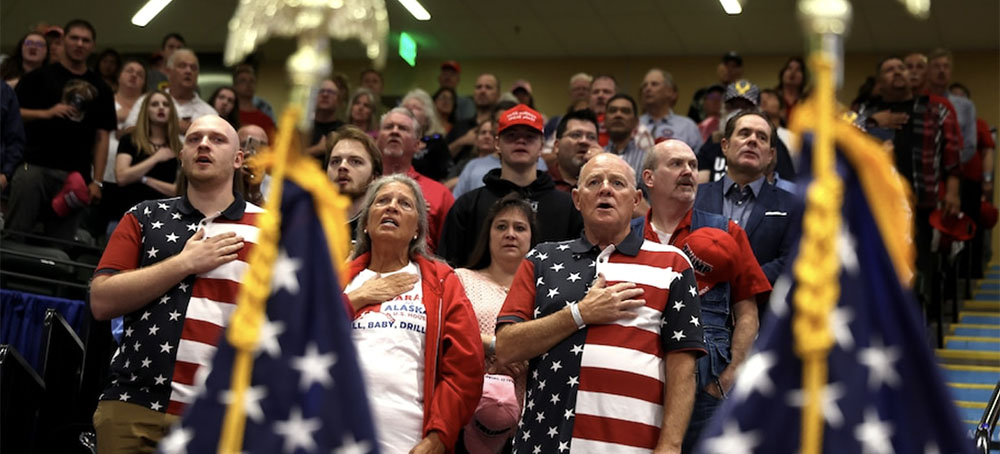 Attendees recite the Pledge of Allegiance at a 'Save America' rally featuring former president Donald Trump at Alaska Airlines Center in Anchorage on July 9. (photo: Justin Sullivan/Getty Images)
In both swing states and safe seats, GOP candidates say that liberals hate them personally and may turn rioters or a police state on people who disobey them
“We would expect them to make our borders porous,” Peroutka told the crowd, which had come to hear the Republicans running for state attorney general. “We would expect them to make our cities unsafe places to live. We would expect them to try to ruin our economy.” The country was “at war,” he explained, “and the enemy has co-opted members and agencies and agents of our government.”
On Tuesday, Peroutka easily dispatched a more moderate Republican to win the nomination. State Del. Dan Cox, who won Donald Trump’s endorsement after supporting the former president’s effort to subvert the 2020 election, also dispatched a Republican endorsed by the state’s popular governor, Larry Hogan.
Both candidates described a country that was not merely in trouble, but being destroyed by leaders who despise most Americans — effectively part of a civil war. In both swing states and safe seats, many Republicans say that liberals hate them personally and may turn rioters or a police state on people who disobey them.
Referring to the coronavirus and 2020 protests over police brutality, Cox told supporters at a rally last month, “We were told 14 days to bend the curve, and yet antifa was allowed to burn our police cars in the streets.” He continued: “Do you really think, with what we’re seeing — with the riots that have happened — that we should not have something to defend our families with? This is why we have the Second Amendment.”
The rhetoric is bracing, if not entirely new. Liberal commentators made liberal use of the word “fascism” to describe Trump’s presidency. The baseless theory that President Barack Obama was undermining American power as a foreign agent was popular with some Republicans, including Trump, who succeeded Obama in the White House.
Many Democrats saw the backlash to Obama as specific to his race, and saw Biden as unlikely to inspire mass opposition to Trump in the presidential election. But many Republicans also portray Biden as a malevolent figure — a vessel for a hateful leftist campaign to weaken America.
“It’s purposeful,” said former Alaska governor Sarah Palin, who is running in next month’s special election for the state’s sole House seat, in an interview with former Trump adviser Stephen K. Bannon. “It’s all about the fundamental transformation of America. You only fundamentally transform something for which you have disdain.”
That argument has been dramatized in ads that, for instance, show one armed candidate appearing to charge into the home of a political enemy, and another warning of “the mob” that threatens ordinary Americans. In many cases the candidates are brandishing firearms while threatening harm to liberals or other enemies.
In central Florida, U.S. Army veteran Cory Mills has run ads about his company selling tear gas that was used to quell riots in 2020. “You may have seen some of our work,” he says, introducing a montage of what are labeled “antifa,” “radical left” and “Black Lives Matter” protesters running from the gas.
In northwest Ohio, a campaign video for Republican congressional nominee J.R. Majewski shows him walking through a dilapidated factory, holding a semiautomatic weapon, warning that Democrats will “destroy our economy” with purposefully bad policies.
“Their agenda is bringing America to its knees, and I am willing to do whatever it takes,” says Majewski, who’s seeking a House seat in a district around Toledo that has been redrawn to make Rep. Marcy Kaptur (D-Ohio) beatable. “If I have to kick down doors, that’s just what patriots do.”
In Missouri, Republican Senate candidate Eric Greitens has issued two ads this summer in which he holds or fires weapons, vowing to go “RINO hunting” — for “Republicans in name only” — in one ad and targeting the “political establishment” in the second.
Dreading deep losses in November, some Democrats have spent money to help Republican candidates who talk this way under the theory that they will be easier to beat in November. The Democratic Governors Association spent more than $1.1 million on positive ads for Cox, as he was telling voters that they might one day have to battle antifa with their own weapons.
Candidates like Majewski, however, have won with no assistance from Democrats, aided instead by high turnout and grass-roots energy. The idea that the Biden administration’s policies are designed to fail — to raise gas prices, or increase the cost of food — is a popular campaign theme.
Pollsters have found that Americans are worried about the country sticking together; a YouGov poll released last month had a majority of both Democrats and Republicans agreeing that America would one day “cease to be a democracy.”
Republican wins since 2020, including a sweep in Virginia’s state elections and victory in a special election in June between two Hispanic candidates in South Texas, haven’t lightened the GOP mood. Andy Surabian, a Republican strategist who works with Trump-backed U.S. Senate candidates J.D. Vance in Ohio and Blake Masters in Arizona, said that last year’s vaccine-or-test mandate for large companies was a turning point in views of the Biden administration, even after it was blocked by the Supreme Court’s conservative majority.
“It’s the number one thing that caused people to go from ‘maybe this is incompetence’ to ‘there’s something else going on here,’ ” Surabian said. “Like, do these people actually want a Chinese-style social credit system?”
Rick Shaftan, a conservative strategist working with Republican challengers this cycle, said that the party’s voters were nervously watching crime rates in the cities, asking whether public safety was being degraded on purpose. He also pointed to government responses to the pandemic as a reason that those voters, and their candidates, were nervous.
“People paid a lot of attention to the truckers,” said Shaftan, referring to Canadian protests against vaccine mandates that occupied Ottawa this year and briefly shut down an international bridge. “Canada’s supposed to be a democracy. … People worry: Can that happen here?”
The arrests of hundreds of rioters who stormed the Capitol on Jan. 6, 2021, has frequently been cited by Republican candidates as proof of a government war on its people.
In early July, at a town hall meeting in southwest Washington state, Republican congressional hopeful Joe Kent told his audience that the “phony riot” on Jan. 6 was being “weaponized against anybody who dissents against what the government is telling us,” from parents angry about public school education to people who had questioned the outcome of the 2020 election.
“These are the types of tactics that I would see in Third World countries when I was serving overseas,” Kent told the crowd gathered in a gazebo in Rochester, a town currently represented by Rep. Jaime Herrera Beutler (R-Wash.). “You’d see the Praetorian Guard or the intelligence services grab the opposition and throw them in the dungeons. I never thought I’d see that in America.”
Trump himself has frequently accused President Biden of trying to ruin the country and create conflict to maintain power.
“Joe Biden helped lead his party’s vile campaign against our police officers, and then he carried the rioters’ agenda straight into the White House,” Trump told supporters at a rally in Las Vegas last month, joined by Clark County Sheriff Joe Lombardo, the GOP nominee for governor. “The streets are flowing with the blood of innocent crime victims.”
After a draft Supreme Court opinion in Dobbs v. Jackson Women’s Health Organization overturning federal abortion rights was leaked in early May, a group calling itself Jane’s Revenge took credit for vandalism against crisis pregnancy centers, where women are discouraged from terminating their pregnancies. Those incidents quickly made it into political ads that asked why Democrats were not more strongly condemning violence.
Some Republicans also point to a California man’s alleged assassination plot against Supreme Court Justice Brett M. Kavanaugh, who was among the majority in Dobbs.
“Radical liberals are behaving like terrorists, calling for a summer of rage,” says a narrator in a new ad from Catholic Vote, a conservative group spending $3 million this month to target vulnerable Democratic members of the House. “An assassination attempt on a Supreme Court justice. Domestic terrorists calling it ‘open season.’ ”
Several have echoed Vance, the “Hillbilly Elegy” author, who has argued that the rise in fentanyl deaths looks like an “intentional” result of the Biden administration’s border policies — a way for an unpopular president to “punish the people who didn’t vote for him.”
The argument is not just that Democrats disagree with conservatives, but that they despise them and hurt them on purpose. This past week, after a man attacked Rep. Lee Zeldin (R-N.Y.) at a rally for his gubernatorial campaign, Biden and Vice President Harris condemned the violence, as did Gov. Kathy Hochul (D).
But local Republicans suggested that Democrats had effectively encouraged the attack, pointing to a Democratic news release about the rally “encouraging people to stalk” the candidate, according to one GOP county executive. Although the district attorney who let the attacker out of jail was a Zeldin supporter, the candidate and his party argued that Democratic bail overhauls, passed in 2019, had let the attacker off scot-free.
“If you love America, they hate you,” says Jim Pillen, the Republican nominee for governor of Nebraska, in one TV spot. “If you support the police, they call you racist.”
 Residents from various communities in mostly rural northeastern Connecticut stage a protest outside Day Kimball Hospital, Monday, July 18, 2022 in Putnam, Conn. The protesters are concerned with Day Kimball Healthcare's plans to affiliate with Covenant Healthcare, a Catholic health system that abides by directives set by the U.S. Conference of Catholic Bishops. (photo: Susan Haigh/AP)
These are states such as Oregon, Washington, California, New York and Connecticut, where abortion will remain legal despite the U.S. Supreme Court’s recent ruling overturning Roe v. Wade.
Concerns in these blue states pertain to such services as contraception, sterilization and certain procedures for handling pregnancy emergencies. These services are widely available at secular hospitals but generally forbidden, along with abortion, at Catholic facilities under the Ethical and Religious Directives set by the U.S. Conference of Catholic Bishops.
The differing perspectives on these services can clash when a Catholic hospital system seeks to acquire or merge with a non-sectarian hospital, as is happening now in northeastern Connecticut. State officials are assessing a bid by Catholic-run Covenant Health to merge with Day Kimball Healthcare, an independent, financially struggling hospital and health care system based in the town of Putnam.
“We need to ensure that any new ownership can provide a full range of care — including reproductive health care, family planning, gender-affirming care and end-of-life care,” said Connecticut Attorney General William Tong, a Democrat.
Lois Utley, a specialist in tracking hospital mergers, said her organization, Community Catalyst, has identified more than 20 municipalities in blue or purple states where the only acute care hospitals are Catholic.
“We are definitely sliding backwards in terms of comprehensive reproductive health,” Utley said. “Catholic systems are taking over many physician practices, urgent care centers, ambulatory care centers, and patients seeking contraception won’t be able to get it if their physician is now part of that system.”
According to the Catholic Health Association, there are 654 Catholic hospitals in the U.S., including 299 with obstetric services. The CHA says more than one in seven U.S. hospital patients are cared for in a Catholic facility.
The CHA's president, Sister Mary Haddad, said the Catholic hospitals provide a wide range of prenatal, obstetric and postnatal services while assisting in about 500,000 births annually.
“This commitment is rooted in our reverence for life, from conception to natural death,” Haddad said via email. “As a result, Catholic hospitals do not offer elective abortions.”
Protocols are different for dire emergencies when the mother “suffers from an urgent, life-threatening condition during pregnancy,” Haddad said. “Catholic health clinicians provide all medically indicated treatment even if it poses a threat to the unborn.”
This approach is now being mirrored in several states imposing bans that allow abortions only to save a mother’s life. There is concern that doctors governed by such bans — whether a state law or a Catholic directive — may endanger a pregnant woman’s health by withholding treatment as she begins to show ill effects from a pregnancy-related problem.
In California, Democratic state Sen. Scott Wiener is among those warily monitoring the proliferation of Catholic health care providers, who operate 52 hospitals in his state.
The hospitals provide “superb care to a lot of people, including low-income communities,” Wiener said. But they “absolutely deny people access to reproductive health care as well as gender-affirming care (for transgender people).”
“It’s the bishop, not professional standards, that are dictating who can receive what health care,” Wiener said. “That is scary.”
Charles Camosy, professor of medical humanities at the Creighton University School of Medicine, says critics of the mergers fail to acknowledge a major benefit of Catholic health care expansion.
“These mergers take place because Catholic institutions are willing to take on the really hard places where others have failed to make money,” he said. “We should focus on what these institutions are doing in a positive way — stepping into the breach where virtually no one else wants to go, especially in rural areas.”
That argument has resonance in mostly rural northeast Connecticut, where Day Kimball serves an aging population of about 125,000.
Kyle Kramer, Day Kimball’s CEO, said the 104-bed hospital has been seeking a financial partner for more than seven years and would soon face “very serious issues” if it had to continue on its own.
Regarding the proposed merger, he said, “Change is always difficult.”
However, he said Day Kimball’s providers would remain committed to comprehensive health care if the merger proceeds, seeking to ensure that patients are informed of all options when it comes to such matters as contraception, miscarriages and ectopic pregnancies.
As for abortions, Kramer said Day Kimball had never performed them for the sole purpose of ending a pregnancy and would continue that policy if partnering with Covenant.
Despite the assurances, some residents are concerned that the region’s only hospital would become Catholic-owned. Some merger opponents protested outside the hospital last Monday.
“The public is being told if you don’t take Covenant, you won’t have a hospital at all,” said Elizabeth Canning of Pomfret, Connecticut. “Which is, of course, frightening. So people go, ‘Okay, well, we’ll take them. ... It’s better than nothing.’”
“I’ve had wonderful care here. That’s not my objection,” Canning continued. “I don’t want any religion involved in my health care.”
Sue Grant Nash, a retired Day Kimball hospice social worker from Putnam, described herself as religious but said she doesn't believe people's values should be imposed on others.
“Very important articles of faith that Catholics may have, and I respect completely, shouldn’t impact the quality of health care that is available to the public,” she said.
There have been related developments in other states.
—In Washington, Democratic state Sen. Emily Randall plans to re-introduce a bill that would empower the attorney general to block hospital mergers and acquisitions if they jeopardize “the continued existence of accessible, affordable health care, including reproductive health care.” Gov. Jay Inslee says he is in support of such a measure.
The state has already passed a bill that bars the state’s religious hospitals from prohibiting health care providers from providing medically necessary care to hasten miscarriages or end nonviable pregnancies, like ectopic pregnancies. Under the new law, patients can sue a hospital if they are denied such care, and providers can also sue if they are disciplined for providing such care.
—In Oregon, the state has new authority to bar religious hospitals from acquiring or merging with another health care entity if that means access to abortion and other reproductive services would be reduced. A law that took effect March 1 requires state approval for mergers and acquisitions of sizable health care entities.
Thirty percent of acute care beds in the state are controlled by systems that restrict access to these services, according to Katie Shriver of the Service Employees International Union, who testified in support of the bill last year.
The law also allows the state to consider end-of-life options allowed by hospitals seeking to establish a footprint or expand in Oregon, which in 1994 became the first state to legalize medical aid in dying.
—In Newport Beach, California, Hoag Memorial Hospital Presbyterian divorced itself from a large Catholic health system earlier this year. The separation from Providence Health & Services, which runs 52 hospitals across seven states, came after a years-long legal battle.
In a 2020 lawsuit, Hoag said it was a “captive affiliate” of Providence, which is headquartered more than 1,000 miles away in Washington state. Hoag was founded as a Presbyterian institution in 1952.
In 2013, Hoag joined with St. Joseph Health, a local Catholic hospital chain, aspiring to broaden access to health care in its area. In 2016, Providence Health absorbed St. Joseph along with Hoag.
Hoag’s doctors questioned Providence’s move to standardize treatment decisions across its hospitals and also balked at restrictions on reproductive care. In 2014 then-Attorney General Kamala Harris approved the health systems’ affiliation on condition that Hoag would not be bound by Catholic health directives.
Hoag’s lawsuit said its “Presbyterian beliefs, values and policies have been compromised due to restrictions within the larger Catholic system.”
— In New York, two Democratic legislators proposed a bill this year that would have required the state’s health department to publish a list of health services that are unavailable at each general hospital so patients can be better informed.
The lawmakers said the legislation, which failed, was needed to address “health care deserts” where hospitals have closed or merged with religiously affiliated entities and reproductive care and other health services have been lost.
The New York Civil Liberties Union, which has raised concerns about hospitals in Schenectady and Lockport affiliating with Catholic entities, says some New York patients have had difficulty obtaining miscarriage services and birth control pills from Catholic providers.
 Survivors of a migrant boat that capsized perch on the overturned vessel off the coast of New Providence island, Bahamas July 24, 2022. (photo: Royal Bahamas Defence Force/Reuters)
Haitian police have arrested more than 40 people but have yet to charge anyone in the murder, in which a group of gunmen that included former Colombian soldiers stormed Moise's home in a pre-dawn raid.
Last month a gang known as "5 segonn," or "5 seconds," took control of the Port-au-Prince Palace of Justice, the seat of the Haitian court system, dashing any remaining hope for progress in the investigation into Moise's murder.
"One year later, the investigation has not advanced," said Samuel Madistin, a lawyer who heads Haitian human rights group Clear Eyes Foundation. "There are people that have been arrested for a year who have never seen a judge."
Prime Minister Ariel Henry spoke at a ceremony at Haiti's national pantheon in Port-au-Prince, where a portrait of Moise was placed amid an arrangement of flowers.
"One year later, we are still in mourning," Henry said in a speech. "We are still struggling to understand this bloody and barbaric episode in our history."
Henry has faced accusations that he was involved in the plot, including by Moise's widow Martine, who was not present at Thursday's ceremony.
Her communications office last week said she would not join any ceremony led by a "Head of Government (who) is the subject of grave accusations about the assassination of the President of the Republic."
Henry denies involvement in the murder and insists his government is committed to bringing the killers to justice.
Kidnappings have spiked across Haiti since last year, while turf wars between gangs in April and May killed 150 people and forced some 10,000 from their homes.
U.S. prosecutors have charged three people with being involved in the conspiracy to kill Moise, but Haiti's probe remains stalled.
In a reflection of the broader collapse of Haiti's justice system, authorities have been unable to wrest control of the Palace of Justice back from the gangs who took it over in a shootout with police in June.
A gang leader known as Izo in a voice note circulated on WhatsApp said his group took over the Palace of Justice because he had been upset that authorities were not freeing jailed gang members despite his having made payments for their release.
State Prosecutor Jacques Lafontant last month said the recording would be transcribed and used as evidence against Izo.
Among those still jailed for their alleged role in the murder are a group of former Colombian military officers, who family members say have been denied due process and subjected to inhumane conditions.
Colombia's Vice President and Foreign Minister Marta Lucia Ramirez met in Bogota on Thursday with family members of the detainees.
"It's totally irregular that there are people detained for so long without us having any guarantees that the process is advancing," she said.
Haitian officials last year said 18 Colombians had been arrested and three were killed by police.
 A forest is incinerated by the Oak Fire near Midpines, north-east of Mariposa, California, on Saturday. (photo: David McNew/AFP/Getty Images)
Blaze exploded on Friday and quickly grew to 11,900 acres in size as Gavin Newsom declares state of emergency for Yosemite area
Discussing the ferocity and fast-growing nature of the blaze, the former vice-president Al Gore, long a campaigner for action on the climate crisis, warned: “The survival of our civilization is at stake.”
The US climate envoy, John Kerry, told the BBC the White House was still considering announcing a climate emergency, adding that Joe Biden was prepared to use “every tool available to him” to tackle climate change, including executive orders.
The fire in Mariposa county, California, named the Oak fire, represented a dangerous start to peak fire season across the western US. The region has already seen blazes accelerated by a long drought, a terrible forewarning of the intensifying effects of the climate crisis.
As the Oak fire grew, more than 6,000 people were placed under evacuation orders and power was shut off to more than 2,000 homes and businesses. More than 2,600 structures were threatened.
In a statement on Saturday, California’s department of forestry and fire protection, or Cal Fire, said: “Fire activity picked up in the afternoon, with winds increasing and temperatures rising. Spotting is a major factor in the growth of the fire. Extreme drought conditions have lead to critical fuel moisture levels.”
More than 400 firefighters were battling the blaze along with helicopters, other aircraft and bulldozers. The fire blocked one of the main routes into Yosemite, where earlier this month a stand of massive and ancient giant sequoias was threatened by the Washburn wildfire. That blaze burned 4,857 acres and is now 79% contained.
The Oak fire was already more than twice the size of the Washburn fire.
“The fire is moving quickly,” said Daniel Patterson, a spokesperson for the Sierra national forest, adding that the blaze “was throwing embers out in front of itself for up to two miles yesterday”.
“These are exceptional fire conditions,” Patterson said.
Gore, who was vice-president to Bill Clinton between 1993 and 2001 and has since campaigned on environmental issues, spoke to ABC’s This Week, repeating his warnings over rising global fossil fuel emissions.
“We’re seeing this global emergency play out and it’s getting worse more quickly than was predicted,” Gore said. “We have got to step up. This should be a moment for a global epiphany.”
Climate scientists, he said, have for years warned that “if we don’t stop using our atmosphere as an open sewer, and if we don’t stop these heat trapping emissions, things are gonna get a lot worse.
“More people will be killed and the survival of our civilization is at stake.”
Meteorologists have warned that five high-pressure weather systems across the northern hemisphere, linked by atmospheric waves, are causing temperatures to soar across continents.
A heatwave in Europe, triggering wildfires in France and Spain and record temperatures in the UK, is mirrored by conditions in the US, where cities in Texas and Oklahoma have seen temperature records fall. At least 31 Chinese cities have been placed under heat warnings, according to the China Meteorological Administration.
But calls for legislative action are running up against political and social paralysis. Andreas Malm, author of the book How to Blow Up a Pipeline, called for stepped-up civil disobedience to force governments and companies to act more coherently.
“Climate activists in Europe and across the global north are assimilating and diversifying and escalating into various different kinds of sabotage and interruption,” Malm told the Guardian, pointing to campaigns to disable large SUVs across parts of Europe and the US.
“This kind of thing is going to escalate,” he added, warning that radical environmental groups were considering “an explicit endorsement of the destruction of infrastructure”.
The Oak fire sent up a pyrocumulus cloud so large it could be seen from space. Its smoke plume has darkened skies for hundreds of miles and caused air quality advisories to be issued as far away as Barstow, between Los Angeles and Las Vegas.
Kim Zagaris, an adviser for the Western Fire Chiefs association, told the LA Times: “When you get a pyrocumulus column, it can pick up a pretty good-sized branch and actually draw it aloft into the column and in some cases drop it a mile or two miles down the head of the fire, which starts additional spot fires.”
Felix Castro, a meteorologist with the US National Weather Service, said the region had experienced 13 consecutive days of triple-digit heat with relative humidity of 8% or 9%. Vegetation in the Sierras had reached near-record dryness, he said, conditions exacerbated by what scientists estimate to be the most arid 22-year period in at least 1,200 years.
“Our drought indices are about as low as they can get, including the last two to three years, for much of our region, with the greatest dryness in the Sierra,” Castro said.
Follow us on facebook and twitter!
PO Box 2043 / Citrus Heights, CA 95611
LOTS OF POSTS IGNORED BY BLOGGER..... OR REMOVED ON THEIR WHIM! ALL POSTS ARE AVAILABLE ON MIDDLEBORO REVIEW AND SO ON BLOGGER DOESN...


