ICC Prosecutor Should Investigate Attacks on Health Care, Detainee Abuses
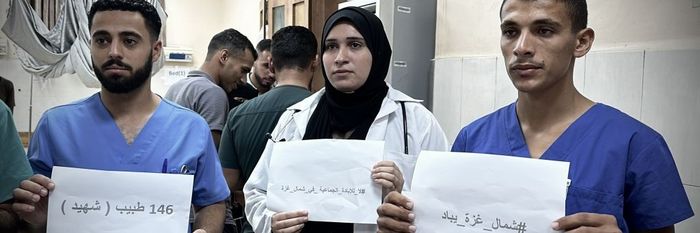
Human Rights Watch – (Jerusalem) – Israeli forces have arbitrarily detained Palestinian healthcare workers in Gaza since hostilities began in October 2023, deported them to detention facilities in Israel, and allegedly tortured and ill-treated them, Human Rights Watch said today. The detention of healthcare workers in the context of the Israeli military’s repeated attacks on hospitals in Gaza has contributed to the catastrophic degradation of the besieged territory’s healthcare system.
Released doctors, nurses and paramedics described to Human Rights Watch their mistreatment in Israeli custody, including humiliation, beatings, forced stress positions, prolonged cuffing and blindfolding, and denial of medical care. They also reported torture, including rape and sexual abuse by Israeli forces, denial of medical care, and poor detention conditions for the general detainee population.
“The Israeli government’s mistreatment of Palestinian healthcare workers has continued in the shadows and needs to immediately stop,” said Balkees Jarrah, acting Middle East director at Human Rights Watch. “The torture and other ill-treatment of doctors, nurses, and paramedics should be thoroughly investigated and appropriately punished, including by the International Criminal Court (ICC).”
From March to June 2024, Human Rights Watch interviewed eight Palestinian healthcare workers who were taken by the Israeli military from Gaza between November and December 2023 and detained without charge for between seven days and five months. Six were detained at work following Israeli sieges of hospitals or during hospital evacuations that they said had been coordinated with the Israeli military. None of the healthcare workers said they were ever informed of the reason for their detention or charged with an offense. Human Rights Watch also spoke with seven people who witnessed Israeli soldiers detaining healthcare workers carrying out their duties.
Human Rights Watch sent a letter to the Israeli military and Israeli Prison Services with the preliminary findings on August 13 but has not received a response.
All the healthcare workers interviewed provided similar accounts of mistreatment in Israeli custody. After being in Gaza, they were deported to detention facilities in Israel, including the Sde Teiman military base in the Negev desert and Ashkelon prison, or, forcibly transferred to the Anatot military base near East Jerusalem and the Ofer detention facility, in the occupied West Bank. All said that they were stripped, beaten, and blindfolded and handcuffed, for many weeks on end, and pressured to confess to being members of the Hamas movement with various threats of indefinite detention, rape, and killing their families in Gaza.
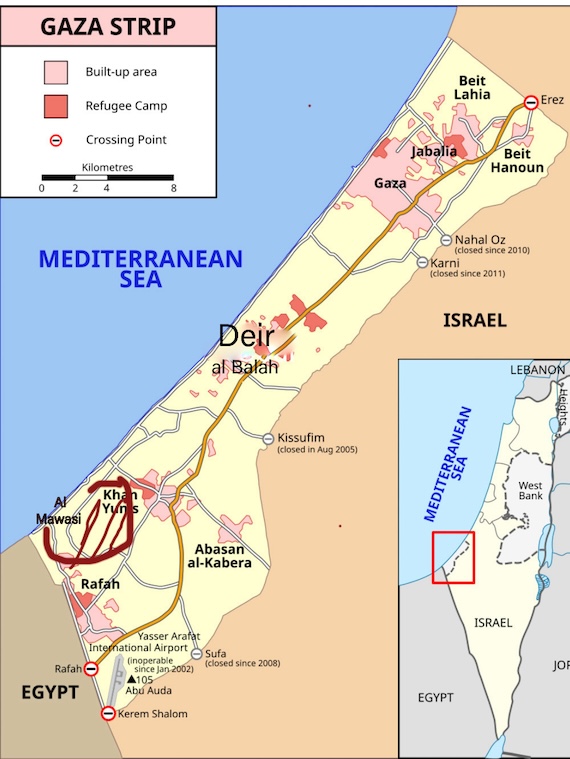
A surgeon said he was “wearing scrubs and Crocs” when Israeli forces detained him during their siege of Kamal Adwan Hospital in Beit Lahia, Gaza, in December. “We were 50 healthcare workers, including nurses and doctors,” he said. “The soldier on the microphone ordered men and boys over 15 years old to evacuate the hospital…. When they took us out of the hospital, they told us to undress and stay in our underwear.”
One paramedic said that at the Sde Teiman detention facility he was suspended from a chain attached to handcuffs, electroshocked, denied medical care for broken ribs caused by beatings, and administered what he believed was a psychoactive drug before interrogations. “It was so degrading, it was unbelievable,” he said. “I was helping people as a paramedic, I never expected something like this.”
Healthcare workers also reported being punished in detention for moving or speaking, and collectively punished if other detainees spoke. “Sometimes if one spoke, they [soldiers] punished the whole warehouse [at Naqab prison], collectively,” one healthcare worker said.
The Gaza Health Ministry reported that Israeli forces have detained at least 310 Palestinian healthcare workers since October 7. Healthcare Workers Watch-Palestine, a nongovernmental organization, documented 259 detentions of healthcare workers and collected 31 accounts describing torture and other abuses by Israeli authorities, including the use of stress positions, deprivation of adequate food and water, threats of sexual violence and rape, and degrading treatment. Healthcare Workers Watch-Palestine helped Human Rights Watch interview released healthcare workers.
The prolonged arbitrary detention and mistreatment of healthcare workers has exacerbated the health crisis in Gaza, Human Rights Watch said. Since October, over 92,000 people in Gaza have been wounded, functional hospitals have fewer than 1,500 inpatient beds, and yet the Israeli authorities have allowed only 35 percent of nearly 14,000 people who requested medical evacuations to leave Gaza, the World Health Organization (WHO) reported on August 5.
The healthcare workers’ accounts are consistent with independent reports, including by the United Nations Office of the High Commissioner for Human Rights (OHCHR), the UN Relief and Works Agency for Palestine Refugees (UNRWA), Israeli news media, and rights groups, documenting dozens of detainee accounts of incommunicado detention, beatings, sexual violence, forced confessions, electrocution, and other torture and abuses of Palestinians in Israeli detention.
The Israeli newspaper Haaretz reported on June 3 that the Israeli military was conducting criminal investigations into the deaths of 48 Palestinians in Israeli detention facilities since October 7. These include Dr. Adnan al-Bursh, a surgeon and head of orthopedics at al-Shifa Hospital, and Dr. Eyad al-Rantisi, the director of a women’s health center at Kamal Adwan Hospital in Beit Lahia.
Common article 3 to the four Geneva Conventions of 1949, applicable to hostilities between Israel and the Palestinian armed groups, provides that “[p]ersons taking no active part in the hostilities … shall in all circumstances be treated humanely.” “Cruel treatment and torture” and “outrages upon personal dignity, in particular humiliating and degrading treatment” are prohibited at all times. Those wounded and sick “shall be … cared for.”
Article 49 of the Fourth Geneva Convention, applicable to occupied territories, prohibits individual forcible transfers within the occupied territory as well as deportations of civilians from occupied territory to the occupying power’s territory, regardless of the motive. Serious violations of Common article 3 and article 49 of the Fourth Geneva Convention committed with criminal intent are war crimes.
Human Rights Watch has found that Israeli authorities for decades have failed to provide credible accountability for torture and other abuses against Palestinian detainees. According to official Israeli statistics, between 2019 and 2022, 1,830 complaints of abuse were opened against Israeli Prison Services officers, with none resulting in a criminal conviction. Israeli authorities have not allowed independent humanitarian agencies access to Palestinian detainees since the start of hostilities.
Governments should support international justice efforts to address Israeli abuses against Palestinian detainees and hold those responsible to account. The United States, the United Kingdom, Germany, and other countries should press Israel to end its abusive detention practices, which form one aspect of systematic oppression underlying Israeli authorities’ crimes against humanity of apartheid and persecution against Palestinians.
The ICC is considering arrest warrant applications against senior Israeli officials for grave international crimes and should ensure that its investigation addresses abuses against Palestinian detainees. Israel’s allies should press the government to urgently allow independent monitoring of detention facilities.
“The torture of Palestinian healthcare workers is a window into the much larger issue of the Israeli government’s treatment of detainees generally,” Jarrah said. “Governments should publicly call on the Israeli authorities to release unlawfully detained healthcare workers and end the cruel mistreatment and nightmarish conditions for all detained Palestinians.”
Humiliation, Ill-treatment, and Torture
The healthcare workers interviewed all reported humiliation, ill-treatment, and torture, including being stripped and beaten, with prolonged painful stress positions, near-constant cuffing, and blindfolding. Some said they were threatened with sexual violence and by attack dogs.
Abuses During Deportation, Detention
All eight men reported being forced to strip publicly immediately after being taken into custody and remain kneeling for extended periods, exposed to the cold, and at various times throughout their detention. Photographs and videos that Israeli soldiers shared online and that Reuters verified show Palestinian detainees unclothed or in underwear. Publishing such images online is an outrage on personal dignity and posted sexualized images are a form of sexual violence, which are war crimes.
“We were forced to strip in the street and remain in our boxers, one by one,” said Osama Tashtash, 28, a doctor at the Indonesian Hospital in Beit Lahia who was arrested in early December at his home nearby. “For an hour and a half, we were on our knees.” He said that during that period, he and other detainees were exposed to danger from Israeli military operations in the area. He said shrapnel fell on them as Israeli soldiers threw grenades at nearby houses and set them on fire.
Dr. Khalid Hamoudeh, 34, was arrested on the morning of December 12 at Kamal Adwan hospital in Beit Lahia. A photograph circulated late that evening by the Israeli broadcaster Channel 12 shows Dr. Hamoudeh shirtless alongside four other men he identified as fellow healthcare workers. The photograph shows the men standing in a row in front of an Israeli soldier holding a light panel, illuminating the detainees.
Dr. Hamoudeh said they were photographed, then designated for release or detention. Behind them the photograph shows hundreds of men sitting in a large pit with at least 18 Israeli soldiers guarding them. A detailed analysis by the investigative TechJournalist identified several detainees with their hands tied behind their back, including Dr. Hamoudeh.
The image, whose site was identified first by the open-source researcher FDov on X, formerly known as Twitter, and later confirmed by Human Rights Watch, was taken approximately half a kilometer northeast of the hospital. Dr. Hamoudeh said that about 50 healthcare workers sitting together separately from internally displaced people. He said he was told to undress and stay in his underwear and was then blindfolded.
The healthcare workers described beatings and physical abuse after being detained, including being punched, kicked with steel-toed boots, slapped, and beaten with assault-rifle butts by Israeli soldiers.
Eyad Abed, 50, a surgeon at the Indonesian Hospital who was detained during a coordinated evacuation of the hospital in November, said:
Every minute we were beaten. I mean all over the body, on sensitive areas between the legs, the chest, the back. We were kicked all over the body and the face. They used the front of their boots which had a metal tip, then their weapons. They had lighters: one soldier tried to burn me but burned the person next to me. I told them I’m a doctor, but they didn’t care.
Abed said that he had broken ribs and a broken tailbone as a result of the physical assault by Israeli soldiers during his arrest and detention, which two months later still had not healed.
An ambulance driver who asked not to be named said while he was being held with dozens of other men in large a metal “cage” near the Israel-Gaza border fence, he saw guards beat to death two men, one of whom he recognized, with metal bars.
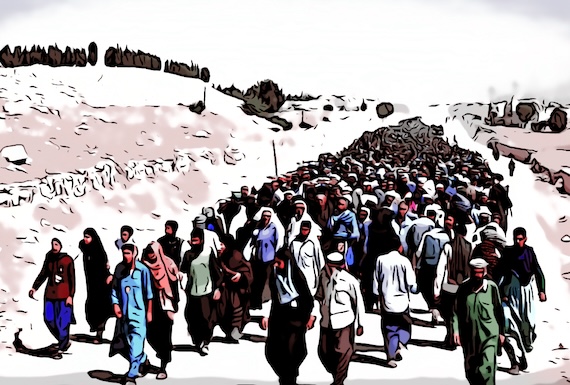
The healthcare workers all described ill-treatment during their deportation from Gaza to detention facilities in Israel, including beatings, sitting in prolonged painful stress positions while blindfolded and cuffed by the hands and feet, being “stacked above each other like sheep,” pepper sprayed, and denied water.
Abuses in Detention Facilities
The healthcare workers said that Israeli authorities abused detainees at detention facilities inside Israel. Four said that when they arrived at detention facilities, the authorities forced them to wear adult diapers and denied them access to toilets.
The ambulance driver, who was detained for five months, was first transferred to a prison in Ashkelon, where guards interrogated him daily for a week, during which time they bound him in his underwear to a chair for between 10 and 15 hours a day in a room with a blasting air conditioner. He said he had been badly beaten and that sitting caused extreme pain in his spine. He said the authorities denied him access to a toilet, forcing him to urinate on himself, and refused to provide him any food or water. He was then transferred to the Ofer military detention facility in the Occupied West Bank, where at night, the guards threw cold water on him and on his mattress.
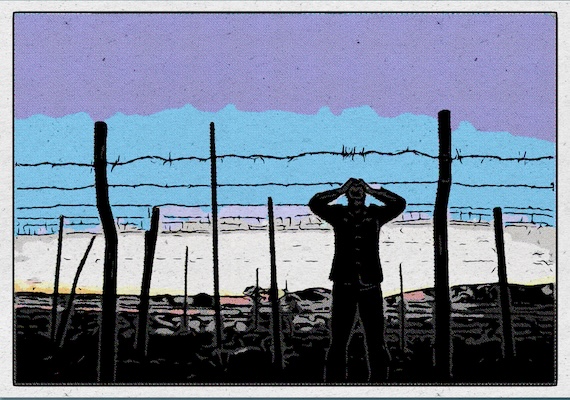
“P.O.W.,” Digital, Dream / Dreamland v3 / IbisPaint / Clip2Comic, 2024.
A paramedic, Walid Khalili, 36, said that when soldiers removed his blindfold at the Sde Teiman facility, he saw he was in a large building “like a warehouse,” with chains hanging from the ceiling. Dozens of detainees in diapers were suspended from the ceiling, with the chains attached to their square metal handcuffs. He said that personnel at the facility then suspended him from a chain, so his feet were not touching the ground, dressed him in a garment and a headband that were attached to wires, and shocked him with electricity.
Two doctors held at Sde Teiman said that other detainees came to them to seek care for wounds inflicted by Israeli authorities. When detainees “lifted their shirts, I saw signs of abuse and physical beatings,” one doctor said. The other said, “I saw [men] who had cigarette burns on their arms, it was very clear. One had a dog bite on his stomach.”
As punishment for moving or speaking, detainees would be forced to stand, sometimes for hours, with their cuffed hands held above their head or fixed to a fence, detainees said. Detainees could hear the screams of other detainees being beaten nearby. One said that after he asked a question, an Israeli officer forced his fingers through a chain-link fence, he “told me to shut up and not say a word,” and pressed downward on the detainee’s fingers for several minutes, causing severe pain until the detainee could no longer feel his fingers.
Three healthcare workers reported soldiers using military dogs to intimidate detainees. “They would threaten to shoot us and start loading their weapons,” one doctor said. “This felt like horror. They brought in military dogs. I screamed, that was the worst moment in my life, because I was still cuffed and blindfolded, not seeing where the dogs are coming from.” Another doctor said dogs were brought in late at night to wake and terrify detainees.
Threats and Acts of Sexual Abuse
Three healthcare workers said that Israeli authorities threatened them with sexual assault. Khader Abu Nada, 30, a nurse at Beit Hanoun hospital in northern Gaza, said that when he denied any Hamas affiliation during his first interrogation at a military base in Gaza, the commander threatened to rape him with an “electric stick.” When Abu Nada continued to deny any Hamas affiliation, soldiers beat him until he was bleeding from his nose, hands, and mouth.
Abu Nada said the commander then asked him where his mother was and threatened to bring her from the checkpoint where he was arrested and strip her in front of everyone. “When I heard this, I was psychologically broken. I felt humiliated,” he said. He said he was threatened with rape again prior to his release.
A detained paramedic who was transferred to al-Naqab prison after 20 days in Sde Teiman, said that a man who was visibly “bleeding from his bottom” was brought in and placed next to him. The man told the paramedic that before he was placed in detention, “three soldiers took turns raping him with an M16 [assault rifle]. No one else knew, but he told me as a paramedic. He was terrified.” In addition, a doctor said while he was detained in a military base, a detainee, “in his late 30s, crying hard … told me he was sexually assaulted during the strip search.”
Cruel, Inhuman, and Degrading Conditions
All the healthcare workers described horrific conditions in detention. Abed, the surgeon, said the food was “horrible” and inadequate, and that he lost 22 kilograms during a month and a half in detention. The bathrooms were “not even fit for animals.” The mattresses and blankets were thin, and the cold nights were “unbearable.” In the cells, water for toilets and for drinking was only available for one hour a day, with a “disgusting” stench emanating from the non-flushable toilets. “They gave us a bag for the garbage. We used to fill it with water and drink from it later. It smelled horrible but we had no choice,” Abed said.
For detainees’ meals at Sde Teiman, soldiers “emptied tuna cans into a garbage bag and gave it to me,” said Dr. Khalid Hamoudeh, whom soldiers ordered to distribute food to detainees. “One time I saw a soldier spit in the bag. Many [detainees] were starving and telling me they were hungry.” A nurse detained at Anatot said, “We got two meals [a day]. It was terrible food. I would just drink water, there were no fruits, not even apples. They gave us food just to survive the day.”
Khalili, the paramedic, said that at one point when he was detained in Sde Teiman, an Israeli news crew arrived, and a detainee who understood Hebrew told him that a prison official told the journalists, falsely, that the detainees were members of a unit of Hamas’s armed wing responsible for the October 7 attacks. The next day, the paramedic said, soldiers brought food and set it in front of the detainees, ordered them not to eat it, took photographs, then took the food away.
Prolonged Cuffing and Blindfolding
The healthcare workers said that they were cuffed almost constantly throughout their detention. They said Israeli authorities often ignored detainees who complained about the tightness of their cuffs or tightened their cuffs as punishment for complaining. In a public letter, an Israeli doctor working in the military field hospital at Sde Teiman wrote that in a single week, “two prisoners had their legs amputated due to handcuff injuries, which unfortunately is a routine event.”
Abu Nada, the nurse, said he was arrested at the Kuwaiti Roundabout in Gaza on November 22 while evacuating from the north with his family. Soldiers ordered him to strip, cuffed and blindfolded him, then took him for questioning. He said his first interrogation ended with an Israeli military commander punching him in the face and kicking him all over his body, then ordering another soldier to tighten his cuffs and drag him to an open field, where he waited on his knees for an hour.
“My wrists hurt so much, they felt paralyzed and numb. I cried so much, I couldn’t take the pain,” Abu Nada said. When he asked a soldier to loosen his cuffs, he said the soldier repeatedly kicked his head instead. “I told him, ‘Kill me I can’t take it anymore, kill me already.’” Israeli soldiers ignored or beat him in response to his multiple requests to loosen his handcuffs.
Abu Nada said his wrists later turned black, and he feared his mistreatment may have caused permanent damage: “I still feel pain in my hands. My hands are weak, and I have no strength to hold or carry anything. Also, there’s still pain from my shoulders all the way to my fingertips. I have severe neck pain from the pressure on my head when they kept pushing our heads down.”
As Physicians for Human Rights Israel has reported, prolonged physical restraint causes intense pain and can result in permanent nerve damage that interferes with using the hands and in extreme cases can lead to death.
The healthcare workers also all reported prolonged, near-constant blindfolding. According to Physicians for Human Rights Israel, “blindfolding can, even with short-term use, induce visual hallucinations in healthy individuals. Over extended periods, prolonged use of blindfolds can contribute to the onset of anxiety disorders, depression, substance abuse, and PTSD (post-traumatic stress disorder) in the medium to long term.”
Medical Neglect
The healthcare workers described medical neglect despite the detainees’ numerous requests and clear, urgent need for treatment for preexisting health conditions, or for injuries sustained during the hostilities in Gaza or from abuses in custody.
A nurse at Awda hospital in northern Gaza, who asked not to be named, said that on November 21 he was injured when an Israeli airstrike hit his hospital. He had emergency surgery at Awda hospital to stabilize broken fingers and a torn tendon in his right hand, which was then placed in a cast, and an open wound on his left hand was wrapped in gauze.
The next day, the nurse left the hospital in an ambulance along with 15 other people, including patients, their companions, and hospital staff, in an evacuation arranged by the Red Cross and Médecins Sans Frontieres (MSF or Doctors Without Borders). “The hospital shared our car license plate number, IDs, and names [with the Israeli military], and everything was approved,” he said.
Shortly after their departure, Israeli soldiers at the Kuwaiti Roundabout stopped the ambulance and ordered all passengers to exit. The nurse and another doctor were taken aside and ordered to strip. “My right hand had a cast and titanium [implants]; I couldn’t use it. I couldn’t even pee alone. The doctor detained with me helped me take off my clothes, even my shoes,” the nurse said.
Cuffed and blindfolded, the nurse was taken to Anatot military base. He said that on intake, soldiers introduced a man as a doctor who examined his wounds but did nothing else. He said despite repeated requests, the dressing was only changed for the first time on the third or fourth day of his detention and rarely after that. “They only changed the gauze on the injuries – no scans, no proper medication, nothing. My injury, the skin was open, [but I was given] nothing to treat possible bacteria,” he said. The nurse also said that after a week of detention he was released and needed surgery to treat hemorrhoids due to constant sitting and being kicked in detention.
Dr. Hamoudeh said that during his detention at Sde Teiman in late December, he saw another detainee with apparent “trauma from beatings, and I was terrified he would die.” He alerted authorities who said they were paramedics – he never saw an Israeli doctor at the facility – and “they took pictures [of the injuries] and sent it to someone. The soldier then told them enough, and not to do any more medical care.” He said when he told soldiers about people in need of medical care, they would reply to him saying they did not care if they died.
Dr. Hamoudeh said that one day in December, soldiers brought in five detained doctors, including Dr. Adnan al-Bursh, head of orthopedics at al-Shifa hospital in Gaza, who was declared dead by Israeli Prison authorities in Ofer prison in April. “Dr. Adnan was in pain from the beatings. He was also punished. He had visible blunt trauma, and he had trouble breathing,” Dr. Hamoudeh said. “What happened to him, happened to many. There’s clear medical neglect.”
Dr. Osama Tushtash, 28, fell ill with a severe fever after a week in detention at what he believed was al-Naqab prison, but Israeli authorities refused to let him see a doctor or even to give him a painkiller. “They just told me to drink water,” he said.
Khalili, the paramedic, said he suffered broken ribs and a lung injury as a result of beatings, but received no medical treatment at Sde Teiman. He said he saw a detainee die from what he believes was cardiac arrest. When a soldier brought in a doctor, who confirmed the detainee was dead, the detainees shouted “Allahu akbar,” prompting a violent raid by an Israeli special unit tasked with prison raids.
Autopsies of Palestinians who died in Israeli detention facilities indicated medical neglect and signs of physical abuse, including bruising and broken bones, Haaretz reported in March. A report released by Physicians for Human Rights Israel documented treatment without consent, surgery performed without an anesthesiologist, and political interference in medical decisions in detention facilities.
In a letter to senior Israeli officials, an Israeli doctor at Sde Teiman field hospital described practices that endangered detainees’ health, including the lack of trained medical staff, and transferring patients back to the detention facility after only an hour of observation following “major [surgical] operations,” Haaretz reported.
Article 91 of the Fourth Geneva Convention requires facilities detaining civilians to “have an adequate infirmary, under the direction of a qualified doctor,” where those detained may receive “the attention they require, as well as an appropriate diet.” Under international human rights law, medical care for detainees should be at least equivalent to that available to the general population. Current conditions of detention violate the Israeli Incarceration of Unlawful Combatants Law, which provides for detainees’ right to medical treatment, hygienic conditions, healthy and dignified sleeping arrangements, and daily outside exercise.
Use of Prisoner Functionaries
Two healthcare workers detained in different facilities said Israeli military commanders tasked them to act as prisoner functionaries or Shawish (an Arabic slang term for “servant” or “subordinate”). The men said that shawish, who act as intermediaries between the guards and detainees, are the only detainees not constantly blindfolded, though their hands remain cuffed. The men prepared and distributed food, assisted detainees with eating or using the toilet, cleaned rooms, transferred detainees to interrogation, and provided basic medical care.
Whistleblowers who spoke to CNN alleged that Israeli authorities appointed detainees as shawish only after they were cleared of suspected links to Hamas, and thus had no reason to detain them. In a statement to CNN, the Israeli military denied holding detainees unnecessarily.
Dr. Hamoudeh said that soldiers at Sde Teiman told him to act as a shawish because he spoke English, warning, “If you do anything, you’ll be punished worse than the rest.” He was interrogated only once, for about 10 minutes, on the tenth day of his detention, and was released without charge after 22 days.
Abu Nada, the nurse, said authorities at the Anatot military base told him to work as a shawish. On the fifth day of his detention, a soldier speaking in Arabic told him that if he wanted a lawyer, he had to provide the lawyer’s phone number, which he could not. He said the soldier told him, “We didn’t find anything on you. But we will continue investigating.” He was released without charge after about eight days, on December 1.
With his blindfold removed, Dr. Hamoudeh saw 10 to 20 detainees with medical conditions at Sde Teiman, some of whom needed immediate medical care. “They [the soldiers] threw this responsibility at me, but [left me] without proper medical equipment and facilities,” Hamoudeh said. “I was terrified some would die. […] The shawish before me told me [before being released] that three detainees died during his time.”
Abu Nada accompanied cuffed, blindfolded detainees from the “warehouse” to the interrogation room. “All the way to interrogation, soldiers would be kicking and assaulting [the detainees],” he said. “I used to cry when transferring them, because I’m the one bringing them to this torture. Soldiers told me to turn my face not to look as they continued to kick and beat the detainees.”
Via Human Rights Watch