14 February 23
Live on the homepage now!
Reader Supported News
ON A BINGE TO SAVE RSN NOW — CHIP-IN! — Of the 280,000 readers who have visited RSN already this month only 112 have clicked the donation link in the newsletter and made a donation. We have to do better, you have to do better. Now is the time.
Marc Ash • Founder, Reader Supported News
Sure, I'll make a donation!

Bernie Sanders, Elizabeth Warren, Back an Additional $2,400 for Social Security Checks
Ayelet Sheffey and Juliana Kaplan, Business Insider
Excerpt: "Sen. Bernie Sanders wants retirees to have more money - and he wants it to come from higher taxes on the wealthy."
Sen. Bernie Sanders wants retirees to have more money — and he wants it to come from higher taxes on the wealthy.
Sanders, alongside Sen. Elizabeth Warren and Reps. Jan Schakowsky and Val Hoyle, introduced legislation to beef up Social Security benefits and keep the program solvent through 2096. Social Security beneficiaries are currently facing down checks being cut as soon as 2035, as the program's trust fund slowly runs out.
"At a time when nearly half of older Americans have no retirement savings and almost 50 percent of our nation's seniors are trying to survive on an income of less than $25,000 a year, our job is not to cut Social Security," Sanders said in a press release. "Our job is to expand Social Security so that every senior in America can retire with the dignity that they deserve and every person with a disability can live with the security they need."
Social Security's solvency and newly-larger checks would be offset by raising the cap on earnings taxed for the program. Currently, only up to $162,000 is taxed for Social Security while any income above that limit is free from the tax. Under Sanders' proposal, that cap would be lifted, and income over $250,000 would be subject to the payroll tax.
It's not the first time Sanders has taken a swing at beefing up benefits and extending solvency. The progressive from Vermont introduced similar legislation over the summer. But the introduction of this legislation comes as negotiations over raising the debt limit are heating up — and Social Security, along with Medicare, have taken the spotlight. With Republicans holding a slim majority over the House, they have expressed their intent to use raising the limit — and keeping the US on top of paying its bills — as leverage to achieve their own priorities, particularly in the form of spending cuts.
While they have yet to make clear what exactly they are looking at cutting in an eventual debt limit deal, some Republican lawmakers had previously looked to Medicare and Social Security as areas to cut. Speaker of the House Kevin McCarthy clarified last month that cuts to both of those programs are "off the table," but Biden and Democratic lawmakers have continued to blast the GOP over their past comments on the issue.
"As House Republicans try to use a manufactured debt ceiling crisis to cut the Social Security that Americans have earned, I'm working with Senator Sanders to expand Social Security and extend its solvency by making the wealthy pay their fair share, so everyone can retire with dignity," Warren said in a statement alongside the legislation.
When it comes to Social Security's solvency, GOP Sen. Rick Scott unveiled a 12-point plan last year that would require all federal programs, including Social Security and Medicare, to sunset every five years, meaning that Congress would have to repeatedly act to renew the programs.
Scott has been adamant on social media that his plan never proposed cuts to the programs, and he proposed legislation last week that would rescind Internal Revenue Service funding and reallocate it to Medicare and Social Security to "address threats of insolvency."
That has not stopped Biden and the White House from blasting his proposal. During remarks last week in Scott's home state of Florida, Biden even brought pamphlets of Scott's plan and said that "I know that a lot of Republicans, their dream is to cut Social Security and Medicare."
"Well, let me say this," Biden said. "If that's your dream, I'm your nightmare."
READ MORE
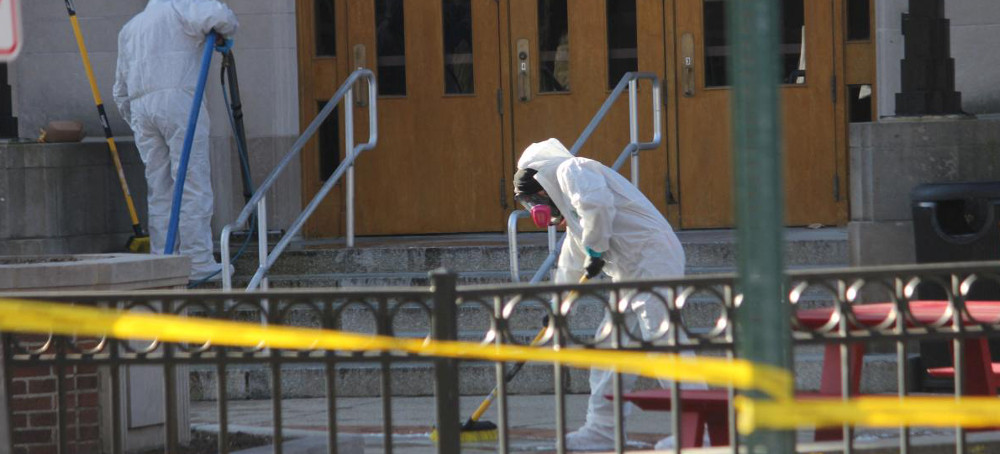 Workers clean the front steps and sidewalk outside Berkey Hall on Tuesday after a shooting at Michigan State University in East Lansing. (photo: Mike Ellis/Reuters)
'We Can't Keep Living Like This': Michigan Governor Denounces Campus Shooting
Richard Luscombe, Guardian UK
Luscombe writes: "Michigan's governor, Gretchen Whitmer, denounced the 'uniquely American problem' of gun violence on Tuesday after a gunman murdered three students on Monday night in a mass shooting at Michigan State University."
Gretchen Whitmer calls for action on ‘uniquely American problem’ after gunman kills three Michigan State students and wounds five
Michigan’s governor, Gretchen Whitmer, denounced the “uniquely American problem” of gun violence on Tuesday after a gunman murdered three students on Monday night in a mass shooting at Michigan State University.
Whitmer spoke at an emotional morning press conference in East Lansing at which authorities identified the shooter, who died by suicide, and revealed other details about the attack that left five other students critically wounded.
“We cannot keep living like this,” the Democratic governor said, noting that Tuesday marked exactly five years since 17 students and staff were killed in Florida in the nation’s worst high school shooting.
“We’re all broken by an all too familiar feeling. Another place that is supposed to be about community and togetherness shattered by bullets and bloodshed.”
Whitmer continued: “We know this is a uniquely American problem. Today is the fifth anniversary of the Parkland shooting. We’re mere weeks past the lunar new year shooting at a dance hall and a few months past a shooting at an elementary school at Uvalde, and looking back at a year marked by shootings at grocery stores, parades and so many other ordinary everyday situations.
“Our children are scared to go to school. People feel unsafe in their houses of worship, or local stores. As parents, we tell our kids, it’s going to be OK. But the truth is words are not good enough. We must act and we will.”
The interim deputy chief of Michigan State’s campus police department, Chris Rozman, named the gunman as 43-year-old Anthony McRae, whom he said had no affiliation to the university.
He said McRae shot dead two students and wounded several others at the campus’s Berkey Hall before walking to the student union building less than a block to the west and killing another.
McRae “quickly fled that building – he was not in the building for that long,” Rozman said. “We have absolutely no idea what the motive was at this point.”
Rozman said the shooter was located in Lansing at 11.35pm, about three hours after the shooting, after a tip from “an alert citizen” who recognized him from a photograph released by police.
McRae died of a self-inflicted gunshot wound, Rozman said, adding that he was unable to provide details of the firearm recovered at the scene and that investigators executed a search warrant on a residence connected to McRae.
Rozman also said authorities expected to release the names of the slain students later on Tuesday.
Cellphone video showed students running across the campus in panic as shots rang out while others barricaded themselves into classrooms and bedrooms for several hours during the hunt for McRae.
“The shooter came in our room and shot three to four times,” a Michigan State student, Dominik Molotky, told ABC News. “I’m pretty sure he hit two students in our classroom.”
The Democratic Michigan congresswoman Elissa Slotkin echoed Whitmer’s calls for gun reform, saying she was “filled with rage” at having to address another press conference only 15 months after a high school shooting in Oxford township near Detroit left three students dead and eight others injured.
“We have children in Michigan who are living through their second school shooting in under a year and a half,” Slotkin said. “If this is not a wake-up call to do something I don’t know what is.
“You either care about protecting kids or you don’t. You either care about having an open honest conversation about what is going on in our society, or you don’t, but please don’t tell me you care about the safety of children if you’re not willing to have a conversation about keeping them safe in a place that should be a sanctuary.”
At least two parents told local media in Michigan that their children had experienced the horror of both shootings. Jennifer Mancini told the Detroit Free Press that her freshman daughter, whom she did not want to identify, had lost two friends in the Oxford shooting.
“She said that she had PTSD,” Mancini said of her daughter. “She said she can’t believe this is happening again.
“She said, ‘Mom I just want to come home, I want to hold you.’”
Andrea Ferguson told Detroit’s Local 4 News that her daughter, whom she also did not name, was “unbelievably terrified” but remained calm because she knew what to do.
“I never expected in my lifetime to have to experience two school shootings. It was like reliving Oxford all over again,” she said.
Whitmer, fighting back tears, said Joe Biden had called to offer condolences and support. The president has repeatedly called for Congress to pass an assault weapons ban, most recently in his State of the Union speech last week.
“Our Spartan community and Michiganders across the state are devastated,” she said in a statement ahead of the briefing, which referred to the Spartans nickname belonging to Michigan State’s athletics teams.
“Spartans will cry and hold each other a little closer. We will mourn the loss of beautiful souls and pray for those fighting for their lives in the hospital.”
The chief medical officer at EW Sparrow hospital in Lansing, Denny Martin, said four of the five wounded required surgery, and all remained in a critical medical condition on Tuesday morning.
Michigan State’s interim president, Teresa Woodruff, said all classes were canceled until at least Monday.
According to the Gun Violence Archive, there had been at least 67 mass shootings in the US in 2023 as of Tuesday, which was the year’s 45th day. The archive defines a mass shooting as one in which four people are wounded or killed, not counting any shooters.
READ MORE
 The former president wants to expand the use of the death penalty, and expand the federal government's options for carrying out death sentences. (photo: Brendan Smialowski/AFP)
Trump Plans to Bring Back Firing Squads, Group Executions if He Retakes White House
Asawin Suebsaeng and Patrick Reis, Rolling Stone
Excerpt: "'What do you think of firing squads?' That's the question Donald Trump repeatedly asked some close associates in the run-up to the 2024 presidential campaign."
The former president wants to expand the use of the death penalty, and expand the federal government's options for carrying out death sentences
"What do you think of firing squads?”
That’s the question Donald Trump repeatedly asked some close associates in the run-up to the 2024 presidential campaign, three people familiar with the situation tell Rolling Stone.
It’s not an idle inquiry: The former president, if re-elected, is still committed to expanding the use of the federal death penalty and bringing back banned methods of execution, the sources say. He has even, one of the sources recounts, mused about televising footage of executions, including showing condemned prisoners in the final moments of their lives.
Specifically, Trump has talked about bringing back death by firing squad, by hanging, and, according to two of the sources, possibly even by guillotine. He has also, sources say, discussed group executions. Trump has floated these ideas while discussing planned campaign rhetoric and policy desires, as well as his disdain for President Biden’s approach to crime.
In at least one instance late last year, according to the third source, who has direct knowledge of the matter, Trump privately mused about the possibility of creating a flashy, government-backed video-ad campaign that would accompany a federal revival of these execution methods. In Trump’s vision, these videos would include footage from these new executions, if not from the exact moments of death. “The [former] president believes this would help put the fear of God into violent criminals,” this source says. “He wanted to do some of these [things] when he was in office, but for whatever reasons didn’t have the chance.”
A Trump spokesman denies Trump had mused about a video-ad campaign. “More ridiculous and fake news from idiots who have no idea what they’re talking about,” the spokesman writes in an email. “Either these people are fabricating lies out of thin air, or Rolling Stone is allowing themselves to be duped by these morons.”
Trump’s enthusiasm for grisly video campaigns has been documented before, including in an anecdote from a former aide that had the then-president demanding footage of “people dying in a ditch” and “bodies stacked on top of bodies” so that his administration could “scare kids so much that they will never touch a single drug in their entire life.”
Asked about firing squads and other execution methods, the spokesman refers Rolling Stone to lines from Trump’s 2024 campaign announcement. “Every drug dealer during his or her life, on average, will kill 500 people with the drugs they sell, not to mention the destruction of families. We’re going to be asking everyone who sells drugs, gets caught selling drugs, to receive the death penalty for their pain.”
At an October rally — to cheers and applause from his audience — Trump pitched a form of supposed justice that has been embraced by some brutal dictatorships. “And if [the drug dealer is] guilty, they get executed, and they send the bullet to the family and they want the family to pay for the cost of the bullet,” Trump said at the rally. “If you want to stop the drug epidemic in this country, you better do that … [even if] it doesn’t sound nice.”
The former president’s zeal for the death penalty has already proven lethal. During the final months of his administration, he oversaw the executions of 13 federal prisoners. Since 1963, only three federal prisoners had been executed, including Oklahoma City bomber and mass murderer Timothy McVeigh. In January 2021, in the final stretch before Biden would become president, Trump oversaw three executions in four days.
“In conversations I’d been in the room for, President Trump would explicitly say that he’d love a country that was totally an ‘eye for an eye’ — that’s a direct quote — criminal-justice system, and he’d talk about how the ‘right’ way to do it is to line up criminals and drug dealers before a firing squad,” says a former Trump White House official.
“You just got to kill these people,” Trump would stress, this ex-official notes.
“He had a particular affinity for the firing squad, because it seemed more dramatic, rather than how we do it, putting a syringe in people and putting them to sleep,” the former White House official adds. “He was big on the idea of executing large numbers of drug dealers and drug lords because he’d say, ‘These people don’t care about anything,’ and that they run their drug empire and their deals from prison anyways, and then they get back out on the street, get all their money again, and keep committing crimes … and therefore, they need to be eradicated, not jailed.”
Trump’s firing-squad fixation may address his desire for the “dramatic,” but some experts believe that an instant death-by-gunshot may be more humane than lethal injection. “There’s pain, certainly, but it’s transient,” according to Dr. Jonathan Groner, a professor of surgery at the Ohio State University College of Medicine. “If you’re shot in the chest and your heart stops functioning, it’s just seconds until you lose consciousness.”
Rules made during Trump’s presidency made federal firing squads more feasible. Previously, lethal injection was the only permissible federal method of execution. But under the administration’s new rules, if lethal injections are made legally or logistically unavailable, the federal government can use any method that is legal in the state where the execution is located.
The rule took effect on Dec. 24, 2020, and thus far has not been applied: All 13 Trump-era executions were done by lethal injection. But the expanded methods of execution could be relevant in the future. Opponents of the death penalty have pushed drugmakers to withhold the drugs needed to conduct lethal injections, complicating efforts to impose capital punishment. In Indiana, home to the Terre Haute facility where most federal executions are conducted, the new policies “legally open the door for the authorized use of firing squads, electrocution, or the gas chamber,” the Indianapolis Star reported at the time.
Former Attorney General Bill Barr, the ideological architect of Trump’s execution binge, told Rolling Stone in December that Trump and his administration would have had more people put to death soon, had he won a second term in 2020. “Yes — that was the expectation,” Barr succinctly summarized in a phone interview.
There are 44 men on federal death row. The only woman on federal death row in modern times was Lisa Montgomery, whom Trump and Barr put to death on Jan. 13, 2020.
There could soon be a 45th prisoner on federal death row. The Justice Department is seeking the death penalty for convicted domestic terrorist Sayfullo Saipov, who steered a truck onto a bike path and pedestrian walkway in New York City on Halloween in 2017, and is set to be sentenced in federal court in the days ahead. Biden and his attorney general, Merrick Garland, implemented a moratorium on capital punishment, but the sentence would leave Saipov eligible for execution under a future president.
READ MORE
 Sen. Kyrsten Sinema listens during a confirmation hearing on Feb. 1, 2022, in Washington, D.C. (photo: Al Drago/Getty)
Kyrsten Sinema Founded Consulting Firm With Arizona Figure Tied to Payday Loan Industry
Daniel Boguslaw, The Intercept
Boguslaw writes: "Since her own impoverished upbringing, Sinema has championed the very same businesses exploiting Americans in poverty, chief among them the payday lending industry. Such lenders have donated more cash to Sinema than any other sitting senator."
Since 2007, the representative has had a consultancy with Chad Campbell, a former legislator who backed industry-supported bills and later lobbied for payday lenders.
Sen. Kyrsten Sinema grew up poor, so poor that, according to her telling, at least, at one point her family lived in an abandoned gas station without utilities or running water. On the campaign trail, the Arizona independent is quick to recount childhood struggles with poverty and homelessness, often recounting how she relied on free school meals subsidized by the government to survive.
Since her own impoverished upbringing, Sinema has championed the very same businesses exploiting Americans in poverty, chief among them the payday lending industry. Such lenders have donated more cash to Sinema than any other sitting senator.
Before taking tens of thousands of dollars in campaign cash from payday lenders for her congressional races, Sinema joined forces with a sometime ally of the industry to form their own company.
In 2007, according to Arizona LLC filings, Sinema started a consulting firm with her friend and former Democratic state Rep. Chad Campbell, a major backer of industry-backed bills in the legislature who would go on to become a payday loan industry lobbyist in Arizona.
Sinema’s alliance with Campbell foreshadowed her political transformation, an evolution that, as her power grew in national politics, saw the onetime progressive shun her roots as a Green Party member and anti-war activist to embrace the very industries she once railed against.
The firm, Forza Consulting LLC, remains active, according to filings, though there is no public indication of corporate activity. Campbell and Sinema are the principals in the company, with Sinema listed as manager, alongside former Democratic state Rep. David Lujan.
“It was just a consulting company we had thought about creating,” Campbell, who served in the Arizona State Legislature from 2007 to 2015, told The Intercept. “And we never had a single thing with it ever. Never existed, in essence.” (Sinema did not respond to a request for comment.)
In Congress, Sinema consistently took positions aligned with payday lenders.
Payday lenders charge exorbitant fees for short-term loans with interest rates as high as 400 percent, named because borrowers are expected to pay off the loans with their next paycheck. The loans, however, are considered predatory and banned or restricted in 18 states because they can lead to a chain of further loans that bury borrowers in debt.
“The vast majority of payday and title loans result in another loan,” notes a 2016 report by the Center for American Progress. “Eighty percent of payday and auto title loans will be rolled over or followed by an additional loan within just two weeks of the initial loan, as borrowers are unable to afford other essential expenses. The median payday loan borrower is in debt for more than six months, and 15 percent of new loans will be followed by a series of at least 10 additional loans.”
Arizona has seen a decade-and-a-half-long fight over payday lending. The lending firms, often storefront operations, operated in the state thanks to a long-standing interest rate exemption. As the expiration date on the exemption approached, both industry advocates and opponents ramped up their work on the issue.
Among the earlier salvos was a 2007 bill in the Legislature that would allow payday lenders to continue operating in the state with capped interest rates and require additional screening measures. Opponents of the bill said it didn’t go far enough and left too much discretion in lenders’ hands. Its proponents dubbed the bill a thorough reform effort that provided necessary loan options for those facing difficult circumstances.
“Saying that people who are in hard financial straits need access to this kind of credit is sort of like giving a starving person rotten food,” Whitney Barkley-Denney, senior policy counsel at the Center for Responsible Lending, told The Intercept. “It makes them sicker than they were in the first place. People who borrow with payday loans find themselves facing bankruptcy, foreclosure, and worse. So the solution to the problems so many people face is higher wages and better jobs, instead of loans that sink them further and further into financial insecurity.”
Among the supporters of the 2007 bill were a lobbyist representing payday lending interests, as well as Chad Campbell, then a state representative from Phoenix. The bill ultimately failed in the Legislature.
In 2008, another attempt by the loan industry to maintain its foothold in the state died at the hands of Arizona voters. Industry groups spent millions promoting Proposition 200, a ballot measure which would have rolled back interest rate caps set to take effect in 2010. Arizona voters defeated the measure by a 3-to-2 margin.
After 2010, the payday lending industry was forced to comply with newly lowered rates, but that didn’t stop loan providers from launching a renewed effort to claw back business.
In 2017, two years after Campbell left the Arizona Legislature, industry-backed workaround bills were advanced to create new loan options that function similarly to payday loans but with names like “flex loans” and “consumer lines of credit.” One bill that would have allowed loans with interest rates exceeding 100 percent was on a fast track to passing in 2017 but was eventually held at bay.
Around that time, Campbell began lobbying for payday loan interests. He was registered in Arizona between 2017 and 2020 as a lobbyist for the Arizona Financial Choice Association, an industry trade group advocating on behalf of the lenders and a chief backer of the failed 2008 ballot measure to allow payday lenders to keep operating. Campbell insisted that the group did not represent payday lenders.
“There is no payday lending. It’s not payday lending,” he said. “I actually helped kill payday lending in Arizona when I was in the Legislature, so I wouldn’t work for payday lending.”
The Arizona Financial Choice Association had come under fire in 2016, when Democratic state Rep. Debbie McCune Davis called for an investigation into its letter drive to support legislation backing the creation of “flex loans.” McCune Davis said that many of the signatories on letters delivered to state politicians didn’t understand the content of the bill, and in some cases, didn’t even understand what the letter was for.
“I was working on a compromise piece of legislation at the state level with the industry at the time,” Campbell said, discussing the period he was registered to lobby.
“By law, I had registered as a lobbyist because that’s how it works here,” Campbell said. “I just had to do it as a formality. But I never worked at the federal level with them in any capacity.”
“So, like I said, this had nothing to do with Kyrsten Sinema in any way shape or form.” Campbell said.
Community Choice Financial, one of the payday lenders represented by the Arizona Financial Choice Association, has donated $21,000 dollars to Sinema since 2016.
The donations were part of Sinema’s haul from payday lenders. She has received the most money of any active senator from the industry, $168,000, and comes in third as among lifetime industry recipients, behind Sens. Richard Shelby, R-Ala., and Harry Reid, D-Nev.
Forza Consulting LLC, the firm Sinema started with Campbell, has not appeared on any of Sinema’s U.S. House or Senate disclosure forms, despite the company’s active status. Another consultancy she incorporated, Sinema Consulting LLC, does appear in disclosures.
Sinema and Campbell served together in the Arizona House of Representatives until 2010, a period that encompassed the first three years after Forza Consulting LLC’s founding in 2007. Sinema went on to the state Senate, then U.S. Congress, while Campbell stayed on in the state House for five more years.
Since their time in state politics, the pair have remained friends. Campbell, for his part, has consistently defended Sinema’s rightward turn. “She believes in the rules and believes in the processes, and she’ll figure out how to use those rules and processes to her advantage to get things done and bring people into alignment with her goals,” he told Mother Jones in 2021. Campbell has also sung Sinema’s praises to The Associated Press and the New York Times.
The two also have more recent financial ties. In 2014, Campbell was listed as a board member of the Arizona-based political mobilization organization Leading for Change. The same year, Sinema received more than $3,000 in income from the organization — a fee for leading a training. (Campbell said he did not facilitate the job and that Sinema was connected to the organization long before he joined the board.)
Since ascending to the U.S. Senate, Sinema has used her increasingly powerful vote to advocate for concessions to the private equity industry, block filibuster reform, and doom progressives’ top priorities.
Last month, she split with the Democratic Party to once again become an independent — signaling that, in the new Congress, her political alignment may stray even further from the liberals of the Democratic Party.
Long before her departure from the party, Sinema consistently rebuffed consumer protection advocates’ attempts to regulate the payday lending industry and repeatedly championed lending groups. She attempted to block reform efforts and sponsored legislation to shield loan companies from federal oversight.
In 2016, she joined Republicans in signing a letter to the Consumer Financial Protection Bureau, or CFPB, condemning the agency’s work reining in payday lenders. In just two days — the day before the letter was sent and the day it went out — she received over $10,000 in donations from the payday lending industry.
In July of the same year, she voted against an amendment that would have stripped language from a House appropriations bill attempting to defund the CFPB’s efforts targeting predatory lenders. She also co-sponsored the Consumer Protection and Choice Act, which sought to shield payday lenders from the CFPB by substituting federal regulatory authority with pro-lender legislation.
Her repeated efforts to chisel away at the CFPB’s enforcement powers — and the means by which she pursued her campaign — soured Sinema’s relationship with progressives in Washington, including the ornery Rep. Barney Frank, D-Mass. Sinema had claimed the former representative supported her efforts to replace the CFPB with a bipartisan commission — a claim Frank said was false and elicited a fiery letter from him in 2015.
“I write this only because you misrepresented my position, seeking inaccurately to portray me as having switched on the matter,” Frank wrote. “I am not surprised when right-wing Republicans do this but disappointed that you joined them in this tactic.”
READ MORE
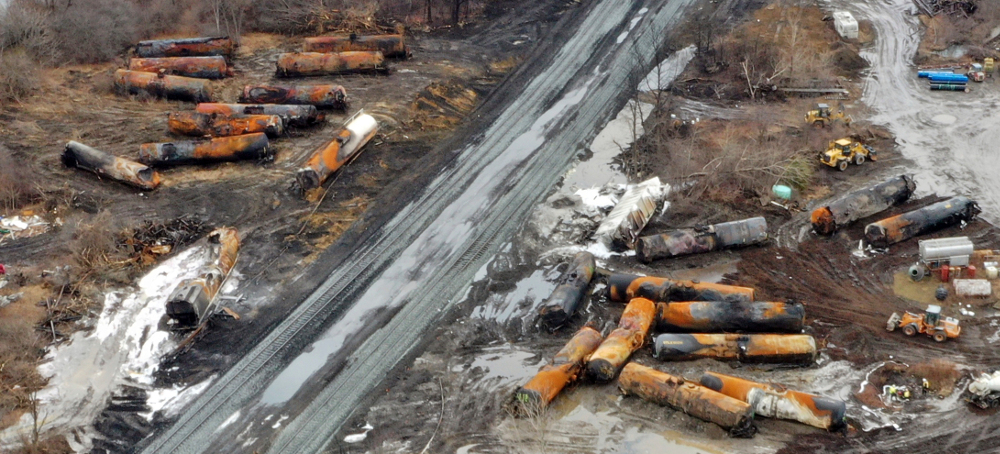 The continuing cleanup Thursday of parts of a Norfolk Southern freight train that derailed in East Palestine, Ohio. (photo: Gene J. Puskar/AP)
Worried Residents Near Ohio Train Derailment Report Dead Fish and Chickens as Authorities Say It's Safe to Return
Aria Bendix and David K. Li, NBC News
Excerpt: "For days, authorities have been telling residents of the area around East Palestine, Ohio, that it is safe to return home after a 150-car train carrying hazardous chemicals derailed Feb. 3."
Residents around East Palestine fear they, their animals and water sources were exposed to hazardous chemicals.
For days, authorities have been telling residents of the area around East Palestine, Ohio, that it is safe to return home after a 150-car train carrying hazardous chemicals derailed Feb. 3.
The Ohio Department of Natural Resources said the chemical spill resulting from the derailment had killed an estimated 3,500 small fish across 7½ miles of streams as of Wednesday.
And one resident of North Lima, more than 10 miles from East Palestine, told WKBN-TV of Youngstown that her five hens and rooster died suddenly Tuesday. The day before, rail operator Norfolk Southern had burned train cars carrying vinyl chloride — a flammable gas — to prevent an explosion.
For some people who live near the derailment site, the reports continue to spur fear that they and their animals might be exposed to chemicals through the air, water and soil.
"Don’t tell me it’s safe. Something is going on if the fish are floating in the creek," Cathey Reese, who lives in Negley, Ohio, told NBC affiliate WPXI of Pittsburgh last week. Reese said she saw dead fish in a stream that flows through her backyard.
Jenna Giannios, 39, a wedding photographer in nearby Boardman, said she has had a persistent cough for the past week and a half. She has been drinking bottled water, and she is uncomfortable bathing in water from the bathroom spigot, she said.
"They only evacuated only 1 mile from that space, and that’s just insane to me," she said, coughing throughout the conversation. "I’m concerned with the long-term heath impact. It’s just a mess."
After the controlled burn, the Environmental Protection Agency warned area residents of possible lingering odors but noted that the byproducts of vinyl chloride can emit smells at levels lower than what is considered hazardous.
Ohio officials said Wednesday that residents could return home after air quality samples "showed readings at points below safety screening levels for contaminants of concern."
The EPA, which is overseeing the air quality testing, said, "Air monitoring since the fire went out has not detected any levels of concern in the community that can be attributed to the incident at this time."
However, the EPA said Friday in a letter to Norfolk Southern that chemicals carried on the train "continue to be released to the air, surface soils, and surface waters."
The EPA said that as of Saturday evening, it had screened the indoor air in 210 homes and hadn't detected vinyl chloride. Another 218 homes had yet to be screened as of Sunday, it said.
The EPA classifies vinyl chloride as a carcinogen; routine exposure could increase one's risk of liver damage or liver cancer. Short-term exposure to high concentrations can cause drowsiness, loss of coordination, disorientation, nausea, headache or burning or tingling, according to the Centers for Disease Control and Prevention.
East Palestine has scheduled an emergency council meeting for Wednesday to respond to constituents' concerns.
Andrew Whelton, a professor of environmental and ecological engineering at Purdue University, said it's possible the burn created additional compounds the EPA might not be testing for.
"When they combusted the materials, they created other chemicals. The question is what did they create?" he said.
Whelton added that some of the other chemicals the train carried could also cause headaches, nausea, vomiting or skin irritation.
In Darlington, Pennsylvania, 4 miles from the accident, managers of the Kindred Spirits Rescue Ranch evacuated 77 of their biggest animals, including a yak and a zebu, for two days.
"We could see the plume come up and over us," said the ranch's founder, Lisa Marie Sopko. "Our eyes were burning, and my face could feel it."
Sopko said she’s concerned about the conditions. The ranch's water comes from its own two wells, but until experts can test them, Sopko said, her team is using one well with a more sophisticated filtration system.
The Ohio Department of Agriculture said the risk to livestock remains low.
"ODA has not received any official reports regarding the wellness of animals related to the incident," it said in a statement.
Still, the Ohio Farm Bureau Federation is urging members to get the water from their local wells tested as soon as possible.
"The biggest concern is the water table at this point, to see what kind of exposure there has been to these chemicals," said the bureau's organizing director, Nick Kennedy.
"There's some level of frustration out there" among farmers, Kennedy added. "They just want answers. Their livelihoods might be at stake here."
Laura Fauss, the public information officer for the Columbiana County Health District, said the department began groundwater sampling last week in partnership with the state Health Department, the state EPA and contractors for Norfolk Southern.
The results haven't come back yet, Fauss said, and she didn't know when to expect them.
She added that her department has received no reports of residents' experiencing abnormal symptoms.
But Giannios said she and other residents haven’t gotten all their questions answered, so in the meantime, she has started a Facebook page where people can keep in touch about their concerns.
READ MORE
 Nobel Prize winning poet Pablo Neruda sits in Paris, France. Forensic experts have determined that Chilean poet Pablo Neruda was poisoned, Rodolfo Reyes, the Nobel Prize winner's nephew, said on Monday, Feb. 13, 2023. (photo: Michel Lipchitz/AP)
Experts Found Chilean Poet Neruda Was Poisoned, Nephew Says
Eva Vergara, Associated Press
Vergara writes: "Forensic experts have determined that Chilean poet Pablo Neruda died of poisoning nearly 50 years ago, a family member of the Nobel Prize winner said Monday."
Forensic experts have determined that Chilean poet Pablo Neruda died of poisoning nearly 50 years ago, a family member of the Nobel Prize winner said Monday.
The revelation by Rodolfo Reyes, a Neruda nephew, is the latest turn in one of the great debates of post-coup Chile. The long-stated official position has been that Neruda died of complications from prostate cancer, but the poet’s driver argued for decades that he was poisoned.
There was no confirmation of Reyes’ comments from forensic experts from Canada, Denmark and Chile who are scheduled to publicly release a report Wednesday on the cause of Neruda’s death.
The public release of the group’s finding has been delayed twice this year, first due to internet connectivity issues of one of the experts and then again because a judge said the panel had yet to reach a consensus.
International forensics experts several years ago rejected the official cause of death as cachexia, or weakness and wasting of the body due to chronic illness — in this case cancer. But at that time they said they had not determined what did kill Neruda.
In an interview with The Associated Press, Reyes said forensic tests carried out in Danish and Canadian labs indicated a presence of “a great quantity of Cloristridium botulinum, which is incompatible with human life.” The powerful toxin can cause paralysis in the nervous system and death.
Reyes first revealed the information to the Spanish news agency EFE earlier Monday.
As a lawyer in the judicial case over his uncle’s death, Reyes said he has access to the forensic report, which was carried out after the same group of experts said in 2017 that there were indications of a toxin in the late poet’s bones and a molar.
The lab tests concluded that the toxin was administered when the poet was alive, Reyes said.
The report is set to be released almost 50 years after the death of the poet and Communist Party member and 12 years after the start of a judicial investigation into whether he was poisoned, as his driver Manuel Araya maintains.
Araya told AP earlier this month he was confident that the forensic findings would support his assertion the poet died after being given “an injection in the stomach” at the clinic where he was hospitalized. Araya said he first heard that version of events from a nurse.
Neruda, who was 69 and suffering from prostate cancer, died in the chaos that followed Chile’s Sept. 11, 1973, coup that overthrew President Salvador Allende and put Gen. Augusto Pinochet in power.
Neruda’s body was exhumed in 2013 to determine the cause of his death but those tests showed no toxic agents or poisons in his bone. His family and driver demanded further investigation.
In 2015, Chile’s government said it was “highly probable that a third party” was responsible for Neruda’s death. Neruda was reburied in his favorite home overlooking the Pacific Coast last year.
In 2017, a team of international scientists determined that Neruda did not die of cancer or malnutrition, rejecting the official cause of death but not saying what he did die of.
“The fundamental conclusions are the invalidity of the death certificate when it comes to cachexia as a cause of death,” Aurelio Luna, one of the panel’s experts, said at that time. “We still can’t exclude nor affirm the natural or violent cause of Pablo Neruda’s death.”
Neruda, who was best known for his love poems, was a friend of Allende, who killed himself rather than surrender to troops during the coup led by Pinochet.
Neruda was traumatized by the military takeover and the persecution and killing of his friends. He planned to go into exile, where he would have been an influential voice against the dictatorship.
But a day before his planned departure, he was taken by ambulance to a clinic in Chile’s capital of Santiago where he had been treated for cancer and other ailments. Neruda officially died there Sept. 23, 1973, from natural causes.
But suspicions that the dictatorship had a hand in the death remained long after Chile returned to democracy in 1990.
The former Mexican ambassador to Chile at the time of the bloody military coup, Gonzalo Martínez Corbalá, told AP on two occasions that he saw Neruda the day before his death and that his body weight was close to 100 kilos (220 pounds). Martínez spoke to AP by phone in 2017, a few days before his death.
Araya told AP last month he still thinks that if Neruda “hadn’t been left alone in the clinic, they wouldn’t have killed him.”
He recalled that on Neruda’s instructions, on Sunday, Sept. 23, the poet’s wife, Matilde Urrutia, and he were at the mansion to pick up the suitcases that would be taken to Mexico the following day. In the middle of the afternoon Neruda asked them to come back quickly. He died that same night.
During his life, Neruda accumulated dozens of prizes, including the 1971 Nobel Prize for Literature, but in recent years criticism has appeared from feminist groups over a rape he committed in the 1930s and which he recounted in his book “I Confess That I Have Lived.” He also is criticized for abandoning his only daughter, Malva Marina, because she was born with hydrocephalus.
READ MORE
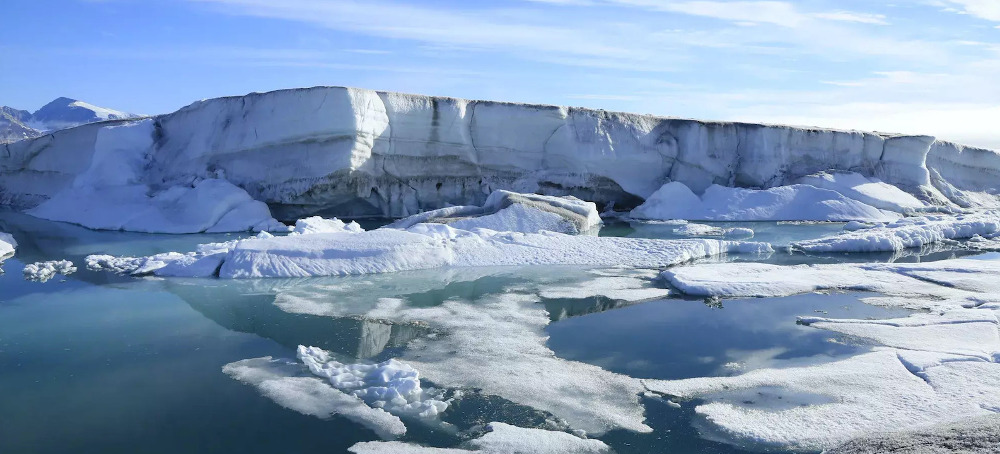 Ice shards float near the large rift formed in the Milne Ice Shelf following the 2020 calving event. (photo: Cameron Fitzpatrick)
The 'Last Ice Area' Is Already Disappearing
Avery Schuyler Nunn, Grist
Nunn writes: "Where there had once been fingers of turquoise, there was now only the vivid white of ice and the ghostly remnants of melt water."
Scientists race to study Arctic lakes before they are lost forever.
Last July, glaciologist Derek Mueller made his fourteenth annual quest to gather samples from Milne Fjord, a research station on the coastal margin of the “Last Ice Area”— a 400,000-square-mile region north of Greenland and the Canadian Arctic Archipelago. The facility sits about 500 miles from the North Pole, nestled between tremendous ice flows. The landscape is rich with harsh beauty: Melt ponds, underlined by glistening ice, rest between white hillocks. Contrasted against the vivid white ice and dark, churning sea, each pool glows with its own crystal-blue light.
Mueller’s work had focused on Milne Fjord’s only known epishelf lake — a microbially rich ecosystem that arises when an ice shelf creates a dam, allowing a thin layer of freshwater to float above seawater connected to the open ocean. As with the rest of the Arctic, they are threatened by climate change. But there was reason to hope for Milne Fjord: For years, scientists believed this area, home to the oldest and thickest ice in the northern hemisphere, would survive the worst effects of global warming.
But as Mueller and his team approached their old testing grounds, they could tell something was amiss. Where there had once been fingers of turquoise, there was now only the vivid white of ice and the ghostly remnants of melt water.
Milne Fjord’s epishelf lake had all but disappeared.
“It’s a mixed bag of emotions,” said Mueller. “There’s the scientific curiosity of measuring a changing system, but at the same time it’s a feeling of great loss.”
The Arctic is no stranger to depletion, warming at a rate nearly four times faster than the rest of the planet. It’s widely known that as glaciers calve and collapse, ice-dependent habitats and the wildlife that depend on them will continue to disappear. But while famished polar bears, retreating ice, and ancient viruses tend to drive headlines about Arctic thaw, the slow but steady thaw of the Last Ice Area places scientists on a new level of alert.
Not only does its disappearance sound an unexpected warning bell for climate change and the carbon cycle, it also means there may be little time left to learn from the Arctic’s unique ecosystems — before they disappear.
The Last Ice Area was once so frozen and hostile it stymied those who sought to traverse it. In the summer 1875, British explorer Albert Hastings Markham wrote of Milne Fjord:
The ice shelf was so rugged, in fact, that the team was forced to turn back. But, nearly 148 years later, the Arctic bears little resemblance to that description. According to NASA, the extent of summer sea ice — the area in which satellite sensors show to be at least 15 percent covered in frozen water — is shrinking by more than 12 percent per decade.
Satellite observations have shown that between 1997 and 2017 alone, the region lost around 31 trillion tons of ice. Even if we do manage to limit global warming to the goal of 1.5 degrees C (2.7 degrees F), a recent study predicted the Earth would still lose a quarter of its glacier mass.
There are myriad reasons why the Arctic is warming so quickly (a phenomenon scientists often refer to as Arctic amplification), but a leading culprit is sea ice melt. The Arctic’s sea ice, typically 3 to 15 feet thick, freezes during winter and melts each summer. The white, snow-covered sheets reflect roughly 85 percent of incoming solar radiation back out to space. The open ocean, on which the ice floats, is so dark that it absorbs 90 percent of it.
As the region’s sea ice melts, solar absorption rates create a positive feedback loop: The warmer the ocean, the less ice. The less ice, the more heat is absorbed. The more heat, the warmer the ocean.
Even accounting for this cycle, most climate models predicted the Last Ice Area would remain relatively frozen, acting as a seasonal stronghold for ice-dependent animals. In the summer ice flows from continental ice shelves near Siberia tend to pile up in the area, forming frozen ridges more than 30 feet high.
But it seems Milne Fjord’s thick ice isn’t enough to shield it from the current pace of warming. “The glaciers melting are bringing freshwater down, adding heat into the fjord and the epishelf lake,” Mueller said. “Having weaker ice in the fjord would mean that the glacier could advance faster, thin out faster, and break up faster. ”
While it’s too early to determine the exact cause behind the disappearance of Milne Fjord’s epishelf lake, Mueller thinks that drainage may be attributed to the Milne Ice Shelf breaking apart two years ago. In 2002, scientists observed a similar phenomenon when the Ward Hunt ice shelf broke off, causing the Disraeli Djord Epishelf Lake to drain away.
“We’re really seeing the last death row of these epishelf lakes,” he said. “There aren’t any others in Canada as far as we know.”
It’s not just epishelf lakes that are disappearing from the Far North. Researchers sometimes refer to Arctic lakes as “sentinels,” due to their swift responses to shifting conditions. “Lakes are more sensitive than other ecosystems to climate change,” said environmental microbiologist Mary Thaler, who felt compelled to study the Arctic’s ecosystems because of the dwindling time they might remain in existence. “They’re like the warning bell going off, the first ones to take the hit, and we see them being utterly transformed.”
According to a 2022 study, lakes constitute almost 40 percent of the Arctic lowlands, the largest surface water fraction of any terrestrial biome. In addition to providing crucial habitat for high Arctic wildlife, marine species, and migratory birds, they are a critical source of freshwater for Indigenous communities such as the Komi and Nenets.
The rapid disappearance of these essential bodies of water has surprised some researchers. Scientists once predicted that climate change would initially expand them across the tundra. Although they knew drainage might eventually occur, it wasn’t expected for a few hundred more years. But it seems that the thawing of underlying permafrost, the frozen mixture of soil and organic matter that blankets the far north, is counteracting the expansion effect.
Permafrost is an important form of long-term storage for carbon — holding nearly twice as much as currently found in the atmosphere. But that ability depends on permafrost remaining frozen. As the ground thaws, plants or animals buried within can resume decomposing, releasing greenhouse gases into the atmosphere. Permafrost, particularly the layers under Arctic lakes, can also contain a particularly high number of frozen microbes, which help facilitate the release of gases. While a few scientists have expressed concerns over the re-release of prehistoric diseases and pathogens, most researchers say the real worry has to do with climate feedback loops.
“The important part is that it is a very large reservoir of carbon that we don’t want moved into the atmosphere,” said Arctic ecologist Elizabeth Webb.
Webb’s research has largely focused on why Arctic lakes are disappearing far more quickly than expected. She found that the decreases in surface water over the last 20 years have been correlated with two distinct climate variables. The first, not surprisingly, is increasing temperatures. The second and far more puzzling factor to researchers is the climate-driven increase in rainfall.
It may seem counterintuitive that more rain could lead to fewer lakes. “We were like, why in what world does this make sense?” Webb said. But because autumnal rain is warmer than the frozen ground, it brings a whole lot of heat to the underlying permafrost. That warmth can open up underground channels that drain surface water.
“This drying of lakes was expected,” says Webb, “but it’s happening way earlier than the models projected.”
But time is short to figure out what it all means for the Arctic and beyond. Researchers in the area lost two years of fieldwork due to the COVID-19 pandemic, and many projects were further delayed by the proposal backlog for expedition funding. Even the unpredictable Arctic weather can turn against scientists, with certain expeditions requiring clear skies in order for helicopters to take scientists to key sample sites. Mueller remembers an expedition where fog and rain delayed his team’s arrival by 10 days. “By the time we actually got there, we basically got the bare minimum of what we needed done,” he said.
For those lucky enough to have procured samples from the disappearing ecosystems of the Arctic, those materials have taken on a new significance.
In Quebec City, Thaler analyzes small amounts of freshwater drawn during a 2016 excursion to Milne Fjord’s epishelf lake. The lake is no more, but the samples teem with life. Thaler goes through each one, trapping bacteria, viruses, and other microbial DNA in filters.
“We had looked at other parts of the Milne Epishelf Lake’s ecosystem but never the viruses,” she said. “Because it’s so dark, cold, and poor in nutrients, most of what’s in the lake is tiny microscopic life — so viruses can make huge differences in which species are going to thrive.
Thaler and her team found that in terms of viruses, the lake had been 25 percent more abundant and diverse compared to the marine layer beneath.
“Everything that is going on in terms of photosynthesis, respiration, and releasing carbon is actually being driven by this microscopic community,” she said. “We wanted to know, are there species or genetic codes or different traits that are only found in this one lake? Now, anything that was unique or special about it has been lost forever.”
Much like the journal entries from 1875, the lake’s samples offer a glimpse into the ecosystems of the past – a historic snapshot of a bygone world. For his part, Mueller thinks back on his work at Milne Fjord with a feeling of apprehension and urgency — but also hope.
“It’s an environment that is stunningly beautiful and rather unique. It would be nice to fully characterize it and understand it before it’s lost forever,” he said. “There’s no local solution to any of this – it’s a global problem, so we need global changes to address this.”
READ MORE
Contribute to RSN
Follow us on facebook and twitter!
Update My Monthly Donation
PO Box 2043 / Citrus Heights, CA 95611