Dear Friend,
At this stage high profile global campaigners and activists need to continue putting pressure on not just the Indian government itself but also companies like Facebook, Google and others to stop investing in the crony capitalist empire of Mukesh Ambani. While ultimately it is the spirit and spread of the Indian farmers movement that will decide whether they win or not, given the deep involvement of US companies with the problem, more support from the American public could certainly help tip the balance.
If you think the contents of this news letter are critical for the dignified living and survival of humanity and other species on earth, please forward it to your friends and spread the word. It's time for humanity to come together as one family! You can subscribe to our news letter here http://www.countercurrents.org/news-letter/.
In Solidarity
Binu Mathew
Editor
Countercurrents.org
Not just Rihanna or Greta, Indian farmers are inspiring the world
by Satya Sagar
At this stage high profile global campaigners and activists need to continue putting pressure on not just the Indian government itself but also companies like Facebook, Google and others to stop investing in the crony capitalist empire of Mukesh Ambani. While ultimately it is the spirit and spread of the Indian farmers movement that will decide whether they win or not, given the deep involvement of US companies with the problem, more support from the American public could certainly help tip the balance.
Farmers’ Protest in India – Price of Failure Will Be immense
by Colin Todhunter
What happened in Mexico should serve as a warning as Indian farmers continue their protest against three
recent farm bills that are designed to fully corporatize the agrifood sector through contract farming, the massive roll-back of public sector support systems, a reliance on imports (boosted by a future US trade deal) and the acceleration of large-scale (online) retail.
Farmers Are Tillers, Not Killers
by Kancha Ilaiah Shepherd
Kangana Ranaut again and again is attacking the Indian farmers as terrorists. She has done that in response to the world famous pop singer Rihanna and famous environmentalist girl Greta’s support to farmers movement. Sachin Tendulkar and other pro-BJP forces also joined the chorus. Most of these forces are pro-monopoly houses and hardly have any engagement with the agrarian production.
Are The Farmers Making Delhi Irrelevant?
by Avay Shukla
And so the farmer has decided to BYPASS Delhi and take it out of
the equation: Rakesh Tikait went to Jind to attend a mahapanchayat on the 3rd of this month, he avoided Delhi and took the longer route via Haryana. The symbolism of this cannot be ignored. And at Jind he announced that he will now take the protests to other parts of India. This reminds me of two historical events. One: the Maginot line was built by France on its borders with Germany to deter any invasion by Hitler. It was so heavily fortified that it was considered impregnable. But when the time came the Germans simply bypassed it and rolled their Panzers through the Ardennes forest into France without any opposition.
The political impact of Kisan Andolan
by Vidya Bhushan Rawat
Tikait has said that voting to BJP was his biggest fault and the farmers have realised that the current farm laws are only meant for crony corporate. The government till date have used their ‘developmental model’ against
Dalits, Adivasis and OBCs but for the first time their ‘model’ is being challenged by the ruling castes, a part of their own ‘structure’ and it has jolted them from inside. There are Maha Panchayats being organised in various parts of Uttar Pradesh and Haryana with massive presence of the people and this is a message for BJP to not be arrogant about its ‘government’.
India: Whose sovereignty is it anyway?
by Bhabani Shankar Nayak
The questions of national sovereignty are dominating debates in Indian politics today. The Indian media has become the voice of the BJP government led by Mr Narendra Modi. The government and media derides anyone as anti-national if one question’s the government of the day. The students, youths, religious minorities, Dalits, tribals, Kashmiris, human rights activists, lawyers, rationalists, writers, journalists, comedians, cartoonists, progressive activists and
farmers are branded as anti-nationals by the government and its media agencies. The poor oppressed and marginalised Indian population and voices of their struggles for justice are considered to be a threat to the sovereignty of the country
Reflections on the farmers movement
by T Navin
Identity politics cannot subsume real politics. Hindutva built on Hindu identity cannot stop emergence of a challenge built on solidarity of the oppressed classes.
Farmers’ Movement: Time to Introspect
by Dr Prem Singh
I personally do not agree with the decision of holding a tractor rally in the capital; that too on Republic Day. However, what could have happened on 26 January can also be imagined. The Republic Day Parade would end at 12 noon on the Rajpath, and the tractor parade of farmers would begin in full swing at the scheduled
‘Janpath’. Had it been possible to arrange for a live broadcast at the departure points and major intersections on the way, the whole country and the world would have witnesses that. Even if the government did not repeal the laws, the movement would have reached the next stage.
Rejecting and Reinventing Indian Republic
by Dr Prakash Louis
Those who were following without bias the farmers movement from September 2020, would vouch for this fact that the farmers have been proclaiming and adhering to a democratic, reconciliatory, progressive and solution seeking thought and procedure. Due to this only they were ready for dialogue with the government and attend 11 rounds of talk.
131st Birth Anniversary of Frontier Gandhi Khan Abdul Ghaffar Khan–Who?
by Shamsul Islam
February 6 is the
131st birth anniversary of Khan Abdul Ghaffar Khan also popularly known as Frontier Gandhi and Badshah Khan. He was a prominent Indian freedom fighter, a die-hard opponent of the two-nation theory and the idea of Pakistan.
Market solutions will make roads unsafe for everyone
by Bobby Ramakant
India along with 193 countries had promised to halve deaths and serious injuries on the roads by 2020 (as part of UN Sustainable Development Goals). But we have failed to keep this promise as the year 2020 passed by. In 2015, number of road traffic accident deaths in India were 146,133. In 2019, instead of declining (by half), the number of people who died in road traffic accidents had increased to 154,000 in India.
Most Cost-Effective and Pain-Reducing Way of Reducing Cancer-Related Distress is to Focus More on Preventive Aspects
by Bharat Dogra
There is increasing concern that the denial of cancer care and diagnosis to a lot of patients during the recent times of lockdowns and concentrating medical attention on Covis-19 is likely to lead to an increase in cancer related deaths in the near future. To give just one indication of this, a Lancet study has presented estimates of a likely increase in cancer deaths over the next five years related to diagnostic delays, ranging from 4.8 per cent from lung cancer to 16.6 per cent from colorectal cancer.
Master of Disaster – Germany’s Private University
Written by Thomas Klikauer and Norman Simms
Nestled in the northern Hanseatic port city of Bremen, Jacobs University is one of Germany’s few private tertiary institutions Jacobs
University In a country dominated by 107 state-run universities., it is soon to join a list of eighteen other private universities and colleges that have closed their doors in the last few years.
JFK, Allen Dulles, and Indonesia
by Edward Curtin
A Review: JFK vs. Allen Dulles by Greg Poulgrain
A Review: JFK vs. Allen Dulles by Greg Poulgrain
Before I digress slightly, let me state from the outset that the book by Greg Poulgrain that I am about to review is extraordinary by any measure. The story he tells is one you will read nowhere else, especially in the way he links the assassination of President Kennedy to former CIA Director Allen Dulles and the engineering by the latter of one of the 20th century’s most terrible mass murders. It will make your hair stand on end and should be read by anyone who cares about historical truth.
About twelve years ago I taught a graduate school course to Massachusetts State Troopers and police officers from various cities and towns. As part of the course material, I had created a segment on the history of the United States’ foreign policy, with particular emphasis on Indonesia.
No one in this class knew anything about Indonesia, not even where it was. These were intelligent, ambitious adults, eager to learn, all with college degrees. This was in the midst of the “war on terror” – i.e. war on Muslim countries – and the first year of Barack Obama’s presidency. Almost all the class had voted for Obama and were aware they he had spent some part of his youth in this unknown country somewhere far away.
I mention this as a preface to this review of JFK vs. Dulles, because its subtitle is Battleground Indonesia, and my suspicion is that those students’ lack of knowledge about the intertwined history of Indonesia and the U.S. is as scanty today among the general public as it was for my students a dozen years ago.
This makes Greg Poulgrain’s remarkable book – JFK vs. Allen Dulles: Battleground Indonesia – even more important since it is a powerful antidote to such ignorance, and a reminder for those who have fallen, purposefully or not, into a state of historical amnesia that has erased the fact that the U.S. has committed systematic crimes that have resulted in the deaths of more than a million Indonesians and many more millions throughout the world over innumerable decades.
Such crimes against humanity have been hidden behind what the English playwright Harold Pinter in his 2005 Nobel Prize address called “a tapestry of lies.” Of such massive crimes, he said:
But you wouldn’t know it.
It never happened. Nothing ever happened. Even while it was happening it wasn’t happening. It didn’t matter. It was of no interest. The crimes of the United States have been systematic, constant, vicious, remorseless, but very few people have actually talked about them.
And when one examines the true history of such atrocities, again and again one comes up against familiar names of the guilty who have never been prosecuted. Criminals in high places whose crimes around the world from Vietnam to Chile to Cuba to Nicaragua to Argentina to Iraq to Libya to Syria, etc. have been – and continue to be – integral to American foreign policy as it serves the interests of its wealthy owners and their media mouthpieces.
In his brilliant new book on U.S./Indonesian history, Dr. Greg Poulgrain unweaves this tapestry of lies and sheds new light on the liars’ sordid deeds. He is an Australian expert on Indonesia whose work stretches back forty years, is a professor at University of the Sunshine Coast in Brisbane and has written four highly-researched book about Indonesia.
In JFK vs. Dulles, he exposes the intrigue behind the ruthless regime-change strategy in Indonesia of the longest-serving CIA director, Allen Dulles, and how it clashed with the policy of President John F. Kennedy, leading to JFK’s assassination, Indonesian regime change, and massive slaughter.
Poulgrain begins with this question:
Would Allen Dulles have resorted to assassinating the President of the United States to ensure that his ‘Indonesian strategy’ rather than Kennedy’s was achieved?
To which he answers: Yes.
But let me not get ahead of myself, for the long, intricate tale he tells is one a reviewer can only summarize, so filled is it with voluminous details. So I will touch on a few salient points and encourage people to buy and read this important book.
Indonesia’s Strategic Importance
The strategic and economic importance of Indonesia cannot be exaggerated. It is the world’s 4th most populous country (275+ million), is located in a vital shipping lane adjacent to the South China Sea, has the world’s largest Muslim population, has vast mineral and oil deposits, and is home in West Papua to Grasberg, the world’s largest gold mine and the second largest copper mine, primarily owned by Freeport McMoRan of Phoenix, Arizona, whose past board members have included Henry Kissinger, John Hay Whitney, and Godfrey Rockefeller.
Long a battleground in the Cold War, Indonesia remains vitally important in the New Cold War and the pivot to Asia launched by the Obama administration against China and Russia, the same antagonists Allen Dulles strove to defeat through guile and violence while he engineered coups home and abroad. It is fundamentally important in the Pentagon’s Indo-Pacific strategy for what it euphemistically calls a “free and open Indo-Pacific.” While not front-page news in the U.S., these facts make Indonesia of great importance today and add to the gravity of Poulgrain’s historical account.
JFK
Two days before President John Kennedy was publicly executed by the US national security state led by the CIA on November 22, 1963, he had accepted an invitation from Indonesian President Sukarno to visit that country the following spring. The aim of the visit was to end the conflict (Konfrontasi) between Indonesia and Malaysia and to continue Kennedy’s efforts to support post-colonial Indonesia with economic and developmental aid, not military. It was part of his larger strategy of ending conflict throughout Southeast Asia and assisting the growth of democracy in newly liberated post-colonial countries worldwide.
He had forecast his position in a dramatic speech in 1957 when, as a Massachusetts Senator, he told the Senate that he supported the Algerian liberation movement and opposed colonial imperialism worldwide. The speech caused an international uproar and Kennedy was harshly attacked by Eisenhower, Nixon, John Foster Dulles, and even liberals such as Adlai Stevenson. But he was praised throughout the third world.
Poulgrain writes:
Kennedy was aiming for a seismic shift of Cold War alignment in Southeast Asia by bringing Indonesia ‘on side.’ As Bradley Simpson stated (in 2008), ‘One would never know from reading the voluminous recent literature on the Kennedy and Johnson administrations and Southeast Asia, for example, that until the mid-1960s most officials [in the US] still considered Indonesia of far greater importance than Vietnam or Laos.
Of course JFK never went to Indonesia in 1964, and his peaceful strategy to bring Indonesia to America’s side and to ease tensions in the Cold War was never realized, thanks to Allen Dulles. And Kennedy’s proposed withdrawal from Vietnam, which was premised on success in Indonesia, was quickly reversed by Lyndon Johnson after JFK’s murder on November 22, 1963. Soon both countries would experience mass slaughter engineered by Kennedy’s opponents in the CIA and Pentagon. Millions would die.
While the Indonesian mass slaughter of mainly poor rice farmers (members of the Communist Party – PKI) instigated by Allen Dulles began in October 1965, ten years later, starting in December 1975, the American installed Indonesian dictator Suharto, after meeting with Henry Kissinger and President Ford and receiving their approval, would slaughter hundreds of thousands East-Timorese with American-supplied weapons in a repeat of the slaughter of more than a million Indonesians in 1965 when the CIA engineered the coup d’état that toppled President Sukarno. The American installed dictator Suharto would rule for thirty years of terror. The CIA considers this operation one of its finest accomplishments. It became known as “the Jakarta Method,” a model for future violent coups throughout Latin America and the world.
And in-between these U.S. engineered mass atrocities, came the bloody coup in Chile on September 11, 1973 and the ongoing colossal U.S. war crimes in Vietnam, Laos, and Cambodia.
Dulles’s Secret
What JFK didn’t know was that his plans for a peaceful resolution of the Indonesia situation and an easing of the Cold War were threatening a covert long-standing conspiracy engineered by Allen Dulles to effect regime change in Indonesia through bloody means and to exacerbate the Cold War by concealing from Kennedy the truth that there was a Sino-Soviet split. Another primary goal behind this plan was to gain unimpeded access to the vast load of natural resources that Dulles had kept secret from Kennedy, who thought Indonesia was lacking in natural resources. But Dulles knew that if Kennedy, who was very popular in Indonesia, visited Sukarno, it would deal a death blow to his plan to oust Sukarno, install a CIA replacement (Suharto), exterminate alleged communists, and secure the archipelago for Rockefeller controlled oil and mining interests, for whom he had fronted since the 1920s.
Reading Poulgrain’s masterful analysis, one can clearly see how much of modern history is a struggle for control of the underworld where lies the fuel that runs the megamachine – oil, minerals, gold, copper, etc. Manifest ideological conflicts, while garnering headlines, often bury the secret of this subterranean devil’s game.
The Discovery of Gold
His murder mystery/detective story begins with a discovery that is then kept secret for many decades. He writes:
In the alpine region of Netherlands New Guinea (so named under Dutch colonial rule – today, West Papua) in 1936, three Dutchmen discovered a mountainous outcrop of ore with high copper content and very high concentrations of gold. When later analyzed in the Netherlands, the gold (in gram/ton) proved to be twice that of Witwatersrand in South Africa, then the world’s richest gold mine, but this information was not made public.
The geologist among the trio, Jean Jacques Dozy, worked for the Netherlands New Guinea Petroleum Company (NNGPM), ostensibly a Dutch-controlled company based in The Hague, but whose controlling interest actually lay in the hands of the Rockefeller family, as did the mining company, Freeport Sulphur (now Freeport McMoRan, one of whose Directors from 1988-95 was Henry Kissinger, Dulles’ and the Rockefeller’s close associate) that began mining operations there in 1966.
It was Allen Dulles, Paris-based lawyer in the employ of Rockefeller’s Standard Oil, who in 1935 arranged the controlling interest in NNGPN for the Rockefellers. And it was Dulles, among a select few others, who, because of various intervening events, including WW II, that made its exploitation impossible, kept the secret of the gold mine for almost three decades, even from President Kennedy, who had worked to return the island to Indonesian control. JFK “remained uninformed of the El Dorado, and once the remaining political hurdles were overcome, Freeport would have unimpeded access.” Those “political hurdles” – i.e. regime change – would take a while to effect.
The Need to Assassinate President Kennedy
But first JFK would have to be eliminated, for he had brokered Indonesian sovereignty over West Papua/West Irian for Sukarno from the Dutch who had ties to Freeport Sulphur. Freeport was aghast at the potential loss of “El Dorado,” especially since they had recently had their world’s most advanced nickel refinery expropriated by Fidel Castro, who had named Che Guevara its new manager. Freeport’s losses in Cuba made access to Indonesia even more important. Cuba and Indonesia thus were joined in the deadly game of chess between Dulles and Kennedy, and someone would have to lose.
While much has been written about Cuba, Kennedy, and Dulles, the Indonesian side of the story has been slighted. Poulgrain remedies this with an exhaustive and deeply researched exploration of these matters. He details the deviousness of the covert operations Dulles ran in Indonesia during the 1950s and 1960s. He makes it clear that Kennedy was shocked by Dulles’s actions, yet never fully grasped the treacherous genius of it all, for Dulles was always “working two or three stages ahead of the present.” Having armed and promoted a rebellion against Sukarno’s central government in 1958, Dulles made sure it would fail (shades of the Bay of Pigs to come) since a perceived failure served his long-term strategy. To this very day, this faux 1958 Rebellion is depicted as a CIA failure by the media. Yet from Dulles standpoint, it was a successful failure that served his long-term goals.
“This holds true,” Poulgrain has previously written, “only if the stated goal of the CIA was the same as the actual goal. Even more than five decades later, media analysis of the goal of The Outer Island rebels is still portrayed as a secession, as covert US support for ‘rebels in the Outer Islands that wished to secede from the central government in Jakarta’. The actual goal of Allen Dulles had more to do with achieving a centralized army command in such a way as to appear that the CIA backing for the rebels failed.”
Dulles’ the Devil
Dulles betrayed the rebels he armed and encouraged, just as he betrayed friend and foe alike during his long career. The rebellion that he instigated and planned to fail was the first stage of a larger intelligence strategy that would come to fruition in 1965-6 with the ouster of Sukarno (after multiple unsuccessful assassination attempts) and the institution of a reign of terror that followed. It was also when – 1966 – Freeport McMoRan began their massive mining in West Papua at Grasberg at an elevation of 14,000 feet in the Alpine region. Dulles was nothing if not patient; he had been at this game since WW I. Even after Kennedy fired him following the Bay of Pigs, his plans were executed, just as those who got in his way were. Poulgrain makes a powerful case that Dulles was the mastermind of the murders of JFK, U.N. Secretary General Dag Hammarskjold (working with Kennedy for a peaceful solution in Indonesia and other places), and Congolese President Patrice Lumumba, the first president of a newly liberated Congo.
His focus is on why they needed to be assassinated (similar in this regard to James Douglass’s JFK and the Unspeakable), though with the exception of Kennedy (since the how is well-known and obvious), he also presents compelling evidence as to the how. Hammarskjold, in many ways Kennedy’s spiritual brother, was a particularly powerful obstacle to Dulles’s plans for Indonesia and colonial countries throughout the Third World. Like JFK, he was committed to independence for indigenous and colonial peoples everywhere and was trying to implement his Swedish-style ‘third way,’ proposing a form of ‘muscular pacifism’.
Poulgrain argues correctly that if the UN Secretary General succeeded in bringing even half these colonial countries to independence, he would have transformed the UN into a significant world power and created a body of nations so large as to be a counter-weight to those embroiled in the Cold War.
He draws on documents from the South African Truth and Reconciliation Commission (TRC) and Chairman Archbishop Desmond Tutu to show the connection between South Africa’s “Operation Celeste” and Dulles’s involvement in Hammarskjold’s murder in September 1961. While it was reported at the time as an accidental plane crash, he quotes former President Harry Truman saying, “Dag Hammarskjold was on the point of getting something done when they killed him. Notice that I said, ‘When they killed him’.” Hammarskjold, like Kennedy, was intent on returning colonized countries to their indigenous inhabitants and making sure Papua was for Papuans, not Freeport McMoRan and imperial forces.
And Dulles sold his overt Indonesian strategy as being necessary to thwart a communist takeover in Indonesia. Cold War rhetoric, like “the war on terrorism” today, served as his cover. In this he had the Joint Chiefs of Staff on his side; they considered Kennedy soft on communism, in Indonesia and Cuba and everywhere else. Dulles’s covert agenda was to serve the interests of his power elite patrons.
While contextually different from David Talbot’s portrayal of Dulles in The Devil’s Chessboard, Poulgrain’s portrait of Dulles within the frame of Indonesian history is equally condemnatory and nightmarish. Both describe an evil genius ready to do anything to advance his agenda.
Dulles and George de Mohrenschildt
Poulgrain adds significantly to our understanding of JFK’s assassination and its aftermath by presenting new information about George de Mohrenschildt, Lee Harvey Oswald’s handler in Dallas. Dulles had a long association with the de Mohrenschildt family, going back to 1920-21 when in Constantinople he negotiated with Baron Sergius Alexander von Mohrenschildt on behalf of Rockefeller’s Standard Oil. The Baron’s brother and business partner was George’s father. Dulles’s law firm, Sullivan & Cromwell, was Standard Oil’s primary law firm. These negotiations on behalf of elite capitalist interests, in the shadow of the Russian Revolution, became the template for Dulles’s career: economic exploitation was inseparable from military concerns, the former concealed behind the anti-communist rhetoric of the latter. An anti-red thread ran through Dulles’s career, except when the red was the blood of all those whom he considered expendable. And the numbers are legion. Their blood didn’t matter.
Standard Oil is the link that joins Dulles [who controlled the Warren Commission investigating the assassination of JFK] and de Mohrenschildt. This connection was kept from the Warren Commission despite Dulles’ prominent role and the importance of the testimony of de Mohrenschildt. Poulgrain argues convincingly that de Mohrenschildt worked in “oil intelligence” before his CIA involvement, and that oil intelligence was not only Dulles’s work when he first met George’s father, Sergius, in Baku, but that that “oil intelligence” is a redundancy. The CIA, after all, is a creation of Wall Street and their interests have always been joined. The Agency was not formed to provide intelligence to US Presidents; that was a convenient myth used to cover its real purpose which was to serve the interests of investment bankers and the power elite, or those I call The Umbrella People who control the U.S.
While working in 1941 for Humble Oil (Prescott Bush was a major shareholder, Dulles was his lawyer, and Standard Oil had secretly bought Humble Oil sixteen years before), de Mohrenschildt was caught up in a scandal that involved Vichy (pro-Nazi) French intelligence in selling oil to Germany. This was similar to the Dulles’s brothers and Standard Oil’s notorious business dealings with Germany.
It was an intricate web of the high cabal with Allen Dulles at the center.
In the midst of the scandal, de Mohrenschildt, suspected of being a Vichy French intelligence agent, “disappeared” for a while. He later told the Warren Commission that he decided to take up oil drilling, without mentioning the name of Humble Oil that employed him again, this time as a roustabout.
“Just when George needed to ‘disappear’, Humble Oil was providing an oil exploration team to be subcontracted to NNGPM – the company Allen Dulles had set up five years earlier to work in Netherlands New Guinea.” Poulgrain makes a powerful circumstantial evidence case (certain documents are still unavailable) that de Mohrenschildt, in order to avoid appearing in court, went incommunicado in Netherlands New Guinea in mid-1941 where he made a record oil discovery and received a $10,000 bonus from Humble Oil.
“Avoiding adverse publicity about his role in selling oil to Vichy France was the main priority; for George, a brief drilling adventure in remote Netherlands New Guinea would have been a timely and strategic exit.” And who best to help him in this escape than Allen Dulles – indirectly, of course; for Dulles’s modus operandi was to maintain his “distance” from his contacts, often over many decades.
In other words, Dulles and de Mohrenschildt were intimately involved for a long time prior to JFK’s assassination. Poulgrain rightly claims that “the entire focus of the Kennedy investigation would have shifted had the [Warren] Commission become aware of the 40-year link between Allen Dulles and de Mohrenschildt.” Their relationship involved oil, spying, Indonesia, Nazi Germany, the Rockefellers, Cuba, Haiti, etc. It was an international web of intrigue that involved a cast of characters stranger than fiction, a high cabal of the usual and unusual operatives.
Two unusual ones are worth mentioning: Michael Fomenko and Michael Rockefeller. The eccentric Fomenko – aka “Tarzan” – is the Russian-Australian nephew of de Mohrenschildt’s wife, Jean Fomenko. His arrest and deportation from Netherlands New Guinea in 1959, where he had travelled from Australia in a canoe, and his subsequent life, are fascinating and sad. It’s the stuff of a bizarre film. It seems he was one of those victims who had to be silenced because he knew a secret about George’s 1941 oil discovery that was not his to share. “In April 1964, at the same time George de Mohrenschildt was facing the Warren Commission – a time when any publicity regarding Sele 40 [George’s record oil discovery] could have changed history – it was decided that electro-convulsive therapy would be used on Michael Fomenko.” He was then imprisoned at the Ipswich Special Mental Hospital.
Equally interesting is the media myth surrounding the disappearance of Michael Rockefeller, Nelson’s son and heir to the Standard Oil fortune, who was allegedly eaten by cannibals in New Guinea in 1961. His tale became front-page news, “a media event closed off to any other explanation and the political implications of his disappearance became an ongoing tragedy for the Papuan people.” To this very day, the West Papuan people, whose land was described by Standard Oil official Richard Archbold in 1938 as “Shangri-la,” are fighting for their independence.
The Sino-Soviet Split
While the gold in West Papua was very important to Allen Dulles, his larger goal was to keep the Cold War blazing by concealing the dispute between China and the Soviet Union from Kennedy while instigating the mass slaughter of “communists” that would lead to regime change in Indonesia, with Major-General Suharto, his ally, replacing President Sukarno. In this he was successful. Poulgrain says:
Not only did Dulles fail to brief Kennedy on the Sino-Soviet dispute early in the presidency, but he also remained silent about the rivalry between Moscow and Beijing to wield influence over the PKI or win its support. In geographical terms, Beijing regarded Indonesia as its own backyard, and winning the support of the PKI would give Beijing an advantage in the Sino-Soviet dispute. The numerical growth of the PKI was seen by Moscow and Beijing for its obvious political potential. Dulles was also focused on the PKI, but his peculiar skill in political intelligence turned what seemed inevitable on its head. The size of the party [the Indonesian Communist Party was the largest outside the Sino-Soviet bloc] became a factor he used to his advantage when formulating his wedge strategy – the greater the rivalry between Moscow and Beijing over the PKI, the more intense would be the recrimination once the PKI was eliminated.
The slaughter of more than a million poor farmers was a trifle to Dulles.
The September 30, 1965 Movement
In the early hours of October 1, 1965, a fake coup d’état was staged by the CIA’s man, Major-General Suharto. It was announced that seven generals had been arrested and would be taken to President Sukarno “to explain the rumor that they were planning a military coup on October 5.” Suharto declared himself the head of the army. Someone was said to have killed the generals. In the afternoon, a radio announcement was made calling for the Sukarno government to be dismissed. This became Suharto’s basis for blaming it on the communists and the so-called September 30 Movement, and he gave the order to kill the PKI leaders. This started the massive bloodshed that would follow.
With one hand, Suharto crushed the Movement, accusing the PKI of being the ultimate instigator of an attempt to oust Sukarno, and with the other hand he feigned to protect the “father of the Indonesian revolution,” while actually stripping Sukarno of every vestige of political support.
When the generals’ bodies were recovered a few days after Oct 1, Suharto falsely claimed the PKI women had tortured and sexually mutilated them as part of some primitive sexual orgy. This heinous perversion of power was the start of the Suharto era. In total control of the media, he manipulated popular wrath to call for revenge.
If this confuses you, it should, because the twisted nature of this fabricated coup was actually part of a real coup in slow motion aimed at ousting Sukarno and replacing him with the CIA’s man Suharto. This occurred in early 1967 after the mass slaughter of communists. It was a regime change cheered on by the American mass media as a triumph over communist aggression.
New Evidence of U.S. Direct Involvement in the Slaughter
Poulgrain has spent forty years interviewing participants and researching this horrendous history. His detailed research is quite amazing. And it does take concentration to follow it all, as with the machinations of Dulles, Suharto, et al.
Some things, however, are straightforward. For example, he documents how, during the height of the slaughter, two Americans – one man and one woman – were in Klaten (PKI headquarters in central Java) supervising the Indonesian army as they killed the PKI. These two would travel back and forth by helicopter from a ship of the U.S. 7th Fleet that was off the coast of Java. The plan was that the more communists killed, the greater would be the dispute between Moscow and Beijing, since they would accuse each other for the tragedy, which is exactly what they did. This was the wedge that was mentioned in the Rockefeller Brothers Panel Report from the late 1950s in which Dulles and Henry Kissinger both participated.
The hatred drummed up against these poor members of the Communist Party was extraordinary in its depravity. In addition to Suharto’s lies about communist women mutilating the generals’ bodies, a massive campaign of hatred was directed against these landless peasants who made up the bulk of the PKI. False Cold War radio broadcasts from Singapore stirred up hostility toward them, declaring them atheists, etc. Wealthy Muslim landowners – the 1 per cent – made outrageous charges to assist the army’s slaughter. Poulgrain tells us:
Muhammadiyah preachers were broadcasting from mosques that all who joined the communist party must be killed, saying they are the ‘lowest order of infidel, the shedding of whose blood is comparable to killing a chicken.’
For those Americans especially, who think this history of long ago and far away does not touch them, its compelling analysis of how and why Allen Dulles and his military allies would want JFK dead since he was a threat to national security as they defined in it their paranoid anti-communist ideology might be an added impetus to read this very important book. Indonesia may be far away geographically, but it’s a small world. Dulles and Kennedy had irreconcilable differences, and when Dulles was once asked in a radio interview what he would do to someone who threatened national security, he matter-of-factually said, “I’d kill him.” The Joint Chiefs of Staff agreed.
I would be remiss if I didn’t say that the introduction to JFK vs. Dulles by Oliver Stone and the afterward by James DiEugenio are outstanding. They add excellent context and clarity to a really great and important book.
Edward Curtin is an independent writer whose work has appeared widely over many years. His website is edwardcurtin.com and his new book is Seeking Truth in a Country of Lies
IF YOU LIKED THE ARTICLE SUPPORT PEOPLE’S JOURNALISM
How alert shopkeeper brought missing child back home
by Rosamma Thomas
National Crime Records Bureau data from 2016 shows that over 60,000 children go missing each year in India, and only about half of them are ever found again. Half of all children who go missing remain untraced.
Changing Lives and Livelihoods of Challakere: First impressions of the Unscientific Science City
by Ashwin Lobo
Villages in Challakere taluk, Chitradurga district of Karnataka have been impacted by the illegal and unscientific diversion of nearly 10,000 acres of pristine Amrit Mahal Kaval grasslands to create a Science City. Kavals are unique ecological landscapes that are dominated by grasses and are perhaps the gene banks of future staples. They support livelihoods that are carbon neutral. But unfortunately, there are no laws or international treaties to protect them.
Villages in Challakere taluk, Chitradurga district of Karnataka have been impacted by the illegal and unscientific diversion of nearly 10,000 acres of pristine Amrit Mahal Kaval grasslands to create a Science City. Kavals are unique ecological landscapes that are dominated by grasses and are perhaps the gene banks of future staples. They support livelihoods that are carbon neutral. But unfortunately, there are no laws or international treaties to protect them.
The Challakere grasslands were historically protected as commons critical to local livelihoods, serving as grazing pastures for livestock. They also are a critical source of food, medicinal plants, to source materials for making agricultural implements, and also firewood for more than 70 villages that surround this landscape. Furthermore they also formed They are a critical habitat to a number of vulnerable and also critically endangered flora and fauna, the Blackbuck, Great Indian Bustard and Lesser Florican which thrived here not too long ago.
A glimpse of the kaval landscape
Following the highly controversial diversion to at least 16 projects constituting the Science City, the kavals have been enclosed by about 100 kms of high security walls and barbed wire fences blocking access of villagers to these invaluable commons which local farming and pastoral communities protected for hundreds of years. Within these walls, construction activities of the scientific establishments have begun destroying the living ecological identity of the region decimating the fragile biodiversity the kavals support.
Who is responsible for this atrocity? In 2008, then Deputy Commissioner of the Chitradurge district, in which the Challakere Kavals lie, with tacit support from senior levels of Governments of Karnataka and India, diverted these pristine grassland ecosystems to DRDO, BARC, ISRO, IISc, KSSIDC as well as a private solar park called Sagitaur. The vil-lagers, artisans and several nomadic pastoral communities were completely kept in the dark about this massive diversion. They realised what was happening to their Kavals only when the walls came up.
An artisan from the Lambani community in Challakere Taluk. Fencing off the kaval land means that this community has lost access to the eechalu mara (Phoenix Sylvestris), theleaves of which they weave into these intricate baskets.
In 2013, ESG challenged this diversion in the National Green Tribunal (South Zone) and secured a stay on the projects on grounds they all had violated environmental and social justice norms. The Tribunal in its final decision in August 2014 lifted the stay, but directed the projects to proceed only if they secured requisite environmental clearances. The Ministry of Environment and Forests accorded conditional clearances to all projects that needed them, except for the solar park which it had exempted as not having significant environmental impact. The directions also recognized various traditional rights of access to the Kavals, to places of cultural and religious importance, and provided the local communities the un-precedented right to examine compliance based on ‘verifiable evidence’. This condition was imposed as project proponents had sought to escape scrutiny on the claim they all were ex-empt on ‘national security’ grounds. This access to information decision was later reaffirmed by the Central Information Commission as well and the Supreme Court also confirmed the Tribunal’s order as final.
Some of the major directions given by NGT include:
1. The KSSIDC and the IISc are directed to permit the villagers to offer pooja, celebrate festivals and conduct traditional rituals on concerned days at the temples located in the sites allotted to them in the land under question, during and even after their es-tablishment and subsequent operation.
2. The BARC is directed to shift the temporary fence abutting the mud road near the south western corner of their land suitably and open up a passage to the villagers to enable them to reach their respective agricultural lands and also Kaluvehalli village.
3. The BARC and IISc are directed to evolve and implement a joint action to plan to enable free movement of villagers from Khudapura to Old Sheep farm through their respective premises.
4. The ISRO is directed to provide water to the villagers of Ullarti village through the borewells located in the site allotted to them, on a continuous basis i.e., during the establishment and operating phases of the organization.
5. Citing an Office Memorandum issued by the MoEF, M/s. Sagitaur Ventures India Pvt. Limited, the 14th Respondent in Application no. 6 of 2013, claims that it need not obtain EC from the MoEF. We direct the MoEF to revisit the exemption order with regard to EC given to M/s. Sagitaur Ventures India Pvt. Limited and pass suitable or-ders in the light of recent research findings and other relevant materials available.
But eight years after the Tribunal’s decision much has changed for the people of Challakere. Access to places of worship have been cut off, reaching agricultural fields and other basic services in the villages is a long strenuous walk – with little provision for pathways and no consultation ever was undertaken. The solar park has continued to grow. Many of the pastoralists have been forced to sell their cattle as there is no longer any grazing pasture to graze them. Agriculture too has declined as much of the area’s water has been diverted for the Science City. Polluting industries like stone crushers are widespread, providing construction material to the various projects. And villagers are arrested or threatened that they will be shot if they venture into any of the cordoned off land – the very same land that their forefathers freely used for centuries, if not millenia.
In January 2021, the ESG team visited these villages to understand what the futuristic Science City means to the local communities. The stories we heard left us grasping for reason, as we struggled to fully comprehend just how much they have lost; We also were amazed by their resilience, particularly their feisty spirit to struggle on and pro-tect the last remaining patches of these once pristine grasslands.
One story we’d like to share is that of Ramappa, a farmer from Neralagunte village. He owns land adjacent to the DRDO facility and his borewell is right near the boundary wall of DRDO. On several occasions, while going to check the well at night, guards from the DRDO have held up their guns and threatened to shoot him if he approaches too close. They have in-structed him to stay 150 ft away from the wall. But this is practically impossible as his house, borewell and field all fall within this ‘security’ area. “I live in a perpetual state of fear on my own land. Every time I step out at night I’m wary of seeing the glint of a gun or hearing the shout of a guard”, Ramappa laments.
Below are photos from the recent field visit to Challakere which illustrate just how things have changed:
Entire landscapes engineered into rubble and dust
Livelihoods that remain, but only just
Once mighty bulls, starved of grass
Pastures they grazed, a sea of glass
Paths to farms, brutally blocked
“Trespassers will be prosecuted. Or even shot.”
Fields once fertile, now parched with thirst
Smiles of hope, despite the worst
Entire landscapes
engineered into rubble and dust
Livelihoods that remain,
but only just.
Once mighty bulls,
starved of grass
Pastures they grazed,
a sea of glass.
Paths to farms,
brutally blocked.
“Trespassers will be prosecuted.
Or even shot.”
Fields once fertile,
now parched with thirst.
Smiles of hope,
despite the worst
Weaving blankets of resistance
Finding cracks in the walls
We will keep up the struggle
To reclaim it all
Ashwin Lobo, Research Associate, ESG
IF YOU LIKED THE ARTICLE SUPPORT PEOPLE’S JOURNALISM
The Christmas Tree
by Philip A Farruggio
Story of a traumatic divorce


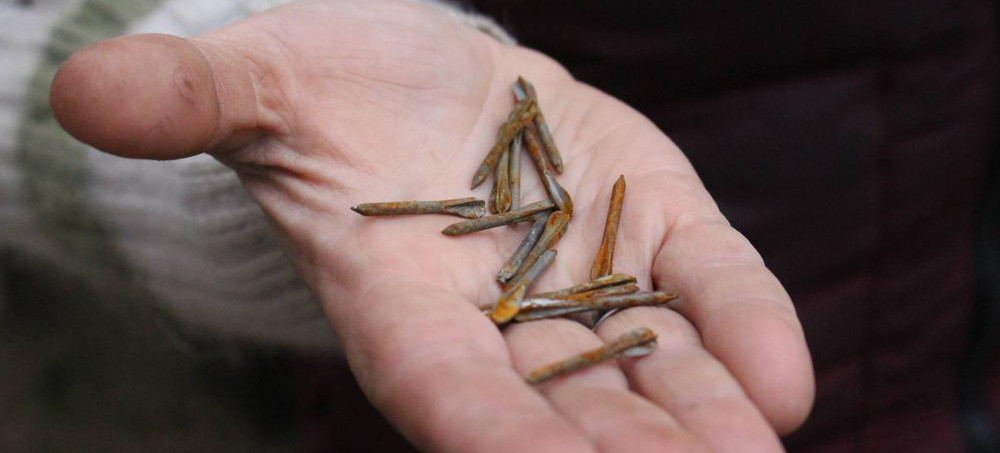 Svitlana Chmut holds fléchettes, small arrow-like projectiles dispersed by a Russian artillery shell, in Bucha, Ukraine, on April 16, 2022. (photo: Alex Horton/The Washington Post)
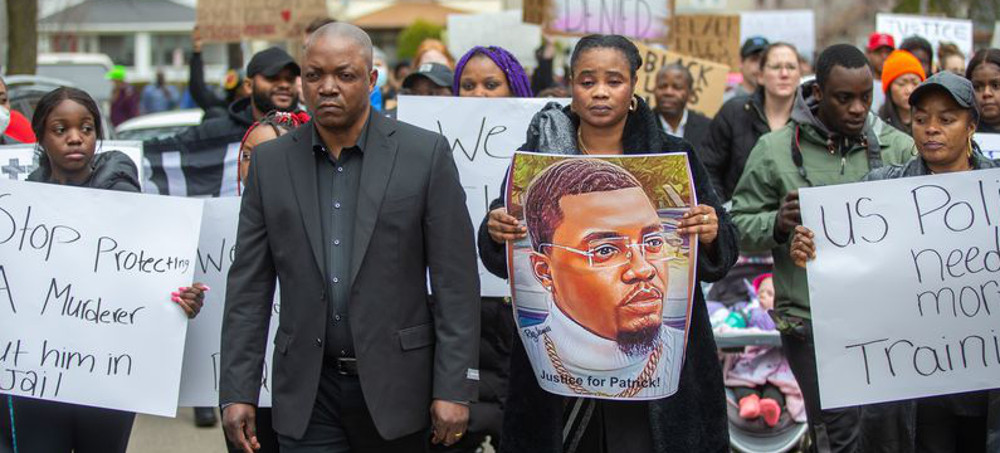 Peter Lyoya, center left, and members of his family lead hundreds of protesters through the Boston Square neighborhood during the Justice for Patrick Lyoya march in Grand Rapids on Saturday, April 9, 2022. (photo: Daniel Shular/MLive.com)
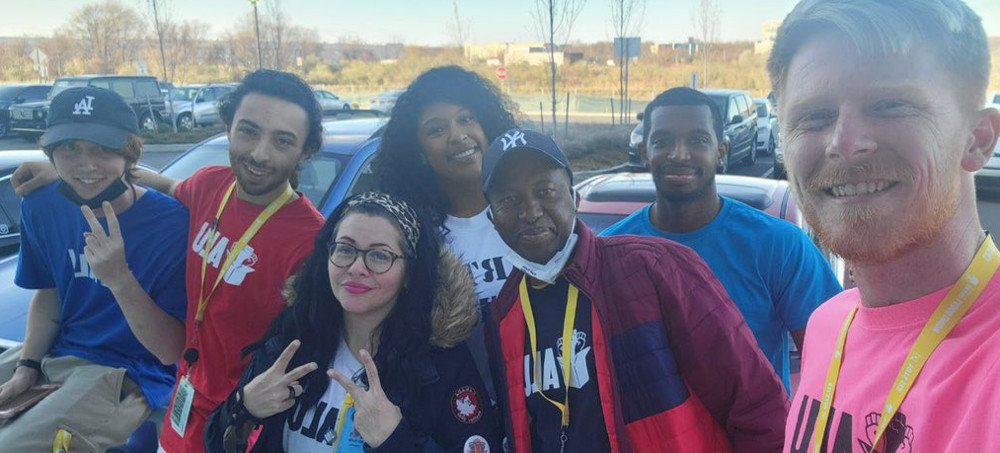 Amazon Labor Union organizers at the LDJ5 Amazon sorting facility on Staten Island, New York, which has a unionization election beginning April 25, 2022. (photo: Amazon Labor Union/Twitter)
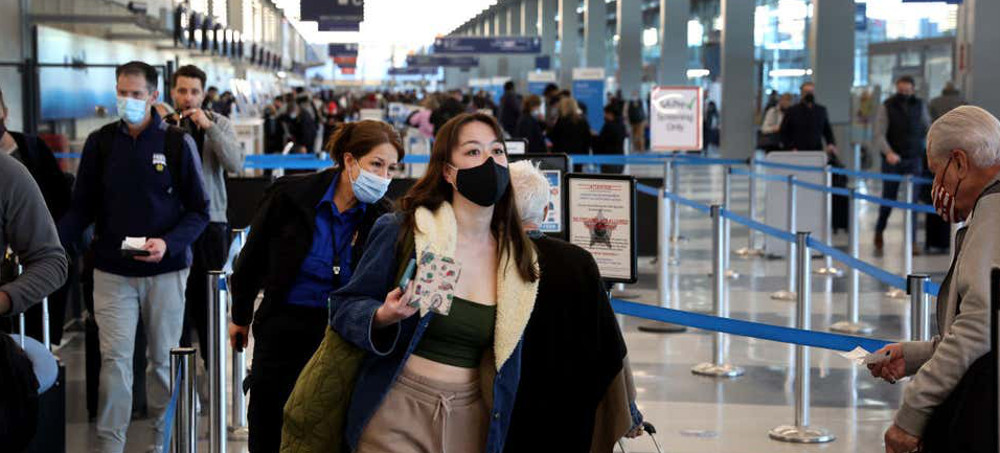 People go through TSA screening as they catch flights at O'Hare International Airport on March 11, 2022, in Chicago, Illinois. (photo: Scott Olson/Getty)
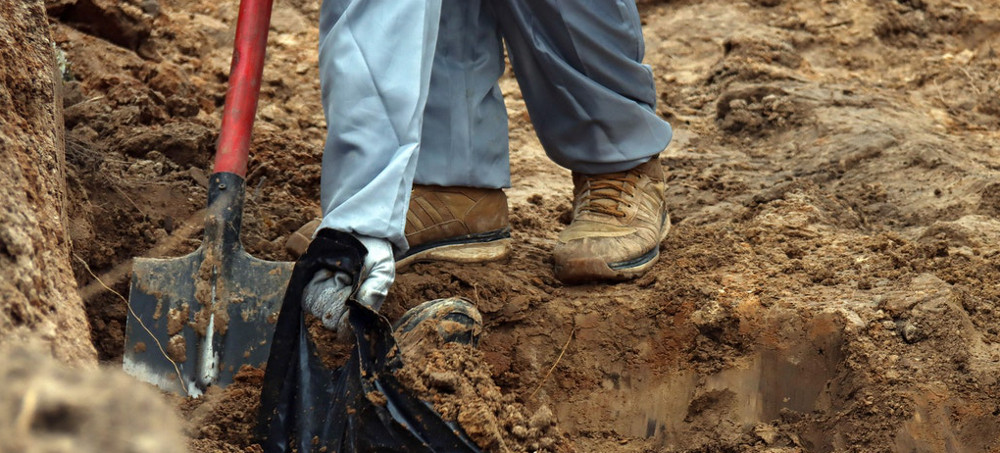 An investigator pulls human remains from a mass grave in Bucha, Ukraine on April 13, 2022. (photo: Anatolii Siryk/Getty)
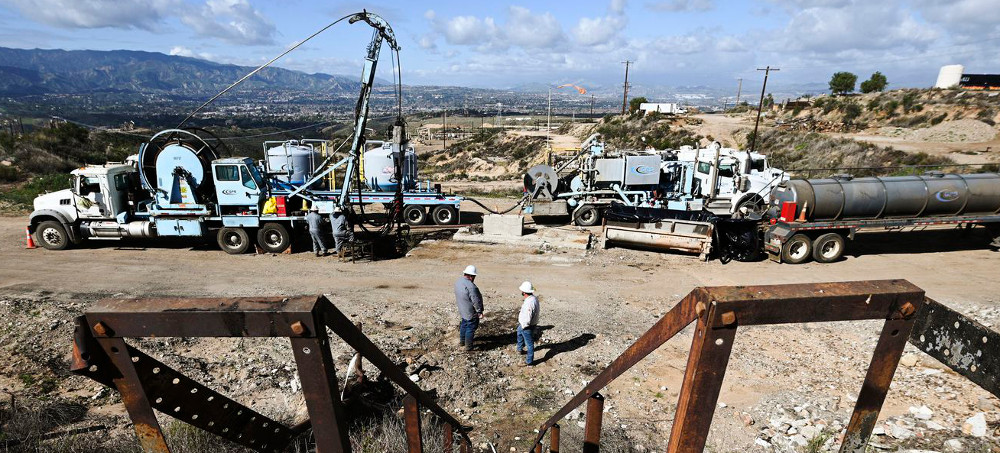 A crew plugs abandoned oil wells at the Placerita Oil Field in Southern California. Abandoned oil and gas wells could be used to generate geothermal energy. (photo: Robyn Beck/Getty)