Showing posts with label BUFFALO NY. Show all posts

Tuesday, May 24, 2022

RSN: Cornel West | Trump Isn't Out There With a Gun, but He's Enabled This War Against Black People


Reader Supported News
23 May 22

Live on the homepage now!
Reader Supported News

IS NOT CONTRIBUTING THE MOST IMPORTANT THING? To some people holding out and not donating is a badge of honor. We have people on our list who have been there for years who simply will not contribute, no matter what. Even though they can easily afford ten dollars a month. Wondering who you are and what your mindset is?
Marc Ash • Founder, Reader Supported News

Sure, I'll make a donation!


Mourners at the scene of a mass shooting in Buffalo, New York, 19 May 2022. (photo: Matt Rourke/AP)
Cornel West | Trump Isn't Out There With a Gun, but He's Enabled This War Against Black People
Cornel West, Guardian UK
West writes: "White supremacy is as American as apple pie, as the latest killings in Buffalo show. Biden needs to take a stand against neofascists."


White supremacy is as American as apple pie, as the latest killings in Buffalo show. Biden needs to take a stand against neofascists

Last weekend, just as I finished a live performance in California of Four Questions, the Grammy award-winning jazz collaboration for which I provided spoken words, word reached me about the racist killing of 10 people as they shopped in Buffalo, New York. I try never to be surprised by evil and never paralysed by despair. Instead, my immediate reaction was “here we go again”, with the horror, the suffering and then the now familiar routine of rhetorical gestures and superficial posturing.

On Tuesday, Joe Biden described white supremacy as a poison, and he is right, but – as ever –  Ehe fails to understand the gravity of his failure to make racial justice a priority; to see this cowardly white supremacy as a threat to American democracy.

The simple truth is that you cannot see this latest neofascist attack in isolation. Think of the attack on the Emanuel African Methodist Episcopal church in Charleston, when a white supremacist terrorist killed nine African Americans during their Bible study in 2015. Think of the attack on the American Asian community in Atlanta last year, when four people were murdered amid assertions from prosecutors that the attack was fuelled by race and gender hatred. Or the attack on Chicanos in El Paso, Texas, in 2019, when 22 people were killed in an allegedly hate-motived shooting; and the murder of 11 Jewish Americans at the Tree of Life synagogue in Pittsburgh the same year by a man who said Jews “were committing a genocide to his people”.

White supremacy is as American as apple pie. It was constitutive of the founding of our nation, like a serpent wrapped around the legs of the table on which the Declaration of Independence and constitution were signed. What we saw in Buffalo at the weekend is another manifestation of it.

From what we know, the alleged shooter was a young and gullible man who got caught in the web of neofascist propaganda. But it is important to look beyond him – to look to those who have created this atmosphere of anger and hate.

After the death of George Floyd, there was a marvellous display of multiracial solidarity, not just here but around the world. But the US has been unable to fight against this neofascist challenge. The Trump forces have got stronger. They have become the public face of US neofascism, and their targets are black people and indigenous people and LGBTQ people.

Trump is not out there with a gun, but he is leading a campaign continuing what Malcolm X called a war against black and coloured people. He is doing it within the electoral political system. He is not killing folks. But he bears responsibility in terms of the context. Have no doubt, he is still the dominant figure.

The campaigning and reflection after the death of George Floyd should have made things better in the US. And, for a beautiful moment, it did. But that moment passed. The press is fickle, the pandemic started to kick in, and other issues such as Ukraine and inflation captured attention. Look at the polls and see how issues of race have fallen down the list of people’s priorities.

The impact of the George Floyd marches was blunted. Congress was unable to enact any meaningful legislation, including the George Floyd bill itself, which would have given us some mechanism with which to address police misconduct and brutality. The Democratic party was not even able to act decisively to uphold voting rights for black people. That is a colossal failure of the Biden administration, but then Biden bears a lot of responsibility when it comes to the position and arrogance of these white supremacists.

Last year Biden said America was not a racist country, and his vice-president, Kamala Harris, backed him on that. But these are lies, and those lies have their effect. If we operate on that level, how can we ever address the vicious legacy of racism and white supremacy?

To the president and Democrats in power, I say: “Shame on you, you dropped the ball.” They must be vigilant and stop acting as if these murders are something they can address in a couple of weeks and then move on. Race is the most explosive issue in the history of this country: from war to civic strife to Buffalo.

The president can’t stop a rightwing gangster killing black people, but he can send a message. He can say: I am being consistent because one of my major priorities is to ensure black people have their rights. If, after all the demonstrations and the campaigns, racists pick up the message that politicians don’t really care about black people, we end up exactly where we are today.

Neofascists and the far right have momentum with their narrative of the great replacement, but someone – and ideally it would be Biden – needs to explain to them what is really going on: that in some places there is replacement in the name of fairness. That sometimes they are seeing visible black folk where they did not previously see them. The racists need to know that they are living in a changing society and we are concerned about them being treated fairly, just as they should be concerned about others being treated fairly. There is a fascist story about replacement and a progressive story about replacement. The neoliberal story cannot counter the fascist story, and we on the left have been unable to get our story out.

So how should black America respond? Since the shootings, I have spoken to so many people and appeared on so many radio stations. People are devastated. The answer is to be a love warrior of the highest sort, a justice warrior, to never give in and never give up. The anger is there, and I don’t aim to calm it down, but I want to rechannel it. Our organisation must be perennial. But counter-terror in the face of terror and counter-violence in the face of violence are not the moral and spiritual options that we need.

It is for us to respond with the same grace and dignity as the people who were killed in that store last weekend: they were very dignified people. Think of Ruth Whitfield. She was 86, a strong member of her community, and had just been visiting her husband in his nursing home. We have to be continuous with the best of our history.

Above all, remember Mamie Till, the mother of Emmett Till, the 14-year-old black boy abducted and lynched by Mississippi racists in 1955. She said: “I don’t have a minute to hate, I’ll pursue justice for the rest of my life.”



READ MORE


Ahead of Biden Visit, Israel Launches Biggest Eviction of Palestinians in DecadesSafa Muhammed Aba al-Najjar, left, and Yusara al-Najjar sit on a bed frame in front of what used to be their house in the West Bank, before it was demolished by the Israeli army on May 11. (photo: Steve Hendrix/WP)

Ahead of Biden Visit, Israel Launches Biggest Eviction of Palestinians in Decades
Steve Hendrix and Shira Rubin, The Washington Post
Excerpt: "The Najjar family knew what to expect on the morning of May 11 when a neighbor called: 'The bulldozer is coming.' For the second time in five months, the Israeli military had come to knock down their house."

ALSO SEE: Colonel in Iran Revolutionary Guard Assassinated

The Najjar family knew what to expect on the morning of May 11 when a neighbor called: “The bulldozer is coming.” For the second time in five months, the Israeli military had come to knock down their house.

But this time there was reason to fear that the house would be gone for good. After decades of demolition, rebuilding and a more than 20-year legal battle, Israel’s highest court this month gave the military permission to permanently evict more than 1,000 Palestinians here and repurpose the land for an army firing range.

Less than a week after the high court ruling, the Najjars’ house was demolished, marking the start of what activists say will probably be the biggest mass expulsion of Palestinians in the occupied West Bank since the 1967 war, when hundreds of thousands of Palestinians fled or were driven from territories captured by Israel.

The court was unswayed by historical documents presented by advocates for the Palestinians, showing what they said was evidence that the proposal to establish a firing range, decades ago, was meant to prevent Palestinians from claiming the land.

“We had 30 minutes to get out what we could,” said Yusara al-Najjar, who was born in a hand-hewn cave on this same slope in the Negev desert 60 years ago. She looked over the pile of broken blocks and twisted metal that had been her family home and wiped her hands with a slap. “It took no time and our house was gone, again.”

The demolitions have sparked expressions of concern from Washington ahead of a planned June visit to Israel by President Biden, coming at a time of mounting instability in Israel’s coalition government and the recent approval of more than 4,200 new housing units in Israeli settlements in the West Bank. U.S. State Department spokesman Ned Price, responding to a question about the high court ruling, beseeched both Israelis and Palestinians to avoid steps that raise tensions. “This certainly includes evictions,” he said.

The European Union urged Israel to halt the demolitions. A United Nations human rights panel warned that the “forcible transfer” of residents would amount to “a serious breach of international and humanitarian and human rights laws.”

The Israel Defense Forces said in a statement that the demolitions were in accordance with the high court’s years-long review and its unanimous ruling on behalf of the military.

“The Supreme Court fully accepted the State Of Israel’s position, and ruled that the petitioners were not permanent residents of the area,” the statement said. “The court also noted that the petitioners rejected any attempted compromise offered to them.”

The tug of war for these dry rolling hills south of the biblical city of Hebron began in the 1980s, when Israeli officials laid claim to several areas of the West Bank for the stated reason of creating military training grounds.

This region of 8,000 to 14,000 acres — known in Arabic as Masafer Yatta and in English as the South Hebron Hills — was designated as Firing Zone 918.

“The vital importance of this firing zone to the Israel Defense Forces stems from the unique topographical character of the area, which allows for training methods specific to both small and large frameworks, from a squad to a battalion,” the military said in court documents reported by the Times of Israel.

But human rights activists, both Palestinian and Israeli, contend that the real purpose of many of the firing zones has been to clear away Arab residents and strengthen Israel’s grip on more occupied Palestinian territory. Often, the designation has made way for expanding Israeli settlements, which are considered illegal by most of the international community.

Archived minutes from a 1981 meeting recently found by researchers on the Israeli-Palestinian conflict seemed to support that idea. Then-agriculture minister — later prime minister — Ariel Sharon is recorded saying it was important to slow the “expansion of Arab villagers from the hills,” according to a story in Israel’s Haaretz newspaper on the document. “We have an interest in expanding and enlarging the shooting zones there, to keep these areas, which are so vital, in our hands.”

The document was entered as legal evidence.

Israeli officials argued that the residents of eight to 12 small hamlets in Zone 918 — most of them tent-dwelling herders who still wintered in caves dug from the limestone — could not show legal ownership of the land.

What followed was a legal Catch-22. Residents and their advocates repeatedly applied for permits to build houses and string power lines. Military officials, saying no one was allowed to live inside a firing range, denied the applications and then regularly dispatched armed demolition squads to knock down the “illegal” structures.

Officials issued the first eviction orders in 1999 but have since refrained from physically removing families as the legal challenges dragged on. Instead, according to advocates, the repetitive demolitions amount to strategic harassment meant drive the families away.

“I don’t think we’ll see pictures of people being put on trucks, because of the optics,” said Dror Sadot of B’Tselem, an Israeli human rights organization that has worked on the case. “What we’ll see will just be more repeated demolitions, which will force the community to leave because they can’t live there anymore.”

Over the years, the court has entertained compromises, including one that would allow evicted Palestinians to return to the fields on Jewish holidays and other periods when no military training was likely to take place. Residents rejected those proposals out of hand.

The high court finally brought an end to the challenge on May 5, ruling unanimously for the military and finding that the Palestinian families had failed to prove they had a legal claim to the land or had lived there before it was designated as a firing range.

“There is the law that works for the Jews, but for us it is nonexistent,” said Nidal Younes, head of the Masafer Yatta village council, who noted that a nearby outpost maintained by Israeli settlers is not subject to evictions under the order.

In her village, Najjar shakes her head at the idea that she is a newcomer to the land where she says her grandparents dug a limestone herder’s shelter in the 1950s and where she was born in 1961.

Now she and her family have been forced back into that cave, which, like many families, they have maintained over the years as a kitchen and extra living space. As the number of Israeli settlers in the area grew, and with them incidents of settler vandalism and physical attacks, they saw it as a refuge from violence.

The simple houses of block and metal roofing they built have all been demolished.

Tending to a batch of traditional labneh cheese under solar-powered lights, Najjar described the most recent unannounced appearance of the bulldozer, escorted by more than a dozen soldiers with automatic weapons.

“They didn’t say why they were here, they gave us no papers,” she said. “But we knew.”

The soldiers instructed the men of the family to stay well away from the house as the women raced to grab clothes and bedding. They struggled with a washing machine. Many of their belongings were still inside when the soldiers told them to stand back.

It took less than two hours for the bulldozer to level two houses and two sheep pens in the village of seven families, Najjar said. In all, the army demolished 20 structures in three villages that day, according to Basel Adra, a Palestinian activist who documents IDF activity in the area.

The IDF has not said when it plans to carry out more demolition orders.

READ MORE

Ukraine Rules Out Any Ceasefire Deal That Involves Ceding Territory to Russia
Lorenzo Tondo, Guardian UK
Tondo writes: "Ukraine has said it will not agree to any ceasefire deal that would involve handing over territory to Russia, as Moscow intensified its attack in the eastern Donbas region on Sunday."
READ MORE


Federal Indian Boarding School System Intentionally Sought to Destroy Native Families'Chiricahua Apaches Four Months After Arriving at Carlisle,' black-and-white photographic portrait of a group of Apaches at the Carlisle boarding school. (photo: Richard Henry Pratt Papers, Beinecke Rare Book & Manuscript Library/Wikimedia Commons)

Federal Indian Boarding School System Intentionally Sought to Destroy Native Families
Levi Rickert, Native News Online
Rickert writes: "The 106-page Federal Indian Boarding School Initiative Investigative Report released on May 11 provides a glimpse into the deliberate intention of the federal government to disrupt the Native American family structure through assimilation."

The 106-page Federal Indian Boarding School Initiative Investigative Report released on May 11 provides a glimpse into the deliberate intention of the federal government to disrupt the Native American family structure through assimilation. The report says the government’s plan involved the permanent breaking of family ties.

A section of the report, Section 7: Federal Indian Boarding School System Framework, reads: “The Department has stated it was ‘indispensably necessary that [the Indians] be placed in positions where they can be controlled, and finally compelled, by stern necessity, to resort to agricultural labor or starve,’ later adding that ‘[i]f it be admitted that education affords the true solution to the Indian problem, then it must be admitted that the boarding school is the very key to the situation.’”

Reading that section of the report brought back memories of the day I first met Dr. Suzanne Cross (Saginaw Chippewa Indians) in the late 1990s when I served on the Native American subcommittee of the Michigan Department on Aging. Dr. Cross is an assistant professor emeritus at Michigan State University and served as a consultant to the National Native American Boarding School Healing Coalition (NABS). She came to our subcommittee to discuss the work she had done on her doctoral dissertation on historical trauma. The conversation quickly moved to the historical trauma associated with Indian boarding schools.

Several adults told stories of abuse they suffered at Indian boarding schools, and others shared how boarding schools affected their families. One Ojibwa woman shook and wept, telling us how her mother never hugged her during her life. The mother had learned during her years at an Indian boarding school that she should never hug or show physical affection.

Last week's release of the report on the purposeful and deliberate plan by the federal government to destroy Native families also brought back memories of an interview I did with American Indian Movement co-founder Dennis Banks (Ojibwa) in the fall of 2009 at Grand Valley State University. During the interview, Banks recounted his experiences attending various Indian boarding schools. He told me the experience caused him to maintain an indifferent attitude towards his mother because he felt she had abandoned him during the years he attended Indian boarding schools.

Banks recalled on certain occasions, school officials would announce a mail call so that students could get mail from home. He would show up, but he never received any mail. He felt as if his mother did not love him.

Years passed by and he eventually was able to go home when he was in his late teen years. He said the first day home was awkward, but on the second day home, his mother made him a blueberry pie because she knew it was his favorite. He felt then perhaps things could return to normal. So, he began talking to her and asked her why didn’t she ever send him any letters or try to bring him home. She told him she did.

He did not believe her.

For the rest of their lives together, he told me, he would look at his mother and have a sense of indifference towards her. This feeling lasted until she died.

Decades later, while he was in his 70s, Banks saw an Internet advertisement with information about how he could obtain his own Indian boarding school records. He followed through on the offer and received several boxes with his school records.

In the boxes, Banks found 14 unopened letters from his mother. He took them to his mother’s grave, where he sat in a lawn chair reading them one by one. Inside of one of the letters was a money order to pay for a bus ticket home for him.

In that moment, Banks, one of the greatest Native American warriors of the last century, wept at his mother’s grave and asked her for forgiveness. He had been lied to by the Indian boarding school officials, not his mother.

As I interviewed Banks at the university in my hometown, I recognized that his inner child, which had been wounded for decades, still resented the policy set forth by the federal government to destroy the very fabric of Native American families.

Banks’ story is just one among a multitude of survivor stories about how Indian Boarding Schools tore Native families apart.

“There's not a single American Indian, Alaskan Native, or Native Hawaiian in this country whose life hasn't been affected by these schools,” Assistant Secretary of Indian Affairs Bryan Newland said during the press conference about the investigation and report last week.“That impact continues to influence the lives of countless families, from the breakup of families and tribal nations, to the loss of languages and cultural practices and relatives. We haven't begun to explain the scope of this policy until now.”

During last week’s press conference, Interior Secretary Deb Haaland (Laguna Pueblo) said, “The consequences of federal Indian boarding school policies, including the intergenerational trauma caused by forced family separation and cultural eradication, which were inflicted upon generations of children, as young as four years old, are heartbreaking and undeniable. When my maternal grandparents were only eight years old, they were stolen from their parents, culture, and communities and forced to live in boarding schools until the age of 13. Many children like them never made it back to their homes.”

The Interior’s report calls for the continuation of the investigation of boarding schools with many more survivor stories to be collected as part of Secretary Haaland's yearlong tour called "The Road to Healing."

For countless boarding school survivors and their families, the road to healing will be paved with pain. Telling their stories will be haunting and painful, but hopefully it will give them the same type of release that Dennis Banks felt as he sat by his mother’s grave in a lawnchair, reading her long lost letters and confronting the past.



READ MORE


Stronger Public Health Systems and Uniform Messaging Are Critical to Fight COVID-19Testing is crucial to addressing the pandemic's many costs, as are more preventative measures. (photo: Wang Ying/Xinhua/Getty Images)

Stronger Public Health Systems and Uniform Messaging Are Critical to Fight COVID-19
Natasha Ishak, Vox
Ishak writes: "Covid-19 isn't going anywhere it seems, yet conflicting public health messaging and a lack of funds may only prolong the crisis."

Covid-19 isn’t going anywhere it seems, yet conflicting public health messaging and a lack of funds may only prolong the crisis.

Covid-19 — and the resulting pandemic associated with the virus — continues to threaten the world. In the US, a majority of the population is experiencing low Covid-19 community levels, according to the Centers for Disease Control and Prevention (CDC). Yet roughly a third of Americans are still living in areas with high risks, primarily in the Northeast and Midwest.

As we enter our third summer since the Covid-19 outbreak began, public health experts are warning of another likely wave of infections. But as public concerns over the pandemic begin to wane, public health messaging around Covid-19 may become more challenging.

On Thursday, the CDC recommended those living in communities with high levels of infection wear face masks indoors in public settings, even though the federal mask mandate is no longer in effect after it was overturned by a federal judge.

“We urge local leaders to encourage the use of prevention strategies like masking in public indoor settings, and increasing access to testing and treatment for individuals,” CDC director Dr. Rochelle Walensky told the New York Times.

Hospital data remains a primary metric in how experts are tracking trends in the pandemic. As of early May, Covid-19 hospitalizations were up by 22.4%, with about 3,000 people admitted with Covid-19 per day, according to the CDC. Experts believe those numbers will only trend upward in the months to come, underlining the need for strong public health measures.

Public health messaging around Covid-19 must continue

With the politicization of Covid-19, public health messaging around the pandemic in the US has faced an uphill battle — and it shows. Beyond the recent hikes in hospitalizations, as of May 20, only 66.5% of the US population had been fully vaccinated — lagging behind other wealthy nations like France, Japan, and the UK — while just 46.4% had received a booster, according to CDC data.

But in a country where public health recommendations like getting vaccinated and wearing masks have become the cruxes of political debates, getting citizens on board with public health measures is easier said than done.

Research shows that masks, if used correctly, can be a valuable tool for reducing the spread of the virus. But the CDC’s mask recommendation for people living in areas with high risks of Covid-19 this week was met with mixed responses online. Some have criticized the agency’s inconsistency in its masking policy, while others tried to paint the CDC’s motives as political, pointing to the upcoming midterm elections.

In April, US District Judge Kathryn Kimball Mizelle ruled to overturn the CDC’s mask mandate for public transit. In her ruling, Mizelle — a Trump nominee who was rated “not qualified” for that position by the American Bar Association — contended that the federal public health agency had overstepped its authority in enacting the public health mandate.

Michael Osterholm, director of the Center for Infectious Disease Research and Policy at the University of Minnesota, says a combination of confusing guidelines from public officials and a lack of careful reporting by the media have led to the politicization of public health measures.

“The U.S. public is done with the pandemic even though the virus is not done with us, and we have to recognize that in public health,” Osterholm said in a televised interview with ABC News following the ruling. “What has happened is this has become really a philosophical and political issue, not a science issue.”

According to Dr. Renuga Vivekanandan, the division chief for infectious disease at CHI Health and Creighton University, strong public health measures and messaging are crucial in preventing the spread of the coronavirus. “It’s very important to have public health measures to try to blunt the Covid-19 or any other type of infection rate,” Dr. Vivekanandan told Vox. “We have to have a uniform message [and] make sure we give the right information to our community.”

Vivekanandan, whose work focuses on preventing the spread of infections in public settings, says she is focused on providing patients with the right information regarding proper pandemic mitigation tools, such as vaccinations, boosters, and masking in public, even though she still encounters people unwilling to get vaccinated.

“There are some individuals who still want to think about it or who still do not want to receive the vaccine, but I think that’s an individual choice,” said Vivekanandan. “But as public health [officials], we’re just going to continue to stay with that messaging and show what works and what doesn’t.” Relatively low vaccinations, as well as booster rates, are other public health mitigation tools that would benefit from stronger public health messaging, she said.

Building public health infrastructure and stabilizing funding is key

Despite these concerns around the erosion of public trust in public health, experts are undeterred and have proposed ways to strengthen the country's public health measures. Doubts about the authority that government health entities can wield when it comes to enacting public health measures in times of crisis only fuel distrust and conspiracies around government health guidelines. Rebuilding public trust is key and that starts by establishing credibility through clearer government structures and providing a uniform message around Covid-19 public safety protocols.

A 2021 report from the think tank Bipartisan Policy Center suggested 10 broad recommendations to prepare the US for the next pandemic cycle, including the need to clarify federal responsibilities during a pandemic and create a national board on pandemic preparedness, which would be tasked with establishing a standard of benchmarks to evaluate the country’s preparedness.

Beyond rebuilding public trust, building out public health infrastructure and stabilizing funding are key ways to address the current pandemic and better prepare for what may lie in store in the future. It’s critical that the US continues to respond, as Covid-19 is certainly not going away.

“The pandemic is going to be a turning point,” said Tom Frieden, a former director of the CDC, and a member of the American Public Health Association. “Whether it’s toward a healthier society or one more resistant to collective action to protect one another, time will tell.”

Weak public health messaging may also have wider implications when it comes to fighting off the next wave of Covid-19 infections. Congress has been in deadlock over President Joe Biden’s Covid-19 relief proposal — which was slashed from $22 billion to $15 billion — since early March. A seeming lack of urgency in dealing with the pandemic could affect the ease of accessing more funding as well. White House pandemic coordinator Dr. Ashish Jha warned that drained funds, which would cover the country’s purchase of the next generation of Covid-19 vaccines, could lead to issues in the fall when the US is expected to see more waves of infection.

In a 2021 report by Trust for America’s Health, which issues annual findings on the country’s readiness in facing health crises, the Trust recommended addressing the steady decline in public health funding through the creation of a mandatory $4.5 billion-per-year public health infrastructure fund. Legislation to establish a similar “off-limits” fund dedicated to public health infrastructure development was introduced in Congress by Democratic Sen. Patty Murray last year.

“While the vaccines have given us a way to get through COVID, we also have to learn from this pandemic and make sure we are better prepared for the next public health emergency. That means finally making — and maintaining — the kind of bold investments in public health I have been pushing for, for years,” Murray said of the Public Health Infrastructure Saves Lives Act.

Until a more robust public health infrastructure is implemented, the onus of keeping the next Covid-19 wave at bay lies with each community member.

“What I’ve thought about during the pandemic, it’s not ‘I’ it’s ‘us,’” Vivekanandan said. “I think the public health community have been doing their very best... communicating that public health message about how we can all work together to make sure every time we have a wave [we] bring the wave down and protect each other.


READ MORE


Rosemary Radford Ruether, a Founding Mother of Feminist Theology, Has Died at Age 85Rosemary Radford Ruether was among the first scholars to think deeply about the role of women in Christianity. She died Saturday at the age of 85. (photo: Garrett-Evangelical Theological Seminary)


Rosemary Radford Ruether, a Founding Mother of Feminist Theology, Has Died at Age 85
Monique Parsons, NPR
Parsons writes: "One of the founding mothers of feminist theology has died. Rosemary Radford Ruether was among the first scholars to think deeply about the role of women in Christianity, shaking up old patriarchies and pushing for change."


READ MORE


Ancient Forest Found Growing Out of Giant Sinkhole in ChinaPalm trees growing out of another giant sinkhole in China's Hubei Province in 2020. (photo: Song Wen/Xinhua/Getty Images)

Ancient Forest Found Growing Out of Giant Sinkhole in China
Olivia Rosane, EcoWatch
Rosane writes: "At the bottom of a 630-foot sinkhole in China lies a green surprise: an ancient forest with trees stretching nearly 130 feet out of the depths."

At the bottom of a 630-foot sinkhole in China lies a green surprise: an ancient forest with trees stretching nearly 130 feet out of the depths.

The unusual sinkhole was first discovered by cave explorers in China’s southern Guangxi region, who alerted scientists to their find, according to The Guardian. After confirming the forest’s existence, researchers think it has even more secrets to reveal.

“I wouldn’t be surprised to know that there are species found in these caves that have never been reported or described by science until now,” expedition leader Chen Lixin said, as The Guardian reported.

Lixin’s team completed their expedition on May 6, USA TODAY reported. In addition to the trees, they also encountered undergrowth that reached their shoulders. The sinkhole contains three caves and has a total volume of 5 million cubic meters, meaning it would take 2,000 Olympic swimming pools to fill it. It is 1,000 feet long and 500 feet wide. It is also the 30th sinkhole found in China’s Leye county, according to China’s state-run Xinhua news agency. It was found near the village of Ping’e in Luoxi township.

Known as “tiankeng,” or “heavenly pits” in China, giant sinkholes are common in this portion of the country, The Washington Post reported. It is a karst landscape, which is a landscape formed when rainwater mixes with carbon dioxide and wears away at bedrock, National Cave and Karst Research Institute (NCKRI) executive director George Veni told Live Science.

“Because of local differences in geology, climate and other factors, the way karst appears at the surface can be dramatically different,” Veni, who was not a part of the exploration, told Live Science. “So in China you have this incredibly visually spectacular karst with enormous sinkholes and giant cave entrances and so forth. In other parts of the world you walk out on the karst and you really don’t notice anything. Sinkholes might be quite subdued, only a meter or two in diameter. Cave entrances might be very small, so you have to squeeze your way into them.”

Veni said the presence of the ancient forest was not necessarily surprising.

“It’s not unusual to have trees growing out of cave entrances,” he told The Washington Post. “It’s just that this [sinkhole] is particularly large and particularly deep, so it’s not the sort of thing that most people would expect.”

Still, he acknowledged to Live Science, “This is cool news.”


READ MORE

Special Coverage: Ukraine, A Historic Resistance
READ MORE


Contribute to RSN

Follow us on facebook and twitter!

Update My Monthly Donation

PO Box 2043 / Citrus Heights, CA 95611


Monday, May 23, 2022

RSN: Paul Krugman | How the West Is Strangling Putin's Economy


Reader Supported News
22 May 22

Live on the homepage now!
Reader Supported News

PANIC MODE OVER MINIMAL FUNDING — What is now a serious shortfall in funding for May can be erased quite easily with a few decent days of fundraising. Easily. Completely ignoring fundraising got us here, reasonable donations will absolutely get us out. With urgency … right now!
Marc Ash • Founder, Reader Supported News

Sure, I'll make a donation!


Local residents scavenge pieces of aluminum from destroyed Russian tanks on Monday in Biskvitne, Ukraine. (photo: John Moore/Getty Images)
Paul Krugman | How the West Is Strangling Putin's Economy
Paul Krugman, The New York Times
Krugman writes: "Russia's military failure in Ukraine has defied almost everyone's predictions."

Russia’s military failure in Ukraine has defied almost everyone’s predictions. First came abject defeat at the gates of Kyiv. Then came the incredible shrinking blitzkrieg, as attempts to encircle Ukrainian forces in the supposedly more favorable terrain in the east have devolved into a slow-motion battle of attrition.

What’s important about this second Russian setback is that it interacts with another big surprise: The remarkable — and, in some ways, puzzling — effectiveness, at least so far, of Western economic sanctions against the Putin regime, sanctions that are working in an unexpected way.

As soon as the war began there was a great deal of talk about bringing economic pressure to bear against the invading nation. Most of this focused on ways to cut off Russia’s exports, especially its sales of oil and natural gas. Unfortunately, however, there has been shamefully little meaningful movement on that front. The Biden administration has banned imports of Russian oil, but this will have little impact unless other nations follow our lead. And Europe, in particular, still hasn’t placed an embargo on Russian oil, let alone done anything substantive to wean itself from dependence on Russian gas.

As a result, Russian exports have held up, and the country appears to be headed for a record trade surplus. So is Vladimir Putin winning the economic war?

No, he’s losing it. That surging surplus is a sign of weakness, not strength — it largely reflects a plunge in Russia’s imports, which even state-backed analysts say is hobbling its economy. Russia is, in effect, making a lot of money selling oil and gas, but finding it hard to use that money to buy the things it needs, reportedly including crucial components used in the production of tanks and other military equipment.

Why is Russia apparently having so much trouble buying stuff? Part of the answer is that many of the world’s democracies have banned sales to Russia of a variety of goods — weapons, of course, but also industrial components that can, directly or indirectly, be used to produce weapons.

However, that can’t be the whole story, because Russia seems to have lost access to imports even from countries that aren’t imposing sanctions. Matt Klein of the blog The Overshoot estimates that in March, exports from allied democracies to Russia were down 53 percent from normal levels (and early indications are that they fell further in April). But exports from neutral or pro-Russian countries, including China, were down almost as much — 45 percent.

Some of this may, as Klein has suggested, reflect fear, even in non-allied countries, of “being on the wrong side of sanctions.” Imagine yourself as the chief executive of a Chinese company that relies on components produced in South Korea, Japan or the United States. If you make sales to Russia that might be seen as helping Putin’s war effort, wouldn’t you worry about facing sanctions yourself?

Sanctions on Russia’s financial system, such as the freezing of the central bank’s reserves and the exclusion of some major private banks from international payment systems, may also be crimping imports. Hard currency may be flowing into Russia, but using that currency to buy things abroad has become difficult. You can’t conduct modern business with suitcases full of $100 bills.

Now, it’s possible, even likely, that over time Russia will find workarounds that bypass Western sanctions. But time is one thing Putin doesn’t seem to have.

As I said, the war in Ukraine appears to have devolved into a battle of attrition, and that’s not a battle Putin seems likely to win: Russia has suffered huge equipment losses that it won’t be able to replace any time soon, while Ukraine is receiving large equipment inflows from the West. This war may well be over, and not to Putin’s advantage, before Russia finds ways around Western sanctions.

One final point: The effect of sanctions on Russia offers a graphic, if grisly, demonstration of a point economists often try to make, but rarely manage to get across: Imports, not exports, are the point of international trade.

That is, the benefits of trade shouldn’t be measured by the jobs and incomes created in export industries; those workers could, after all, be doing something else. The gains from trade come, instead, from the useful goods and services other countries provide to your citizens. And running a trade surplus isn’t a “win”; if anything, it means that you’re giving the world more than you get, receiving nothing but i.o.u.s in return.

Yes, I know that in practice there are caveats and complications to these statements. Trade surpluses can sometimes help boost a weak economy, and while imports make a nation richer, they may displace and impoverish some workers. But what’s happening to Russia illustrates their essential truth. Russia’s trade surplus is a sign of weakness, not strength; its exports are (alas) holding up well despite its pariah status, but its economy is being crippled by a cutoff of imports.

And this in turn means that Putin is losing the economic as well as the military war.


READ MORE


The Consumer Fuel Price Gouging Prevention Act, ExplainedAll across the country, consumers are feeling the burden of high gas prices and are desperate for relief. (photo: Justin Sullivan/Getty Images)

The Consumer Fuel Price Gouging Prevention Act, Explained
Natasha Ishak, Vox
Ishak writes: "Democrats want oil and gas companies to pay for their greed, but critics believe that won't reverse high fuel prices."

Democrats want oil and gas companies to pay for their greed, but critics believe that won’t reverse high fuel prices.

As the average consumer bears the brunt of rising gas prices, big oil and gas companies have continued to rake in historic profits. Lawmakers alarmed at the stark contrast between the industry’s earnings and consumers’ struggles pushed for — and passed through the US House of Representatives on Thursday — a bill that would make predatory price hikes unlawful and expand federal authority to investigate alleged price-gouging. The Consumer Fuel Price Gouging Prevention Act is meant to help alleviate rising gas prices; the national average gas price reached $4.45 per gallon last week — a record high for the US. Some states, like California, have seen gas prices reach $6 per gallon.

That has led to an unprecedented first quarter for oil and gas companies. According to an analysis by the watchdog group Accountable.US, the country’s top 21 companies took in $41 billion in profits during this year’s first quarter — $1.2 billion more on average per company compared to the same period last year, the report noted. Companies like Devon Energy are so flush with cash they’ve rewarded shareholders with “record” payouts. And Congress certainly has taken notice.

“I’m a proud capitalist, and what we’re experiencing with fuel prices is the result of a broken market,” said Rep. Katie Porter, a California Democrat and one of the original co-sponsors of the Consumer Fuel Price Gouging Prevention Act. “Big Oil executives are bragging to shareholders about price-gouging families at the pump. They’re purposely keeping supply low to earn record-high profits, squeezing families — and our entire economy — in the process.”

House legislators passed the bill with a vote of 217-207, with zero support from Republicans. Four moderate Democrats — Reps. Lizzie Fletcher, Jared Golden, Stephanie Murphy, and Kathleen Rice — bucked party line and voted against the bill.

“The Consumer Fuel Price Gouging Prevention Act would not fix high gasoline prices at the pump, and has the potential to exacerbate the supply shortage our country is facing, leading to even worse outcomes,” Fletcher wrote in a statement. “For these reasons, I voted no on this legislation.”

Even some Democrats who ultimately supported the legislation voiced concerns over the bill. “It just, you know, seems like we’re treating oil and gas like Big Tobacco, and sometimes they’re unjustly targeted,” said Rep. Vicente Gonzalez of Texas.

In addition to vetoes from the four Democrats and widespread Republican opposition, the legislation has received pushback from powerful industry lobbying groups, including the American Petroleum Institute and the National Association of Manufacturers.

With oil and gas corporations resisting regulations and virtually no support from Republicans, the fuel price-gouging bill may face an uphill battle in the Senate, where Democrats hold a slim majority.

What does the fuel price-gouging bill really do?

The Consumer Fuel Price Gouging Prevention Act is comprised of a few main components: Firstly, the legislation would allow the president to declare an energy emergency effective for up to 30 days, though that declaration could be renewed.

During that energy emergency period, it would become unlawful for any person to sell consumer fuel at a price that is “unconscionably excessive” or that suggests exploitative practices. The bill would also expand the Federal Trade Commission’s authority to investigate and address potential instances of fuel price-gouging conducted by larger companies, defined as companies with $500 million in yearly wholesale or retail sales in the US. Under the bill, state authorities would be granted enforcement powers against fuel price-gouging violations through civil court action.

The legislation is meant to address record-high gas prices in the US, which some lawmakers and watchdogs allege have largely been manufactured by oil and gas corporations. Like other goods on the market, the cost of a gallon of gas is influenced by the market’s supply and demand. Major events like the COVID-19 crisis, Russia’s invasion of Ukraine, and a disrupted supply chain can influence the supply and demand of certain goods on the market.

What remains debatable, however, is how much the price of certain goods becomes affected when variables in the market change. There is no legal definition of what exactly constitutes price-gouging in the US. Oil and gas companies like Chevron and Shell may take advantage of the market’s instability by excessively hiking up gas prices while limiting production to boost profits, which in turn hurts consumers.

It is difficult to know how much of an increase in oil and gas production — which lawmakers like Rep. Porter are demanding — would be enough to alleviate current price-gouging concerns, or even if it would help address the gas crisis at all. Republicans nonetheless believe that targeting the industry isn’t a viable solution, but rather increasing domestic production is the way to alleviate pain at the pump. But GOP lawmakers likely won’t get their wish for a variety of reasons, including resistance from oil and gas companies. A survey conducted by the Federal Reserve Bank of Dallas in March found that many companies did not anticipate increasing production anytime soon. The Federal Bank of Dallas covers the Eleventh Federal Reserve District, including high oil-producing states like Texas and New Mexico.

On average, the Federal Reserve in Dallas survey found that oil and gas companies operating in the district are expecting crude oil prices to hit $93 per barrel by the end of the year, while some even expected prices to go as high as $200 per barrel. At the time of the survey in March, the price of crude oil had hit $100 per barrel. Nearly 60% of corporate respondents in the survey cited “investor pressure to maintain capital discipline” as the main reason oil companies weren’t drilling more despite soaring gas prices. Lawmakers naturally took notice.

“Big Oil is threatening our entire economy by keeping supply low and jacking up prices at the pump far beyond the inflation rate to satisfy Wall Street,” Porter wrote in a tweet ahead of the fuel price-gouging bill’s approval by the House, citing the survey’s results. “Oil and gas company executives are *literally* admitting it.”

Analysts believe the best indicator of inflation is the consumer price index (CPI), which essentially measures changes in the prices of goods and services frequently bought by average consumers. The Bureau of Labor Statistics found that the consumer price index had increased 8.3% over the last 12 months ending in April. Among all categories included in measuring CPI, fuel oil prices had increased the most by far, jumping more than 80% over the past 12 months.

But high inflation rates aren’t only affecting gas prices — the housing market, as well as food and grocery prices, have seen soaring prices, too. The ripple effect can have an outsized impact on the average American, particularly low-income families with limited transportation options and who are already running on a tight household budget.

“This inflation thing is a real problem. When you’re paying twice as much to fill your gas tank and twice as much for everything, you’ve got to say to yourself, ‘Well, do I really need to buy everything at King’s [Food Market]?’” one shopper, who now splits her shopping between multiple stores to get the cheapest prices, told the New York Times.

Will the fuel price-gouging bill actually make a difference?

Opponents of the bill argue that price gouging is already illegal in most states, rendering the legislation moot. Instead, they believe that legislators should be focusing on increasing domestic energy production and improving the country’s competitive edge in the global market. The American Petroleum Institute called the bill “misguided” and labeled it as an empty attempt by Democrats to sway voters ahead of the midterm elections in November. Other industry groups feel similarly to many Republicans, who claim their concerns have to do with domestic production and energy security.

“[Combatting price-gouging] starts with opening our diverse resources on federal lands, approving responsible exploration and production, supporting sustainable permitting, and quickly building out more energy infrastructure,” Rachel Jones, vice president of energy and resources policy at the National Association of Manufacturers, wrote in a letter to House leadership in response to the bill.

According to AAA, the main factor driving high gas prices across the country is the tight supply of oil up against market demand.

“The high cost of oil, the key ingredient in gasoline, is driving these high pump prices for consumers,” Andrew Gross, a spokesperson for the company, said in a statement. “Even the annual seasonal demand dip for gasoline during the lull between spring break and Memorial Day, which would normally help lower prices, is having no effect this year.”

Supporters of the bill contend that corporate profiteering by oil and gas companies inherently worsen gas prices. But there is little consensus among experts on the fuel price-gouging bill’s effectiveness. Some believe it may even have a negative effect on the market.

“There is no material prospect that, in any enduring way, gouging legislation can have any substantial effect on inflationary pressure,” Lawrence Summers, the former Treasury Secretary under the Clinton administration, told Bloomberg Television in an interview last week. He added that there was a possibility such legislation may “cause and contrive all kinds of shortages” and undermine companies’ moves to boost supply.

Arguments over whether the fuel price-gouging bill is an effective enough solution to the US’s high gas prices may be for naught if the law is not approved by the Senate, where Democrats have been unable to pass important legislative items in the past, frequently failing to reach the 60-vote threshold needed to end a filibuster and move legislation forward.

But this may not be the last we hear of anti-price gouging legislation as lawmakers try to find ways to fight the economic downturn. Earlier this month, President Joe Biden called on the FTC and state attorneys general to crack down on price-gouging as part of efforts to manage the country’s baby formula shortage, following reports of unfair practices by individual resellers. He could follow suit for oil and gas as well.


READ MORE


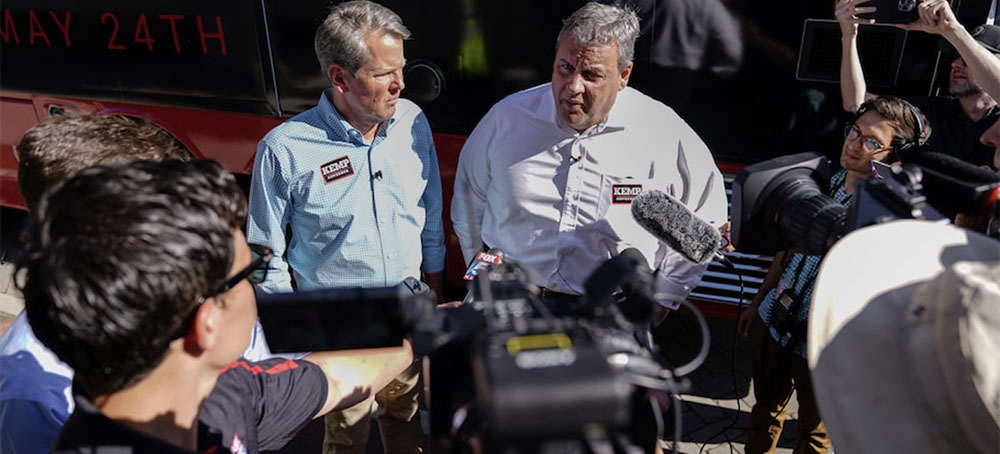
Inside the Republican Push to Stop Trump's 'Vendetta Tour' in GeorgiaFormer New Jersey governor Chris Christie (R) and Gov. Brian Kemp speak to reporters at a campaign event on May 17, 2022 in Alpharetta, Ga. (photo: Elijah Nouvelage/Getty Images)

Inside the Republican Push to Stop Trump's 'Vendetta Tour' in Georgia
Annie Linskey, Josh Dawsey, Michael Scherer and Matthew Brown, The Washington Post
Excerpt: "Republican governors hatched the plan months ago. Meeting at the desert Biltmore resort in Phoenix in mid-November, they agreed to confront a new threat to their incumbents: Former president Donald Trump was ramping up support for primary challengers as part of what one former governor called 'a personal vendetta tour.'"

GOP governors hatched a plan months ago that will culminate in a closely-watched gubernatorial primary on Tuesday

Republican governors hatched the plan months ago. Meeting at the desert Biltmore resort in Phoenix in mid-November, they agreed to confront a new threat to their incumbents: Former president Donald Trump was ramping up support for primary challengers as part of what one former governor called “a personal vendetta tour.”

To protect incumbents up for reelection this year, the Republican Governors Association decided to spend millions of dollars in primaries, an unusual step for an organization that typically reserves its cash for general election matchups against Democrats.

“The focus is on 2022. I don’t believe we should spend one more moment talking about 2020,” Republican Governors Association Co-Chairman Doug Ducey said in an interview with The Washington Post. Asked if Trump’s help for his preferred candidates was worth much, the Arizona governor, who pointed to states where GOP governors avoided or defeated Trump challengers, replied: “It hasn’t been to date.”

The gambit is set to culminate Tuesday in Georgia, where Republican Gov. Brian Kemp is heavily favored to defeat former senator David Perdue in a closely-watched primary. Trump recruited Perdue and made him his marquee candidate in a larger crusade against GOP officeholders who opposed his fight to overturn the 2020 election, which was rooted in false claims about fraud.

The RGA invested some $5 million in Georgia, according to a person familiar with the group’s outlays, who like others spoke on the condition of anonymity to describe sensitive details. A parade of Republican governors and luminaries have lined up to protect Kemp. And former vice president Mike Pence, who once served as governor of Indiana, will appear with Kemp on Monday — setting the stage for Pence’s most direct confrontation yet against Trump in the midterms.

The influx of RGA money in Georgia, according to strategists on both sides of the governor’s race, has dealt a devastating blow to Perdue, who has struggled to raise funds to compete.

“This is just not the best use of our money. We would much rather use it just in races against Democrats,” said former New Jersey governor Chris Christie, who is the co-chair of a 2022 fundraising arm for the RGA and described the November meeting in Phoenix to The Post. “But it was made necessary because Donald Trump decided on the vendetta tour this year and so we need to make sure we protect these folks who are the objects of his vengeance.”

The clash has brought into focus an extraordinary battle over the future direction of the GOP that extends well beyond Georgia. On one side is an aggrieved former president who retains widespread loyalty in the party from voters. On the other, conservative governors who align with Trump on many issues but have grown tired of his election claims, which post-election audits have shown to be false.

And the latter has already had success.

Trump’s endorsed candidate lost badly in Idaho’s gubernatorial primary, where the RGA backed Gov. Brad Little, and the former president backed away from early rumblings that he might challenge incumbent governors in Ohio and Alabama. In Nebraska, the political machine of outgoing Republican Gov. Pete Ricketts helped sink Trump’s choice for governor in an open race, who had been accused of sexually assaulting multiple women

Angry that Kemp refused to help him overturn the election results in a key battleground state, Trump set out to topple him. He called him “a turncoat,” a “coward” and “a complete and total disaster.” He pumped $2.64 million from his political action committee into efforts to unseat Kemp, far more than the former president has spent on any other race.

“It’s not easy to beat a sitting governor,” Trump said in a Monday interview with The Post. “I’m the one who got that guy elected. I endorsed him, and he won. He’s not good on election integrity, and he did a terrible job on election integrity. We’ll see what happens.”

Trump added that he’s heard Perdue is “surging,” though recent polls do not reflect a change in the race.

Perdue has told local media that he does not believe the outside support has helped Kemp. “The RINOs march a parade into Georgia to, in my opinion, circle the wagons around a very embattled, weak governor,” Perdue said to WSB-TV, a local station. He was using a disparaging acronym for “Republicans In Name Only.”

Weeks ago, as it appeared increasingly likely Perdue was going to lose, Trump began distancing himself from the candidate, deciding against doing another in-person rally and complaining to advisers that Perdue was not working hard in the race, according to people familiar with the situation, who spoke on the condition of anonymity to describe private conversations. Trump is slated to hold a tele-rally with Perdue on Monday evening.

Such a posture was striking, the people familiar with the matter said, since Trump had to talk Perdue into getting in the race all along — after Perdue privately pinned blame on Trump for depressing GOP turnout in the January 2021 Senate runoff with his fraud claims.

On Friday, Trump tried to quell the notion that he has given up on Perdue, posting on his social media platform that it’s a “phony narrative” and adding “I am with David all the way.”

The Republicans backing Kemp have in recent days sought to frame the race as a potentially brutal political setback for Trump. “It’s clearly the most important race for Donald Trump in the country. He’s made Brian Kemp public enemy No. 1,” Christie said. “We have to decide if we want to be the ‘party of me’ or the ‘party of us.’ And that’s what a lot of these primaries are going to decide.”

In open defiance to the party’s de facto leader, a string of old guard Republicans, including three sitting governors, former president George W. Bush and Pence have rallied around Kemp, as they try to create a barrier to protect conservative governors from what they view as Trump’s whims.

A recent Fox News poll found 60 percent of Republican voters backed Kemp, putting him 32 percentage points ahead of Perdue. To avoid a runoff, Georgia candidates need to win a majority of the vote.

Kemp’s backers hope that a victory will send the message that it’s possible to stand up to Trump without paying the ultimate political price. “This is an important one. Him losing gives people courage to speak out,” said Bill Palatucci, a Republican National Committeeman from New Jersey and an ally of Christie.

On the campaign trail, Kemp touts conservative policies he and the GOP-controlled state legislature enacted during his term, including an election security law that voting rights groups argued would lead to voter suppression and brought backlash from civil and business leaders in the state. Kemp has cited concerns about the 2020 election, even though he certified the results of the election that President Biden won in the state.

In this year’s legislative session, Kemp has signed laws appealing to conservative voters on a range of issues, including measures that permit the carrying of a firearm without a license, add restrictions on the teaching of race, history, gender and sexuality in classrooms, and “the toughest abortion bill in the country,” in the governor’s words. The bill bans on abortion after a doctor can detect what they call “a fetal heartbeat in the womb,” usually at about six weeks, before many women know they are pregnant.

“We didn’t waver when we passed the heartbeat bill and Hollywood tried to cancel us,” Kemp declared Saturday during an event that attracted about 200 people in Watkinsville, Ga., with Ricketts, the Nebraska governor who is also an RGA co-chair. “And we didn’t waver when Major League Baseball pulled the All-Star Game when we passed the strongest elections integrity act in the country. Because we had seen the mechanical issues with the 2020 election that frustrated me and it frustrated a lot of other people.”

“I think he did what was right around the election, and more importantly, I believe he’s been a true conservative on all the things conservatives care about. It’s not like Brian is somebody who the president would call a RINO,” said Pence’s longtime chief of staff Marc Short. Short, joined Kemp’s campaign as a senior adviser in the race.

A former CEO of Reebok and Dollar General, Perdue is a known figure in Georgia whose family has been involved in the state’s business community and politics for decades. He has echoed Trump’s false election claims on the trail.

“This governor’s race right now will determine whether or not we have a conservative Republican in the White House in ’24,” said Perdue at an event on Friday.

The cousin of a former governor and heir to a major political dynasty in the state, Perdue ran as a political outsider in 2014. He lost to now-Sen. Jon Ossoff (D) in a January 2021 runoff that, together with another Senate runoff in the state, handed Democrats unified control of Congress. In his bid for governor, Perdue has taken on a strident tone as he champions false election claims.

He frequently lambastes Kemp for “dividing the Republican Party” over 2020 and warning that he cannot defeat likely Democratic gubernatorial nominee Stacey Abrams in the fall. He campaign ads feature Trump. “The Democrats walked all over Brian Kemp,” Trump says in one spot. Trump then turns to Perdue, who he calls “smart” and “tough.”

In another, Perdue speaks to the camera and says: “Kemp caved before the election, and the country is paying the price today.”

Even with the cash infusion from Trump, Georgia political observers said there’s little evidence that the campaign is doing much with the cash.

“I’m on the biggest radio station in the state of Georgia. I haven’t heard an ad in weeks on the radio station. I’m not seeing his TV stuff,” said Erick Erickson, a prominent conservative radio host in Georgia who is backing Kemp. “By all accounts, it looks like the Perdue campaign has just totally given up.”

Erickson said that listeners call into the show to complain that Kemp didn’t do more in the 2020 election for Trump. “But they say they’re still voting for Kemp.” He said multiple Kemp volunteers had door-knocked in his suburban Atlanta neighborhood, but not a single one from Perdue’s campaign had showed up.

Republican strategists in the state said Perdue’s campaign hasn’t been as strong as his previous ones and is overly reliant on Trump’s endorsement — and the false claims of electoral fraud.

“In 2014 he ran the ultimate outsider’s campaign — Trump before there was Trump. If he ran that same campaign this year, he’d be in a different place,” said Seth Weathers, a longtime Georgia Republican strategist and initial state director for Trump’s campaign in 2016. “Instead, it’s been a boring Trump video over and over again.”

In addition to Trump’s endorsement, former Alaska Republican governor Sarah Palin and far-right Rep. Marjorie Taylor Greene (R-Ga.) have appeared at campaign stops with Perdue where they promote debunked election conspiracy theories.

“That position of governor is so very important when we talk about election integrity,” Palin said in a brief stop Friday afternoon at the Savannah-Hilton Head International Airport where Perdue also appeared. Palin said that she has spoken with Trump several times in the past week, and the two “talked about election integrity.”

“Trump’s like, ‘Can you imagine if all of us are in position at the same time, what it is that we’d be able to accomplish’” Palin recounted.

Ducey, the Arizona governor, said that Kemp’s strong relations with other governors and the fact that he’s defeated Abrams before meant there was “never a moment of hesitation” in getting in the race.

“If Brian Kemp gets over the finish line in the fashion that I believe is possible,” he said, “It speaks volumes to the good people of Georgia.”


READ MORE


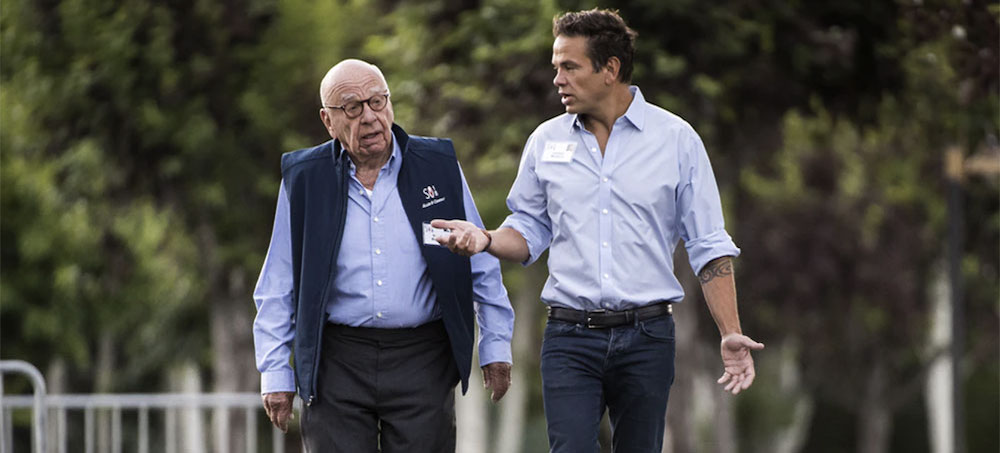
After Buffalo, Will Corporate America Turn Against the Murdochs and Fox News?Rupert Murdoch, left, and his son Lachlan Murdoch in Sun Valley, Idaho, on July 13, 2018. (photo: David Paul Morris/Bloomberg/Getty Images)


After Buffalo, Will Corporate America Turn Against the Murdochs and Fox News?
Peter Maass, The Intercept
Maass writes: "If your anger at Fox News is directed toward Tucker Carlson, you're focusing on the symptom rather than the cause of what's wrong. It is the Murdoch family, which owns Fox News, that's the biggest advocate in America for the 'great replacement theory.'"

Why the Murdochs should become the next Sacklers.


If your anger at Fox News is directed toward Tucker Carlson, you’re focusing on the symptom rather than the cause of what’s wrong. It is the Murdoch family, which owns Fox News, that’s the biggest advocate in America for the “great replacement theory.”

It’s right to be furious about Carlson espousing the racist conspiracy theory that inspired a white supremacist to kill 10 people in Buffalo last weekend, but Carlson serves at the pleasure of Rupert Murdoch and his heirs. Even if popular pressure forced Carlson off the air, the Murdochs would just find or create another racist host to take his place, probably a worse one. (They’ve done it before.) That’s why we need to focus on the Murdoch family, on its base of support in corporate America, and ask a simple question: Shouldn’t the Murdochs become the next Sacklers?

The decisive role of the Murdochs was emphasized this week by Senate Majority Leader Chuck Schumer, D-N.Y., who implored them to cease platforming “great replacement” lies. “For years, these types of beliefs have existed at the fringes of American life,” Schumer wrote in a letter to Rupert Murdoch, his eldest son Lachlan, and two Fox News executives. “However, this pernicious theory, which has no basis in fact, has been injected into the mainstream thanks in large part to a dangerous level of amplification by your network and its anchors.”

In other words, the Murdochs are Stormfront with clout.

Due to public pressure, most major advertisers have pulled away from Carlson in recent years, and other programs on Fox News are heading in that direction. But it doesn’t really matter: The network derives most of its income from cable providers that pay generous fees to carry it. Comcast and other cable companies do not think twice about pouring nearly $2 billion a year into a pseudo news operation that’s been described as a “hate-for-profit racket.” So long as there’s not too much of a stink — which a campaign called #UnFoxMyCableBox is aiming to create — cable providers do not mind enriching a family whose marketing of intellectual poison remains an attractive business proposition.

The Murdochs have adopted an ancient strategy associated with money launderers and bootleggers who do not wish to live in the shadows: They surround their objectionable endeavors with reputable ones. Challenges to their propriety are diminished by the legitimate things they actually do and the upstanding associates they really have. The Murdochs, for instance, possess an array of valuable assets in the U.S. that include a network of TV stations that broadcast sports and entertainment programs. This gives the family a loyal army of bankers, producers, actors, sports stars, and journalists who are willing to see them as they wish to be seen and uninterested in asking about those other things they do with their money and time.

Just last week, Lachlan Murdoch, who runs the family’s sprawling empire on a day-to-day basis (Rupert is 91 years old), had a friendly earnings call with a group of Wall Street analysts. The softball financial questions from the representatives of Morgan Stanley, Credit Suisse, Wells Fargo, and Bank of America steered miles away from the political untidiness at Fox News. Nobody asked why Lachlan, when Carlson breaks another taboo, responds by texting or calling his favorite host to let him know the family is behind him all the way.

On Monday, Lachlan was back in the establishment’s kind embrace, this time with advertising executives and media buyers who were attending the “upfront” presentations of his family’s U.S. broadcast units: Fox Entertainment, Fox Sports, and Fox News. Lachlan, according to Variety, was dressed in sneakers and watched as his management team outlined their offerings for the coming year, including the next Super Bowl and World Cup, as well as entertainment programs featuring, among others, actors Jon Hamm and Susan Sarandon. The presentation about Fox News made no mention of the network spreading the idea that white Americans are being replaced by nonwhite immigrants, and Carlson’s name was not uttered once.

The inevitable truth is that corporate America loves the Murdochs. Powerful executives who would leave a room if Alex Jones or Steve Bannon presented himself are delighted to have a moment with Rupert or Lachlan.

Hollywood and the Murdochs

Is there any way to disconnect corporate America from the family that operates the “central node” of the far-right conspiracy machine?

Reader, I have mused about this a lot. Again and again. Perhaps too much. In fact, maybe I have a problem. But the dilemma of Fox News and the Murdochs does not go away, it just gets worse. Government action is not the answer, as the protections of the First Amendment exist for good reason. The key question, in my mind, isn’t whether the government should allow the Murdochs to operate a racist cable network — they have that right — it’s whether major corporations should line up to do business with them.

The prospects are not good for a change of heart in corporate America. For instance, it’s impossible to imagine that Roger Goodell, the NFL commissioner who is paid $63 million a year by billionaire team owners to make as much money for them as possible, will suddenly decide to pull the plug on the league’s lucrative $2.3 billion-a-year contract with Fox Sports. Goodell, remember, is the man who had no problem with the banishment of quarterback Colin Kaepernick for taking a knee during the national anthem to protest police violence against Black people.

But let’s think creatively. Fox Corp., the parent company of the Murdochs’ networks in the U.S., is a shareholder-owned firm in which the Murdochs have a controlling stake. What would happen to the share price if NFL players or their union spoke out against the owners of Fox Sports and called for the league to not renew its broadcast rights (which unfortunately don’t expire for a number of years)? Alas, there’s a tremendous disincentive for players to criticize the Murdochs, because they could forget about ever being hired by Fox Sports as a commentator after they retire. And Goodell might be tempted to allow the Kaepernick treatment for any dissidents, meaning that their playing careers could be in jeopardy too. So this thought experiment isn’t encouraging.

How about the Murdochs in Hollywood? The major companies that will no longer put their ads on Fox News are glad to have their wares advertised on Fox television shows like “The Simpsons.” Corporations respond to consumers, and while consumers punish them for supporting political programs on Fox News, that’s not the case for sponsoring “The Masked Singer” on Fox TV. Absent consumer pressure, there’s no market-driven reason for any company to withdraw its ads from, say, “The Cleaning Lady.” Balance sheets do not have line items for doing the right thing by turning against the first family of “great replacement.”

What about the creative talent? While Hollywood proclaims itself to be devoutly anti-racist, there’s little sign that the enlightened writers, actors, and producers who create Murdoch’s entertainment programs are having second thoughts about who they work for. Susan Sarandon, famous for her political activism, was on the upfronts stage last week to promote her new Fox show and did not, in front of Lachlan Murdoch, seize the moment to pull a Nan Goldin.

Goldin is an art photographer who set off a dramatic wave of protests against the Sackler family — the owners of the pharmaceutical company that flooded the U.S. with the addictive painkiller OxyContin. Goldin became addicted to opioids after OxyContin was prescribed for her tendonitis, and in 2018 she led a now-famous protest at the Sackler Wing of the Metropolitan Museum of Art, in which she and other activists threw prescription bottles into a reflecting pool and shouted “Sacklers lie, people die!” Those protests came amid a wave of lawsuits that recently culminated with a settlement in which the Sackler family agreed to pay as much as $6 billion to communities harmed by the opioid epidemic and transfer ownership of Purdue Pharma. The family’s name has been taken down from the Met and other museums.

Lawsuits against the Murdochs have not gotten far because the First Amendment offers broad protections for news organizations and individuals in ways that no constitutional provision or law protects a pharmaceutical company. Proving direct harm from an opiate is far easier in a court of law than proving direct harm from a broadcast. There are exceptions, but they are narrow. While the conspiracy theorist Alex Jones has been sued into bankruptcy for saying the Sandy Hook school shooting was a hoax, that’s because he was accused of defamation — making false statements about the parents of the slain students and causing them damage.

You never know what a bit of protesting might do, however. Unfortunately, it’s hard to find examples of anyone in the television business, even people who don’t currently work on Fox shows, protesting against the Murdochs in a consistent and public way. It’s a pattern that seems to affirm the silencing effect, in itinerant Hollywood, of not knowing who will sign your next paycheck. Though one exception is Judd Apatow, the prolific director and writer who for years has been drilling holes into the family Murdoch.

Reporting the Murdochs

There’s been extensive discussion in the media about needing to cover the GOP as an extremist entity that threatens democracy rather than as a standard political party. The same discussion should probably be raised about Fox and the Murdochs. Should they be covered as something other than a conservative news outlet with a cranky proprietor who enjoys watching his children battle each other for his attention and love? If so, what would that mean?

For a long time, news organizations have treated the Murdochs with generosity and indulgence, as a tale of financial success and succession intrigue. I’m not referring just to the usual suspects of CNBC and MarketWatch, but also the New York Times and the Washington Post, among others. Just watch this 2018 public interview of Lachlan Murdoch by New York Times reporter Andrew Ross Sorkin and try not to cringe at Sorkin’s knee-bending solicitude. The only remotely tough question came during the audience Q&A from a New Yorker reporter.

The Times has improved in the past few years, starting with an excellent series in 2019 that was headlined “How Rupert Murdoch’s Empire of Influence Remade the World.” In April, the Times published another lengthy investigation, “How Tucker Carlson Stoked White Fear to Conquer Cable.” But this kind of hard-nosed criticism remains patchy. In March, the Times published a puff piece about Kathryn Murdoch, the wife of James Murdoch, Rupert’s younger son. The article, “How a Murdoch Hopes to Save American Democracy,” was more than 1,300 words of fluff about a supposedly centrist member of the Murdoch clan donating to nonpartisan causes. It neglected to mention that Kathryn Murdoch has never criticized Fox News and that her husband played a loyal and key role in the family empire, stepping aside in 2020 mainly because his father finally chose Lachlan as second-in-command.

One of the lessons of the past few years is that journalists need to call things by their names, and that means, when covering Fox News, naming not just the hosts who mouth the words that inspire violence, but the family that approves of these words and pays for them to be spread from coast to coast. This is a drum I’ve been banging for a long time, and while the coverage of the Murdochs has improved, it has a ways to go. In an otherwise acceptable news story this week about the conservative media’s embrace of “great replacement” ideas, the Washington Post mentioned Tucker Carlson 15 times — but did not once mention the Murdochs.

READ MORE


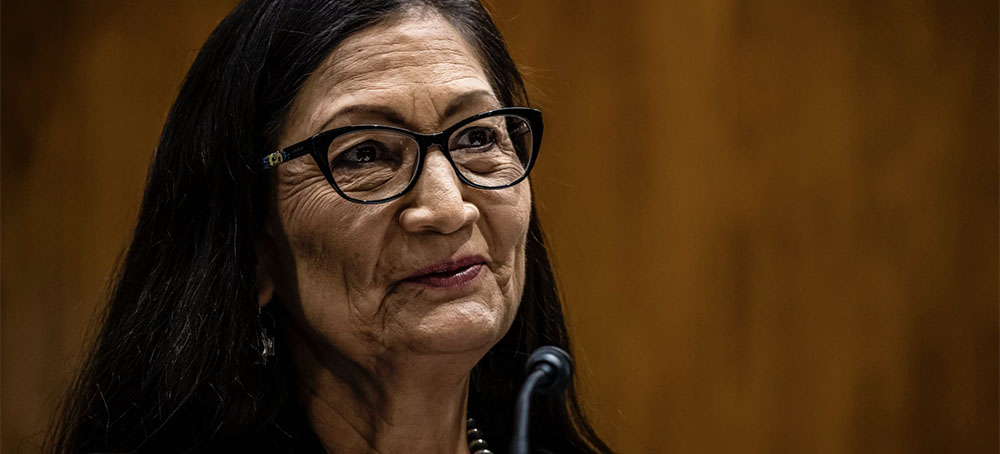
Haaland Seeks Healing for Native American Boarding School SurvivorsInterior Secretary Deb Haaland will speak with survivors of Native American boarding schools as part of a tour called "The Road to Healing." Her department found that between 1819 and 1969, the federal government operated or supported more than 400 schools. (photo: Samuel Corum/Getty Images)

Haaland Seeks Healing for Native American Boarding School Survivors
Michel Martin, Tinbete Ermyas and Kira Wakeam, NPR
Excerpt: "The Interior Department found that the U.S. operated or actively supported more than 400 American Indian boarding schools between 1819 and 1969 - a history that affects the agency's own leader."

The Interior Department found that the U.S. operated or actively supported more than 400 American Indian boarding schools between 1819 and 1969 – a history that affects the agency's own leader.

Secretary Deb Haaland, the first Native American to serve as a Cabinet secretary, tells NPR's All Things Considered that she had grandparents who were taken from their homes and placed in these schools.

"[Those are] formidable years in a child's life," she says. "It's devastating. It's important that our country realizes and understands this history because I think it's important for every single American to know what happened."

The department's findings came after an investigation into these schools and the role the federal government played in sustaining them.

Much like in Canada, Native children who attended these schools were forcibly taken from their families to be "assimilated," as it was described at the time.

Many children reported brutal conditions. Others never returned home.

U.S. officials identified at least 53 schools with marked or unmarked burial sites with the remains of children who died there.

In an effort to confront this history, Haaland says she plans to meet with boarding school survivors across the country in a tour called "The Road to Healing."

"I always enjoy visiting with people in Indian Country. We're all relatives," she says. "Above all, I just need to hear those stories myself."

This interview has been edited and condensed for clarity.

On why this is the first documentation by the U.S. government on the prevalence of Indian boarding schools:

Perhaps part of it stems from the fact that we haven't had a lot of Native American leadership in our country. Representation matters. And that's one of the reasons why I felt it was important for me to raise this issue.

On the lingering effects of these boarding schools on Indigenous communities:

There are current impacts in drug addiction and poverty and the lack of economic development, and health disparities. When people are invisible, you don't have to pay attention. We should care about every single community in this country. So bringing all of these things to light; it will make us become a better country.

On the idea that bringing up painful history is divisive:

These are real people, and these are their lives. I think it's important that we heal as a country. Everyone's experience in the boarding school system, whether they're a survivor or a descendant, that pain is real. And it's incumbent on me to ensure that I am paying attention to that and that I am doing all I can to make sure that we can heal and get people past that pain.


READ MORE


Taliban Enforce Face Coverings for Afghanistan's Female News PresentersSonia Niazi, from Tolo News, presents a live broadcast on Sunday. (photo: Wakil Kohsar/AFP/Getty Images)

Taliban Enforce Face Coverings for Afghanistan's Female News Presenters
Associated Press
Excerpt: "Afghanistan's Taliban rulers have begun enforcing an order requiring all female TV news presenters in the country to cover their faces while on air, as part of a hardline shift that has drawn condemnation from rights activists."
READ MORE


Los Alamos Lab Helps Fight Fires, Now It's Threatened by OneNew Mexico. (photo: Robert Browman/AP)

Los Alamos Lab Helps Fight Fires, Now It's Threatened by One
Morgan Lee, Associated Press
Lee writes: "Public schools were closed and evacuation bags packed this week as a stubborn wildfire crept within a few miles of the city of Los Alamos and its companion U.S. national security lab - where assessing apocalyptic threats is a specialty and wildland fire is a beguiling equation."

From nuclear bombs to climate change the Los Alamos National Laboratory specializes in existential threats, including predicting and preventing wildfires. But now a massive wildfire threatens the historic New Mexico lab itself.

Public schools were closed and evacuation bags packed this week as a stubborn wildfire crept within a few miles of the city of Los Alamos and its companion U.S. national security lab – where assessing apocalyptic threats is a specialty and wildland fire is a beguiling equation.

Lighter winds on Friday allowed for the most intense aerial attack this week on those flames west of Santa Fe as well as the biggest U.S. wildfire burning farther east, south of Taos.

“We had all kinds of aviation flying today,” fire operations chief Todd Abel said at a Santa Fe National Forest briefing Friday evening. “We haven’t had that opportunity in a long time.”

People who remained on alert to prepare for evacuations west of Santa Fe included scientists at Los Alamos National Laboratory who are tapping supercomputers to peer into the future of wildfires in the American West, where climate change and an enduring drought are fanning the frequency and intensity of forest and grassland fire.

The research and partnerships eventually could yield reliable predictions that shape the way vast tracks of national forests are thinned – or selectively burned – to ward off disastrously hot conflagrations that can quickly overrun cities, sterilize soil, and forever alter ecosystems.

“This actually is something that we’re really trying to leverage to look for ways to deal with fire in the future,” said Rod Linn, a senior lab scientist who leads efforts to create a supercomputing tool that predicts the outcome of fires in specific terrain and conditions.

The high stakes in the research are on prominent display during the furious start of spring wildfire season, which includes a blaze that has inched steadily toward Los Alamos National Laboratory, triggering preparations for a potential evacuation.

The lab emerged out of the World War II efforts to design nuclear weapons in Los Alamos under the Manhattan Project. It now conducts a range of national security work and research in diverse fields of renewable energy, nuclear fusion, space exploration, supercomputing, and efforts to limit global threats from disease to cyberattacks. The lab is one of two U.S. sites gearing up to manufacture plutonium cores for use in nuclear weapons.

With nearly 1,000 firefighters battling the blaze, laboratory officials say critical infrastructure is well safeguarded from the fire, which spans 67 square miles.

Still, scientists are ready.

“We have our bags packed, cars loaded, kids are home from school ­– it’s kind of a crazy day,” said Adam Atchley, a father of two and laboratory hydrologist who studies wildfire ecology.

Wildfires that reach the Los Alamos National Laboratory increase the risk, however slightly, of disbursing chemical waste and radionuclides such as plutonium through the air or in the ashes carried away by runoff after a fire.

Mike McNaughton, an environmental health physicist at Los Alamos, acknowledges that chemical and radiological waste was blatantly mishandled in the early years of the laboratory.

“People had a war to win, and they were not careful,” Mr. McNaughton said. “Emissions now are very, very small compared with the historical emissions.”

Dave Fuehne, the laboratory’s team leader for air emissions measurement, says a network of about 25 air monitors encircle the facility to ensure no dangerous pollution escapes the lab unnoticed. Additional high-volume monitors were deployed as fire broke out in April.

Trees and underbrush on the campus are removed manually – 3,500 tons over the course of the last four years, said Jim Jones, manager of the lab’s Wildland Fire Mitigation Project.

“We don’t do any burning,” Mr. Jones said. “It’s not worth the risk.”

Jay Coghlan, director of the environmental group Nuclear Watch New Mexico, wants a more thorough evaluation of the lab's current fire risks and questions whether plutonium pit production is appropriate.

This year's spring blazes also have destroyed mansions on a California hilltop and chewed through more than 422 square miles of tinder-dry northeastern New Mexico. In Colorado, authorities said Friday one person died in a fire that destroyed eight mobile homes in Colorado Springs.

The sprawling fire in New Mexico's Sangre de Cristo Mountain range is the largest burning in the United States, with at least 262 homes destroyed and thousands of residents displaced.

Nearly 2,000 fire personnel are now assigned to that fire with a 501-mile perimeter – a distance that would stretch from San Diego to San Francisco.

Mr. Atchley says extreme weather conditions are changing the trajectory of many fires.

“A wildfire in the ’70s, ‘80s, '90s, and even the 2000s is probably going to behave differently than a wildfire in 2020,” he said.

Mr. Atchley says he’s contributing to research aimed at better understanding and preventing the most destructive wildfires, superheated blazes that leap through the upper crowns of mature pine trees. He says climate change is an unmistakable factor.

“It’s increasing the wildfire burn window. … The wildfire season is year-round,” Mr. Atchley said. “And this is happening not only in the United States, but in Australia and Indonesia and around the world.”

He’s not alone in suggesting that the answer may be more frequent fires of lower intensity that are set deliberately to mimic a cycle of burning and regeneration that may have taken place every two to six years in New Mexico before the arrival of Europeans.

“What we’re trying to do at Los Alamos is figure out how do you implement prescribed fire safely ... given that it’s exceedingly hard with climate change,” he said.

Examples of intentional prescribed burns that escaped control include the 2000 Cerro Grande Fire that swept through residential areas of Los Alamos and across 12 square miles of the laboratory – more than one-quarter of the campus. The fire destroyed more than 230 homes and 45 structures at the lab. In 2011, a larger and faster-moving fire burned the fringes of the lab.

Mr. Atchley said the West's forests can be thought of and measured as one giant reserve that stores carbon and can help hold climate change in check – if extreme fires can be limited.

Land managers say expansive U.S. national forests can't be thinned by hand and machine alone.

Mr. Linn, the physicist, says wildfire modeling software is being shared with land managers at the U.S. Forest Service, as well as the Geological Service and Fish and Wildlife Service, for preliminary testing to see if it can make prescribed fires easier to predict and control.

“We don’t advocate anybody using any of these models blindly,” he said. “We're in that essential phase of building those relationships with land managers and helping them to begin to make it their model as well.”


READ MORE

Special Coverage: Ukraine, A Historic Resistance
READ MORE


Contribute to RSN

Follow us on facebook and twitter!

Update My Monthly Donation

PO Box 2043 / Citrus Heights, CA 95611


WBUR TODAY: 5 local takeaways from Tuesday

                                                                                                                                            ...