We have it within our power to make the world over again. — Thomas Paine
For most of our history as a species, people have lived under kings, queens, bullies, dictators, autocrats and tyrants—people like Donald Trump and Vladimir Putin.
But the Framers of our Constitution were determined to create a system of government where the people could govern themselves under the rule of law.
That is what is at stake today – because Trump wants to destroy the whole project of democratic self-government.
He has no respect for the Constitution or the outcome of our elections. He has positioned himself and his party outside the constitutional order. And he’s waging war on our democratic institutions and the rule of law in America. He wants to recapture the government to use it as an instrument of self-enrichment and total corruption — just what the Founders opposed.
American democracy is a precious inheritance — something rare in the history of the world and rare even on Earth today. We must defend it with everything we’ve got.
I appreciate you hanging tough for American democracy through these tough times, and I am sending love, strength and gratitude to you for your amazing solidarity and friendship.
With gratitude and nothing but high hopes for America,
Ann Arbor (Informed Comment) – The announcement Wednesday that Spain, Ireland and Norway will recognize the State of Palestine diplomatically on May 28 is not unprecedented in Europe or in the world. In Europe, Sweden, the Czech Republic, Slovakia, Poland and Iceland have all done so. Indeed, most countries recognize Palestine. The outliers were the […]
excerpt:
Ann Arbor (Informed Comment) – The announcement Wednesday that Spain, Ireland and Norway will recognize the State of Palestine diplomatically on May 28 is not unprecedented in Europe or in the world. In Europe, Sweden, the Czech Republic, Slovakia, Poland and Iceland have all done so. Indeed, most countries recognize Palestine. The outliers were the U.S., Australia and most countries of Western Europe. Now the Western European consensus against this step is crumbling, as well. Belgium came close to joining the other three and it could yet do so.
As for France, its foreign minister, Stéphane Séjourné, said Wednesday that recognizing Palestine was “not taboo.” He said that France would prefer to take that step, however, when it would have a practical effect. He said, “”it is not just a symbolic issue or the challenge of taking a political position, but a diplomatic tool in the service of a solution yielding two states living side by side, in peace and security”.
President Emmanuel Macron is not as free to act decisively as Spain’s Prime Minister Pedro Sanchez. He leads a centrist government that has increasingly sought support from the right and big capital, though he once served in a Socialist cabinet. His backing for the International Criminal Court’s request for warrants against two top Israeli leaders has caused a backlash among his right wing colleagues.
Spain’s Sanchez, in contrast, is the Secretary-General of the Spanish Socialist Workers’ Party and the head of a left wing coalition in parliament. He is facing vehement demands from those further to his left that he unrecognize Israel the way Colombia has over the brutal Gaza campaign, and that he stop selling Israel arms.
Sanchez explained his reasoning in a speech, insisting that the step was not “anti-Israel.”
“We must say to the Palestinians that we are with them, that there is hope,” he said. He continued the affirmation that “the land and identity of Palestine will continue to exist in our hearts, in international legality and in the future of a harmonious Mediterranean.” In the past, Sanchez has defined the Palestinian state as the territory of “Gaza, the West Bank, with East Jerusalem as its capital.”
He said that Spain’s foreign policy has to be coherent. Madrid voted in the UN General Assembly for Palestinian admission as a member state in the United Nations. “If Spain voted in favor of recognizing Palestine as a state with full rights in the UNO,” he said, “we must also recognize it bilaterally.”
Sanchez has been scathing on Netanyahu’s Gaza campaign. He complained Wednesday, “He doesn’t have a peace project for Palestine.” He said it was legitimate to fight Hamas after what it did on Oct. 7. But, he cautioned, “Netanyahu generates so much rancor that the two-state solution is in danger of being made unviable.” The present offensive, he said, “will only increase hatred by worsening security prospects for Israel and the entire region.”
In a subtle slam at the United States, the Spanish PM observed, “The countries that believe in a rules-based international order are obliged to act in Ukraine and Palestine, without double standards, and to do everything in our power — providing humanitarian aid, assisting the displaced, and using every political avenue to say that we will not allow the two-state solution to be forcibly destroyed.”
Sanchez made an excellent point when he went on to point out that a two state solution that guarantees security to both sides requires that the two parties feel themselves able to negotiate with legitimacy and must have the same status as states. He said that recognizing the State of Palestine was a way of enabling it to confront Hamas, an organization, he insisted, that must disappear so that the Palestine Authority can rule Gaza, the West Bank and East Jerusalem as its capital.
I have long argued that the reason for which treaties like the 1993 Oslo Accords have been so easily trashed by the Israelis is that the Palestinians are stateless and so Israel, a state, does not have to treat them as a legitimate government. It can easily renege on any agreement with them, since they have no legitimate status. Only be recognizing them as a state can third parties actually push Israel and the Palestinians to a settlement. Sanchez sees this.
He accused right wing Spanish leader José Maria Aznar of not being able to see the Palestinians and their suffering, even though he was able to see what no one else was — the weapons of mass destruction in Iraq in 2003.
Sanchez’s comments on the issue are informed, ethical and insightful. No one on the US political scene speaks halfway so coherently on this matter.
The prime minister also said the step was intended to push for a cease fire in Gaza. “In a while when shelling ceases and the dust of the tanks and the destruction of buildings dissipates, we will realize that we have witnessed one of the darkest episodes of the 21st century, and I want the Spaniards to be able to say with their heads high that they were on the right side of history.”
( Middle East Monitor ) – The Democracy Perception Index (DPI) issued its 2024 report on 8 May, revealing important and interesting shifts in global perceptions about democracy, geopolitics and international relations. The conclusions in the report were based on the views of over 62,000 respondents from 53 countries, representing roughly 75 per cent of […]
( Middle East Monitor ) – The Democracy Perception Index (DPI) issued its 2024 report on 8 May, revealing important and interesting shifts in global perceptions about democracy, geopolitics and international relations. The conclusions in the report were based on the views of over 62,000 respondents from 53 countries, representing roughly 75 per cent of the world’s total population.
The survey was conducted between 20 February and 15 April this year, when the world was largely transfixed by the Israeli war against the Palestinians in the Gaza Strip.
It is important to note that the DPI, although informative, is itself conceived in a biased context as it is the product of a global survey conducted by western-based companies and organisations.
The DPI results were published ahead of a scheduled 2024 Copenhagen Democracy Summit, whose speakers will include Hillary Clinton, US Republican Senate leader Mitch McConnell and President of the European Council Charles Michel. The first speaker listed on the conference website is Anders Fogh Rasmussen, the Founder and Chairman of the Alliance of Democracies Foundation, which commissioned the DPI.
All of this is reflected in the kind of questions which are being asked in the survey, placing greater emphasis on whether, for example, ties should be cut with Russia over Ukraine, and China over a war that is yet to take place in Taiwan. Such major shortcomings notwithstanding, the outcome of the research remains interesting and worthy of reflection.
There are some major takeaways from the report. For a start, there is growing dissatisfaction with the state of democracy, and such discontent is not limited to people living in countries perceived as non-democratic; it also includes people in the US and Europe.
What’s more, democracy, in the collective awareness of ordinary people, is not a political term often infused as part of official propaganda. When seen from the viewpoint of the people, democracy is a practical notion, whose absence leads to dire implications. For example, 68 per cent of people worldwide believe that economic inequality at home is the greatest threat to democracy.
On the question of “threats to democracy”, there is growing mistrust of Global Corporations (60 per cent), Big Tech (49 per cent) and their resulting Economic Inequality (68 per cent), and Corruption (67 per cent). This leads to the unmistakable conclusion that western globalisation has failed to create the proper environment for social equality, empower civil society or build democratic institutions. The opposite, based on people’s own perceptions, seems to be true.
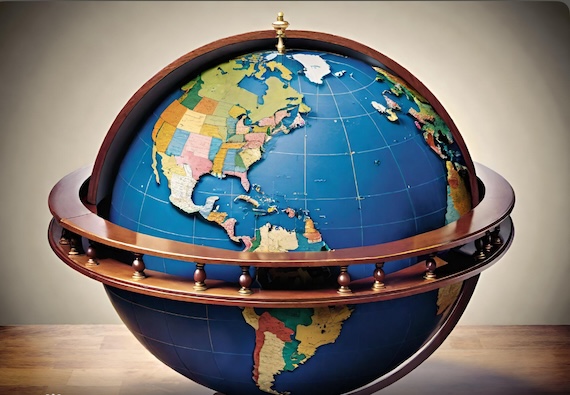
“Globe.” Digital, Dream / Dreamland v. 3.
Then we have global priorities which, as seen by many nations around the world, remain committed to ending wars, poverty, hunger, combating climate change, etc. However, this year’s top priority among European countries, 44 per cent, is also centred on reducing immigration, a significant number compared with the 24 per cent who prioritise fighting climate change.
Although the world appears to be divided about cutting ties with Russia and China, the selection of the question again reeks with bias.
The respondents in western countries, who are subjected to relentless media propaganda, prefer cutting such ties, while most people in the rest of the world prefer keeping them. Consequently, due to China’s positive perception in Asia, the Middle East and North Africa, the DPI gave Beijing a “net positive”. Russia, on the other hand, is on the “path of image rehabilitation in most countries surveyed with the exception of Europe,” reported Politico.
The greatest decline was suffered by the United States, largely due to Washington’s support for Israel in its ongoing war in the Gaza Strip. “Over the past four years… perceptions of the US’s global influence became more positive – peaking in 2022 or 2023 – and then declined sharply in 2024,” the report concluded.
The large drop took place in the Muslim countries that were surveyed: Indonesia, Malaysia, Turkiye, Morocco, Egypt and Algeria. Some western European countries are also becoming more critical of the US, including Switzerland, Ireland and Germany.
Most people (55 per cent compared with 29 per cent) believe that social media has a positive effect on democracy. Despite growing social media censorship, many in the Global South still find margins in these platforms which allow them to escape official or corporate media censorship. Growing criticism of social media companies, however, is taking place in western countries, according to the survey.
Despite official propaganda emanating from many governments, especially in the west, regarding the greatest threats to world peace, the majority of people want their governments to focus on poverty reduction, fight corruption, promote economic growth, and improve healthcare and education, while working to reduce income inequality. “Investing in security and defence,” came seventh on the list.
Finally, people in countries which have an overall negative perception of the United States include some of the most influential global and regional powers, such as China, Russia, Indonesia, Austria, Turkiye, Australia and Belgium.
Despite massive media propaganda, censorship and scaremongering, people around the world remain clear on their collective priorities, expectations and aspirations, which are real democracy, social equality and justice. If these collective yearnings continue to be denigrated and ignored, we should expect more social upheaval, if not outright insurrections and military coups in coming years.
The views expressed in this article belong to the author and do not necessarily reflect the editorial policy of Middle East Monitor or Informed Comment.
By Colin John Irwin, University of Liverpool | – With the announcement by Norway and Ireland that they have recognised Palestine as an independent state, and Spain expected to follow suit by the end of May, it appears that international momentum for a two-state solution to the Israeli-Palestinian conflict is growing. The concept has long […]
With the announcement by Norway and Ireland that they have recognised Palestine as an independent state, and Spain expected to follow suit by the end of May, it appears that international momentum for a two-state solution to the Israeli-Palestinian conflict is growing.
The concept has long been supported by the US and its allies, as well as most Arab states and the United Nations. In 2017, Hamas amended its charter to accept the existence of Israel based on borders established after the six-day war in 1967. It reportedly indicated recently a willingness to disarm if a Palestinian state were established. But the present Israeli government led by the prime minister, Benjamin Netanyahu remains implacably opposed to a two-state solution.
Could things be different under different leadership? To answer this, we need to know whether the Israeli and Palestinian people could be persuaded to accept such a plan. Here it’s worth taking a look at what polling tells us.
Politicians all too often find it convenient to blame the public for their failures. This is particularly true of failed peacemaking. The Palestinian Center for Policy and Survey Research (PCPSR) has tracked the ups and downs of support for the two-state solution from a high of 51% and 53% for Palestinians and Israeli Jews in polls taken in 2016 to a low of 33% and 34% respectively in 2022.
But pollsters in both Israel and Palestine, who do excellent work to the highest technical standards, sadly have had little or no opportunity to measure public opinion in support of a successful peace process. They measure the situation as it is – in the context of failure. Instead they need to measure what could be, how attitudes could change given proactive political leadership determined to get to peace. With such leadership the numbers change significantly.
Most recently, on the Palestinian side the Institute for Social and Economic Progress asked the two-state solution question in March 2024 in the context of “serious negotiations” and got a 72.5% positive response. This contrasted with PCPSR results a few months earlier in December 2023 which registered support for the two-state solution at only 34% among Palestinians when framed without the context of serious negotiations. Clearly “serious negotiations” are the key.
On the Israeli side, a poll run for the Geneva Initiative in January 2024 got a result of 51.3% support for the two-state solution. Specifically, this was framed in the context of a “return of the hostages agreement, to establish in the future a non-militarised Palestinian state in the West Bank and Gaza, and total normalisation between Israel and Saudi Arabia”. This was only two percentage points below the high point of support at 53% recorded by the PCPSR in 2016.
Security has always been the top priority for Israelis and when that is factored in, success in negotiations can be assured. And significantly demilitarising a future Palestine is not a deal-breaker for the Palestinians, according to the Institute for Social and Economic Progress March 2024 poll.
A PCPSR poll completed for the Palestine Peace Initiative also in March 2024 found that 50.4% of respondents said the two-state solution would be acceptable to Palestinians providing they also get security and an independent state free from occupation.
The solution then to the implementation of the two-state solution appears to be to combine all the elements that can make it a success.
Additionally the scale that is used is also important. In real negotiations it is important to know where the “red lines” are and what the people can be persuaded to accept given positive political leadership.
In Northern Ireland, where public opinion polls were used to detail every element of a peace agreement, the people were asked what was: “essential” (a red line), what was “desirable” or “acceptable”, what was “tolerable” (not wanted but with political leadership could be made into a “yes”), and what was “unacceptable” under any circumstances (another red line).
When we used this scale to gauge support for a two-state solution in 2009, only 21% of Israelis and 24% of Palestinians considered it “unacceptable”. This compares very favourably with equivalent results for views of power sharing in Northern Ireland in polls I conducted in January 1998 that found it was “unacceptable” for 52% of Protestants and 27% of Catholics. Despite this, with political leadership from the UK, Ireland, the US and EU working together, peace was made.
Clearly the same can be done for Israel and Palestine with the full support of the international community.
Positive polling
Just to make sure, Mina Zemach – the pollster I work with in Israel – ran the 2009 two-state solution (TSS) question for me again in May 2024. The findings are published here for the first time. The result among Israeli respondents was 43% “unacceptable”. It was not as good as the 2009 result – but still better than the result for Northern Ireland where peace was achieved.
Critically then, the two-state solution needs to be tested along with all the positive elements of incentives and process, both international and domestic, that can be deployed to maximise the potential for getting to peace. And when we know what that magic formula is – do it. Turn fiction into fact and end this forever war.
As I’ve noted, on Monday evening Trump posted a 30-second video on his Truth Social site featuring images of hypothetical newspaper articles celebrating his 2024 victory and referring to “the creation of a unified Reich” under the headline “What’s next for America?”
References to “the creation of a unified Reich” appear three times in the short video, including “German industrial strength significantly increased after 1871, driven by the creation of a unified Reich.” One hypothetical article asserts that Trump deported 15 million migrants in a second term, while text onscreen lists the start and end days of World War I. Another headline says he rejected “globalists.”
There have been indications of Trump’s fascination with fascism before this. Consider his uses of fascist language — calling immigrants “vermin” who “poison the blood” of America — and his repeated fascistic claims that “I am your voice. I alone can fix it.”
Besides, the white Christian nationalism that Trump touts bears a remarkably close resemblance to Nazism.
During his time in office, Trump reportedly claimed that Adolf Hitler “did some good things.” Trump berated his generals with insults like, “you f—king generals, why can’t you be like the German generals … in World War II?” according to the account of former White House Chief of Staff John Kelly.
But this Third Reich video is the first time Trump has explicitly embraced Nazi fascism.
The “Third Reich” was the official Nazi designation for its regime from January 1933 to May 1945, as the presumed successor to the medieval and early modern Holy Roman Empire of 800 to 1806 (which the Nazis designated the First Reich) and the German Empire of 1871 to 1918 (which they called the Second Reich). Hitler stoked resentment against the loss of the German Empire and against Jews, whom the Nazis often referred to as globalists.
The Trump campaign has distanced itself from the video. A campaign spokesman claimed it was “not an [official] campaign video” and was “reposted by a staffer who clearly did not see the word.”
Yet it remained posted on Truth Social for 19 hours before finally being taken down yesterday.
In July 2015, during Trump’s first bid for the White House, his campaign’s official Twitter account posted — and then quickly deleted — an image featuring Nazi soldiers superimposed between the stripes of an American flag. At the time, the executive vice president of the Trump Organization — a fellow named Michael Cohen — blamed the post on a “young intern” who apparently “did not see very faded figures within the flag.”
Trump’s defenders argue that there’s no valid comparison between Trumpism and Nazism, yet Trump and his campaign continue to invite the comparison.
I don’t believe the Monday post was a mistake. I believe Trump is now moving to openly signal his embrace of fascism.

 / democracydocket
Facebook:
/ democracydocket
Facebook:  / democracydocket
X/Twitter:
/ democracydocket
X/Twitter:  / democracydocket
TikTok:
/ democracydocket
TikTok:  / democracydocket
Threads: https://www.threads.net/@democracydocket
/ democracydocket
Threads: https://www.threads.net/@democracydocket


 This work


