12 November 22
Live on the homepage now!
Reader Supported News
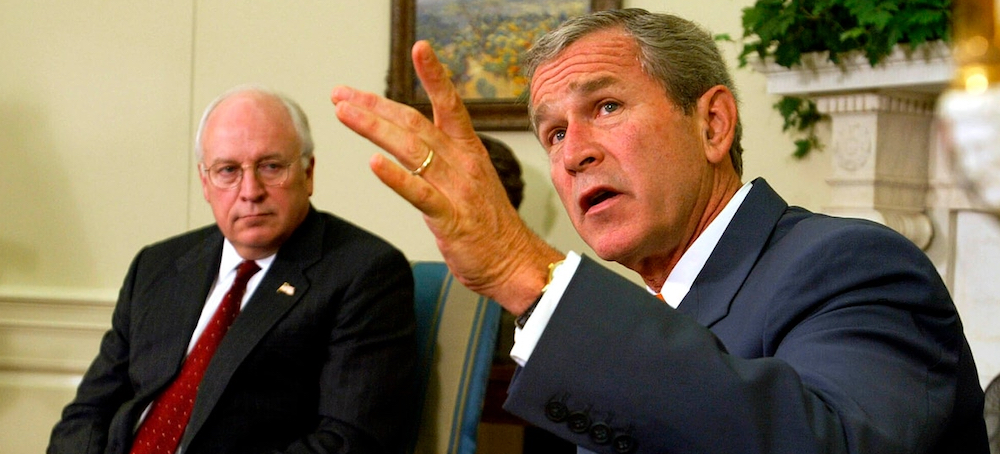
In a newly declassified interview conducted in 2004, Bush shows not a glimmer of awareness of the destruction and carnage he had unleashed on the world.
“The President and Vice President were seated in chairs in front of the fireplace. The President’s demeanor throughout was relaxed. He answered questions without notes,” according to the document drafted by the commission’s Executive Director Philip Zelikow. “The portrait of Washington was over the fireplace, which was flanked by busts of Lincoln and Churchill. Paintings of southwestern landscapes are on the wall. It was a beautiful spring day.” The document, whose declassification was first reported by the Wall Street Journal, is not an official transcript but is described as “a memorandum for the record.” It was authorized for release by the Interagency Security Classification Appeals Panel.
One of the most striking aspects of the declassified document is the apparent absence of even a glimmer of self-awareness by Bush about the significance of the death and destruction he was unleashing with his global war. The interview took place just as a massive insurgency was erupting in Iraq against a U.S. occupation that would kill thousands of U.S. soldiers and tens of thousands of Iraqi civilians. While the document is a rough transcript and summary, Bush comes off as almost childishly simplistic in his insights and analysis. The lack of any sensitive information contained within the document should spur questions as to why it took more than 18 years to be made public.
The declassified document does not contain any groundbreaking revelations, but it does offer some new texture to the internal events immediately following the attacks. That morning, after the first plane had hit the World Trade Center, Bush was reading “The Pet Goat” with second grade students at Emma E. Booker Elementary School in Sarasota County, Florida. Bush told the commissioners that he had seen the first plane hit but thought it was an accident. “He recalled that he and others thought the building had been hit by a twin engine plane. He remembered thinking, what a terrible pilot.” Soon after the second plane hit the south tower of the World Trade Center at 9:03 a.m., chief of staff Andy Card approached Bush as he sat listening to the students reciting more passages from “The Pet Goat” and informed him that it appeared the U.S. was under attack.
The commissioners asked the commander-in-chief why he continued to sit in the classroom. “He was trying to absorb the news. He remembered a child, or someone, reading. He remembered watching the press pool and noticing them talking on their phones. He realized the country was watching his behavior. He had to send the right signals. He wanted to collect his thoughts,” according to the notes. “He felt he should project calm and strength, until he could understand better what was happening.” Bush “thought it was important to keep his body language calm in the face of danger. As the president, he was conscious that ‘people react off me.’”
Perhaps the most interesting passages from the document relate to the extent to which Cheney was empowered to effectively take command authority that morning. Bush said he was pressured to get on Air Force One, so he “made some quick remarks and blasted out of there.” Cheney, he recalled, urged him, “Don’t come home.” Cheney “told him that Washington was under attack. He strongly recommended that the President delay his return to Washington. There was no telling how much more the threat might be. The President agreed, reluctantly.” Once Cheney was at the helm inside the Presidential Emergency Operations Center, an underground bunker beneath the East Wing of the White House, he and Bush discussed the “rules of engagement” for the evolving situation, including confronting other potential hijacked aircraft. “Yes, engage the enemy. You have the authority to shoot down an airplane,” Bush reportedly told Cheney. “The President understood this from his experience in the Texas Air National Guard,” according to the notes. “He had been trained to shoot down planes. He understood generally how this worked — one plane would lock on, one would ID. He understood the consequences for the pilot, how a pilot might feel to get the order to shoot down a US airliner. It would be tough.”
The document describes a chaotic scene with communications equipment failing and Bush being overwhelmed with rumors and reports about other potential targets, including Air Force One and his private ranch in Crawford, Texas. Bush “had heard of the fog of war. That day he saw it, firsthand. He wanted to go back to D.C.” Instead, Bush was flown to Barksdale Air Force Base in Louisiana while Cheney ran things from the bunker under the White House. The document states that during this period, the secure phone line between Bush and Cheney kept failing. Bush also tried to reach Defense Secretary Donald Rumsfeld but said that “they couldn’t find him.” Bush “was very frustrated about not being able to make contact with different people.” He also complained that “there was not good television on” Air Force One. He was eventually moved to Offutt Air Force Base in Omaha, Nebraska, where he had better secure communications equipment. Bush would spend some nine hours aboard Air Force One that day and did not return to the White House until 7 p.m.
Cheney, according to the document, gave direct authorization to the military to shoot down civilian aircraft after being presented with intelligence that the planes had been hijacked. “Then they heard that an aircraft was down in Pennsylvania. The Vice President thought we’d shot it down. It took a while to sort this out. In the next half hour there were two or three occasions like this: a report of an incoming, would he reiterate authorization? Yes. In every case, though, the problem was resolved without shots being fired.” According to the declassified notes, there were five reports of additional hijackings that all turned out to be false. When one of the commissioners pressed Cheney about apparent discrepancies in the timeline of when exactly Bush gave the vice president authority to direct the shooting down of U.S. civilian planes, “The President said: Look, he didn’t give orders without my permission.”
One of the 9/11 commissioners “asked if the President or the Vice President had been involved in permitting planes carrying Saudi nationals to leave after 9/11. No, the President said. He had no idea about this until he read about it in the papers.” Cheney, the document noted, “also gave a negative answer,” but added that his answer was “hard to hear.”
Several 9/11 commissioners raised the issue of the infamous Presidential Daily Briefing from August 6, 2001, titled “Bin Laden Determined to Strike in US.” That document cites foreign intelligence indicating that Osama bin Laden “wanted to hijack US aircraft” in an effort to free Islamic extremist prisoners held by the U.S. on terror convictions. It also stated that the FBI had information “that indicates patterns of suspicious activity in this country consistent with preparations for hijackings or other types of attacks, including recent surveillance of federal buildings in New York.” Bush repeatedly rejected the notion that he had received any “actionable intelligence” and said it was just a “general assessment,” and that he had personally requested information that ultimately led to the production of that specific briefing. “It reaches the conclusion that Bin Ladin wants to attack us,” Bush told the commissioners. “Yeah, the President commented, he’s trying to do that. So is al Qaeda.” Bush claimed that none of the briefings he received “was commenting on a threat in America. There was no actionable intelligence on such a threat — not one.” Bush told the commissioners that CIA Director George Tenet told him, “The threat was overseas — that was what George said.” Bush “said he thought that if there had been a serious concern in August [2001], he would have known about it.”
The declassified document also contains some reflections from Bush and Cheney on the initial stages of the so-called war on terror. Bush complained that U.S. allies were reluctant to join in the global assassination program implemented after 9/11. “On bringing terrorists to justice, their approach was not as tough as ours. Foreign governments were less willing to kill them, to go after them in the remote places of the world. Our own agencies, the President said, were pretty darn robust.”
Cheney also decried congressional oversight of covert operations, particularly those run by the CIA, saying it had weakened the agency. “The standards that had been applied to the intelligence community had left them inclined to be risk averse. The penalties were high for getting involved in actions that might later be judged to be inappropriate,” the notes read. Cheney “mentioned the example of having nasty people on the CIA payroll. The officials then try to be careful; they don’t take things on.” Throughout his political career, Cheney was notorious for despising congressional oversight of U.S. covert operations. Five days after 9/11, he said on NBC’s “Meet the Press,” “We also have to work, though, sort of the dark side, if you will. We’ve got to spend time in the shadows in the intelligence world. A lot of what needs to be done here will have to be done quietly, without any discussion, using sources and methods that are available to our intelligence agencies.”
When asked how the U.S. could “make the country less vulnerable to attack,” Bush “said they were trying to kill a lot of the enemy. They are killers. We had to kill them before they kill us.”
The document also describes some of the White House efforts to cajole Muslim nations, like Saudi Arabia and Pakistan, into supporting a much wider U.S. war. The Saudis, Bush asserted, were “unhappy” with the U.S. position on Israel, and “Pakistan was too close to the Taliban. They had to change Pakistan’s behavior. But the country was smothered in congressional sanctions; there were no carrots they could use. After 9/11 this changed.” In the case of both nations, the document notes that following alleged Al Qaeda attacks against them, they fell more in line with the White House’s wishes. “The enemy helped give us an opportunity,” according to the document. In Pakistan there were two assassination attempts on President Pervez Musharraf in December 2003. “That helped him change some more.” In Saudi Arabia, Al Qaeda took responsibility for the May 2003 bombing of a series of residential compounds in Riyadh, including one operated by the U.S. private military contractor Vinnell Corporation. “After that, the Saudis were better warfighters.”
In an unusual admission, the document states that Bush acknowledged that the U.S. economic sanctions on Iraq were “recruiting terrorists. Their propaganda with reports of starving Iraqi children were hurting us.”
Bush also told the commissioners that working with Vladimir Putin, who had assumed the presidency in Russia in 2000, “was important,” especially to facilitate the use by U.S. military and intelligence of bases in central Asia, including Uzbekistan, to stage its operations in Afghanistan. “He spoke with Putin about this in the summer of 2001. He remembered Putin complaining about Pakistan — and about Saudi Arabia — being safe havens for the terrorists, urging the need to find the source of these problems.” Developing a better relationship with Putin and Russia, Bush said, “would make it easier for the U.S. to base activity in the ‘Stans.’ This was hard for Russia historically, to accept.”
The document describes a lengthy discussion on why the U.S. did not actively try to kill bin Laden before 9/11. Bill Clinton did sign a presidential finding to kill bin Laden and authorized a missile attack against a suspected Al Qaeda camp in Afghanistan in 1998 following the bombing of the U.S. embassies in Kenya and Tanzania. Without directly criticizing Clinton, Bush decried the launching of cruise missiles in an effort to assassinate bin Laden. Bush “said he was concerned about an empty response that Bin Ladin and others would use to propaganda advantage,” according to the notes. “If that had been ineffective, the enemy would have used it to show their ability to thwart U.S. technology and military might.” Bush “said you must use ground forces for a job like this.”
As the commissioners questioned Bush about why he did not authorize military activity to kill bin Laden in the months before 9/11, Bush mentioned that he had recently spoken with British Prime Minister Tony Blair who observed that “they were being criticized for not launching a preemptive attack against Afghanistan. And they were criticized for preemptively attacking Iraq.” Blair allegedly told Bush that if the president had said “before 9/11 that he wanted to put forces in Afghanistan, he — Blair — would have been floored. ‘I would have looked at you like a nut,’ Blair said. There was an appetite for a ‘throat slit’ (killing Bin Ladin), not a war footing.” With no apparent sense of the lethal irony present, Bush told the commissioners, “A president can’t force preemptive war without a cause. The country didn’t like war. ‘I don’t like it either,’ the President said.”
According to the document, the commissioners discussed 9/11 “conspiracy theories” with Bush, and the president said he had seen some, including ones that “were worse than anything he had seen coming out of even the John Birch Society in Midland, Texas.” Commissioner Richard Ben-Veniste told Bush that the commission “wanted to deal with as many of these conspiracy themes as possible. Their goal was to make the country safer.”
Follow us on facebook and twitter!
PO Box 2043 / Citrus Heights, CA 95611