SUBSCRIBE TO THIS NEWSLETTER TO RECEIVE TIMELY REPORTS
WeSuck: First Came the Hype; then Came Adam Neumann’s Self-Dealing; then Came the IPO Scandal; Now Comes the Bankruptcy
By Pam Martens and Russ Martens: November 3, 2023 ~
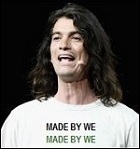
Adam Neumann, Former Chairman and CEO of WeWork
WeWork, the flexible-office-space company, is the quintessential proof that you can’t put lipstick on a pig forever. On Tuesday, the Wall Street Journal reported that WeWork “ is planning to file for bankruptcy as early as next week….”
On October 5, the credit ratings agency Fitch downgraded WeWork’s long-term debt deeper into junk bond territory after WeWork elected to withhold interest payments on its debt that were due Oct. 2. Year-to-date, the publicly-traded stock of WeWork has lost 98 percent of its value. Its shares were trading for pennies in August on the New York Stock Exchange when the financial wizards at the company came up with the idea to do a 1-for-40 reverse stock split in early September to put a little lip gloss on the pig. Yesterday, the stock closed at $1.11, which would mean that it actually closed at just under 3 cents were it not for the 1-for-40 reverse stock split.
The collapse in the share price in August came as a result of an 8-K filing with the Securities and Exchange Commission on August 8 which had included these fatal words: “…as a result of the Company’s losses and projected cash needs, combined with increased member churn and current liquidity levels, substantial doubt exists about the Company’s ability to continue as a going concern.”
Back in 2019, venture capitalists had valued this company at $47 billion and were hoping to cash out in a hot IPO. Yesterday, the company closed with a market value of $59 million.
JPMorgan Securities LLC, a unit of five-felony-count JPMorgan Chase, which is currently making headlines with its own scandal of being the financier to Jeffrey Epstein’s sex trafficking ring for 15 years, was going to be the lead underwriter of the 2019 IPO of WeWork, along with Goldman Sachs. But then Scott Galloway, a professor at NYU’s Stern School of Business began to write viral posts on his blog. One of those posts stated that “bankers (JPM and Goldman) stand to register $122 million in fees flinging feces at retail investors visiting the unicorn zoo.”
After reading the 2019 IPO prospectus, Wall Street On Parade called WeWork’s planned IPO “hype wrapped in subterfuge.” We said “It’s a money-losing commercial real estate company attempting to pass itself off as the Dalai Lama of office space rentals. The company has never made a dime of profits and its losses spiraled to $900 million in the first half of this year.”
To enhance its valuation, WeWork attempted to portray itself as interconnected to technological breakthroughs. We explained in 2019:
“We’re also going to have to excise ‘the extensive technology infrastructure’ because what they’re really talking about is not Silicon Valley breakthrough technology but jazzing up drab offices with beer taps, microbrewed coffee, fruit-infused water and WiFi – the latter of which you can get for free in any Panera’s, along with a table and chair, for the price of a cup of herbal tea.”
In 2019, WeWork was represented by a very sophisticated law firm, Skadden Arps, Slate, Meagher & Flom. The Wall Street bank underwriters were represented by another sophisticated law firm, Simpson, Thacher & Bartlett. Somehow, all of the Big Law masterminds paid big fees to scrutinize what they were helping to bring to the public markets, failed to see the self-dealing by WeWork’s then Chairman and CEO, Adam Neumann, as fatal to a public listing of its stock.
Neumann owed his loyalty to the company under the past century of corporate law. But, instead, he was buying up commercial real estate on his own behalf and then leasing it back to WeWork. According to the IPO prospectus, WeWork was leasing four properties from Neumann on which it owed “future undiscounted minimum lease payments” of “approximately $236.6 million….”
Neumann also owned another six properties which WeWork might decide to buy from him according to the prospectus. Neumann also had the right to overrule the Board of Directors. According to the prospectus:
“Adam [Neumann] controls a majority of the Company’s voting power, principally as a result of his beneficial ownership of our high-vote stock. Since our high-vote stock carries twenty votes per share, Adam will have the ability to control the outcome of matters submitted to the Company’s stockholders for approval, including the election of the Company’s directors. As a founder-led company, we believe that this voting structure aligns our interests in creating shareholder value.”
That didn’t turn out to be true. As of this morning, Forbes puts Neumann’s net worth at $2.2 billion. WeWork’s shareholders are sitting with an effective 3-cent stock that is likely to be wiped out in bankruptcy.
How did Neumann get so rich bringing a dog to market? In October 2019, CNBC reported this:
“Former WeWork CEO Adam Neumann will get up to $1.7 billion to walk away from the company and give up his voting rights, according to people familiar with the matter. SoftBank will pay Neumann up to $970 million for his shares, a $185 million consulting fee and will offer him $500 million in credit to help repay his loans to J.P. Morgan Chase, UBS and Credit Suisse, said the people, who asked not to be named because details of the agreement are private.”
What is Neumann up to lately? Last week he was cavorting in Riyadh, along with speakers Jamie Dimon, Chairman and CEO of JPMorgan Chase, and David Solomon, Chairman and CEO of Goldman Sachs, at the Saudi Arabia investment summit.
The IPO in 2019 was so heavily panned by Professor Galloway, ourselves, and numerous others that it was cancelled — delivering egg to the faces of its underwriters and their well-paid lawyers. Neumann resigned as CEO shortly after the IPO was pulled. Two years later, WeWork did an end run by going public by merging with a special-purpose acquisition company (SPAC).
The key functions of Wall Street are to efficiently allocate capital to deserving businesses and act as an effective pricing mechanism. When a company goes from a valuation of $47 billion in 2019 to $9 billion in 2021 to $59 million in 2023, Wall Street’s pricing mechanism is broken. And when a CEO pockets $2.2 billion after nefarious self-dealings and the company files bankruptcy four years later, Wall Street’s key function as an efficient allocator of capital is also broken. (See House Lawmakers Will Hear Today How the Integrity of U.S. Markets Is Being Dirtied by SPACs and Direct Listings: Coinbase Should Be a Case Study.)
Yesterday, another once highly celebrated young entrepreneur, Sam Bankman-Fried, whose FTX crypto exchange had been gearing up to go public but is now in bankruptcy, was convicted of pulling off a massive fraud.
For why WeWork’s Adam Neumann was never prosecuted, see this blog post from former U.S. Labor Secretary Robert Reich, titled: “The 6 secrets to becoming a fabulously rich con artist.”
Something is fundamentally wrong with the structure of Wall Street, the watchdogs that are supposed to be policing it, the Senate Banking Committee that is supposed to be attending to timely reforms, and the Big Law firms that seem more interested in raking in billions than insuring the integrity of markets.
The failure of all of these checks and balances have their roots in the corruption of campaign financing laws with unlimited money from corporations, hedge funds and Wall Street’s billionaires now grossly disfiguring every aspect of government by the people. This simply can’t end well. As we saw in 2008, markets eventually collapse under the weight of their own corruption, cratering the U.S. economy in the process.