Showing posts with label DEMOCRATIC PRIMARIES. Show all posts

Monday, June 10, 2024

Fresh Calls to 'Reject AIPAC' After Analysis of GOP Money in Dem Primaries

 SCRUTINIZE YOUR CANDIDATES - DON'T BLINDLY VOTE BLUE!


AIPAC and its various affiliates are ANTI-DEMOCRACY, known for their LIES and 

FALSE CLAIMS attacking opponents. Please SHARE and speak out.

AMERICANS DO NOT SUPPORT ISRAEL'S GENOCIDE!


Fresh Calls to 'Reject AIPAC' After Analysis of GOP Money in Dem Primaries


"George Latimer in New York and Wesley Bell in Missouri are trying to become Democratic members of Congress off millions of dollars of money from rich right-wing Republicans," said one group.

Politico reported Sunday that the American Israel Public Affairs Committee "the biggest source of Republican money flowing into competitive Democratic primaries this year," sparking new calls for candidates and voters nationwide to #RejectAIPAC.

"If you don't want Republican megadonors to choose your next Democratic congressperson for you, then there's only one option: #RejectAIPAC," Naftali Ehrenkranz, digital director at Get Free, said on social media, pointing to the reporting.

Also noting the "bombshell" report, Yonah Lieberman, co-founder of the Jewish American organization IfNotNow, said that "AIPAC is a GOP front group. Democrats who accept their money or endorsement should be shamed out of the party."

Institute on Race, Power, and Political Economy senior fellow Nina Turner, a former Democratic congressional candidate, declared, "AIPAC is a right-wing group that buys deep blue seats."

Trita Parsi, executive vice president of the Quincy Institute for Responsible Statecraft, drew a comparison to the National Rifle Association, saying, "Imagine how mainstream Democrats would react if the NRA was the single biggest source of Republicans donating into Democratic primaries."

Support for or criticism of the Israeli government has become a defining issue in this election cycle over the past eight months, as Israel has waged a war on the Gaza Strip that has led to a genocide case at the International Court of Justice. AIPAC, which supports pro-Israel Democratic and Republican candidates, has targeted progressives who oppose the military assault.

"We are proud to engage in the democratic process in a bipartisan way to help elect candidates who support the U.S.-Israel relationship," AIPAC spokesperson Marshall Wittmann said in a statement. "Candidates from both parties should welcome the engagement of pro-Israel activists because Americans overwhelmingly stand with the Jewish state. In fact, those who object to our participation only represent a small, extremist fringe."

Gallup polling released in March shows that 55% of Americans disapprove of Israeli military actions in Gaza—which as of Sunday, have killed over 37,000 people, according to local officials. A Pew Research Center survey published last week found that 53% of U.S. adults have little to no confidence that Israeli Prime Minister Benjamin Netanyahu will "do the right thing regarding world affairs."

Politico put out the findings from its analysis—which is based on a review of Federal Election Commission filings from AIPAC, the ActBlue and WinRed donation platforms, and individual campaigns—a day after thousands of American critics of Israel's war and U.S. complicity in it descended on the White House while Israeli forces slaughtered hundreds more Palestinians.

According to the outlet:

Only about 2% of this cycle's donors to Democratic candidates or through the Democratic giving platform ActBlue have also given to Republicans over the past few cycles, Politico's analysis found. But 46% of donors who have given to Democratic candidates via AIPAC this cycle have given to Republicans since the 2020 cycle.

For Republican donors, giving to Democratic candidates in primaries helps ensure more moderate, pro-Israel candidates win in deep-blue seats where the general election is all but certain to be uncompetitive, and financial support for GOP candidates would be a waste.

The top recipient of AIPAC money—at least $1.61 million—is Westchester County Executive George Latimer, who launched his challenge to Democratic Congressman Jamaal Bowman in New York's 16th Congressional District after visiting Israel.

Responding to the report on social media Sunday, Bowman—who has called Israel's assault on Gaza genocide—said that "Republicans are setting records spending against us. And we're going to break records beating them."

Politico pointed out that "competitive Democratic primaries are also the biggest targets for AIPAC's affiliated super PAC, United Democracy Project, which has already spent $19.8 million in them this year, including $9.3 million in the Bowman-Latimer race. That makes it by far the biggest outside group in Democratic primaries, with more money flowing from UDP than the next 10 biggest spenders combined. (The super PAC has also spent in a handful of GOP primaries, dropping $3 million total.)"

The New York arm of the Working Families Party, which is backing Bowman in the June 25 primary, shared Politico's graph of top AIPAC beneficiaries and stressed that "we must be united in rejecting AIPAC's efforts to subvert our democracy."

After Bowman and two incumbents is St. Louis County Prosecuting Attorney Wesley Bell, at $869,300. He is trying to oust another progressive "Squad" member, Democratic Congresswoman Cori Bush, in the August 6 primary for Missouri's 1st District.

"My opponent Wesley Bell is among AIPAC's TOP 4 recipients this cycle—and is gladly taking money from anti-abortion, anti-LGBTQ+, anti-labor, pro-NRA Republicans who expect his loyalty in return above all else," Bush said on social media. "We deserve better. #StLouisIsNotForSale."

Fellow "Squad" member Congresswoman Alexandria Ocasio-Cortez (D-N.Y.) also weighed in, saying, "Hmm it's almost like AIPAC functions as a political slush fund for Republican billionaires and should not have influence in the Democratic Party, let alone our primaries."

People for Bernie—which was initially launched in support of U.S. Sen. Bernie Sanders' (I-Vt.) 2016 Democratic presidential campaign—said, "Simply put: George Latimer in New York and Wesley Bell in Missouri are trying to become Democratic members of Congress off millions of dollars of money from rich right-wing Republicans."

Justice Democrats, which worked to elect Bowman, Bush, and Ocasio-Cortez, asserted that reelecting the New York and Missouri progressives "is a vote to #RejectAIPAC and Republican donors spending in our elections."

The group also noted Republican President Donald Trump, who is expected to face Democratic President Joe Biden in November. Justice Democrats said, "Now that it's undeniable that AIPAC is *the* vehicle for Republican billionaires to spend in Democratic primaries, you have to ask what type of candidates would be willing to be bought and paid for by Trump donors?"
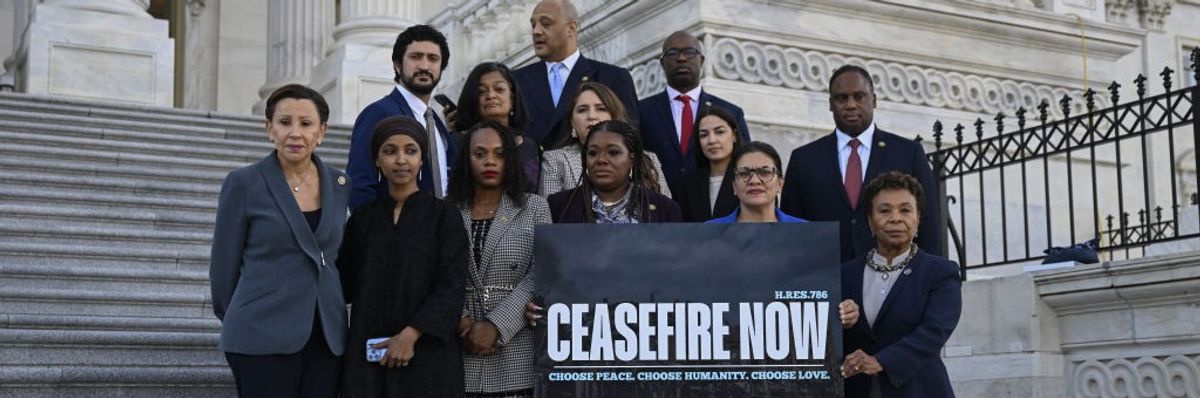

Progressive members of Congress hold a banner demanding a cease-fire

Progressive members of Congress hold a banner demanding a cease-fire in Israel's assault on the Gaza Strip in front of U.S. Capitol in Washington, D.C. on November 8, 2023.

 (Photo: Celal Gunes/Anadolu via Getty Images)


Friday, June 3, 2022

POLITICO NIGHTLY: A midterm alarm for Dems in California


View in browser
 
POLITICO Nightly logo

BY DAVID SIDERS

With help from Lauren Gardner

A sign reading 'I Voted' stands outside a voting center in Los Angeles, California.

A sign reading 'I Voted' stands outside a voting center in Los Angeles, California. | Mario Tama/Getty Images


EARLY WARNING SYSTEM — After this week’s break in the primary calendar, seven states will hold elections on Tuesday. In the biggest of them, California, Democrats are already looking at some troubling early turnout numbers: So far, only about 2.2 million Californians have returned ballots. That’s less than a third of the total early vote at this point in California’s recall election last year.

Primary turnout is traditionally apoor indicator of general election turnout. But Paul Mitchell, a leading political data expert in California, says Democrats have reason to be concerned this year.

Nightly spoke with Mitchell, vice president of Political Data Inc., which works with Democrats and in nonpartisan races, about what turnout can — and can’t — tell us about the state of the electorate nearly halfway through this midterm election year. This conversation has been edited.

Why is early turnout so low in California?

Voter registration is at a record high in California going back to like the 1910s. Mailing everybody a ballot is now statewide, post-Covid. All ballots can be mailed without even having a postage stamp.

You don’t even have to mail your ballot. In a lot of areas, you’ll have campaigns calling supporters and offering to pick up their ballots.

So, all the mechanical pieces are there to make voting easier. And we would expect that to either create higher turnout or at least create a higher floor, so that no matter how boring an election is, at least X percent of voters are going to vote.

Why aren’t they?

The election is just so damn boring. You’ve got statewide elections for governor on down that have a lot of candidates nobody’s ever heard of, outside of the obvious winners that we’re going see like Gavin Newsom. There’s not a lot of attention being paid to those races. It’s just not that interesting.

There are no ballot measures. Locally, we would expect more enthusiasm because redistricting has kind of shook up the ant farm, and now we have new districts, new open seats. We’ve had this exodus from the Assembly where there are more open Assembly seats than we’ve seen in over a decade. So, there are some things afoot that would make you think, Hey, this is going to be an interesting election, but the voters just aren't buying it.

Should Democrats be worried?

At the top of the ticket, it probably doesn’t matter. I would expect the Democrats to be the top vote getters in all these statewide primary elections. And unless something goes awry, they’re probably all going to have easily beatable Republican opponents, and those races are not going to be competitive.

Where Democrats do need to worry is those competitive congressional districts.

California has a number of congressional districts that could be considered swing districts. If Democrats aren’t successful in reelecting Katie Porter and Mike Levin and Josh Harder and then maybe even picking up the Mike Garcia seat in North L.A. County or pushing Michelle Steel and that district to potentially either pick it up or maybe pick that up 2024 — that’s where macro-level turnout can make a big difference.

If there’s nothing interesting on the statewide ballot in the 2022 general and voters aren’t enthusiastic, just like they are here now in this primary, then, in those kinds of elections, Republicans could win some of these seats.

And the reason is that when turnout drops, it doesn’t drop evenly for all groups. It drops most precipitously for lower income, minorities, younger people. And suburban white affluent voters who are homeowners always stay relatively high turnout. And so, when the floor falls out on a low turnout election and you have those critical Democratic core groups voting at 18 percent turnout and core Republican groups voting at 70 percent turnout, then you have a recipe for disaster in those competitive congressional districts.

So, should Democrats in Washington and elsewhere be freaking out?

I think the question Democrats nationally need to be asking about California is, How do we make that election interesting to our voters? You look at Georgia — right now, Georgia’s having primary election turnout that’s through the roof. They don’t have the mechanical pieces that make voting easy in Georgia. But what they have is an enthusiasm around elections that are polarizing the electorate, getting them excited and getting them to turn out and vote. Democrats nationally need to be looking at California and saying, How do we kind of jolt the electorate into caring about this election cycle and turning out?

All of this, for Democrats — going back to the last redistricting, to Republican control of the House, going to the Donald Trump success, all this stuff — it all started by Democrats not turning out in 2010. And Democrats not turning out in 2022 would be potentially just as catastrophic for the next decade. So 2022 could be a redux of 2010 and 2014 in terms of having these huge impacts.

It’s one of these things where Democrats win an election in a presidential year, and then they sit on the couch in a gubernatorial and go, “Oh, you know, voting? I already did that.”

Welcome to POLITICO Nightly. Reach out with news, tips and ideas at nightly@politico.com . Or contact tonight’s author at dsiders@politico.com on Twitter at @davidsiders.


DON'T MISS DIGITAL FUTURE DAILY - OUR TECHNOLOGY NEWSLETTER, RE-IMAGINED:  Technology is always evolving, and our new tech-obsessed newsletter is too! Digital Future Daily unlocks the most important stories determining the future of technology, from Washington to Silicon Valley and innovation power centers around the world. Readers get an in-depth look at how the next wave of tech will reshape civic and political life, including activism, fundraising, lobbying and legislating. Go inside the minds of the biggest tech players, policymakers and regulators to learn how their decisions affect our lives. Don't miss out, subscribe today.


WHAT'D I MISS?

— In a rare prime-time address, Biden demands action on guns: It was, at once, a call for action and the first true attempt by President Joe Biden to outline the specific proposals that he wanted to see enacted . Biden called for a ban on assault weapons and high-capacity magazines, and, if such policies couldn’t be passed, the raising of the age that one could purchase an assault weapon from 18 to 21. He called for strengthening background checks, repealing the legal immunity that gun manufacturers enjoy, and codifying a ban on so-called ghost guns. And he called for addressing what he deemed the “mental health crisis” in America while expanding “red flag” laws.

— Covid vaccination for kids under 5 expected to start June 21: States can start ordering children’s vaccines on Friday, White House coronavirus response coordinator Ashish Jha said during a White House press briefing, but orders won’t ship until the Food and Drug Administration authorizes the shots for kids between 6 months and 5 years old. The FDA’s vaccine advisory committee is set to discuss Pfizer’s and Moderna’s applications — both of which call for a smaller dose than adults receive — in two weeks.

— Economic recovery buoys Social Security, Medicare: The financial health of Social Security improved slightly over the past year, though the program’s trust fund remains on track to be depleted by the mid-2030s, according to the annual trustee report released today. The report projects that the program’s combined reserves will be depleted by 2035, one year later than was projected last August. A key Medicare fund also had an improved outlook, with a two-year solvency extension.

— Florida Supreme Court locks in DeSantis-backed redistricting map: Florida Gov. Ron DeSantis’ push to redraw the state’s congressional map and give a substantial advantage to Republicans will likely remain in place for this year’s elections. The state Supreme Court — in a 4-1 divided ruling in which two justices recused themselves — declined to wade into an ongoing legal dispute over the map. Voting and civil rights groups opposed to the GOP-approved redistricting map asked the state high court to block it in late May.

— Trump to meet with House Freedom Caucus: A group of House Freedom Caucus members are slated to meet with Donald Trump next week to discuss the group’s “strategy” heading into the next Congress, two Republicans familiar with the matter tell POLITICO. The meeting is expected to address how GOP primary season has played out so far, and what the party’s base voters are looking for heading toward November.

— Pennsylvania GOP gubernatorial nominee shares documents with Jan. 6 panel, agrees to interview: The Jan. 6 select committee received materials this week from Pennsylvania GOP gubernatorial nominee Doug Mastriano — and with them, perhaps, a new dilemma. Mastriano’s previously unreported cooperation with the Capitol attack probe came in the form of a submission, obtained by POLITICO, that includes documents about his work to arrange buses that carried pro-Trump protesters to Washington on Jan. 6, 2021.

— Avenatti gets 4 years in prison for cheating Stormy Daniels: Michael Avenatti was sentenced Thursday to four years in prison for cheating client Stormy Daniels, the porn actor who catapulted him to fame, of hundreds of thousands of dollars in book proceeds. The California lawyer, currently incarcerated, learned his fate in Manhattan federal court, where Judge Jesse M. Furman said the sentence will mean that Avenatti will spend another 2 1/2 years in prison on top of the 2 1/2 years he is already serving after another fraud conviction.

FROM THE HEALTH DESK

GOVERNMENT BY TWEET  The FDA’s Twitter account has been an unexpected pandemic star. In one memorable instance, which racked up 51,000 retweets, it reminded sentient Americans thatthey're not, in fact, horses . “Seriously, y’all,” the agency instructed. “Stop it.”

The account uses humor to raise awareness — like riffing off an SNL skit to warn bodybuilders about the unknowns of supplements — while taking more serious approaches to some issues. FDA reporter Lauren Gardner chatted with Brad Kimberly, the agency's social media director, how his content strategy and why he likes amplifying former wrestlers so much. This conversation has been edited.

OK, so you are responsible for "you are not a horse"?

Yes. I did make those words happen.

When you took over the Twitter account in 2018, why did you decide to mix humor with the serious stuff? Did your approach change during the pandemic, or have you been this meme-y all along?

The pandemic has given us an opportunity to talk a little more directly to people. In the last year, we've really focused on speaking in first person from the FDA account -- the FDA account is a personality -- and we want to be able to communicate with people in a way that they can understand.

We're pretty science heavy; there's a lot of complicated messages that we're trying to get across, and not everybody out there has an M.D. or a PhD. So how can I communicate these complicated ideas to the masses? How can I get my mom to understand them? Things like "you're not a horse, you're not a cow” are little moments of experimentation where we're like, Well, let's change our tone a little bit and our voice and see what happens.

Who is your target audience? You mentioned making sure that your mom can understand this. Twitter users, you would think, generally skew a bit younger. But at the same time, my mom and dad are on Twitter to complain about Philadelphia sports and to vote on “The Voice.” 

I want to be able to communicate clearly in a way, and sometimes maybe cleverly in a way, that when people share it among their friends — who are people who don't necessarily follow us — that it is useful information. As much as I want to make a pun about a peanut butter recall being a sticky situation, should I put that on social media?

I want us to sound like we're just another friend that you're talking to about the news of the day. In our case, it's news about the Food and Drug Administration and the amazing work that a lot of people here do.

We want to bring some attention to a lot of issues — using humor to maybe poke a little fun at the use of veterinary-grade ivermectin in an effort to get people to maybe stop doing that. That is certainly not the way we would normally speak. But it made a huge difference.

You seem to have an affinity for former wrestlers — retweeting when they've gotten their boosters and such. 

We want people to go out and get vaccinated if they're eligible and go get boosted if they're eligible. And so sometimes we'll engage with celebrities or even amplify celebrities.

We did something with Lucy Lawless. I engaged with Conan O'Brien at one point last year, where he was talking about the milk crate challenge. Mark Hamill, Mr. T. And if somebody sees a tweet from Mr. T, and he's getting his booster and says, Hey, maybe I want to do that, that’s great.

Read Friday’s Prescription Pulse for more of this interview.

AROUND THE WORLD

OPEC BOOSTS OUTPUT — OPEC+ announced today that members of the oil cartel agreed to a larger-than-expected hike in output , signaling a potential thaw in relations between the U.S. and Saudi Arabia ahead of a potential trip by Biden’s trip to the Middle East.

A derek pumps in a oil field in Kuwait near the Saudi Arabian border.

A derek pumps in a oil field in Kuwait near the Saudi Arabian border. | Joe Raedle/Getty Images


The White House offered measured praise for the move, giving credit to Riyadh for acknowledging tight market conditions and pushing OPEC members to boost their production.

“We welcome the important decision from OPEC+ today to increase supply in July and August based on new market conditions,” White House press secretary Karine Jean-Pierre said on Twitter after OPEC+’s announcement. “We recognize the role of Saudi Arabia as the chair of OPEC+ and its largest producer in achieving this consensus amongst the group members.”

Members of the oil-producing group said they would increase collective production by 648,000 barrels a day in July and August rather than the 400,000 barrels a day they had originally planned to add. The announcement, made after representatives of OPEC and Russia met, comes as Biden is considering visiting with leaders of Saudi Arabia and other Middle Eastern countries.


STEP INSIDE THE WEST WING: What's really happening in West Wing offices? Find out who's up, who's down, and who really has the president’s ear in our West Wing Playbook newsletter, the insider's guide to the Biden White House and Cabinet. For buzzy nuggets and details that you won't find anywhere else, subscribe today.


NIGHTLY NUMBER

550

The number of confirmed monkeypox cases the World Health Organization has reported since May 13 in 30 countries where the virus isn’t endemic.

PARTING IMAGE

Elise Schering displays a simple message during a National Gun Violence Awareness Day rally at the Capitol in Sacramento, Calif.

Elise Schering displays a simple message during a National Gun Violence Awareness Day rally at the Capitol in Sacramento, Calif. | Rich Pedroncelli/AP Photo


Did someone forward this email to you? Sign up here.


Follow us on Twitter

Chris Suellentrop @suellentrop

Myah Ward @myahward


FOLLOW US

Follow us on FacebookFollow us on TwitterFollow us on InstagramListen on Apple Podcast


 POLITICO, LLC 1000 Wilson Blvd. Arlington, VA, 22209, USA


Wednesday, July 8, 2020

RSN: FOCUS: The Corporate Media Convinced Millions That Bernie Was "Unelectable"


Reader Supported News
07 July 20

That’s way too low. It’s a great project with a great community, but that kind of response to funding appeals obviously will not work. Working to change that.
Marc Ash
Founder, Reader Supported News


If you would prefer to send a check:
Reader Supported News
PO Box 2043
Citrus Hts, CA 95611


Reader Supported News
07 July 20
It's Live on the HomePage Now:
Reader Supported News


FOCUS: The Corporate Media Convinced Millions That Bernie Was "Unelectable"
Bernie Sanders, left, and Joe Biden chat before a Democratic presidential debate in Charleston, S.C. (photo: AP)
Branko Marcetic, Jacobin
Marcetic writes: "There is overwhelming evidence a surge of mostly older, Trump-fearing voters decided the Democratic primary - and that Bernie Sanders failed to counter an establishment messaging campaign that Trump would beat him in a general election." VVVVVVVVVVVVVVVVVVVVV


hy did Joe Biden win the Democratic primary and Bernie Sanders lose it?
Everyone has a theory: Sanders went too far left, or too far woke; he couldn’t expand his base, particularly into the black electorate; his surprise 2016 showing mostly owed to anti-Clintonism, and his insurgent campaign turned off loyal Democrats; meanwhile, Biden was an electoral powerhouse able to excite voters with his “moderate” agenda and historic ties to the party.
Accepting all this has meant crashing headlong into a series of inconvenient facts. Sanders’s leftward stances on issues like immigration supposedly lost him rural counties, but he had the best standing with rural voters, out of all Democrats. He supposedly alienated rank-and-file Democrats with his rhetoric, yet held sky-high favorability ratings among them throughout 2020. He failed to expand his base, but won nearly every demographic in Nevada, even moderates and conservatives, and led nationally among black voters on the eve of South Carolina.
Then there’s the downright inexplicable. How did Sanders lose when surveys and exit poll after poll showed the public, and especially Democrats, overwhelmingly supported his policies, even in states he lost badly? How was he so decisively beaten despite being the first in either party to ever win the popular vote in the opening three contests, given that every Democrat since 1976 who’s won the first two alone has clinched the nomination? And when no nominee since 1972 has placed below second in either, how did Biden pull off a historic rout after coming a lowly fourth and fifth? More strangely, how did he do it when he neither visited nor even had a campaign operation in many of the states he ended up winning?
Answering these questions means understanding the topsy-turvy world of the 2020 election, the continuing power of legacy media, and how primary elections can swing wildly based on delicate shifts in perception.
All About Trump
The 2020 primary was all about Donald Trump. From the contest’s beginning to its end, anywhere between 55–65 percent of Democratic voters prioritized picking a nominee who could beat Trump over one they agreed with on the issues, unsurprising for an incumbent election. This was favorable turf for Biden, who made defeating the president the crux of his campaign, to the extent that he once told audiences the first thing he’d do as president was “make sure that we defeat Donald Trump.”
Just as consistently, voters saw Biden as the candidate by far most likely to win against Trump. For the seven months to January 2020, he hovered around 40 percent on that question in a Washington Post–ABC News poll, while Sanders trailed a distant second in the teens.
“If there would be a horse leading right now for me, it would probably be Biden, because all the polls indicate he would beat Trump handily,” one fifty-seven-year-old voter told the New York Times.
“Basically whoever can beat Donald Trump, but I think Biden has the best chance,” another older voter said when asked who she was backing, pointing to head-to-head polling.
As Patrick Murray, the director of Monmouth University Polling Institute told the paper, voters in Iowa felt “they have to vote for Joe Biden as the centrist candidate, to keep somebody from the left who they feel is unelectable from getting the nomination.”
Besides a corporate and political establishment united against him, Sanders had to overcome something else: decades’ worth of conventional wisdom, internalized by mostly older Democratic voters, that only unexciting centrists can win elections, and running leftward is electoral suicide.
This sentiment wasn’t just in Iowa. On the eve of the New Hampshire primary, mostly older voters in the state’s rural parts told VTDigger the same message: they preferred Sanders, but were going to vote for Pete Buttigieg because his more centrist politics would appeal to non-Democrats.
“It’s more important to get Donald Trump out. Period,” one retired pilot told the paper, having decided against voting for Sanders after watching Trump survive impeachment. “It’s more important than my personal politics.”
In Pennsylvania, one 2016 Sanders voter now focused on beating Trump fretted that “the S-word” would sink him in rural Pennsylvania. Interviewing thirty suburban voters, the Philadelphia Inquirer found a “consistent dividing line”: those most concerned with winning went for Biden, while those who prioritized a particular issue went for Sanders. In the wealthy Virginia suburb of Ashburn, one progressive health and wellness consultant reported her mostly Republican clientele “hate Trump, but they won’t vote for Sanders,” leading her to go for Biden. “Whoever can beat Trump is what I care about,” she explained.
The corporate media, particularly cable news, was pivotal to this. As I found when I studied two months’ worth of MSNBC’s Democratic primary coverage in 2019, these themes were relentlessly advanced by the network: beating Trump was all that mattered, Biden was the safest bet to do so, and running Sanders — when the network deigned to mention him at all — would be a risk. This was on top of the way cable news, chasing ratings, had whipped up fear of Trump among its viewersprompting a spike in anxiety among news consumers that psychologists began noting.
These narratives were reinforced by the invasion of liberal news sources by the tiny, unrepresentative group of “Never Trump” Republicans, who incessantly warned Sanders was an electoral liability. (“A sociopath will beat a socialist, I think, seven days a week and twice on Sunday,” said the man who brought us Sarah Palin). “I thought Never Trump Republicans wouldn’t vote for Sanders,” one older voter, a former professor, told the Times in March, switching to Biden despite her support for Sanders’s ideas.
The Three Days That Decided the Race
All of this had an impact. Unlike Republicans, Democratic voters have a high degree of trust in legacy mediaCNN especially, and get much of their news from television — particularly so for voters over fifty. This is, incidentally, the same demographic that most consumes cable news, votes in disproportionately high numbers in primary elections, and increased its share of the vote in this year’s primaries.
Sanders’s greatest obstacle was arguably convincing this cohort of voters to abandon their long-held skepticism about the Left in electoral politics, and to defy the relentless media messaging that reinforced it. And for a brief moment, he did. After winning the vote in Iowa and New Hampshire, and after Biden failed to crack third in either, perceptions of Biden’s electability collapsed, and for the first time in the race, Sanders led the field in both electability and voting intention.
But rather than momentum, these developments prompted a barrage of attacks and apocalyptic warnings from Democratic officials and pundits about Sanders’s threat to Democrats’ chances in November. A group of party centrists spent millions blanketing South Carolina with ads making these charges. Party leaders and rival candidates openly vowed to deprive him of the nomination if he won the most votes.
When Sanders defended Fidel Castro’s literacy program on 60 Minutes it was seized upon by anti-Sanders officials in Florida for a round of withering attacks and warnings of how they would play in the state. A statistical analysis by In These Times found CNN covered Sanders three times as negatively after his blowout Nevada win as they did Biden after his romp through South Carolina, assailing Sanders’s electability above all.
Many factors led to Biden’s triumph in the Palmetto State, from its conservatism and Biden’s close association with the nation’s first black president to, most importantly, Rep. Jim Clyburn’s endorsement that Sanders, crucially, never tried to head off. But it’s difficult to argue this media narrative didn’t play a role in the old, white tidal wave that swept Biden to victory.
Data show that while the nonwhite vote in South Carolina rose 10 percent since 2016, the white vote spiked by 19 percent. And while the number of voters aged eighteen to forty-four rose by 42,028, turnout among those forty-five and older skyrocketed by nearly three times that (123,130), with most of the gains concentrated among those sixty-five and over. As he would in every state that followed, Biden dominated among this group, and among voters who prioritized beating Trump.
Biden’s electability and support rebounded overnight, buoyed by more than $100 million in free media, much of it positive. As In These Times found, while post-Nevada negative coverage of Sanders fearmongered about the senator’s electability, what negative coverage there was of Biden focused mostly on the challenges he faced to win the nomination, and was even encouraging (“Vice President Biden has to get a little more inspirational”). While CNN never interviewed Sanders after Nevada, instead inviting Biden on to ask him if his chief rival would be a “McGovern-like mistake for this party,” it did interview the former vice president after he dominated in South Carolina. The network didn’t give Sanders the same courtesy it had given Biden to comment on his rival’s win.
What happened next is well known: with no path forward in the more diverse states ahead, and at the urging of former president Barack Obama, Biden’s fellow centrists stepped down and endorsed him, adding to his momentum; Sanders neither sought nor received the same assist from his only ally, Elizabeth Warren, who vowed to win the nomination by overturning the judgment of the primary voters.
Not-So Super Tuesday
The race essentially ended on Super Tuesday. Biden swept to victory in various conservative Southern states on the back of older anti-Trump voters, many of whom settled on Biden at the last minute. Virginia, competitive on the eve of South Carolina, saw a record turnout that suddenly swung behind Biden, with two-thirds concerned about nominating someone “too liberal,” and some explicitly saying they were out to block Sanders.
“The idea of risking the nomination to somebody like Bernie Sanders, the concern would be that he wouldn’t have the broad appeal to defeat Donald Trump,” one voter said.
“[Trump] has been the single biggest driver to the Democratic Party of Virginia,” former governor and lobbyist Terry McAuliffe told the Times. “There are a lot of like-minded Republicans who said, ‘I can’t vote for Trump but you got to give me somebody who we can vote for.’ Biden was always at the top of that list.”
Meanwhile, in states that Sanders should’ve won, Warren’s presence took a further toll. Sanders’s losing margins in Maine, Massachusetts, and Texas (1, 7, and 4 points, respectively) were dwarfed by Warren’s totals (16, 21, and 11 percent). In delegate-rich California, in which Sanders had heavily invested but won by only 7 points, she received 13 percent. We can only speculate how exactly these numbers would have shifted had Warren followed Buttigieg and Klobuchar’s lead. But it’s clear it would have made a difference.
On the eve of South Carolina, a slim plurality (21 percent) of Buttigieg voters had Sanders as their second choice, with Biden and Warren splitting 19 percent. Yet when the dust had settled a few days later, it was clear Buttigieg’s largely olderwhite voter base had shifted mostly to Biden in the wake of the South Bend mayor dropping out and endorsing the former vice president. At that same point, a whopping 40 percent of Warren voters had picked Sanders as their second choice, with Biden and Buttigieg splitting a mere 16 percent. How might a Buttigieg-style exit from the race have not just arrested Biden’s sense of momentum, but impacted these numbers?
These kinds of decisions had vast reverberations in a race where many voters weren’t sure what to do until the moment they got in the voting booth. Late deciders, a significant fraction of Super Tuesday’s voters and more likely to be looking for a candidate to beat Trump, swung overwhelmingly for Biden. In Minnesota, Maine, and Massachusetts, all states in which Biden was given little chance to win on the eve of voting, 55, 47, and 51 percent of voters made up their minds in the last few days, lifting him to victory.
The Super Tuesday result, made worse by the slow count of California’s votes, fatally dented Sanders’s perceived electability among the key older demographic, and did the opposite for Biden. Such voters had allowed themselves to be persuaded by the septuagenarian socialist after his first three primary wins; Biden’s victories in South Carolina and Super Tuesday gave them permission to go back to where they had always been most comfortable. In every state thereafter, Biden held a near-monopoly on voters over fifty, mirrored by Sanders’s domination of those below that age threshold. But 2020 wasn’t the year of youth turnout surge.
The irony was, the fears driving many older liberals from Sanders were never well-founded. He annihilated his rivals in donor numbers from Obama-to-Trump counties, had historic electoral strength in such areas, and had the largest lead among independents in head-to-head polling with Trump among all his rivals. This trend continued in the primary. As the Wall Street Journal later noted, “where voters are older, moderate or closely aligned with the Democratic Party, rather than independents, Mr. Sanders doesn’t win”; but in states with “either unusually large shares of self-described ‘very liberal’ voters, or unusually large numbers of independents participating,” he did.
According to exit polls, Sanders won independents in eighteen of twenty-three contests between February 3 and March 17, including in twelve of the seventeen states he lost to Biden. By contrast, Biden won Democrats in seventeen of those contests. Even in California and Colorado, both open primaries (where one didn’t need to be a Democrat to vote) that he convincingly lost, his losing margins against Sanders among Democrat voters were slim: 33–30 and 25–23, respectively. Democratic voters tried to imagine what people who weren’t like them wanted; unwittingly, they actually did the opposite, mostly voting in line with how other Democrats voted, and rejecting the leaning of a majority of independent voters.
One could point to any number of the campaign’s strategic errors to explain its defeat, including a failure to aggressively prosecute Biden’s record. One could also point to the unquantifiable impact of voter suppression, regularly cited to cast doubt on Republican victories, but shrugged off by the media when it disadvantaged Sanders.
Perhaps the overarching mistake, though, was declining to adjust to the political climate of the Democratic Party in 2020, where cautious, fearful, and mostly older Democratic voters concerned primarily with simply beating Trump needed assurance that someone with Sanders’s politics was “electable.” Ironically, Sanders may have benefitted from flipping the conventional advice, and running a more centrist campaign for the primary to assuage these voters’ concerns, before moving left in the general, when they had nowhere else to go.
Instead, Sanders ran the same issue-focused campaign he had run in 2016. Absent the historic youth voter surge he promised, always a questionable prospect, and with the campaign declining to expand to a national level its innovative organizing approach aimed at turning out nonvoters in the early states, running this strategy could work as long as the field remained divided. Once the establishment got its act together, Biden, the sole corporate Democrat with any significant nonwhite support, ended up the only warm body who could serve as the vessel for panicked stop-Sanders Democrats, and voters were driven to him by a unified front of messaging from the media and party establishment.
Biden ran a poor, often nonexistent campaign, and was on the wrong side of the issues from most of his party’s rank and file. And yet in many ways, he and the establishment that dragged him over the finish line more accurately took the pulse of the Democratic voting public in 2020, capitalizing on a political climate they helped create. Sanders ran a campaign to win the presidency; but Biden and the establishment that willed him to victory ran one for the Democratic nomination.


Newsom Takes On Social Media Companies, Kentucky Says No To Data Centers, A Judge Blocks Mail-Ballot Rule, and Law…

                            LOTS OF POSTS IGNORED BY BLOGGER..... OR REMOVED ON THEIR WHIM! ALL POSTS ARE AVAILABLE ON MIDDLEBORO REVIEW AND...