
Showing posts with label APF. Show all posts

Sunday, March 26, 2023

FOCUS: From Boston to Detroit — Why Atlanta's 'Cop City' Protests Are Galvanizing Communities Around the US


Reader Supported News
26 March 23

Live on the homepage now!
Reader Supported News
ON FUNDING AN EXTRAORDINARY EFFORT IS ALWAYS NEEDED — We don’t get reasonable donations by being reasonable. It always requires a major intense effort to get the few donations we need to meet our expenses. If you care about this project, bear with us, we have to battle for a budget. With respect and appreciation.
Marc Ash • Founder, Reader Supported News

Sure, I'll make a donation!


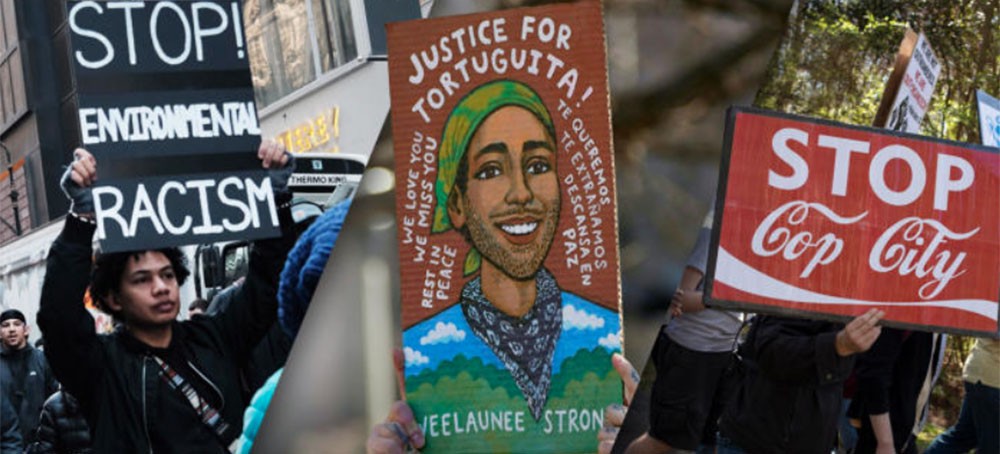
Protests against a plan to build a new police and firefighter training center in Atlanta have spread to cities including New York, Detroit and Miami. (image: Spencer Platt/Cheney Orr/AFP/Andrew Lichtenstein/Corbis)
FOCUS: From Boston to Detroit — Why Atlanta's 'Cop City' Protests Are Galvanizing Communities Around the US
Marquise Francis, Yahoo! News
Francis writes: "Protests over the construction of a new 85-acre training center for police and firefighters in Atlanta have spread well beyond the city’s limits, and are gaining momentum across the country." 


Protests against a plan to build a new training center for police and firefighters in Atlanta have spread to cities across the country. The center's critics are wary that, if successful, it could create a precedent for others to follow.

Protests over the construction of a new 85-acre training center for police and firefighters in Atlanta have spread well beyond the city’s limits, and are gaining momentum across the country.

For more than two years, the proposed training center, dubbed “Cop City” by its opponents, has been the subject of criticism from environmentalists and social justice advocates alike, who argue that its construction would harm the local ecosystem and accelerate the militarization of the police. But in recent months the issue has garnered increased national attention, especially after the fatal police shooting in January of Manuel Terán, a 26-year-old environmental activist who was protesting the facility’s construction.

In the immediate aftermath of Terán’s death, vigils in his honor were held across the country, from Tallahassee to Los Angeles. Since then, what began as a local issue has continued to spark demonstrations in a variety of other cities, where activists have felt inspired to stand in solidarity with Atlanta while warning against the construction of similar facilities in their own backyards.

In late February, dozens of protesters took to the streets of downtown Detroit, stopping midday traffic while chanting, “Stop Cop City!” Less than two weeks later, similar chants were shouted by more than 50 students and community members on the campus of Harvard University. Then last weekend, in Providence, R.I., dozens gathered outside a Home Depot with signs that read, “Defund and Reimagine.”

Students at Harvard said they rallied because of their own concerns about systemic police violence.

“Believe it or not, the same concerns in Atlanta are also in Massachusetts, whether we have our own Cop City to prove it,” Karen Choi, a sophomore at the school and one of the event’s organizers, told Yahoo News. “The issue of violence is systemic, rooted in a history of police brutality that has long been safeguarded by a numbers game that prioritizes profit.”

Maggie House, a student at the Harvard Graduate School of Design, said she chose to demonstrate because she believes police brutality, forest devastation and climate change are “national and global issues which unite our generation.”

“Allowing Cop City to move forward not only increases the risk for militarized police force[s] to be used against all Americans, it has the potential to carve a pathway for private investors to partner with police foundations nationally to create similar projects with equally devastating effects,” House told Yahoo News.

Detroit activists offered similar explanations for rallying against the Atlanta training center.

“Those same tools of militarized police impact us here in Detroit, just as they do in Atlanta,” Antonio Cosme, an education coordinator with the National Wildlife Federation, told Bridge Detroit last month. “I see Detroit and Atlanta as being deeply, deeply interwoven in their cultural fabric.”

Tiffany Roberts, a public policy director for the Southern Center for Human Rights, an Atlanta-based public interest law firm dedicated to prison reform, has been an outspoken critic of the center. She told Yahoo News that she’s encouraged by the wide range of demonstrations taking place in cities across the country.

“The courageous organizing by these young people has really been a source of pride for me,” Roberts said, adding that she thinks the intersectionality of issues on display in the Cop City debate makes it resonate more widely. “They can talk about police militarization and they can talk about the environment and they can talk about environmental racism.”

In an interview with the Intercept earlier this year, Casey Sharp, a Georgia-based archaeologist who has helped facilitate communications between activists and local leaders in Atlanta, predicted that the Cop City protests “will become another Standing Rock,” referring to demonstrations beginning in 2016 over the planned construction of a 1,200-mile-long oil pipeline through the Standing Rock Sioux Reservation in North Dakota that drew national attention.

The debate over Cop City

The Atlanta Public Safety Training Center, which is set to include a shooting range, fire training towers and a mock city featuring homes and streets, was approved by the Atlanta City Council in 2021 with the backing of the Atlanta Police Foundation (APF), a nonprofit largely funded by corporate donors. Amid a flurry of lawsuits attempting to halt the project altogether, a spokesperson for the city said “construction is ongoing” but offered no specifics on the current status of the center.

The training center is estimated to cost around $90 million, a third of which is expected to be paid by taxpayers. The rest will come from private donations raised by the APF.

Proponents of the center say it is needed to help boost law enforcement recruitment, retention and morale in the wake of severe staffing shortages in the city.

Atlanta City Council member Michael Julian Bond, who voted in favor of the plan two years ago, told Yahoo News in January that the center represents a necessary investment in public safety that’s been decades in the making.

“The city desperately needs new training facilities,” Bond said, citing an increase in 911 calls in the last three years after the police killings of George Floyd in Minneapolis and Rayshard Brooks in Atlanta. “There is a continuingly demonstrated need for police, fire and emergency services.”

But critics believe that besides harming the region’s environment, the facility will further strain relations between police and the community, particularly the Atlanta area’s majority Black population.

In an interview with the New York Times earlier this month, Arthur Rizer, a former Washington state police officer and policing expert, said, “I do share the concern of the citizens of Atlanta that the apparent focus is going to be a paramilitary-type training, urban assault tactics, which quite frankly have not been effective at reducing crime.”

Activists fear Atlanta’s Cop City could set a precedent

In recent months, the growing backlash against Cop City in Atlanta has raised concerns for activists in other parts of the country that their cities could be next.

“Cop City, if built, will set a new precedent for police militarization, not just in Atlanta, not just in the Southeast, not just in the country, but in the world,“ Jonah Sylvester, an organizer with the Weelaunee Defense Society of Pittsburgh, told the Pittsburgh City Paper earlier this month.

In 2020, the city of Pittsburgh acquired a former hospital from the federal government, at no cost, in order to build a regional policing and first responder training center, similar to the one proposed in Atlanta. Though no concrete plans have been put in motion, city officials have said the project would cost about $120 million.

In New Jersey, Gov. Phil Murphy, a Democrat, included in his latest budget a new $120 million state police training center to replace the 100-year-old facility currently shared by the State Police Academy, the National Guard, the New Jersey Department of Corrections and the Juvenile Justice Commission.

The recent push for new police training centers in Atlanta and elsewhere is a direct response to the 2020 protests following the murder of Floyd and other high-profile police killings.

Atlanta officials like Mayor Andre Dickens, a Democrat, have touted the police training center as exactly the kind of reform that community members demanded in 2020.

“Good community policing depends on high-quality training,” Bryan Thomas, a spokesperson for Dickens’s office, told Yahoo News.

But critics are wary of any type of massive investment in policing, arguing that the focus on training misses the point of what the 2020 protests sought to accomplish.

“It wasn’t training that people asked for in 2020,” Roberts said. “What people asked for in 2020 was for police to stop killing [Black] people.”

Environmental concerns over the center

Environmental activists also object to the plans for the center, which is slated to be built on the site of a former prison farm in the South River Forest, a sprawling 3,500-acre green space just outside the city’s limits.

The land was designated as part of a 2017 proposal to create green space and recreation options for underserved parts of Atlanta. But the City Council scrapped those plans just four years later, agreeing instead to lease the land to APF to build the training center.

Many community activists argue that preserving the park’s greenery will help combat climate change, as trees absorb carbon dioxide and produce oxygen, while making the area less susceptible to flooding.

Terán, who was killed following a clash with police in the South River Forest in January, was among those who objected to the training facility for environmental reasons.

His death, which is being investigated by the Georgia Bureau of Investigation (GBI), has prompted widespread outrage, exacerbating long-simmering tensions between protesters and law enforcement throughout Atlanta.

While police initially claimed that Terán was shot after he opened fire on a state trooper, evidence has since come to light that casts doubt on that narrative, including body camera footage from one of the responding officers at the scene as well as the findings of an independent autopsy commissioned by Terán’s family.

The Atlanta Police Department declined Yahoo News’ request for comment on the shooting, and the GBI pointed to its previous statements about the case.

“The GBI cannot and will not attempt to sway public opinion in this case but will continue to be led by the facts and truth,” the bureau said in a statement on March 10. “We understand the extreme emotion that this has caused Terán’s family and will continue to investigate as comprehensively as possible.”

Peaceful vigils held throughout Atlanta in the wake of the shooting have turned violent in recent weeks. At one particular demonstration earlier this month, three dozen people, many of them from out of state, were arrested and charged with domestic terrorism after, police said, they hurled bricks and fireworks at officers.

According to Atlanta police, a group of violent agitators had used “the cover of a peaceful protest” to “destroy property and attack officers.” But Defend the Atlanta Forest, a local activist group, insists that those arrested, including one person from Canada and another from France, weren’t actually among the agitators, but were simply concertgoers attending a nearby music festival.

City Council member Bond, whose father, Julian Bond, was a prominent leader in Georgia’s civil rights movement, condemned those who have responded to Terán’s death with violence.

“I regret that someone has lost his life in pursuing his ideals as an activist,” Bond said. “I also regret that a peaceful demonstration about his death was co-opted by a few who embedded themselves to commit acts of violence.”

“Martin Luther King never set a police car on fire,” he continued. “And he changed the world.”


READ MORE


Contribute to RSN

Follow us on facebook and twitter!

Update My Monthly Donation

PO Box 2043 / Citrus Heights, CA 95611


Saturday, March 25, 2023

FOCUS: Investment Fund Links to Atlanta Police and 'Cop City' Project Revealed


Reader Supported News
24 March 23

Live on the homepage now!
Reader Supported News

IF YOU ARE GOING TO STAY, YOU HAVE TO HELP — The budget is too thin to do this. We have many, many more readers than donors and it is breaking the process down. We understand that we will lose some readers, although in fairness we haven’t lost many yet. If you stay we need your help and we need it now.
Marc Ash • Founder, Reader Supported News

Sure, I'll make a donation!


The Atlanta police foundation has helped Atlanta become the most surveilled city in the U.S. (photo: Elijah Nouvelage/Reuters)
FOCUS: Investment Fund Links to Atlanta Police and 'Cop City' Project Revealed
Nina Lakhani, Guardian UK
Lakhani writes: "A new investigation has uncovered connections between private equity firms and the contentious development of a sprawling police and fire service training complex in Atlanta known as 'Cop City' and the police force which fatally shot an environmental activist." 


Exclusive: Roark Capital and Silver Lake Management showed to have a web of connections to the Atlanta police foundation

Anew investigation has uncovered connections between private equity firms and the contentious development of a sprawling police and fire service training complex in Atlanta known as “Cop City” and the police force which fatally shot an environmental activist.

Private equity refers to an opaque form of financing away from public markets in which funds and investors manage money for wealthy individuals and institutional investors such as university endowments and state employee pension funds.

Research shared exclusively with the Guardian details links between Roark Capital, an Atlanta-based private equity firm which owns the country’s second-largest restaurant company, Inspire Brands, and a corporate backer of the Atlanta police foundation (APF).

Paul Brown, the CEO of Inspire Brands, whose portfolio includes fast-food franchises Dunkin’, Baskin Robbins and Arby’s, sits on the board of trustees of the APF, which is raising $60m from corporate funders to build Cop City in the Atlanta forest previously earmarked for a public park.

Police foundations are non-profits which raise private money from individual and corporate donors that is funnelled to police departments with little oversight or accountability. The APF has previously helped Atlanta police fund recruitment drives, surveillance cameras and Swat team equipment.

The police crackdown on community protests against Cop City have led to dozens of charges of domestic terrorism and the police killing of the environmental activist Manuel Paez Terán, known as “Tortuguita”. Police said Paez Terán shot at them first, but have not produced any body-cam or other video footage of the shooting.

The APF has helped Atlanta become the most surveilled city in the US in large part thanks to a program called Operation Shield.

The Silicon Valley firm Silver Lake Management, one of the world’s largest tech-focused private equity firms, has invested more than $1bn in Motorola Solutions, which designed and implemented the surveillance system for Operation Shield, according to a new report by the Private Equity Stakeholder Project (PESP).

Motorola has been criticised for providing hi-tech surveillance equipment used in US prisons, on the US-Mexico border and in the West Bank. Several European pension funds have divested from Motorola, and it was included in a UN list of companies “that had raised particular human rights concerns” by providing surveillance tools and other services to the Israeli government.

Operation Shield currently boasts more than 12,800 private and public interconnected cameras monitored by the police – the highest number per capita in the country. Motorola has sold more than $22m worth of products and services to the Atlanta police department since 2016.

Silver Lake Management has invested money from pension funds paid into by Texas and Ohio teachers and South Dakota and California state employees, according to PitchBook.

In 2022, Silver Lake added Shadowbox Studios (formerly Blackhall Studios), a television and film studio company, to its portfolio with a $500m investment. The studios are located south of the Cop City site.

At an APF meeting on the Cop City budget in February, the agenda included what appeared to be a discussion on a possible future relationship between Shadowbox and the APF. The meeting agenda included the following item: “Are there any scenarios where we can come up with some agreement to work with Shadowbox for them to help fund some components and in return they have access to use the facility for filming purposes?”

There is no evidence that Shadowbox had any knowledge of the agenda item or that it has contributed in any way to the APF.

“We’ve shown that private equity does have its hands in the controversy that is unfolding around Atlanta and its police force. Knowing the relationships Roark Capital and Silver Lake Management have with Cop City, [the Atlanta police department] and APF will give activists another tool to demand accountability for the recent violence and the destruction of the Georgia environment,” said Amanda Mendoza, PESP researcher and co-author of the report.

The private equity industry manages about $11tn globally. Asset managers and funds buy and restructure companies including startups, franchises, troubled businesses and real estate operations using their clients’ money. Yet unlike banks and other publicly listed companies, private equity firms are exempt from most financial disclosure rules, making it extremely difficult to track their assets – or risks.

It means people such as firefighters, nurses and teachers whose pensions are invested in private equity funds have little way of knowing if their retirement nest egg is financing police surveillance equipment, defence contractors, hospitals or coal plants.

The report Private Equity Profits from Destroying the Atlanta Forest is the latest attempt by researchers to uncloak the industry’s activity.

Roark Capital mostly invests in franchises like fast-food chains and in February 2023 claimed $33bn in assets under management. The company has lobbied against a federal minimum wage, and a 2020 report by the Government Accountability Office found employees at some Roark brands were among the most frequent recipients of food stamps in some states.

After protests swept across the US in response to the 2020 police killing of George Floyd, Inspire Brands CEO and APF board member Paul Brown posted a letter on LinkedIn calling attention to “violence” and “attacks” by protesters – without mentioning the police violence that triggered the protests. (Roark’s own CEO donated thousands of dollars to the former Georgia senator David Perdue as he promoted the big lie and sought to overturn the 2020 presidential election.)

Another Roark connection is Marshall Freeman, who for seven years served as chief operating officer of the APF and sits on the board of the Inspire Brands Foundation, the company’s philanthropic arm. Freeman has joined the Atlanta police department as a deputy chief administrative officer.

Roark has invested money from several public worker pensions funds, including those of firefighters and police in Colorado, Los Angeles city employees, Oregon and New York state workers, and Louisiana teachers, according to PitchBook.

“The enormous amounts of money at the disposal of private equity often comes from state employees and retirees, who would be very surprised to learn where their investments are going. That’s why it’s important to follow the money,” said Charles Mahoney, associate professor of political science at California State University who researches private equity investments in defence and national security.

Roark Capital did not respond to multiple requests for comment. Silver Lake declined to comment.

Atlanta is the US’s 38th most populous city, according to the 2020 census. The APF, a non-profit whose corporate backers also include UPS, Home Depot, Wells Fargo and Coca Cola, is the second-largest police foundation in the country after New York City.

According to LittleSis, a corporate finance watchdog group, “police foundations act as a backchannel for corporate and wealthy interests by funding policing even further, adding to already overinflated budgets without any required public oversight, approval, or accountability.”

The Atlanta police department was allotted a third of the city’s $700m budget in 2022, and has received additional money through the APF to expand its surveillance capacity and recruit more officers.

Less than a week after Atlanta police shot and killed Rayshard Brooks in the summer of 2020, the APF gave every officer in the city a $500 bonus.

The APF received a record $11.7m in donations in 2021, a figure likely to rise since Georgia passed new legislation expanding personal tax breaks last year. In addition to funding the police directly, the city has also given the APF more than $3.6m since 2016 for Swat team equipment, licence plate readers and thousands of cameras for Operation Shield.

Mendoza said: “When it comes to policing, which already faces severe accountability and transparency issues, private equity involvement adds an additional layer of opaqueness. This report is just scratching the surface in investigating how private equity has contributed to not only moving these dangerous projects forward but also supporting a devolving situation of violence in the city.”

Paez Terán was part of a broad social movement that opposes the $90m Cop City training complex planned for 85 acres of the South River forest, one of Atlanta’s largest remaining green spaces. The social movement also opposes plans to develop 40 acres of public park in the same forest.

Paez Terán’s death was the first known killing by police of an environmental activist in the US. The police crackdown has continued since his death amid growing local opposition to Cop City. Community concerns include increasing police militarization and excessive force especially against Black residents, as well as losing part of a forest that had been included in 2017 plans to create what would have been the city’s largest park.


READ MORE


Contribute to RSN

Follow us on facebook and twitter!

Update My Monthly Donation

PO Box 2043 / Citrus Heights, CA 95611


ICYMI: Democrats Are Crushing It. Here’s The Proof.

                                                                                                                                            ...