Showing posts with label CALIFORNIA RECALL. Show all posts

Wednesday, June 30, 2021

POLITICO NIGHTLY: A pandemic list you want to be first on


POLITICO Nightly logo

BY RENUKA RAYASAM

Presented by

AARP

With help from David Giambusso

THE WORLD’S FOUR PANDEMICS — Sure, there are pockets of vaccine resistance across the country, places where Covid is surging. Sure, the pace of U.S. vaccinations is far behind President’s Joe Biden’s July 4 goal. But compared to the rest of the world, the U.S. looks like a pandemic success story.

About 46 percent of the country has been fully vaccinated against Covid, including nearly 80 percent of people who are 65 and older. And out of the 150 million Americans who have been fully vaccinated against Covid as of June 21, a minuscule number — only 4,115 people — were hospitalized or died from a breakthrough infection, according to the CDC. Hospitalizations and deaths are generally on the decline. Today the U.S. topped a Bloomberg resiliency ranking based on vaccination rates, lockdown severity and other measures.

The rest of the world isn’t so lucky. The vaccine rollout is going more slowly in other wealthy countries in Europe, except for the U.K. Most poor countries are still waiting on donated doses. Earlier this week 1.5 million Covid vaccine doses from the U.S. arrived in Honduras through COVAX, a global vaccine sharing mechanism that has drawn criticisms for moving too slowly.

“The story of Covid in 2021 is one of disparities,” said Jennifer Nuzzo, senior scholar at the Johns Hopkins Center for Health Security. “We are just having completely different pandemics.”

Here’s a look at trends around the world with countries split into four broad categories:

High vaccination rates, low deaths: Israel has dominated the world’s vaccine race, with 57 percent of its population fully vaccinated against Covid , according to data from the New York Times. Only a handful of places, like Gibraltar and Malta, have higher vaccination rates.

Cases in Israel have soared recently even among vaccinated people because of the Delta variant first detected in India. But only one death has been recorded in the country in the past two weeks, another sign of how effective mRNA vaccines like those from Pfizer and Moderna have been in preventing serious illness.

This lucky category includes the U.S., where vaccination rates remain high in most areas, and hospitalizations and deaths are falling.

A cyclist travels along Southbank in Brisbane, Australia. Queensland Premier Annastacia Palaszczuk has announced a three-day lockdown for much of the state as health authorities work to contain a growing Covid-19 cluster.

A cyclist travels along Southbank in Brisbane, Australia. Queensland Premier Annastacia Palaszczuk has announced a three-day lockdown for much of the state as health authorities work to contain a growing Covid-19 cluster. | Jono Searle/Getty Images

Low vaccination, low deaths: There are two groups of countries that have managed to keep deaths low even without high vaccination rates. The first is wealthy countries including Australia, where only 5 percent are fully vaccinated, and New Zealand, where only 8 percent are fully vaccinated. Both continue to resort to harsh lockdown measures to keep the virus contained. In Sydney more than 5 million residents are subject to a stay at home order.

The second group is poorer countries that don’t have access to a big supply of vaccines, but may be avoiding Covid deaths for now through some combination of a younger population, undercounting and luck.

“It’s like throwing a match into a pile of sticks,” said Abraar Karan, an infectious disease fellow at Stanford University. “It may not catch every time.” Karan is particularly worried about the possibility of Covid taking off in sub-Saharan African countries that don’t have widespread life-saving resources like oxygen tanks.

High vaccination, high deaths: There are only a handful of countries that fit this pattern, and they largely have one thing in common: They relied on Chinese-made vaccines, which have proven to be less effective against the Delta variant. In the Seychelles, nearly 70 percent of the population is fully vaccinated, yet deaths per 100,000 people are the highest in the world over the last seven days. Over the weekend, the Indian Ocean archipelago extended restrictions in response to persistently high cases.

Still, the experience of these high vaccination countries shows just how we’ve “ratcheted up our expectations” about vaccines, Nuzzo said. Even the effectiveness rate of Chinese-made vaccines, which could range from 51 percent to 78 percent, would have been considered a huge success a year ago. The World Health Organization authorized Sinovac for emergency use earlier this month and Sinopharm in May.

Low vaccination, high deaths: Many, many countries fit this category. As Americans start thinking about Independence Day parties, many countries are suffering from Covid surges while struggling to find vaccine doses.

Just 4 percent of India’s population is fully vaccinated. Just 2 percent of Paraguay’s population is vaccinated, and the country has the second highest global death rate currently at 1.82 per 100,000 people over the last seven days. Namibia, where 1 percent of the population is vaccinated, is next on the list. In Argentina, more than 500 people are dying a day from Covid and just 9 percent of the population is fully vaccinated.

Because of the global vaccine inequities, wealthy countries like the U.S. should rethink the approach to vaccinations, Karan said, focusing on donating doses to get health care workers vaccinated in poorer countries rather than rolling out vaccines to kids in the U.S.

“We know the variant story is one that is going to keep going,” said Karan. “As this gets more transmissible, eventually that will start to threaten wealthy countries again.”

Welcome to POLITICO Nightly. Reach out with news, tips and ideas for us at rrayasam@politico.com, or on Twitter at @renurayasam.

A message from AARP:

Millions of family caregivers are struggling to provide care for their older parents and spouses. Many are sacrificing their income, tapping into life savings, and taking on debt to keep their loved ones safe—at home and out of nursing homes that could put their lives at risk. Family caregivers are reaching their breaking point. Congress must pass the Credit for Caring Act now to give caregivers some of the relief they desperately need. Learn more.

 
AROUND THE NATION

THE ELECTION THAT NEVER SLEEPS — After the results of ranked-choice tallies were released, Kathryn Garcia, New York City’s former sanitation commissioner, overtook Maya Wiley for second-place in the city’s mayoral election. The city’s Board of Elections tallied 11 rounds of ranked-choice voting today.

Eric Adams now outpaces Garcia by just 2.2 points, but with about 124,000 New York City mayoral absentee ballots that won’t be counted until next week, the final outcome is still very much up in the air. Adams is up by just 15,908 votes.

New York City editor David Giambusso emails Nightly: “Adding to the uncertainty, the city’s Board of Elections is reporting about 100,000 more votes were cast on election night than previously thought. The error-prone board is saying election night totals weren’t final, but the difference between 800,000 votes on election night and roughly 900,000 being reported today was enough for Adams to begin sowing doubt about the integrity of the numbers. ‘We have asked the Board of Elections to explain such a massive increase and other irregularities before we comment on the Ranked Choice Voting projection,’ Adams said in a statement issued today.”

HOT OFF THE PRESSES — A week ago, three lawmakers from the Northwest joined dozens of their Republican colleagues in creating the new Conservative Climate Caucus to show they were serious about addressing the growing threats to the planet. Then they went silent as a devastating heat wave hit the region. Read the rest of Zack Colman’s story here.


SUBSCRIBE TO WEST WING PLAYBOOK: Add West Wing Playbook to keep up with the power players, latest policy developments and intriguing whispers percolating inside the West Wing and across the highest levels of the Cabinet. For buzzy nuggets and details you won't find anywhere else, subscribe today.


WHAT'D I MISS?

— Biden to visit site of Surfside building collapse on Thursday: The announcement of the president’s Florida visit is a departure from the White House’s position a day earlier that Biden had no immediate plans to visit the site of the disaster.

— DHS Intel bulletin warns of risks as attack anniversaries near: The Department of Homeland Security has warned its law enforcement partners about concerns about violent attacks in the lead-up to the anniversaries of two domestic terror attacks, according to a recent intelligence bulletin reviewed by POLITICO. The department sent out the bulletin Monday. “While violent extremists typically have not conducted attacks on dates they perceive as significant, DHS continues to review publicly available social media for explicit threats of violence in the lead-up to anniversaries of DVE [domestic violent extremist] attacks, including the 2019 El Paso shooting on 3 August and the 2017 Charlottesville car attack on 12 August,” the bulletin says.

— Biden: Infrastructure deal is a ‘generational investment’: At an event today in LaCrosse, Wis., the president hailed the bipartisan framework released last week as a “great deal for the American people.”

President Joe Biden speaks at an event in LaCrosse, Wis.

— House appropriators look to honor Jan. 6 responders: House appropriators agreed today to fund the creation of a plaque to honor the police who protected the Capitol during the Jan. 6 insurrection . The Appropriations Committee approved an amendment on the issue by voice vote during a markup of its $4.8 billion bill to fund parts of the legislative branch, including the Capitol Police, the Capitol Visitor Center and the Congressional Budget Office. The amendment, offered by Rep. Jaime Herrera Beutler (R-Wash.), would create a plaque that specifically lists all of the Capitol Police and D.C. police officers who served on that day.

— Maine governor faces pressure to decriminalize prostitution: Maine Gov. Janet Mills has just one day to decide if her state will become the first in the nation to partially decriminalize prostitution , a move intended to help those trapped in the sex trade. The legislation, if enacted, would add momentum to a nationwide lobbying campaign that is pushing states to combat commercial sexual exploitation by reducing penalties for those who sell sex — and increasing punishment for people purchasing sex. The bill, which Mills is facing a deadline to act on by Wednesday, would become law two months after Manhattan District Attorney Cy Vance ordered a halt to prosecution of prostitution offenses and as state lawmakers across the country consider similar moves.


Advertisement Image 

 
ASK THE AUDIENCE

Nightly asks you: Last summer, before July Fourth, we asked you how the pandemic changed your holiday . After a year of surges, vaccines and variants, we want to know: How are you celebrating July Fourth this year? Is the pandemic still affecting your usual plans? Send us your answers using our form, and we’ll include select responses in our Friday edition.

AROUND THE WORLD

PAUSE ON PINTS — The Irish soon may find it easier to fly to Europe than to get a pint at their local.

The government today reversed its plan to reopen pubs and restaurants next week for indoor service, citing the surging risk of infections from the Delta variant of Covid-19.

The move infuriated publicans and restaurateurs who had been assured for weeks they could welcome customers through their doors starting Monday. For thousands of pubs, it would have been their first trade in 16 months, while restaurants without outdoor dining have been shut since Christmas Eve.

Prime Minister Micheál Martin, who had looked relieved a month ago when announcing the July 5 reopening, appeared drawn as he told the nation live on TV that the move must be indefinitely postponed.


JOIN FRIDAY FOR A PLAYBOOK INTERVIEW WITH ANITA DUNN: Anita Dunn, a senior White House adviser to President Biden and one of the most influential women in Washington, will join Playbook co-author Ryan Lizza to discuss the administration’s legislative priorities, including getting the massive infrastructure plan through Congress, the latest on efforts to get 70% of U.S. adults vaccinated against Covid, and preparations for the White House’s first big public event on Independence Day. Don’t miss this Playbook Live event, REGISTER HERE.


NIGHTLY NUMBER

49 percent

The percentage of Arizona residents who oppose the audit of presidential election ballots cast in 2020 in the Phoenix metropolitan area, according to a new Bendixen & Amandi International poll. In addition, a narrow majority favors President Biden in a 2024 rematch against Trump, even as a majority doesn’t want Biden to run again.

PARTING WORDS

NEWSOM TRIES TO PLAY D — Gov. Gavin Newsom is suing his own appointed elections chief to get two words next to his name on the recall ballot: Democratic Party.

The governor and his staff overlooked paperwork last year that would have allowed him to state his party preference on a recall ballot, according to a legal filing first reported Monday by Courthouse News. That apparent misstep means that Newsom would appear on the recall ballot without a party designation, while dozens of challengers will have their party preferences listed, Kevin Yamamura writes.

Newsom filed a lawsuit Monday against Secretary of State Shirley Weber in Sacramento Superior Court seeking to put his party preference on the ballot, based on the Courthouse News document. The Democratic governor nominated Weber to her post in December, replacing Alex Padilla, whom Newsom named to the U.S. Senate.

Weber, a former Democratic assemblymember, took office in January and is now in charge of certifying the recall election. The legal challenge comes as California’s gubernatorial recall draws ever closer, with an election possibly happening in September. Weber last week confirmed that proponents had more than enough signatures to qualify the contest, and several administrative steps remain before the date is confirmed.

A message from AARP:

Family Caregivers Need Help Now

Caring for loved ones shouldn’t lead to bankruptcy and financial ruin. But that is exactly what is happening for too many family caregivers. The financial strain of caregiving is immense, and it is unacceptable that more isn’t being done to provide support for them. That’s why AARP is fighting for America’s 48 million family caregivers and their loved ones who depend on their care to survive. Family caregivers nationwide spend over one-quarter of their income, on average, providing this essential care. Congress must pass the Credit for Caring Act to help alleviate some of the financial strain of caregiving.

Tell Congress to act now to help protect family caregivers from financial devastation. Tell Congress to pass the Credit for Caring Act.


Did someone forward this email to you? Sign up here.


Follow us on Twitter

Renuka Rayasam @renurayasam

Chris Suellentrop @suellentrop

Tyler Weyant @tweyant

Myah Ward @myahward


FOLLOW US


POLITICO, LLC 1000 Wilson Blvd. Arlington, VA, 22209, USA


Monday, April 26, 2021

POLITICO NIGHTLY: Biden’s 2020 opponents still can’t win … him over


POLITICO Nightly logo

BY ELANA SCHOR

With help from Michael Grunwald

LEFT BEHIND — One of Joe Biden’s opponents in the 2020 Democratic primary recently scored a major victory, getting a signature policy proposal embraced by the president’s team. And it wasn’t Bernie Sanders or Elizabeth Warren.

Sen. Michael Bennet (D-Colo.), who ended his Hail Mary of a White House bid on the night of the New Hampshire primary, has long championed the expanded child tax credit that Biden ended up including in his $1.9 trillion coronavirus relief law. While Sanders’ push for a $15 minimum wage fell to a parliamentarian’s ruling (on top of internal Democratic resistance) and Warren’s wealth tax got nixed outright by the White House, the senator whose presidential campaign was weakest ended up with the greatest success in influencing Biden’s early agenda.

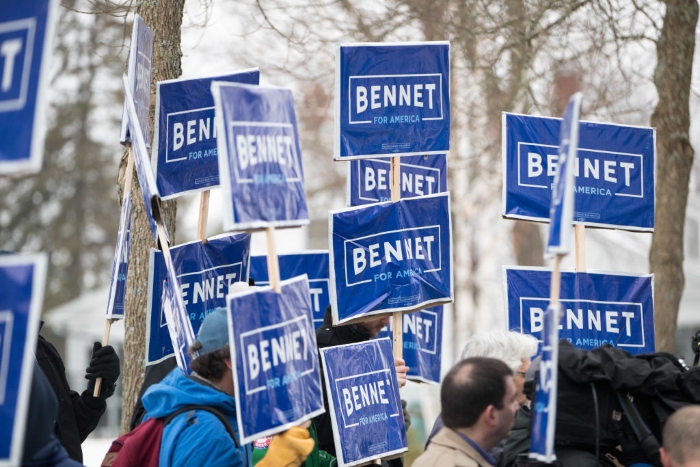
Supporters of then-Democratic presidential candidate Sen. Michael Bennet (D-Colo.) hold up signs outside of the Webster Elementary School during the presidential primary on Feb. 11, 2020, in Manchester, N.H.

Supporters of then-Democratic presidential candidate Sen. Michael Bennet (D-Colo.) hold up signs outside of the Webster Elementary School during the presidential primary on Feb. 11, 2020, in Manchester, N.H. | Getty Images

The fact that Bennet — and not better-known progressive senators with millions of Twitter followers — got such a big policy win tells us a lot about Biden’s relationship with the left. When it comes to cooperating with the GOP, the president has surprised liberals by seeming to veer closer to Sanders’ agenda than to Bennet’s quiet centrism. But Biden’s policies have yet to truly touch the sort of “big, structural change” that Warren built her presidential campaign on and that Sanders staked a claim to long before the Trump years.

Medicare for All, once a rallying cry for progressives (and a policy that Biden explicitly ran against), is back to its pipe dream status. Sanders and others are pressing Biden just to back a much smaller-scale expansion of health care in the still-unreleased second half of his infrastructure plan.

We’ve told you in Nightly before that progressives have yet to use their political leverage to extract concessions from Democratic leaders the way that conservatives often did during the GOP’s years in power. And to be sure, much of Sanders’ and Warren’s current version of pragmatism stems from a desire to pick their spots rather than try to willfully tank the priorities of a Democratic president.

But with the exception of Bennet, not one of Biden’s 2020 challengers has used the platform they built during the campaign to coax the president on board for their most trademark agenda items. No, not even the opponent who became his vice president (hello, former Sen. Kamala Harris) or the one who became his transportation secretary (the Supreme Court reform pitch Pete Buttigieg once made is DOA with most Democrats).

Sen. Cory Booker’s (D-N.J.) proposal to create “baby bonds” as a means to close the nation’s yawning racial wealth gap has support from Majority Leader Chuck Schumer but isn’t in the mix during the current infrastructure debate. Sen. Kirsten Gillibrand (D-N.Y.) staked her 2020 campaign on fighting sexual misconduct and pushing for paid family leave, and though the latter idea has gained traction under Biden, other lawmakers have largely laid effective claims to its success.

Perhaps the biggest lesson, then, is that Biden didn’t just beat his opponents in 2020. He also has quietly sapped some of their influence over his party — with a smile, of course.

Welcome to POLITICO Nightly. Reach out with news, tips and ideas for us at eschor@politico.com and rrayasam@politico.com, or on Twitter at @eschor and @renurayasam.


JOIN AN IMPORTANT CONVERSATION, SUBSCRIBE TO "THE RECAST": Power is shifting in Washington and across the country. More people are demanding a seat at the table, insisting that all politics is personal and not all policy is equitable. “The Recast” is a twice-weekly newsletter that explores the changing power dynamics in Washington and breaks down how race and identity are recasting politics and policy across America. Get fresh insights, scoops and dispatches on this crucial intersection from across the country and hear critical new voices that challenge business as usual. Don't miss out, SUBSCRIBE . Thank you to our sponsor, Intel.


FIRST IN NIGHTLY

POLITICS, PA — Democrats sighed with relief when the state of Biden’s blue-collar birthplace slid back into their column in 2020. But his party now fears those slim gains could be easily erased here ahead of a perilous midterm, with the House majority at stake, Congress reporter Sarah Ferris writes.

Pennsylvania will host several of the House’s toughest races in 2022, not to mention a critical open-seat Senate contest — none of them a guarantee in a perennial swing state where the party performed worse than expected down the ballot last fall.

Those highly competitive House races, from the Pittsburgh suburbs to the Lehigh Valley to Scranton with its post-industrial revival, are drawing fistfuls of cash as Democrats attempt to defy the historical odds of losing seats after winning the White House. The state’s midterm races are shrouded in uncertainty, with its congressional maps set to be redrawn as both parties scramble to predict how voters will act without Donald Trump atop the ticket.

Every House Democrat in Pennsylvania, even in the toughest districts, held onto their seat alongside Biden’s victory in the state last fall. But their narrow margins in those down-ballot races tell another story: Pennsylvania’s most endangered House Democrats — Reps. Conor Lamb, Matt Cartwright and Susan Wild — each won by less than 4 percentage points. Meanwhile, one of the party’s top GOP targets, Rep. Brian Fitzpatrick, won by double digits.

The future of Speaker Nancy Pelosi’s gavel may now depend on how the party fares in a cycle when neither Biden nor Trump is on the ballot.

AROUND THE NATION

DON’T CLOSE THE GRILL JUST YET — Senior writer Michael Grunwald emails Nightly:

No, Biden is not confiscating your cheeseburgers. No matter what you’re hearing from Fox News or a Twitter swarm of Republican leaders, including Texas Gov. Greg Abbott and Donald Trump Jr., Biden’s proposal to cut U.S. carbon emissions says absolutely nothing about banning beef or rationing meat or forcing you to eat Brussels sprouts on July 4. It’s malarkey. It’s a Whopper. It’s USDA Prime bull.

Still, there are lessons to learn from this fake news cycle — about the potent politics of meat, the partisan politics of climate, and the challenges Biden will face in meeting his green goals.

First, a quick story. Pollsters often include a “control question” to weed out trollish respondents who might just answer randomly or say yes to everything. Data for Progress founder Sean McElwee says he considered using the tactic of another pollster, who had included a control in surveys asking whether the government should erect statues of Adolf Hitler, but he worried that could get him in trouble. He instead, in a poll conducted last year, chose the next-most-unpopular policy he could think of: whether the government should ban meat.

“Banning meat was the most unpopular idea we’ve ever tested,” McElwee said to Nightly.

America is a carnivorous nation, dedicated to the proposition that ballpark hotdogs and juicy steaks and fast-food burgers and bacon-wrapped everything are our inalienable rights. That’s why Republicans routinely attack Democratic climate policies as assaults on America’s grilling freedoms; they even ate burgers at their first 2019 news conference blasting the Green New Deal.

Yet while Rep. Alexandria Ocasio-Cortez’s office did once release a memo suggesting that the Green New Dealers hoped to phase out beef someday, Biden has never said or implied anything of the sort, or even supported the Green New Deal. The ferocious GOP denunciations of his nonexistent plan to limit Americans to one burger a month are a transparent effort to tie him to a radical caricature of the green agenda.

In recent years, the GOP has edged away from full-throated denial of climate science, and quite a few Washington Republicans have supported modest forms of climate action, with some even calling for market-oriented taxes on carbon. But none have expressed support for Biden’s ambitious climate policies, and the right-wing aneurysm over his fictitious meat limits is a reminder that none of them will. Climate is literally red meat for their base, a culture-war issue of identity, and they want to stand with delicious all-American beef against the imaginary hordes of unkempt eco-leftists who would banish it from their barbecues.

At the same time, it’s true that meat in general and beef in particular has a heavy carbon footprint, and that eating less would help the climate. The Biden administration has denied it has any intention of adjusting U.S. diets, which may be smart self-preservational politics. But the president’s long-term goal of a carbon-neutral nation probably would require us to stop shoving so many Big Macs into our bellies.

The World Resources Institute has estimated that for the world to meet its 2050 goals under the Paris climate agreement, U.S. beef consumption, currently the equivalent of about three burgers a week per American, would have to decline 50 percent over three decades. That’s far from the 90 percent reduction by 2030 that’s all over Fox News, based on a distortion of a single University of Michigan study. And Americans already eat about one-third less beef than we did in 1970, a shift that has significantly reduced emissions even though we’re eating more meat (mostly chicken) overall. So that kind of shift is not unimaginable. But it’s definitely a stretch.

A carbon tax could help accelerate a change to American eating habits by making beef more expensive, but Republican support for that kind of policy has largely been purely rhetorical. Government research into plant-based and cell-based alternatives to meat and dairy could also help, and Biden’s $2.5 trillion infrastructure plan does emphasize new climate-oriented research. But diets change only when individuals change, and the administration does not seem eager to launch a national conversation about the hidden costs of meat. If every American switched just one burger to a plant-based burger every week, it could save a land area the size of Massachusetts from deforestation every year. You probably won’t hear that from Biden, though.

Some evolutionary biologists believe eating meat is a big part of what made us human. Our ancestors who started hunting animals 2 million years ago developed bigger brains for tracking down prey and smaller stomachs as they began consuming less roughage. We may need to ease up a bit to avoid grilling the planet, but it’s going to take a brave politician to say so. And as long as Americans will believe their political opponents are trying to steal their meat, we’re going to keep hearing a lot of baloney.

WHAT'D I MISS?

Nightly video player of Attorney General Merrick Garland

— DOJ opens policing probe over Breonna Taylor’s death: The Justice Department is opening a sweeping probe into policing in Louisville, Ky., over the March 2020 death of Breonna Taylor, who was shot to death by police during a raid at her home, Attorney General Merrick Garland announced today. It’s the second such sweeping probe into a law enforcement agency by the Biden administration in a week.

— Biden will share millions of AstraZeneca vaccine doses worldwide: The Biden administration is preparing to send up to 60 million AstraZeneca doses to countries in need over the next several months, once a federal safety review is conducted, according to two senior Biden administration officials.

— California recall backers have enough signatures: California election officials confirmed today that recall proponents collected enough valid signatures for a special gubernatorial contest this year, making it all but certain that voters will decide Gov. Gavin Newsom’s fate this fall.

— Cuomo offers blanket denial of harassment allegations: New York Gov. Andrew Cuomo fiercely denied allegations of sexual harassment leveled at him over the past several months during his first in-person Q&A with press since late last year.

— Biden advances emergency Covid-19 workplace safety rules after weeks of delay: The Biden administration is advancing emergency workplace safety rules to prevent the spread of the coronavirus after weeks of delay and growing pressure from Democrats and safety advocates. The Labor Department sent the safety standards to the Office of Management and Budget for review tonight, according to a DOL spokesperson, the first step before they are released publicly and go into effect.

AROUND THE WORLD

A SIDE OF CATCH-UP — European Commission President Ursula von der Leyen is keen to help Americans with their holiday plans — but she’s playing catch-up with EU governments who are already doing their own thing.

A number of EU countries are breaking away from jointly adopted guidelines on pandemic travel, as some capitals rush to reopen for summer tourists.

In a sign that the Commission chief is again on the defensive, as she was at the start of the pandemic when some countries unilaterally slammed shut their borders, von der Leyen on Sunday told the New York Times that she hoped to reopen the EU to U.S. visitors who have been inoculated with vaccines approved by the European Medicines Agency.

But Croatia and Greece, two EU countries whose economies rely heavily on tourism, have already announced that they are open to U.S. travelers, as has Iceland, which is part of the EU’s border-free Schengen zone. Some U.S. airlines have raced to add flights to those destinations, anticipating a rush of post-pandemic summer travel.

MORE THAN WORDS — For more than a century the U.S. had not formally recognized the killing of more than a million Armenians by the Ottoman Empire during World War I as genocide. Over the weekend, that changed. In the latest POLITICO Dispatch, Charlie Mahtesian explains what it means for Armenian Americans.

Play audio

Listen to the latest POLITICO Dispatch podcast


DON'T MISS OUT ON OUR NEW PLAYBOOK DEEP DIVE PODCAST: Washington is full of whispers, colorful characters and little-known back stories that even D.C. insiders might not know. Playbook Deep Dive is a new, weekly podcast that pulls back the curtain on the stories behind the power. From Congress and the White House to bar stools and backrooms, POLITICO's top reporters and Playbook authors bring you the most compelling and confounding stories that explain what’s really going on in Washington. SUBSCRIBE NOW.


NIGHTLY NUMBER

7

The number of states losing a congressional seat in reapportionment, according to today’s announcement from the Census Bureau . California, Illinois, Michigan, Ohio, West Virginia, Pennsylvania and New York lost a seat, while Oregon, Montana, Colorado, North Carolina and Florida gained a seat. Texas gained two.

PARTING WORDS

Graphic of members of the 117th Congress

DIVING INTO 117 — It shouldn’t have come as a surprise that the 117th Congress would be the most diverse ever. The past six congresses have increasingly bested the last by including more and more non-white lawmakers. And this class is not only racially and ethnically diverse, there are more women and members of the LGBTQ community, too.

With about one-quarter of voting members (23 percent) in the House of Representatives and Senate now belonging to a racial or ethnic minority, and with women accounting for slightly more than a quarter of seats, Congress is getting closer to being demographically reflective of the country.

POLITICO’s new video interview series Red, Fresh and Blue introduces first-term lawmakers from both sides of the aisle and looks at what makes them tick. This season, Playbook co-author Eugene Daniels sat down with five freshman members for a free-wheeling conversation on everything from the insurrection to voting rights to Bitcoin.

Did someone forward this email to you? Sign up here.


Follow us on Twitter

Renuka Rayasam @renurayasam

Chris Suellentrop @suellentrop

Tyler Weyant @tweyant

Myah Ward @myahward


FOLLOW US


POLITICO, LLC 1000 Wilson Blvd. Arlington, VA, 22209, USA


Together we're building the power to shape our shared future

        LOTS OF POSTS IGNORED BY BLOGGER..... OR REMOVED ON THEIR WHIM! ALL POSTS ARE AVAILABLE ON MIDDLEBORO REVIEW AND SO ON BLOGGER DOESN...