Showing posts with label CREDIT DEFAULT SWAPS. Show all posts

Thursday, March 7, 2024

Wall Street Mega Banks Have Created a Circular Firing Squad with Credit Derivatives and Capital Relief Trades – with the Fed’s Blessing

 

SUBSCRIBE TO THIS NEWSLETTER TO RECEIVE TIMELY REPORTS


Wall Street Mega Banks Have Created a Circular Firing Squad with Credit Derivatives and Capital Relief Trades – with the Fed’s Blessing

Jamie Dimon Is In a Whale of a MessBy Pam Martens and Russ Martens: March 6, 2024 ~

On June 11, 2015, the Office of Financial Research (OFR) released a sobering report on how banks were reducing their requirements to hold adequate capital against potential losses by engaging in non-transparent “capital relief trades” with potentially questionable counterparties. The OFR researchers summarized the problem as follows:

“Capital relief transactions may have benefits to banks. But, even if real risk transfer is involved, these transactions can pose financial stability concerns by increasing interconnectedness, transforming credit risk into counterparty risk, and obscuring capital adequacy to investors and counterparties. And while bank supervisors have extensive data about banks, they may have less information about the nonbanks who are selling credit risk to those banks and ultimately bearing the risk of loss.”

The Office of Financial Research was created under the Dodd-Frank financial reform legislation of 2010 to make sure that Wall Street mega banks could never again ravage the economy and financial system of the United States — as they did in 2008 – by engaging in reckless derivative trades and toxic bets. OFR describes its mission as follows:

“Our job is to shine a light in the dark corners of the financial system to see where risks are going, assess how much of a threat they might pose, and provide policymakers with financial analysis, information, and evaluation of policy tools to mitigate them.”

Buried in the June 2015 OFR report was a bombshell. When JPMorgan Chase was initiating hundreds of billions of dollars in risky derivative trades in London in 2012, using deposits from its federally-insured bank in the U.S., it was attempting to engage in tricked-up capital relief trades. The insanity of this gamesmanship resulted in $6.2 billion in losses at the bank; an investigation by the FBI; embarrassing Senate hearings; a scathing 300-page report by the U.S. Senate’s Permanent Subcommittee on Investigations; charges of engaging in “unsafe and unsound” banking practices by the Office of the Comptroller of the Currency; and the payment of $920 million in fines to its regulators.

Credit derivatives are frequently used in capital relief trades. In an effort to curb the trillions of dollars in credit derivatives that the Wall Street mega banks are using for non-transparent purposes with non-transparent counterparties, on July 27 of last year the FDIC, the Office of the Comptroller of the Currency (OCC), and the Federal Reserve released a proposal to require higher capital levels at banks with $100 billion or more in assets; (only 37 banks would be impacted). Community banks will not be impacted at all by the new proposals according to the federal regulators.

On September 12, 2023, the banking cartel made its anger and intention to push back known in a 7-page letter. The cartel demanded that the three federal agencies turn over all “evidence and analyses the agencies relied on” in making the proposal.

One of the signatories to the letter was the Bank Policy Institute (BPI), whose Board of Directors consists of the CEOs of the biggest banks. BPI is Chaired by none other than Jamie Dimon, Chairman and CEO of the notorious London Whale bank, JPMorgan Chase.

BPI next launched an ad campaign that grossly distorted what the increase in capital would do, claiming that it would harm working families. (The mega banks that will be most impacted are the same mega banks that blew up the U.S. economy in 2008; put millions of Americans out of work; left millions of working families in foreclosure; got a secret $29 trillion bailout from the Federal Reserve; and then used big chunks of that bailout money to lavish million-dollar bonuses on bank executives.)

Sixteen days after the big bank cartel had posted its September 12, 2023 letter attacking the newly proposed increase in capital rules, the Federal Reserve issued a suspiciously timed announcement of how banks could game the newly-proposed capital rules, with the Fed’s blessing, through the use of a specific style of capital relief trade. The Fed wrote as follows:

“In some synthetic securitizations, a Board-regulated institution transfers the risk of a reference portfolio of on-balance sheet exposures to a special purpose vehicle using a guarantee or credit derivative. The special purpose vehicle issues credit-linked notes to investors, and the Board-regulated institution takes the cash proceeds of the notes as collateral supporting the special purpose vehicle’s performance on the guarantee or credit derivative.

“Under the Board’s capital rule, a Board-regulated institution can recognize the credit risk mitigation of the collateral on the reference portfolio under the rules for synthetic securitizations provided that the requirements in section 41 or 141, as applicable (12 CFR 217.41, .141), are met and that the transactions satisfy the definition of ‘synthetic securitization’ (12 CFR 217.2, ‘synthetic securitization’).”

All you need to know about the above two paragraphs is that the words “synthetic” and “special purpose vehicle” and “credit derivatives” played a central role in crashing Wall Street and the U.S. economy in 2008. The Federal Reserve has apparently learned nothing from the worst financial crash since the Great Depression.

For the most hair-raising part of this story, let us back up to September 29, 2022 – almost exactly one year before the Fed gave its blessing to capital relief trades using credit derivatives. On that date the OFR issued a report that concluded: “When Choosing Counterparties, Banks Tend to Pick Riskier Ones.”

The report was authored by Dasol Kim, a Research Principal at OFR, and Andrew Ellul, a Visiting Fellow at OFR and Professor of Finance at Indiana University’s Kelley School of Business. In a blog post, they summarized their findings as follows:

“In a recent working paper analyzing who banks chose as counterparties in the over-the-counter (OTC) derivatives market, the authors found that banks are more likely to choose riskier nonbank counterparties that are already heavily connected and exposed to other banks, which leads to an even more densely connected network. Furthermore, banks do not hedge these exposures, but rather increase them by selling rather than purchasing credit derivative swaps against these counterparties. Finally, the authors found that common counterparty exposures are correlated with systemic risk measures despite greater regulatory oversight following the 2008 financial crisis.” (Italic emphasis added.)

The only common-sense way to think of this is that Wall Street has once again created a circular firing squad with the U.S. banking system and U.S. economy as collateral damage.

For an idea of what can happen when a mega bank sells credit default swaps, consider how Howie Hubler, a star bond trader at Morgan Stanley, lost $9 billion. Hubler was one of those who made early derivative bets that the lowest-rated subprime bonds would fail during the 2007-2008 financial crisis using credit default swaps. He bought protection by purchasing credit default swaps on subprime debt. But because Hubler had to pay out premiums on these credit default swaps until the price collapse arrived, he sold $16 billion in credit default swaps on higher-rated debt, obviously to collect the premiums to offset what he was paying out while he waited. When the $16 billion turned out to be toxic as well, Morgan Stanley lost at least $9 billion.

According to a government audit of the Fed’s secret loans to the Wall Street mega banks and their trading subsidiaries from December 2007 through early July 2010, Morgan Stanley was the second largest recipient (after Citigroup) of the Fed’s secret bailout loans. Morgan Stanley received a total of $2.04 trillion in cumulative loans from the Fed; Citigroup received $2.5 trillion in cumulative loans from the Fed.

Federal regulators were caught napping in the lead up to the 2008 financial collapse. They are clearly still napping. According to the most recent trading and derivatives report from the Office of the Comptroller of the Currency for the third quarter of 2023, just four commercial banks (JPMorgan Chase, Citigroup’s Citibank, Goldman Sachs Bank USA and Bank of America) hold 94 percent of all credit derivatives held at 4,600 commercial banks. If you want the quintessential definition of concentrated risk, this is it.

https://wallstreetonparade.com/2024/03/wall-street-mega-banks-have-created-a-circular-firing-squad-with-credit-derivatives-and-capital-relief-trades-with-the-feds-blessing/


Sunday, March 19, 2023

The Next Bomb to Go Off in the Banking Crisis Will Be Derivatives

SUBSCRIBE TO THIS NEWSLETTER TO RECEIVE IT IN A TIMELY MANNER


The Next Bomb to Go Off in the Banking Crisis Will Be Derivatives

By Pam Martens and Russ Martens: March 16, 2023 ~

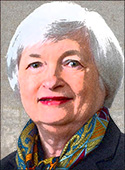
Janet Yellen

U. S. Treasury Secretary Janet Yellen

U.S. Treasury Secretary Janet Yellen finds herself in a very dubious position. Under the Dodd-Frank financial reform legislation of 2010, the U.S. Treasury Secretary was given increased powers to oversee financial stability in the U.S. banking system. This increase in power came in response to the 2008 financial crisis – the worst financial collapse since the Great Depression. The legislation made the Treasury Secretary the Chair of the newly created Financial Stability Oversight Council (F-SOC), whose meetings include the heads of all of the federal agencies that supervise banks and trading on Wall Street. The legislation also required the Treasury Secretary’s authorization before the Federal Reserve could create any more of those $29 trillion emergency bailout programs for the mega banks – which had tethered themselves to casino trading on Wall Street since the repeal of the Glass-Steagall Act in 1999.

Yesterday, after the Swiss banking behemoth Credit Suisse had traded at an all-time low of less than two bucks; blown out its credit default swaps to unprecedented levels; and tanked the Dow Jones Industrial Average by more than 700 points intraday, Bloomberg News ran this headline at 12:54 p.m. – “US Treasury Reviewing US Banks’ Exposure to Credit Suisse.” By “exposure,” the Treasury really means how many billions of dollars of underwater derivatives are U.S. banks on the hook for as a counterparty to Credit Suisse. The Treasury also has to worry about U.S. banks’ exposure to Credit Suisse’s other major counterparties that U.S. banks do business with, even if the banks are not direct counterparties to Credit Suisse itself.

If the U.S. Treasury Secretary and her staff at F-SOC were just yesterday getting around to finding out which U.S. banks had counterparty exposure to Credit Suisse’s derivatives, we are all in very big trouble. The serious problems at Credit Suisse have been making headlines for two years, including here at Wall Street On Parade.

In July of 2021, the law firm Paul, Weiss, Rifkind, Wharton & Garrison released a 165-page report on the internal investigation it had conducted for the Board of Credit Suisse into how the bank came to lose $5.5 billion conducting highly-leveraged and dodgy derivative trades for the family office hedge fund, Archegos Capital Management, which went belly-up in March of 2021. The Paul, Weiss lawyers wrote:

“The Archegos-related losses sustained by CS are the result of a fundamental failure of management and controls in CS’s Investment Bank and, specifically, in its Prime Services business. The business was focused on maximizing short-term profits and failed to rein in and, indeed, enabled Archegos’s voracious risk-taking. There were numerous warning signals — including large, persistent limit breaches — indicating that Archegos’s concentrated, volatile, and severely under-margined swap positions posed potentially catastrophic risk to CS. Yet the business, from the in-business risk managers to the Global Head of Equities, as well as the risk function, failed to heed these signs, despite evidence that some individuals did raise concerns appropriately.”

Six months ago, Dennis Kelleher, President and CEO of the nonprofit watchdog, Better Markets, released a statement about the deteriorating condition of Credit Suisse, highlighting the following:

“As the financial condition of Credit Suisse continues to deteriorate, raising questions of whether it will collapse, the world and U.S. taxpayers should be deeply worried as multiple, simultaneous shocks shake the foundations of economies worldwide. Credit Suisse is a global, systemically significant, too-big-to-fail bank that operates in the U.S. and is deeply interconnected throughout the global financial system. Its failure would have widespread and largely unknown repercussions from the inconvenient to the possibly catastrophic.

“That is due, in part, to the failure of the Federal Reserve to properly regulate the activities of foreign banks that have U.S.-based operations. The U.S. has a largely ineffective regulatory framework with gaping loopholes that fail to include some of even the most basic safety and soundness requirements, which incentivizes regulatory arbitrage. As a result, the U.S. financial system and economy are needlessly threatened.

“An effective and appropriate regulatory framework for large foreign banks that covers all of their U.S.-based affiliates should have been established when the Fed set up so-called U.S.-based intermediate holding companies (‘IHCs’) that they regulate. Instead, U.S.-based branches of foreign banks (which are not consolidated within the IHC) face significantly weaker standards than the IHC, remarkably including no specific capital requirements in the U.S. Furthermore, the branches have significantly weaker liquidity requirements. This has resulted in many foreign banks – including in particular Credit Suisse – engaging in regulatory arbitrage by shifting large amounts of assets from their IHCs to their branches, entities that are entirely reliant on the resources of their foreign-based parent companies. The 2008 financial collapse proved that these resources are not available in periods of stress, which is why the U.S. bailed out so many foreign banks operating in the U.S. The Fed should have stopped that long ago.

“As is well-known, risks in the global financial system that materialize elsewhere easily end up becoming risks here in the U.S. and threaten our financial system and economy. Those risks are amplified by the unprecedented fiscal and monetary policies attempting to address the many unexpected shocks from the pandemic and war. The Fed must see Credit Suisse as a warning sign and improve the regulatory framework for large foreign banks and all banks to ensure that the American financial system and economy are properly protected.”

Credit Suisse’s reputation has taken more hits from its involvement in the Greensill Capital scandal and the infamous spy-gate scandal in 2019 where the bank spied on and followed various employees.

Nervousness about Credit Suisse reached a pivotal moment in the fall of last year. On November 30, its 5-year Credit Default Swaps (CDS) blew out to 446 basis points. That was up from 55 basis points in January of 2022 and more than five times where CDS on its peer Swiss bank, UBS, were trading. The price of a Credit Default Swap reflects the cost to traders, or investors with exposure, to insuring themselves against a debt default by the bank.

If all of this didn’t awaken Secretary Yellen from her slumber about the contagion risks posed by a deteriorating Credit Suisse, she should have been jolted upright on December 5 of last year when researchers for the Bank for International Settlement (Claudio Borio, Robert McCauley and Patrick McGuire) released an astonishing report that found that foreign banks had secret derivative debt that is “10 times their capital.”

The report focused on the amount of derivative debt that was not being captured through regular statistical reporting because it is held off the banks’ balance sheets. The researchers refer to this exposure as “staggering” and note the potential for upsets to dollar swap lines to settle it as it comes due.

The report raises further alarm bells with this: “For banks headquartered outside the United States, dollar debt from these instruments is estimated at $39 trillion, more than double their on-balance sheet dollar debt and more than 10 times their capital.” Their on-balance sheet dollar debt is $15 trillion.

The most recent quarterly derivatives report from the U.S. regulator of national banks, the Office of the Comptroller of the Currency (OCC), found that as of September 30, 2022 four U.S. mega banks held 88.6 percent of all notional amounts of derivatives in the U.S. banking system. The total notional amount for all banks was $195 trillion. JPMorgan Chase held $54.3 trillion of that; Goldman Sachs held $50.97 trillion; Citigroup’s Citibank held $46 trillion; and Bank of America held $21.6 trillion. Even though the Dodd-Frank legislation required that most of these derivative trades move to central clearing, as of September 30, 2022 the OCC report found that 58.3 percent of these derivatives were not being centrally-cleared, meaning they were over-the-counter (OTC) private contracts between counterparties, thus adding another layer of opacity to an unaccountable system.

For the role that Citigroup played in keeping these dangerous derivatives inside federally-insured banks, see our December 2014 report: Meet Your Newest Legislator: Citigroup.


LINK


Thursday, March 16, 2023

Moody’s Downgrades Entire U.S. Banking System; Credit Suisse Plummets. Welcome to Banking Crisis 3.0

 SUBSCRIBE TO THIS NEWSLETTER & RECEIVE IT IN A TIMELY MANNER

Moody’s Downgrades Entire U.S. Banking System; Credit Suisse Plummets. Welcome to Banking Crisis 3.0

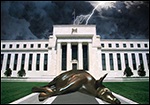
Federal Reserve Building, Washington, D.C.By Pam Martens and Russ Martens: March 15, 2023 ~

The “Related Articles” linked below (a tiny sampling of relevant articles) will remind our readers just how long and in how many different ways we have been attempting to warn that the U.S. banking system was incompetently structured and at risk of systemic contagion. We have also repeatedly warned that the crony, captured Fed was the worst possible banking supervisor and should be stripped of its bank regulatory powers and restricted to setting monetary policy. We have repeatedly cautioned, citing experts in the field, that the Fed’s stress tests were little more than a placebo and would not prevent the next banking crisis. (Check out our numerous articles at this link. Scroll down.)

On July 29 of last year we wrote that Wall Street Megabanks’ Multi-Billion Dollar Blunders Suggest Money Controls as Good as George Bailey’s Uncle Billy and summed up our analysis with: “This is the stuff of banana republics – not a financial system befitting a superpower.”

On a regular basis, we emailed these articles to key staff of the Senators and House Reps who sit on the Senate Banking and House Financial Services Committees.

Late Monday, the credit rating agency, Moody’s, downgraded the entire U.S. banking system outlook to negative from stable. (Let that sink in for a moment – a downgrade of the entire U.S. banking system.) The news of the Moody’s downgrade did not hit the wires until yesterday, which should have cratered the most vulnerable bank stocks. Instead, there was a highly suspicious short squeeze that fueled a big rally in the prices of publicly-traded banks.

That unwarranted optimism has now been reversed this morning with Dow futures down more than 600 points just after 8:00 a.m. in New York; major banks in Europe temporarily halted from trading after steep selloffs; and troubled Swiss behemoth bank, Credit Suisse, down 24 percent to a new all time low of $1.74 in morning trade in Europe following multiple trading halts. For the systemic contagion posed by Credit Suisse, see our February 10 article: Credit Suisse Tanks Yesterday to $3.02; It’s Lost Over 90 Percent of Its Market Value Since 2007; It’s Not Alone.

We say in our headline above that this is Banking Crisis 3.0 because this is the third time (excluding the emergency measures taken in 2020 as a result of the COVID pandemic) that the Federal Reserve has deployed emergency measures to bail out the U.S. banking system in the past 15 years. (Prior to the repeal of the Glass-Steagall Act in 1999, which prevented the combination of Wall Street trading houses with federally-insured banks, there had been no major Fed bailouts for 66 years.)

The banking crisis of 2008 was widely covered by the media, which even went to court to get the Fed to come clean on the dollar amounts and names of the banks that received trillions of dollars in secret, cumulative loans from the Fed. (See our report last year: Mainstream Media Has Morphed from Battling the Fed in Court in 2008 to Groveling at its Feet Today.)

But because Congress failed to restore the Glass-Steagall Act after the 2008 financial crash – the worst since the Great Depression – the Fed was back to secretly bailing out the trading units of the behemoth depository banks in September 2019. Mainstream media – across the board – censored this critical story. See our report: There’s a News Blackout on the Fed’s Naming of the Banks that Got Its Emergency Repo Loans; Some Journalists Appear to Be Under Gag Orders.

That censorship allowed Congress to kick the can down the road, leading to this even greater Banking Crisis 3.0 today.

Related Articles:

Secretary Yellen, We’ve Got a “Staggering” Problem: New Report Shows Foreign Banks Have Secret Derivative Debt that Is “10 Times their Capital”

Evidence Grows that Crypto and Federally-Insured Banks Are a Combustible Mixture

Casino Banking: Wall Street Mega Banks Traded More in their Federally-Insured Bank than the Total for their Bank Holding Company

Shhh! Don’t Tell the Fed or Mainstream Media that Systemic Contagion at Wall Street Banks Is Already Here

Another Dangerous Virus Hits the U.S. – Wall Street Bank Contagion

Wall Street Banks Tank Yesterday as Contagion Threat Grows

Contagion – What the Next Wall Street Crisis Will Look Like

Add 4,281 Hedge Fund Clients to What Makes JPMorgan Chase the Riskiest Mega Bank in the U.S.

New Study: Wall Street Banks Are Doubling Down on Risk by Selling Credit Default Swaps on their Risky Derivatives Counterparties

Internal Charts Show Treasury Agency Assigned to Measure Risk in U.S. Markets Slept through the Repo Crisis of 2019 and the Fed’s $19.87 Trillion Bailout

The Fed Has Misled the Public about the “Strength” of the Wall Street Mega Banks: This Chart Shows the True Picture

An Insider Blows the Whistle on How the Fed Has Allowed Crypto to Invade Federally-Insured Banks

LINK


Sunday, February 12, 2023

Credit Suisse Tanks Yesterday to $3.02; It’s Lost Over 90 Percent of Its Market Value Since 2007; It’s Not Alone

SUBSCRIBE TO THIS NEWSLETTER TO RECEIVE TIMELY REPORTS 


Credit Suisse Tanks Yesterday to $3.02; It’s Lost Over 90 Percent of Its Market Value Since 2007; It’s Not Alone

By Pam Martens and Russ Martens: February 10, 2023 ~

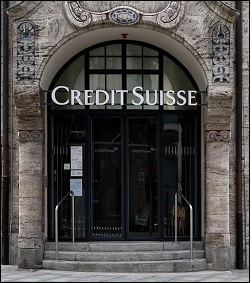
Credit SuisseCredit Suisse continued its long death spiral yesterday, losing 15.64 percent of its market value in one trading session to close at $3.02 on the New York Stock Exchange. The trading action came on the heels of an earnings report that was excruciatingly bad – even for Credit Suisse.

The Global Systemically Important Bank (G-SIB), which means it’s interconnected to other G-SIBs that could bring down the global financial system, reported yesterday that its clients had yanked over $100 billion in just the fourth quarter — which was more than eight times the outflow in the third quarter. Its pre-tax loss for the quarter was $1.51 billion, marking its fifth consecutive earnings loss.

Credit Suisse is Switzerland’s second largest bank, after UBS, but its troubled history looks more like that of a bank in a banana republic. On March 26, 2021, the family office hedge fund, Archegos Capital Management, defaulted on margin calls to its prime brokers and went belly up, leaving major investment banks with more than $10 billion in losses. Credit Suisse took the lion’s share of those losses, acknowledging a loss of more than $5.5 billion. (To fully appreciate the wild risks that mega banks were taking with Archegos, see our report: Archegos: Wall Street Was Effectively Giving 85 Percent Margin Loans on Concentrated Stock Positions – Thwarting the Fed’s Reg T and Its Own Margin Rules.)

The Board of Credit Suisse decided to hire the Big Law firm, Paul, Weiss, Rifkind, Wharton & Garrison, to conduct an internal investigation of the Archegos fiasco. Paul Weiss issued a 165-page report in July of 2021, detailing its version of what had happened. Paul Weiss, reliably, found that no fraud had occurred — just zombie risk management at a Global Systemically Important Bank. (Some shareholders might have been more comforted with a finding of fraud.)

Paul Weiss investigators portrayed the zombie risk managers at Credit Suisse as follows:

“The Archegos-related losses sustained by CS [Credit Suisse] are the result of a fundamental failure of management and controls in CS’s Investment Bank and, specifically, in its Prime Services business. The business was focused on maximizing short-term profits and failed to rein in and, indeed, enabled Archegos’s voracious risk-taking. There were numerous warning signals — including large, persistent limit breaches — indicating that Archegos’s concentrated, volatile, and severely under-margined swap positions posed potentially catastrophic risk to CS. Yet the business, from the in-business risk managers to the Global Head of Equities, as well as the risk function, failed to heed these signs, despite evidence that some individuals did raise concerns appropriately.”

Credit Suisse’s reputation has taken more hits from its involvement in the Greensill Capital scandal and the infamous spy-gate scandal in 2019 where the bank spied on and followed various employees. (You can’t make this stuff up.)

Nervousness about Credit Suisse reached a pivotal moment in the fall of last year. On November 30, its 5-year Credit Default Swaps (CDS) blew out to 446 basis points. That was up from 55 basis points in January of 2022 and more than five times where CDS on its peer Swiss bank, UBS, were trading. The price of a Credit Default Swap reflects the cost to traders, or investors with exposure, to insuring themselves against a debt default by the bank.

The big move in CDS on Credit Suisse had started in early October of 2022. On October 3, 2022, Dennis Kelleher, President of the nonprofit watchdog, Better Markets, summed up the situation and its potential impact on American taxpayers as follows:

“As the financial condition of Credit Suisse continues to deteriorate, raising questions of whether it will collapse, the world and U.S. taxpayers should be deeply worried as multiple, simultaneous shocks shake the foundations of economies worldwide. Credit Suisse is a global, systemically significant, too-big-to-fail bank that operates in the U.S. and is deeply interconnected throughout the global financial system. Its failure would have widespread and largely unknown repercussions from the inconvenient to the possibly catastrophic.

“That is due, in part, to the failure of the Federal Reserve to properly regulate the activities of foreign banks that have U.S.-based operations. The U.S. has a largely ineffective regulatory framework with gaping loopholes that fail to include some of even the most basic safety and soundness requirements, which incentivizes regulatory arbitrage. As a result, the U.S. financial system and economy are needlessly threatened.

“An effective and appropriate regulatory framework for large foreign banks that covers all of their U.S.-based affiliates should have been established when the Fed set up so-called U.S.-based intermediate holding companies (‘IHCs’) that they regulate. Instead, U.S.-based branches of foreign banks (which are not consolidated within the IHC) face significantly weaker standards than the IHC, remarkably including no specific capital requirements in the U.S. Furthermore, the branches have significantly weaker liquidity requirements. This has resulted in many foreign banks – including in particular Credit Suisse – engaging in regulatory arbitrage by shifting large amounts of assets from their IHCs to their branches, entities that are entirely reliant on the resources of their foreign-based parent companies. The 2008 financial collapse proved that these resources are not available in periods of stress, which is why the U.S. bailed out so many foreign banks operating in the U.S. The Fed should have stopped that long ago.

“As is well-known, risks in the global financial system that materialize elsewhere easily end up becoming risks here in the U.S. and threaten our financial system and economy. Those risks are amplified by the unprecedented fiscal and monetary policies attempting to address the many unexpected shocks from the pandemic and war. The Fed must see Credit Suisse as a warning sign and improve the regulatory framework for large foreign banks and all banks to ensure that the American financial system and economy are properly protected.”

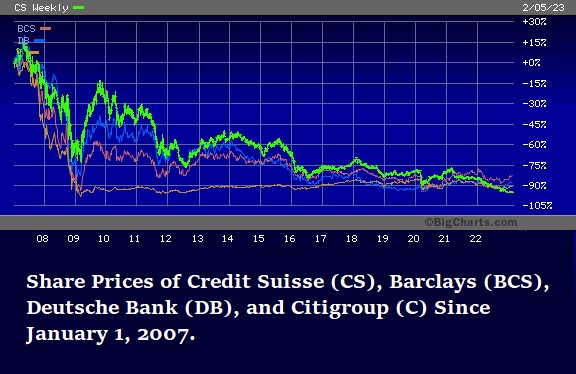
Unfortunately, Credit Suisse is far from alone. As the chart above indicates, Credit Suisse, Barclays (U.K.), Deutsche Bank (Germany) and Citigroup (U.S.) have lost the bulk of their market value since January 1, 2007 – or prior to the financial crisis of 2008. And all of these banks are also G-SIBs and interconnected to one another through derivatives, loan relationships and the like.

The bottom line is that Congress, the Fed and other federal regulators have seriously failed in their obligation to ensure that there is not another replay of the Wall Street mega bank meltdown of 2008 – which brought on the worst economic collapse since the Great Depression.   

LINK


Sunday, December 4, 2022

Credit Default Swaps Blow Out on Credit Suisse as its Stock Price Hits an All-Time Low of $2.82

SUBSCRIBE TO THIS NEWSLETTER 


Credit Default Swaps Blow Out on Credit Suisse as its Stock Price Hits an All-Time Low of $2.82

By Pam Martens and Russ Martens: December 1, 2022 ~

Credit Suisse That $4 billion capital raise that was supposed to shore up confidence in global banking behemoth Credit Suisse turns out to have been too little, too late. Yesterday, 5-year Credit Default Swaps (CDS) on Credit Suisse blew out to 446 basis points. That’s up from 55 basis points in January and more than five times where CDS on its peer Swiss bank, UBS, are trading.

The price of a Credit Default Swap reflects the cost of insuring oneself against a debt default by the bank. Who might be desperate to buy protection against a default by Credit Suisse and driving up the cost of that protection? The mega banks on Wall Street that are counterparties to its derivative trades come to mind, as well as hedge fund speculators.

Things don’t look any brighter this morning for Credit Suisse. Its shares are trading in Europe at 2.67 Swiss Francs or approximately $2.82 – an all-time low. Year-to-date, shares of Credit Suisse have lost 66 percent of their value as of yesterday’s close on the New York Stock Exchange.

Credit Suisse is Switzerland’s second largest bank, after UBS. It has been embroiled in nonstop scandals that suggest incompetent risk controls inside the bank.

In late March and early April of last year, Credit Suisse lost $5.5 billion from the highly-leveraged, highly concentrated stock positions it was financing via tricked-up derivatives for Archegos Capital Management, the family office hedge fund of Sung Kook “Bill” Hwang. Archegos blew up on March 25, 2021 after it defaulted on margin calls to the banks financing its trades. (See our report: Archegos: Wall Street Was Effectively Giving 85 Percent Margin Loans on Concentrated Stock Positions – Thwarting the Fed’s Reg T and Its Own Margin Rules. Also see: Justice Department and SEC Portray Serially-Charged Banks on Wall Street as Hapless Victims of Archegos Fraud. Nobody’s Buying It.)

The Board of Credit Suisse decided to hire the Big Law firm, Paul, Weiss, Rifkind, Wharton & Garrison, to conduct an internal investigation of the matter. On July 29, 2021 Paul Weiss issued a 165-page report on its version of what happened. Paul Weiss generously found that no fraud had occurred — just zombie risk management at a Global Systemically Important Bank (G-SIB).

This is how the Paul Weiss report portrayed the zombie risk managers at Credit Suisse:

“The Archegos-related losses sustained by CS [Credit Suisse] are the result of a fundamental failure of management and controls in CS’s Investment Bank and, specifically, in its Prime Services business. The business was focused on maximizing short-term profits and failed to rein in and, indeed, enabled Archegos’s voracious risk-taking. There were numerous warning signals—including large, persistent limit breaches — indicating that Archegos’s concentrated, volatile, and severely under-margined swap positions posed potentially catastrophic risk to CS. Yet the business, from the in-business risk managers to the Global Head of Equities, as well as the risk function, failed to heed these signs, despite evidence that some individuals did raise concerns appropriately.”

And this:

“…a Prime Services business [lending to hedge funds] with a lackadaisical attitude towards risk and risk discipline; a lack of accountability for risk failures; risk systems that identified acute risks, which were systematically ignored by business and risk personnel; and a cultural unwillingness to engage in challenging discussions or to escalate matters posing grave economic and reputational risk. The Archegos matter directly calls into question the competence of the business and risk personnel who had all the information necessary to appreciate the magnitude and urgency of the Archegos risks, but failed at multiple junctures to take decisive and urgent action to address them.”

Credit Suisse’s reputation took another hit from its involvement in the Greensill Capital scandal and its infamous spy-gate scandal in 2019 where the bank spied on, and followed, various employees.

And if all of this wasn’t enough, on November 2 S&P cut Credit Suisse’s credit rating to one notch above junk. That was followed by more disturbing news on November 23 when the bank reported that its clients had yanked $88.3 billion of their assets out of the bank.

According to an historical timeline on the Credit Suisse website, it was previously known as Schweizerische Kreditanstalt, which was eventually shorted to SKA. The timeline notes that SKA’s New York Branch was granted a license to accept deposits in 1964. Credit Suisse’s New York branch has continued for decades to accept deposits, but they are not insured. In the resolution plan for Credit Suisse that it filed with the Federal Reserve in 2020, it writes:

“Our New York Branch is not a member of, and its deposits are not insured by, the FDIC. CS’ biggest U.S. presence is through its broker-dealer related businesses. Typically broker-dealer activities are resolved with a rapid runoff of the businesses as long as the resolution strategy is supported by adequate operational capabilities, such as the ability to transfer client accounts to peer institutions while causing minimal disruptions to the broader financial markets.”

Wall Street trading houses accepting uninsured deposits resulted in the banking crisis of the early 1930s when thousands of banks failed and people rushed to pull their money from uninsured banks. Congress passed the 1933 Glass-Steagall Act banning the combination of investment banks/brokerage firms with federally-insured banks. (Federal deposit insurance was also created under the Glass-Steagall Act to restore confidence in the U.S. banking system.) The Glass-Steagall Act served the nation well for 66 years until its repeal under the Bill Clinton administration in 1999, allowing trading firms to merge with federally-insured, deposit-taking banks. It took just nine years without Glass-Steagall for Wall Street to collapse in a replay of the crash of 1929.

Despite both Democrats and Republicans promising in their 2016 campaign platforms to restore the Glass-Steagall Act, the idea quickly bit the dust once the Trump administration took office. (See Mnuchin Says Trump Administration Never Intended to Restore Glass-Steagall Act.) Instead of Congress removing the Wall Street trading casino from the nation’s federally-insured banks, Congress has sat back and allowed the crypto circus to spread its risk directly into federally-insured banks

It’s time for the American people to pick up the phone and demand better from their elected members of Congress.

 LINK


Tuesday, October 18, 2022

Three Business Days after Credit Suisse Was Named “Credit Derivatives House of the Year,” Its Own Credit Derivatives Blew Out


SUBSCRIBE TO THIS NEWSLETTER

Three Business Days after Credit Suisse Was Named “Credit Derivatives House of the Year,” Its Own Credit Derivatives Blew Out

By Pam Martens and Russ Martens: October 18, 2022 ~

Credit SuisseCredit Suisse presents a cautionary tale about creating so much innovation in the realm of credit derivatives that one gets named “Credit Derivatives House of the Year.” That award might sound like a good thing to traders who make their living cooking up and trading exotic derivatives but it might sound like a very bad thing to pension funds and mutual funds who own big chunks of the stock and bonds of that bank and remember how credit derivatives blew up much of Wall Street in 2008.

On September 28, Risk.net named Credit Suisse the “Credit Derivatives House of the Year.” Three businesses days later, Credit Suisse saw its own Credit Default Swaps blow out to more than 300 basis points and some of its own bonds trade at 63 cents on the dollar. Simultaneously, its shares traded at an intraday low of $3.70 in New York on October 3, closing at $4.01, and putting it in crisis management mode.

On the same day that its stock, bonds and Credit Default Swaps were exhibiting severe stress, Reuters decided to run an article in the early afternoon reminiscing on the serial scandals that have plagued the global bank: words like “cocaine,” “kickbacks,” “fraud,” and “spying,” reminded investment managers of just how voluminous and varied Credit Suisse’s scandals had been of late.

Losing billions of dollars on derivatives and being scandalized in news headlines is apparently no barrier to getting an award from Risk.net.

In late March and early April of last year, Credit Suisse lost $5.5 billion from the highly-leveraged, highly concentrated stock positions it was financing via tricked-up derivatives for Archegos Capital Management, the family office hedge fund of Sung Kook “Bill” Hwang. Archegos blew up on March 25, 2021 after it defaulted on margin calls to the banks financing its trades. (See our report: Archegos: Wall Street Was Effectively Giving 85 Percent Margin Loans on Concentrated Stock Positions – Thwarting the Fed’s Reg T and Its Own Margin Rules.)

To cover their backsides, the Board of Credit Suisse decided to hire the BigLaw firm, Paul, Weiss, Rifkind, Wharton & Garrison, to conduct an internal investigation of the matter. On July 29, 2021 Paul Weiss issued a 165-page report on its version of what happened. Paul Weiss found no fraud had occurred — just zombie risk management at a Global Systemically Important Bank (G-SIB). (We’re not sure if fraud might have been a less troubling determination.)

This is how the Paul Weiss report portrayed the zombie risk managers at Credit Suisse:

“The Archegos-related losses sustained by CS [Credit Suisse] are the result of a fundamental failure of management and controls in CS’s Investment Bank and, specifically, in its Prime Services business. The business was focused on maximizing short-term profits and failed to rein in and, indeed, enabled Archegos’s voracious risk-taking. There were numerous warning signals—including large, persistent limit breaches — indicating that Archegos’s concentrated, volatile, and severely under-margined swap positions posed potentially catastrophic risk to CS. Yet the business, from the in-business risk managers to the Global Head of Equities, as well as the risk function, failed to heed these signs, despite evidence that some individuals did raise concerns appropriately.”

And this:

“…a Prime Services business with a lackadaisical attitude towards risk and risk discipline; a lack of accountability for risk failures; risk systems that identified acute risks, which were systematically ignored by business and risk personnel; and a cultural unwillingness to engage in challenging discussions or to escalate matters posing grave economic and reputational risk. The Archegos matter directly calls into question the competence of the business and risk personnel who had all the information necessary to appreciate the magnitude and urgency of the Archegos risks, but failed at multiple junctures to take decisive and urgent action to address them.”

The report from Paul Weiss sounds very similar to the findings of the U.S. Senate’s Permanent Subcommittee on Investigations’ on how JPMorgan Chase dodged risk limits and lost more than $6 billion using bank depositors’ money to make high risk derivative trades in the London Whale scandal of 2012-2013. That 300-page report found the following:

“In the first three months of 2012, when the CIO [Chief Investment Office] breached all five of the major risk limits on the Synthetic Credit Portfolio [SCP], rather than divest itself of risky positions, JPMorgan Chase disregarded the warning signals and downplayed the SCP’s risk by allowing the CIO to raise the limits, change its risk evaluation models, and continue trading despite the red flags.”

And, of course, there were also the zombie risk managers at Morgan Stanley who allowed Howie Hubler to lose at least $9 billion on derivative trades following the 2007-2008 financial crisis. Bestselling author, Michael Lewis, wrote about Hubler’s losses in his book, The Big Short, describing Hubler as a star bond trader at Morgan Stanley, making as much as $25 million in one year. Hubler was one of the Wall Street traders who made early bets that lower-rated subprime bonds would fail. He used credit default swaps to make his bets. But because he had to pay out premiums on these bets until the collapse came, he placed $16 billion in other bets on higher-rated portions of the subprime market, according to Lewis. When those bets failed, Morgan Stanley lost at least $9 billion.

The really big problem in all this hubris is that Credit Suisse, JPMorgan Chase and Morgan Stanley are not just trading houses; each of these financial institutions accept deposits from the public. In the case of JPMorgan Chase and Morgan Stanley, their deposit-taking units are federally-insured and backstopped by the U.S. taxpayer. In the case of Credit Suisse, its New York branch accepts deposits, but they are not insured.

In the resolution plan for Credit Suisse that it filed with the Federal Reserve, it writes:

“Our New York Branch is not a member of, and its deposits are not insured by, the FDIC. CS’ biggest U.S. presence is through its broker-dealer related businesses. Typically broker-dealer activities are resolved with a rapid runoff of the businesses as long as the resolution strategy is supported by adequate operational capabilities, such as the ability to transfer client accounts to peer institutions while causing minimal disruptions to the broader financial markets.”

According to an historical timeline on the Credit Suisse website, it was previously known as Schweizerische Kreditanstalt, which was eventually shorted to SKA. The timeline notes that SKA’s New York Branch was granted a license to accept deposits in 1964.

Wall Street trading houses accepting uninsured deposits resulted in the banking crisis of the early 1930s when thousands of banks failed and people rushed to pull their money from uninsured banks. Congress passed the 1933 Glass-Steagall Act banning the combination of investment banks/brokerage firms with federally-insured banks. (Federal deposit insurance was also created under the Glass-Steagall Act to restore confidence in the U.S. banking system.) The Glass-Steagall Act served the nation well for 66 years until its repeal under the Bill Clinton administration in 1999, allowing trading firms to merge with federally-insured, deposit-taking banks. It took just nine years without Glass-Steagall for Wall Street to collapse in a replay of the crash of 1929.

It’s long past the time to restore Glass-Steagall and permanently separate the nation’s taxpayer-backstopped banks from the Wall Street casino.

LINK


Trump's Friday Meltdown: Begging Iran, Ditching Ukraine, and Blaming Everybody But Himself – 7/31/26

                                               LOTS OF POSTS IGNORED BY BLOGGER..... OR REMOVED ON THEIR WHIM! ALL POSTS ARE AVAILABLE ON MI...