Showing posts with label GOLDMAN SACHS. Show all posts

Tuesday, April 1, 2025

"Dow Down, April Fools Up"


"Dow Down, April Fools Up"

This is real. This is dangerous. And unless something changes fast, the only ones laughing will be the ultra-rich, while everyday Americans get stuck with the bill.


Rise and shine…it’s April Fools’ Day. But while most of us are dodging harmless pranks from coworkers or family, the real joke is unfolding in real time, and the punchline is America’s economy. Tomorrow, April 2, marks Trump’s Economic D-Day, a day that’s already sending shockwaves through the markets. And guess what? It’s no prank; it’s an absolute disaster.


Wall Street isn’t laughing. Goldman Sachs has issued a dire warning, signaling massive market losses, surging recession fears, and an economic outlook so grim it makes the 2008 collapse look like a minor inconvenience. Dow futures? Plummeting. Nasdaq? Tanking. S&P? Free falling. And yet, Trump; whose business acumen includes bankrupting casinos and running a fake university, wants us to believe this is all part of his “genius” economic strategy. Spoiler alert: It’s not.

Let’s break it down: GDP is down 1%, unemployment has climbed to 4.5%, and core inflation has surged to 3.5%. Consumer confidence? At rock bottom. Recession odds? A staggering 35%; and rising. The average American is feeling the squeeze, but Trump and his billionaire cronies? They’ll be just fine, sipping champagne on their private jets while middle-class families struggle to put food on the table.

The cruelest part? This economic crisis isn’t the result of some global catastrophe. It’s a self-inflicted wound, courtesy of an administration that governs via executive order, cable news soundbites, and half-baked policies scribbled on Mar-a-Lago napkins. The so-called “America First” agenda has once again left America last, proving that economic policy should never be dictated by a guy who can’t even define what stagflation is.

Even the wolves of Wall Street; who usually cheer for tax cuts and deregulation, are in full panic mode. When Goldman Sachs, a firm that would sell its own grandmother for a profit, is warning that Trump’s latest economic move is a recipe for recession, you know we’re in serious trouble. But what’s Trump’s response? Blame the media. Blame the Democrats. Blame immigrants, windmills, and maybe even Joe Biden. Anyone but himself.

Meanwhile, in Congress, House Minority Leader Hakeem Jeffries took the floor in a marathon speech; not a filibuster as described by media, since no bill was up for a vote, but a desperate attempt to inject some reality into the conversation. Jeffries isn’t just speaking to his colleagues; he’s speaking to all of us, reminding Americans that while Trump drives the economy off a cliff, Republicans are standing by, too afraid, or too complicit to stop him.

So, what happens next? The markets are already crashing, businesses are putting hiring on hold, and regular Americans; those who don’t have offshore bank accounts, golden parachutes or a billionaire son-in-law, are bracing for impact. Rents? Higher. Wages? Stagnant. Inflation? About to get worse. This isn’t just bad policy; it’s an economic train wreck in slow motion.

And the worst part? Trump doesn’t care. He never has. As long as he can shift blame and distract his base with more lies, he considers it a win. But for the rest of us, there’s nothing funny about what’s happening. This is real. This is dangerous. And unless something changes fast, the only ones laughing will be the ultra-rich, while everyday Americans get stuck with the bill.

April Fools’ Day may be today, but the real joke is what’s coming tomorrow. And trust me; this is one prank that’s going to hurt.

(Kindly consider supporting this platform and all independent journalists here on Substack. Plus, the first 240 Founding Members to this platform receive a rare, signed, numbered edition of my NYT Bestseller “Revenge, How Donald Trump weaponized The US Department Of Justice Against His Critics.” Join now!)

Monday, November 18, 2024

Trump Makes Second Attempt to Install Wall Street’s Lawyer, Jay Clayton, to Oversee Prosecutions of Wall Street SAY NO TO JAY CLAYTON!

TODD BLANCH = MATT GAETZ DEFENSE COUNSEL 

IN THE NY LAWSUITS, FALSIFICATION OF BUSINESS RECORDS, TODD BLANCH 

ARGUED IN OPENING ARGUMENTS & CLOSING ARGUEMENTS THAT TRUMP 

HAD NEVER MET STORMY DANIELS...WHICH WAS TRUMP'S IRRELEVANT 

ARGUMENT....DON'T GET LOST IN TRUMP'S LIES!

SAY NO TO JAY CLAYTON!


SUBSCRIBE TO THIS NEWSLETTER TO RECEIVE TIMELY REPORTS! 


Trump Makes Second Attempt to Install Wall Street’s Lawyer, Jay Clayton, to Oversee Prosecutions of Wall Street

By Pam Martens and Russ Martens: November 18, 2024 ~

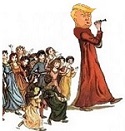
Trump, Pied PiperLast week President-elect Donald Trump announced the nomination of Jay Clayton to become U.S. Attorney for the Southern District of New York – the regional office of the U.S. Department of Justice that brings (or passes on bringing) criminal prosecutions against the Wall Street megabanks for their serial looting of the American people.

In Trump’s first term as President, Clayton was tapped by Trump to serve as Chairman of the Securities and Exchange Commission – notwithstanding that Clayton had represented 8 of the 10 largest Wall Street banks in the prior three years as a law partner at Sullivan & Cromwell, one of the oldest Wall Street go-to law firms. Clayton returned to Sullivan & Cromwell after his stint at the SEC and currently serves there as Senior Policy Advisor and Of Counsel.

When Clayton’s name was first announced by Trump to be SEC Chair in early January 2017, Senator Sherrod Brown, then the Democrat’s ranking member of the Senate Banking Committee, issued the following statement:

“It’s hard to see how an attorney who’s spent his career helping Wall Street beat the rap will keep President-elect Trump’s promise to stop big banks and hedge funds from ‘getting away with murder.’ I look forward to hearing how Mr. Clayton will protect retirees and savers from being exploited, demand real accountability from the financial institutions the SEC oversees, and work to prevent another financial crisis.”

Our Revolution, the organization created by supporters of Senator Bernie Sanders after his failed bid for the Presidency, ramped up the heat against Clayton serving as SEC Chair with an email blast asking Sanders’ supporters to sign a petition against Clayton. The email message read in part:

“Clayton’s ties to Wall Street are deep. His law firm specializes in protecting Wall Street banks, and during the financial crisis he worked as a bailout attorney for Goldman Sachs, where his wife works today…The SEC chair is supposed to referee Wall Street banks, but Clayton has spent his entire career protecting their interests – and more than half of his family income currently comes from one of them. How can he be trusted to suddenly switch sides and put working Americans first?”

The link to the petition called this a “hostile takeover” of America. That hostile takeover now looks like a warm, cuddly blanket compared to what Trump is unleashing today. Saturday Night Live’s James Austin Johnson, playing Trump, described his cabinet picks as follows: “…I am very fastly picking the most epic cabinet of all time. They’re some of the most dynamic, free-thinking, animal killing, sexually criminal, medically crazy people in the country.” Saturday Night Live forgot to reference Fox News host Pete Hegseth, the man Trump has nominated to be Secretary of Defense and head the U.S. military and Pentagon, despite his tattoos espousing white supremacy rhetoric.

Most notable about the current Trump nomination of Clayton is that this is not the first time that Trump has attempted to put this deeply conflicted man – who has zero experience as a criminal prosecutor – in charge of the federal prosecutor’s office that handles criminal prosecutions of Wall Street. The first time was more of an attempted coup d’état rather than an appointment. Here are the hubristic details of what went down with Clayton in Trump’s last year in office as President – six months before Trump fueled the insurrection on the U.S. Capitol building on January 6, 2021.

Shortly after 9 p.m. on June 19, 2020, the then U.S. Attorney General, William Barr, blindsided prosecutors in the Southern District of New York with the announcement that their boss, Geoffrey Berman, was stepping down as U.S. Attorney and would be replaced with the sitting SEC Chairman, Jay Clayton.

What Barr had not foreseen was that Berman had no intention of being ousted quietly. In fact, he would later write a tell-all book on the experience. Berman writes the following in Holding the Line: Inside the Nation’s Preeminent US Attorney’s Office and Its Battle with the Trump Justice Department:

“Throughout my tenure as U.S. attorney, Trump’s Justice Department kept demanding that I use my office to aid them politically, and I kept declining — in ways just tactful enough to keep me from being fired.”

Two hours after Barr’s announcement, Geoffrey Berman released his own statement indicating that the U.S. Attorney General had just told a brazen lie to the American people. Berman’s statement was this: “I learned in a press release from the Attorney General tonight that I was ‘stepping down’ as United States Attorney.  I have not resigned, and have no intention of resigning my position, to which I was appointed by the Judges of the United States District Court for the Southern District of New York.”

The next day, Barr issued another statement indicating that President Trump was removing Berman from his post but would leave Berman’s Deputy in charge of the office on an interim basis. Barr had stated the prior Friday evening that he would be putting in Craig Carpenito, the sitting U.S. Attorney for the District of New Jersey, as acting head of the office until Clayton’s confirmation hearing. The acknowledgement by Barr that Berman’s Deputy would fill the post until a confirmation occurred appeased Berman and he agreed to step down.

The same day, then Senate Judiciary Committee Chairman Lindsey Graham, Republican of South Carolina, released a statement indicating that he would not move forward on Clayton’s nomination without the standard policy of getting a go-ahead from the two Senators of the state where the new U.S. Attorney will serve, i.e., New York. That meant that Senators Chuck Schumer and Kirsten Gillibrand would have to give the greenlight to Clayton. Instead, Schumer released the following statement:

“Forty seven years ago, Elliott Richardson had the courage to say no to a gross abuse of presidential power. Jay Clayton has a similar choice today: He can allow himself to be used in the brazen Trump-Barr scheme to interfere in investigations by the U.S. Attorney for the Southern District of New York, or he can stand up to this corruption, withdraw his name from consideration, and save his own reputation from overnight ruin.”

According to the New York Times, Senator Gillibrand had also stated that Clayton should withdraw his name from consideration.

That was the end of the Trump-Barr-Clayton attempted coup d’état on June 19, 2020. It was followed by the violent and deadly attempted coup d’état on January 6, 2021 at the Capitol building.

Now Trump’s plan to install Clayton in the U.S. Attorney’s Office for the Southern District of New York is back and, incredibly, Clayton looks like one of the more reasonable Trump cabinet picks – on the mere basis that he hasn’t been accused of sexually assaulting anyone or having his body decorated with white supremacy images.

What Trump is attempting to do for Wall Street’s serial miscreants today is precisely what he is planning to do for himself at Main Justice – the U.S. Department of Justice in Washington, D.C. Trump has nominated his sycophant, Matt Gaetz, to be U.S. Attorney General and his defense counsel, Todd Blanche, to be Deputy Attorney General, a position that oversees the criminal division of the U.S. Department of Justice.

Blanche represented Trump in the federal cases brought by Special Counsel Jack Smith and in the New York case where Trump was accused of attempting to illegally influence the 2016 election by paying hush money to porn star Stormy Daniels, who testified in court that the two had sex in a hotel room. According to Daniels’ statements to the media, Trump’s wife, Melania, was caring for their four-month old son, Barron, at the time. The hush money trial ended with Trump being convicted on all 34 criminal felony counts – making him the first convicted felon in U.S. history to be elected President of the United States.

In the 2020 effort by Trump to install Clayton, mainstream media focused on the fact that the U.S. Attorney’s office for the Southern District was actively investigating Trump ally, Rudy Giuliani, and Deutsche Bank, a major financial lender to Trump’s companies. That might have been relevant. But also noteworthy was the ongoing criminal investigations of two Wall Street megabanks.

Goldman Sachs was under investigation in one of the biggest financial frauds in history – a case involving a Malaysian sovereign wealth fund known as 1MDB. Goldman raised over $6 billion in bond offerings for 1MDB but, according to the Justice Department, $4.5 billion of that was “misappropriated” and used “to fund the co-conspirators’ lavish lifestyles, including purchases of artwork and jewelry, the acquisition of luxury real estate and luxury yachts, the payment of gambling expenses, and the hiring of musicians and celebrities to attend parties.” Goldman made more than $600 million in fees from the bond offerings, according to the Justice Department.

On June 6, 2020 Reuters reported that Malaysia would not accept $3 billion from Goldman to settle the case. On June 11 – just eight days before Berman was abruptly dismissed from his post — the New York Times reported the following:

“Goldman Sachs is trying to get federal prosecutors to ease up on the bank for its role in a brazen scheme to loot billions of dollars from a Malaysian sovereign wealth fund.

“Lawyers for the bank have asked Deputy Attorney General Jeffrey Rosen to review demands by some federal prosecutors that Goldman pay more than $2 billion in fines and plead guilty to a felony charge, according to three people briefed on the matter.

“The bank has sought to pay a lower fine and avoid a guilty plea, according to the people, who spoke on condition of anonymity because the talks are continuing.”

What most Americans have never heard about in this famous case is that Clayton’s law firm, Sullivan & Cromwell, was involved in making some of those luxury purchases on behalf of the gang of alleged criminals who looted 1MDB, according to the U.S. Department of Justice.

Sullivan & Cromwell’s name makes seven appearances in the criminal complaint filed in court by the Justice Department.

While Sullivan & Cromwell is named 7 times in the complaint, the giant law firm Shearman & Sterling is mentioned 94 times. Shearman & Sterling has represented Goldman Sachs and other Wall Street banks on numerous occasions.

Something else that the public does not know is that a unit of JPMorgan Chase, a bank that has pleaded guilty to five criminal felony counts, is named 61 times in the 1MDB complaint for its role in wiring the looted funds. While the Justice Department did not bring charges against J.P. Morgan in the matter, the Swiss regulator, FINMA, found in 2017 that the bank had committed serious anti-money laundering breaches in its handling of monies belonging to 1MDB.

Just three months after the attempted Clayton coup, the U.S. Department of Justice gave JPMorgan Chase a deferred prosecution agreement for two criminal felony counts involving sprawling crimes in the trading of precious metals and U.S. Treasuries. But instead of the case being brought by the U.S. Attorney’s Office for the Southern District of New York – where JPMorgan’s trading desks are located – the case was inexplicably handled by the District of Connecticut.


WALL STREET ON PARADE

Thursday, August 15, 2024

$28 TRILLION AT RISK! Exposure at Hedge Funds Has Skyrocketed to Over $28 Trillion; Goldman Sachs, Morgan Stanley and JPMorgan Are at Risk


SUBSCRIBE TO THIS NEWSLETTER TO RECEIVE TIMELY REPORTS!

THERE'S ALWAYS A JEFFREY EPSTEIN CONNECTION!


Exposure at Hedge Funds Has Skyrocketed to Over $28 Trillion; Goldman Sachs, Morgan Stanley and JPMorgan Are at Risk

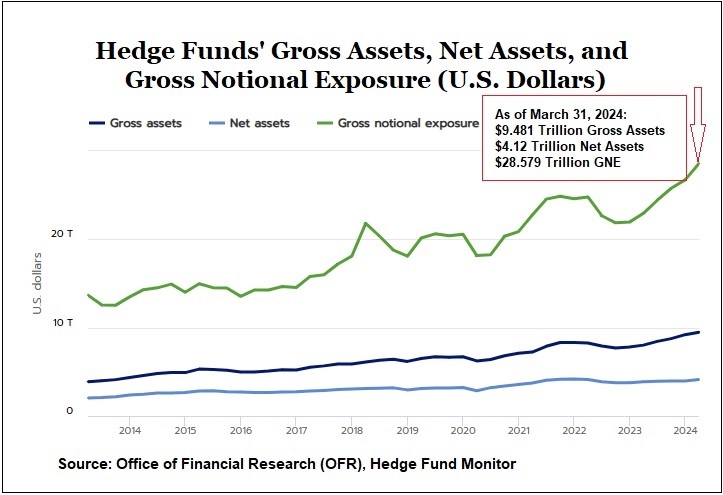
Hedge Funds' Gross Assets, Net Assets and Gross Notional Exposures

By Pam Martens and Russ Martens: August 12, 2024 ~

According to a report at the U.S. Treasury’s Office of Financial Research (OFR), the Gross Notional Exposure at hedge funds has skyrocketed by 24.5 percent in the span of one year: from $22.946 trillion on March 31, 2023 to $28.579 trillion on March 31, 2024. (Run your cursor along the top green line at this link to observe the stunning growth in hedge fund exposures despite the banking crisis in the spring of 2023 when the second, third and fourth largest banks blew up.)

Gross Notional Exposure (GNE) is defined by OFR as “the sum of the absolute value of long and short exposures, including those on and off the balance sheet.”

The OFR was created under the Dodd-Frank financial reform legislation of 2010 to keep bank and market regulators informed of growing risks, in the hope of preventing another financial crisis like that of 2007-2010 from occurring.

Unfortunately, Wall Street’s lobbying, bullying and regulatory capture has exponentially outstripped the clout of the OFR. As a result, all that the public can do is read about the potentially catastrophic risks inherent on Wall Street today at the OFR’s website and wonder when the next blowup and Fed bailout will occur. (See our report: Former New York Fed Pres Bill Dudley Calls This the First Banking Crisis Since 2008; Charts Show It’s the Third.)

The OFR carries this mild statement as to what can go wrong at over-leveraged hedge funds: “…Leveraged hedge funds are dependent on creditors’ willingness and ability to continue to lend. Further, declines in collateral and asset values can lead to margin calls that require hedge funds to tap their liquid assets….”

Allow us to fill in the gaps in that statement. The largest megabanks on Wall Street – which since the repeal of the Glass-Steagall Act in 1999 are also allowed to own taxpayer-backstopped, federally-insured, deposit-taking banks – are the major source of providing that leverage to hedge funds. This hedge fund lending and servicing operation at the megabanks is given the benign title of “Prime Broker.”
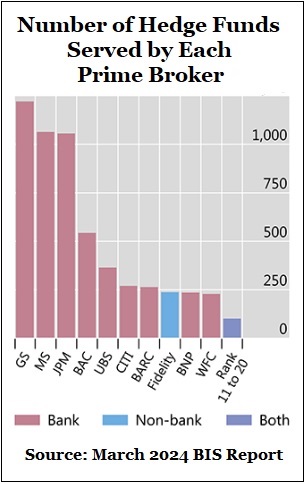
Number of Hedge Funds Served by MegabanksAccording to a March 4 report from the Bank for International Settlements, the Prime Broker operations of Goldman Sachs (GS), Morgan Stanley (MS), and JPMorgan Chase (JPM) (all U.S. financial institutions which own federally-insured banks) were each servicing more than 1,000 hedge funds as of 2022. (See chart to the right from that report.)

Making this situation even more outrageous, each of these megabanks has a notorious reputation for mismanaging risk in their relationships with hedge funds in the past.

Let’s start with Morgan Stanley. During the 2008 financial crisis, Morgan Stanley owned a hedge fund called FrontPoint Partners, which was shorting subprime collateralized debt obligations (CDOs) filled with subprime residential mortgages. To be more precise, FrontPoint was hoping to profit on American homeowners being unable to pay their tricked-up mortgages and being thrown out on the street.

FrontPoint was also gleefully betting that the biggest banks on Wall Street would collapse. Michael Lewis writes in his bestselling book, The Big Short, that FrontPoint was shorting “Bank of America, along with UBS, Citigroup, Lehman Brothers, and a few others.” Lewis notes that “They weren’t allowed to short Morgan Stanley because they were owned by Morgan Stanley, but if they could have, they would have.”

And while Morgan Stanley’s own hedge fund, FrontPoint, was shorting subprime and the Wall Street banks, the Federal Reserve was infusing $16 trillion cumulatively in secret revolving loans to shore up the Wall Street banks, including $2.04 trillion in revolving loans to Morgan Stanley. (See Table 8 of the GAO report here.)

A footnote in the GAO report tells us this: “Morgan Stanley funds include TALF borrowing by funds managed by FrontPoint LLC, which was owned by Morgan Stanley at the time TALF operated.” TALF was one of the numerous emergency lending programs created by the Fed during the 2007-2010 financial crisis.

According to Fed data, FrontPoint received over $4 billion of Morgan Stanley’s $9.3 billion in TALF loans. While Morgan Stanley was the second largest recipient of total Fed emergency lending programs, it was the number one borrower under TALF with 43 percent of those funds going to FrontPoint.

How risky was Morgan Stanley at the time the Fed was flooding it with emergency lending? According to the Financial Crisis Inquiry Commission report on the 2007-2010 crisis, both Lehman Brothers (which went bankrupt) and Morgan Stanley had reached leverage ratios of 40:1 by the end of 2007 – “meaning for every $40 in assets, there was only $1 in capital to cover losses. Less than a 3% drop in asset values could wipe out a firm.”

Next, let’s consider how Goldman Sachs was interacting with a hedge fund going into the Wall Street collapses of 2008.

John Paulson is the founder of the hedge fund Paulson & Co. On April 16, 2010, the Securities and Exchange Commission announced formal charges against Goldman Sachs pertaining to the infamous 2007 ABACUS deal: “The SEC alleges that one of the world’s largest hedge funds, Paulson & Co., paid Goldman Sachs to structure a transaction in which Paulson & Co. could take short positions against mortgage securities chosen by Paulson & Co. based on a belief that the securities would experience credit events.” Translation, Paulson helped Goldman select dodgy investments that were likely to default or receive credit downgrades and then made easy bets that they would.

The SEC complaint goes on: “…after participating in the portfolio selection, Paulson & Co. effectively shorted the RMBS [Residential Mortgage Backed Securities] portfolio it helped select by entering into credit default swaps (CDS) with Goldman Sachs to buy protection on specific layers of the ABACUS capital structure. Given that financial short interest, Paulson & Co. had an economic incentive to select RMBS that it expected to experience credit events in the near future. Goldman Sachs did not disclose Paulson & Co.’s short position or its role in the collateral selection process in the term sheet, flip book, offering memorandum, or other marketing materials provided to investors.”

According to the SEC’s complaint, Paulson & Co. paid Goldman Sachs approximately $15 million for structuring and marketing ABACUS. By October 2007, 83 percent of the bonds in the portfolio had been downgraded and 17 percent were on negative watch. By Jan. 29, 2008, 99 percent of the portfolio had been downgraded.

The SEC estimated that investors lost more than $1 billion in the ABACUS deal while Paulson profited by approximately the same amount.

On July 15, 2010, the SEC announced that Goldman Sachs would pay $550 million to settle its ABACUS charges. Fabrice Tourre, a young Goldman investment banker involved in the deal, was the only person to face a civil trial. No one was criminally prosecuted. John Paulson walked free – ostensibly because he didn’t actually sell the product or misrepresent it to investors – he just stacked the deck against investors and, apparently, that’s not a big deal in the eyes of the SEC.

As one more example of the dystopian world in which we now live, there were media reports in March that Donald Trump was considering John Paulson as his Treasury Secretary if he won the presidential election in November.

And then there is JPMorgan Chase – the poster boy for everything that is wrong with the U.S. financial system today. JPMorgan Chase has the distinction of admitting to five criminal felony counts brought by the U.S. Department of Justice since 2014 while still being allowed by its regulators to grow wildly in scope and size.

Under the Dodd-Frank financial “reform” legislation, banks were required to relinquish their ownership of hedge funds. But instead, JPMorgan Chase retained its stake in the hedge fund, Highbridge Capital Management, whose sale to the bank was brokered by the sex trafficker of children, Jeffrey Epstein, who remained a pampered client at the bank for more than 15 years, despite his serving jail time and being placed on a sex-offender registry.

The now settled federal lawsuit brought by the Attorney General of the U.S. Virgin Islands alleged that JPMorgan Chase had “actively participated” in Epstein’s sex trafficking. A  Memorandum of Law arguing for partial summary judgment in the case, makes the following points:

“Even if participation requires active engagement…there is no genuine dispute that JPMorgan actively participated in Epstein’s sex-trafficking venture from 2006 until 2019. The Court found allegations that the Bank allowed Epstein to use its accounts to send dozens of payments to then-known co-conspirators [redacted] provided excessive and unusual amounts of cash to Epstein; and structured cash withdrawals so that those withdrawals would not appear suspicious ‘went well beyond merely providing their usual [banking] services to Jeffrey Epstein and his affiliated entities’ and were sufficient to allege active engagement.”

The U.S. Virgin Islands’ attorneys cite to internal emails at JPMorgan Chase showing that employees at the bank were aware of Epstein’s “[c]ash withdrawals … made in amounts for $40,000 to $80,000 several times a month” while also being aware that Epstein paid his underage sexual assault victims in cash.

JPMorgan Chase’s involvement in the Epstein sex trafficking ring was also alleged in a class action lawsuit against JPMorgan Chase brought by lawyers David Boies and Bradley Edwards on behalf of Epstein’s victims. (JPMorgan Chase paid $290 million to settle that case last year.) At a March 13, 2023 court hearing in the case, Boies argued in open court that JPMorgan Chase had used a private jet owned by its hedge fund, Highbridge Capital Management, to transport girls for Epstein’s sex trafficking operation. A January 13, 2023 amended complaint filed by Boies’ law firm provided the following details on that allegation:

“As another example of JP Morgan and [Jes] Staley’s benefit from assisting Epstein, a highly profitable deal for JP Morgan was the Highbridge acquisition.

“In 2004, when Epstein’s sex trafficking and abuse operation was running at full speed, Epstein served up another big financial payday for JP Morgan.

“Epstein was close friends with Glenn Dubin, the billionaire who ran Highbridge Capital Management.

“Through Epstein’s connection, it has been reported that Staley arranged for JP Morgan to buy a majority stake in Dubin’s fund, which resulted in a sizeable profit for JP Morgan. This arrangement was profitable for both Staley and JPMorgan, further incentivizing JP Morgan to ignore the suspicious activity in Epstein’s accounts and to assist in his sex-trafficking venture.

“For example, despite that Epstein was not FINRA-certified, Epstein was paid more than $15 million for his role in the Highbridge/JP Morgan deal.

“Moreover, Highbridge, a wholly-owned subsidiary of JP Morgan, trafficked young women and girls on its own private jet from Florida to Epstein in New York as late as 2012.”

There appears to be little to no guardrails or moral compass on Wall Street in its pursuit of profits. That will doom both it and the U.S. economy if federal regulators continue to stand down.

 

WALL STREET ON PARADE


Monday, June 24, 2024

The Fed and FDIC Wake Up Suddenly to the Threat of Derivatives, Flunking the Four Largest Derivative Banks on their Wind-Down Plans


SUBSCRIBE TO THIS NEWSLETTER TO RECEIVE TIMELY REPORTS!


The Fed and FDIC Wake Up Suddenly to the Threat of Derivatives, Flunking the Four Largest Derivative Banks on their Wind-Down Plans

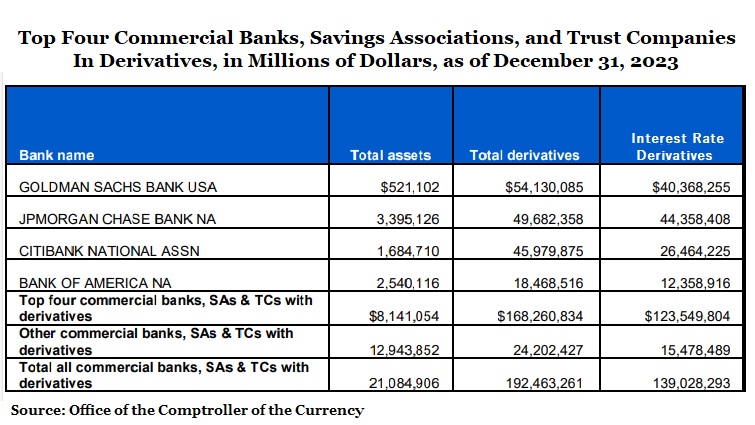
Four Megabanks' Exposure to Interest Rate Derivatives

By Pam Martens and Russ Martens: June 24, 2024 ~

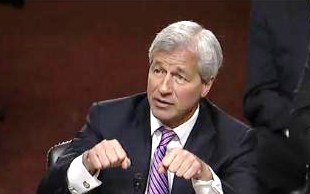
Jamie Dimon, Chairman and CEO of JPMorgan Chase, Testifying at Senate Banking Hearing on the Bank’s London Whale Scandal on June 13, 2012

Since the financial crash of 2008 and the Fed’s multi-trillion dollar bank bailouts that followed, the Office of the Comptroller of the Currency (OCC) has been waving a giant red flag every quarter in its “Bank Trading and Derivatives Activities” reports. For sixteen years the OCC has been reporting that just four megabanks are responsible for more than 80 percent of the trillions of dollars in bank derivatives.

As the chart above shows, as of December 31, 2023, Goldman Sachs Bank USA, JPMorgan Chase Bank N.A., Citigroup’s Citibank and Bank of America held a staggering total of $168.26 trillion in derivatives out of a total of $192.46 trillion at all U.S. banks, savings associations and trust companies. That’s four banks holding 87 percent of all derivatives at all 4,587 federally-insured institutions in the U.S. that existed as of December 31, 2023.

Now, it would appear, some market-savvy bank examiner embedded in one of those megabanks has had an epiphany and decided to ask the question: “How is it possible that all four of these megabanks with trillions of dollars in derivatives happened to be on the correct sides of these trades during the fastest and steepest interest rate increases in 40 years?” Multiple bank counterparties to these trades should be reporting massive losses and yet all we hear are crickets.

This puzzle becomes all the more urgent if you take a closer look at the above chart and notice that $40.368 trillion of Goldman Sachs Bank USA’s $54.13 trillion in derivatives are interest rate derivatives, or 75 percent. JPMorgan Chase’s interest rate derivatives represent 89 percent of its total of $49.68 trillion in derivatives.

The OCC report for the quarter ending December 31, 2023 also shows that $20.8 trillion of these interest rate derivative contracts at these four megabanks have maturities in excess of five years – a very long time to climb out on a limb on interest rate decisions by the Fed.

On Friday, the Federal Deposit Insurance Corporation (FDIC) and the Federal Reserve Board jointly released their findings on the resolution or wind-down plans in a potential bankruptcy of the eight megabanks in the U.S. The plans are also known as “living wills.”

It came as no surprise to us that the four largest U.S. derivative banks — JPMorgan Chase, Citigroup’s Citibank, Bank of America and Goldman Sachs — were faulted on shortcomings in how they planned to wind down their derivatives. The surprise was that the Fed – which has a gold-plated revolving door to these banks – would acknowledge the derivatives problem after years of ignoring it.

The Fed and FDIC wrote the following in their letter to Jamie Dimon, the Chairman and CEO of JPMorgan Chase, which regulators already acknowledge is the riskiest bank in the U.S. (but nonetheless allowed it to get even bigger and riskier in May of last year by rubber-stamping its purchase of the collapsed First Republic Bank):

“The Agencies found the Covered Company’s 2023 Plan to have a shortcoming related to the implementation of its derivatives unwind strategy. An assessment of the Covered Company’s capability to unwind its derivatives portfolio under conditions that differed from those specified in the 2023 Plan revealed some weaknesses in the refresh of and approach to compiling financial results. This, in turn, raises questions about the firm’s ability to implement this aspect of its preferred strategy in an actual resolution event. Specifically, in response to a capabilities test initiated by the Agencies, the response from the firm showed that the firm is unable to update certain economic conditions in its entity-level-resource-needs calculation of resolution capital execution need (RCEN) and resolution liquidity execution need (RLEN) associated with unwinding its derivatives portfolio in a timely manner. Furthermore, the firm did not accurately incorporate funding assumptions as specified by the Amended and Restated Support Agreement dated June 5, 2019, as amended, in the current resolution metrics production process. To remediate this shortcoming, the Covered Company’s 2025 Plan should demonstrate, including through reporting in the 2025 Plan on internal validation and testing conducted by the Covered Company, that the Covered Company has developed the ability to quantify each material legal entity’s RLEN and RCEN for changes in macro/financial market conditions, calculate recapitalization needs for a macro scenario change in a timely way, and provide for downstream liquidity and capital funding needs according to the terms of the Amended and Restated Support Agreement. The Covered Company should develop and submit to the Agencies by September 1, 2024, a description of the key actions needed to remediate this shortcoming and a timeline illustrating the date of their expected completion.”

Adding to the hubris, this is now the second time in eight years that federal regulators have told Dimon to get his act together in dealing with derivatives if the bank has to wind-down operations. In a letter dated April 12, 2016, the Fed and the FDIC faulted the bank on its trading and derivative plans. The letter was apparently so frightening that numerous segments were redacted by the two federal regulators by blacking out the text.

The Fed and FDIC appear like indulgent parents of an out-of-control teen when it comes, particularly, to JPMorgan Chase, Jamie Dimon and derivatives. This is, after all, the bank that triggered an in-depth investigation by the U.S. Senate’s Permanent Subcommittee on Investigations in 2012-2013 for gambling in derivatives in London using deposits from its federally-insured bank and losing $6.2 billion of its depositors’ money. This became infamously known as the bank’s “London Whale” scandal.

Dimon was hauled before the Senate Banking Committee on June 13, 2012 to answer questions about the London Whale scandal. Instead of falling on his sword or taking a humble approach to the bank’s abysmal conduct, he spoke as if he were testifying as an expert witness for the banking industry instead of the man sitting at the center of the scandal. Dimon said this in answer to a question from Senator Jerry Moran:

“We have to get rid of anything that looks like too-big-to-fail. We have to allow our biggest institutions to fail. It is part of the health of the system, and we should not prop them up. We have to allow them to fail.

“And I would go one step further. You want to be sure that they can fail and not damage the American economy and the American public. So a big bank, you want to be in a position where a big bank can be allowed to fail.

“I wouldn’t call it ‘resolution.’ I think that’s the wrong name. I think we should call it ‘bankruptcy.’ Personally, I call it ‘bankruptcy for big dumb banks.’ I think when you have bankruptcy, I’d have clawbacks. I’d fire the management. I’d fire the Board. I’d wipe out the equity and the unsecured [debt holders] should only recover whatever they recover like in a normal bankruptcy.”

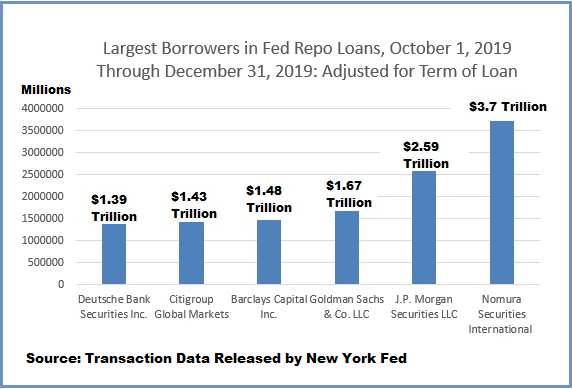
Just six years after Dimon’s “bankruptcy for big dumb banks” speech to the Senate Banking Committee, his bank began secretly taking trillions of dollars in emergency bailout loans from the Fed for a financial crisis that has yet to be explained. (See chart below.)

Fed's Repo Loans to Largest Borrowers, Q4 2019, Adjusted for Term of Loan

The four megabanks that were not faulted last Friday by the Fed or FDIC for their wind-down plans were Wells Fargo, Bank of New York Mellon, State Street and Morgan Stanley. (Morgan Stanley’s bank holding company has a monster amount of derivatives according to the OCC, however, its federally-insured banking footprint pales in comparison to JPMorgan Chase, Bank of America and Citigroup’s Citibank.)


WALL STREET ON PARADE


Monday, June 10, 2024

Nvidia Hit a $3 Trillion Market Cap Last Week; Dark Pools Are Making Over 300,000 Trades in the Stock Weekly


SUBSCRIBE TO THIS NEWSLETTER TO RECEIVE TIMELY REPORTS!

PLEASE READ & SHARE! THIS IS AN ISSUE BEING OVERLOOKED & IGNORED!


Nvidia Hit a $3 Trillion Market Cap Last Week; Dark Pools Are Making Over 300,000 Trades in the Stock Weekly

By Pam Martens and Russ Martens: June 10, 2024 ~

The much-hyped artificial intelligence chipmaker, Nvidia (ticker NVDA), reached a market cap of $3 trillion on Thursday, beating out Apple as the second most valuable company, just behind Microsoft. This morning, Nvidia’s 10-for-1 stock split will become effective, reducing its share price to, ideally, entice more retail investors.

Year-to-date, Nvidia’s stock price is up 144 percent through the closing bell on Friday.

The company was founded on April 5, 1993 and lived the bulk of its existence in obscurity until a New York Times article appeared on September 1, 2017 with this headline: “Why a 24-Year-Old Chipmaker Is One of Tech’s Hot Prospects.”

Browsing the company’s prolific newsroom reveals no shortage of bold pronouncements. A June 2 press release carries this seismic prediction:

“The next industrial revolution has begun. Companies and countries are partnering with NVIDIA to shift the trillion-dollar traditional data centers to accelerated computing and build a new type of data center — AI factories — to produce a new commodity: artificial intelligence….”

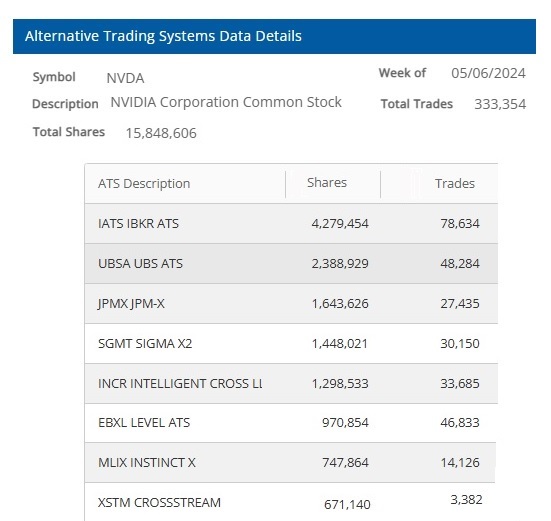
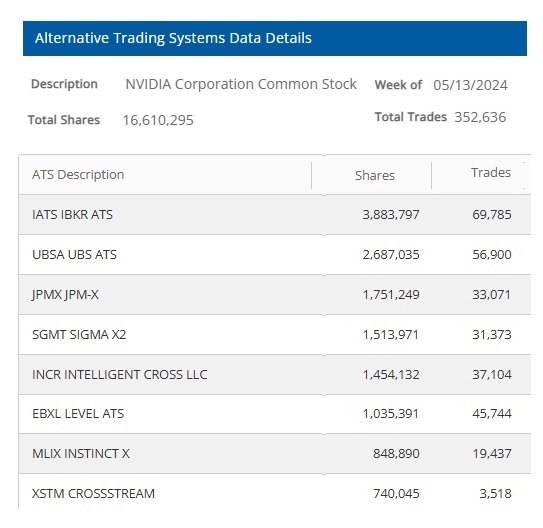
Our first instinct was to take a look to see how much trading in Nvidia’s shares is occurring in Dark Pools – non-transparent trading platforms operated by some of the biggest trading houses on Wall Street (which are also, insanely, allowed to own some of the largest federally-insured U.S. commercial banks which hold trillions of dollars in deposits).

Wall Street’s self-regulator, FINRA, began providing some Dark Pool data back in 2014. Unfortunately, the trading data for each Dark Pool and the respective stock it is trading is lumped together for the entire week, not by the minute or hour or day, and the data arrives to the public two weeks late for big cap stocks and four weeks late for smaller companies.

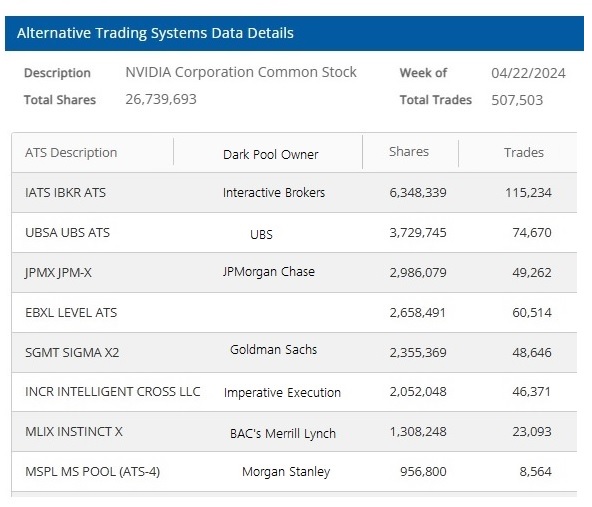
The charts below show the top eight Dark Pools that made the largest number of trades in Nvidia’s stock for a recent three weeks that FINRA has made trading data available. The Dark Pool owned by Interactive Brokers has consistently been the largest trader of Nvidia’s shares. In second and third place has been global banking behemoths UBS and JPMorgan, respectively. Dark Pools owned by other global trading powerhouses, Goldman Sachs, Morgan Stanley, and Bank of America’s Merrill Lynch, have also ranked in the top eight.

Interestingly, JPMorgan has shelled out $250 million in fines to the Office of the Comptroller of the Currency; $98.2 million to the Federal Reserve and $100 million (netted down from $200 million) to the Commodity Futures Trading Commission since March for failing to provide proper surveillance of “billions” of trades. The regulators were deafeningly silent on whether JPMorgan’s Dark Pools were involved in these infractions. (See here, here and here.)

Following the stock market crash of 1929 (which ushered in the Great Depression), the U.S. Senate Banking Committee conducted an exhaustive investigation into the trading structure and trading practices on Wall Street. The titans of Wall Street were put under oath and troves of documents were subpoenaed. The Senate investigations focused on the collusive dealings of “pools.” The 1930s Senate investigation found the following:

“A pool, according to stock exchange officials, is an agreement between several people, usually more than three, to actively trade in a single security. The investigation has shown that the purpose of a pool generally is to raise the price of a security by concerted activity on the part of the pool members, and thereby to enable them to unload their holdings at a profit upon the public attracted by the activity or by information disseminated about the stock. Pool operations for such a purpose are incompatible with the maintenance of a free and uncontrolled market.”

The Senate Banking Committee of 1934 concluded as follows:

“The conclusion is inescapable that members of the organized exchanges who had a participation in or managed pools, while simultaneously acting as brokers for the general public, were representing irreconcilable interests and attempting to discharge conflicting functions. Yet the stock exchange authorities could perceive nothing unethical in this situation.”

As Wall Street On Parade has previously reported, U.S. regulators are not only allowing these quasi stock exchanges to operate in darkness, they are allowing Goldman Sachs, Bank of America Merrill Lynch, JPMorgan Chase and others to trade their own publicly-traded bank stocks in their own Dark Pools.

The U.S. stock market, once the envy of the world, remains dangerously opaque today, in no small part because of the sick revolving door structure between Wall Street and its regulators.

Congress does not feel compelled to tackle the problem because corporate media has chosen to ignore the mushrooming problem. Even after bestselling author and Wall Street veteran, Michael Lewis, went on the heavily watched 60 Minutes program on CBS in 2014 and told viewers that “The United States stock market, the most iconic market in global capitalism is rigged,” Congress and the SEC have continued to dance around the problem.

Until the public demands change, the darkness will continue to deepen in increasingly dangerous ways.


WALL STREET ON PARADE

60 Minutes Sanitizes Its Report on High Frequency Trading


By Pam Martens: April 1, 2014

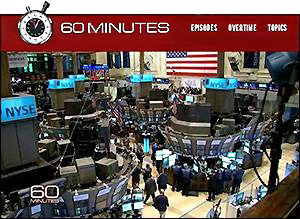
Floor of the New York Stock Exchange as Featured in 60 Minutes Report on High Frequency Trading

Two of the chief culprits of aiding and abetting high frequency traders, the New York Stock Exchange and the Nasdaq stock exchange, failed to come under scrutiny in the much heralded 60 Minutes broadcast on how the stock market is rigged.

This past Sunday night, 60 Minutes’ Steve Kroft sat down with noted author Michael Lewis to discuss his upcoming book, “Flash Boys,” and its titillating revelations about how high frequency traders are fleecing the little guy.

Kroft says to Lewis: “What’s the headline here?” Lewis responds: “Stock market’s rigged. The United States stock market, the most iconic market in global capitalism is rigged.”

Kroft then asks Lewis to state just who it is that’s rigging the market. (This is where you need to pay close attention.) Lewis responds that it’s a “combination of these stock exchanges, the big Wall Street banks and high-frequency traders.” We never hear a word more about “the big Wall Street banks” and no hint anywhere in the program that the New York Stock Exchange and Nasdaq are involved.

60 Minutes pulls a very subtle bait and switch that most likely went unnoticed by the majority of viewers. In something akin to its own “Flash Boys” maneuver, it flashes a photo of the floor of the New York Stock Exchange as Kroft says to the public that: “Michael Lewis is not talking about the stock market that you see on television every day. That ceased to be the center of U.S. financial activity years ago, and exists today mostly as a photo op.”

That statement stands in stark contrast to the harsh reality that the New York Stock Exchange is one of the key facilitators of high frequency trading and making big bucks at it.

In this Google cache of a promotional piece aimed at high frequency traders, the New York Stock Exchange explains how it is offering a “fully managed co-location space next to NYSE Euronext’s US trading engines in the new state-of-the-art data center.” Who is it for? The NYSE says it is for “High frequency and proprietary trading firms, hedge funds and others who need high-speed market access for a competitive edge.” More eye-popping details on how the New York Stock Exchange is arming high frequency traders in Mahwah, New Jersey against the little folks who can’t afford tens of thousands of dollars a year for a “competitive edge” are provided on its web site here. (The closer a high frequency trader’s computers are located to the New York Stock Exchange’s main computers, the faster their trades are executed.)

The Securities and Exchange Commission knows full well this is going on. Just this past December 24, the SEC filed this rule change in the Federal Register, announcing that the New York Stock Exchange was changing its pricing for some of its co-location services and computer cabinets for outside users. Like some kind of a half-off sale at Macy’s, the NYSE says it will offer: “a one-time Cabinet Upgrade fee of $9,200 when a User requests additional power allocation for its dedicated cabinet such that the Exchange must upgrade the dedicated cabinet’s capacity. A Cabinet Upgrade would be required when power allocation demands exceed 11 kWs. However, in order to incentivize Users to upgrade their dedicated cabinets, the Exchange proposes that the Cabinet Upgrade fee would be $4,600 for a User that submits a written order for a Cabinet Upgrade by January 31, 2014…”

The Federal Register notice also shines light on some pricing comparisons between what the NYSE is offering high frequency traders versus the Nasdaq stock market, writing: “The Exchange also believes that the Cabinet Upgrade fee is reasonable because it would function similar to the NASDAQ charges for comparable services. In particular, NASDAQ charges a premium initial installation fee of $7,000 for a ‘Super High Density Cabinet’ (between 10 kWs and 17.3 kWs) compared to $3,500 for other types of cabinets with less power.The Exchange charges only one flat rate for its initial cabinet fees ($5,000), regardless of the amount of power allocation.”

Congress is equally aware of what is going on. As far back as October 28, 2009, the U.S. Senate Banking committee took testimony from Larry Leibowitz, head of technology at the NYSE on the fact that it was offering co-location to outside trading firms. Neither the Flash Crash of 2010 or confidence-busting trading “glitches” since then have roused Congress and the SEC from their slumber.

Another opportunity emerges in the 60 Minutes broadcast for Kroft to call out the New York Stock Exchange or Nasdaq for their practices. As Kroft explains how this young former trader from the Royal Bank of Canada, Brad Katsuyama, figured out how high frequency traders were gaming the market and made appointments with institutional investors to share his insights, Kroft says “and some of the most famous names in the American stock market heard the pitch.” At this exact moment a photo of the exterior of the New York Stock Exchange flashes across the screen, giving the impression that the NYSE is some poor, naïve victim of a cartel of high frequency traders.

What is also preposterous about this 60 Minutes segment is that it deals exclusively with gaming the system through miles of fiber optic cable. That is so yesterday, according to the Futures Industry magazine. On January 24 of last year, the publication wrote that “High frequency traders can use wireless to connect to data sources or exchanges about 1.5 times faster than through fiber optics, enabling them to quote prices at tighter bid-ask spreads than rivals or execute trades more quickly than other firms. Such are the potential competitive advantages, however, that many projects are pursued behind a veil of silence.”

The article noted that San Diego-based NexxCom Wireless was building a millimeter wave network between New York, London and Frankfurt and considering connections to Zurich and Milan with the potential to add Stockholm and Moscow.

Within less than 24 hours of the big splash made by the 60 Minutes broadcast, the Wall Street Journal reported that the FBI was all over the problem and had been for a year. The question, of course, is – will anyone ever acknowledge the key role being played by the New York Stock Exchange and Nasdaq.

Related Article:

60 Minutes Takes a Pass On Wall Street’s Secret Spy Center


WALL STREET ON PARADE

Top News | 'He’s Not Going to Run Unopposed': Sanders Rejects Schumer for Majority Leader

                                                               LOTS OF POSTS IGNORED BY BLOGGER..... OR REMOVED ON THEIR WHIM! ALL POSTS ARE...