SUBSCRIBE TO THIS NEWSLETTER TO RECEIVE TIMELY REPORTS!
PLEASE READ & SHARE! THIS IS AN ISSUE BEING OVERLOOKED & IGNORED!
Nvidia Hit a $3 Trillion Market Cap Last Week; Dark Pools Are Making Over 300,000 Trades in the Stock Weekly
By Pam Martens and Russ Martens: June 10, 2024 ~
 The much-hyped artificial intelligence chipmaker, Nvidia (ticker NVDA), reached a market cap of $3 trillion on Thursday, beating out Apple as the second most valuable company, just behind Microsoft. This morning, Nvidia’s 10-for-1 stock split will become effective, reducing its share price to, ideally, entice more retail investors.
Year-to-date, Nvidia’s stock price is up 144 percent through the closing bell on Friday.
The company was founded on April 5, 1993 and lived the bulk of its existence in obscurity until a New York Times article appeared on September 1, 2017 with this headline: “Why a 24-Year-Old Chipmaker Is One of Tech’s Hot Prospects.”
Browsing the company’s prolific newsroom reveals no shortage of bold pronouncements. A June 2 press release carries this seismic prediction:
“The next industrial revolution has begun. Companies and countries are partnering with NVIDIA to shift the trillion-dollar traditional data centers to accelerated computing and build a new type of data center — AI factories — to produce a new commodity: artificial intelligence….”
Our first instinct was to take a look to see how much trading in Nvidia’s shares is occurring in Dark Pools – non-transparent trading platforms operated by some of the biggest trading houses on Wall Street (which are also, insanely, allowed to own some of the largest federally-insured U.S. commercial banks which hold trillions of dollars in deposits).
Wall Street’s self-regulator, FINRA, began providing some Dark Pool data back in 2014. Unfortunately, the trading data for each Dark Pool and the respective stock it is trading is lumped together for the entire week, not by the minute or hour or day, and the data arrives to the public two weeks late for big cap stocks and four weeks late for smaller companies.
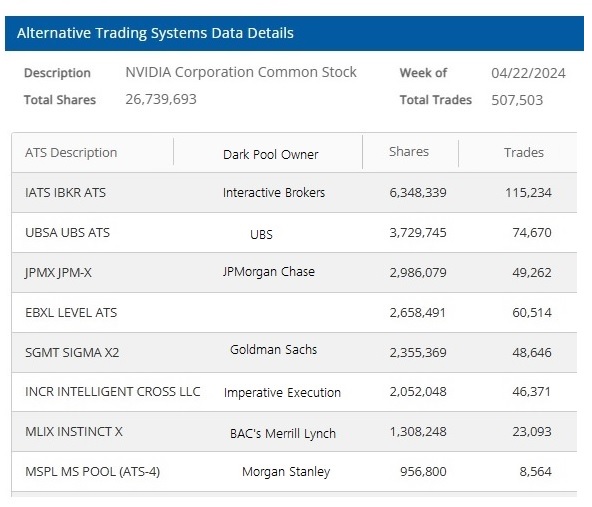
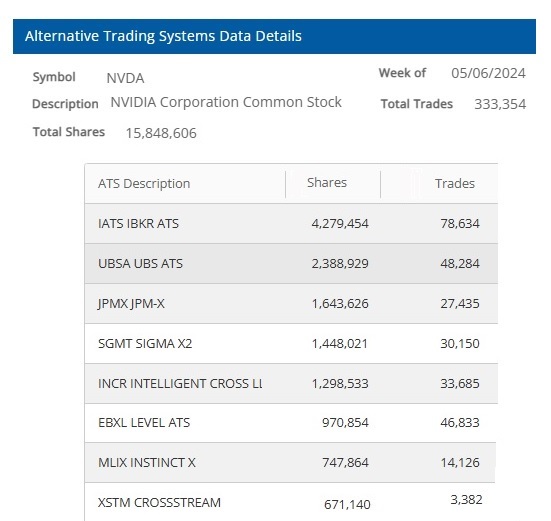
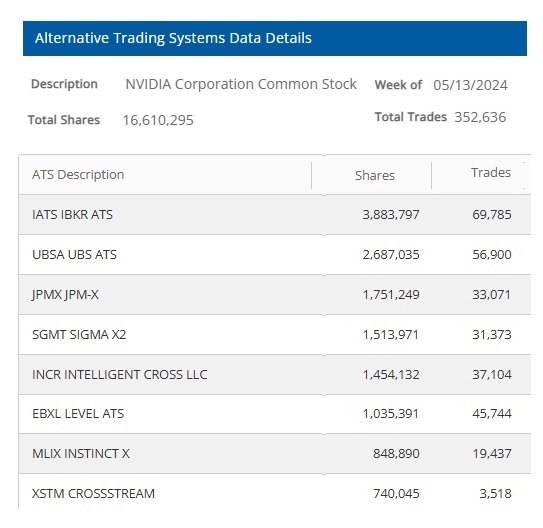
The charts below show the top eight Dark Pools that made the largest number of trades in Nvidia’s stock for a recent three weeks that FINRA has made trading data available. The Dark Pool owned by Interactive Brokers has consistently been the largest trader of Nvidia’s shares. In second and third place has been global banking behemoths UBS and JPMorgan, respectively. Dark Pools owned by other global trading powerhouses, Goldman Sachs, Morgan Stanley, and Bank of America’s Merrill Lynch, have also ranked in the top eight.
Interestingly, JPMorgan has shelled out $250 million in fines to the Office of the Comptroller of the Currency; $98.2 million to the Federal Reserve and $100 million (netted down from $200 million) to the Commodity Futures Trading Commission since March for failing to provide proper surveillance of “billions” of trades. The regulators were deafeningly silent on whether JPMorgan’s Dark Pools were involved in these infractions. (See here, here and here.)
Following the stock market crash of 1929 (which ushered in the Great Depression), the U.S. Senate Banking Committee conducted an exhaustive investigation into the trading structure and trading practices on Wall Street. The titans of Wall Street were put under oath and troves of documents were subpoenaed. The Senate investigations focused on the collusive dealings of “pools.” The 1930s Senate investigation found the following:
“A pool, according to stock exchange officials, is an agreement between several people, usually more than three, to actively trade in a single security. The investigation has shown that the purpose of a pool generally is to raise the price of a security by concerted activity on the part of the pool members, and thereby to enable them to unload their holdings at a profit upon the public attracted by the activity or by information disseminated about the stock. Pool operations for such a purpose are incompatible with the maintenance of a free and uncontrolled market.”
The Senate Banking Committee of 1934 concluded as follows:
“The conclusion is inescapable that members of the organized exchanges who had a participation in or managed pools, while simultaneously acting as brokers for the general public, were representing irreconcilable interests and attempting to discharge conflicting functions. Yet the stock exchange authorities could perceive nothing unethical in this situation.”
As Wall Street On Parade has previously reported, U.S. regulators are not only allowing these quasi stock exchanges to operate in darkness, they are allowing Goldman Sachs, Bank of America Merrill Lynch, JPMorgan Chase and others to trade their own publicly-traded bank stocks in their own Dark Pools.
The U.S. stock market, once the envy of the world, remains dangerously opaque today, in no small part because of the sick revolving door structure between Wall Street and its regulators.
Congress does not feel compelled to tackle the problem because corporate media has chosen to ignore the mushrooming problem. Even after bestselling author and Wall Street veteran, Michael Lewis, went on the heavily watched 60 Minutes program on CBS in 2014 and told viewers that “The United States stock market, the most iconic market in global capitalism is rigged,” Congress and the SEC have continued to dance around the problem.
Until the public demands change, the darkness will continue to deepen in increasingly dangerous ways.
60 Minutes Sanitizes Its Report on High Frequency Trading
By Pam Martens: April 1, 2014
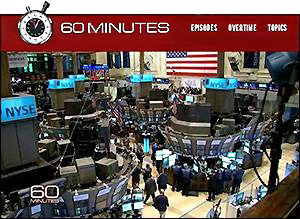
Floor of the New York Stock Exchange as Featured in 60 Minutes Report on High Frequency Trading
Two of the chief culprits of aiding and abetting high frequency traders, the New York Stock Exchange and the Nasdaq stock exchange, failed to come under scrutiny in the much heralded 60 Minutes broadcast on how the stock market is rigged.
This past Sunday night, 60 Minutes’ Steve Kroft sat down with noted author Michael Lewis to discuss his upcoming book, “Flash Boys,” and its titillating revelations about how high frequency traders are fleecing the little guy.
Kroft says to Lewis: “What’s the headline here?” Lewis responds: “Stock market’s rigged. The United States stock market, the most iconic market in global capitalism is rigged.”
Kroft then asks Lewis to state just who it is that’s rigging the market. (This is where you need to pay close attention.) Lewis responds that it’s a “combination of these stock exchanges, the big Wall Street banks and high-frequency traders.” We never hear a word more about “the big Wall Street banks” and no hint anywhere in the program that the New York Stock Exchange and Nasdaq are involved.
60 Minutes pulls a very subtle bait and switch that most likely went unnoticed by the majority of viewers. In something akin to its own “Flash Boys” maneuver, it flashes a photo of the floor of the New York Stock Exchange as Kroft says to the public that: “Michael Lewis is not talking about the stock market that you see on television every day. That ceased to be the center of U.S. financial activity years ago, and exists today mostly as a photo op.”
That statement stands in stark contrast to the harsh reality that the New York Stock Exchange is one of the key facilitators of high frequency trading and making big bucks at it.
In this Google cache of a promotional piece aimed at high frequency traders, the New York Stock Exchange explains how it is offering a “fully managed co-location space next to NYSE Euronext’s US trading engines in the new state-of-the-art data center.” Who is it for? The NYSE says it is for “High frequency and proprietary trading firms, hedge funds and others who need high-speed market access for a competitive edge.” More eye-popping details on how the New York Stock Exchange is arming high frequency traders in Mahwah, New Jersey against the little folks who can’t afford tens of thousands of dollars a year for a “competitive edge” are provided on its web site here. (The closer a high frequency trader’s computers are located to the New York Stock Exchange’s main computers, the faster their trades are executed.)
The Securities and Exchange Commission knows full well this is going on. Just this past December 24, the SEC filed this rule change in the Federal Register, announcing that the New York Stock Exchange was changing its pricing for some of its co-location services and computer cabinets for outside users. Like some kind of a half-off sale at Macy’s, the NYSE says it will offer: “a one-time Cabinet Upgrade fee of $9,200 when a User requests additional power allocation for its dedicated cabinet such that the Exchange must upgrade the dedicated cabinet’s capacity. A Cabinet Upgrade would be required when power allocation demands exceed 11 kWs. However, in order to incentivize Users to upgrade their dedicated cabinets, the Exchange proposes that the Cabinet Upgrade fee would be $4,600 for a User that submits a written order for a Cabinet Upgrade by January 31, 2014…”
The Federal Register notice also shines light on some pricing comparisons between what the NYSE is offering high frequency traders versus the Nasdaq stock market, writing: “The Exchange also believes that the Cabinet Upgrade fee is reasonable because it would function similar to the NASDAQ charges for comparable services. In particular, NASDAQ charges a premium initial installation fee of $7,000 for a ‘Super High Density Cabinet’ (between 10 kWs and 17.3 kWs) compared to $3,500 for other types of cabinets with less power.The Exchange charges only one flat rate for its initial cabinet fees ($5,000), regardless of the amount of power allocation.”
Congress is equally aware of what is going on. As far back as October 28, 2009, the U.S. Senate Banking committee took testimony from Larry Leibowitz, head of technology at the NYSE on the fact that it was offering co-location to outside trading firms. Neither the Flash Crash of 2010 or confidence-busting trading “glitches” since then have roused Congress and the SEC from their slumber.
Another opportunity emerges in the 60 Minutes broadcast for Kroft to call out the New York Stock Exchange or Nasdaq for their practices. As Kroft explains how this young former trader from the Royal Bank of Canada, Brad Katsuyama, figured out how high frequency traders were gaming the market and made appointments with institutional investors to share his insights, Kroft says “and some of the most famous names in the American stock market heard the pitch.” At this exact moment a photo of the exterior of the New York Stock Exchange flashes across the screen, giving the impression that the NYSE is some poor, naïve victim of a cartel of high frequency traders.
What is also preposterous about this 60 Minutes segment is that it deals exclusively with gaming the system through miles of fiber optic cable. That is so yesterday, according to the Futures Industry magazine. On January 24 of last year, the publication wrote that “High frequency traders can use wireless to connect to data sources or exchanges about 1.5 times faster than through fiber optics, enabling them to quote prices at tighter bid-ask spreads than rivals or execute trades more quickly than other firms. Such are the potential competitive advantages, however, that many projects are pursued behind a veil of silence.”
The article noted that San Diego-based NexxCom Wireless was building a millimeter wave network between New York, London and Frankfurt and considering connections to Zurich and Milan with the potential to add Stockholm and Moscow.
Within less than 24 hours of the big splash made by the 60 Minutes broadcast, the Wall Street Journal reported that the FBI was all over the problem and had been for a year. The question, of course, is – will anyone ever acknowledge the key role being played by the New York Stock Exchange and Nasdaq.
Related Article:
60 Minutes Takes a Pass On Wall Street’s Secret Spy Center