Showing posts with label CHENEY. Show all posts

Saturday, November 12, 2022

FOCUS: Jeremy Scahill | US Government Quietly Declassifies Post-9/11 Interview With Bush and Cheney


Reader Supported News
12 November 22

Live on the homepage now!
Reader Supported News
A HANDFUL OF DONATIONS ARE KEEPING RSN GOING — Each day the people who take a moment out of their day to make a donation to RSN are the ones keeping RSN going. It may not be a record fundraising haul but it works if the people who believe in RSN do what they can to help out. It does matter.
Marc Ash • Founder, Reader Supported News

Sure, I'll make a donation!


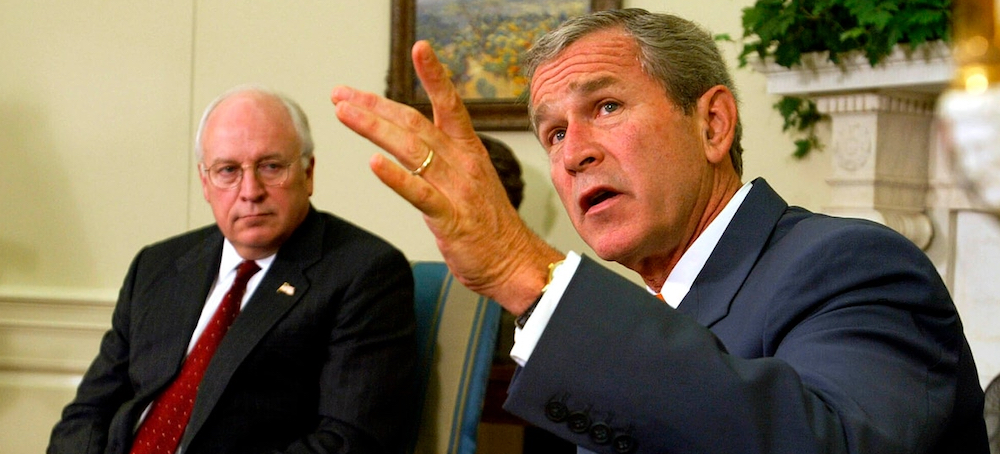
George W. Bush, right, with Richard B. Cheney at his side, speaks during a meeting with congressional leaders in the Oval Office on Sept. 18, 2002. (photo: Doug Mills/AP)
FOCUS: Jeremy Scahill | US Government Quietly Declassifies Post-9/11 Interview With Bush and Cheney
Jeremy Scahill, The Intercept
Scahill writes: On Wednesday, AS the eyes of the U.S. public were focused on Tuesday's midterm election results, a U.S. government panel quietly released a newly declassified summary of an Oval Office joint interview conducted with President George W. Bush and Vice President Dick Cheney about the September 11 attacks."


In a newly declassified interview conducted in 2004, Bush shows not a glimmer of awareness of the destruction and carnage he had unleashed on the world.

On Wednesday, as the eyes of the U.S. public were focused on Tuesday’s midterm election results, a U.S. government panel quietly released a newly declassified summary of an Oval Office joint interview conducted with President George W. Bush and Vice President Dick Cheney about the September 11 attacks. The interview, carried out by members of the 9/11 Commission, was not recorded and the summary document constitutes the only known official record of the meeting. The meeting took place on April 29, 2004.

“The President and Vice President were seated in chairs in front of the fireplace. The President’s demeanor throughout was relaxed. He answered questions without notes,” according to the document drafted by the commission’s Executive Director Philip Zelikow. “The portrait of Washington was over the fireplace, which was flanked by busts of Lincoln and Churchill. Paintings of southwestern landscapes are on the wall. It was a beautiful spring day.” The document, whose declassification was first reported by the Wall Street Journal, is not an official transcript but is described as “a memorandum for the record.” It was authorized for release by the Interagency Security Classification Appeals Panel.

One of the most striking aspects of the declassified document is the apparent absence of even a glimmer of self-awareness by Bush about the significance of the death and destruction he was unleashing with his global war. The interview took place just as a massive insurgency was erupting in Iraq against a U.S. occupation that would kill thousands of U.S. soldiers and tens of thousands of Iraqi civilians. While the document is a rough transcript and summary, Bush comes off as almost childishly simplistic in his insights and analysis. The lack of any sensitive information contained within the document should spur questions as to why it took more than 18 years to be made public.

The declassified document does not contain any groundbreaking revelations, but it does offer some new texture to the internal events immediately following the attacks. That morning, after the first plane had hit the World Trade Center, Bush was reading “The Pet Goat” with second grade students at Emma E. Booker Elementary School in Sarasota County, Florida. Bush told the commissioners that he had seen the first plane hit but thought it was an accident. “He recalled that he and others thought the building had been hit by a twin engine plane. He remembered thinking, what a terrible pilot.” Soon after the second plane hit the south tower of the World Trade Center at 9:03 a.m., chief of staff Andy Card approached Bush as he sat listening to the students reciting more passages from “The Pet Goat” and informed him that it appeared the U.S. was under attack.

The commissioners asked the commander-in-chief why he continued to sit in the classroom. “He was trying to absorb the news. He remembered a child, or someone, reading. He remembered watching the press pool and noticing them talking on their phones. He realized the country was watching his behavior. He had to send the right signals. He wanted to collect his thoughts,” according to the notes. “He felt he should project calm and strength, until he could understand better what was happening.” Bush “thought it was important to keep his body language calm in the face of danger. As the president, he was conscious that ‘people react off me.’”

Perhaps the most interesting passages from the document relate to the extent to which Cheney was empowered to effectively take command authority that morning. Bush said he was pressured to get on Air Force One, so he “made some quick remarks and blasted out of there.” Cheney, he recalled, urged him, “Don’t come home.” Cheney “told him that Washington was under attack. He strongly recommended that the President delay his return to Washington. There was no telling how much more the threat might be. The President agreed, reluctantly.” Once Cheney was at the helm inside the Presidential Emergency Operations Center, an underground bunker beneath the East Wing of the White House, he and Bush discussed the “rules of engagement” for the evolving situation, including confronting other potential hijacked aircraft. “Yes, engage the enemy. You have the authority to shoot down an airplane,” Bush reportedly told Cheney. “The President understood this from his experience in the Texas Air National Guard,” according to the notes. “He had been trained to shoot down planes. He understood generally how this worked — one plane would lock on, one would ID. He understood the consequences for the pilot, how a pilot might feel to get the order to shoot down a US airliner. It would be tough.”

The document describes a chaotic scene with communications equipment failing and Bush being overwhelmed with rumors and reports about other potential targets, including Air Force One and his private ranch in Crawford, Texas. Bush “had heard of the fog of war. That day he saw it, firsthand. He wanted to go back to D.C.” Instead, Bush was flown to Barksdale Air Force Base in Louisiana while Cheney ran things from the bunker under the White House. The document states that during this period, the secure phone line between Bush and Cheney kept failing. Bush also tried to reach Defense Secretary Donald Rumsfeld but said that “they couldn’t find him.” Bush “was very frustrated about not being able to make contact with different people.” He also complained that “there was not good television on” Air Force One. He was eventually moved to Offutt Air Force Base in Omaha, Nebraska, where he had better secure communications equipment. Bush would spend some nine hours aboard Air Force One that day and did not return to the White House until 7 p.m.

Cheney, according to the document, gave direct authorization to the military to shoot down civilian aircraft after being presented with intelligence that the planes had been hijacked. “Then they heard that an aircraft was down in Pennsylvania. The Vice President thought we’d shot it down. It took a while to sort this out. In the next half hour there were two or three occasions like this: a report of an incoming, would he reiterate authorization? Yes. In every case, though, the problem was resolved without shots being fired.” According to the declassified notes, there were five reports of additional hijackings that all turned out to be false. When one of the commissioners pressed Cheney about apparent discrepancies in the timeline of when exactly Bush gave the vice president authority to direct the shooting down of U.S. civilian planes, “The President said: Look, he didn’t give orders without my permission.”

One of the 9/11 commissioners “asked if the President or the Vice President had been involved in permitting planes carrying Saudi nationals to leave after 9/11. No, the President said. He had no idea about this until he read about it in the papers.” Cheney, the document noted, “also gave a negative answer,” but added that his answer was “hard to hear.”

Several 9/11 commissioners raised the issue of the infamous Presidential Daily Briefing from August 6, 2001, titled “Bin Laden Determined to Strike in US.” That document cites foreign intelligence indicating that Osama bin Laden “wanted to hijack US aircraft” in an effort to free Islamic extremist prisoners held by the U.S. on terror convictions. It also stated that the FBI had information “that indicates patterns of suspicious activity in this country consistent with preparations for hijackings or other types of attacks, including recent surveillance of federal buildings in New York.” Bush repeatedly rejected the notion that he had received any “actionable intelligence” and said it was just a “general assessment,” and that he had personally requested information that ultimately led to the production of that specific briefing. “It reaches the conclusion that Bin Ladin wants to attack us,” Bush told the commissioners. “Yeah, the President commented, he’s trying to do that. So is al Qaeda.” Bush claimed that none of the briefings he received “was commenting on a threat in America. There was no actionable intelligence on such a threat — not one.” Bush told the commissioners that CIA Director George Tenet told him, “The threat was overseas — that was what George said.” Bush “said he thought that if there had been a serious concern in August [2001], he would have known about it.”

The declassified document also contains some reflections from Bush and Cheney on the initial stages of the so-called war on terror. Bush complained that U.S. allies were reluctant to join in the global assassination program implemented after 9/11. “On bringing terrorists to justice, their approach was not as tough as ours. Foreign governments were less willing to kill them, to go after them in the remote places of the world. Our own agencies, the President said, were pretty darn robust.”

Cheney also decried congressional oversight of covert operations, particularly those run by the CIA, saying it had weakened the agency. “The standards that had been applied to the intelligence community had left them inclined to be risk averse. The penalties were high for getting involved in actions that might later be judged to be inappropriate,” the notes read. Cheney “mentioned the example of having nasty people on the CIA payroll. The officials then try to be careful; they don’t take things on.” Throughout his political career, Cheney was notorious for despising congressional oversight of U.S. covert operations. Five days after 9/11, he said on NBC’s “Meet the Press,” “We also have to work, though, sort of the dark side, if you will. We’ve got to spend time in the shadows in the intelligence world. A lot of what needs to be done here will have to be done quietly, without any discussion, using sources and methods that are available to our intelligence agencies.”

When asked how the U.S. could “make the country less vulnerable to attack,” Bush “said they were trying to kill a lot of the enemy. They are killers. We had to kill them before they kill us.”

The document also describes some of the White House efforts to cajole Muslim nations, like Saudi Arabia and Pakistan, into supporting a much wider U.S. war. The Saudis, Bush asserted, were “unhappy” with the U.S. position on Israel, and “Pakistan was too close to the Taliban. They had to change Pakistan’s behavior. But the country was smothered in congressional sanctions; there were no carrots they could use. After 9/11 this changed.” In the case of both nations, the document notes that following alleged Al Qaeda attacks against them, they fell more in line with the White House’s wishes. “The enemy helped give us an opportunity,” according to the document. In Pakistan there were two assassination attempts on President Pervez Musharraf in December 2003. “That helped him change some more.” In Saudi Arabia, Al Qaeda took responsibility for the May 2003 bombing of a series of residential compounds in Riyadh, including one operated by the U.S. private military contractor Vinnell Corporation. “After that, the Saudis were better warfighters.”

In an unusual admission, the document states that Bush acknowledged that the U.S. economic sanctions on Iraq were “recruiting terrorists. Their propaganda with reports of starving Iraqi children were hurting us.”

Bush also told the commissioners that working with Vladimir Putin, who had assumed the presidency in Russia in 2000, “was important,” especially to facilitate the use by U.S. military and intelligence of bases in central Asia, including Uzbekistan, to stage its operations in Afghanistan. “He spoke with Putin about this in the summer of 2001. He remembered Putin complaining about Pakistan — and about Saudi Arabia — being safe havens for the terrorists, urging the need to find the source of these problems.” Developing a better relationship with Putin and Russia, Bush said, “would make it easier for the U.S. to base activity in the ‘Stans.’ This was hard for Russia historically, to accept.”

The document describes a lengthy discussion on why the U.S. did not actively try to kill bin Laden before 9/11. Bill Clinton did sign a presidential finding to kill bin Laden and authorized a missile attack against a suspected Al Qaeda camp in Afghanistan in 1998 following the bombing of the U.S. embassies in Kenya and Tanzania. Without directly criticizing Clinton, Bush decried the launching of cruise missiles in an effort to assassinate bin Laden. Bush “said he was concerned about an empty response that Bin Ladin and others would use to propaganda advantage,” according to the notes. “If that had been ineffective, the enemy would have used it to show their ability to thwart U.S. technology and military might.” Bush “said you must use ground forces for a job like this.”

As the commissioners questioned Bush about why he did not authorize military activity to kill bin Laden in the months before 9/11, Bush mentioned that he had recently spoken with British Prime Minister Tony Blair who observed that “they were being criticized for not launching a preemptive attack against Afghanistan. And they were criticized for preemptively attacking Iraq.” Blair allegedly told Bush that if the president had said “before 9/11 that he wanted to put forces in Afghanistan, he — Blair — would have been floored. ‘I would have looked at you like a nut,’ Blair said. There was an appetite for a ‘throat slit’ (killing Bin Ladin), not a war footing.” With no apparent sense of the lethal irony present, Bush told the commissioners, “A president can’t force preemptive war without a cause. The country didn’t like war. ‘I don’t like it either,’ the President said.”

According to the document, the commissioners discussed 9/11 “conspiracy theories” with Bush, and the president said he had seen some, including ones that “were worse than anything he had seen coming out of even the John Birch Society in Midland, Texas.” Commissioner Richard Ben-Veniste told Bush that the commission “wanted to deal with as many of these conspiracy themes as possible. Their goal was to make the country safer.”


READ MORE


Contribute to RSN

Follow us on facebook and twitter!

Update My Monthly Donation

PO Box 2043 / Citrus Heights, CA 95611


Thursday, July 1, 2021

POLITICO NIGHTLY: What comes next for the Trump Org.?


POLITICO Nightly logo

BY MYAH WARD

Presented by

AARP

INDICTED — It’s official: The Trump Organization has been charged with criminal conspiracy, grand larceny, falsifying business records and tax fraud, and its longtime CFO, Allen Weisselberg, was escorted into a Manhattan courtroom this afternoon, where he pleaded not guilty to a variety of financial crimes that carry significant prison sentences.

The indictments, which allege the tax-fraud scheme ran over the course of at least 15 years, come after prosecutors spent more than two years probing the financial records of the Trump family-owned company.

Manhattan District Attorney Cy Vance brought the charges, working alongside New York Attorney General Letitia James. Both officials are Democrats, which is sure to provide fuel for former President Donald Trump’s claims that the investigation is politically motivated. Earlier today, the Trump Organization accused Vance of using Weisselberg as a “pawn in a scorched earth attempt to harm the former President.”

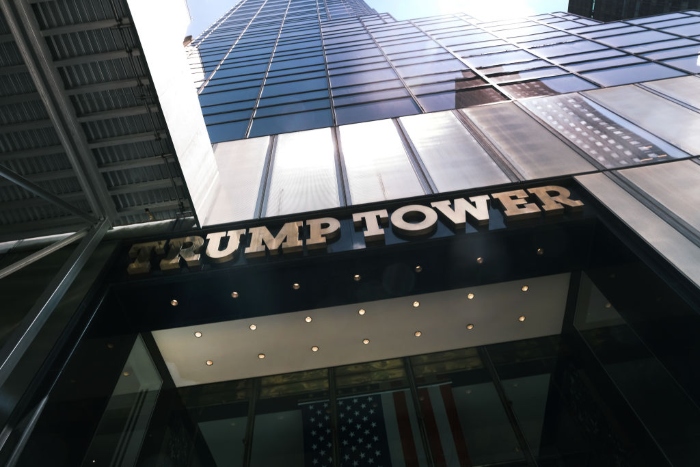
Trump Tower, home to the Trump Organization, stands along Fifth Avenue in New York City.

Trump Tower, home to the Trump Organization, stands along Fifth Avenue in New York City. | Spencer Platt/Getty Images

Nightly chatted with POLITICO’s Betsy Woodruff Swan over Slack to break down the charges, and what today’s news may mean for Trump.

Why does this matter?

Depending on how things go, it could do serious damage to Trump’s business interests. A criminal conviction could result in steep fines, loss of liquor licenses and long-term reputational damage, among other problems. And regardless of whether the company is convicted, banks and other financial institutions may be loath to continue doing business with Trump Org. because of the indictment. It’s a real problem for the company.

Did anything about the indictment surprise you?

The fact that this is Vance’s team’s opening salvo has left some observers underwhelmed. Vance has eight years of Trump’s tax returns, and has put a large and well-resourced team of prosecutors on this case. Many people were expecting more (including charges against the former president himself). The conduct as alleged is obviously egregious. But — so far! — it hasn’t lived up to some people’s expectations. That said, the investigation is ongoing and more charges could come.

Here’s what Ben Wittes — who runs Lawfare blog for the Brookings Institution and follows Trump’s legal woes very closely — told me: “If you had told me a year ago when this stuff was at the Supreme Court that this is what it would ultimately be about, I would have said, ‘Oh.’”

With the charges not mentioning Trump or his family members, what is the risk for the former president?

It’s honestly hard to say. The rest of the probe is a bit of a black box. But there’s always risk when your company as a whole is indicted.

How much of this do you think is about getting Weisselberg to cooperate with prosecutors? And how likely do you think he is to flip?

Weisselberg cooperation: I’ve heard different things from different people on the specifics of the strategy.

How likely is he to flip? He’s facing the rest of his life in prison, based on the charges they’ve brought. That’s a much longer potential sentence than some were expecting, and certainly puts him under real pressure.

Did the indictment tell us anything more about Vance’s strategy, or how he’s handling the case?

It’s notable for what’s not in it: Nothing on hush money payments, nothing on manipulation of property values, nothing on shady foreign business partners, nothing on illegal activity related to Trump’s personal taxes. So that means that either indictments related to those topics may be forthcoming, or they’re off the table altogether.

Do your sources have any predictions about what may be next?

Sadly no! People are all over the place.

We have more about the far reaching consequences of the indictment, including a piece about business risks to the Trump Organizationa look at how House Democrats lament their lack of power and an explainer on the tight connection between the former president and his organization .

Welcome to POLITICO Nightly. We won’t be publishing on Monday, July 5. But we’ll be back and better than ever Tuesday, July 6. Reach out with news, tips and ideas for us at mward@politico.com, or on Twitter at @MyahWard.

A message from AARP:

Millions of family caregivers are struggling to provide care for their older parents and spouses. Many are sacrificing their income, tapping into life savings, and taking on debt to keep their loved ones safe—at home and out of nursing homes that could put their lives at risk. Family caregivers are reaching their breaking point. Congress must pass the Credit for Caring Act now to give caregivers some of the relief they desperately need. Learn more.

 
WHAT'D I MISS?

— Cheney joins Dems on Jan. 6 probe, defying McCarthy threat: Speaker Nancy Pelosi has chosen GOP Rep. Liz Cheney to join the Democrat-led investigation of the Jan. 6 Capitol attack , a rare cross-aisle elevation of one of Trump’s most prominent conservative critics. The select committee on the insurrection will be helmed by Rep. Bennie Thompson (D-Miss.), who had previously crafted a bipartisan plan to establish an outside commission to lead the probe into the Jan. 6 violence. After Senate Republicans blocked the investigation, the House Democratic majority opted to create a new panel, which won just two Republicans on the floor on Wednesday.

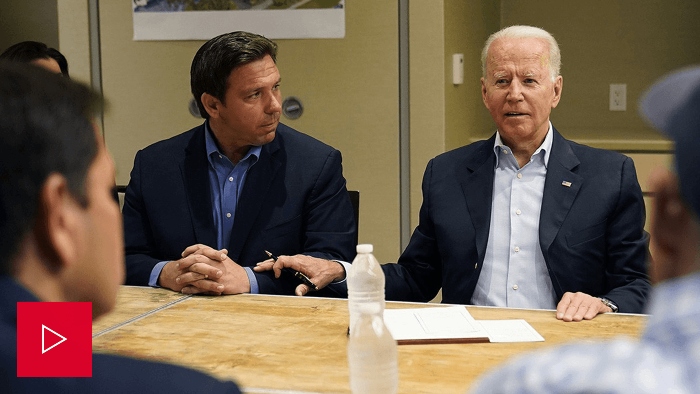
Florida Gov. Ron DeSantis and President Joe Biden

— Biden, DeSantis survey Surfside collapse scene: This morning, Florida Gov. Ron DeSantis praised Biden’s federal response to the collapse of a condo building in the coastal Miami suburb of Surfside — providing a moment of bipartisan bonhomie between the leader of the Democratic Party and a rising star within Trump’s GOP. Speaking at a command briefing near the site of the deadly disaster, DeSantis — seated beside Biden — said the president had “recognized the severity of this tragedy from day one, and you’ve been very supportive.”

— Supreme Court sides with Arizona on voting restrictions: The Voting Rights Act sustained another blow at the Supreme Court today, as the justices took a narrow view of when a state’s voting practices can be held to violate the rights of minorities. In a pair of high-profile cases from Arizona, the justices split 6-3 along ideological lines, with the conservative majority concluding that a disparate impact on minority groups would typically not be enough to render voting rules illegal under the act.

— California elections chief certifies Newsom recall election: California’s elections chief certified the gubernatorial recall today, setting up a September 14 election to consider whether Gov. Gavin Newsom should remain in office. It officially marks the state’s second-ever gubernatorial recall after the 2003 ouster of then-Gov. Gray Davis, whom voters replaced with Gov. Arnold Schwarzenegger.


SUBSCRIBE TO WEST WING PLAYBOOK: Add West Wing Playbook to keep up with the power players, latest policy developments and intriguing whispers percolating inside the West Wing and across the highest levels of the Cabinet. For buzzy nuggets and details you won't find anywhere else, subscribe today.


ON THE ECONOMY

SEARCHING HARD OR HARDLY SEARCHING? Friday morning, the federal government will release its much-anticipated June jobs report — a key gauge of where exactly the labor market stands after months of disappointing numbers. Economists predict that the U.S. added around 700,000 jobs in June — which would be up from 559,000 in May, but still much lower than the unrealized forecasts from months ago projecting gains of at least 1 million.

What explains month after month of disappointing jobs numbers? Many Republicans have endorsed a straightforward answer: boosted unemployment benefits are keeping would-be employees from taking jobs, leading to a worker shortage — and there is some evidence for that, like a recent WSJ report that states where GOP governors have ended the supplemental payment are seeing their labor market bounce back quickly.

But a new study by the job-listing website Indeed suggests that reality may be a bit more complicated.

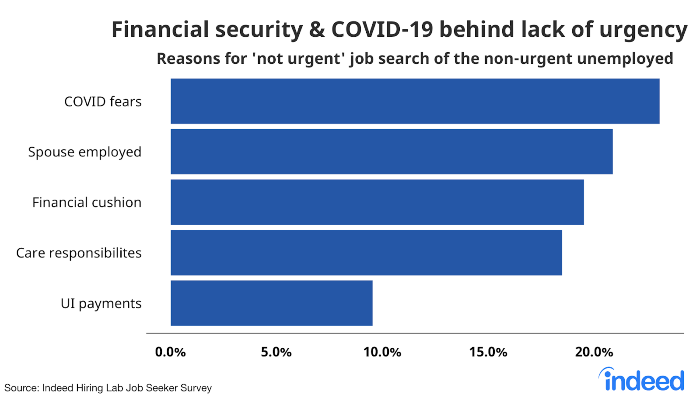
Indeed graphic of data on financial security and Covid-19 being behind a lack of employment search urgency

Just roughly 10 percent of job seekers — both employed and jobless workers — were “urgently” looking for work in late May and early June, according to Indeed’s survey of 5,000 Americans. And among those who were urgently looking, more than 20 percent said they didn’t want to start work immediately.

Why? Fears related to Covid-19 topped the list of respondents’ explanations for their lack of urgency. The number two reason? Employed spouses. Having a financial cushion came in third, and UI payments was at the bottom of the list, cited by less than 10 percent of respondents.

Myah talked with Nick Bunker, Indeed’s economic research director for North America, about how this survey compares to other economic data, and what questions he was left with after seeing the responses. This conversation has been edited.

What surprised you about the data?

One was that sort of urgency mismatch, or just the extent to which lots of jobseekers right now are willing to be pretty patient. Even among people who are actively and urgently searching for a job, about 20 percent don’t want to start a job immediately. That sort of displays the mismatch, as so many employers want to urgently and quickly staff up.

It wasn’t quite “surprising,” but Covid continues to be a concern — not only the [health] fears, but when it comes to the milestones people want to see before starting a job or entering into employment — particularly vaccinations. That was not only just for themselves, but for other people they’re frequently in contact with at work — coworkers or customers. It’s [about] their perceptions of how others they interact with are handling the end of the pandemic and post-pandemic life.

Do you think the way people responded — citing UI payments at the bottom of the list — was honest?

It’s a survey, so we depend on what people say. But if you see, one of the answers was [that respondents had] an increased financial cushion. You can imagine UI possibly contributing that way indirectly: that maybe if they’ve saved large chunks of it, they have this financial cushion and that’s why they might not be searching urgently right now.

There has been a lot of extra saving during the pandemic, and lots of that is folks at the top of the income distribution, but there have been savings by people at the bottom as well. And yes, that savings could get spent as people celebrate what seems to be the end of the pandemic, but it also could be that people just keep that savings, or use it to maybe wait out the labor market a little bit to see what things look like in the fall. The UI benefit could go away tomorrow, but they may have savings that could support them in the next couple weeks or months or maybe even longer.

What are your thoughts about how this survey data compares to other economic data? The WSJ, for example, had a report showing that states that cut some UI payments have seen increased employment.

Part of the reason why we did this survey was to better understand what’s happening on the supply side of the labor market. Demand is really high. The gap we were trying to fill in was: Why does the labor force participation rate continue to be so low? Why, even if people are looking, are they not jumping into jobs right now? Our goal is to complement the publicly available data from the government, which really is the gold standard.

What questions did the data leave you with that you’re hoping to dig into next?

Will we see, maybe in a couple months as time moves on, the sort of collapse of people saying that they’ll take a job? I’ll be looking at the share of job seekers who want to start a job immediately. Does that pick up? What happens to job-searching among the employed? Are people who already have a job more actively searching for jobs, assuming that demand for work continues to pick up?


Advertisement Image 

 
ASK THE AUDIENCE

Nightly asks you: Last summer, before July Fourth, we asked you how the pandemic changed your holiday . After a year of surges, vaccines and variants, we want to know: How are you celebrating July Fourth this year? Is the pandemic still affecting your usual plans? Send us your answers using our form, and we’ll include select responses in our Friday edition.

AROUND THE WORLD

TAX MUNDI — The world’s largest economies agreed today to sweeping changes to the global tax system, despite staunch opposition from low-tax nations like Barbados, Ireland and Hungary.

Four officials at the talks told POLITICO that 130 countries had signed on to the deal, which the Organisation for Economic Cooperation and Development announced soon after. The initiative aims to introduce a global tax for the world’s 100 biggest companies and set an international minimum effective corporate tax rate of at least 15 percent. Nine countries, mostly offering low corporate tax regimes, opposed setting the minimum rate, the people added, speaking on the condition of anonymity.

All G-20 countries — including the U.S., China and France — backed the deal, and their finance ministers are scheduled to approve the agreement on July 9. Many of the details within the deal, such as possible exemptions for the financial industry and manufacturing, were left out of the current pact and will now be hammered out ahead of an October deadline.


JOIN FRIDAY FOR A PLAYBOOK INTERVIEW WITH ANITA DUNN: Anita Dunn, a senior White House adviser to President Biden and one of the most influential women in Washington, will join Playbook co-author Ryan Lizza to discuss the administration’s legislative priorities, including getting the massive infrastructure plan through Congress, the latest on efforts to get 70% of U.S. adults vaccinated against Covid, and preparations for the White House’s first big public event on Independence Day. Don’t miss this Playbook Live event, REGISTER HERE.


NIGHTLY NUMBER

$3 trillion

The amount by which the federal budget gap will widen this year, nearly triple the annual shortfall recorded just two years ago as the pandemic continues to grow the deficit, the Congressional Budget Office said in its latest 10-year projections released today.

FROM THE HEALTH DESK

TO BE SPOOKED, OR NOT TO BE SPOOKED — Should you be freaking out about the Delta variant? Probably not if you’re fully vaccinated. But, as health care reporter David Lim reports in the latest POLITICO Dispatch, it could cause some problems down the road — especially in areas with lower vaccination rates.

Play audio

Listen to the latest POLITICO Dispatch podcast

PARTING WORDS

#FREEBRITNEY INVITED TO THE HILL — Rep. Matt Gaetz of Florida and a handful of other Republicans have invited pop star Britney Spears to testify before Congress about her conservatorship.

“You have been mistreated by America’s legal system. We want to help,” Gaetz wrote in a letter to Spears dated Wednesday. “The United States Congress should hear your story and be inspired to bipartisan action. What happened to you should never happen to any other American.”

Gaetz said he and fellow Republican Reps. Marjorie Taylor Greene (Ga.), Burgess Owens (Utah) and Andy Biggs (Ariz.) have been following her conservatorship battle with “deep concern” and stand with the pop star.

Rumors about Spears’ discontent with her conservatorship spread for years online and trended with the #FreeBritney hashtag. But last week, Spears spoke directly about the issue herself in court, describing her conservatorship as “abusive.” Spears’ father, Jamie Spears, has been the legal manager of his daughter’s multimillion-dollar estate since 2008. He was also the conservator “of her person” until 2019, when he stepped back from this part of the legal agreement for his own health reasons. Since then, Jodi Montgomery, a private professional fiduciary, has been in charge of Spears’ person.

A message from AARP:

Family Caregivers Need Help Now

Caring for loved ones shouldn’t lead to bankruptcy and financial ruin. But that is exactly what is happening for too many family caregivers. The financial strain of caregiving is immense, and it is unacceptable that more isn’t being done to provide support for them. That’s why AARP is fighting for America’s 48 million family caregivers and their loved ones who depend on their care to survive. Family caregivers nationwide spend over one-quarter of their income, on average, providing this essential care. Congress must pass the Credit for Caring Act to help alleviate some of the financial strain of caregiving.

Tell Congress to act now to help protect family caregivers from financial devastation. Tell Congress to pass the Credit for Caring Act.


Did someone forward this email to you? Sign up here.


Follow us on Twitter

Renuka Rayasam @renurayasam

Chris Suellentrop @suellentrop

Tyler Weyant @tweyant

Myah Ward @myahward


FOLLOW US


POLITICO, LLC 1000 Wilson Blvd. Arlington, VA, 22209, USA


Trump's Friday Meltdown: Begging Iran, Ditching Ukraine, and Blaming Everybody But Himself – 7/31/26

                                               LOTS OF POSTS IGNORED BY BLOGGER..... OR REMOVED ON THEIR WHIM! ALL POSTS ARE AVAILABLE ON MI...