Trump’s plan to turn the Justice Department into his personal vendetta machineIs it time to revive Senator Sam Ervin’s proposal for insulating the Department from politics?
Friends, Last week, Trump said that if reelected, he’d appoint a “real special prosecutor” to “go after the most corrupt president in the history of the United States of America, Joe Biden, and the entire Biden crime family.” In other words, if Trump is reelected, you can kiss nonpartisan criminal justice goodbye. His remark made me think back almost a half century ago, to when I was a rookie lawyer in the Justice Department. The department was in shambles, discredited by Nixon’s and Attorney General John Mitchell’s political abuse and corruption. To restore trust in the Justice Department, President Gerald Ford appointed Edward Levi to be attorney general. In naming Levi, who had been president of the University of Chicago and the former dean of its law school, Ford found someone whose reputation for integrity was impeccable. As Levi said at his swearing in, “Nothing can more weaken the quality of life or more imperil the realization of the goals we all hold dear than our failure to make clear by words and deed that our law is not an instrument of partisan purpose.” Levi set out to insulate the Justice Department from politics, instituting rules limiting White House involvement in law enforcement decisions. The Senate Watergate Committee chairman, Senator Sam Ervin, didn’t think Levi’s rules went far enough to protect the department from an unscrupulous future president. Ervin wanted to make the Justice Department an independent agency with an attorney general appointed by the president every six years and removable only for neglect. At the time, I thought Ervin’s proposal too extreme. I assumed America had learned its lesson from Watergate and would never again elect a president as repugnant as Nixon, willing to sacrifice the institutions of government to his own political ambition. Yet there was some precedent for Ervin’s view. The attorney general was originally viewed as having an independent, semi-judicial role — analogous to that of judges. Congress established the office of the attorney general in the Judiciary Act of 1789 — the same act that created the federal court system, as distinct from acts establishing executive departments. In the original draft, attorneys general would be appointed by the Supreme Court, not the president. Congress changed this so that attorneys general would be appointed exactly like federal judges. When George Washington appointed the nation’s first attorney general in 1789, Thomas Jefferson referred to him as “the Attorney General for the Supreme Court.” Early attorneys general shared offices with the court. Their budgets were line items under the federal judiciary, not the executive. Originally, the attorney general was not even in line to succeed to the presidency. Even after the attorney general became a key part of the executive branch and the Department of Justice was established in 1870, presidents continued to respect the need for prosecutorial independence. Until Richard Nixon and his scurrilous Attorney General John Mitchell. But surely, I said to myself at the time, Nixon and Mitchell were the extremes. Edward Levi’s reforms were adequate. Then came the worst offender of all. During his presidency, Donald Trump viewed the Justice Department as an extension of his own will — even claiming, “I have an absolute right to do what I want to with the Justice Department.” Trump interfered in the department’s prosecutions of Michael Flynn and Roger Stone, fired FBI Director James Comey for investigating possible collusion between Russia and Trump associates, and demanded that the department reopen a criminal investigation of Hillary Clinton. John Dean, former White House counsel to Nixon, described Trump’s efforts to use the Justice Department for personal gain as “Nixon on stilts and steroids.” Now, Trump threatens that if reelected he’ll turn the Justice Department into his own personal vendetta machine. If there weren’t already enough reason to fear a second Trump presidency, this would be it. Public trust in our governing institutions has already sunk to a new low — due in large part to Trump’s first term, his subsequent Big Lie that the 2020 election was “stolen,” and now his second Big Lie that Biden is orchestrating a “witch hunt” against him. Even if Biden is reelected, it will be necessary to deal with the damage Trump and his Republican enablers have wrought. Perhaps Sam Ervin’s proposal for an independent Justice Department should be given more serious consideration. What do you think? |
Sunday, August 20, 2023
Trump’s plan to turn the Justice Department into his personal vendetta machine


Monday, February 6, 2023
POLITICO Massachusetts Playbook: Healey strikes a blow to teachers
|







|

Tuesday, December 27, 2022
FOCUS: What Ukraine Can Learn From the Khmer Rouge Trial

27 December 22
Live on the homepage now!
Reader Supported News
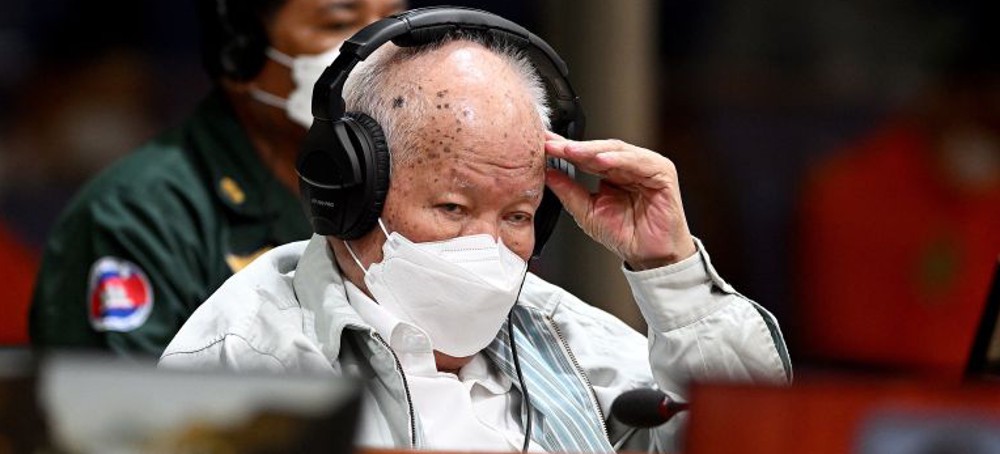
As Ukraine seeks justice for crimes committed by Russia, Cambodia could offer lessons — and cautionary tales.
That decision has ended the tribunal’s judicial work. Now, as it winds down after spending 16 years investigating and prosecuting the senior leaders of the Khmer Rouge, its experiences offer valuable lessons on how best to secure justice in the current conflict that’s shaking the world’s conscience: Russia’s war in Ukraine.
The Khmer Rouge was a Maoist-inspired movement that devastated Cambodia during its brutal four-year rule from 1975 to 1979. The tribunal had the challenging job of investigating events spanning the entire territory of Cambodia over several years and adjudicating some of the most serious crimes known to humanity. It accomplished these tasks, bringing about one of the few convictions of a head of state since World War II. And it did so with an extensive in-person outreach programme that involved hundreds of thousands of Cambodians.
The investigations Ukraine needs
Ukrainian authorities have already prosecuted a small number of cases, several of which have resulted in convictions and sentences, and they are investigating many more. But with tens of thousands of potential cases to investigate, they are overwhelmed, and the situation will only get worse as the war drags on.
The International Criminal Court (ICC) has also opened an inquiry and sent its largest investigative team ever to Ukraine to begin to prepare cases. But the court also faces limitations. Its mandate is to focus on those most responsible for the crimes – in other words, high-level leaders – and it has never indicted more than six individuals from any given situation.
The ICC also has no jurisdiction over the crime of aggression in Ukraine, which is arguably both the most important crime since the invasion led to and facilitated all subsequent crimes and the easiest to link to high-level leaders like Russian President Vladimir Putin.
To help plug these impunity gaps, two additional courts have been proposed. These are a special court for the crime of aggression to be created by agreement between the United Nations and Ukraine and a high war crimes court, which would fall within the Ukrainian domestic court system but have international advisers to assist with investigations and prosecutions.
As these courts set out on the long road to justice for Ukraine, Cambodia’s example shows what they must focus on – and what they cannot afford to forget.
Don’t give up on the “big fish”
The only prosecutions to date in Ukraine have been low-ranking soldiers responsible for crimes that include individual murders and thefts. At the moment, it seems almost inconceivable that Putin and other senior Russian leaders will ever face justice. They are firmly ensconced in power and barricaded behind their nuclear deterrent.
But the lesson of the Khmer Rouge tribunal is that circumstances change. For years after the Khmer Rouge was ousted by a Vietnamese invasion, it was supported by the United States, Australia and China, all of whom saw it as a counterweight to Vietnamese, and therefore, Soviet influence.
It was not until 1997 that the Cambodian government first requested UN assistance in establishing the Khmer Rouge tribunal. By the time the tribunal began its work in 2007, the geopolitical circumstances that had protected the Khmer Rouge leaders for so long had shifted. The Cold War was over, and Vietnam was no longer seen by the Khmer Rouge’s former supporters as an enemy. As a result, the tribunal was able to try and convict two of the most senior members of the regime, including Khieu Samphan.
In the present conflict, the costs of the war in Ukraine have already shattered Putin’s social contract with elite and ordinary Russians alike. As the war drags on, the burdens on all sectors of Russian society will only increase. The results are hard to predict, but Putin may not always be as safe as he looks at the moment.
Massive crimes can be addressed
The scale of the crimes being committed in Ukraine is staggering. Ukrainian authorities have already registered more than 47,000 alleged crimes across a large geographical area. The number of victims is unknown, but the Office of the UN High Commissioner for Human Rights has recorded at least 6,700 civilian deaths since February and believes the true number is considerably higher. The majority of these deaths is likely to be victims of war crimes or crimes against humanity, so it is reasonable to wonder whether this criminal campaign can ever be meaningfully addressed by the justice system.
Here again, the experience of the Khmer Rouge tribunal gives reason for optimism. The Khmer Rouge’s atrocities spanned nearly four years and covered the entire territory of Cambodia. Experts estimate that as many as 1.5 million Cambodians lost their lives during this period, almost a quarter of the population. Despite the scope of the crimes, the Khmer Rouge tribunal succeeded in carrying out a meaningful investigation and trial of senior Khmer Rouge leaders for these atrocities and delivered convictions.
Not every crime committed in Cambodia was investigated, and it is unlikely that every crime committed in Ukraine will be – the number is simply too great – but by organising the Khmer Rouge’s crimes into broad categories – such as torture and execution centres, forced labour sites, forced marriages – the tribunal managed to facilitate more efficient investigations and court proceedings. International advisers with experience with other mass atrocities could assist Ukrainian prosecutors in similarly prioritising cases and organising them thematically.
Location matters
Any trials carried out by the ICC would take place in The Hague, which would also likely to be the seat of the proposed hybrid court for the crime of aggression. Lower-level perpetrators, however, are likely to be tried in Ukraine.
Having court proceedings where crimes occurred is good for accountability. Over the course of 16 years, more than 240,000 Cambodians attended the Khmer Rouge trials in person. The access also meant that the trials were covered extensively by the local media.
Trials conducted in Ukraine would have similar benefits. A court in Ukraine would also be far more accessible to local journalists than one in The Hague. Investigations would also be more efficient and cheaper. Interviewing witnesses would not require plane tickets, hotels and per diems for staff traveling from abroad.
Courts based in Ukraine would also face challenges, though.
During the work of the Khmer Rouge tribunal, the Cambodian government made occasional statements that certain investigations would not be allowed to proceed to trial, resulting in allegations of political interference.
Despite – indeed, because of – the strong emotion triggered by Russia’s campaign of crimes, it is critical that Ukrainian government officials refrain from making any statements that could be interpreted as directing the work of criminal justice officials or pre-judging the merits of any individual cases. War crimes trials in Ukraine would come under intense worldwide scrutiny, and everything possible must be done to ensure that they would be, and would be seen to be, the product of a fair and independent judicial process.
Go where the evidence leads, even if it’s inconvenient
It seems clear that the vast majority of crimes in Ukraine are being committed by Russian forces. But that doesn’t mean that Ukrainian forces haven’t, or won’t, commit crimes as well. The UN already believes that Ukrainian forces have committed war crimes in at least two instances.
Courts based in Ukraine – whether entirely domestic or ones that are aided by international advisers – must be prepared to investigate and prosecute if necessary any credible allegations of war crimes committed by Ukrainian forces, regardless of rank. Carrying out these investigations and prosecutions would be extremely difficult in a country that is still at war and that is clearly the victim of Russian aggression. But applying the law even-handedly would be key to establishing the credibility and legacy of the verdicts delivered.
The pursuit of justice for Ukraine won’t be easy. But the Khmer Rouge tribunal’s work shows that much can be achieved, even against the odds, and that even criminal heads of state can be punished.
Follow us on facebook and twitter!
PO Box 2043 / Citrus Heights, CA 95611
Sunday, December 11, 2022
Garrison Keillor | Novelist in Room 717, Recuperating

10 December 22
Live on the homepage now!
Reader Supported News
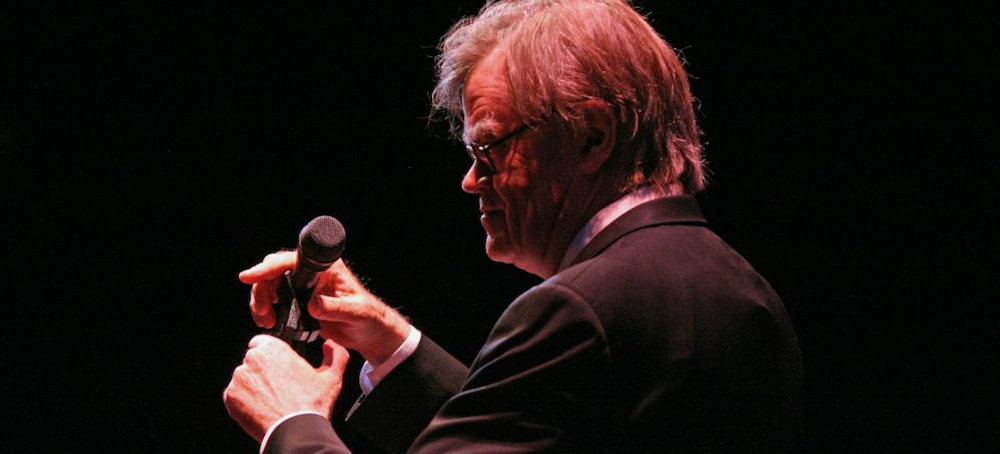
Airports have become ginormous as they’ve added vast shopping arcades and fine restaurants so it’s a mile from the TSA guy with blue gloves to my gate and sometimes a man in a motorized cart stops and asks if I’d like a lift and I am tempted but so far I have declined. My legs are not so strong because I no longer drink milk, which builds strong bodies. I suppose I could order a double latte, but in my mind I cannot hear John Wayne say, “I’d like a double latte, Pilgrim” and so I don’t. And I feel that accepting a ride in a motorized cart is the first step to assisted living and a salt-free diet and hiring a woman trainer named Melissa to come help me do squats. I do squats privately and for a purpose, to plug in a power cord, but I wouldn’t want Melissa to observe this.
Anyway, here I am in Fort Lauderdale in a hotel, and I should be grateful for the sunshine but I miss winter, the sense of purpose it gives. My purpose is to write and write until I get the hang of it and most good writing occurs in northern latitudes. Hemingway wrote For Whom the Bell Tolls in Idaho, other books in Paris and Illinois, and in Key West and Cuba, he mostly went fishing and drank and got depressed. Saul Bellow was a Chicago guy. Tolstoy never lived in Tahiti nor did Proust hang out in Polynesia. They needed bitter cold mornings to rouse them to make coffee and build a fire and get to work.
The effect of comfort is to make you sleepy; bitter cold promotes alertness. Make note of it.
In January 1841, Herman Melville, 22, eager to escape a New England winter, sailed on the whaling ship Acushnet to the South Pacific. He jumped ship and lived among the Typee cannibal tribe in the Marquesas Islands and had a love affair with a Typee girl and wrote a book about it, Typee. It has paradise scenery and nudity and cannibalism in it and if only he’d included those elements in his next book, Moby-Dick, it would be more widely read. It’s an American classic, like Ralph Waldo Emerson, but nobody reads either of them.
Everything on the Best Books of 2022 lists is very dark, not a single comic novel anywhere, they’re all about traumatic displacement and grief and alienation, and sitting in this little hotel room, I think about writing a COVID novel. The virus brings on an intense temporary adolescence with identity issues, self-pity, a sense of meaninglessness, which fits in well with the current trend in fiction.
A COVID novel with a cannibal romance. It won’t be based on my wife’s family, they’re all semi-vegans, so I’ll invent a lover, a hefty girl who gives me love bites, whose family is very touchy-feely, especially of my meatier parts, and at mealtime they sit close by and say a prayer in hopes I’ll close my eyes but I don’t, I sing to them instead. I read somewhere that music calms the cannibalistic urge, so I sing:
Here I sit beside the fire
With my love, my heart’s desire,
While her family looks my way,
Imagining me as their entrée.
If you eat me, you will get
A virus you will soon regret,
That gives you feelings of putrescence
As you felt in adolescence.
Feast on fowl, feast on fish,
You can make a tasty dish
That is healthy and mammalian,
But spare this old Episcopalian.
I can promise you one thing. I intend to survive at the end.
READ MORE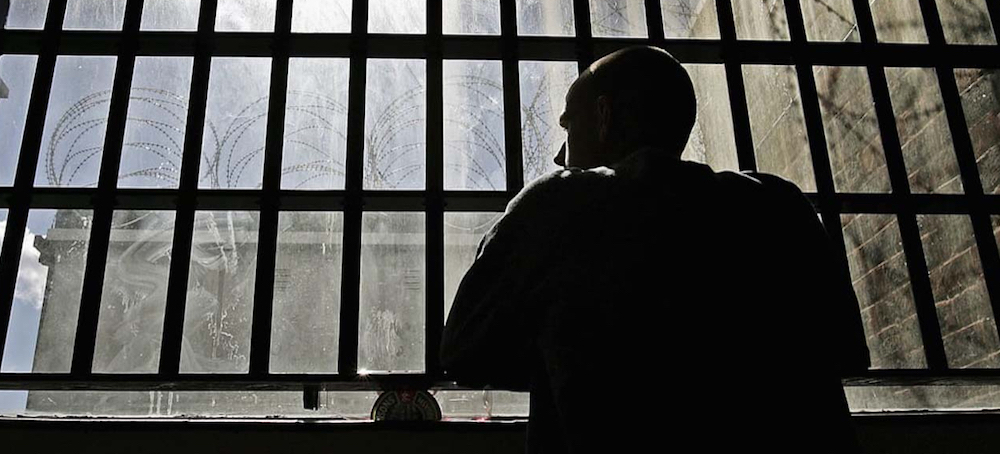 A prisoner. (photo: Peter Macdiarmid/Getty Images)
Americans are rightly decrying Putin's Russia for attempting to lock someone away for years over a trumped up-drug offense. But for marginalized communities in the United States, that's a not so foreign experience
Griner’s release was garnered through a “prisoner swap” in which Biden freed and sent convicted arms Viktor Bout dealer to Russia. Her arrival back to her home country ends a nine-month-long ordeal that began when the basketball star, in Russia to play in one of the country’s basketball leagues, was detained at a Russian airport for having cartridges containing hashish oil. Throughout 2022, her arrest, and subsequent nine-year sentence, were publicly condemned by public officials, activists, fellow athletes, entertainers, and Biden, who in August called her sentence “unacceptable” and demanded her “immediate release.”
He speaks for millions of American citizens who agree that Griner’s release is a positive development. It’s easy for him, and other Americans to point the finger at Putin, but we’re not doing enough about the failings of our own criminal justice system.
Americans gasped at Griner’s plight in a remote Russian penal colony, where no one knew her whereabouts and she was subject to a facility defined by what Reuters describes as “tedious manual work, poor hygiene and lack of access to medical care.” But similar human rights abuses exist in the American prison system. Brittney Griner’s incarceration was national news — even though it would have been even more amplified if she wasn’t a Black queer woman — but the American criminal justice system’s failings are often seen as an ancillary issue compared to world affairs, mass shootings, and Oscar slaps. Few currently incarcerated people have Griner’s mesh of notoriety and mass advocacy, but their families love them just the same. Of course, even other celebrities are subject to mistreatment, as rapper YNW Melly recently revealed that he’s facing “mistreatment, discrimination and misuse of authority” as well as “mental and emotional abuse” at Florida’s Broward County Jail.
On September 26th, thousands of incarcerated people in Alabama state prisons went on strike because of what incarcerated activist Kinetik Justice deemed a “humanitarian crisis.”
“Our lives don’t mean anything. Our lives don’t have any value. So, nobody cares that 100 people have overdosed,” Justice told criminal justice publication Vera. The organizers, who paused the strike in October, are seeking massive decarceration because of malnutrition, dilapidated facilities, overcrowding, and other abuses.
Griner was rightfully labeled a Russian political prisoner, but the U.S. Government has numerous people in the carceral state who are also deemed as political prisoners. In 1981, Black Panther Mumia Abu-Jamal was sentenced to death (since scaled back to a life sentence) in Philadelphia for murder in a case in which witnesses were bribed, Black jurors were excluded, and Judge Albert Sabo, according to a court stenographer. said he was “going to help them fry the n—–.” (Sabo, who died in 2002, denied he made the remark). Indigenous activist Leonard Peltier was sentenced to life for allegedly killing two FBI agents, through there’s little evidence that he committed the crimes and multiple witnesses have said their since-recanted statements were made under FBI duress. Joy Powell is a Rochester, New York-based activist who challenged police brutality and was then convicted of burglary and assault with no evidence or witnesses. While serving her 16-year sentence for the assault, she was given another 25-year sentence for a cold case murder which she says she was falsely convicted of. Incarcerating people for political purposes is no anomaly in America. The plight of currently incarcerated Ferguson activist Joshua Williams, sentenced to eight years for stealing chips and lighting a trash can on fire during a 2014 Mike Brown protest, indicates that it’s a reliable part of the state’s toolkit to suppress freedom fighters.
New York’s ABC 7 reports that 18 people have died at New York City’s Rikers Island since January, including at least five overdoses and five suicides. The jail is scheduled to close in 2027 because of a history of corruption and the mistreatment of incarcerated people. But closing Rikers alone won’t stop the issues plaguing the justice system, on a state or federal level. Biden and Vice President Kamala Harris have pushed back against activists’ demands to defund the police. In August, Biden told participants at a mid-term election rally that “when it comes to public safety, the answer is not to ‘defund the police,’ it’s to fund the police.”
Abolitionists and criminal justice reform advocates have proven that inflating police budgets does not lower crime, and that the mitigating factors that spur criminality would be alleviated by offering those funds to communities through programs and other means of aid. In reality, the reticence to defund the police by Biden and other state politicians with the meanest to do so isn’t just about placating police unions, but continuing the low-cost prison labor that states rely on. Prison is big business, which necessitates warehousing people in often dehumanizing, abusive environments. So it’s easy to villainize Russia for their treatment of Brittney Griner, but we should all realize that what happened to her overseas is not so foreign.
On a federal level, Biden announced mass clemency for people convicted of marijuana possession, but the decision hasn’t actually freed anyone. The pardon excludes people who were simultaneously charged with possession of another drug, and “non-citizens not lawfully present in the United States at the time of their offense,” according to Biden. The Marshall Project reported that as of October 15th, 2022 there was no one in federal prison for simple possession of marijuana anyway. Biden’s decriminalization of simple marijuana possession is a toothless gesture that doesn’t go far enough as his 2020 campaign promise to “decriminalize cannabis use and automatically expunge prior convictions.” And that speaks nothing to what The Last Prisoner project estimates are roughly 30,000 people incarcerated in state prisons for marijuana-related offenses.
Biden made a slew of criminal justice reform promises during his campaign, and a notable amount of them haven’t come to pass. He promised to end the death penalty in the federal system, but in September the Southern District Attorney’s office of New York announced their intention to seek the death penalty against Sayfullo Habibullaevic Saipov, who killed eight people in 2017. Biden also said that he would end solitary confinement, but MSNBC reported in September that the use of restrictive housing increased 11 percent since spring 2021. A 2021 federal oversight report revealed that the 2018 First Step Act, ratified by former President Trump to potentially reduce federal sentences, was faltering from racial disparities in the risk assessment tool used to gauge worthiness for sentence reduction. A Forbes report revealed that at least one incarcerated woman participated in programs that should have given her First Step Act time credits, but never received them. Newly elected Bureau of Prisons director Colette Peters has said that she plans to address the flaws with the First Step Act, but in general, it’s hard to see how she can turn an inherently violative environment into a humane one.
READ MORE 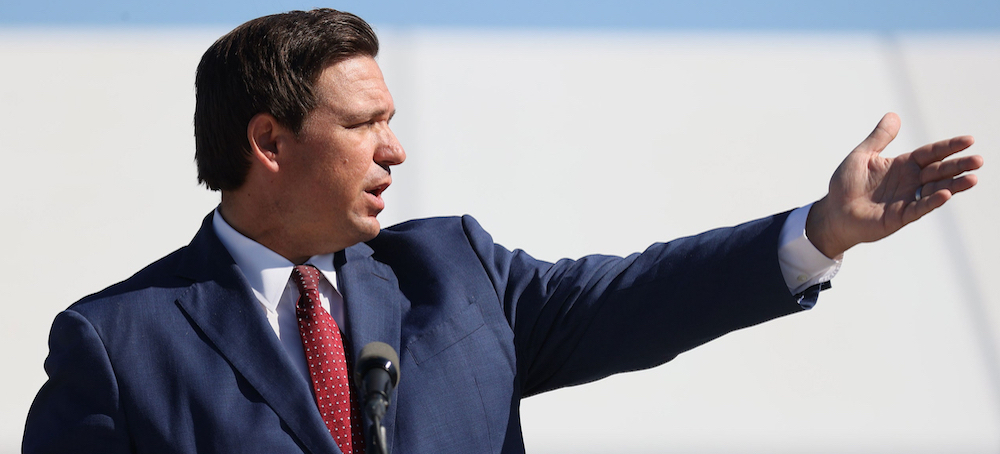 Governor Ron DeSantis of Florida. (photo: Joe Raedle/Getty Images)
Ron DeSantis hopes to beat Trump by running as the manly man who rejects vaccines and welcomes mass death
This is purely political, of course. The Pentagon requires all personnel to take vaccines for any number of illnesses and military leaders obviously think this is ridiculous. But we have civilian control of the military for good reasons even if, from time to time, partisan politics wins the day. As it happens, very few service members have refused to take the vaccine and the military will surely be able to maintain readiness without the mandate.
After all we've been through in the last three years, the anti-vaxxers are still claiming victims. There are outbreaks of measles and other dangerous diseases all over the country due to this new resistance to the science that has saved countless lives over many decades. There remain pockets of liberal intransigence on the subject, but resistance is concentrated mainly on the right among people who have been influenced by conspiracy theories and right-wing politicians and media. It's tremendously ironic, since the political leader who can take credit for pushing a swift rollout of the COVID vaccines is none other than their Dear Leader Donald Trump. It's the one positive achievement of his presidency, and it's the one his followers boo him for.
On Thursday, the Democratic staff of the Senate Committee on Homeland Security & Governmental Affairs released its report on the government's handling of the pandemic, focusing on the first six months. (It's necessary to say "Democratic staff" because in the current 50-50 Senate the committees are evenly split and the Republicans, as usual, refused to cooperate. This problem will go away in the new Senate, with a 51-seat Democratic majority.) It's a devastating document that describes, the first months of the crisis "one of the worst public health responses in U.S. history." Multiple failures, including in threat recognition, cohesive response, clear communication and timely mitigation measures "resulted in the avoidable yet devastating loss of human life."
We all saw this happen in real time but the details of how chaotic it was behind the scenes are downright chilling. The administration "failed to take decisive action and adequately convey the threat to the American people" and "remained focused on containing the virus by trying to keep it out of the U.S., rather than implementing needed measures to mitigate its spread within the country." (You may remember Trump's comments at the CDC that he was eager to "keep his numbers down.")
The report cites example after example of how "contradictory and inadequate communications left Americans confused and unclear on what to do to minimize their risk and over time, eroded public trust in public health guidance." That's an understatement. Tens of thousands of people, if not hundreds of thousands, died unnecessarily because of Trump's refusal to back the social distancing and masking measures that were all we had in the beginning as scientists were trying to understand the scope of the crisis.
And what went on within the Trump administration, as it abruptly shifted responsibility from one agency to the other and injected politics into every aspect of the response, was even worse than we knew. The report reveals that the administration's "influence in CDC's guidance expanded to the point where political officials within HHS altered public health guidance and reports." Former CDC chief of staff Kyle McGowan is quoted saying that "every time that the science clashed with the messaging, messaging won." It was a disaster. But the report does indeed credit the administration with quickly approving Operation Warp Speed, which, as I said, is the one big thing Trump did right — and the one thing his followers resent him for.
One major finding of the report, as with others we have already seen, is that the government was woefully unprepared for a pandemic at virtually every level, even if we look past the Trump administration's missteps. This goes to the heart of the troubling question of why the United States handled COVID response so much worse than most other major industrialized countries. The Government Accountability Office, House Democrats and the National Academies have previously issued reports that came to similar conclusions. None of those have gotten much press and it seems clear that the government, no matter which party holds the White House, isn't going to take their recommendations seriously enough to prepare for the next pandemic either.
Perhaps that explains why Florida Gov. Ron DeSantis is riding so high on his pandemic-response reputation. Despite the fact that Florida has among the higher per-capita death tolls in the country, DeSantis has bamboozled the media into seeing him as a crusader for common sense public health measures. Apparently his "maverick" image on the pandemic is considered the key to his potential presidential campaign. (Appointing an anti-vaxxer as Florida's surgeon general was a sweet way to own the libs, you must admit,) Evidently, he plans to run to Trump's right as the guy who didn't succumb to all that weak-kneed, girly-man, Fauci-loving, vaccination nonsense.
It's hard to say whether that will work in the real world. Florida voters sure seem to love it, so maybe that approach will be hugely popular all over the nation if he runs. It's clear that America is done with the COVID pandemic and has simply accepted that it's going to keep killing people at the rate of about 100,000 a year. There's no discussion about funding any more major medical interventions or new pandemic preparedness. Vaccine manufacturers are pulling back. The scientific progress we've made is already slipping away. It looks like we'll be dealing with the next pandemic on a wing and a prayer, all over again.
As I write this, 1,092,099 people have died of COVID in the United States. About 1,500 more succumbed just yesterday. It is now the third leading cause of death in the nation. Are Americans really going to decide that a ruthless politician who embraced that as the new normal is just what the doctor ordered?
READ MORE 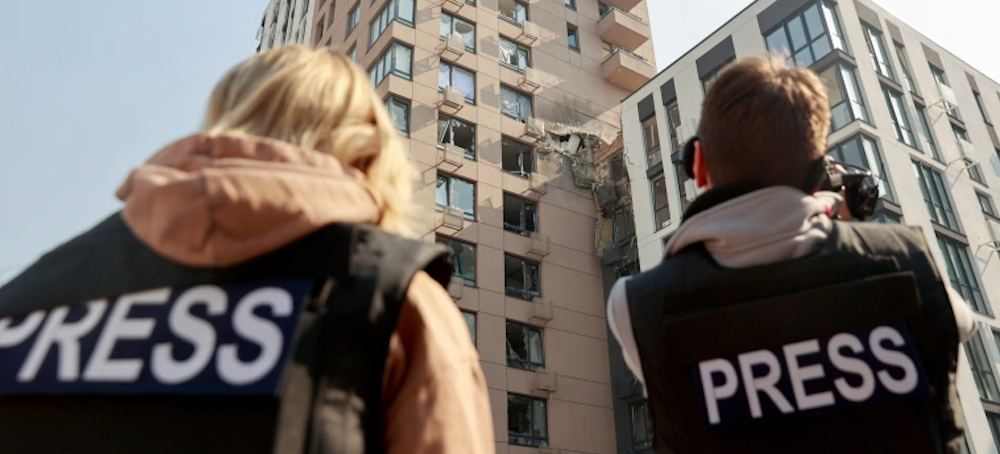 Journalists work near buildings hit by Russian attacks in Kyiv, Ukraine. (photo: Serhii Nuzhnenko/Reuters)
International Federation of Journalists said 20 more journalists killed so far this year compared with 47 in all of 2021
The IFJ said on Friday that 67 journalists and media workers have been killed around the world so far this year, up from 47 in 2021.
More media workers were killed covering the war in Ukraine – 12 in total – than in any other country this year, according to the IFJ. Most of them were Ukrainian journalists but several foreign reporters also died, with many deaths occurring in the first chaotic weeks of the war.
The IFJ report also called out the fatal shooting of Al Jazeera journalist Shireen Abu Akleh who was killed by Israeli forces on May 11 as she was covering an Israeli military raid on a refugee camp in Jenin in the northern occupied West Bank. The Al Jazeera network this week formally requested the International Criminal Court investigate and prosecute those responsible for killing Abu Akleh.
The report, released on the eve of the United Nations Human Rights Day, also shows that “political repression has reared its ugly head” in 2022. IFJ recorded at least 375 media professionals –10 more than last year – currently in prison for doing their job.
Most of those jailed are in China, Myanmar, Turkey, Iran and Belarus.
With the number of media workers killed on the rise, the IFJ and other media rights groups have called on governments to take more concrete action to protect journalists as well as media freedom.
“The failure to act will only embolden those who seek to suppress the free flow of information and undermine the ability of people to hold their leaders to account, including in ensuring that those with power and influence do not stand in the way of open and inclusive societies,” IFJ General Secretary Anthony Bellanger said in a statement.
The IFJ also said “the rule by terror of criminal organizations in Mexico, and the breakdown of law and order in Haiti, have also contributed to the surge in killings” and that 2022 has been one of the deadliest ever for journalists in Mexico, which is now considered the most dangerous country for reporters outside a war zone.
The Brussels-based IFJ, which represents 600,000 media professionals from trade unions and associations in more than 140 countries, also recorded five journalists’ deaths amid this year’s political crisis in Pakistan. The organisation warned of new threats to journalists in Colombia and continued danger for journalists in the Philippines, despite new leadership there.
READ MORE "When you're infected by Pegasus, spies effectively hold a clone of your phone." (photo: Shutterstock)
When you’re infected by Pegasus, spies effectively hold a clone of your phone – we’re fighting back
This may read like an eerie movie scene, but there are many Central American journalists who have lived it for real. The suspicion you’re being followed, ditching your phone before meetings, using encrypted messaging and email apps, speaking in code, never publishing your live location – these are ordinary routines for many in my profession.
I wouldn’t know until more than a year later what my source really meant. My colleagues weren’t just being trailed as they investigated that story. They, and at least 18 other members of El Faro – including me – had been the repeated targets of a weapons-grade espionage software called Pegasus. Pegasus is the gleaming toy of the Israel-based spyware firm NSO Group. Forensic analysis by the Citizen Lab and others found that Pegasus attacks in El Salvador started in June 2020 and continued until November 2021. In all, 35 journalists and members of civil society were spied on with this tool.
When you’re infected by Pegasus, spies effectively hold a clone of your phone. They can see everything, from your personal pictures and texts to your purchases and your selection and use of apps. When the spying was discovered I had to take measures that included exiting my family group chat and deleting my banking apps.
For journalists, this means spies can see every chat and phone call with our sources. I was hacked while I pursued and published private videos of two brothers of President Nayib Bukele negotiating over El Salvador’s Bitcoin Law with foreign businessmen before it came into effect. My colleagues Gabriela Cáceres and Carlos Martínez were hacked as they continued to reveal more details about the government’s dealing with gangs and a thwarted criminal investigation about it. I could go on and on.
Journalism has become even harder after the attacks. When news of the hacking broke, a few sources jokingly answered our calls by greeting the good people who might be listening. But many more picked up the phone only to say we should stop calling them, and most simply didn’t respond at all. In one instance, a source told me that he now understood why his wife had been fired from her government position. I felt horrible. Guilty. Powerless.
That’s how Pegasus makes you feel above all: powerless. We believe the infections in El Faro happened through a “zero-click exploit”, meaning we didn’t even click on a phony link to open a door for the spies. They just broke in. Change your number, get a new device – they’ll just break in there, too.
And yet we refused to be powerless. We told our story to news outlets all over the world. In El Salvador, we held press conferences, went on TV and filed a case before the attorney general’s office. None of this brought any kind of accountability for the illegal spying. So, represented by the Knight First Amendment Institute at Columbia University, 14 of my colleagues at El Faro and I have decided to sue NSO Group.
I can assure you we’re not in this for the money: if we wanted to be rich, we wouldn’t be independent journalists. We’re doing this as a progression of our everyday work in El Salvador to expose official wrongdoing. We’re doing this in the United States because we’ve exhausted all legal avenues in El Salvador’s co-opted institutions.
And we’re doing this not just for us. In April, the Israeli newspaper Haaretz assembled a list of more than 450 law-abiding men and women around the world whose devices had been hacked by NSO Group’s Pegasus. Many of them are not in countries or positions where they can sue.
But someone has to. NSO executives shouldn’t be able to wash their hands as their tools are used to persecute journalists. In a very real sense, NSO set the hounds on us. And now we’re fighting back.
READ MORE 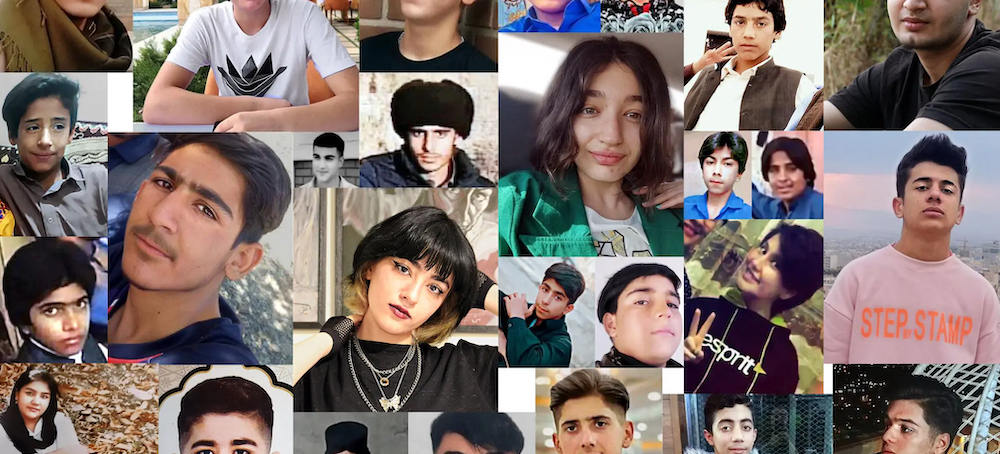 These are among the nearly 50 minors that rights groups say Iran has killed in the past two months, as protests swept the country. Security forces shot or beat to death most of them during protests. (photo: Amnesty International)
In updated research, Amnesty International has documented how the unlawful killings of children by Iran’s security forces continue unabated, detailing the names and details of at least 44 children and the heartless violence inflicted upon their families.
“The authorities have not only condemned families of children killed to a lifetime of inconsolable sadness, but they have also inflicted extreme mental anguish upon them through cruel restrictions on burials, commemorations and relentless intimidation aimed at enforcing silence. These practices violate the absolute prohibition on cruel, inhuman, and degrading treatment or punishment,” said Heba Morayef, Amnesty International’s Regional Director for the Middle East and North Africa.
“The recent establishment of a UN fact-finding mission to collect, consolidate and analyse evidence of such violations sends a clear message to the Iranian authorities that they can no longer commit crimes under international law and other grave violations of human rights without fear of consequences. Amnesty International now urges all states to exercise universal jurisdiction to criminally investigate Iranian officials involved in militarized attacks on demonstrators, including children.”
Amnesty International’s research has shown that Iran’s security forces shot 34 of the identified child victims with live ammunition in the heart, head or other vital organs. At least four were killed by metal pellets unlawfully fired by the security forces at close range. Five other children, four girls and one boy, died from injuries consistent with fatal beatings, and one girl was killed after being struck on the head with a tear gas canister. The recorded child victims include 39 boys, aged between two and 17, and five girls, three of whom were 16 years old, one 17 years old, and one aged six.
Children represent 14% of overall deaths of protesters and bystanders recorded by Amnesty International, which exceeds 300 since the protests erupted. Our investigations into killings by security forces continue and the number of those killed, including children, is believed to be higher (For more information on the organization’s methodology, see here).
The Iranian authorities have routinely harassed and intimidated the families of child victims to coerce them into silence or to force them to accept narratives absolving authorities of responsibility for the deaths of their loved ones in written statements or video recordings broadcast on state television. Amnesty International has identified such practices against the relatives of at least 13 child victims. Information obtained by the organization from informed sources indicates that security forces subjected them to coercion including arbitrary arrest and detention, threats to bury the bodies of their loved ones in unidentified location, and threats to kill, rape, detain or otherwise harm bereaved parents and their surviving children.
The father of Koumar Daroftadeh, a 16-year-old boy killed by live ammunition said on 13 November in an interview with Radio Farda, an independent media outlet:
“They [security and intelligence agents] summoned me and told me that I should say whatever they dictate to me… The authorities killed my son and must be held accountable.
Cruel restrictions on burials and commemorations
Security and intelligence agents often threatened not to return the bodies of child victims for burial unless families commit, in writing, to remaining silent and observing restrictions on funeral and memorial ceremonies.
In some cases, officials prepared the bodies of victims for burial without notifying families, then handed them the bodies, wrapped in shrouds, minutes before the scheduled burial, denying families their right to wash and prepare their loved ones for burial in accordance with their own religious and cultural traditions.
Other restrictions included forcing families to bury their loved ones in remote villages, banning the use of word “martyr” and prohibiting relatives from hanging large memorial banners or sharing images of victims and funeral posters on social media.
Denying responsibility for unlawful killings of children
The Iranian authorities have publicly denied responsibility for the killing of at least 19 of the child victims. They have blamed 12 of these deaths on attacks by either “hired terrorists” or “unknown persons”, attributed three to suicidal or accidental falls from heights, one to a suicidal or accidental drug overdose, one to a dog bite, one to a motorcycle accident and another to a stampede.
For nine other children, all from the oppressed Baluchi minority, the authorities have questioned their deaths, claiming in their reports to member states of the UN Human Rights Council that “there is no death record” for the children concerned in the Sistan and Baluchistan province.
Children from persecuted minorities most targeted
Over 60% of the children killed were from Iran’s oppressed Baluchi and Kurdish minorities. These communities have long suffered from systemic discrimination and persecution by the authorities.
A family member of a child unlawfully killed in Sistan and Baluchistan told Amnesty International:
“They did not pay any attention to us. They [Iranian authorities] do not consider us [Baluchis] human. There are many witnesses [to the killings], but their testimonies are worthless against the Islamic Republic because the authorities do not accept them.”
Of the 44 recorded child victims, 18, which amounts to 40%, belonged to Iran’s oppressed Baluchi minority. Thirteen of them were killed by security forces on 30 September in Zahedan, Sistan and Baluchistan province, during the deadliest day of the authorities’ crackdown on the protests, widely known to Iranians as “Bloody Friday”.
Ten of the children killed, which amounts to 20%, were from the Kurdish minority and were killed in eight cities or towns in the Kurdish populated provinces of Kurdistan, Kermanshah and West Azerbaijan.
The remaining 16 child victims were killed in six other provinces across Iran.
“The authorities have been killing children in a bid to crush the spirit of resistance among the country’s youth and retain their iron grip on power at any cost. And yet despite that, many children have courageously continued to take to the streets in search of a future without political oppression and inequality,” said Heba Morayef.
READ MORE 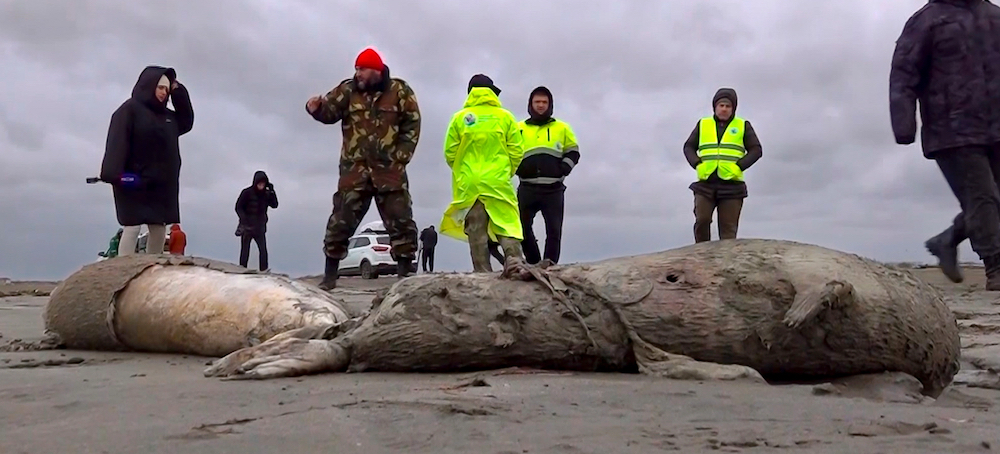 Dead seals washed ashore of a Russian coast off the Caspian Sea. (photo: AP)
The authorities in the Russian province of Dagestan said that it's still unclear what caused the animals' deaths, but they likely died of natural reasons.
Regional officials initially said Saturday that 700 dead seals were found on the coast, but on Sunday Zaur Gapizov, head of the Caspian Environmental Protection Center, said according to the state RIA Novosti news agency that after a broader inspection of the coast the number of dead animals was 1,700.
Gapizov said the seals likely died a couple of weeks ago. He added that there was no sign that they were killed by poachers.
Experts of the Federal Fisheries Agency and prosecutors inspected the coastline and collected data for laboratory research, which didn't immediately spot any pollutants.
Several previous incidents of mass deaths of seals were attributed to natural causes.
The data about the number of seals in the Caspian varies widely. The fisheries agency has said the overall number of Caspian seals is 270,000-300,000, while Gapizov's center put the number at 70,000.
Follow us on facebook and twitter!
PO Box 2043 / Citrus Heights, CA 95611
Trump's Friday Meltdown: Begging Iran, Ditching Ukraine, and Blaming Everybody But Himself – 7/31/26
LOTS OF POSTS IGNORED BY BLOGGER..... OR REMOVED ON THEIR WHIM! ALL POSTS ARE AVAILABLE ON MI...

-
04 April 23 Live on the homepage now! Reader Supported News Dahlia Lithwick | Let Donald Trump Cry It Out Dahlia Lithwick, Slate Lithwic...
-
LOTS OF POSTS IGNORED BY BLOGGER..... ALL POSTS ARE AVAILABLE ON MIDDLEBORO REVIEW AND SO ON Right now, we are standing on the edge of a he...
-
LOTS OF POSTS IGNORED BY BLOGGER..... ALL POSTS ARE AVAILABLE ON MIDDLEBORO REVIEW AND SO ON We love making ice cream, but our mission has ...


