Showing posts with label DISABLED. Show all posts

Friday, November 8, 2024

Trump Voter Realizes MAGA POLICY HURTS HIM...


Adam Mockler

685K subscribers


Adam Mockler with MeidasTouch Network breaks down Donald Trump's supporters reacting to the policy. Use code 'blueheart' for 15% off on MERCH: https://adammockler.com/ Become a member to support me!    / @adammockler     / adammockler   Adam Mockler Socials: Subreddit:   / adammockler   Discord:   / discord   Instagram:   / adammockler   Twitter: https://x.com/adammocklerr TikTok:   / adammockler  

Monday, August 19, 2024

Donald Trump’s shocking cruelty exposed by his own family | 60 Minutes Australia


60 Minutes Australia

5.82M subscribers


Wednesday, January 20, 2021

FAIR: Media Elevate Eugenicists, Sideline Disabled Voices in Discussions of Covid Rationing


FAIR
View article on FAIR's website

Media Elevate Eugenicists, Sideline Disabled Voices in Discussions of Covid Rationing


In the sticky conversations around rationing life-saving treatments and vaccines during the Covid pandemic, corporate media have elevated some experts without disclosing their troubling views on disability, aging and the value of human life. Meanwhile, media outlets have largely sidelined the voices of disabled activists and others who could speak on behalf of those most affected by the pandemic.

'Quality of life'
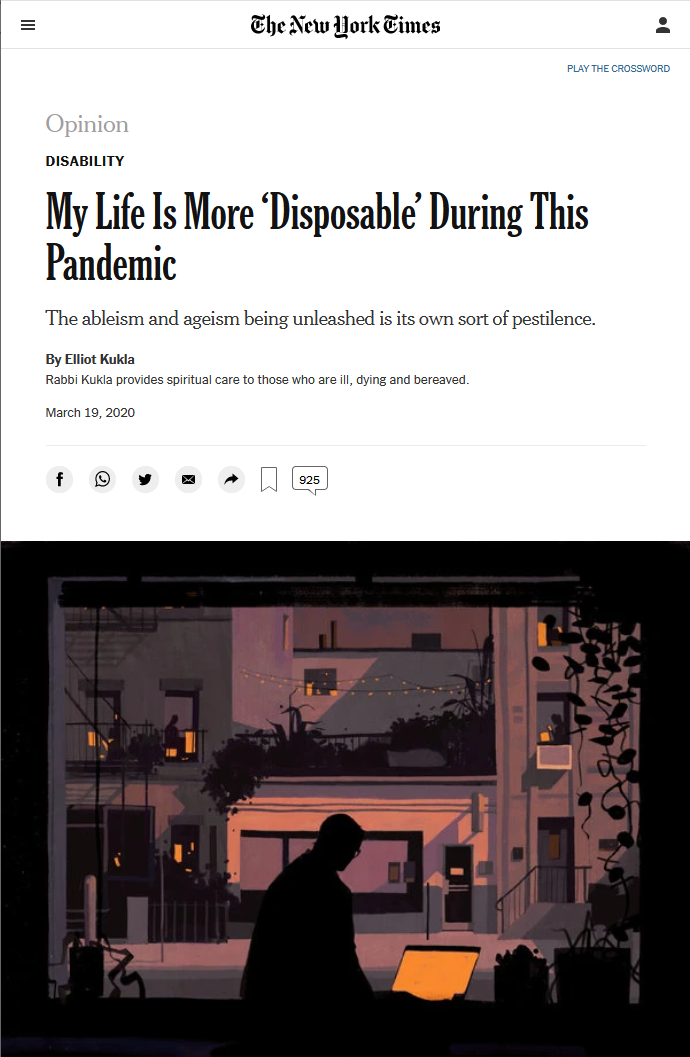
NYT: My Life Is More ‘Disposable’ During This Pandemic

"The stark message to chronically sick, disabled people and elders is that we are 'acceptable losses,'" Elliot Kukla wrote in the New York Times (3/19/20).

In the first weeks of the Covid outbreak, national media outlets did shine a spotlight on issues for disabled people, including the potential for discriminatory triage guidelines. Disabled voices appeared in the op-ed pages of the New York Times (3/19/20, 3/23/20), Washington Post (4/6/20, 4/9/20) and Vox (4/4/20), advocating for their rights.

Disability became a viral social media topic in July 2020, after a Texas woman shared a&feature=emb_logo">recording of a doctor refusing life-saving treatment for her Covid-infected husband, Michael Hickson, a Black father of five who was already a quadriplegic with brain damage. On tape, his doctor defended his choice based on Hickson’s lack of “quality of life,” by which he clarified to mean Hickson being “paralyzed with a brain injury,” not the infection. He also referred to Covid medication as being appropriate for patients who are “walking and talking.”

A few national outlets picked up the story, reflecting varying degrees of understanding of the disability issues at stake. Newsweek (7/2/20) leaned on statements by the hospital and care agency only, which defended the doctor’s medical choice but glided over his statements. Nor did Newsweek's article itself include all of the doctor’s incriminating words—or any input from disability advocates.

The Washington Post (7/5/20) described the contrast between Hickson’s wife, who wanted life-saving measures used, and his sister, who sought legal guardianship to let him die, as between a “voice of hope” and “a pragmatist,” respectively. The sister’s pragmatism was illustrated by her acceptance that Hickson was no longer “a genius,” or “the person he was before 2017,” when he was injured—with the Post not questioning the assumption that that prior brain damage was relevant to whether he should be saved.

None of the national stories pointed out how the doctor’s statements by themselves violated federal anti-discrimination rules for Covid triage, as a physician pointed out in an op-ed in The Hill (7/15/20). Still, the Hickson case brought brief attention to disability issues, with follow-up stories from outlets like USA Today (7/14/20) and Politico (8/10/20) covering state and local battles for disability rights.

'Happiness'

NYT: Restarting America

Peter Singer (New York Times Magazine, 4/10/20) rejects comparisons of the Covid death toll to Vietnam War casualties, because "this is killing mostly older people. I think that’s really relevant."

While national corporate media have sometimes, especially early on, centered disabled and affected voices during this pandemic, representatives of affected groups have not been included in conversations about rationing and other policy issues.  No advocates of disability or aging were invited to participate in either of two debates on Covid-19 ethical issues published in the New York Times Magazine and hosted by staff writer Emily Bazelon: “Restarting America Means People Will Die. So When Do We Do It?” (4/10/20), and “People Are Dying. Whom Do We Save First With the Vaccine?” (12/24/20).

Both conversations brought together five “thinkers,” as Bazelon described them. Each included author Peter Singer, described as “bioethics professor at Princeton [University].” Singer’s beliefs are guided by a “utilitarian” philosophy, which, he says, “does the most to increase the net surplus of happiness over misery” (NPR, 6/1/20). Singer has received significant positive attention in the last few years from national media outlets. An otherwise glowing article on Singer in Vox (12/11/20) did point to one notable mark on his record:

He has also been at times a controversial figure in modern ethics, alienating many in the disability community with what they’ve called his simplistic and horrifying takes on intellectual disabilities.

Indeed, Singer has argued, repeatedly and emphatically, that parents should be able to euthanize their disabled babies — not just abort fetuses, but kill actual infants. He describes nondisabled lives as “hav[ing] a greater chance at happiness” than disabled lives (New York Times, 2/16/03). Singer also believes that people with significant cognitive disabilities, such as Alzheimer's disease, cease being “persons,'' because they lack self-awareness, and so can ethically be euthanized by caregivers (New Yorker, 9/6/99).

Otherwise, Singer claims to value human and animal life highly (Vox, 10/27/20). He wrote a book called Animal Liberation and opposes eating, testing on or harming animals. (He has not offered an opinion on disabled animals.)

Disabled activists, religious scholars and others have spoken out ardently against Singer’s views for years, describing them as “eugenics” (e.g., Independent,, 10/10/11; National Review, 9/2/13;), which is defined as a coordinated effort to improve the genetic make-up of a population. The most famous eugenicists, the Nazis, sterilized and killed disabled people.

The beliefs that undergird Singer’s positions on disability correspond to some of his opinions on Covid. In the April debate in the New York Times Magazine, and in other writings around that time, Singer argues that the consequences of "lockdowns" are "horrific," because "more younger people are going to die," and that most of the people who died have been very old, with “underlying medical conditions.”

In the December New York Times Magazine debate, Singer argues that we should reconsider the plan to vaccinate older people in nursing homes first. “I think we should ask questions about the quality of their lives,” he says. “The objective that we should aim for is to reduce years of life lost.” He has said that he would give up lifesaving measures to someone “much younger” than himself, if that person didn’t have “underlying health conditions that mean that their life expectancy is no greater than mine” (NPR, 6/1/20).

Criticism of Singer was more prominent in mainstream media ten or more years ago, when British media outlets referred to him as “the man who would kill disabled babies” (Independent, 5/13/98) and “the most dangerous man in the world” (Guardian, 11/5/99).  Yet Singer's reputation would not have been a mystery to Bazelon or the Times when they selected him for the two Covid-19 debates. He has published similar views in the Times recently.

In 2017, Singer argued in a Times op-ed (4/3/17) that rape charges were unfair against a woman who had sex with a noncommunicative man with cerebral palsy. Singer’s argument shifted: the man “may lack the concept of consent altogether,” he offered at one point; elsewhere he suggested, even if the woman “wronged or harmed him, it must have been in a way that he is incapable of understanding and that affected his experience only pleasurably.”  The Times earlier (1/26/07) gave Singer space to question a disabled body’s autonomy, dismissing qualms about doctors deliberately stunting the growth of a disabled child as "lofty talk about human dignity."

Singer’s collection of beliefs is peculiar to him and nonscientific, yet he was invited to the Covid debate table among experts on public health. His ideas of “happiness” and “quality of life” are not measurable, and there is no evidence that happiness correlates with physical or cognitive ability. Scientists also cannot predict the life expectancy of anyone with “underlying medical conditions.”

What is more, Singer has no experience working in medicine or public health; bioethics is a humanities discipline, created in the late 1960s. He acknowledges as much in a Washington Post op-ed (4/27/20) on Covid-19, in which he and his co-author suggest people could voluntarily get sick to provoke immunity. “We are ethicists, not medical or biological scientists,” they write. “When it comes to factual beliefs about the pandemic, we defer to expert scientific opinion, as everyone should.”

'Diminishing capacities'

Singer was not the only controversial bioethicist to participate in Bazelon’s New York Times Magazine debates on Covid rationing. Her first conversation also included Ezekiel Emanuel. Unlike Singer, Emanuel does have a medical background, although not in epidemiology; he is an oncologist.

Even more than Singer, Emanuel has become one of the national media’s go-to experts on Covid, making frequent appearances on CNN (10/13/20), MSNBC (10/2/20), CNBC (10/13/20) and other news networks throughout the crisis, as well as writing numerous op-eds and being sought for comment. His media profile was further elevated after President-elect Joe Biden appointed him to his Covid-19 task force. Previously, Emanuel worked on the creation of the Affordable Care Act under President Barack Obama.
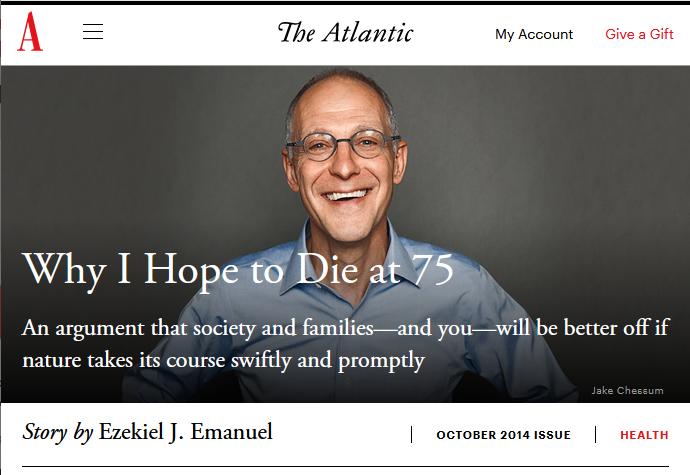
At;antic: Why I Hope to Die at 75

A member of Joe Biden's Covid advisory panel argued that "society and families—and you—will be better off if nature takes its course swiftly and promptly," and kills him at age 75 (Atlantic, 10/14).

Like Singer, Emanuel has shared disturbing views on disability and aging in the past. Most famously, he published a piece in the Atlantic (10/14) titled “Why I Hope to Die at 75.”  In the essay, Emanuel writes that aging “renders many of us, if not disabled, then faltering and declining, a state that may not be worse than death but is nonetheless deprived.” The article enumerates a long list of physical and cognitive losses, or “diminishing capacities,” associated with aging. Emanuel lists various conditions that are normally experienced by disabled people of all ages and determines they would make life no longer worth living.

A good deal of Emanuel’s article focuses on how people over 75 almost never achieve great things, which, for him, is associated with production and validation in a capitalist society. When asked about seniors over 75 who do lead active lives, he replied (Technology Review, 8/21/19): “When I look at what these people ‘do,’ almost all of it is what I classify as play. It’s not meaningful work. They’re riding motorcycles; they’re hiking.”

Emanuel’s 2014 Atlantic essay ends with a promise to avoid any medical tests or interventions after 75, including the flu shot. He refers to pneumonia as “the friend of the aged” by gifting the elderly with death.

For this and other reasons, advocates for the disabled and elderly were especially concerned when Emanuel’s name was announced as part of Biden’s Covid-19 advisory team. These advocates and others spoke out on social media and in the independent press. Corporate media mostly ignored the controversy in its coverage of his appointment, with Fox News (11/9/20) and USA Today (11/25/20) as notable exceptions. But USA Today only mentioned the controversy to defend Emanuel, calling his Atlantic essay a “personal preference,” even though the essay used “we” and “us” language, making assumptions about shared views on aging and disability. The essay also included a long critique of the American impulse to fight aging.

Emanuel appears on talk shows regularly discussing Covid, but he has rarely if ever been asked about his views on disability and aging since 2014. Bazelon did bring it up during the Times Magazine debate. He told her the premise of his Atlantic article was a “personal preference, not a policy proposal,” the same language used by USA Today.

If Emanuel’s outlook on aging and disability is a “personal preference,” he has nonetheless pursued policies that seem to align with it. During Obama’s presidency, he proposed systematizing the rationing of scarce medical resources, like organs, based on a calculus of age and disability instead of first-come, first-serve. He also argued in opposition to the Hippocratic oath putting individual patients over cost and the greater good. These views were controversial, prompting some conservatives to suggest the ACA would instill “death panels’ (Forbes, 9/24/14).

Emanuel has been proposing a similar approach to who should receive Covid-19 treatment and vaccination. He proposes prioritizing individuals with greater social value and more estimated years remaining, which is calculated based on age and disability (New York Times, 3/12/20; NEJM, 5/21/20).

Several media outlets, especially the New York Times, have provided extraordinary and mostly uncritical space for Emanuel’s ideas on Covid, even though he is not an epidemiologist. He is also not the only member of Biden’s Covid advisory board. The Times has published 12 op-eds related to Covid written or co-written by Emanuel since the pandemic started (e.g.,  4/14/20, 7/29/20)—more than the total number of Times op-eds about how Covid has affected disabled people and seniors. Emanuel has also written several Covid-related opinion pieces for the Washington Post (e.g., 4/22/20, 7/31/20), as well as for USA Today (3/19/20, 10/10/20), Science (9/11/20) and the Atlantic (4/18/20, 5/22/20) (for which he previously wrote reviews of DC-area restaurants).

Corporate media’s elevation of Emanuel and Singer as experts on Covid-19, without scrutinizing their troubling views, points to how unprepared news outlets are to report on the nuances of disability in the age of Covid. On November 7, many disabled people on Twitter were pleasantly surprised after CNN’s Jake Tapper mentioned “#cripthevote” on live television, a popular hashtag for disabled political conversation.

“This is not a community that gets a lot of attention as a political force,” Tapper said. About 25% of the US population has a disability, according to the Centers for Disease Control, and this percentage is likely to have grown in the last year, with the rise in long-haul Covid illness.


Tuesday, February 4, 2020

Amanda Marcotte | Voting to Acquit This Noxious Criminal Is the Point of No Return for the Republican Party


Reader Supported News
03 February 20
It's Live on the HomePage Now:
Reader Supported News

Amanda Marcotte | Voting to Acquit This Noxious Criminal Is the Point of No Return for the Republican Party
Donald Trump, Susan Collins, Lamar Alexander, Rand Paul, Ted Cruz, and Mitch McConnell (photo: AP/Getty Images/Salon)
Amanda Marcotte, Salon
Marcotte writes: "Today Republicans make it official: Out of sheer lust for power, they've rejected democracy and basic decency."
EXCERPTS: 

Sen. Lamar Alexander, R-Tenn., all but admitted as much Thursday, in a series of tweets acknowledging that the accusation against Trump — that he withheld military aid and political support for Ukraine in order to force that struggling nation's president to help him cheat in the election — "has already been proven." But Trump's behavior, Alexander claimed, was merely "inappropriate" but "does not meet the U.S. Constitution's high bar for an impeachable offense."
This will be the final note of a long process in which the Republicans allowed arguments in the Congressional Record, most notably from fabled defense lawyer Alan Dershowitz, defending a president's "right" to cheat in elections, and then affirmed this belief with a formal vote.
Dershowitz is now running around, making incoherent claims that he wasn't arguing what he said he was arguing, but that hardly matters. His case for presidential tyranny was made on the Senate floor, and his attempts to claw it back in the media don't carry anywhere near the same weight. 
For those of us who have watched Republicans closely throughout this process, what has been striking is the shamelessness and bad faith on display, as they have competed to be the biggest lickspittle to the wannabe fascist smearing his fake tan all over the White House.
Was it Senate Majority Leader Mitch McConnell, openly bragging about how he was coordinating with the Trump defense team to rig this sham of a trial? 
Was it Sen. Ted Cruz of Texas starting a podcast about impeachment dedicated to licking Trump's shoes, despite the fact that Trump spent the election calling Cruz's wife ugly and accusing Cruz's dad of murdering JFK? 
Was it Sen. Rand Paul of Kentucky using the trial as an excuse to air the name of the whistleblower who first reported Trump's bribery scheme, a move clearly meant to suggest to intimidate other federal employees out of stepping forward with information about Trump's crimes and corruption? 
Was it Sen. Susan Collins of Maine working herself into an outrage over Rep. Adam Schiff, D-Calif., accusing Republicans of being a bunch of quislings who let Trump control them, even though the upcoming miscarriage of justice proves Schiff correct? 
Republicans have structural and geographic advantages that allow them to stave off the threat of actual democracy, but they fear that this won't last forever. As never-Trumper Evan McMullin noted on Twitter:


READ MORE


Emmanuel Smith, who has brittle bone disease, said their caucuses had to travel over an hour each way to caucus in 2016. (photo: Nick Rohlman/Nick Rohlman/Guardian UK)

'You Basically Are Nothing': The Americans Shut Out of the Iowa Caucuses
Sam Levine, Guardian UK
Excerpt: "Hundreds of thousands of Iowans are barred from the Iowa caucus because of physical and legal barriers."

EXCERPTS:
They were part of one of the largest groups shut out of Monday’s caucus: people with felony convictions. Iowans are barred from voting for life once they commit a felony, and people can’t vote even if they committed a crime decades ago. The state’s policy, one of the strictest in the country, means more than 42,000 Iowans out of prison won’t have a say in choosing a presidential candidate. Almost 10% of the black voting-age population can’t vote because of a felony conviction.
For decades, the Iowa caucuses have marked the beginning of the presidential primary, and often set the tone for the election year. But the event has come under increasing scrutiny for giving some voters – namely white and wealthy Iowans – outsized power in choosing the president in a state that’s already more than 90% white. Meanwhile, the physical and legal barriers built into the structure of the caucuses leave out large swaths of the population, whether they are disabled, work long hours, or were once convicted of a crime.
A few miles north, Gretchen Brown-Waech was getting ready for a historic caucus designed to serve another community often sidelined in the political dialogue: the 300,000 voting-age Iowans with disabilities.
For decades the population has struggled to take part in the caucuses, which requires Iowans to physically show up at a location and spend hours choosing a candidate. Brown-Waech, who is deaf, first tried to caucus in the 1990s, but when people started talking over each other, she found it overwhelming and left early. She didn’t try again until 2016 with the help of a friend because she felt the choice was so important.
Now, on Monday, after pressing state Democratic party officials, Brown-Waech is leading the first ever Iowa caucus in American Sign Language. She expects about 20 people to come to the event on Monday, some from hours away, including a deaf couple in their 60s that has never voted. “Anytime anyone who is not part of the mainstream is shut out of the political process, our country loses,” said Brown-Waech. “If we don’t design something for people on the margins, someone will always be left out.”
Since 2016, advocates have been pushing the Iowa Democratic party to address obstacles like transportation, navigating crowded spaces and seating that people with disabilities face to caucusing. The party has introduced some solutions – like allowing some groups to hold satellite caucuses in their homes or accessible locales.


Immigrant detainees gather in a common area at one of the housing units at the Adelanto ICE Processing Center. (photo: Chris Carlson/AP)


The Ex-Leader of an Anti-Immigration Group Is Creating the Office in Charge of Fielding Civil Rights Complaints From Detainees
Hamed Aleaziz, BuzzFeed
Aleaziz writes: "The Trump administration has named a hardline former leader of an anti-immigration group to help set up a new role created by Congress to oversee complaints of civil rights violations in detention centers and help those affected by misconduct." 

“That’s like letting the fox watch the hens,” one congressional staffer told BuzzFeed News.

he Trump administration has named a hardline former leader of an anti-immigration group to help set up a new role created by Congress to oversee complaints of civil rights violations in detention centers and help those affected by misconduct, according to an internal memo obtained by BuzzFeed News.
The Office of the Immigration Detention Ombudsman was created in the most recent appropriations bill to “address issues that arise in DHS detention facilities” and remain independent of Immigration and Customs Enforcement or US Customs and Border Protection. The office will report directly to the secretary of Homeland Security.
Ken Cuccinelli, the controversial second-in-command at the Department of Homeland Security, appointed Julie Kirchner, former leader of FAIR, a group that advocated for policies that restrict immigration, to help set up the office, according to the memo. Cuccinelli also tapped Tracy Short — a former top ICE official who signed memos during the Trump administration to stop the agency from granting reprieves for certain immigrants facing deportation — to also help figure out the plans for the office.
“To spearhead this effort, I have asked Julie Kirchner, outgoing Citizenship and Immigration Services Ombudsman, and Tracy Short, Senior Advisor at Immigration and Customs Enforcement, to work with senior leadership and staff within the Department to lay the proper foundation for the [office],” according to the memo, which was dated Jan. 28.
Congress provided $10 million for the office to address issues of misconduct by DHS officials in detention centers, establish a process to oversee complaints made against immigration officials, inspect facilities, provide recommendations for improvement, and potentially help those whose rights have been violated while in custody.
“In the immediate days and weeks Julie and Tracy will be contacting a variety of individuals across the Department to solicit their input and request information regarding the formation of this new office,” Cuccinelli wrote.
Kirchner was initially picked as the ombudsman at USCIS in 2017, before her departure in the role was announced late last year.
When her appointment was originally announced in 2017, advocacy groups were outraged, due to her background at FAIR, which the Southern Poverty Law Center had labeled a hate group and "America’s most influential anti-immigrant organization."
"Kirchner’s new position is a very powerful one, which it makes it all the more disturbing considering her past work," the SPLC said at the time.
The move to appoint Kirchner and Short to help “lay the proper foundation” for the office will likely spur criticism from Congressional officials.
“That’s like letting the fox watch the hens,” said one congressional staffer in a message to BuzzFeed News.
John Sandweg, former acting head of ICE during the Obama administration, said the move was not surprising, but potentially indicative of how the administration sees the role.
“These are the architects of the Trump administration’s immigration enforcement policies,” he said. “It’s not a surprise they would try to build this thing in a way that makes it as less impactful as possible and seems inconsistent with the intent of Congress when they created the office. We have to wait to see what the end product is.”
DHS did not immediately comment.
ICE has expanded the number of people it detains to record levels under President Trump. As of late January, the agency was detaining nearly 41,000 immigrants. The peak came last summer, when around 55,000 immigrants were in custody in local jails and private prisons across the country.
In December, the House Oversight and Reform Committee announced it had opened an investigation into the medical care of immigrant detainees in the wake of a BuzzFeed News story that revealed a series of allegations of substandard care from a whistleblower.


Washington Post reporter Wesley Lowery told Politico about the emotional toll discussions on racism in politics can take on reporters of color. (photo: Kris Connor/Getty Images)

Washington Post Threatened Another Star Reporter Over His Tweets
Maxwell Tani, The Daily Beast
Tani writes: "The Washington Post's controversial decision to punish a reporter last week over a Kobe Bryant tweet is not the first time the newspaper's strict social-media policies have caused internal headaches and clashes between management and the paper's high-profile journalists."
READ MORE


Democratic presidential candidate and former South Bend, Indiana mayor Pete Buttigieg speaks during a campaign event on January 31, 2020 in Clinton, Iowa. (photo: Joe Raedle/Getty Images)

Pete Buttigieg's Elite-Friendly Politics Won't Help the Marginalized
Paul M. Renfro, Jacobin
Renfro writes: "Pete Buttigieg is this election's poster child for 'progressive neoliberalism' - offering up platitudes about diversity while leaving untouched the very structures that oppress people. It's time we left this kind of politics in the past."
READ MORE


Indian nationals arrive at the New Delhi airport in October after being deported from Mexico as they tried to enter the US. (photo: AFP/Getty Images)

'Scared for My Life': Why More Indians Are Joining Migrants on Risky Journey to Reach the US
Arya Sundaram, Guardian UK
Sundaram writes: "Many US immigration lawyers say the rise in undocumented Indian migration is linked to the rise of the Hindu nationalist ruling party - and the sectarian violence it has inspired."
READ MORE


A young farmer. (photo: SimonSkafar/Getty Images)

Climate Change Is Making It Harder to Be a Young Farmer
Leah Douglas, Grist
Douglas writes: "With this season's severe flooding, raging wildfires, and delayed planting, many of the country's farmers are struggling to adjust as climate change sets in."

EXCERPT:
There are about 340,000 farms in the United States — 17 percent of the total — whose operators have been farming for less than 10 years, according to the Department of Agriculture’s Agricultural Resource Management Survey. Two-thirds of these farmers say they are already experiencing climate change, a 2017 survey by the National Young Farmers Coalition found.
“With climate change, it’s hard to put your finger on single events,” says Ben Whalen, who has farmed for three years at Bumbleroot Organic Farm near Portland, Maine. “But we’re accepting the reality that the weather is just going to get more extreme and unpredictable. That’s the mindset that we’re adopting as we start planning for the future of the farm.”


Top News | 'He’s Not Going to Run Unopposed': Sanders Rejects Schumer for Majority Leader

                                                               LOTS OF POSTS IGNORED BY BLOGGER..... OR REMOVED ON THEIR WHIM! ALL POSTS ARE...