Showing posts with label DARK POOLS. Show all posts

Monday, June 10, 2024

Nvidia Hit a $3 Trillion Market Cap Last Week; Dark Pools Are Making Over 300,000 Trades in the Stock Weekly


SUBSCRIBE TO THIS NEWSLETTER TO RECEIVE TIMELY REPORTS!

PLEASE READ & SHARE! THIS IS AN ISSUE BEING OVERLOOKED & IGNORED!


Nvidia Hit a $3 Trillion Market Cap Last Week; Dark Pools Are Making Over 300,000 Trades in the Stock Weekly

By Pam Martens and Russ Martens: June 10, 2024 ~

The much-hyped artificial intelligence chipmaker, Nvidia (ticker NVDA), reached a market cap of $3 trillion on Thursday, beating out Apple as the second most valuable company, just behind Microsoft. This morning, Nvidia’s 10-for-1 stock split will become effective, reducing its share price to, ideally, entice more retail investors.

Year-to-date, Nvidia’s stock price is up 144 percent through the closing bell on Friday.

The company was founded on April 5, 1993 and lived the bulk of its existence in obscurity until a New York Times article appeared on September 1, 2017 with this headline: “Why a 24-Year-Old Chipmaker Is One of Tech’s Hot Prospects.”

Browsing the company’s prolific newsroom reveals no shortage of bold pronouncements. A June 2 press release carries this seismic prediction:

“The next industrial revolution has begun. Companies and countries are partnering with NVIDIA to shift the trillion-dollar traditional data centers to accelerated computing and build a new type of data center — AI factories — to produce a new commodity: artificial intelligence….”

Our first instinct was to take a look to see how much trading in Nvidia’s shares is occurring in Dark Pools – non-transparent trading platforms operated by some of the biggest trading houses on Wall Street (which are also, insanely, allowed to own some of the largest federally-insured U.S. commercial banks which hold trillions of dollars in deposits).

Wall Street’s self-regulator, FINRA, began providing some Dark Pool data back in 2014. Unfortunately, the trading data for each Dark Pool and the respective stock it is trading is lumped together for the entire week, not by the minute or hour or day, and the data arrives to the public two weeks late for big cap stocks and four weeks late for smaller companies.

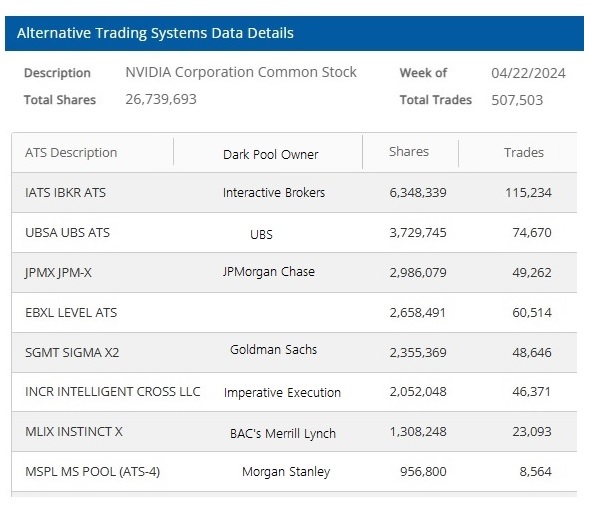
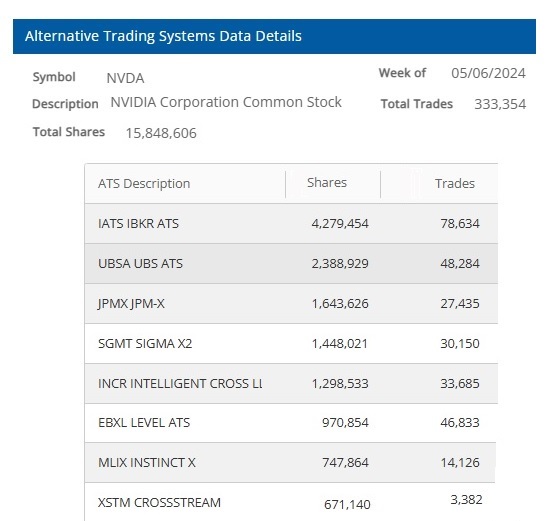
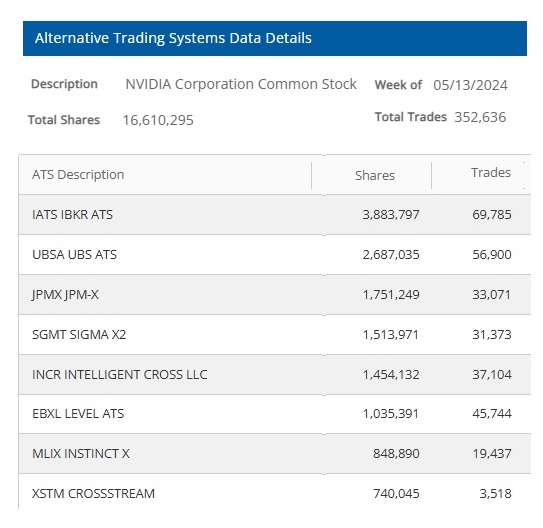
The charts below show the top eight Dark Pools that made the largest number of trades in Nvidia’s stock for a recent three weeks that FINRA has made trading data available. The Dark Pool owned by Interactive Brokers has consistently been the largest trader of Nvidia’s shares. In second and third place has been global banking behemoths UBS and JPMorgan, respectively. Dark Pools owned by other global trading powerhouses, Goldman Sachs, Morgan Stanley, and Bank of America’s Merrill Lynch, have also ranked in the top eight.

Interestingly, JPMorgan has shelled out $250 million in fines to the Office of the Comptroller of the Currency; $98.2 million to the Federal Reserve and $100 million (netted down from $200 million) to the Commodity Futures Trading Commission since March for failing to provide proper surveillance of “billions” of trades. The regulators were deafeningly silent on whether JPMorgan’s Dark Pools were involved in these infractions. (See herehere and here.)

Following the stock market crash of 1929 (which ushered in the Great Depression), the U.S. Senate Banking Committee conducted an exhaustive investigation into the trading structure and trading practices on Wall Street. The titans of Wall Street were put under oath and troves of documents were subpoenaed. The Senate investigations focused on the collusive dealings of “pools.” The 1930s Senate investigation found the following:

“A pool, according to stock exchange officials, is an agreement between several people, usually more than three, to actively trade in a single security. The investigation has shown that the purpose of a pool generally is to raise the price of a security by concerted activity on the part of the pool members, and thereby to enable them to unload their holdings at a profit upon the public attracted by the activity or by information disseminated about the stock. Pool operations for such a purpose are incompatible with the maintenance of a free and uncontrolled market.”

The Senate Banking Committee of 1934 concluded as follows:

“The conclusion is inescapable that members of the organized exchanges who had a participation in or managed pools, while simultaneously acting as brokers for the general public, were representing irreconcilable interests and attempting to discharge conflicting functions. Yet the stock exchange authorities could perceive nothing unethical in this situation.”

As Wall Street On Parade has previously reported, U.S. regulators are not only allowing these quasi stock exchanges to operate in darkness, they are allowing Goldman Sachs, Bank of America Merrill Lynch, JPMorgan Chase and others to trade their own publicly-traded bank stocks in their own Dark Pools.

The U.S. stock market, once the envy of the world, remains dangerously opaque today, in no small part because of the sick revolving door structure between Wall Street and its regulators.

Congress does not feel compelled to tackle the problem because corporate media has chosen to ignore the mushrooming problem. Even after bestselling author and Wall Street veteran, Michael Lewis, went on the heavily watched 60 Minutes program on CBS in 2014 and told viewers that “The United States stock market, the most iconic market in global capitalism is rigged,” Congress and the SEC have continued to dance around the problem.

Until the public demands change, the darkness will continue to deepen in increasingly dangerous ways.
WALL STREET ON PARADE

60 Minutes Sanitizes Its Report on High Frequency Trading


By Pam Martens: April 1, 2014
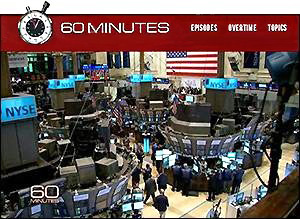
Floor of the New York Stock Exchange as Featured in 60 Minutes Report on High Frequency Trading

Two of the chief culprits of aiding and abetting high frequency traders, the New York Stock Exchange and the Nasdaq stock exchange, failed to come under scrutiny in the much heralded 60 Minutes broadcast on how the stock market is rigged.

This past Sunday night, 60 Minutes’ Steve Kroft sat down with noted author Michael Lewis to discuss his upcoming book, “Flash Boys,” and its titillating revelations about how high frequency traders are fleecing the little guy.

Kroft says to Lewis: “What’s the headline here?” Lewis responds: “Stock market’s rigged. The United States stock market, the most iconic market in global capitalism is rigged.”

Kroft then asks Lewis to state just who it is that’s rigging the market. (This is where you need to pay close attention.) Lewis responds that it’s a “combination of these stock exchanges, the big Wall Street banks and high-frequency traders.” We never hear a word more about “the big Wall Street banks” and no hint anywhere in the program that the New York Stock Exchange and Nasdaq are involved.

60 Minutes pulls a very subtle bait and switch that most likely went unnoticed by the majority of viewers. In something akin to its own “Flash Boys” maneuver, it flashes a photo of the floor of the New York Stock Exchange as Kroft says to the public that: “Michael Lewis is not talking about the stock market that you see on television every day. That ceased to be the center of U.S. financial activity years ago, and exists today mostly as a photo op.”

That statement stands in stark contrast to the harsh reality that the New York Stock Exchange is one of the key facilitators of high frequency trading and making big bucks at it.

In this Google cache of a promotional piece aimed at high frequency traders, the New York Stock Exchange explains how it is offering a “fully managed co-location space next to NYSE Euronext’s US trading engines in the new state-of-the-art data center.” Who is it for? The NYSE says it is for “High frequency and proprietary trading firms, hedge funds and others who need high-speed market access for a competitive edge.” More eye-popping details on how the New York Stock Exchange is arming high frequency traders in Mahwah, New Jersey against the little folks who can’t afford tens of thousands of dollars a year for a “competitive edge” are provided on its web site here. (The closer a high frequency trader’s computers are located to the New York Stock Exchange’s main computers, the faster their trades are executed.)

The Securities and Exchange Commission knows full well this is going on. Just this past December 24, the SEC filed this rule change in the Federal Register, announcing that the New York Stock Exchange was changing its pricing for some of its co-location services and computer cabinets for outside users. Like some kind of a half-off sale at Macy’s, the NYSE says it will offer: “a one-time Cabinet Upgrade fee of $9,200 when a User requests additional power allocation for its dedicated cabinet such that the Exchange must upgrade the dedicated cabinet’s capacity. A Cabinet Upgrade would be required when power allocation demands exceed 11 kWs. However, in order to incentivize Users to upgrade their dedicated cabinets, the Exchange proposes that the Cabinet Upgrade fee would be $4,600 for a User that submits a written order for a Cabinet Upgrade by January 31, 2014…”

The Federal Register notice also shines light on some pricing comparisons between what the NYSE is offering high frequency traders versus the Nasdaq stock market, writing: “The Exchange also believes that the Cabinet Upgrade fee is reasonable because it would function similar to the NASDAQ charges for comparable services. In particular, NASDAQ charges a premium initial installation fee of $7,000 for a ‘Super High Density Cabinet’ (between 10 kWs and 17.3 kWs) compared to $3,500 for other types of cabinets with less power.The Exchange charges only one flat rate for its initial cabinet fees ($5,000), regardless of the amount of power allocation.”

Congress is equally aware of what is going on. As far back as October 28, 2009, the U.S. Senate Banking committee took testimony from Larry Leibowitz, head of technology at the NYSE on the fact that it was offering co-location to outside trading firms. Neither the Flash Crash of 2010 or confidence-busting trading “glitches” since then have roused Congress and the SEC from their slumber.

Another opportunity emerges in the 60 Minutes broadcast for Kroft to call out the New York Stock Exchange or Nasdaq for their practices. As Kroft explains how this young former trader from the Royal Bank of Canada, Brad Katsuyama, figured out how high frequency traders were gaming the market and made appointments with institutional investors to share his insights, Kroft says “and some of the most famous names in the American stock market heard the pitch.” At this exact moment a photo of the exterior of the New York Stock Exchange flashes across the screen, giving the impression that the NYSE is some poor, naïve victim of a cartel of high frequency traders.

What is also preposterous about this 60 Minutes segment is that it deals exclusively with gaming the system through miles of fiber optic cable. That is so yesterday, according to the Futures Industry magazine. On January 24 of last year, the publication wrote that “High frequency traders can use wireless to connect to data sources or exchanges about 1.5 times faster than through fiber optics, enabling them to quote prices at tighter bid-ask spreads than rivals or execute trades more quickly than other firms. Such are the potential competitive advantages, however, that many projects are pursued behind a veil of silence.”

The article noted that San Diego-based NexxCom Wireless was building a millimeter wave network between New York, London and Frankfurt and considering connections to Zurich and Milan with the potential to add Stockholm and Moscow.

Within less than 24 hours of the big splash made by the 60 Minutes broadcast, the Wall Street Journal reported that the FBI was all over the problem and had been for a year. The question, of course, is – will anyone ever acknowledge the key role being played by the New York Stock Exchange and Nasdaq.

Related Article:

60 Minutes Takes a Pass On Wall Street’s Secret Spy Center


WALL STREET ON PARADE

Tuesday, March 19, 2024

******MUST READ ***** JPMorgan’s Federally-Insured Bank Is Fined $348 Million for Losing Track of “Billions” of Trades


SUBSCRIBE TO THIS NEWSLETTER TO RECEIVE TIMELY REPORTS


JPMorgan’s Federally-Insured Bank Is Fined $348 Million for Losing Track of “Billions” of Trades

By Pam Martens and Russ Martens: March 18, 2024 ~

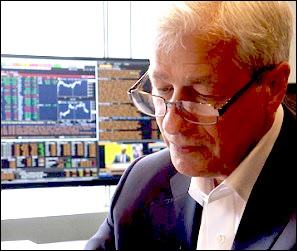
Jamie Dimon Sits in Front of Trading Monitor in his Office (Source -- 60 Minutes Interview, November 10, 2019)

Jamie Dimon Sits in Front of Trading Monitor in his Office (Source: 60 Minutes Interview, November 10, 2019)

On Thursday of last week, two of JPMorgan Chase Bank’s federal regulators fined the riskiest bank in the United States $348 million dollars for engaging in “unsafe and unsound banking practices” for failing to supervise “billions” of trades on at least 30 global trading venues.

The Office of the Comptroller of the Currency (OCC) fined JPMorgan Chase Bank $250 million while the Federal Reserve fined the bank $98.2 million. The OCC said the misconduct occurred since at least 2019. The Fed said the bank had engaged in the misconduct over the span of nine years, from 2014 to 2023.

The key outrage embedded in these charges – that mainstream media failed to point out in its coverage last week – is that this “trading” activity did not occur at the registered brokerage firm of JPMorgan, which has properly licensed traders and trading supervisors. It occurred at the federally-insured bank, which is not allowed to have licensed traders – because casino banking brings on bank runs, bank panics and giant scandals that undermine Americans’ confidence in federally-insured banks.

Under Jamie Dimon at the helm of this federally-insured bank, as both Chairman and CEO, JPMorgan Chase Bank has turned giant scandals into an art form. Its rap sheet reads like that of an organized crime family and includes an unprecedented five criminal felony charges.

***JP MORGAN CHASE settled to avoid public release of 
damning information...THEY KNEW what JEFFREY 
EPSTEIN was doing...it needs to be investigated WHO and WHY funds were paid....there are still unanswered questions****

Just last year, its salacious activities with sex trafficker Jeffrey Epstein, to whom it doled out mountains of hard cash for more than a decade (which he then used to silence his underage victims and accomplices), generated news headlines around the world. The bank settled those charges last year, which had been brought in two civil lawsuits by his victims and by the Attorney General of the U.S. Virgin Islands, for a combined $365 million. (See JPMorgan’s Settlements Reach $365 Million Over Civil Claims It Banked Jeffrey Epstein’s Sex Trafficking of Minors; Criminal Charges Could Lie Ahead.)

Adding to the outrage over the mild slap on the wrist from these two regulators last week is that this federally-insured bank was previously charged with engaging in unsafe and unsound banking activities when it used depositors’ money from its federally-insured bank to engage in massive high-risk credit derivative trades in London in 2012 and lost $6.2 billion of depositors’ money. The case became infamously known as the London Whale scandal.

The OCC wrote as follows in its settlement document covering the London Whale matter in 2013:

“The credit derivatives trading activity constituted recklessly unsafe and unsound practices, was part of a pattern of misconduct and resulted in more than minimal loss, all within the meaning of 12 U.S.C. § 1818(i)(2)(B)”;  and “The Bank failed to ensure that significant information related to the credit derivatives trading strategy and deficiencies identified in risk management systems and controls was provided in a timely and appropriate manner to OCC examiners.”

The Securities and Exchange Commission (SEC) also settled charges with the bank in the London Whale matter. The SEC focused on JPMorgan’s ineffective internal controls and failure to keep the Audit Committee of its Board informed in a timely manner as required under its own rules and under the Sarbanes-Oxley Act. The SEC also found the company violated securities laws by filing false information with the SEC: “As a result of its failure to maintain effective internal control over financial reporting as of March 31, 2012, and disclosure controls and procedures, and as a result of its filing of inaccurate reports with the Commission (specifically, the Form 8-K filed on April 13, 2012, and the Form 10-Q filed on May 10, 2012), JPMorgan violated Sections 13(a), 13(b)(2)(A), and 13(b)(2)(B) of the Exchange Act and Rules 13a-11, 13a-13, and 13a-15 there  under,” the SEC said in its settlement document.

At the time of the London Whale scandal, a woman named Ina Drew was in charge of the unit of the federally-insured bank that oversaw the derivatives trading in London. That unit of the bank was called the Chief Investment Office. (That unit was created after Jamie Dimon took the helm at the bank.)

Ina Drew testified about the matter before the U.S. Senate’s Permanent Subcommittee on Investigations on March 15, 2013. Drew told the hearing panel that beginning in 1999, she “oversaw the management of the Company’s core investment securities portfolio, the foreign-exchange hedging portfolio, the mortgage servicing rights (MSR) hedging book, and a series of other investment and hedging portfolios based in London, Hong Kong and other foreign cities.”

Drew told the Senate Subcommittee that the investment securities portfolio exceeded $500 billion during 2008 and 2009 and as of the first quarter of 2012 was $350 billion. But during the 13 years that Drew supervised massive amounts of securities trading, she had neither a securities license nor a principal’s license to supervise others who were trading securities.

At the time, we asked numerous Wall Street regulators to explain how this is possible at Wall Street mega banks. One regulator who spoke on background only told us that Drew could not hold a securities license because she worked for the federally-insured bank, not its broker-dealer (a/k/a brokerage firm). Only employees of broker-dealers are allowed to hold securities licenses. But apparently, not having a securities license does not stop one from supervising a $500 billion portfolio of securities that are, most assuredly, traded by someone.

It is a long-held requirement by U.S. securities regulators that if you are going to supervise persons holding a securities license, you must also hold the appropriate securities licenses yourself. Drew, without a license, was supervising traders in London who were registered with the Financial Services Authority (now Financial Conduct Authority).

In its 10-K (annual report) filing in February with the SEC, JPMorgan Chase indicated there is a third unnamed regulator that is currently investigating these billions of unsupervised trades. The bank said it was “also in advanced negotiations with a third U.S. regulator, but there is no assurance that such discussions will result in a resolution.”

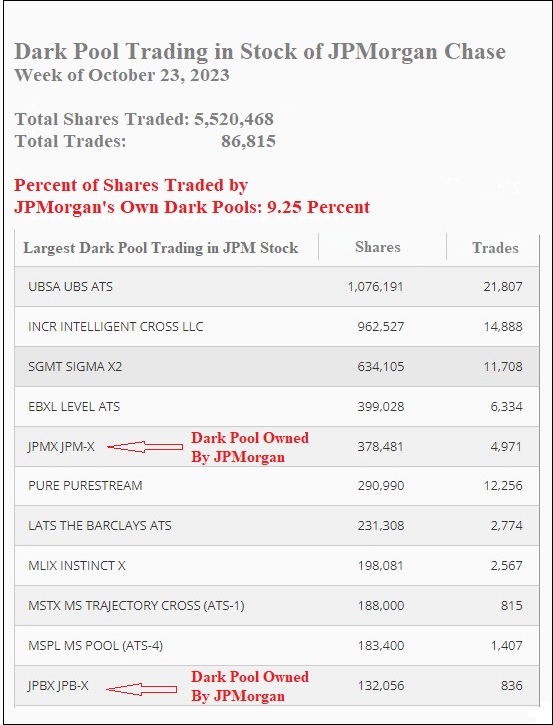
That third regulator should closely examine what is going on in JPMorgan’s own Dark Pools, where the bank is preposterously allowed to trade large amounts of its own bank stock in its own Dark Pools. (See chart below as an example of what went on in the week of October 23, 2023.) Dark Pools are thinly regulated trading platforms inside the mega banks on Wall Street, and elsewhere, which lack the transparency of stock exchanges.

Dark Pool Trading in JPMorgan Chase Stock, Week of October 23, 2023

Related Articles:

If a Stockbroker Had Jamie Dimon’s BrokerCheck Record, He’d Be Unemployable on Wall Street

JPMorgan Chase Owns $2.2 Trillion in Stock Derivatives; Two-Thirds the Total for All Banks

OCC Report: JPMorgan Chase and Citibank Control 76 Percent of all Precious Metals Contracts at 5,362 Federally-Insured Banks

Both Citigroup and JPMorgan Have Now Received Huge Fines for Crimes the Regulators Won’t Reveal


https://wallstreetonparade.com/2024/03/jpmorgans-federally-insured-bank-is-fined-348-million-for-losing-track-of-billions-of-trades/


Tuesday, April 11, 2023

First Republic Bank: Dark Pool Trading by “Rescuers” Exploded in Volume as FRC Tanked

 SUBSCRIBE TO THIS NEWSLETTER TO RECEIVE IT IN A TIMELY MANNER

First Republic Bank: Dark Pool Trading by “Rescuers” Exploded in Volume as FRC Tanked

By Pam Martens and Russ Martens: April 10, 2023

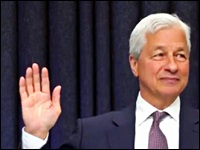
Jamie Dimon Being Sworn In at House Financial Services Committee Hearing, May 27, 2021

Jamie Dimon Being Sworn In at House Financial Services Committee Hearing, May 27, 2021

Jamie Dimon, the Chairman and CEO of JPMorgan Chase, has cranked up his public relations machine since March 16 to promote the narrative that he came to the “rescue” of the plunging regional lender, First Republic Bank. The so-called “rescue” consisted of 11 banks, including JPMorgan Chase, dumping a total of $30 billion in “uninsured” deposits into First Republic.

But one of the bank’s key problems was that it already had too many uninsured deposits. (This was like seeing a house on fire and throwing 11 expensive martinis at it.)

According to First Republic’s regulatory filings, as of December 31, 2022, it had total deposits of $176.25 billion, of which $119.47 billion (or 68 percent) were uninsured. The Federal Deposit Insurance Corporation (FDIC) caps federal deposit insurance at $250,000 per depositor, per bank. But banks such as First Republic, that cater to the very wealthy, have a significant number of customer accounts that dramatically exceed the $250,000 cap. In the digital age, those deposits can rapidly move elsewhere when a bank panic sets in.

The stock market was unpersuaded that this Dimon rescue plan was anything more than a hastily thrown together p.r. stunt. First Republic Bank’s stock closed on March 16 – after the news about the $30 billion hit the wires – at $34.27. It has continued to move lower, hitting $14.03 by the closing bell on Friday. That’s a year-to-date decline of 90 percent – not exactly anyone’s idea of a “rescue.”

S&P Global also wasn’t buying the idea of the “rescue” either. Three days after the p.r. news of the 11 banks tossing $30 billion of uninsured deposits at First Republic, it downgraded the bank’s credit rating by three notches, putting it deeper into junk territory.

Wall Street mega banks have a long history of talking a good game while surreptitiously doing deceitful things behind a dark curtain. Let’s not forget that some of the biggest names on Wall Street, in the leadup to the financial crisis of 2008, were driving the U.S. housing market deeper into despair by shorting (making bets against) the residential mortgage bonds they had sold to their own customers as solid investments.

Our suspicions about the “rescue” of First Republic Bank were aroused further last week when multiple news reports indicated that Morgan Stanley, one of the 11 Wall Street banks that chipped in for the $30 billion “rescue” of First Republic Bank, was now hiring some of its largest advisor teams and providing a home to the billions in assets managed by those teams. (See here and here.)

We decided to take a look behind one of the darkest curtains on Wall Street – the trading that occurs in the Dark Pools owned by these wily mega banks on Wall Street. (See Related Articles below.) Dark Pools are effectively unregulated stock exchanges operating inside the largest trading houses on Wall Street.

Wall Street’s self-regulator, FINRA, after public uproar, began releasing weekly aggregated totals for trading in Dark Pools in 2014. But the data is far from transparent. For example, a number of the Wall Street banks own more than one Dark Pool. There is no way to tell if a two-sided market is occurring between Dark Pools owned by the same parent. There is no hour-by-hour or day-by-day breakdown of trading, just data lumped together for each Dark Pool for an entire week. There is also a multiple-week delay in reporting the data. For example, the most recent data for Dark Pool trading in the shares of First Republic is for the week of March 20.

Despite the Dark Pools continued ability to operate in the shadows, what we could discern from the FINRA Dark Pool data was that there was an absolute explosion in the quantity of shares of First Republic Bank traded by its “rescuers” in their Dark Pools as the bank was plunging in value in mid-March.

The volume of shares traded by Dark Pools went from 2.8 million shares in a little more than 32,000 trades for the week of February 27, 2023; to 13 million shares in more than 123,000 trades for the week of March 6; to an explosion of 70.8 million shares traded in Dark Pools for the week of March 13 in a stunning 653,922 separate trades.

Dark Pools owned by the “rescuers” of First Republic – including JPMorgan Chase, Goldman Sachs, Morgan Stanley, and Bank of America’s Merrill Lynch – were among the largest Dark Pool share traders of First Republic for the weeks of February 27 through March 13.

And this is by no means the full story. As we previously reported, Goldman Sachs Is Quietly Trading Stocks In Its Own Dark Pools on 4 Continents. 

Related Articles:

The SEC Is Allowing 5-Count Felon JPMorgan Chase to Trade Its Own Bank Stock in its Own Dark Pools

A Massive Increase in Trading in GameStop by Dark Pools Owned by the Mega Wall Street Banks Coincided with the Spike in its Share Price

After Charges of Running a Price Fixing Cartel on Nasdaq in the 90s, Wall Street Banks Are Now Trading Their Own Stocks in Darkness

Dark Pools Traded 791% More Boeing Stock During Week of 737 Max Crash

Another Wall Street Inside Job?: Stock Buybacks Carried Out in Dark Pools

Should This Be Illegal – Banks Recommending a Stock to the Public then Secretly Trading It in their own Dark Pool?

Shades of 1930 in Wall Street Banks’ Dark Pools?


LINK


Wednesday, July 13, 2022

The Stock Exchange of the Future Has Arrived – With a Very Dark Past

SUBSCRIBE TO THIS NEWSLETTER


The Stock Exchange of the Future Has Arrived – With a Very Dark Past

By Pam Martens and Russ Martens: July 12, 2022 ~

MEMXOn May 4, 2020, while Jay Clayton was the Chairman of the Securities and Exchange Commission in the Trump administration, the SEC granted approval for a new national stock exchange called MEMX, whose Wall Street megabank owners have admitted to a collective nine criminal felony counts brought by the U.S. Department of Justice.

JPMorgan Chase accounts for five of those felony counts; Goldman Sachs and a subsidiary account for two felony countsCitigroup and UBS account for one felony count each.

The other owners of MEMX include: Bank of America, BlackRock, Charles Schwab, Citadel Securities, E*TRADE, Fidelity Investments, Flow Traders, Jane Street, Manikay Partners, Morgan Stanley, TD Ameritrade, Virtu Financial, Wells Fargo, and Williams Trading.

The SEC’s letter approving MEMX as a national securities exchange stated that the SEC was confident that MEMX would “prevent fraudulent and manipulative acts and practices, promote just and equitable principles of trade…”;  “not permit unfair discrimination between customers, issuers, or dealers…” and that it would “protect investors and the public interest.”

The SEC included that language in its letter because that is what is demanded of a Self Regulatory Organization (SRO), which is a designation given to all national stock exchanges in the United States.

Allowing admitted felons, that have repeatedly engaged in market rigging, to self-regulate and run their own stock exchange is nothing short of breathtaking, especially since five of the owners of MEMX were previously charged with price fixing on the Nasdaq stock exchange.

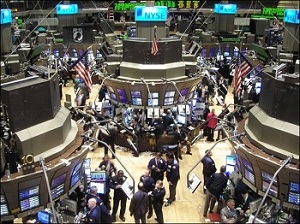
New York Stock Exchange Trading Floor

New York Stock Exchange Trading Floor

Adding to the concerns about this stock exchange, it does not have a trading floor where human traders can police the activities of other human traders. To the right is a photo of what the New York Stock Exchange’s 16,000 square foot trading floor looks like. To the left below is a photo from the MEMX website showing the only physical facility that it has posted on its website. The job openings posted at MEMX indicate that it has a “Fully Remote Workforce” who can work in the currently approved states of: New Jersey, New York, Connecticut, Pennsylvania, Florida, Illinois, Kansas, Georgia, North Carolina, Nevada and Oregon.

Photo from MEMX Website of its Physical Facility

Photo from MEMX Website of its Physical Facility

Perhaps because Nasdaq was intimately aware of how five of these MEMX owners had rigged its stock market in the 90s, John Zecca, the Chief Legal Officer and Chief Regulatory Officer of Nasdaq, filed a letter of concern with the SEC prior to the Commission’s approval of the MEMX application to run a national stock exchange. The letter said in part:

“…as Nasdaq prepares for the prospect of facing yet another new player in a growing field of competitors, Nasdaq notes that any approval by the Commission of the MEMX application would highlight a significant disparity in its regulatory treatment of the incumbent exchanges. Indeed, it would be incongruous for the Commission to freely permit large banks and broker-dealers, which control much of the order flow for equities securities in the United States, and which in many cases own or operate their own alternative trading systems [Dark Pools], to form a consortium to own and operate a new national securities exchange, without also permitting investor-owned exchanges like Nasdaq to own or operate [Dark Pools] and similar venues on the same terms as do the banks and broker-dealers.”

Not only is the SEC allowing megabanks such as JPMorgan Chase, Citigroup, Goldman Sachs, Morgan Stanley, and Bank of America’s Merrill Lynch to operate Dark Pools (where stock trading occurs in the dark) but the SEC has for years been allowing these firms to trade their own bank’s stock in their own Dark Pool. And each of these megabanks is also allowed to hold trillions of dollars in opaque derivatives contracts, despite derivatives being a key cause of the financial collapse in 2008.

But the rotten cherry on the top of this explosive concoction is that JPMorgan Chase, Citigroup, Goldman Sachs, Morgan Stanley and Bank of America are also allowed by federal regulators to operate federally-insured banks which collectively hold trillions of dollars of the life savings of average Americans.

Jay Clayton, who was at the helm of the SEC when MEMX was approved, had previously represented 8 of the 10 largest Wall Street banks as their underwriting counsel in the three years before he became SEC Chairman under Trump. Those banks included five of the MEMX owners: JPMorgan Chase, Citigroup, Goldman Sachs, Morgan Stanley and Bank of America/Merrill Lynch.

Another dubious actor that is a MEMX owner is Citadel Securities, part of billionaire Ken Griffin’s sprawling tentacles in U.S. markets.

Citadel Securities has captured a giant chunk of retail trading by generous payments for order flow to at least nine online brokers. (See our report: Citadel Is Paying for Order Flow from Nine OnLine Brokerage Firms – Not Just Robinhood.) There is growing concern among members of Congress that Citadel Securities’ motivation in paying for this order flow is to be able to trade against unsophisticated retail traders, known as “dumb money” on Wall Street, in order to unfairly enhance its own bottom line. The disciplinary history of Citadel Securities advances that theory.

On June 25, 2014, Citadel Securities was fined a total of $800,000 by its various regulators for serious trading misconduct. Citadel paid the fines in the typical manner, without admitting or denying the charges. The New York Stock Exchange alleged that the following had occurred:

“The firm sent multiple, periodic bursts of order messages, at 10,000 orders per second, to the exchanges. This excessive messaging activity, which involved hundreds of thousands of orders for more than 19 million shares, occurred two to three times per day.”

In addition, according to the York Stock Exchange, Citadel “erroneously sold short, on a proprietary basis, 2.75 million shares of an entity causing the share price of the entity to fall by 77 percent during an eleven-minute period.” In another instance, according to the New York Stock Exchange, Citadel’s trading resulted in “an immediate increase in the price of the security of 132 percent.”

On January 9, 2014, the New York Stock Exchange charged Citadel Securities LLC with engaging in wash sales 502,243 times using its computer algorithms. A wash sale is where the buyer and the seller are the same entity and no change in beneficial ownership occurs. (Wash sales are illegal because they can manipulate stock prices up or down.) Citadel Securities paid a $115,000 fine for these 502,243 violations and walked away. That’s less than 23 cents per violation.

On January 13, 2017 the SEC settled a case against Citadel Securities for $22.6 million in fines and disgorgements, alleging the following had occurred:

“…two algorithms used by Citadel Securities did not internalize retail orders at the best price observed nor sought to obtain the best price in the marketplace. These algorithms were triggered when they identified differences in the best prices on market feeds, comparing the SIP feeds to the direct feeds from exchanges. One strategy, known as FastFill, immediately internalized an order at a price that was not the best price for the order that Citadel Securities observed.  The other strategy, known as SmartProvide, routed an order to the market that was not priced to obtain immediately the best price that Citadel Securities observed.”

More recently, on July 16, 2020, Citadel Securities agreed to a $700,000 fine by Wall Street’s self-regulator, FINRA, for executing customer orders at prices worse than it traded for its own account. Citadel Securities was allowed to neither admit nor deny the charges. The activities occurred over a period of years.

On November 13, 2020, FINRA fined Citadel Securities $180,000 for failing to mark 6.5 million equity trades as short sales. Citadel did not admit or deny the allegations but paid the fine. The activity occurred between September 14, 2015 and July 21, 2016, according to FINRA.

After the stock market crash of 1929 and Great Depression that followed, the U.S. Senate Banking Committee was incentivized by public outrage to conduct three years of hearings into the self-dealing and rigged trading by the major Wall Street banks. The hearings generated bold front-page headlines showing entrenched corruption in the trading practices on Wall Street that had led to the crash. That level of public attention prompted Congress to pass the Securities Exchange Act of 1934, which created the Securities and Exchange Commission and empowered it to register, regulate and oversee brokerage firms, clearing agencies, and stock exchanges.

The ’34 Act, as it’s known on Wall Street, specifically cited the national interest in explaining why stock exchanges had to be Federally regulated. The legislation makes the following critical points regarding how corrupted trading can lead to economic disaster:

“Frequently the prices of securities on such exchanges and markets are susceptible to manipulation and control, and the dissemination of such prices gives rise to excessive speculation, resulting in sudden and unreasonable fluctuations in the prices of securities which (a) cause alternately unreasonable expansion and unreasonable contraction of the volume of credit available for trade, transportation, and industry in interstate commerce, (b) hinder the proper appraisal of the value of securities and thus prevent a fair calculation of taxes owing to the United States and to the several States by owners, buyers, and sellers of securities, and (c) prevent the fair valuation of collateral for bank loans and/or obstruct the effective operation of the national banking system and Federal Reserve System.

“National emergencies, which produce widespread unemployment and the dislocation of trade, transportation, and industry, and which burden interstate commerce and adversely affect the general welfare, are precipitated, intensified, and prolonged by manipulation and sudden and unreasonable fluctuations of security prices and by excessive speculation on such exchanges and markets, and to meet such emergencies the Federal Government is put to such great expense as to burden the national credit.”

Tens of millions of Americans lived through the nightmare of an inadequately policed Wall Street during and after the financial collapse in 2008. Clearly, the Dodd-Frank financial reform legislation of 2010 did not accomplish the job of reform. It’s long past the time for the Senate Banking Committee to hold comprehensive hearings and pass serious legislation that will actually protect the public from the Wall Street cabal. 


LINK


Sunday, May 8, 2022

Goldman Sachs Says Its Dark Pools Are Under Investigation – Along with About Everything Else the Firm Does


SUBSCRIBE TO THIS NEWSLETTER TO UNDERSTAND WALL STREET & ITS ABUSE


Goldman Sachs Says Its Dark Pools Are Under Investigation – Along with About Everything Else the Firm Does

By Pam Martens and Russ Martens: May 6, 2022 ~

David Solomon, Chairman and CEO, Goldman Sachs

David Solomon, Chairman and CEO, Goldman Sachs

We’ve been reading SEC filings for more than 35 years. We have to sadly say that the 10-Q that Goldman Sachs filed with the SEC on May 2, for the quarter ending March 31, 2022, shocks even our well-documented assessment of Wall Street as a crime syndicate. Goldman Sachs has listed pretty much everything the firm does as a target of an ongoing investigation, notwithstanding that the company and a subsidiary were criminally charged by the U.S. Department of Justice in the looting and bribery scandal known as 1MDB in October 2020, admitted to the charges, and had to pay over $2.9 billion. The good news is that Goldman Sachs’ Dark Pools are one of the areas it lists as being under a probe.

Dark Pools (also benignly called Alternative Trading Systems or ATS) are effectively unregulated stock exchanges being run by the same megabanks on Wall Street that blew up the U.S. financial system in 2008 and received the largest taxpayer bailout in U.S. history. The radical right in the U.S. Congress apparently believes that unbridled greed and outrageously reckless conduct that craters America’s economy deserves to be rewarded with less regulatory oversight, thus Dark Pools have not been shut down.

Not only are Goldman Sachs, JPMorgan, UBS, Morgan Stanley, Merrill Lynch, and numerous others, allowed to trade hundreds of New York Stock Exchange and Nasdaq listed stocks in their own Dark Pools, but they are also allowed to trade their own bank’s stock in their own Dark Pools. We have asked the SEC for years now how it is legal for a bank to trade its own stock – possibly making a two-sided market in that stock because some of these firms own more than one Dark Pool. We’ve yet to receive an answer. (Dare we hope that this is finally being seriously investigated by Gary Gensler’s SEC?)

The name of Goldman Sachs’ Dark Pool that trades in the U.S. is called Sigma X2. It used to be called simply Sigma X. According to a publicly-available document, Sigma X is now used by Goldman Sachs to designate the Dark Pools it operates in foreign jurisdictions, which include Europe, Japan, Hong Kong and Australia.

According to a “Frequently Asked Questions” document from Goldman Sachs, under the question “Is SIGMA X a dark pool that only matches trades anonymously, without information leakage? Or will information regarding my orders be conveyed to potential liquidity providers,” Goldman says this: “The matching process for SIGMA X is completely internal, and SIGMA X will not disseminate any pre-trade information to internal trading desks or external counterparties. Executed trades are publicly reported where required by applicable rules.”

In other words, this is an unlit market where pre-trade prices are not available to the public and trades are only reported after they have occurred in darkness, if they are reported at all.

How Goldman’s Dark Pool functions was written about in the Michael Lewis bestseller, Flash Boys, and the seminal work on Dark Pools by Wall Street Journal reporter Scott Patterson, Dark Pools: The Rise of the Machine Traders and the Rigging of the U.S. Stock Market.

Michael Lewis related the story in Flash Boys of how Rich Gates, the operator of a mutual fund, together with his colleagues devised a test to see if they entered an order into a Dark Pool they would get ripped off. Lewis writes as follows:

“Gates and his colleagues wound up making hundreds of such tests, with their own money, in several Wall Street dark pools. In the first half of 2010 there was only one Wall Street firm in whose dark pool the test came back positive: Goldman Sachs. In the Goldman dark pool, Sigma X, he got ripped off a bit more than half the time he ran the tests.”

Patterson writes in his book on Dark Pools that the U.S. stock market has degenerated into:

“pools within pools, all connected electronically, forming a single sloshing pool of dark electronic liquidity. By 2012, the amount of stock trading that took place in dark pools and internalizers was a whopping 40 percent of all trading volume – and it was growing every month…

“No one – no one – truly knew what was taking place inside the guts of this Frankenstein’s monster of a market.”

Clearly Patterson is an expert on Dark Pools; but for some reason the Wall Street Journal allows him to report on everything but Dark Pools.

In the early 1930s, following the stock market crash of 1929, the U.S. Senate Banking Committee issued subpoenas and conducted extensive investigations over multiple years into the trading structure and trading practices on Wall Street. The Senate investigations focused on the collusive dealings of “pools,” which have today been reincarnated as Dark Pools. The 1930s Senate investigation found the following:

“A pool, according to stock exchange officials, is an agreement between several people, usually more than three, to actively trade in a single security. The investigation has shown that the purpose of a pool generally is to raise the price of a security by concerted activity on the part of the pool members, and thereby to enable them to unload their holdings at a profit upon the public attracted by the activity or by information disseminated about the stock. Pool operations for such a purpose are incompatible with the maintenance of a free and uncontrolled market.”

The Senate Banking Committee of 1934 concluded as follows:

“The conclusion is inescapable that members of the organized exchanges who had a participation in or managed pools, while simultaneously acting as brokers for the general public, were representing irreconcilable interests and attempting to discharge conflicting functions. Yet the stock exchange authorities could perceive nothing unethical in this situation.”

As for the other areas in which Goldman Sachs is under a government investigation or named as a defendant in a lawsuit, the 10-Q filing offers this:

“[Goldman Sachs] Group Inc. and certain of its affiliates are subject to a number of other investigations and reviews by, and in some cases have received subpoenas and requests for documents and information from, various governmental and regulatory bodies and self-regulatory organizations and litigation and shareholder requests relating to various matters relating to the firm’s businesses and operations, including: “securities offering process and underwriting practices”; “firm’s investment management and financial advisory services”; “Research practices, including research independence and interactions between research analysts and other firm personnel, including investment banking personnel, as well as third parties”; “Transactions involving government-related financings and other matters, municipal securities, including wall-cross procedures and conflict of interest disclosure with respect to state and municipal clients, the trading and structuring of municipal derivative instruments in connection with municipal offerings, political contribution rules, municipal advisory services and the possible impact of credit default swap transactions on municipal issuers”; “The offering, auction, sales, trading and clearance of corporate and government securities, currencies, commodities and other financial products and related sales and other communications and activities, as well as the firm’s supervision and controls relating to such activities, including compliance with applicable short sale rules, algorithmic, high-frequency and quantitative trading, the firm’s U.S. alternative trading system (dark pool), futures trading, options trading, when-issued trading, transaction reporting, technology systems and controls, communications recordkeeping and recording, securities lending practices, prime brokerage activities, trading and clearance of credit derivative instruments and interest rate swaps, commodities activities and metals storage, private placement practices, allocations of and trading in securities, and trading activities and communications in connection with the establishment of benchmark rates, such as currency rates”; “Insider trading, the potential misuse and dissemination of material nonpublic information regarding corporate and governmental developments and the effectiveness of the firm’s insider trading controls and information barriers.”

The above is not a complete listing, just the highlights.

The involvement of Goldman Sachs in the implosion of the family office hedge fund, Archegos Capital Management, in March of last year has not gone away either. Goldman Sachs reports the following in its 10-Q:

“GS&Co. is among the underwriters named as defendants in a putative securities class action filed on August 13, 2021 in New York Supreme Court, County of New York, relating to ViacomCBS Inc.’s (ViacomCBS) March 2021 public offerings of $1.7 billion of common stock and $1.0 billion of preferred stock. In addition to the underwriters, the defendants include ViacomCBS and certain of its officers and directors. GS&Co. underwrote 646,154 shares of common stock representing an aggregate offering price of approximately $55 million and 323,077 shares of preferred stock representing an aggregate offering price of approximately $32 million. The complaint asserts claims under the federal securities laws and alleges that the offering documents contained material misstatements and omissions, including, among other things, that the offering documents failed to disclose that Archegos Capital Management (Archegos) had substantial exposure to ViacomCBS, including through total return swaps to which certain of the underwriters, including GS&Co., were allegedly counterparties, and that such underwriters failed to disclose their exposure to Archegos. The complaint seeks rescission and compensatory damages in unspecified amounts. On November 5, 2021, the plaintiffs filed an amended complaint, and, on December 22, 2021, the defendants filed motions to dismiss the amended complaint. On January 4, 2022, the plaintiffs moved for class certification.

“[Goldman Sachs] Group Inc. is also a defendant in putative securities class actions filed beginning in October 2021 and consolidated in the U.S. District Court for the Southern District of New York. The complaints allege that Group Inc., along with another financial institution, sold shares in Baidu Inc. (Baidu), Discovery Inc. (Discovery), GSX Techedu Inc. (Gaotu), iQIYI Inc. (iQIYI), Tencent Music Entertainment Group (Tencent), ViacomCBS, and Vipshop Holdings Ltd. (Vipshop) based on material nonpublic information regarding the liquidation of Archegos’ position in Baidu, Discovery, Gaotu, iQIYI, Tencent, ViacomCBS and Vipshop, respectively. The complaints generally assert violations of Sections 10(b), 20A and 20(a) of the Exchange Act and seek unspecified damages.

“On January 24, 2022, the firm received a demand from an alleged shareholder under Section 220 of the Delaware General Corporation Law for books and records relating to, among other things, the firm’s involvement with Archegos and the firm’s controls with respect to insider trading.”

For more on the Archegos matter, see our recent report: Justice Department and SEC Portray Serially-Charged Banks on Wall Street as Hapless Victims of Archegos Fraud. Nobody’s Buying It. 

  • © 2022 Wall Street On Parade. Wall Street On Parade ® is registered in the U.S. Patent and Trademark Office. WallStreetOnParade.com is a financial news website operated by Russ and Pam Martens to help the investing public better understand systemic corruption on Wall Street. Ms. Martens is a former Wall Street veteran with a background in journalism. Mr. Martens' career spanned four decades in printing and publishing management.


Newsom Takes On Social Media Companies, Kentucky Says No To Data Centers, A Judge Blocks Mail-Ballot Rule, and Law…

                            LOTS OF POSTS IGNORED BY BLOGGER..... OR REMOVED ON THEIR WHIM! ALL POSTS ARE AVAILABLE ON MIDDLEBORO REVIEW AND...