Showing posts with label BANK BAILOUTS. Show all posts

Sunday, July 9, 2023

If Banks Can Be Bailed Out, Student Debt Can Be Canceled
 

If Banks Can Be Bailed Out, Student Debt Can Be Canceled

Braxton Brewington/In These Times
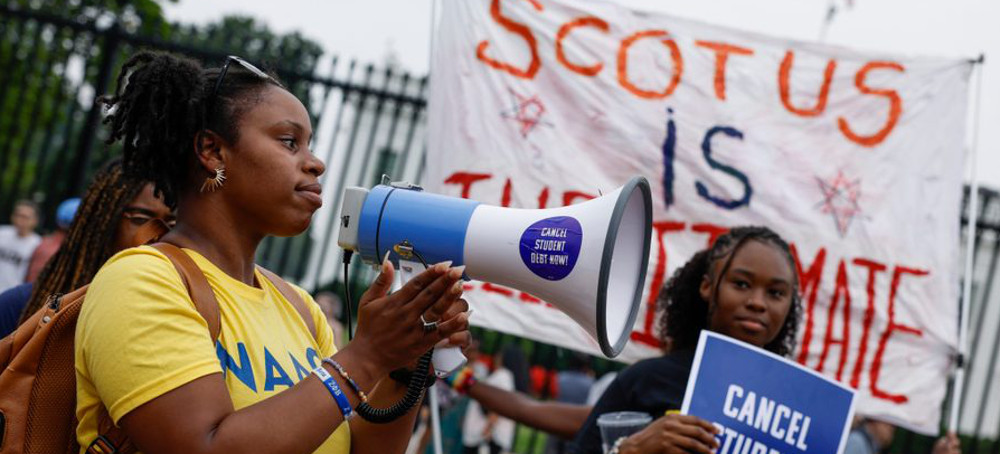
If Banks Can Be Bailed Out, Student Debt Can Be CanceledCici Gordon with the NAACP leads student debt relief activists in a chant in front of the White House after the U.S. Supreme Court struck down President Biden's student debt relief program on June 30, 2023, in Washington, D.C. (photo: Anna Moneymaker/Getty)

Biden must act now to make student debt relief a reality—no matter what the Supreme Court says.

Last month, in a hat-trick for right-wing litigants, the U.S. Supreme Court ruled in favor of structural racism, homophobia and mass indebtedness — in that order.

First, the conservative majority struck down affirmative action, ending race-conscious admissions programs for institutions of higher learning. Next, the Court slashed LGBTQ protections, ruling in favor of a plaintiff seeking to refuse services to a hypothetical gay couple. To bring the 2023 session to a close, the Court blocked $10,000 of student debt relief that more than 43 million Americans were counting on in the wake of pandemic-era hardships. According to six right-wing justices, while the HEROES authority grants the Education Secretary power to “waive or modify” student loans in an emergency, President Biden’s debt relief plan was too “significant” to be what Congress intended.

Just a year after overturning Roe v. Wade, these rulings serve as a stark reminder that this Court is on a warpath against the rights and freedoms Americans gained over decades of progressive political change.

In a press conference after the student debt ruling, a reporter asked Biden if this was a “rogue” Court. He hesitated, and then responded solemnly, “This is not a normal court.”

He’s not wrong, in the sense that judges don’t normally take luxurious gifts from billionaires with ties to the cases before them. But as for the radical decisions this Court has handed down, abnormality as a descriptor doesn’t go far enough. Justice Elena Kagan made it plain in her dissent: the ruling on student debt “violated the constitution.” To even hear the case in the first place, she wrote, “exceed[ed] the permissible boundaries of the judicial role.”

There’s another way the decision wasn’t normal. Typically a party seeks to remedy a concrete injury that they themselves suffered. But in Biden v. Nebraska, six Republican-controlled states sued on behalf of student loan servicer MOHELA, claiming that a loss of financial revenue to MOHELA harms the state of Missouri. The Court generally doesn’t “allow plaintiffs to rely on injuries suffered by” third parties. That’s one of the basic limits on federal judicial power. But this tenuous and debunked claim of financial harm was deemed sufficient to undo Biden’s initial iteration of student debt relief.

In a Roosevelt Institute report I co-authored, myself and fellow researchers revealed that after Biden’s student debt relief plan would have been implemented, MOHELA would earn more revenue than ever before — a direct contradiction to the Republicans’ claim that revenue would be cut nearly in half. How did such a flawed claim squeeze by the Supreme Court’s fact finding process? Well, they didn’t have one. In granting certiorari before judgment through the shadow docket, no court ever conducted a discovery — the legal procedure in which someone at the Court reviews the evidence. Every step of the way, Republicans’ lies were taken for truth.

To put it plainly, Republicans sued to stop Biden’s student debt policy simply because they didn’t like the policy. But we already have a process where grievances like these can be sorted — we call them elections. Now, if you’re a Republican that can place a bogus lawsuit before a sympathetic judge, you don’t need to make your case to voters, because the politicians with gavels and robes will decide on these issues instead.

It’s no wonder confidence in the Supreme Court is at a historic low, with more than half of Americans saying they want it to be structurally reformed. That will require a tectonic shift in the legislative branch — which is past due for major reforms itself. Until then, the executive branch can’t let the Supreme Court have the last word on such consequential issues. President Biden needs to be willing to act in the name of justice just as boldly as the Court is willing to undermine it.

Thanks to relentless grassroots pressure since the legal challenges to relief began, Biden announced he would take another go at student debt relief, this time by invoking the Higher Education Act — the exact authority advocates like the Debt Collective and progressive congress members have pushed for years. But still, he’s slow-walked the execution, and the White House has admitted that relief “could take some time.” Worse, he’s moving forward with resuming payments in the fall, inevitably harming the exact low-income borrowers whose debts he promised to cancel.

The Biden administration can and must implement student debt relief right away, acting swiftly before Republicans can concoct another frivolous legal challenge.

It doesn’t have to be this way. The Biden administration can and must implement student debt relief right away, acting swiftly before Republicans can concoct another frivolous legal challenge. Organizers are already working to push the White House to act fast.

We know it can be done. When Silicon Valley Bank crashed earlier this year, President Biden saved the bank and its financial investors within 72 hours. There was no political grandstanding over whether Section 13(3) of the Federal Reserve Act provided the authority to bail out venture capitalists. No internal hemming and hawing over whether negligent bank runs warranted “unusual and exigent circumstances.” There was just action.

It’s that sense of urgency and unwavering support that the Biden administration must now treat another constituency that’s too big to fail — over 43 million student debtors.

As Sen. Bernie Sanders (I-Vt.) put it, if the Supreme Court wants to “quit and run for office” on their extremist views, let them. But while they’re still one of the three branches of government, the other two must intervene.

LINK


Thursday, October 13, 2022

Shhh! Don’t Tell the Fed or Mainstream Media that Systemic Contagion at Wall Street Banks Is Already Here


SUBSCRIBE TO THIS NEWSLETTER

Shhh! Don’t Tell the Fed or Mainstream Media that Systemic Contagion at Wall Street Banks Is Already Here

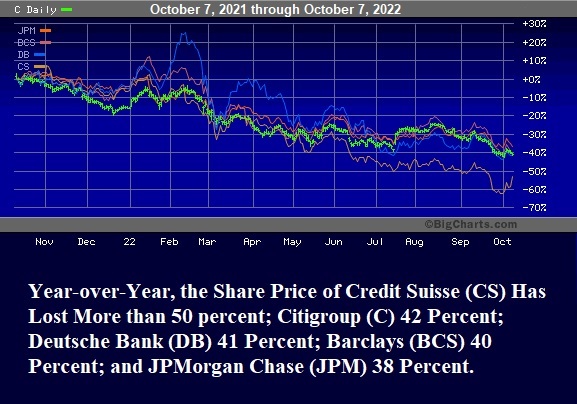
Stock Prices of Wall Street Mega Banks from October 7, 2021 through October 7, 2022

By Pam Martens and Russ Martens: October 10, 2022 ~

At Fed Chairman Jerome Powell’s last press conference on September 21 he said that there is “good reason to think that this will continue to be a reasonably strong economy.” Unfortunately, the U.S. can’t have a strong economy without strong banks willing and able to lend. And there are serious storm fronts in that area that the Fed Chair and mainstream media are choosing to ignore.

Last week multiple news outlets raised the question as to whether the troubles at Credit Suisse signaled another “Lehman moment.” (See herehere, and here, for example.) A “Lehman moment” refers to the former 158-year old Wall Street investment bank, Lehman Brothers, collapsing into bankruptcy on September 15, 2008 during a widening financial crisis on Wall Street. Because Lehman was the only major Wall Street firm that the Fed allowed to collapse into bankruptcy (rather than orchestrating a bailout), it has been mistakenly viewed all these years as the catalyst for the carnage that followed. As we will explain shortly, that role rightfully belongs to Citigroup.

According to documents released by the Financial Crisis Inquiry Commission (FCIC), at the time of Lehman Brothers’ bankruptcy it had more than 900,000 derivative contracts outstanding and had used the largest banks on Wall Street as its counterparties to many of these trades. The FCIC data shows that Lehman had more than 53,000 derivative contracts with JPMorgan Chase; more than 40,000 with Morgan Stanley; over 24,000 with Citigroup’s Citibank; over 23,000 with Bank of America; and almost 19,000 with Goldman Sachs.

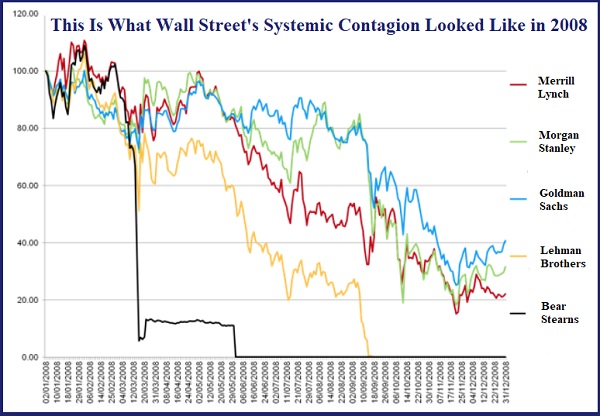
Below is a share price chart of what contagion looked like on Wall Street in 2008. Notice the highly correlated share price pattern in 2008 and the highly correlated share price pattern in the chart above in 2022.

This Is What Wall Street's Systemic Contagion Looked Like in 2008

Lehman’s interconnectedness with other major Wall Street firms certainly fueled some of the systemic contagion on Wall Street in 2008. But the real culprit was Citigroup – a reckless trading house on Wall Street which owned, both then and now, a large federally-insured commercial bank, Citibank. These are just a few of the headlines about Citigroup that ran long before Lehman’s collapse into bankruptcy:

January 10, 2008, Wall Street Journal: “Citigroup, Merrill Seek More Foreign Capital,” noting: “Two of the biggest names on Wall Street are going hat in hand, again, to foreign investors.”

January 17, 2008, Los Angeles Times: “Citigroup Loses Nearly $10 Billion”

March 5, 2008, MarketWatch: “Citigroup CEO Says Firm ‘Financially Sound’” with the opening sentence explaining that “The chief executive of Citigroup sought to allay investor fears Wednesday, a day after the stock hit a multiyear low…”

April 20, 2008, New York Times: “Citigroup Records a Loss and Plans 9000 Layoffs,” explaining that the bank reported a $5.1 billion loss and would have to slash jobs.

June 26, 2008, Wall Street Journal: “Citigroup: Worth Less and Less Every Day,” shares the news that the stock was worth one-third of where it had been at its 52-week high.

July 23, 2008, Bloomberg News: “Citigroup Unravels as Reed Regrets Universal Model.”

On July 14, 2008, Bloomberg News reported that in addition to holding $2.2 trillion in assets on its balance sheet, Citigroup has $1.1 trillion of “mysterious” assets off its balance sheet, including “trusts to sell mortgage-backed securities, financing vehicles to issue short-term debt and collateralized debt obligations, or CDOs, to repackage bonds.”

Sheila Bair, the Chair of the Federal Deposit Insurance Corporation in 2008, wrote the following about Citigroup in her book Bull by the Horns:

“By November [2008], the supposedly solvent Citi was back on the ropes, in need of another government handout. The market didn’t buy the OCC’s and NY Fed’s strategy of making it look as though Citi was as healthy as the other commercial banks. Citi had not had a profitable quarter since the second quarter of 2007. Its losses were not attributable to uncontrollable ‘market conditions’; they were attributable to weak management, high levels of leverage, and excessive risk taking. It had major losses driven by their exposures to a virtual hit list of high-risk lending; subprime mortgages, ‘Alt-A’ mortgages, ‘designer’ credit cards, leveraged loans, and poorly underwritten commercial real estate. It had loaded up on exotic CDOs and auction-rate securities. It was taking losses on credit default swaps entered into with weak counterparties, and it had relied on unstable volatile funding – a lot of short-term loans and foreign deposits. If you wanted to make a definitive list of all the bad practices that had led to the crisis, all you had to do was look at Citi’s financial strategies…What’s more, virtually no meaningful supervisory measures had been taken against the bank by either the OCC or the NY Fed…Instead, the OCC and the NY Fed stood by as that sick bank continued to pay major dividends and pretended that it was healthy.”

Notice the sentence in the above paragraph that reads: “It was taking losses on credit default swaps entered into with weak counterparties….” Bair was describing the situation in 2008. Now consider this headline we ran just last week at Wall Street On ParadeNew Study: Wall Street Banks Are Doubling Down on Risk by Selling Credit Default Swaps on their Risky Derivatives Counterparties. It is nothing less than an indictment of the U.S. Congress that this is allowed to happen after derivatives caused the greatest U.S. economic collapse in 2008 since the Great Depression.

The official report from the Financial Crisis Inquiry Commission, following an in-depth investigation of the 2008 collapse, wrote this about Credit Default Swaps:

“OTC derivatives contributed to the crisis in three significant ways. First, one type of derivative—credit default swaps (CDS)—fueled the mortgage securitization pipeline. CDS were sold to investors to protect against the default or decline in value of mortgage-related securities backed by risky loans…

“Second, CDS were essential to the creation of synthetic CDOs. These synthetic CDOs were merely bets on the performance of real mortgage-related securities. They amplified the losses from the collapse of the housing bubble by allowing multiple bets on the same securities and helped spread them throughout the financial system…

“Finally, when the housing bubble popped and crisis followed, derivatives were in the center of the storm. AIG, which had not been required to put aside capital reserves as a cushion for the protection it was selling, was bailed out when it could not meet its obligations. The government ultimately committed more than $180 billion because of concerns that AIG’s collapse would trigger cascading losses throughout the global financial system. In addition, the existence of millions of derivatives contracts of all types between systemically important financial institutions—unseen and unknown in this unregulated market—added to uncertainty and escalated panic, helping to precipitate government assistance to those institutions.”

This morning the Bank of England is in full blown crisis mode, setting up another emergency bailout facility that is very similar to that used by the Fed during the 2008 financial crisis. And, once again, derivatives are at the heart of the problem.

For its part, the Fed announced last year that it had, for the first time in its 109-year history, created a Standing Repo Facility where, on a permanent basis it will make $500 billion available to bail out the hubris on Wall Street. The Fed Chair has the power to increase that $500 billion on a temporary basis at his “discretion.”

And if all of this wasn’t sickening enough, the Fed Chairman who set the Fed on the course of endless Wall Street bailouts, quantitative easing, and destructive meddling in markets — Ben Bernanke — was one of three receiving the Nobel Prize in economic sciences this morning. (You can’t make this stuff up.)

It’s long past the time for the United States Congress to put an end to these serial bailouts of Wall Street by the Fed and pass legislation to restore the Glass-Steagall Act so that the casinos on Wall Street are permanently separated from the nation’s federally-insured banks.


LINK


Trump admits humiliating defeat in pool debacle

                                                     LOTS OF POSTS IGNORED BY BLOGGER..... OR REMOVED ON THEIR WHIM! ALL POSTS ARE AVAILABLE...