
07 June 23
Live on the homepage now!
Reader Supported News
I'M GOING TO CHALLENGE ALL OF YOU - The fundraising at this stage is awful, the worst we have ever seen. We have to do better and we have to do so now. We can’t wait any longer. One or even a few readers cannot sustain the organization but collectively our community easily can. I need you to get involved and pitch-in.
Marc Ash • Founder, Reader Supported News
Sure, I'll make a donation!
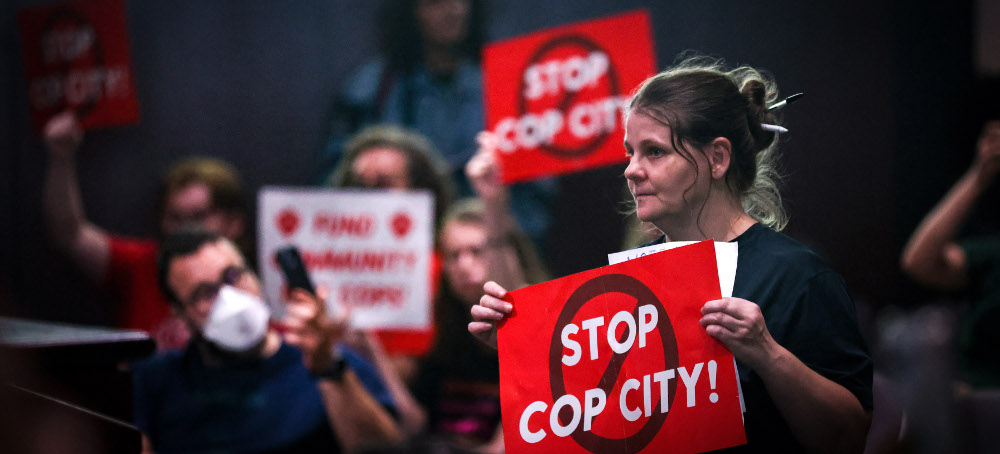
FOCUS: George Chidi | No One Believes in Cop City. So Why Did Atlanta's City Council Fund It?
George Chidi, The Intercept
Chidi writes: "How the fight could influence whether Georgia stays blue in 2024’s Senate and presidential races."
How the fight could influence whether Georgia stays blue in 2024’s Senate and presidential races.
Last week, as Atlanta was absorbing yet another piece of bad news about its snakebit proposal for a new police and fire training facility — that it would cost the public twice as much as had been discussed — MSNBC host Chris Hayes said what much of the national audience must be thinking.
“I have to say, I’ve followed this story from afar and only moderately closely, but I remain mystified why Atlanta officials are just so so SO intent on building this thing,” he tweeted.
The city first accepted the proposal to build the Atlanta Public Safety Training Center — Cop City in the vernacular, a $90 million, 85-acre campus just outside of the city proper — while crime was rising in 2021, but also while the wounds of the George Floyd and Rayshard Brooks protests were still healing. A multimillion-dollar police training center, in the middle of a forest, with little transparency or recourse for voters, felt like a slap in the face to people who had been marching Atlanta flat for democracy.
The plan calls for the city to pay about $33 million today and another $1.2 million a year for the next 30 years to cover debt for the entity building it, the Atlanta Police Foundation. That public cost is about twice as high as was reported in late 2021 when the proposal was first authorized and comes after nearly two years of strident opposition by residents and activists far and wide. City officials are quietly arguing that this was always the cost and that everyone has simply been mistaken, despite no real effort made to correct that mistake before local journalists at the Atlanta Community Press Collective dug closely through the figures.
But here’s the thing: The Atlanta City Council still voted to fund Cop City early Tuesday morning, by a vote of 11-4.
Anticipating a potential disruption, Mayor Andre Dickens closed City Hall for regular business on Monday and banned outside liquids in the building, airport security-style. Dozens of cops hovered at the edges of City Hall’s atrium as hundreds of people waited hours and hours for their turn to voice their opposition. Virtually everyone here stood against the proposal.
Moments after the vote, activists shouted threats at City Council members. At one point, an activist lunged over the railing between the crowd and the dais to shout, “I will fucking find your ass,” at council member Jason Winston, a ring of cops separating the two.
The short answer to Hayes’s question is that officials don’t think their practical alternatives to replace the city’s ad hoc, dilapidated, and unsuitable facilities are any better. And they believe that people aren’t angry because of a dispute over Cop City’s cost or the environmental challenges associated with the land, but because the city’s messaging was badly bungled. Critically, City Hall’s leaders believe that potential electoral blowback is limited.
In another city, a training facility might be a parochial argument. But like all things in Atlanta politics, state and national political forces come to bear. Georgia is all too often the center of the political universe, and conflict descends upon it like up-tempo cicadas in the summer.
Cop City is caught between four different groups with four very different political agendas.
On one side, police abolitionists have made opposition to Cop City their shibboleth, a sign of ideological fidelity to anti-authoritarian principles. They’re not negotiating. Police are pitching a mock city to train police how to enter buildings in an active shooting situation. Opponents asked the council to consider all the ways $90 million might be used to keep that shooting from happening in the first place, likening the training center to a medieval fort in an occupied city or the infamous School of the Americas at what we used to call Fort Benning.
Graffiti declaring that “Cop City will never be built” ornaments the famed Krog Street tunnel, and overpasses, and subway pylons, and street signs. The energy of youth and activism — a product of four years of hard-fought progressive politics in this state and this city — organically suffuses their messaging as both an appeal to Atlanta’s left-leaning public and as a national call to fight.
National observers might try to connect the Stop Cop City movement to political forces that elected two U.S. senators and denied Donald Trump a presidency, but that’s not quite it, because the protesters are just as pissed off at Democrats as anyone else. After all, the decision-makers for the city of Atlanta are almost all Democrats. The mayor is a Democrat. At least 12 of the city’s 15 council members are Democrats. And eight of those Democrats voted to pass the ordinance.
Directly opposite the abolitionists stands a decidedly Republican opponent: Georgia’s Attorney General Chris Carr. Carr is a politically ambitious prosecutor who will almost certainly run for higher office in 2026. He’s not exactly counting on the Atlanta vote to propel him to the governor’s mansion. To the degree that Cop City is a political question, Carr wants to show a statewide Republican primary audience that he is willing to confront “antifa” — antifascists — and “domestic terrorists” on terms Georgia’s conservative base would find acceptable.
As crime rose in Atlanta during the pandemic, Carr and the state have responded by stepping up enforcement while ignoring local sensibilities. The Georgia State Patrol began car chases in ways that the Atlanta Police Department wouldn’t consider, increasingly resulting in deadly crashes. It wasn’t an Atlanta police officer who shot the environmental activist Manuel “Tortuguita” Terán dead in January near the Cop City site. An autopsy report laid responsibility on six Georgia State Patrol officers.
The killing set off a new wave of activism and media attention. Activists tied that death, and the city’s liberal leadership, to the same illiberal forces in state government and in corporate Georgia who would criminalize dissent. For Carr’s crowd, concerns raised by city leaders — read: Democrats — about using state police and terrorism statutes to constrain civil protest are unimportant at best to aspirational Republican leaders and a side benefit in practice.
“What is happening is state Republicans are using this vote on this proposed project to launch themselves into office for the next cycle,” said James Woodall, public policy advocate for the Southern Center for Human Rights. “The silence by Democrats to let that happen demonstrates why this state is not blue.”
Then, on Thursday, police raided a house near the facility which had been an activist staging ground for protests. Cops picked up three activists: Marlon Scott Kautz, 39, and Adele Maclean, 42, both of Atlanta, and Savannah Patterson, 30, of Savannah, Georgia. Each were charged with money laundering and charity fraud.
The arrests introduced yet another challenge to the progressive credentials of city leaders in Atlanta: an attack on the mechanisms of protest in a city historically defined by the civil rights struggle.
But while Atlanta police officers conducted the arrests, it was Carr’s office who drove them. Georgia Bureau of Investigation officers swore out the arrest warrants before a DeKalb County Superior Court judge, describing the three activists as part of “a group classified by the United States Department of Homeland Security as Domestic Violent Extremists.”
The local district attorney, Sherry Boston, didn’t argue the state’s case against bond for the three in front of a magistrate’s court judge. Deputy Attorney General John Fowler from Carr’s office made that argument instead. The judge was unimpressed.
“I’m concerned about some of the same things that the defense attorney mentions about the line between legitimate free speech and crossing into illegal violent acts,” said DeKalb Magistrate Court Judge James Altman. “Paying for camping supplies and the like? I don’t find it very impressive. There’s not a lot of meat on the bones of the allegations that thousands of dollars are going to fund illegal activities.”
Altman actually wished the three arrestees good luck and wondered what the state was thinking.
The city and the Atlanta voting public are caught between these two forces.
Dickens won Atlanta’s mayoral election in 2021 with a mandate amid one of the fastest increases in violent crime in the city’s history. But the political machine Dickens inherited is built out of Bondo, duct tape, and bailing wire. City Hall’s relationship with both the public and its police department was ruined by neglect and the erosion of trust that began in 2020 with the police shooting of Brooks and continued with the soft “blue flu” sickout that police subsequently staged in protest of the charges laid on the two cops who shot him.
Dickens has been a one-man army repairing relationships across the board, meeting frenetically with neighborhood groups and civic organizations while fending off a spurious initiative to separate Atlanta’s wealthy Buckhead neighborhood into a new city. He’s also cleaved ever closer to the Atlanta Police Foundation, which is funding Cop City with $30 million in donations collected from the city’s corporate sector, and to other organizations that Dickens believed could rebuild the frayed relationship to the police. The foundation administers the city’s ever-expansive camera network, helps fund housing in the city for police officers, operates the city’s gang youth diversion centers, and has helped run the analytics on the city’s targeted repeat offender enforcement plan.
And the city’s homicide rate, year to date, has fallen about 35 percent and is trending back to the pre-pandemic baseline. While Atlanta’s crime increase was fourth-fastest in America for large cities, its fall has been just as fast. One year ago, Atlanta had recorded about 167 homicides in the previous 365 days. The annual count is 134 at the week ending May 27, an annualized rate of about 26 per 100,000 residents. If the city holds at the current pace, it will record 107 homicides in 2023, only seven more than the 2019 low.
One can attribute the fall in homicides to many things, just as the sharp spike in 2020 had many causes. The administration points to evermore aggressive enforcement around gangs, guns, and drugs.
When it comes to Cop City, the city has never had a Plan B. The general consensus is that the current situation is untenable: The police department rents classroom space at Atlanta Metropolitan State College, with hands-on training in neighboring jurisdictions. The fire department has been training in a vacant elementary school which is now condemned. No credible alternative has been discussed in the six-year process of planning for a new police training facility. Ending this project would set the process back to square one.
In the absence of a training facility owned by the city, Atlanta will pay whatever the market demands, said Chata Spikes, a city spokesperson for the project. The Atlanta Public Safety Training Center is more than a recruiting tool or a facility for progressive police training: It’s necessary cost containment, she said.
“This morning’s vote approving the budget resolution for the Atlanta Public Safety Training Center marks a major milestone for better preparing our fire, police and emergency responders to protect and serve our communities,” the mayor said in a statement. “We know there have been passionate feelings and opinions about the training center. … I know there is more work to be done and I am committed to building trust, and my administration looks forward to continuing the conversation in the weeks ahead.”
The last side is the Atlanta public, exerting whatever influence it can on the other three.
Most Atlanta residents are neither policing abolitionists nor cop cheerleaders. Many neighborhoods, including majority-Black, overwhelmingly Democratic communities on Atlanta’s Westside, measure the city by its responsiveness to neighborhood blight, traffic problems, and crime. Conceptually, a police training center isn’t inherently controversial to most Atlantans.
It also isn’t being built in any of their backyards. Rather than muddle through one of the city’s acrimonious planning fights, city leaders alighted on a plan to build Cop City on city-owned land that wasn’t actually in the city, but in a neighboring county. A quirk in state law allows them to sidestep the normal planning and zoning process that way.
The most vocal neighborhood-level opposition has come from the City Council district closest to the Cop City site: Atlanta’s 5th District, held by Liliana Bakhtiari. Four of the other nine districts show significant opposition, political observers say. When the Cop City budget proposal came up for discussion in Atlanta’s City Council two weeks ago, hundreds of opponents came in a line winding through the marble halls and onto the street. The chamber recorded seven hours of public comment, with not one single speaker in favor of the project.
“Your hands are not tied. You are the rope,” Rohit Malhotra, founder and executive director of the Center for Civic Innovation in Atlanta, said at 3:20 a.m., among the last speakers of the night, imploring the council to change its position.
But City Council members voting to fund the facility believe opposition is too diffuse in the remaining districts to create a political opening for a challenger. And City Council members believe there’s a distinction to be made between highly motivated activists enjoying the spectacle of free-wheeling public comment and the quiet masses who don’t attend hearings at City Hall.
All four of the “no” votes came from members elected in 2021. Three of Atlanta’s 15 City Council members are elected citywide. Among them, only Keisha Waites (who replaced Dickens on the council) voted against the funding, joining Bakhtiari from the well-gentrified East Atlanta, Jason Dozier who represents parts of downtown Atlanta and much of the Atlanta University Center area with the city’s famed historically Black colleges, and Antonio Lewis, whose district starts with the rapidly gentrifying Capitol View neighborhood and ends in some of South Atlanta’s poorest neighborhoods.
Questions have been building about Cop City since its first hearing. How would the Atlanta Police Foundation raise its end of the cost? From which corporate donors? How would it administer the property? Who will get to train there? Would police really engage in military-style training? How can we tell the environmental remediation claims made by the city would be served? How does the facility connect with the city’s purported commitment to criminal justice reform and social justice? What about mental health training? Why does it cost so much?
The mayor’s office has wanted to manage the narrative. So it instructed the Atlanta Police Foundation to refer all public inquiries to City Hall and to clam up. The city appointed an advisory committee, which stopped having meetings once protests escalated. The mayor appointed a new advisory committee with some Cop City critics on the panel, then initially declared that its meetings would be held privately. Dickens quickly reversed himself, but by then, the damage had been done. The result has been a disaster as protest intensified and Atlanta’s political failure to register public discontent compounded on itself without credible answer. Meanwhile, Republicans at the state level have done, well, whatever they thought was necessary, without regard to the political challenges they created for Atlanta’s leaders.
Phone calls and emails made to the Atlanta Police Foundation from The Intercept and other publications were redirected to the city’s police department, which was not equipped to answer questions that are fundamentally political. The mayor’s office repeated its talking points.
The process has not met the expectations of a city that is continually engaged in biennial warfare in the name of preserving democracy. Cop City increasingly looked like a wall with no windows.
But last week’s arrests broke silences. Over the weekend, U.S. Sens. Jon Ossoff and Raphael Warnock, who had previously refrained from public criticism of the project, both made statements about the arrests.
Both Ossoff and Warnock upheld the virtues of nonviolent protest in their statements and made a distinction between that and violent opposition. Those statements were an acknowledgement that the fight over Cop City has a national audience and might give city leaders pause.
“It is imperative that the response of government to the violent few not intimidate or infringe on the Constitutional rights of those engaged in nonviolent protest and civil disobedience,” Ossoff said.
Warnock, who has a history of nonviolent protest in Atlanta and has recently been confronted by activists in public forums for his silence, sharply questioned the arrests. “These tactics, coupled with the limited public information provided so far, can have a chilling effect on nonviolent, constitutionally-protected free speech activities those of us in the fight for justice have been engaged in for years,” he said. “The work of bail funds and providing support and legal representation has been critical to moving our nation forward, including during the Civil Rights Movement and in the years since. … The images of the raid reinforce the very suspicions that help to animate the current conflict — namely, concerns Georgians have about over-policing, the quelling of dissent in a democracy, and the militarization of our police.”
The people who held down chairs in the hall for 16 hours awaiting the funding vote are, often, the same people who knock on doors and phone bank and raise money during election season. The impact of this vote isn’t likely to change much about the composition of the Atlanta City Council. But it could impact the 2024 presidential race in Georgia, and by extension in America, given Georgia’s newfound swing-state status.
In the absence of strong grassroots activism, Georgia Democrats look at results like Stacey Abrams’s 54-46 loss to Brian Kemp for governor last year. With it, they can squeeze out narrow victories that denied Trump this state’s 16 electors and denied Herschel Walker a Senate seat.
If the vote had failed, the right would have weaponized that failure as Atlanta “coddling criminals” and “defunding the police.” But they’ll do that anyway. The question is whether Democrats will lose more from the attacks than they gain from activist support. It is the Democratic Party’s job to make that calculation. But the comments by Ossoff and Warnock this weekend suggest they’re thinking about it.
READ MORE
Contribute to RSN
Follow us on facebook and twitter!
Update My Monthly Donation
PO Box 2043 / Citrus Heights, CA 95611

 / meidastouch
Add the MeidasTouch Podcast: https://podcasts.apple.com/us/podcast...
Buy MeidasTouch Merch: https://store.meidastouch.com
Follow MeidasTouch on Twitter:
/ meidastouch
Add the MeidasTouch Podcast: https://podcasts.apple.com/us/podcast...
Buy MeidasTouch Merch: https://store.meidastouch.com
Follow MeidasTouch on Twitter:  / meidastouch
Follow MeidasTouch on Facebook:
/ meidastouch
Follow MeidasTouch on Facebook:  / meidastouch
Follow MeidasTouch on Instagram:
/ meidastouch
Follow MeidasTouch on Instagram:  / meidastouch
Follow MeidasTouch on TikTok:
/ meidastouch
Follow MeidasTouch on TikTok:  / meidastouch


