|


|
|
|
This morning, CBS News cameras captured on video the sight of former president Trump’s lawyers entering the Department of Justice. Shortly after their two-hour meeting ended, a message appeared on the Trump-affiliated social media site Truth Social, in all caps: “HOW CAN DOJ POSSIBLY CHARGE ME, WHO DID NOTHING WRONG, WHEN NO OTHER PRESIDENT’S [sic] WERE CHARGED, WHEN JOE BIDEN WON’T BE CHARGED FOR ANYTHING, INCLUDING THE FACT THAT HE HAS 1,850 BOXES, MUCH OF IT CLASSIFIED, AND SOME DATING BACK TO HIS SENATE DAY WHEN EVEN DEMOCRAT SENATORS ARE SHOCKED. ALSO, PRESIDENT CLINTON HAD DOCUMENTS, AND WON IN COURT. CROOKED HILLARY DELETED 33,000 EMAILS, MANY CLASSIFIED, AND WASN’T EVEN CLOSE TO BEING CHARGED! ONLY TRUMP - THE GREATEST WITCH HUNT OF ALL TIME!” It appears there is reason to suspect Trump’s lawyers delivered to the former president bad news about Trump’s refusal to return to the government—that is, to the American people—the classified documents he stole when he left the White House. The Twitter account of the Republican National Committee promptly tweeted footage of House Oversight Committee chair Representative James Comer (R-KY) suggesting that the “Biden family” has engaged in “a pattern of bribery, where payments would be made through shell accounts and multiple banks,” in a system of “money laundering.” There is no evidence of these accusations, and their framing of Biden as part of a “family corruption scandal” is pretty transparently designed to make the Bidens look like the Trumps, although there is no Biden family business as there is a Trump Organization. Republican leaders have tiptoed around former president Trump even if they were hoping to move him offstage, but that caution broke today when the governor of New Hampshire, Chris Sununu, who in February said he would vote for Trump if he is the 2024 nominee, warned in a Washington Post op-ed that the Republican Party must break free of Trump and the culture wars or face “electoral irrelevance.” Sununu announced that he would not seek the party’s presidential nomination himself, keeping his powder dry to try to correct the Republican Party’s course. In a clear shot at the many Republicans jumping into the race, he warned that “candidates should not get into this race to further a vanity campaign, to sell books or to audition to serve as Donald Trump’s vice president.” He promised to work for whichever candidate he thought best positioned to win in 2024. Sununu called for returning the party to “classic conservative principles of individual liberty, low taxes and local control,” saying that Republicans need to “expand beyond the culture wars that alienate independents, young voters and suburban moms” and appeal to new voters on substantive issues. He also took on the issue of abortion, which has created a groundswell of opposition to Republicans, saying that “Republicans should recognize that every time they open their mouths to talk about banning abortion, an independent voter joins the Democrats.” Indeed, as Kate Riga of Talking Points Memo wrote today, the abortion issue is suddenly toxic for Republicans. After years of calling for the end of the 1973 Roe v. Wade decision legalizing abortion, Republicans got their wish almost a year ago with the Dobbs v. Jackson Women’s Health decision. Republican-dominated states promptly began to pass antiabortion laws at the state level. But a majority of voters actually support abortion access, even in Republican-dominated states. They are eager to restore abortion rights, while the evangelical base of the Republican Party wants a federal abortion ban. Republicans running for president are now trying to avoid the issue, since they need to support a federal ban on abortion to win base voters but will repel a majority of general voters if they do. Putting Republicans into power will likely mean a federal ban that will run badly against the popular will. It is not clear how Republican candidates will square this circle, but it is unlikely to go away simply because Republicans try not to talk about it. While many eyes in the United States are focused on domestic political events, today’s news also included reports that the Ukrainian military may have begun its counteroffensive to push Russian invaders out of Ukraine (although Ukrainian officials denied it, saying that no single action would indicate that a counteroffensive had begun). The U.K. Ministry of Defence reported that there has been a “substantial increase in fighting along numerous sectors of the front, including those which have been relatively quiet for several months.” It also said that the feud between the mercenary Wagner Group and the Russian Ministry of Defence has “reached an unprecedented level.” It is not clear they will continue to cooperate. Natasha Bertrand, Zachary Cohen, and Kylie Atwood of CNN reported today that Ukraine has encouraged sympathizers and agents in Russia to sabotage targets there, diverting Russian attention from Ukraine and bringing the threat of war home to Russians. Tonight, part of the Nova Kakhovka Dam was breached, sending a flood down the Dnipro River. The breach will create flooding downstream. It will also affect drinking water, and the electricity for more than 3 million people. It threatens the Zaporizhzhia Nuclear Power Plant, whose reactors are cooled with water from the reservoir above the dam, but tonight the Ukrainian state nuclear energy company Energoatom said the situation is under control. — Notes: Twitter: RonFilipkowski/status/1665762038281322496 atrupar/status/1621233676909514757 DefenceHQ/status/1665951346464309249 MarkHertling/status/1665922657408147457 mefimus/status/1665942450362372096 Osinttechnical/status/1665907948986458113 RNCResearch/status/1665769123111129088 https://www.nytimes.com/2023/06/05/us/politics/trump-justice-dept-classified-documents.html https://www.washingtonpost.com/world/2023/06/05/belgorod-russia-ukraine-counteroffensive-militias/ https://www.nytimes.com/2023/06/05/us/politics/pence-2024-president-candidate.html https://www.washingtonpost.com/opinions/2023/06/05/chris-sununu-trump-gop-2024/ https://talkingpointsmemo.com/news/republican-haley-desantis-trump-abortion https://www.cnn.com/2023/06/05/politics/ukraine-sabotage-agents-russia-drone-attacks/index.html |

04 June 23
Live on the homepage now!
Reader Supported News
With cross-border strikes, residents of the Russian region of Belgorod are starting to understand the horrors of war being waged at their doorstep.
He had heard the thud of explosions in distant villages in the past, he said, and in October shelling damaged a nearby shopping mall. But nothing like this.
“Everything changed,” he said.
Fifteen months after Russian missiles first roared toward Kyiv, residents of the Russian border region of Belgorod are starting to understand the horror of having war on their doorstep.
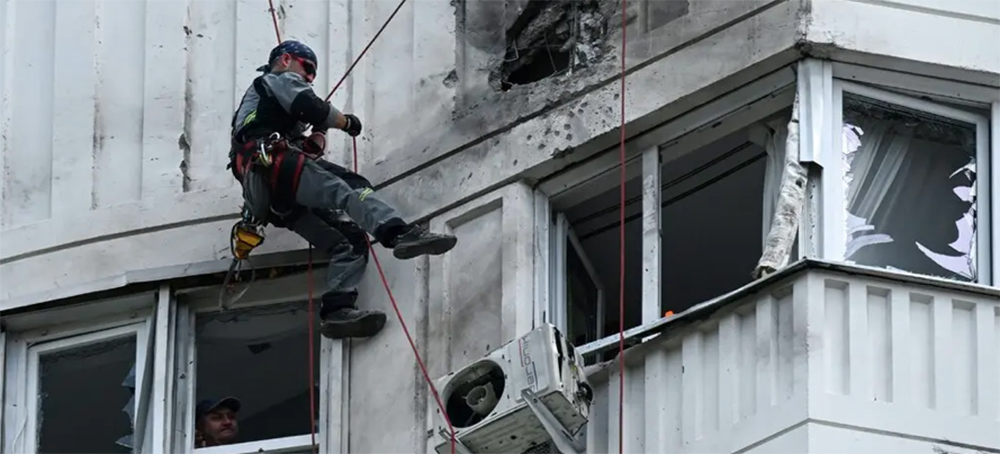
Shebekino, a town of 40,000 six miles from the border, has effectively become a new part of the front line as Ukraine has intensified attacks inside Russia, including on residential areas near its own borders. The spate of assaults, most recently by militia groups aligned against Moscow, has sparked the largest military evacuation effort in Russia in decades.
“The town became a ghost in 24 hours,” said Ruslan, 27, who evacuated on Thursday after a sustained campaign of shelling.
In the last several days, The New York Times interviewed more than half a dozen residents of the border region to get a sense of the deepening anxiety among Russian civilians. Like Ruslan, most insisted on being identified by only their first names, citing a fear of retribution for speaking about the war.
“Shebekino was a wonderful, flowery town on the border with Ukraine filled with happy, neighborly people,” said Darya, 37, a local public sector employee. “Now only pain, death and misery live in our town. There is no power, no public transport, no open businesses, no residents. Just an empty, shattered town in smoke.”
The hardship is familiar to Ukrainians, who have seen cities like Bakhmut obliterated and others ravaged by civilian casualties. So are the sleepless nights; Russian missiles targeted Kyiv at least 17 times in May. But many Russians had not expected something similar to happen on their home turf.
Explosions are audible, too, in the city of Belgorod, the regional capital 20 miles to the north of Shebekino, and residents there have increasingly begun seeking access to basements that can be used as bomb shelters. People who had previously tried to go about their daily business suddenly discovered they could not.
“We are at a turning point right now,” said Oleg, a businessman in the city. “When this all started,” he said, referring to the war, “the people who opposed it here were a minority. Now after four days of being shelled, people are changing their minds.”
Belgorod’s regional governor, Vyacheslav Gladkov, said 2,500 residents had been evacuated and taken to temporary shelters in sports arenas farther from the border. Thousands more left on their own accord, residents said in interviews.
Mr. Gladkov said nine residents had died from shelling over the past three days. It is unclear how many Russians in the border region have been killed overall, but this was almost surely the deadliest week for the Belgorod region since the start of the war.
Flare-ups and cross-border shelling between Ukrainian and Russian forces have occurred regularly throughout the war. The recent attacks on Belgorod were undertaken by two paramilitary groups made up of Russians fighting for Ukraine’s cause; they have claimed that they target only security infrastructure, and portrayed their fight as one for liberation from President Vladimir V. Putin’s rule.
But their claims have clashed with accounts of widespread residential destruction described by witnesses and seen in videos posted on social media and verified by The Times. One of the two groups, the Russian Volunteer Corps, has also acknowledged shelling Shebekino’s urban area with “bouquets of Grads,” a Soviet-designed multiple rocket launcher that covers a large area with explosives.
As footage of that shelling filled Belgorod’s public chat rooms, citizens volunteered to drive affected families to safety, donated money and opened homes to refugees. In doing so, they underlined what they said was the inadequacy of the local government’s response, and the growing realization that they had only themselves to rely on.
It was a sign of spontaneous social organization that Mr. Putin has systematically undermined in recent years as he tightened control. The arrival of the war on Russian soil is rekindling a grass-roots civic spirit borne of necessity, with as yet unpredictable consequences for the country’s politics.
To some in the region, the assaults on Shebekino, the most sustained attack on a Russian town since the start of the war, made clear Moscow’s lack of concern for their fate. In social media posts, they used the hashtag #ShebekinoIsRussia, a cry for attention from the wider public across the country, which has largely carried on with daily life. In interviews, some in Shebekino expressed anger at how state television anchors struggled to pronounce the town’s name, even as they lauded the evacuation efforts.
“It seems that in Moscow they don’t understand what we have going on here,” said Ruslan, the English teacher. Citing explosions over the Kremlin last month, he said: “When drones flew to Moscow, there were immediately big stories, it was all over the news. And here people have been under fire for months, and nothing.”
Despite an uptick of attacks on Russian soil, only one in four Russians is following the war closely and most likely going beyond state media to seek information about it, according to a May poll conducted by the independent Moscow-based public opinion firm Levada Center. Almost half of respondents said they don’t follow the conflict at all, or only cursorily.
Levada’s director, Denis Volkov, said it was too early to say whether the escalation of border attacks would rally Russians around the flag.
“We have a very disjointed society,” he said. “No one has much interest beyond their own nose.”
But the violence is causing residents of Shebekino to re-evaluate their apathy or support for the war, and the disruption of the last week is breeding resentment against authorities who they believe have failed to protect them.
“People are disappointed that it has gotten to this stage, that this was permitted to happen,” said Elena, a Belgorod resident who volunteered to evacuate people from Shebekino.
Darya, the public sector employee, described a chaotic evacuation. As the sounds of explosions grew near, she said, her family gathered necessities and waited for the official transport promised by regional authorities. When it didn’t arrive, they called an evacuation help line set up by the governor and were told to wait, in vain.
They eventually left the town in their private car, leaving behind an older relative who could not be easily moved.
“We saw many Shebekino residents sitting on the side of the highway in their cars, because they had nowhere to go,” she said.
Evacuation did not always bring safety. Two women died near Shebekino after their car was hit by a shell on the side of the road on Thursday, according to Mr. Gladkov, the governor. His claim could not be independently verified.
There is also the realization among border residents that there is no end in sight to the war.
Russia has annexed parts of four Ukrainian regions that it has occupied, and is planning to hold elections there in September, despite the expected Ukrainian counteroffensive aimed at wrestling back territory from Moscow’s forces.
“I don’t understand the point of these annexations, I don’t even know where they are,” said Alina, 31, a social media manager in Belgorod.
“This is just some kind of farce.”
In the city of Belgorod, with a population of 340,000, the pain and confusion of the war is made more acute by historical ties to Ukraine. It is only 25 miles from the border, and only 50 miles from Kharkiv, Ukraine’s second largest city.
Before the war, people from Belgorod traveled to Kharkiv to shop, or even just for a night out. Many have relatives living across the border.
Ruslan, the English teacher, said that he was always opposed to the war, and that his position hasn’t changed with the destruction of his city. But his feelings toward Ukraine have.
“I thought I was able to empathize, but when it comes to your home, it’s a completely different feeling,” he said.
“I understand that it’s all because of Putin, but at the same time I have a slightly different attitude toward the Ukrainian armed forces,” he continued.
“Now I think, maybe they are no different from ours.”
Follow us on facebook and twitter!
PO Box 2043 / Citrus Heights, CA 95611
LOTS OF POSTS IGNORED BY BLOGGER..... OR REMOVED ON THEIR WHIM! ALL POSTS ARE AVAILABLE ON MIDDLEBORO REVIEW AND SO ON BLOGGER DOESN...