Showing posts with label BITCOIN. Show all posts

Tuesday, December 10, 2024

Trump Has a Slush Fund to Prop Up the Dollar – Will He Use It to Prop Up Bitcoin Instead?


SUBSCRIBE TO THIS NEWSLETTER TO RECEIVE TIMELY REPORTS!


Trump Has a Slush Fund to Prop Up the Dollar – Will He Use It to Prop Up Bitcoin Instead?

By Pam Martens and Russ Martens: December 10, 2024 ~

Trump, Pied PiperThe dark veil behind which the U.S. political system has operated since the U.S. Supreme Court’s Citizens United decision and its progeny turned presidential elections into a subtle form of payoffs and kickbacks has been lifted. Donald Trump is handing out cabinet posts and ambassadorships to his largest donors in the most scandalous manner in U.S. presidential history.

Now Trump’s crypto megadonors are demanding their own form of a kickback – a Bitcoin Strategic Reserve, where the U.S. government would, effectively, prop up the price of Bitcoin by buying up large amounts each year and holding it as a Strategic Reserve. (Skeptics might be forgiven for seeing that as a means for Bitcoin billionaires to sell their Bitcoin without driving down the price too much because there is a perpetual buyer on the other side of their trade.)

Most Americans have heard of the Strategic Petroleum Reserve (SPR). The U.S. Department of Energy describes the SPR like this:

“The Strategic Petroleum Reserve (SPR), the world’s largest supply of emergency crude oil was established primarily to reduce the impact of disruptions in supplies of petroleum products and to carry out obligations of the United States under the international energy program. The federally-owned oil stocks are stored in huge underground salt caverns at four sites along the coastline of the Gulf of Mexico. The sheer size of the SPR (authorized storage capacity of 714 million barrels) makes it a significant deterrent to oil import cutoffs and a key tool in foreign policy.”

Until more green energy sources are established, Americans must use petroleum products to drive their cars to work, to stay warm in the winter, and for various other essential functions. Other than speculative trading and money laundering, we can’t think of anything that Bitcoin does.

In July 2019, NYU Professor and economist Nouriel Roubini critiqued the lack of a useful purpose for Bitcoin as follows:

“Crypto currencies are not even currencies. They’re a joke…The price of Bitcoin has fallen in a week by how much – 30 percent. It goes up 20 percent one day, collapses the next. It is not a means of payment, nobody, not even this blockchain conference, accepts Bitcoin for paying for conference fees cause you can do only five transactions per second with Bitcoin. With the Visa system you can do 25,000 transactions per second…Crypto’s nonsense. It’s a failure. Nobody’s using it for any transactions. It’s trading one sh*tcoin for another sh*tcoin. That’s the entire trading or currency in the space where’s there’s price manipulation, spoofing, wash trading, pump and dumping, frontrunning. It’s just a big criminal scam and nothing else.”

The FBI reported that crypto schemes defrauded victims out of $5.6 billion in 2023, accounting for 50 percent of fraud victims’ total financial losses.

One of the politicians pushing for a crypto or Bitcoin strategic reserve is Senator Cynthia Lummis, a Republican from Wyoming whose campaign coffers benefit from the generosity of wealthy crypto investors. On July 31, Lummis introduced Senate bill S.4192 which is aptly called The Bitcoin Act of 2024. The official summary of the bill reads as follows:

“This bill provides for the acquisition and storage of the cryptocurrency Bitcoin by the U.S. government.

“The Department of the Treasury must purchase one million Bitcoins over a five-year period and hold the Bitcoins in trust for the United States. All Bitcoins acquired under this bill must be held for at least 20 years unless used to retire outstanding federal debt.

“The bill directs Treasury to establish a Strategic Bitcoin Reserve for the secure storage of U.S. Bitcoins. The reserve must be a decentralized network of secure facilities across the United States. Existing U.S. Bitcoin holdings must be transferred to the reserve. States may voluntarily store Bitcoin holdings in the reserve in segregated accounts.

“The bill also reduces the total amount of U.S. dollars Federal Reserve banks may hold in surplus and requires Federal Reserve banks to remit a certain amount of net earnings annually to the purchase of Bitcoins.”

Let all that sink in for a moment. Some of the greatest investment and tech minds in the U.S. have called crypto a scam and a pump and dump scheme. (Warren Buffett called it “rat poison squared.”) And yet a Senate bill wants to get the U.S. Treasury and the central bank of the United States, the Federal Reserve, engaged in propping up crypto. Fortunately, as of this morning, the Lummis bill had zero co-sponsors.

Trump appears to be in favor of the Bitcoin Strategic Reserve. At the Nashville Bitcoin Conference in July, Trump was a featured speaker and told the crowd this:

 “It will be the policy of my administration to keep 100 percent of all Bitcoin the US government currently holds [seized from fraudulent actors] or acquires in the future…as a core of the strategic national Bitcoin stockpile.”

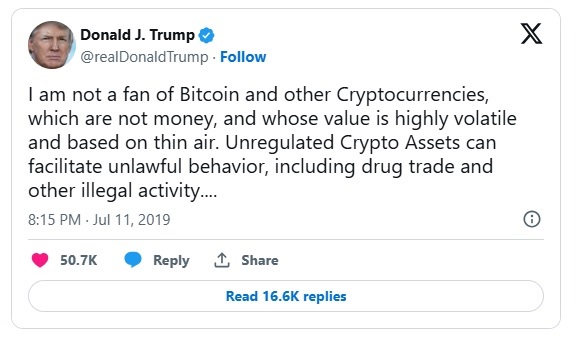
As recently as 2019, before all that money began to flow into his campaign from the ultra-wealthy crypto bros, Trump was a crypto skeptic, calling it “based on thin air” and facilitating “drug trade and other illegal activity.”

Even if Lummis can’t drag her proposed legislation over the finish line, Trump has another resource he might try to use to prop up the price of cryptocurrencies – especially since he and his family stand to financially benefit from a crypto operation, World Liberty Financial. While the footnote at the company’s website goes out of its way to emphasize that Trump and his family and the Trump Organization do not own the business and are not officers of the business, it does share this:

“DT Marks DeFi, LLC and its affiliates, including Donald J. Trump has or may receive approximately 22.5 billion tokens from World Liberty Financial, and will be entitled to receive 75% of net protocol revenues as defined in a services agreement to include revenue from any source after deduction of agreed reserves, expenses and other amounts, which amount cannot yet be determined….”

The resource we’re referring to is the Exchange Stabilization Fund (ESF) – an entity that most Americans do not know exists. It’s essentially a slush fund available to the sitting U.S. Treasury Secretary since 1934, with the approval of the President. The ESF grew from $94.3 billion in assets prior to Trump taking office in his first term as President to $682 billion as of September 30, 2020, four months before he left office.

The size of the ESF slush fund matters because under current law (31 U.S.C. §5302) the decisions on how to spend the billions in this slush fund belong to the Treasury Secretary and “are final and may not be reviewed by another officer or employee of the Government.” The law also provides that the Treasury Secretary “with the approval of the President, may deal in gold, foreign exchange, and other instruments of credit and securities the Secretary considers necessary.”

The “other instruments” might be interpreted to include cryptocurrencies by some legal brain serving in the second Trump administration.

We know that Trump in his first term as President issued an Executive Memorandum on March 20, 2020 giving U.S. Treasury Secretary Steve Mnuchin complete discretion to use $50 billion in the Treasury’s Exchange Stabilization Fund (ESF) as Mnuchin solely saw fit. On the prior Tuesday and Wednesday of that same week, Mnuchin had already used $20 billion of the Exchange Stabilization Fund to bail out Wall Street. As Mnuchin’s letter of November 19 to Fed Chair Jerome Powell confirms, he gave (or committed) $10 billion from the ESF to the Fed’s Commercial Paper Funding Facility on March 17 and another $10 billion to another Fed emergency lending program, the Money Market Mutual Fund Liquidity Facility, on March 18.

Trump has nominated a hedge fund manager, Scott Bessent, to become U.S. Treasury Secretary. (See Donald Trump’s Treasury Nominee Made Big Bets this Year on Chinese Stocks and a Big Short on the U.S. Market.) What could possibly go wrong?


WALL STREET ON PARADE


Sunday, September 22, 2024

PUBLIC CITIZEN: a supernova that burns everything to ash


What types of businesses come to mind when you think about corporate money in politics?

Big Oil?

Big Pharma?

Wall Street?

Big Tech?

All true.

But a newcomer is putting those veterans to shame when it comes to the obscene amounts of money Corporate America spends corrupting our elections.

  • As detailed in a recent Public Citizen report, the cryptocurrency sector alone is responsible for essentially half (48%) of ALL the disclosed corporate money lavished on political candidates so far this year.
  • In other words, the crypto kingpins are spending virtually as much to distort our democracy as all other Big Businesses combined!
  • Crypto is currency that exists only as digital (i.e. computer) files. It is not backed up by any government and so far it is largely unregulated. Bitcoin may be the most well known example.
  • With the crypto “industry” spending so much so fast, those old-timers — Big Oil, Big Pharma, Wall Street, Big Tech, and more — will surely ramp up their spending beyond even the insane levels we’ve already seen from them.
  • And we can only imagine the untold amounts they are spending in the shadows using dark money conduits.
  • So the absolute dumpster fire of corporate money in politics could very well become a veritable supernova that burns everything to ash.

All of this, of course, was set off by the Supreme Court’s infamously anti-democratic Citizens United ruling back in 2010.

Public Citizen called for a constitutional amendment to overturn Citizens United within moments of the decision being handed down. We’ve also consistently fought for disclosure of the secret spending that was unleashed by the ruling. And we’ve been a leader in the fight against corporate money in politics ever since.

Add your name today in support of a constitutional amendment to overturn Citizens United and get corporate money out of politics.

Because winning a constitutional amendment can take years or even decades, we have to keep demanding it — over and over and over — until we get it.

So please add your name today even if you’ve taken action before in support of a constitutional amendment to overturn Citizens United.

Click to add your name now.

Thanks for taking action.

For democracy,

- Robert Weissman & Lisa Gilbert, Co-Presidents of Public Citizen


Donate | Public Citizen | 1600 20th Street NW | Washington DC 20009 

Saturday, December 31, 2022

Opinion | Did the Tesla Story Ever Make Sense?


TomDispatch:

As 2022 ends, New York Times columnist Paul Krugman and why he wouldn't trust Elon Musk with his cat (and why Tesla stock has headed for the cellar). Tom
"If you’re one of those people who bought Bitcoin or another cryptocurrency near its peak last fall, you’ve lost a lot of money. Is it any consolation to know that you would have lost a similar amount if you had bought Tesla stock instead?
OK, probably not. Still, Tesla stock’s plunge is an opportunity to talk about what makes businesses successful in the information age. And in the end, Tesla and Bitcoin may have more in common than you think.
It’s natural to attribute Tesla’s recent decline — which is, to be sure, part of a general fall in tech stocks, but an exceptionally steep example — to Elon Musk’s purchase of Twitter and the reputational self-immolation that followed. Indeed, given what we’ve seen of Musk’s behavior, I wouldn’t trust him to feed my cat, let alone run a major corporation. Furthermore, Tesla sales have surely depended at least in part on the perception that Musk himself is a cool guy. Who, aside from MAGA types who probably wouldn’t have bought Teslas anyway, sees him that way now?
On the other hand, as someone who has spent much of his professional life in academia, I’m familiar with the phenomenon of people who are genuinely brilliant in some areas but utter fools in other domains. For all I know, Musk is or was a highly effective leader at Tesla and SpaceX.
Even if that’s the case, though, it’s hard to explain the huge valuation the market put on Tesla before the drop, or even its current value. After all, to be that valuable, Tesla would have to generate huge profits not just for a few years but in a way that could be expected to continue for many years to come.
Now, some technology companies have indeed been long-term moneymaking machines. Apple and Microsoft still top the list of the most profitable U.S. corporations some four decades after the rise of personal computers.
But we more or less understand the durability of the dominance of Apple and Microsoft, and it’s hard to see how Tesla could ever achieve something similar, no matter how brilliant its leadership. Both Apple and Microsoft benefit from strong network externalities — loosely speaking, everyone uses their products because everyone else uses their products.
In the case of Microsoft, the traditional story has been that businesses continued to buy the company’s software, even when it was panned by many people in the tech world, because it was what they were already set up to use: Products like Word and Excel may not have been great, but everyone within a given company and in others it did business with was set up to use them, had I.T. departments that knew how to deal with them and so on. These days, Microsoft has a better reputation than it used to, but as far as I can tell, its market strength still reflects comfort and corporate habit rather than a perception of excellence.
Apple’s story is different in the details — more about individual users than institutions, more about physical products than about software alone. And Apple was widely considered cool, which I don’t think Microsoft ever was. But at an economic level it’s similar. I can attest from experience that once you’re in the iPhone/iPad/MacBook ecosystem, you won’t give up on its convenience unless offered something a lot better.
Similar stories can be told about a few other companies, such as Amazon, with its distribution infrastructure.
The question is: Where are the powerful network externalities in the electric vehicle business?
Electric cars may well be the future of personal transportation. In fact, they had better be, since electrification of everything, powered by renewable energy, is the only plausible way to avoid climate catastrophe. But it’s hard to see what would give Tesla a long-term lock on the electric vehicle business.
I’m not talking about how great Teslas are or aren’t right now; I’m not a car enthusiast (I should have one of those bumper stickers that say, “My other car is also junk”), so I can’t judge. But the lesson from Apple and Microsoft is that to be extremely profitable in the long run a tech company needs to establish a market position that holds up even when the time comes, as it always does, that people aren’t all that excited about its products.
So what would make that happen for Tesla? You could imagine a world in which dedicated Tesla hookups were the only widely available charging stations, or in which Teslas were the only electric cars mechanics knew how to fix. But with major auto manufacturers moving into the electric vehicle business, the possibility of such a world has already vanished. In fact, I’d argue that the Inflation Reduction Act, with its strong incentives for electrification, will actually hurt Tesla. Why? Because it will quickly make electric cars so common that Teslas no longer seem special.
In short, electric vehicle production just doesn’t look like a network externality business. Actually, you know what does? Twitter, a platform many of us still use because so many other people use it. But Twitter usage is apparently hard to monetize, not to mention the fact that Musk appears set on finding out just how much degradation of the user experience it will take to break its network externalities and drive away the clientele.
Which brings us back to the question of why Tesla was ever worth so much. The answer, as best as I can tell, is that investors fell in love with a story line about a brilliant, cool innovator, despite the absence of a good argument about how this guy, even if he really was who he appeared to be, could found a long-lived money machine.
And as I said, there’s a parallel here with Bitcoin. Despite years of effort, nobody has yet managed to find any serious use for cryptocurrency other than money laundering. But prices nonetheless soared on the hype, and are still being sustained by a hard-core group of true believers. Something similar surely happened with Tesla, even though the company does actually make useful things.
I guess we’ll eventually see what happens. But I definitely won’t trust Elon Musk with my cat."
Opinion | Did the Tesla Story Ever Make Sense?
NYTIMES.COM
Opinion | Did the Tesla Story Ever Make Sense?


“Cool” doesn’t necessarily deliver sustained advantage.

Friday, December 23, 2022

POLITICO NIGHTLY: The year’s best political movies and television shows


View in browser
 
POLITICO Nightly logo

BY CALDER MCHUGH AND KATHERINE LONG

Tom Cruise as Capt. Pete “Maverick” Mitchell in “Top Gun: Maverick.”

Tom Cruise as Capt. Pete “Maverick” Mitchell in “Top Gun: Maverick.” | Paramount Pictures

NIGHTLY FLIX — Political junkies had a lot to watch this year. Aside from wall-to-wall coverage of the midterm elections, there was the summer spectacle of the Jan. 6 Committee hearings (which one critic named as one of his top TV shows of 2022 ).

But wide-angle shots of congressional hearings and talking heads predicting doom for Dems weren’t the only political content — on the small screen and the big — this year. Satires of the rich, meditations on cancel culture, depictions of revolution and American exceptionalism were everywhere we looked.

In that spirit, here is Nightly’s list of movies and television shows that said something interesting about our politics and values — and, most importantly, kept us entertained.

TárA beautifully designed epic from director Todd Field, Tár tells the (fictional) story of famous conductor Lydia Tár (Cate Blanchett) as she spirals out of control while rehearsing Mahler’s 5th Symphony. It might sound like a tough sit, but it’s a dynamic, darkly funny look at how fame, and the power that comes with it, can lead to evil, destruction and madness. Tár imagines herself to be above the dominant discourse online or in classrooms, but as the political dance that comes with fame changes, she plows forward without regard for others or how she might be held to account. The film will surely spark discussions about cancel culture, but it’s also about power, abuse and the relationship between boss and worker or teacher and student. It’s such a realistic depiction that it had people on the internet asking whether Lydia Tár is a real person .

AndorDisney’s need to milk Star Wars content and ride the nostalgia train has made for a handful of lackluster shows, such as “The Book of Boba Fett” and “Obi-Wan Kenobi.” But “Andor” is a breath of fresh air. The basis of the Star Wars franchise has always been political, and “Andor” dares to explore the quotidian intricacies of both the Empire and the Rebellion in a way that previous films and series have avoided. In this prequel to the “Rogue One” film, the main character Cassian Andor (Diego Luna) practically stumbles upon the Rebel cause after initially spurning the fight against the Empire. We see the ways in which the Empire travels from planet to planet as unforgiving imperialists, and how their stifling, authoritarian reign impacts the financial stability and health of those it preys upon. The reason “Andor” succeeds is because it ties back to the original Star Wars message that people everywhere are surviving however they can, and that very little is black and white.

NOPEDirector Jordan Peele’s latest effort doesn’t deal as explicitly in the political as either of his first two films. Unlike, say, 2017’s “Get Out,” there are no characters proudly proclaiming they’d vote for Obama for a third time if they could. Without spoiling too much of the plot, “NOPE” asks questions about what it means to put “the other” on display. What seems like an alien life-form arrives around a farm; how each character deals with this — treating it as something to be feared, something to be conquered, something to be gawked at — speaks to their own motivations and how Americans deal with anything they deem unfamiliar or foreign.

The White LotusAccording to “White Lotus” creator Mike White, while the first season of the HBO dramedy focused on wealth, season two was all about sexual politics. There was plenty of time to watch rich people cavorting around Sicily, but a sharper focus on interpersonal dynamics took the show to new heights in its sophomore effort. In one episode, a couple horrifies their friends with their pronouncement that they no longer watch the news — and may not have voted. “It’s just too depressing,” Daphne (Meghann Fahy) says. What the characters don’t realize is that they’re distillations of the privileged, clueless rich themselves. White creates spot-on depictions of everything from the desires of “banker and tech bros” to the white male guilt of Albie (Adam DiMarco), a son of affluence who wants nothing but to prove that he’s different from his misogynistic father and grandfather. All of the guests at The White Lotus are in search of some kind of salvation, and willing to take a wrecking ball to the people and places around them to find it.

The MenuThere was no shortage of “eat the rich” satires on screen this year, including “Bodies, Bodies, Bodies,” “Glass Onion: A Knives Out Mystery” and, to an extent, “The White Lotus.” “The Menu,” though, takes things to new heights — guests at an immersive restaurant experience on an island are treated to a meal that quickly turns sinister. The restaurant industry critiques are a bit sharper than the political ones, and director Mark Mylod has a sense for how to move the camera to depict the wealthy guests at their most callous, thanks to his time working on “Succession.”

Top Gun: MaverickThere’s little that’s more American than “Top Gun.” “Maverick,” the sequel to the 1986 classic, did big business in the box office by playing the hits, so to speak — a bunch of (good looking) fighter pilots who believe in service to their country while also having some fun. As Derek Robertson wrote about the movie in POLITICO Magazine this summer , “after years of Twitter, Trump, Covid, social upheaval, and an ever-more-bland, oppressive pop-cultural sameness, a large number of Americans are desperate for permission to collectively feel good about our life, country and culture, without any of the attendant political baggage.”

AtlantaIn its four-season run, “Atlanta” pushed the boundaries of classic storytelling. What began as a drama about an up-and-coming rapper in Atlanta ended with episodes in seasons three and four — both out this year — about cancel culture, how money and power corrupts, and death and remembrance. Throughout it all, showrunner and star Donald Glover imbued a nuanced understanding of race in America like nothing else on television. “Atlanta” was never simple.

KimiA fast-paced, frenetic thriller from Steven Soderbergh, “Kimi,” which stars Zoë Kravitz in the titular role, is a pandemic-era drama that actually works. Kimi, an agoraphobe whose anxiety has only gotten worse throughout Covid, hears a message during her work (from home) on a new smart speaker from a woman who claims she’s in trouble. As Kimi pushes her concern for what’s on the message up the chain of command, she realizes that the company she works for is trying to bury this information. She’s forced to go outside and confront the world. Kimi comes home with an understanding that big tech has invaded our lives, that the government has structures in place to allow it to do so and that resistance to powerful, faceless corporations can be deadly.

RRRA three-hour epic set in a British colonized India in the 1920s, “RRR” manages to surprise audiences again and again. The Telugu-language film follows two powerful revolutionaries (based on real Indian revolutionaries) who are practically unstoppable against the British regime, but their clashing motives become a wrench in their friendship and goals. Rama Raju (Ram Charan) is one of Britain’s top soldiers, with the ability to fight a crowd of 500 men and come out victorious. Komaram Bheem (N. T. Rama Rao Jr.) is a motorcycle-wielding member of the Adivasian God tribe who travels to Delhi to save a young girl who was “bought” by the British empire. “RRR” celebrates the reclaiming of one’s land from imperial overlords, shown through song and dance and action-packed, slow-motion-driven battles. It is a film that explores the lengths one is willing to go to take down an oppressive regime.

Dishonorable mention: Don’t Worry DarlingAll the drama at Cannes aside, Olivia Wilde’s biggest budget directorial effort yet tried to wade into questions of incel culture, the evolution of women’s rights and the postwar American experience. It fails spectacularly. All the high-minded concepts are over-wrought and under-considered, and the movie feels like it was made by a group of people who have been in Hollywood for so long that they’ve completely misunderstood the social and political ills actually plaguing the country. It’s the closest thing we got in 2022 to 2020’s Imagine video .

Welcome to POLITICO Nightly. Contact tonight’s authors at cmchugh@politico.com and klong@politico.com or on Twitter at @calder_mchugh and @katherinealong .

We’ll be off from Dec. 26 to Jan. 2 for the holidays. Nightly will resume its regular programming on Jan. 3.

THE NEW CONGRESS

THE SANTOS SAGA Republican Rep.-elect George Santos stands accused of fabricating major portions of his biography, from his Jewish ancestry to what companies he worked for. But disgust for Democrats is so strong among some voters in the district whose seat he flipped, they’d rather have a fabulist representing them in Congress, reports Janaki Chadha and Julia Marsh .

“Of course it bothers me,” Daniel Zimmerman, a 70-year-old registered Democrat, told POLITICO as he left a local pharmacy Thursday in Great Neck, a waterfront enclave in the heart of the district. But, he added, he’d vote for Santos again. “Right now I’m a Republican because Democrats, they’re destroying our country. I don’t like the president.”

John Catsimatidis, a Republican billionaire and political powerbroker who often hosts fundraisers at his Long Island home, said GOP leaders “should have done a lot more due diligence” on Santos before he was elected. But, Catsimatidis said, Santos “should be held to the same standard as” Connecticut Sen. Richard Blumenthal (D), who exaggerated his military service record when he ran for the Senate in 2010.

But not everyone in Santos’ soon-to-be district was willing to easily forgive.

Joanne, a 66-year-old Manhasset resident who wasn’t comfortable sharing her last name, said she wouldn’t cast a ballot for Santos again. But she also said she doesn’t think much of politicians from either party. “All of them, they’re getting away with it. And he’s going to get away like the Democrats are getting away [with it]. Everyone in politics, it’s all lies now,” the registered Republican said.

Bruce Blakeman, the Nassau County executive and a Republican, said in an interview with POLITICO that he’d withhold judgment until he heard Santos’ remarks.

WHAT'D I MISS?

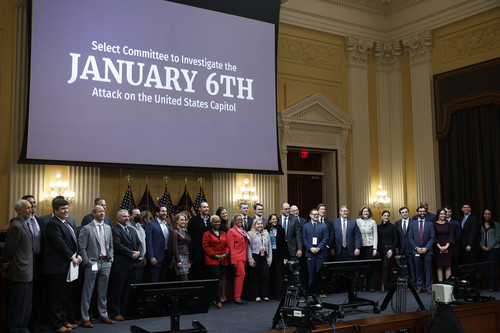
Staff members of the House Select Committee to Investigate the January 6 Attack on the U.S. Capitol pose for a group photo following the committee's last public hearing.

Staff members of the House Select Committee to Investigate the January 6 Attack on the U.S. Capitol pose for a group photo following the committee's last public hearing. | Chip Somodevilla/Getty Images

— Seven takeaways from the Jan. 6 committee’s final report: The Jan. 6 select committee’s long-awaited final report recounted almost every step of Donald Trump’s last-ditch plan to stay in power and slammed home its conclusion: The former president should never hold elected office again. But the end product of the committee’s year and a half of investigative work painted a more comprehensive picture of Trump’s attempt to stop the certification of electoral votes that would seal his loss of the White House to President Joe Biden. Cobbling together nearly 1,200 witness interview transcripts and hard-won documents, the 845-page report uncovers themes and patterns that select panel members clearly hope are of use to the Department of Justice.

— House sends $1.7T government funding bill to Biden: The House today approved a mammoth $1.7 trillion funding package , capping a chaotic week as party leaders dashed to avoid a shutdown and an intensifying winter storm just days before Christmas. The spending bill, which includes a pile of high-profile year-end priorities from Ukraine aid to an election law overhaul, will be Democrats’ final legislative act before surrendering their House majority to Republicans in January. And with their post-midterm leverage boost, GOP leaders successfully negotiated huge hikes to the bill’s military spending, adding billions of dollars beyond what Biden sought, to the consternation of many progressives.

 Biden signs defense bill repealing military vaccine mandate: Biden signed an $847 billion defense policy bill today, killing his own administration’s mandate that troops receive the Covid vaccine. The National Defense Authorization Act, which prescribes military policy and budget priorities each year, cleared Congress this month with overwhelming bipartisan support. The compromise bill also prescribes a whopping $45 billion increase to the defense budget proposed by the Biden administration and would mark a roughly 10 percent increase in military spending over last year.

— Tax forms reveal steep legal fees for voting rights group founded by Stacey Abrams: The voting rights organization founded by Stacey Abrams, Fair Fight Action, spent an additional $12 million in legal fees in 2021, bringing its running total to $37.7 million from 2019 through 2021 alone , according to new filings by the group. A significant portion of the fees went to a single voting rights case that ended this September when a judge rejected the group’s final claims in a bench trial. The recently filed federal 990 form for 2021 also shows that the group paid an additional $4.4 million to the self-described boutique law firm of Abrams’ former campaign chairperson and longtime friend, Allegra Lawrence-Hardy.

— Black voters are moving to the suburbs — and transforming American politics: The latest story in POLITICO Magazine’s “Next Great Migration” series shows how the percentage of Black Americans living in suburbs has increased steadily since 2000 , while the percentage of Black Americans in cities has decreased at the same time. Today, more than one-third of Black Americans live in suburban areas — the fastest-growing areas in the country for Black people. This realignment is already leading to suburbs that are more friendly to Democrats, though challenges in sustaining and growing that political power remain.

AROUND THE WORLD

THEY’RE WATCHING — TikTok’s parent company ByteDance accessed the data of two journalists and other users in an attempt to track down company leaks in revelations that will likely intensify security concerns in the West about the popular video app’s Chinese ownership, writes Clothilde Goujard .

ByteDance employees in China and the U.S. inappropriately pulled the data including the IP addresses —which reveal a person’s general location — of journalists from BuzzFeed News and the Financial Times and people they had connected with via TikTok, according to an internal investigation. ByteDance had tried unsuccessfully to identify staff who had shared internal company documents with the reporters.

The news comes as Congress is set to vote this week to ban TikTok from U.S. federal government phones over fears about privacy and national security. There is also growing European concern over the case.

“We expect clear explanations and irrevocable commitments from TikTok,” tweeted French digital minister Jean-Noël Barrot today. “France and Europe will never compromise on the freedom of the press.”

The investigation conducted by an outside law firm was revealed in emails that ByteDance’s general counsel Erich Andersen sent to employees on Thursday and were shared on Thursday with media outlets including The New York Times. It followed previous reports alleging the company had gathered U.S. users’ data, including their location, phone numbers and birthdays.

NIGHTLY NUMBER

5.5 percent

The amount that prices rose in November from a year earlier , down from 6.1 percent in October and the smallest increase since October 2021. It marks another sign that the long surge in consumer prices appears to be easing.

RADAR SWEEP

CASH RULES EVERYTHING AROUND ME — Eight months ago, the Central African Republic — one of the poorest countries in Africa — celebrated its status as the only country in Africa to adopt Bitcoin as a legal currency . The decision was rooted in decades of colonial rule from the French, which included a “colonial currency.” Bitcoin was something different, but it comes with its own risks; a downturn in the crypto space has imperiled the project. Ben Hunte reports for VICE.

PARTING WORDS

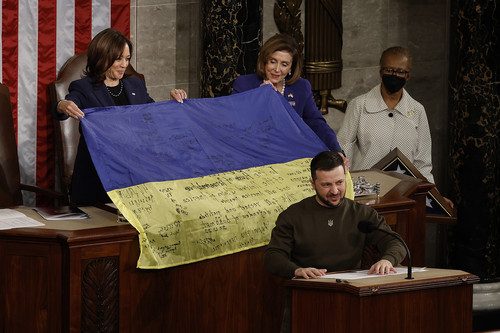
Speaker of the House Nancy Pelosi and Vice President Kamala Harris hold a Ukrainian flag signed by members of Ukraine's military given to them by President of Ukraine Volodymyr Zelenskyy.

Speaker of the House Nancy Pelosi and Vice President Kamala Harris hold a Ukrainian flag signed by members of Ukraine's military given to them by President of Ukraine Volodymyr Zelenskyy. | Chip Somodevilla/Getty Images

ASK THE AUDIENCE — Over the past week, we’ve asked you to write to us about the year’s most important news stories. We’re grateful for all the responses — including from our readers around the world. Here are your rankings of the top stories from 2022, along with excerpts from some of the most interesting answers:

1. The Russian invasion of Ukraine: “Russia’s invasion of Ukraine effectively created the perfect storm,” wrote Constantinos St. Loizides of Nicosia, Cyprus. “First, large scale war in Europe with loss of life among civilians, with the risk at any time of escalating into a nuclear confrontation by strategic dint or even by accident; Energy price hikes of tremendous proportions; Huge disruption of food supply lines; After COVID, further deterioration of commerce through logistics and transportation challenges. The invasion also highlighted, to weary citizens of democratic nations, the growing numbers of autocracies around the world, especially China.”

Karlis Streips of Riga, Latvia adds about the invasion: “I give most of the credit to President Zelensky, who no one expected to be a true war leader, but that is exactly what he has become.”

2. The January 6th Committee: “The careful and systematic investigation conducted by the Committee, and the Committee’s rational conclusions and referrals to the Justice Department, refuted the image of a spontaneous event and revealed a long-planned and organized attempt to overthrow the rule of law and the peaceful transition of power in our democracy,” wrote Dennis Hopwood of Milton-Freewater, Ore.

Patricia Palmer of Boston added that she was most impressed during the hearings by “the gutsy, principled Liz Cheney” and Alitha Young of Round Pond, Maine, said that “[the committee is] helping to secure our precious democracy. What could be more essential or important than that?”

3. America’s southern border: “My nomination would be the de facto open southern border of the United States, with the Biden Administration showing no real interest in controlling it.” wrote Thomas Farrelly of Seattle, Wash. “The story is barely covered by progressive media, including Politico.”

4. The Santos scandal: “The extraordinary level of fabrication by Rep-elect George Santos in his distributed resume, public statements, falsified government filings and outright disrespect for his constituents and the Constitution [is a huge story],” wrote in Sal Samperi of Naples, Fla. “The Santos case is the epitome of destructive disinformation that leads to a completely unwarranted outcome.”

As a bonus, we also got two interesting notes about media and entertainment. “The continuing biggest story is the media’s addiction to profit over truth,” said William Donelson of Memphis, Tenn.

Longtime film critic Daniel M. Kimmel of Somerville, Mass. told us about the state of his side of the industry: “...even as people are returning to movie theaters after the worst of the pandemic, there seems to be a real shift. Many movies are released on streaming services either simultaneously with their theatrical releases or shortly thereafter. While I’ve attended some press screenings this year, I’m reviewing mostly from at home screeners that I can watch from secure apps on my TV. It’s not the end of movie theaters, but it’s a significant change in how we consume movies and I’ve been hearing predictions of this for forty years. It seems to be finally happening.”

Did someone forward this email to you? Sign up here .


Follow us on Twitter

Charlie Mahtesian @PoliticoCharlie

Calder McHugh @calder_mchugh

Katherine Long @katherinealong

Ari Hawkins @_AriHawkins


FOLLOW US

Follow us on FacebookFollow us on TwitterFollow us on InstagramListen on Apple Podcast


POLITICO, LLC 1000 Wilson Blvd. Arlington, VA, 22209, USA


I Spoke with Xavier Becerra About Why Trump's California Attacks Matter to Every American

                                                         LOTS OF POSTS IGNORED BY BLOGGER..... OR REMOVED ON THEIR WHIM! ALL POSTS ARE AVAIL...