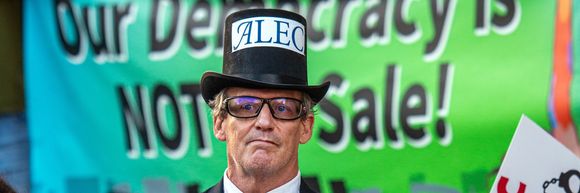
Meeting attendees will once again consider a number of pro-fossil fuel and climate-harming policies at the meeting this week.
Since the summer of 2021, CMD has repeatedly documented ALEC’s consideration and promotion of multiple model bills punishing companies and public entities that embrace environmental, social, and governance factors (ESG) in their business and investing practices.
Consumers’ Research Executive Director Will Hild, an anti-ESG zealot, has become a regular speaker at ALEC meetings since it became a major sponsor, and ALEC has, in turn, promoted his attacks. Hild is again scheduled to speak at this week’s meeting and is likely the sponsor of the workshop, “America Runs on Energy: ESG and Grid Sustainability.” The description of the training claims that “activism in investing is far from new, but the push to give outsized importance to ESG scores has a deleterious effect on our nation’s power grid.” Of course, it mentions nothing about the unfolding climate crisis and its impact on the grid.
One bill, the Act to Define Clean Energy, would replace references to “renewable energy” with “clean energy,” so that “power generation supplied by nuclear fuel” can be promoted in green energy policies.
Model legislation up for a vote at the conference relates to the power grid. The Equitable Escalation of Electricity Demand Act, for example, blames rising electrical costs on electric vehicles (EVs) and Big Tech, and seeks to pass the increased costs on to EV owners and technology companies that manage large data centers.
Another model bill, the Electric Ratepayers Affordability and Reliability Advocacy Act, claims that consumer utility boards have been co-opted by “green energy” advocates and proposes the creation of a new statewide position, a “Ratepayer Affordability and Reliability Advocate” with the “singular mission” of advocating for “the most reliable, [lowest] cost form of electricity in a service area.”
ALEC members will also vote on a related bill, the Electricity Trajectory Management Act, which would stop the decommissioning of power plants that use coal, natural gas, water, or nuclear for energy generation and require building new ones in order to meet the increasing power demands EVs and data centers place on the grid.
Under ALEC’s draft Resolution Urging States to Not Allow the Use of IRIS Assessments to Inform its Rulemakings, state regulators would not be allowed to use the Environmental Protection Agency’s Integrated Risk Information System (IRIS) “as the basis of hazard assessment or risk assessment decisions or as the basis to establish air, water or waste rulemaking.”
The Natural Asset Company Prohibition Act would ban this type of corporation. In 2023, the Securities and Exchange Commission (SEC) floated the idea of including “Natural Asset Companies” (NACs) on the New York Stock Exchange, but then backtracked. NACs are a new type of corporation that put a market value on ecosystems and natural resources and are organized to “actively manage, maintain, restore (as applicable), and grow the value of natural assets and their production.”
The State Financial Officers Foundation (SFOF), the ALEC-tied group of Republican state treasurers, auditors, CFOs, and others weaponized to fight “woke capitalism” and ESG, and American Stewards of Liberty, the group tasked with upending Biden’s 30×30 executive order to help tackle the climate crisis, worked together to drum up opposition to NACs.
ALEC is also seeking to redefine terms used to promote sustainable energy to include traditional methods. One bill, the Act to Define Clean Energy, would replace references to “renewable energy” with “clean energy,” so that “power generation supplied by nuclear fuel” can be promoted in green energy policies. A related model up for consideration, The Affordable, Reliable and Clean Energy Security Act, would include natural gas and nuclear in the definition of “green energy.”