Showing posts with label AYATOLLAH KHOMEINI. Show all posts

Saturday, October 5, 2024

WATCH: CN Live! — ‘Assange Appears as Mideast Burns’


WATCH: CN Live! — ‘Assange Appears as Mideast Burns’


Craig Murray and Richard Medhurst join CN Live! to discuss Julian Assange’s appearance in Strasbourg and to lend their expert analysis to the blow up in the Middle East. 
Read here...

_______________________________________________________________________________________


A Withering Tree of Peace


In Moscow, a birch tree that’s meant to symbolize U.S.-Russian friendship has several times failed to thrive, as Edward Lozansky recounts. But citizen diplomats keep trying. 
Read here...


In Moscow, a birch tree that’s meant to symbolize U.S.-Russian friendship has several times failed to thrive, as Edward Lozansky recounts. But citizen diplomats keep trying.

The latest peace-tree planting ceremony took place in Moscow on Monday.  (Tatiana I. Lozansky)

By Edward Lozansky

As the drums  of war beat louder and the warmongering rhetoric becomes shrill, a group of Russian and American activists assembled in downtown Moscow to replant yet again the symbolic U.S.-Russia friendship birch tree that was initially planted nine years ago.

It has had to be replaced several times as the trees have struggled to survive. Some say it’s because of the severe weather, and some, with a sense of humor, believe it’s because of a  toxic atmosphere between the two countries posioning the tree. 

[Related: War in Ukraine & the ‘Crisis of Western Civilization’]

The first one was planted on April 24, 2015, on the eve of the 70th anniversary of the historic “Elbe River” meeting of the American and Soviet military on April 25, 1945, which became symbolic of their joint victory over Nazi Germany. 

The ceremony took place with the active participation of the U.S. embassy in Moscow. Then Ambassador John F. Tefft was a diplomat of the old “search for compromise” school, which has since been replaced by “rules-based order” diplomacy, meaning U.S. world leadership, another word for “hegemony.”

Invoking the ‘Elbe Spirit’

His science and cultural attaché, Andrew McLean, had delivered a very emotional speech about the importance of the “Elbe Spirit” for future generations. He was followed by many other dignitaries and guests, including Raymond McGovern, former senior C.I.A. analyst during the Reagan and Bush, Sr. days, who read Russian poetry and sang with the crowd the famous military hit “Katyusha.”

Then, everyone got a shovel to plant the first U.S.-Russia friendship tree.

It was still alive the following year, when on April 25, 2016, next to this tree, the sculptural composition of three American and three Soviet soldiers shaking hands on the bridge of the Elbe River was installed. It was made by the famous Russian sculptor Aleksandr Burganov, whose statue of the greatest Russian poet, Aleksandr Pushkin, is installed on the campus of George Washington University, a few blocks away from the White House and State Department.

General Bruce McClintock, then acting military attache at the U.S. embassy in Moscow, on left side in blue uniform, shaking hands with Russian sculptor Alexander Burganov, who created the monument in background, on April 25, 2016. Also shown are General Peter Zwack, former military attache, and Russian officials and public figures. (Tatiana I. Lozansky)

Ambassador Tefft was still in Moscow in 2016, and at the ceremony. The embassy was represented by three U.S. generals who spoke:  military attaché Bruce McClintock and two former attaches, Kevin Ryan and Peter Zwack. 

McClintock shook hands with Russian cosmonaut Alexei Leonov, who, together with U.S. Astronaut Thomas P. Stafford, was commander of the 1975 joint U.S.-U.S.S.R.  Apollo-Soyuz spacecraft.

McClintock at the 2016 event shaking hands with Russian cosmonaut Alexei Leonov, who was on the 1975 Apollo-Soyuz mission. (U.S. embassy)  

This  was the last time U.S.  diplomats took part in subsequent Elbe River ceremonies in the Moscow square that has became known, albeit unofficially, as the “American Corner.”

The U.S. embassy also ignored an invitation to again take part this year,  refusing to send even a low-level diplomat for the symbolic act honoring war veterans.

Glimmer of Hope

There had been a glimmer of hope things could be reversed in April 2020, when we decided to bypass the  diplomats and shoot for the top by inviting Presidents Donald Trump and Vladimir Putin to participate. It was a long shot, but unexpectedly, we got a positive reply. No, they didn’t appear at the “American Corner” but did issue a joint statement.

Both presidents discussed the importance of the event and ended with encouraging words: 

“‘The Spirit of the Elbe’ is an example of how our countries can put aside differences, build trust, and cooperate in pursuit of a greater cause. As we work today to confront the most important challenges of the 21st century, we pay tribute to the valor and courage of all those who fought together to defeat fascism. Their heroic feat will never be forgotten.”

Trump’s critics saw this as additional proof that he was Putin’s stooge, and this was the last time any positive, high-level exchange happened between the two nations.

Nevertheless, in addition to officials, there are also the people’s “diplomats” who understand the critical urgency of the moment and who are trying to send a different message.

Peace rally in Kingston, New York, last Saturday, while Joe Lauria, Consortium News’ editor in chief, was speaking. (Corinna Barnard)

Two days before the tree planting on  Monday this week, in Kingston, New York, at the Four Corners of Freedom at Crown and John Streets, Roger Waters, founder of Pink Floyd [in video link]; Judge Andrew Napolitano, host of Judging Freedom podcast; Scott Ritter, former U.N. weapons inspector, columnist; Joe Lauria, editor-in-chief of Consortium News; Gerald Celente, founder of Occupy Peace, and publisher of the Trends Journal magazine; and Randy Credico, comedian, and WBAI radio host, delivered a peace message to the assembled crowd and via Zoom around the world.

In Moscow, Russian and American peace activists assembled at the “American Corner” to replant once again the birch “U.S.-Russia Friendship Tree” and send the same message of peace across the ocean. Passers-by couldn’t believe they saw American and Russian flags waving together as a sign of friendship between the peoples of both nations in these dangerous times.

As Paula Day, president of the Center for Citizen Initiatives, one of the observers of both the Kingston and Moscow events via Zoom, said:

“Given the tenor of our times, these meet-ups feel a bit like what I imagine early Christians experienced as they gathered in small, discrete groupings hoping to avoid being fed to the lions before a ravening crowd in the Coliseum; the more friends, the more strength and courage in numbers.”

Edward Lozansky is president and founder of the American University in Moscow and the U.S.-Russia Forum. He is also a professor at the Moscow State and National Research Nuclear Universities.

The views expressed are solely those of the author and may or may not reflect those of Consortium News.


Khamenei to US & Europe:
‘Get Lost’


The Iranian supreme leader told a gathering in Tehran that the region will enjoy peaceful coexistence only after the U.S. and Europe leave. 
Read here...


By Brett Wilkins
Common Dreams

Iranian Supreme Leader Ayatollah Ali Khamenei said Wednesday that the United States and some European nations are responsible for the turmoil in the Middle East, and that the people of the region will enjoy peaceful coexistence only after the interlopers leave.

Khamenei — who has led the Islamist theocracy since 1989 — spoke to a group of scientists and scholars in Tehran on Wednesday, one day after Iran retaliated for recent Israeli assassinations of Iranian, Hezbollah, and Hamas leaders by firing around 200 missiles into Israel.

“In our region, the root cause of problems, which leads to conflicts, wars, concerns and hostilities and such like, results from the presence of the same people who claim to advocate peace and tranquility in the region; that is America and some European countries,” the 85-year-old Shia cleric said, according to Iranian state broadcaster Press TV.

“If they get themselves out of this region, beyond a shadow of a doubt these conflicts, these wars, these clashes will come to a complete halt, and the countries of the region will be able to govern themselves, govern their region, and live together in peace, blessing, and prosperity,” Khamenei added.

Khamenei had two additional words of advice for U.S. and European meddlers: “Get lost.”

A History of Western Meddling

British intervention in what was then the Persian Empire started in the 19th century. In the 20th century, Britain and the United States engineered a coup in Iran that restored and perpetuated a monarchy that ruled until overthrown and replaced by the current regime in the late 1970s. Since then, the U.S. has also supported efforts to overthrow the Iranian government, including by training anti-regime militants.
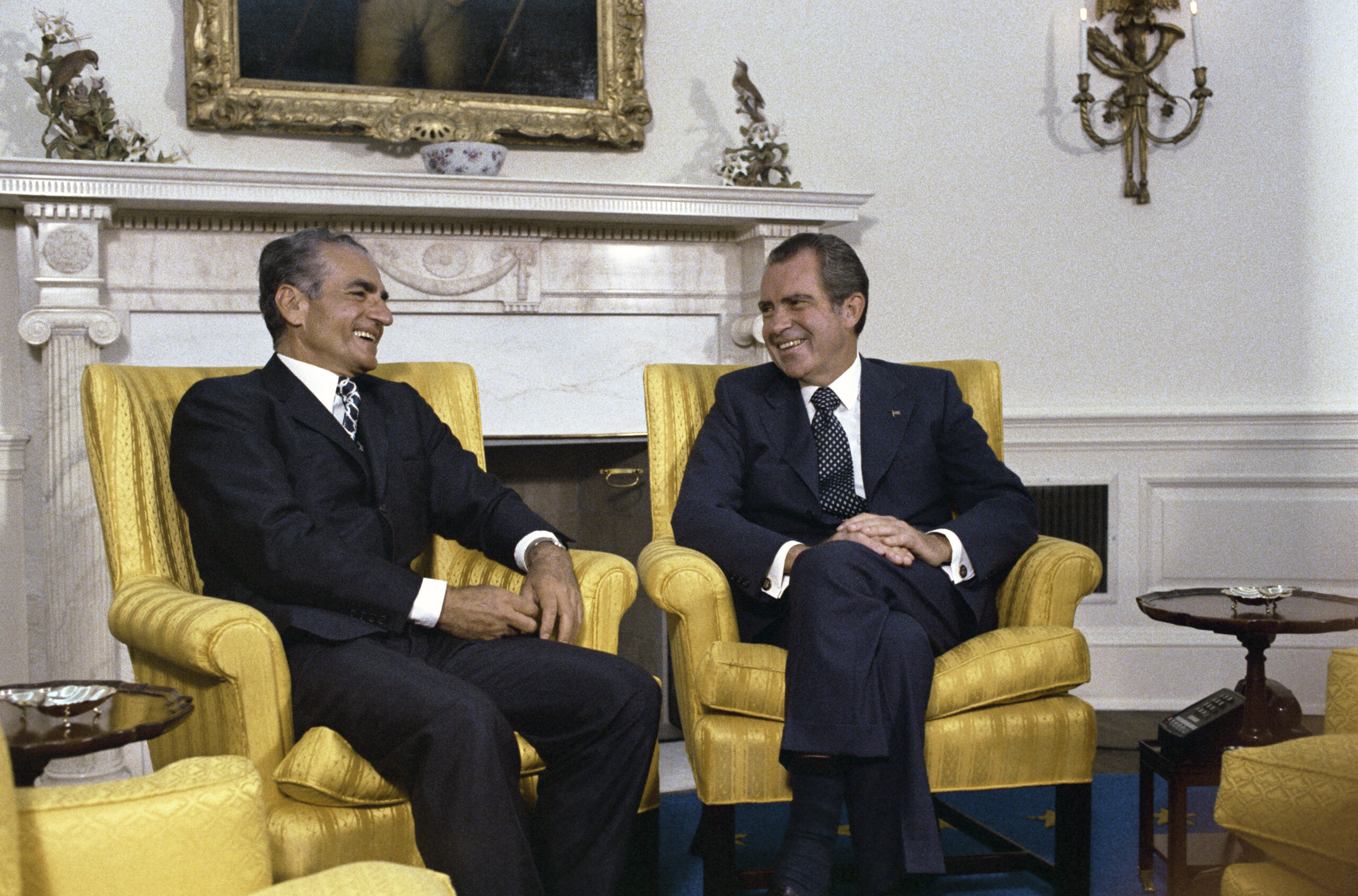
Shah of Iran, left, with President Richard Nixon in the Oval Office, 1973.
(The Nixon library, Wikimedia Commons, Public domain)

Britain opened up Palestine for Zionist colonization, but later ended Jewish immigration as Jews usurped the local Arab population and carried out many deadly terror attacks against both British occupiers and Palestinians.

Following the establishment of the modern state of Israel — largely through ethnic cleansing of Arabs in the 1940s — the United States supported an expansionist Israel with hundreds of billions of dollars in military aid and diplomatic cover, even as it now wages a war on the Gaza Strip for which it is on trial for genocide at the International Court of Justice.

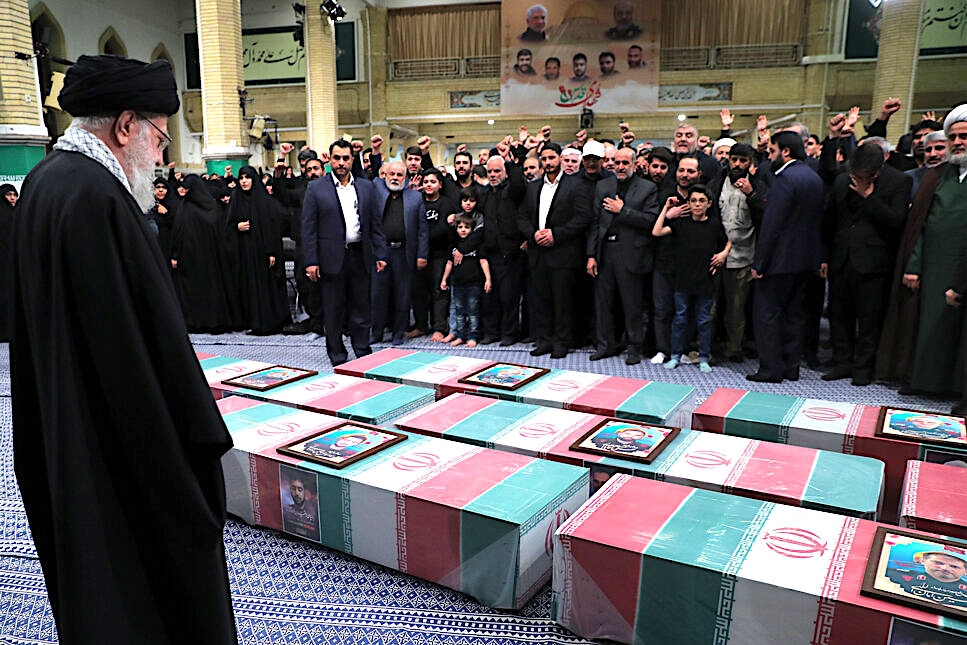
Funeral in Tehran on Jan. 6, 20202, of Iran’s General Qassem Soleimani, killed days earlier by a U.S. assassination. (Mehr News Agency, CC BY 4.0, Wikimedia Commons)

The supreme leader’s speech came amid fears of a wider Middle East war.

While Iran and Hezbollah have shown restraint in responding to Israeli aggression, Israel has escalated its war, which has left more than 148,000 Palestinians dead, injured, or missing in Gaza, where millions more people have been forcibly displaced, starved, and sickened since the Oct. 7, 2023 Hamas-led attack.

Israeli forces have also killed or wounded thousands more people in Lebanon, which Israeli ground troops invaded this week.

The United States, as well as the United Kingdom and other European nations, have supported Israel with billions of dollars worth of weapons and, in the case of the U.S., diplomatic cover including multiple vetoes of United Nations Security Council cease-fire resolutions.

U.N. Secretary-General António Guterres on Wednesday condemned Israel’s assault on Gaza as “the most deadly and destructive military campaign” in his years of leading the world body.

Guterres, who was addressing the Security Council, also said that he “strongly” condemned Tuesday’s “massive missile attack by Iran on Israel,” adding that such action does not “seem to support the cause of the Palestinian people or reduce their suffering.”

Falsely claiming that Guterres failed to “mention Iran by name” or “unequivocally condemn” the Iranian attack, Israeli Foreign Minister Israel Katz on Wednesday declared the U.N. leader “persona non grata” in Israel and banned him from entering the country. 

Brett Wilkins is a staff writer for Common Dreams.

This article is from Common Dreams.

Views expressed in this article and may or may not reflect those of Consortium News.


________________


_______________________________________________________________________


You can make a donation to Consortium News by


credit card online  or by  mailing a check  to


Consortium for Independent Journalism (CIJ)
2200 Wilson Blvd.
Suite 102-231
Arlington, VA 22201


CIJ is a 501-c-3 tax-exempt organization, so your donations may be tax-deductible in the United States. (You also can direct donations to us through your company's charitible-giving programs.)


consortiumnews.com

_______________________________________________________________________________________


Wednesday, September 18, 2024

AS`AD AbuKHALIL: Iran’s Crucial Decision on Israel

President Biden has gotten BAD ADVICE & those who surround him ignore

the lengthy history. 

In addition, too many ELECTED OFFICIALS benefit from ENDLESS WARS - the 

WAR MONGERS:

COMMON DREAMS: 'Obvious Conflict of Interest': Report Reveals 50+ US Lawmakers Hold Military Stocks


INTELLIGENCE AGENICIES HAVE SO FAR SUCCEEDED IN ARRESTING 

TERROGRAM PARTICIPANTS & PROTECTING POWER PLANTS, SHUTTING 

DOWN RUSSIAN PROPAGANDA THAT NOT ONLY CIRCULATED RUSSIAN 

PROPAGANDA BUT GENEROUSLY FUNDED RIGHT WING OUTLETS THAT 

PROVIDED DISINFORMATION TO AMERICANS, BUT UNCONDITIONAL 

SUPPORT FOR ISRAEL'S GENOCIDE PAINTS A TARGET ON AMERICA! 

RUSSIA THRIVES ON CREATING DIVISION. 

MERCERS SUPPORTED & FUNDED THE LIES, DISINFORMATION, HATE 

& ANGER....

IT ONLY TAKES ONLY WELL FUNDED ZEALOT LIKE TIMOTHY MCVEIGH TO 

CREATE A CATASTROPHIC EVENT.... 

*****MUST READ!**** "Terrorgram"

   THIS IS THE RESULT OF GREAT EFFORT BY THE LAW ENFORCEMENT 

                AGENCIES INVOLVED FOR WHICH WE SHOULD BE GRATEFUL! 

                THIS IS THE PRODUCT OF TRUMP ENCOURAGING HATE & VIOLENCE 

                WHILE REPUBLICANS & THE MAGE GOP REMAIN SPINELESS & 

                FAIL TO CONDEMN THE RHETORIC. 

                NOTE THE ARRESTS FOR PLANNING TO ATTACK NEW JERSEY POWER

                PLANT - ARTICLES POSTED SEPARATELY

POWER PLANT TARGETING ARRESTS - WHITE SUPREMACISTS & NAZIS


DOJ alleges Russia funded US media company linked to right-wing social media stars

LOOK AT THE NAMES:


How one billionaire family bankrolled election lies, white nationalism — and the Capitol riot


The Mercers and Stephen Bannon: How a populist power base was funded and built


AS`AD AbuKHALIL: Iran’s Crucial Decision on Israel

Tehran will eventually need to address Tel Aviv, maybe even more so after the pager terrorist attack in Lebanon. But Iran will do so on its own terms, not on the timeline dictated by its enemies. 

Ali Khamenei leading the funeral on April 4, 2024, for the IRGC soldiers killed in the Israeli attack on the Iranian consulate in Damascus. (Khamenei.ir, Wikimedia Commons, CC BY 4.0)


By As`ad AbuKhalil
Special to Consortium News

Iran faces probably its most difficult decision since its 1979 victory in the Iranian Revolution.

Israel has launched strikes deep into the heart of Tehran and Beirut’s southern suburbs, significantly strengthening its strategic position.

[On Tuesday, Israel was accused by U.S. officials of planting explosives in pagers made in Hungary, which were sold to Lebanon and then remotely detonating them, killing 12 people and injuring more than 2,700. Hezbollah vowed revenge on Israel.]

Before the pager terrorist attack, Hezbollah leader Hassan Nasrallah conceded that the two earlier strikes on Iran and Lebanon were an Israeli achievement, a rare concession from any Arab leader. 

But Israel’s bold and risky aggression must be understood in the context of Tel Aviv’s strategic failure to eliminate Hamas in its war on Gaza.

Israel’s Free Hand to Kill

Israel has succeeded in exterminating tens of thousands of Palestinians and rendering much of Gaza uninhabitable. A state that has historically shown little compunction for ethnically cleansing the native Palestinian population in favor of European immigrants, has once again prioritized its occupation’s security over humanitarian concerns and international law. 

As long as Israel enjoys unconditional American support, it knows it can violate international norms and laws of war, and perhaps even resort to the deployment of nuclear weapons — with U.S. backing.

Since the assassination of Qasem Soleimani, the former chief of the Iranian Revolutionary Guard Corps, during the Trump administration, Iran has struggled to reassert its sovereignty and project deterrence against Israel. 

Iran’s relatively open society presents vulnerabilities, unlike Saddam Hussein’s tightly controlled Iraq, for instance, where foreigners were thoroughly scrutinized or banned altogether. Iran’s tourism industry and dual citizenships have allowed the Mossad to infiltrate Iranian society and to recruit spies and saboteurs. 

Several assassination attempts, some successful, have targeted Iranian scientists and regime figures. Additionally, Israel and Saudi Arabia have collaborated to fund and support domestic ethnic opposition groups and the terrorist organization Mujahideen-e-Khalq (MEK), which was previously supported by Saddam Hussein’s regime and is now backed by the Mossad, the Saudi regime, and the Israel lobby in Washington.  (The U.S. once classified it as a terrorist organization for its resort to indiscriminate bombings, but Israel managed to have it delisted).

Iran, a nation with diverse ethnicities and religious groups, has long seen its adversaries exploit these internal divisions. These enemies leverage inequalities to stir unrest and recruit spies for the Mossad and other hostile forces. 

The U.S., under a president with questionable mental acuity, continues to support Israel unconditionally, even as Israel’s mass violence against Palestinians escalates. There seem to be no red lines for the White House, perhaps even if Israel were to resort to nuclear weapons against its enemies.

Iran does not wish to confront Israel directly while the U.S. is prepared to deploy warships across the region in Israel’s defense. Israel’s need for direct U.S., European, and even Arab military intervention to defend itself against non-state actors in Palestine and Lebanon exposes its own strategic vulnerabilities.

Israel used to be able to take on several Arab armies without external military support and now it cries for help from NATO when threatened by the relatively small armies of Hamas and Hezbollah. 

Political Dissent in Iran

The recent Iranian presidential election revealed significant dissatisfaction among the Iranian population. Opposition to the regime is no longer confined to young college students in major cities. In this election, a candidate aligned, openly, with the Iranian Revolutionary Guards faced off against a representative of the so-called reformist opposition, and the latter emerged victorious. 

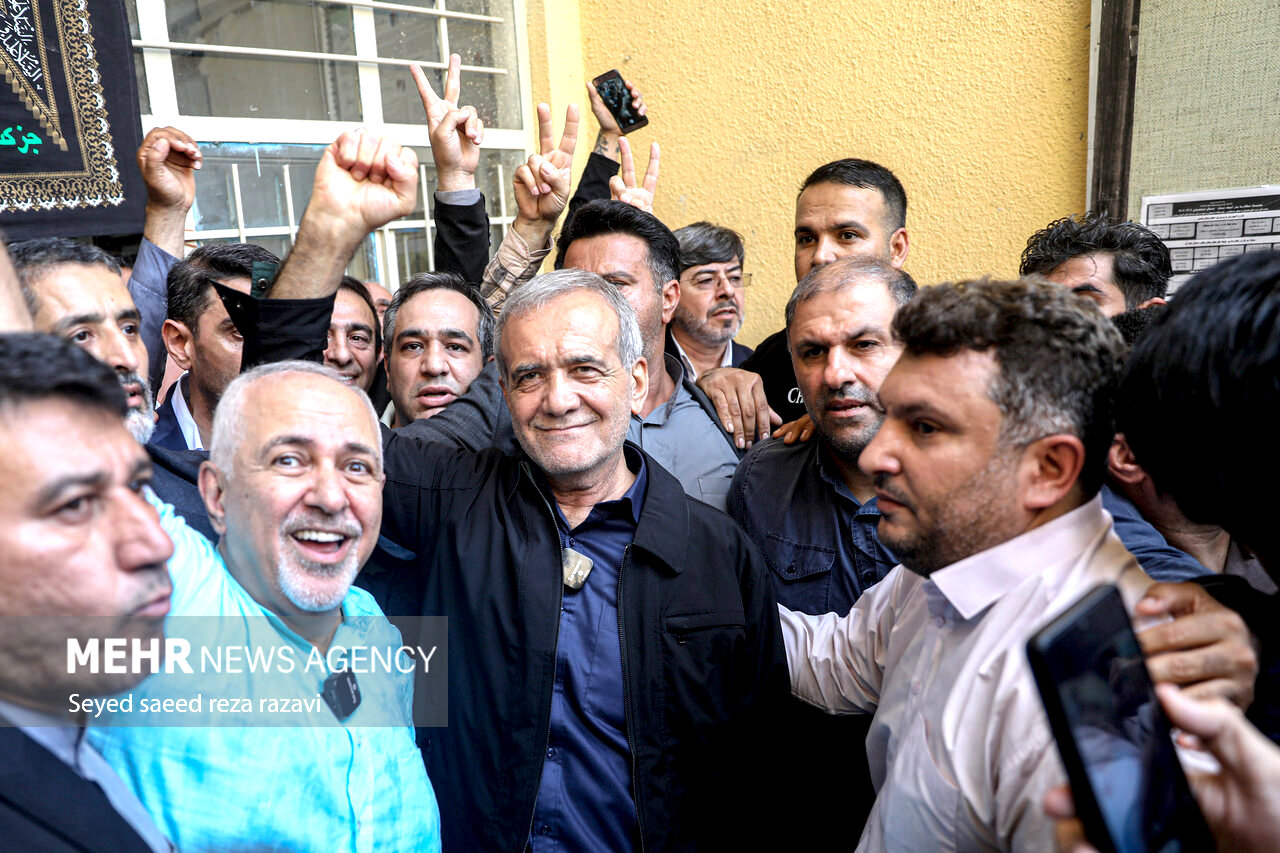
Iran’s President Masoud Pezeshkian voting in the July 5 runoff election. (Mehr News Agency, Wikimedia Commons, CC BY 4.0)

The regime faces a crisis of legitimacy as the revolutionary credentials that once sustained it wane over time. Economic reform and job creation have become the government’s top priorities — more important even than retaliation against Israel.

Furthermore, recent visitors to Iran report strong manifestations of dissatisfaction among the population regarding generous Iranian support for the Palestinian struggle. Many Iranians maintain that the needs of the Iranian people should be prioritized over the military requirements of Arab resistance against Israel.

Foreign policy is a big priority for the regime but less so for the populace, and we should not rule out the possibility that Western propaganda has actually succeeded inside Iran as it succeeded in the former Soviet bloc countries during the Cold War.
Iran under the Shah was not only unconcerned over the plight of Palestinians but the Shah was a very close ally of Israel and helped fund and arm its clients in the region including the Phalange and their allies in Lebanon — as early as 1958 during the mini-civil war (and the later civili war in 1975). 

It was Ayatollah Ruhollah Khomeini personally who injected Palestine into the core of the ruling doctrine of the government and even of the religious-political ideology that came to power in Iran.

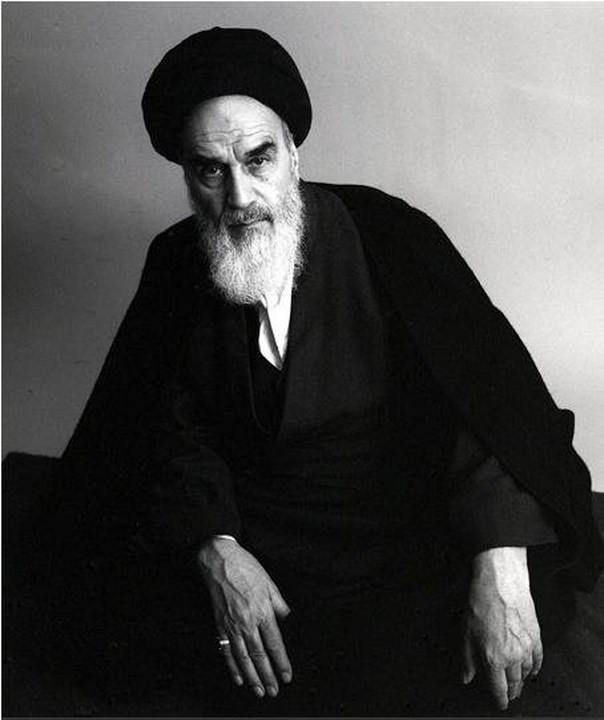
Khomeini in the 1970s. (Wikimedia Commons, Public domain)

Some elements of the reformist opposition, who are aligned with the duo of former President Hassan Rouhani and former Foreign Minister Javad Zarif, believe that if Iran were to make further concessions, the U.S. will lift the sanctions and usher in economic prosperity. 

The Rouhani government operated under this assumption, negotiating a nuclear deal that ultimately did not serve Iran’s interests. Foolishly, they agreed to the pact in the final days of the Obama administration without securing a durable, U.S. Senate-approved treaty. As a result, when Donald Trump took office, he easily dismantled the agreement, despite its earlier endorsement by a United Nations Security Council resolution with U.S. assent.

Iran’s Decision

Iran must take all these factors into consideration when contemplating how to responded to its sovereignty being directly violated by Israel multiple times over the past year — first with the attack on its consulate in Damascus, and more recently with the assassination of a Hamas leader in a government guesthouse in Tehran. 

While Iran’s response to the first violation was symbolic but strong, a similar symbolic response to the second could harm Iran’s strategic position with Israel. Iran wants to send a clear message of deterrence but does not want to escalate into an all-out war.

It also naively fears that Israel could drag the U.S. into a military confrontation with Iran. 

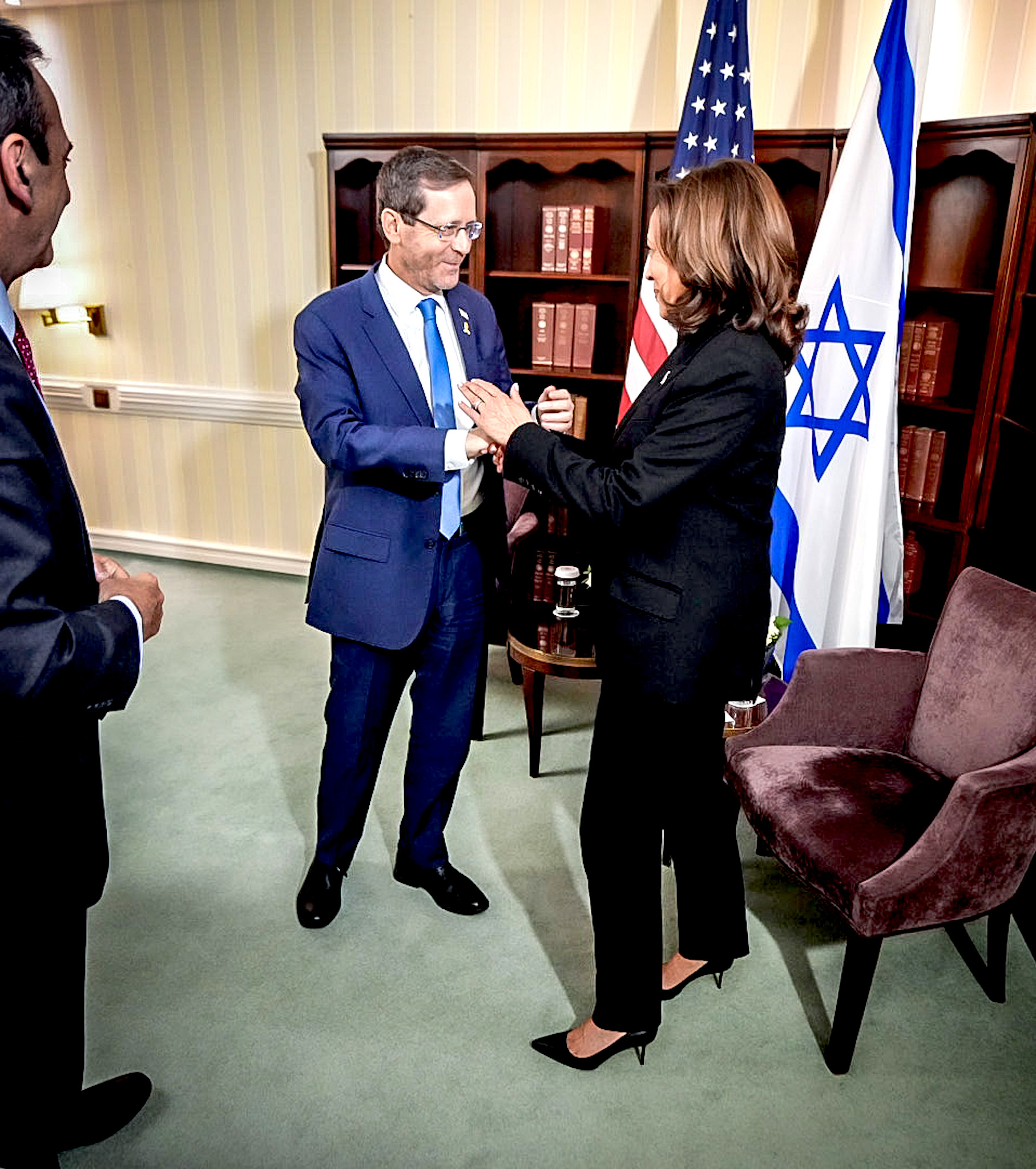
U.S. Vice President Kamala Harris with Israeli President Isaac Herzog at the Munich Security Conference in February. (Office of the Vice President, Wikimedia Commons, Public domain)

Although it’s possible that a second Trump administration, or the present one, might support Israel in an attack on Iran, it is highly unlikely that the U.S. would participate in a full-scale war against Iran, especially after the failures of recent U.S. military interventions in the Middle East.

As former Defense Secretary Robert Gates famously warned once at West Point, any president who considers starting a new war in the Middle East should have his head examined.

For Iran, relying too heavily on its regional allies to respond to Israeli aggression could damage its standing in the Arab world. It must respond on its own terms, or its regional influence will suffer. 

Gulf media outlets have already accused Iran of avoiding direct confrontation with Israel, even though there is no geographical border between the two nations. These same outlets rarely miss an opportunity to undermine support for Iran on behalf of Israel. 

This war, involving key Iranian allies Hamas and Hezbollah, is one of the longest in the history of the Arab-Israeli conflict (perhaps with the possible exception of the war of attrition between Egypt and Israel, 1968 and 1970). 

While Iran remains the only country willing to risk its own stability and economic well-being to provide military and financial support to Arab resistance groups, there is growing pressure from Arab public opinion for Iran to take more direct action against Israel if it is to benefit from its continued support for the Palestinian cause.

Iran can’t leave its sovereignty violated repeatedly by Israel, in both Syria and Iran.  This is a major vulnerability that the “resistance axis” has to address at some point, and probably in coordination with the Russian government, which still remains aligned with Netanyahu over Israeli aggression in Syria.

Iran will eventually need to address Israel. But it will do so on its own terms, not on the timeline dictated by its enemies. 

Iran will have to decide: how to protect Iranian sovereignty and strategic deterrence without starting a regional war with Israel and instigating a direct U.S. military intervention against the Islamic republic. 

Thus it has little choice but to wait out this period of intense U.S. attention and presence in the waters of the Middle East. 

As`ad AbuKhalil is a Lebanese-American professor of political science at California State University, Stanislaus. He is the author of the Historical Dictionary of Lebanon (1998), Bin Laden, Islam and America’s New War on Terrorism (2002), The Battle for Saudi Arabia (2004) and ran the popular The Angry Arab blog. He tweets as @asadabukhalil

The views expressed are solely those of the author and may or may not reflect those of Consortium News.

Please Donate Today to CN’s Fall Fund Drive 


Tuesday Afternoon Updates – Error 404: President Not Found

                                                                                                                                            ...