JOHN KIRIAKOU:
_______________________________________________________________________________________
Vijay Prashad:
Many countries with supposedly centre-left or left governments have joined the U.S. in proposals that seek to undermine Venezuelan democratic processes. Read here... _______________________________________________________________________________________
Colonialism as a Bulwark
_______________________________________________________________________________________
2200 Wilson Blvd. Suite 102-231 Arlington, VA 22201 |
Tuesday, August 27, 2024
JOHN KIRIAKOU: The Slide Into Authoritarianism


Friday, May 3, 2024
This is how authoritarianism is normalized
I cannot stop thinking about this: It's now been one week since Donald Trump's lawyers told the Supreme Court that presidents should be able to murder political rivals or stage coups—and multiple Supreme Court justices acted like it was a serious argument.
This is how authoritarianism is normalized. I can't stop thinking about it—nor should any of us who are dedicated to democracy.
My head nearly exploded hearing this exchange in particular, with Trump's lawyer arguing that presidents are entitled to immunity for violating criminal laws for any "official act":
Justice Sonia Sotomayor asked Trump's lawyer: "If the president decides that his rival is a corrupt person, and he orders the military or orders someone to assassinate him, is that within his official acts for which he can get immunity?"1
Trump's lawyer responded: "It would depend on the hypothetical, but we concede that could be an official act."2
Justice Elena Kagan followed up, asking, "How about if the president orders the military to stage a coup?"3
Trump's lawyer responded: "It would depend on the circumstances whether it was an official act."4
This is how democracies die and dictatorships arise. It's truly terrifying.
We cannot minimize what's at stake. And we certainly cannot rely on the courts to save our democracy from Trump. No way. That is as clear as day.
Our only way forward is to defeat Trump decisively at the ballot box in November. And that's why I'm writing today.
My good friends at MoveOn are the best in the business at engaging and turning out voters at scale, and I'm impressed by their data-driven, innovative, and bold plan to defeat Trump and save our democracy this November. But MoveOn needs your financial support to make their plans a reality.
Will you join me and donate $5 a month to MoveOn from now through Election Day to defeat Trump, save our democracy, restore our freedoms, and build a future where everyone can thrive?
No, I'm sorry, I can't make a monthly donation.
The Republican justices last week refused to even consider the facts of the Trump case in front of them and instead were focused on future hypotheticals. By blowing it up into something else, the Republican justices are blowing up Trump's trial—which is exactly their intention. Read for yourself:
Justice Samuel Alito: "I'm not discussing the particular facts of this case."5
Justice Neil Gorsuch: "I'm not concerned about this case so much as future ones too."6
Justice Brett Kavanaugh: "Like Justice Gorsuch, I'm not focused on the here and now of this case. I'm very concerned about the future."7
Trump attempted a coup, but the Republican justices can't be bothered. Not even with Trump poised to be president again.
I'm outraged. I'm disgusted. And I'm motivated to fight like hell to save our democracy. I hope you are, too, because time is short, and it's going to take each and every one of us.
MoveOn briefed me a few months ago on their plan for the 2024 election, which The New York Times called "ambitious."8 If there's anything we need in this moment, it's ambition.
And my friends at MoveOn just updated me on their progress, and, wow, I am impressed!
MoveOn is focusing on convincing "surge voters"—people who voted for the first time, or were more active, after Trump's win in 2016—that their vote matters. These people do not consistently vote.
The data are clear that winning this election won't come down to turning so-called "swing voters" into Biden voters. Instead, it will be turning out people who might otherwise not go to the polls at all.9
And that's exactly where MoveOn comes in. MoveOn has a tremendous track record when it comes to engaging and turning out voters, using data-driven and highly effective strategies.
Already, MoveOn is starting the organizing to reach out to surge voters and talk to them about the stakes of this election and the issues they care about and make the pragmatic and strategic case as to why their vote is critical.
Effective organizing is incredibly time and work intensive. And that work absolutely must happen right now.
Our nation's highest court is considering whether presidents can murder political opponents and order military coups. Our democracy is hanging by a thread. We have a lot of work ahead of us to fix it. But, first, we MUST defeat Trump decisively in November. It truly is up to us.
So, will you please join with me, reject defeatism, and channel your outrage into action by donating $5 a month to power MoveOn's game-changing election plan?
No, I'm sorry, I can't make a monthly donation.
Thanks for all you do.
–Robert Reich
Sources:
1. "Donald J. Trump v. United States," U.S. Supreme Court, April 25, 2024
https://act.moveon.org/go/191292?t=6&akid=383323%2E3735812%2EnzTPe9
2. Ibid.
3. Ibid.
4. Ibid.
5. Ibid.
6. Ibid.
7. Ibid.
8. "MoveOn Will Spend $32 Million to Back Biden and Other Democrats," The New York Times, January 26, 2024
https://act.moveon.org/go/186159?t=8&akid=383323%2E3735812%2EnzTPe9
9. "Turnout Data Reveals the Core of Democrats' Success in Special Elections," The New York Times, February 2, 2024
https://act.moveon.org/go/186323?t=10&akid=383323%2E3735812%2EnzTPe9

Want to support MoveOn's work? The MAGA movement's book bans have forced teachers and librarians across the country to remove books from their shelves and censor what young people can learn. MoveOn is fighting back, including by filling a "Banned Bookmobile" with books that the far right has banned and driving it to key cities and towns to raise the visibility of book bans, hand out banned books for free, and bring people together to stop censorship. To keep up the fight against book bans and the MAGA politicians who support them, we need your help.
Will you start a monthly gift to power and sustain MoveOn's critical work?
No, I'm sorry, I can't make a monthly donation.
PAID FOR BY MOVEON POLITICAL ACTION, https://pol.moveon.org/. Not authorized by any candidate or candidate's committee. MoveOn Political Action - PO Box 96142, Washington, D.C. 20090-6142.
Sunday, March 3, 2024
My Ultimate History Crash Course | Robert Reich
Are we in a second Gilded Age? Is Trump really a Fascist? Why are we so politically polarized? How did corporations take over our politics? To understand the present, study the past. Please join me as I share 6 crucial lessons from history.
Sunday, November 19, 2023
Altemeyer on Trump’s Supporters
Altemeyer on Trump’s Supporters
When writing my book Conservatives Without Conscience (Penguin, 2007) about the authoritarianism that was gaining influence in the Republican Party in the early 2000s, I read most everything that social scientists had to say about folks with such dispositions. Particularly helpful was psychology professor Bob Altemeyer’s book for Harvard University Press, The Authoritarian Specter (1996). No one has done more ground-breaking work in testing the nature of these people than this professor, who was then at the University of Manitoba in Canada. A native of St. Louis who had done his graduate work at Carnegie Mellon University in Pittsburgh, Bob is also a keen student of American politics. Indeed, his son is in the business in Canada, and a member of the Manitoba Legislature.
I thought it would be helpful to many Americans to be exposed to Bob’s scholarly studies, and convinced him to write them up in a book for the general reader. He did, and placed it online for anyone to read for free. See The Authoritarians. (Last time I checked, over 670,000 people had visited the book, and hopefully read it!)
Bob Altemeyer saw Donald Trump coming. More accurately, he saw the kinds of men and women who would vote for a Donald Trump-type candidate for high office. These are people he described in earlier works as Right Wing Authoritarians, and Enemies of Freedom. Without going too deep into the weeds, let me note a few of these people score high on testing that shows they not only can be devoted followers of authoritarian leaders, the so-called social dominators like Trump who want to be in charge, but they also test high as social dominators themselves. These seemingly incongruous testing results—testing high as both followers and leaders—have been explained as the social dominators envisioning the type of follower they want as leaders, or their willingness to be good followers until they get their chance to become leaders. I labeled these “double high” people as conservatives without conscience, because it is a perfect description of those who top both scales in this testing.
When I started writing about these authoritarian personalities in 2005, I was looking for an explanation of the people who had taken charge of the Republican Party. That’s when I found Altemeyer’s work, which was (and still is) widely accepted. In fact, he was awarded the prestigious prize for behavioral science research in 1986, when the American Association for the Advancement of Science recognized his work. Working in 2005, I asked him what percentage of the American population might he estimate (or intelligently guess) were authoritarian followers, and he thought maybe 30 percent. Working on my book it seemed inconceivable that so few could ever elect a president. When Trump emerged in 2015 as a GOP contender, while I thought he could win the nomination, I was certain that was the end of the road: “Of only one thing am I absolutely certain: Donald Trump will never be President of the United States, so rest easy. Authoritarians remain a minority in America, thankfully,” I declared on July 24, 2015.
Authoritarians do remain a minority, but with non-voters and anti-Hillary Clinton voters, Trump pulled off a historic upset. It appears his core supporters remain faithful—regardless of what he does or doesn’t do. So, I asked Bob Altemeyer, what if anything would get through to the Trump supporters, given the fact Trump has shown himself, so far, totally incompetent as President of the United States. Set forth below in italics is material from Bob, who is now enjoying his retirement.
It took many months for Americans to stop supporting President Nixon during Watergate, and even at the end he could count on a hard knot of supporters who would believe him, as he said to [his chief of staff] H. R. Haldeman, because they wanted to. (NYT, 11/22/1974, p. 20). A few days before he resigned, 24% of a Gallup sample approved of the way Nixon was doing his job, including 38% of the Republicans polled.
Most of Donald Trump’s supporters are probably people whom social psychologists call authoritarian followers, because they are so supportive of the authorities they consider legitimate. These are the people Trump was talking about when he famously bragged that he could shoot somebody in broad daylight on Fifth Avenue and it would make no difference to his backers. They are the people who so willingly took the “loyalty pledge” at Trump rallies in the early primaries—even calling on Trump to “do the swearing” when he had skipped it.
We know enough about authoritarian supporters from research, and history, to know it will be very hard to change their minds about the leader they adore.
- They are extremely ethnocentric, dividing the world sharply into people in their in-group, and automatically disliking all others. They feel politicians who promote minority rights and immigration discriminate against them. Donald Trump tells them they are right. He is their champion.
- They are highly dogmatic. They get their ideas from others in the in-group, especially from their leader, not from evidence and logic. They say there is no evidence that will make them change their minds. They’re quite comfortable believing “alternate facts.”
- They get great satisfaction from being part of a large movement. Being in a cohesive crowd at rallies thrills them because they silently tell one another, just by being there, that they are powerful and right. They create an echo chamber that reinforces the belief that all the good people think like they do.
- They severely limit their sources of information. They get the news that they want to get. This also produces an echo chamber when the news sources they trust are copying each other and relaying Trump’s message.
- They have highly compartmentalized minds. When an unpleasant truth forces its way into their awareness, they do not try to integrate the other things they believe with it. Instead they put it in a box and isolate it from the rest of their thinking, which proceeds as if the truth never existed.
Put all this together and you get an idea how hard it will be to change their minds about Donald Trump.
One can expect some of Trump’s followers to waver if the months ahead are thick with damaging revelations like those that brought down the Nixon White House. But a repeat of “Watergate-type scandals” may not damage Trump as much as they did Nixon.
Nixon had little means of communicating directly with his supporters. Trump’s followers eagerly await his tweets to tell them the truth they will believe and repeat to one another. And so far, they have apparently believed everything he’s said.
Second, the major news outlets in the 1970s were the three TV networks. There was no Fox News. And while there were some newspaper columnists and radio personalities who supported Nixon, today there are dozens of Trump-endorsing blogs that are on tens of millions of “Favorites” lists in American homes.
Third, Trump’s party controls all three branches of the federal government.
Given this gloomy assessment of how likely Trump’s support is going to weaken, it seems clear that the more effective strategy now is to activate the Americans who oppose him, who happily amount to a solid majority of the public.
Questions [people ask):
How do people get this way? Answer: There is evidence that authoritarian followers are more afraid than most people. And also, that they were trained in self-righteousness, and ethnocentric thinking in early age.
Will Trump supporters never change? Answer: Some will, if their personal experience shows them Trump has misled them or caused them grief, such as a loss of medical coverage. And if you anticipate a close election in 2020, these people are worth pursuing. But Trump will blame others, and his supporters will give him the benefit of the doubt more than most people will.
Isn’t all this true of Obama/Clinton supporters too? Answer: Yes, to a certain extent, but the studies show it’s much more prevalent “on the right.” If you want a generalization about generalizations, these things are about 2-3x as true among right-wingers as among left-wingers. Research has shown that “progressives” are much less ethnocentric, much less prejudiced, much more likely to be guided by logic and evidence, much more likely to have consistent ideas, much less likely to conform, much less likely to trust someone just because he says he agrees with them, have much more self-insight, and so on.
With that information in mind, from someone who may understand Trump supporters better than Trump does, it is clear that to prevail in 2018 and 2020, Democrats must focus on getting sympathetic non-voters to the polls, and bring back into the fold the anti-Hillary folks, who suffered from Clinton exhaustion—voters who are clearly not right-wing authoritarians.
Wednesday, June 7, 2023
Goodbye, CNN's Chris Licht. But what's the lesson?
Goodbye, CNN's Chris Licht. But what's the lesson?
CNN sought to move to a "center" that no longer exists
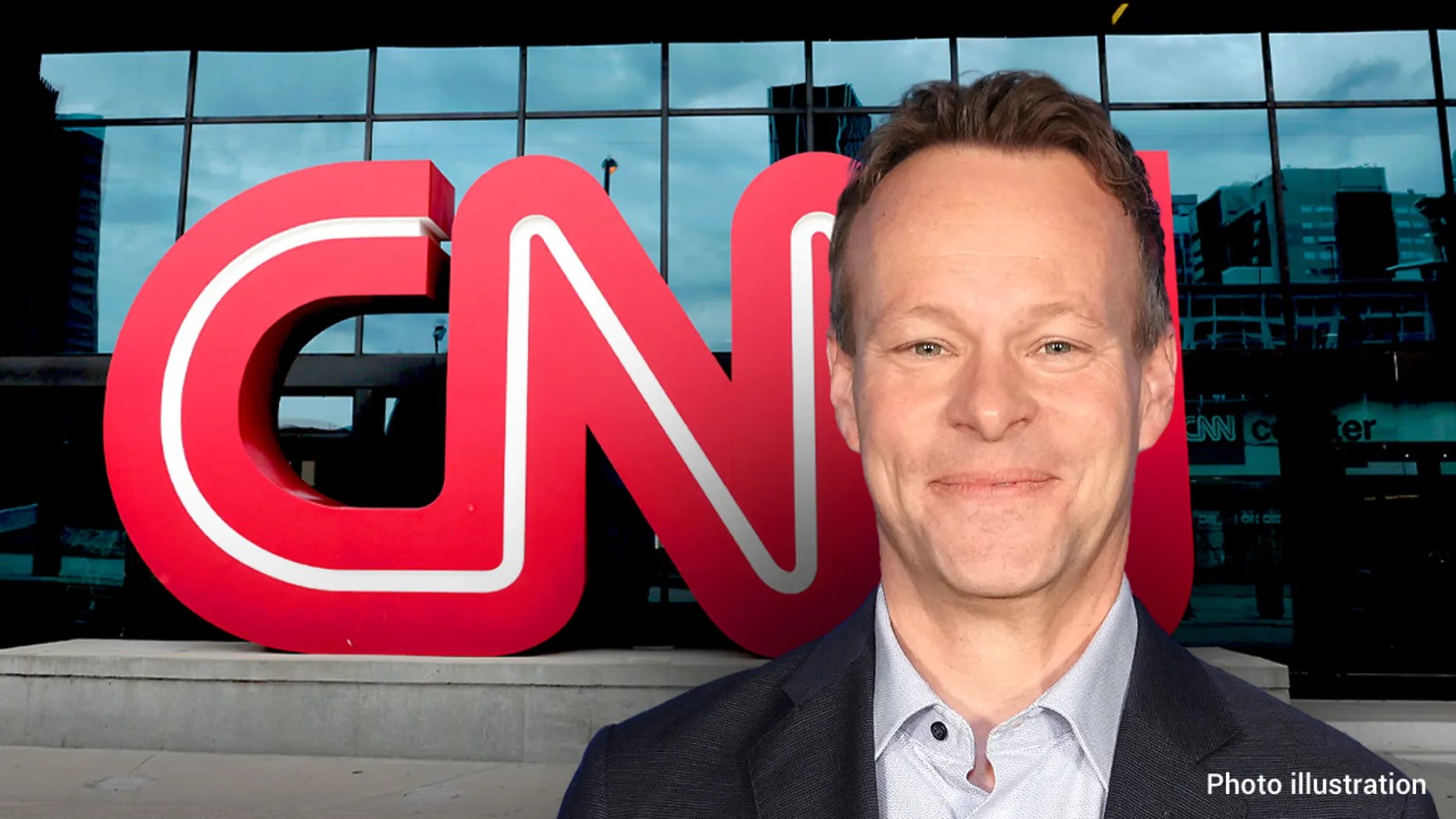 |
As I predicted yesterday, Chris Licht is out at CNN.
David Zaslav — CEO of Warner Bros. Discovery, which owns CNN — delivered the news this morning to CNN staff, noting that Licht’s job "was never going to be easy" and that Licht had "poured his heart and soul into it."
What should CNN or any other media enterprise learn from this debacle?
The lesson is that Licht’s goal of shifting CNN from anti-Trump confrontation toward an imagined political center was doomed from the start, because there is no longer a political center.
For years now — since Newt Gingrich took over the House in 1995 — Americans have been moving toward either authoritarianism or democracy.
The old political center of “liberal” Republicans like Jacob Javits and Nelson Rockefeller and “conservative” Democrats like Scoop Jackson and Joe Lieberman (and, some would say, Bill Clinton) has been disappearing.
Before Newt there had been stirrings of rightwing fascism — led by Father Coughlin, Huey Long, and Charles Lindbergh in the 1930s, Joe McCarthy in the 1950s, and by George Wallace, Richard Nixon and Spiro Agnew in the 1960s.
But Newt turned the growing anger of the non-college white working class into the beginnings of an authoritarian political movement that would undergird the Republican Party for the next thirty years.
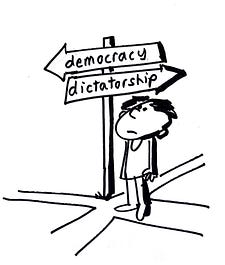 |
By 2016, Donald Trump was helpful to anyone who still had trouble making the choice between authoritarianism and democracy. Trump required they take sides.
Chris Licht’s predecessor at CNN was Jeff Zucker, who understood that the only big pool of viewers available to CNN were those who still believed in democracy. Zucker competed mightily with MSNBC for them.
Trump was helpful to Zucker in the same way he was helpful to Americans who had trouble making the choice. Trump forced viewers to choose between Fox News and the alternative, thereby giving Zucker’s CNN a fitting nemesis.
CNN’s new management came along at a time of establishment confusion over whether the old political center would return after Trump. America’s business establishment — including Warner Bros Discovery billionaire John Malone — hoped it would. But that proved a pipe dream. The division between authoritarianism and democracy is now too deep. If anyone had any doubts, CNN’s Trump town hall should have erased them.
What especially confused Chris Licht and the rest of CNN’s management was the difference between being politically partisan, and standing up against authoritarian demagogues. They assumed that holding Trump accountable for what he did (and continues to do) was inconsistent with so-called “balanced journalism.”
Wrong. It is not partisan to stand up for decency and democracy. That’s where CNN’s audience wanted — and presumably still wants — CNN to be.
That’s where most Americans want the nation to be.
Friday, April 21, 2023
Top Russia Expert finally EXPOSES Republican TIES to Putin | Burn the Boats
Olga Lautman is a researcher and analyst who has spent years researching Vladimir Putin’s authoritarian regime. She and Ken discuss the progress of the war in Ukraine, and the dangers posed by the Republican Party’s underlying sympathies for authoritarian movements around the world.
Friday, February 24, 2023
Altemeyer on Trump’s Supporters
IN 2017, JOHN DEAN wrote the article below that defines tRump supporters.
It continues to be TRUE!
Altemeyer on Trump’s Supporters

When writing my book Conservatives Without Conscience (Penguin, 2007) about the authoritarianism that was gaining influence in the Republican Party in the early 2000s, I read most everything that social scientists had to say about folks with such dispositions. Particularly helpful was psychology professor Bob Altemeyer’s book for Harvard University Press, The Authoritarian Specter (1996). No one has done more ground-breaking work in testing the nature of these people than this professor, who was then at the University of Manitoba in Canada. A native of St. Louis who had done his graduate work at Carnegie Mellon University in Pittsburgh, Bob is also a keen student of American politics. Indeed, his son is in the business in Canada, and a member of the Manitoba Legislature.
I thought it would be helpful to many Americans to be exposed to Bob’s scholarly studies, and convinced him to write them up in a book for the general reader. He did, and placed it online for anyone to read for free. See The Authoritarians. (Last time I checked, over 670,000 people had visited the book, and hopefully read it!)
Bob Altemeyer saw Donald Trump coming. More accurately, he saw the kinds of men and women who would vote for a Donald Trump-type candidate for high office. These are people he described in earlier works as Right Wing Authoritarians, and Enemies of Freedom. Without going too deep into the weeds, let me note a few of these people score high on testing that shows they not only can be devoted followers of authoritarian leaders, the so-called social dominators like Trump who want to be in charge, but they also test high as social dominators themselves. These seemingly incongruous testing results—testing high as both followers and leaders—have been explained as the social dominators envisioning the type of follower they want as leaders, or their willingness to be good followers until they get their chance to become leaders. I labeled these “double high” people as conservatives without conscience, because it is a perfect description of those who top both scales in this testing.
When I started writing about these authoritarian personalities in 2005, I was looking for an explanation of the people who had taken charge of the Republican Party. That’s when I found Altemeyer’s work, which was (and still is) widely accepted. In fact, he was awarded the prestigious prize for behavioral science research in 1986, when the American Association for the Advancement of Science recognized his work. Working in 2005, I asked him what percentage of the American population might he estimate (or intelligently guess) were authoritarian followers, and he thought maybe 30 percent. Working on my book it seemed inconceivable that so few could ever elect a president. When Trump emerged in 2015 as a GOP contender, while I thought he could win the nomination, I was certain that was the end of the road: “Of only one thing am I absolutely certain: Donald Trump will never be President of the United States, so rest easy. Authoritarians remain a minority in America, thankfully,” I declared on July 24, 2015.
Authoritarians do remain a minority, but with non-voters and anti-Hillary Clinton voters, Trump pulled off a historic upset. It appears his core supporters remain faithful—regardless of what he does or doesn’t do. So, I asked Bob Altemeyer, what if anything would get through to the Trump supporters, given the fact Trump has shown himself, so far, totally incompetent as President of the United States. Set forth below in italics is material from Bob, who is now enjoying his retirement.
It took many months for Americans to stop supporting President Nixon during Watergate, and even at the end he could count on a hard knot of supporters who would believe him, as he said to [his chief of staff] H. R. Haldeman, because they wanted to. (NYT, 11/22/1974, p. 20). A few days before he resigned, 24% of a Gallup sample approved of the way Nixon was doing his job, including 38% of the Republicans polled.
Most of Donald Trump’s supporters are probably people whom social psychologists call authoritarian followers, because they are so supportive of the authorities they consider legitimate. These are the people Trump was talking about when he famously bragged that he could shoot somebody in broad daylight on Fifth Avenue and it would make no difference to his backers. They are the people who so willingly took the “loyalty pledge” at Trump rallies in the early primaries—even calling on Trump to “do the swearing” when he had skipped it.
We know enough about authoritarian supporters from research, and history, to know it will be very hard to change their minds about the leader they adore.
- They are extremely ethnocentric, dividing the world sharply into people in their in-group, and automatically disliking all others. They feel politicians who promote minority rights and immigration discriminate against them. Donald Trump tells them they are right. He is their champion.
- They are highly dogmatic. They get their ideas from others in the in-group, especially from their leader, not from evidence and logic. They say there is no evidence that will make them change their minds. They’re quite comfortable believing “alternate facts.”
- They get great satisfaction from being part of a large movement. Being in a cohesive crowd at rallies thrills them because they silently tell one another, just by being there, that they are powerful and right. They create an echo chamber that reinforces the belief that all the good people think like they do.
- They severely limit their sources of information. They get the news that they want to get. This also produces an echo chamber when the news sources they trust are copying each other and relaying Trump’s message.
- They have highly compartmentalized minds. When an unpleasant truth forces its way into their awareness, they do not try to integrate the other things they believe with it. Instead they put it in a box and isolate it from the rest of their thinking, which proceeds as if the truth never existed.
Put all this together and you get an idea how hard it will be to change their minds about Donald Trump.
One can expect some of Trump’s followers to waver if the months ahead are thick with damaging revelations like those that brought down the Nixon White House. But a repeat of “Watergate-type scandals” may not damage Trump as much as they did Nixon.
Nixon had little means of communicating directly with his supporters. Trump’s followers eagerly await his tweets to tell them the truth they will believe and repeat to one another. And so far, they have apparently believed everything he’s said.
Second, the major news outlets in the 1970s were the three TV networks. There was no Fox News. And while there were some newspaper columnists and radio personalities who supported Nixon, today there are dozens of Trump-endorsing blogs that are on tens of millions of “Favorites” lists in American homes.
Third, Trump’s party controls all three branches of the federal government.
Given this gloomy assessment of how likely Trump’s support is going to weaken, it seems clear that the more effective strategy now is to activate the Americans who oppose him, who happily amount to a solid majority of the public.
Questions [people ask):
How do people get this way? Answer: There is evidence that authoritarian followers are more afraid than most people. And also, that they were trained in self-righteousness, and ethnocentric thinking in early age.
Will Trump supporters never change? Answer: Some will, if their personal experience shows them Trump has misled them or caused them grief, such as a loss of medical coverage. And if you anticipate a close election in 2020, these people are worth pursuing. But Trump will blame others, and his supporters will give him the benefit of the doubt more than most people will.
Isn’t all this true of Obama/Clinton supporters too? Answer: Yes, to a certain extent, but the studies show it’s much more prevalent “on the right.” If you want a generalization about generalizations, these things are about 2-3x as true among right-wingers as among left-wingers. Research has shown that “progressives” are much less ethnocentric, much less prejudiced, much more likely to be guided by logic and evidence, much more likely to have consistent ideas, much less likely to conform, much less likely to trust someone just because he says he agrees with them, have much more self-insight, and so on.
With that information in mind, from someone who may understand Trump supporters better than Trump does, it is clear that to prevail in 2018 and 2020, Democrats must focus on getting sympathetic non-voters to the polls, and bring back into the fold the anti-Hillary folks, who suffered from Clinton exhaustion—voters who are clearly not right-wing authoritarians.
Wednesday, February 22, 2023
Ruth Ben-Ghiat | Every Day the War Goes On Is a Victory for Putin

22 February 23
Live on the homepage now!
Reader Supported News

Why Putin will never give in or give up on Ukraine
Many analyses, including my own, have focused on how the war has backfired on the Kremlin. Putin had undertaken the invasion motivated by a desire to secure his place in history as an imperial conqueror. Instead, his military has been exposed as weak, unmotivated, and plagued by institutionalized lying (when no one dares to tell the truth to the leader, leading to poor decision-making). Russian troops are ill-fed, inadequately clothed, and equipped with dated and inferior weapons. Russia is a kleptocracy, and the military has been ravaged by corruption and theft no less than other state institutions.
Autocrats view their people as assets to exploit, and they don't care how many of their people die on or off the battlefield. That's why hundreds of thousands of young men have fled Russia —they know Putin would send them to their deaths without a second thought. This brutal mentality is partly why Putin can play a long game in this conflict.
Putin also has no interest in shortening the conflict because his war against Ukraine is not just about occupying territory. It is a war of annihilation that is meant to suppress Ukraine's sovereignty, identity, and culture. To the autocrat, every day spent killing the enemy and reducing his cities to rubble furthers the cause.
So does forcing millions to flee. Depopulation does the autocrats' job for him if the goal is to rid the occupied territory of any trace of the enemy. Since the war started, almost six million Ukrainians have been internally displaced and other eight million have gone into exile as refugees. At least 7,100 Ukrainian civilians have been killed, according to the UN High Commissioner for Human Rights, and as of December 2022, up to 13,000 Ukrainian combatants had perished. All of this is excellent news for Putin; why would he stop his war now?
Finally, waging war abroad has strengthened Putin's position at home. The Kremlin disinformation machine has sold the war as a patriotic vindication of a threat on Russia's border. It builds on well-established narratives that express "grievances, paranoia, and [an] imperialist mind-set" to frame the invasion of Ukraine as continuing the redemptive trajectory opened by the 2014 annexation of Crimea. Putin's personality cult propaganda presents it all as part of a master plan.
Authoritarians engaged in wartime crackdowns also welcome the departure of domestic critics and “defeatists.” So what if between 500,000 and 1 million Russians have left their country due to the war —an exodus comparable only to the outflows during the 1917 Russian Revolution and the 1991 collapse of the Soviet Union? Good riddance to them, says the autocrat. Their departure merely speeds up the "self-purification of society" as Putin calls it.
That hygienic action seems to include bumping off Russian elites who have criticized Putin or turned against him. Dozens of important individuals have died in suspicious circumstances in 2022, giving rise to "Sudden Russian Death Syndrome," as Elaine Godfrey terms it. "The longer this war lasts, the more Russian society is cleansing itself from liberalism and the Western poison," said the pro-Putin business magnate Konstantin Malofeyev, articulating the authoritarian logic.
"The collapse of Western hegemony that has begun is irreversible," Russian President Vladimir Putin told his people in September 2022 when he annexed four Ukrainian territories. "And I repeat again —nothing will be the same as before. Fate and history called us onto the battlefield for our people, for great historical Russia!"
We may like to think that Putin may abandon this grandiose mission or "come to his senses” because he is being humiliated every day on the battlefield, but that is not how autocrats operate. Until the United States and its allies give Ukraine the weapons it needs to repel the Russian invader, Putin will consider it worth his while to continue a war he thinks will put him on par with Peter the Great.
Authoritarianism is about having the power to get away with crime. Waging a genocidal war against another country without other nations forcing a cessation of conflict counts as a big win in the autocratic world. Far from standing down, look for Putin to escalate hostilities as this tragic war enters its second year.
READ MORE 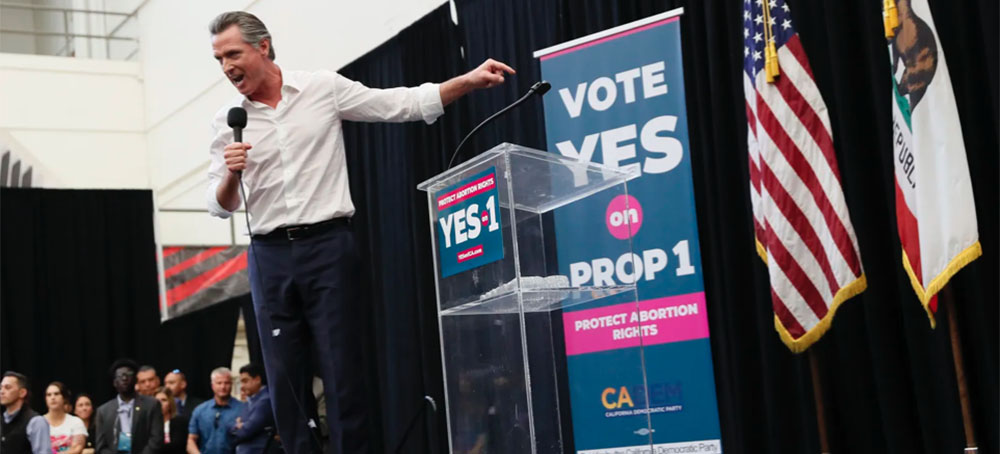 California Gov. Gavin Newsom speaking at a rally on Nov. 6, 2022 endorsing ballot proposition 1 — to add abortion protections to the state's constitution — at Long Beach City College. (photo: Robert Gauthier/Los Angeles Times/Getty Images)
Led by California Gov. Gavin Newsom, the Reproductive Freedom Alliance creates a formal structure for governors "to strengthen reproductive freedom in the face of an unprecedented assault on abortion access and other forms of reproductive health care," according to a joint statement from the governors.
These efforts include sharing strategies to protect abortion providers from prosecution and maximize federal funding for reproductive health care. The group also aims to create a more coordinated response to efforts to limit abortion access, including a Texas lawsuit threatening FDA approval of a key abortion drug.
'DREAM BIGGER':How weekend marches keep advocates' fight for Roe v. Wade alive on 50th anniversary
Who is in the Reproductive Freedom Alliance?
The group calls itself nonpartisan but only Democratic governors have joined so far. These governors include:
- California Gov. Gavin Newsom
- Colorado Gov. Jared Polis
- Connecticut Gov. Ned Lamont
- Delaware Gov. John Carney
- Hawai’i Gov. Josh Green
- Illinois Gov. JB Pritzker
- Maine Gov. Janet Mills
- Maryland Gov. Wes Moore
- Massachusetts Gov. Maura Healey
- Michigan Gov. Gretchen Whitmer
- Minnesota Gov. Tim Walz
- New Jersey Gov. Phil Murphy
- New Mexico Gov. Michelle Lujan Grisham
- New York Gov. Kathy Hochul
- North Carolina Gov. Roy Cooper
- Oregon Gov. Tina Kotek
- Pennsylvania Gov. Josh Shapiro
- Rhode Island Gov. Daniel McKee
- Washington Gov. Jay Inslee
- Wisconsin Gov. Tony Evers
'IT'S TIME FOR US TO BE BOLD':Why six religious leaders are fighting to expand abortion access
Advocates: Alliance needed 'now more than ever'
In a joint statement, the governors pledged to work together "to strengthen abortion firewalls across America."
"As governors representing nearly 170 million people across every region of the country, we are standing with all people who believe in reproductive freedom and health care," the group said. "We are standing with them to say, 'enough.'"
Alexis McGill Johnson, president of Planned Parenthood Federation of America, said in a statement that the alliance is needed "now more than ever" as medication abortion and other forms of abortion access are threatened.
"It will be more important than ever for elected leaders to be bold and invest in health care services, patients, and abortion providers," Johnson said.
READ MORE 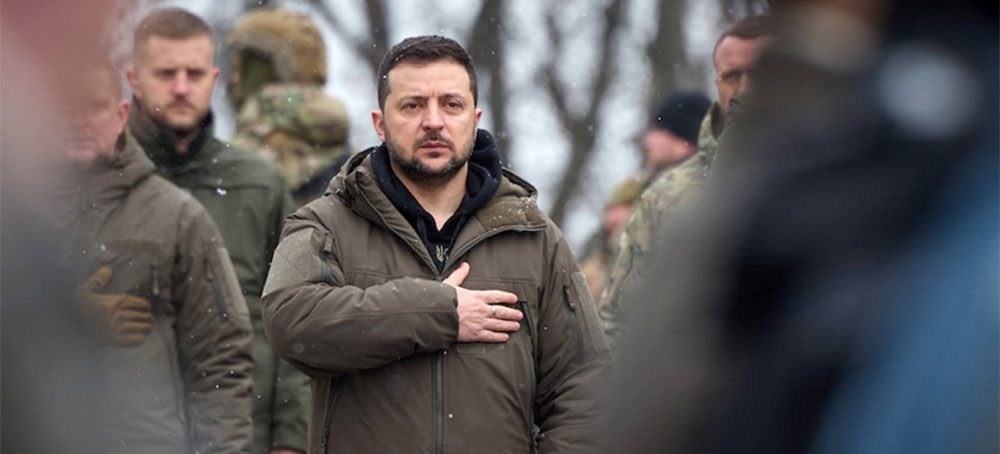 Ukrainian President Volodymyr Zelensky takes part in a ceremony in Kyiv to commemorate the 105th anniversary of the Battle of Kruty against Bolshevik Red Army on Jan. 29, 2023. (photo: Ukrainian Presidential Press/AFP)
Volodymyr Zelensky came into office thinking peace with Putin was possible. He now believes victory is the only answer.
Alexander Lukashenko, one of the Kremlin’s key allies, was inviting a delegation of officials to Minsk to negotiate an end to the war that Russia had launched just three days earlier, according to Andriy Sybiha, the deputy head of Ukraine’s presidential office, who was in the room for the call.
Zelensky was incensed at the invitation to another negotiation — recalling talks over the conflict in Ukraine’s east, known as “Minsk 1” and “Minsk 2,” that took place in the Belarusian capital in 2014 and 2015 — in which Kyiv was forced to make concessions to the Kremlin under the threat of battlefield losses.
“There will be no Minsk,” Zelensky said, according to Sybiha. “There will be no Minsk 3.”
Zelensky’s refusal to entertain another Minsk negotiation — despite Russian attack helicopters, fighter jets and tanks descending on Kyiv — showed how the Ukrainian leader was hardening in the face of Russian President Vladimir Putin’s threat, a process that began many months before the invasion and accelerated as the war unfolded.
The comedian turned president refused offers to be spirited away to safety and emerged as a far fiercer foe than Moscow has expected, part of a broader transformation that has cemented his global reputation as a hard-bitten wartime leader.
“Of course, we all have changed, including the president,” said Andriy Yermak, head of the Ukrainian presidential office. “The ordeals that have marked his tenure — they can’t but change a person. Has he become harder? Of course, he has. Has he become stronger? From my point of view, he was always strong.”
In the past year, Zelensky has risen to global renown, fashioning himself as the brash conscience of Western democracies, as he pushes for more weapons to bolster Ukrainian forces. With the savvy of a professional entertainer, he has delivered hundreds of speeches presenting the war as a Manichaean struggle between democracy and autocracy, freedom and tyranny, fairness and injustice — and most recently, at last week’s Munich Security Conference, David and Goliath. In a distracted Western world, he has kept the Ukrainian cause alive.
All the while, Zelensky himself has changed, hardening into a more uncompromising leader strained by the exigencies of war. His positions, particularly on how to deal with Russia, have grown stauncher with every attack, mirroring a broader defiance toward Moscow that has welled up in Ukrainian society, even as millions of Ukrainians find themselves exhausted after nearly a year of total war.
Where Zelensky as a presidential candidate in 2019 held out Russia as a prospective partner with whom he could negotiate peace, he now regularly brands Russia a terrorist state that must be vanquished to save the West, completing a transformation that has made him arguably Putin’s most vocal and determined global opponent.
He derided Putin in an interview with Sky News last month. “Who is he now?” Zelensky asked. “After the full-scale invasion, for me he is nobody. Nobody.”
Zelensky’s transformation became particularly apparent in September, when he stood in front of Ukraine’s government complex in his army-green T-shirt and fleece — the same day Putin “annexed” four regions in eastern Ukraine — and closed the door to any possible discussions with the Russian leader.
Ukraine, Zelensky said, had tried through negotiations to find a peaceful coexistence with Russia “based on equal, honest, dignified and just terms.”
“It is clear that with this Russian president, that is impossible,” Zelensky declared. “He doesn’t know what honesty and dignity are. Therefore, we are ready for a dialogue with Russia — but already with a different Russian president.”
Zelensky would later moderate his position under pressure from Washington, but the thrust of his message remained clear: The Ukrainian leader had reached a point of no return with Putin.
The metamorphosis into hardened wartime leader was complete.
Gone was the boyish, turtlenecked comedian who campaigned for Ukraine’s presidency in 2019 on idealistic promises to find a way to make peace with Russia. Gone, too, was the eager young president jumping through hoops in his first year in office to land a meeting with Putin in search of elusive common ground. Gone was the wartime leader of the early weeks who sent emissaries to talks in Belarus and Turkey in the hope that reason might prevail.
Experience and tragedy had washed over him. Cynicism battled with idealism inside him. He had seen the aftermath of atrocities and grasped the hands of the loved ones of Ukraine’s dead soldiers. He coldly fired a childhood friend who had served as his intelligence chief. His style of management toughened to fit the circumstances of war. So did his positions toward both Russia and the West.
David Arakhamia, the leader of Zelensky’s faction in parliament, said the Ukrainian leader had grown more cynical due to Russia’s perfidy but also after seeing “how the international community plays games.”
“It often happens that they tell you, ‘We are for democracy’ and such and then do something with the Russians,” Arakhamia said. “I don’t want to name countries, but there are statistics. You can see who has what trade balance with them. It’s clear that is simply cynicism.”
Convinced there is no deal with Russia to be had, Zelensky now faces increasing pressure to sustain and extend Western support for a prolonged fight against Moscow that Kyiv is unable to win on its own. Both Ukraine and Russia are preparing new offensive operations ahead of a spring fighting season that could prove decisive in the trajectory of the war.
Zelensky, in the Sky News interview, warned that Ukraine was just a “first step” for Putin and that the Russian leader could “move further.”
“They don’t want any talks, and this was the case before the invasion. President Putin decided so,” Zelensky said. “He doesn’t want negotiations because he doesn’t want peace.”
The comedian and the spy
Zelensky took power in 2019 brimming with youthful sincerity about building a new European Ukraine and espousing idealism about making peace with Russia — positions that helped him defeat his more nationalist, hard-line opponent, Petro Poroshenko, with a resounding 73 percent of the vote.
As an entertainer, Zelensky had long articulated pro-European views through his skits and characters and often imbued his jokes with a skepticism of Moscow. At the same time, he primarily spoke Russian, grew up in a Russian-speaking family in the Ukrainian city of Kryvyi Rih and enjoyed significant fame across Russia as an actor. He was seen as the candidate more pragmatic about Moscow.
In between navigating a U.S. impeachment scandal, Zelensky spent much of his first year in office trying to make progress with the Kremlin, arranging prisoner swaps, pulling forces back from the front line and working to tee up an in-person meeting with Putin mediated by Germany and France.
William B. Taylor Jr., the top official at the U.S. Embassy at the time, recalled finding Zelensky in his office in the summer of 2019 expressing curiosity about the “Steinmeier Formula,” an interpretation of the Minsk accords named after Germany’s former foreign minister that the Ukrainian president hoped might lead to a deal with the Kremlin.
“No one knows what it is,” Taylor recalled replying. “Steinmeier doesn’t know what it is.”
Zelensky, according to Taylor, grabbed his phone and pointed to a document explaining the formulation, thinking that somewhere in the details of the legalese a workable compromise with Moscow might be found.
“It’s a terrible idea,” Taylor replied, though Zelensky went on to endorse it in the coming months, trying to land a face-to-face with Putin.
When that meeting materialized in Paris in December 2019, Putin treated Zelensky as an actor who wandered accidentally onto the set of a diplomatic negotiation, at one point instructing the Ukrainian leader to turn around and smile for the cameras, when they sat down with German Chancellor Angela Merkel and French President Emmanuel Macron.
Still, Zelensky departed Paris hopeful.
Within weeks, Russia agreed to a broader prisoner exchange and offered Ukraine a $3 billion gas arbitration settlement as well as a new gas transit deal.
“But when it came to the details, when the exchanges started and they started to cheat, he already started to say, ‘They don’t seem to keep their word at all and most likely will lie,’” Arakhamia said. “The first changes in the relationship for him already started then.”
“I saw the man who said one thing and then did another,” Zelensky told Sky News.
As Putin and Zelensky sized up one another, views began to evolve.
“The Russians initially thought Zelensky getting elected was going to play into their hands — a Ukrainian nationalist sort of government was defeated by a Russian-speaking candidate talking about the need for peace and to talk to the Russians,” said Henry E. Hale, a political science professor at George Washington University and co-author of “The Zelensky Effect.” “Soon, it became clear to the Kremlin that he wasn’t going to hand over the farm, that in fact he was just as European-oriented as the other side had been in Ukraine. Therefore, their only action was going to have to be military, if they were going to have hopes of reintegrating Ukraine into Russia’s orbit.”
During a year of negotiations following the Paris meeting, the Ukrainians came to understand that Russia “didn’t sincerely want to end the war,” Yermak said. “The process had reached a dead end.”
By early 2021, Zelensky believed that negotiations wouldn’t work and that Ukraine would need to retake the Donetsk and Luhansk regions “either through a political or military path,” Arakhamia said.
The Kremlin disengaged.
“Zelensky came to realize what Russian intentions were about, at least Kremlin intentions,” Hale said. “And the Kremlin came to realize what he was about.”
Russia built up forces on Ukraine’s border in the spring of 2021 and rebuffed Kyiv’s calls for talks.
“What’s the use of meeting with Zelensky if he has handed over his country to complete outside management?” Putin said in June 2021. “Key questions in Ukrainian life are being solved not in Kyiv but in Washington and partially in Berlin and in Paris. What’s there to talk about?”
Soon after, Putin published a treatise saying that sovereignty for Ukraine was possible only “in partnership with Russia” and warning that he would not allow Moscow’s “historical territories and people close to us living there to be used against Russia.”
By then, Ukrainian authorities had placed Viktor Medvedchuk, a pro-Russian Ukrainian politician who was friends with Putin, under house arrest. U.S. intelligence later in the year began to warn that Russia was preparing for a full-scale invasion of Ukraine.
“When they realized they couldn’t steamroll us, they went to the extreme and made this historically tragic mistake for everyone, including for Russia, and attacked us,” Yermak said.
The day before, Zelensky again tried to talk to Putin.
“Today I initiated a phone call with the president of the Russian Federation,” Zelensky said in a direct address to the Russian people he gave on the eve of the war. “The result was silence.”
Toughened by tragedy
Dmytro Kuleba, Ukraine’s foreign minister, watched as Zelensky morphed from a peacetime president into a wartime leader almost overnight. “He led. He gave orders. He kept people in their places because some felt panicked. And he did all of this by his own example,” Kuleba said.
“He became more resolute in making decisions. … He became more uncompromising on the behavior of people,” Kuleba added.
Arakhamia, the head of Zelensky’s parliamentary faction, said the Ukrainian leader became “10 times tougher compared to when he took office in 2019,” understanding that mistakes — though perhaps understandable in peacetime — were no longer acceptable and would cost Ukrainian lives.
Zelensky remained adamant that Ukraine would not enter another Minsk-type negotiation with Russia, but emissaries from the Ukrainian government still held talks with the Russians in Belarus and Turkey throughout March, until the discovery of Russian atrocities in the Kyiv suburb of Bucha. When Zelensky visited Bucha on April 4, he looked visibly stricken, telling reporters it was “very difficult to talk when you see what they have done here.”
Arakhamia said he called the leader of the Russian negotiating team and explained that Ukraine could no longer participate in any negotiations. “How can I fly in and sit down at a table and speak to them?” Arakhamia said. “I simply don’t understand.”
Oleksiy Danilov, secretary of Ukraine’s National Security and Defense Council, recalled having dinner with Zelensky the following evening in Kyiv’s equivalent of the White House Situation Room. Danilov said he and a group of 10 other top advisers had a frank conversation with Zelensky about the prospect of negotiations with Russia and the likelihood that “even if you agree with them on something, they will definitely break their word.”
As he ate, Zelensky listened to everyone carefully, Danilov said.
“I think he made a decision for himself that it is extremely dangerous to negotiate with the Russians,” Danilov said. “Moreover, it is absolutely not in favor of our country, despite the difficult situation, despite the fact that we are suffering losses.”
On the eve of Russia’s orchestrated “annexations” of four regions in eastern Ukraine, Zelensky again met with his top advisers to decide on a response. Sybiha, the deputy head of the presidential office, said the team made the decision to rule out any negotiations with Putin, “noting everyone was unanimous in their opinion.”
Zelensky’s interactions with other leaders and staff are now squarely focused on how to achieve victory on the battlefield, not how to reach an agreement with Moscow.
“The challenge of any country at war is you want complete vanquishment of the enemy, but in reality, it is probably going to be something short of that. The question is what,” Hale said. “My sense is that he has to just fight for everything that he can right now and cross the bridge of how to settle and when to settle when it comes.”
Kuleba, the foreign minister, said Zelensky’s team believes only in victory.
“He is leading the country to the victory that he personally, sincerely believes in — and it’s take it or leave it. It’s true. There is nothing in between for him,” Kuleba said. “And this is also how I feel, because if we imply there is something in between, we are not going to win.”
READ MORE 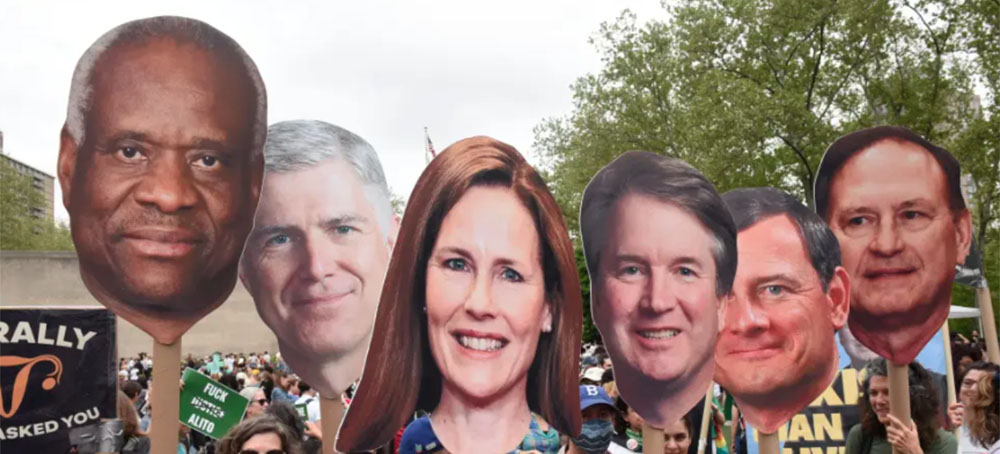 Abortion rights supporters hold signs of U.S. Supreme Court Justices as they participate in a rally and march on May 14, 2022 in New York City. (photo: Stephanie Keith/Getty Images)
ALSO SEE: At Least 10 Palestinians Killed During Israeli Raid in West Bank
Anti-boycott law provides model for legislation to protect oil companies, gun makers and contentious industries from protest
The supreme court declined to hear an appeal from the editor of the Arkansas Times, Alan Leveritt, after a federal court upheld a law requiring him to sign a commitment not to boycott Israel in order to receive advertising contracts from the state.
The American Civil Liberties Union (ACLU) asked the supreme court to overturn the Arkansas law on the grounds it is in conflict with the court’s own ruling 40 years ago that popular boycotts have a long tradition in American history and are protected speech under the first amendment.
The law is one of more than 30 passed by states in recent years, backed by both Republicans and Democrats, that require individuals or companies to pledge not to boycott Israel or its settlements in the occupied Palestinian territories in order to do business with the state.
The laws, pushed by groups such as American Israel Public Affairs Committee (Aipac) and the American Jewish Committee with the backing of the Israeli government, are primarily aimed at the Palestinian Boycott, Divestment and Sanctions (BDS) movement. But they have also provided the template for legislation to curb boycotts of companies over the climate crisis, gun control, factory farming and others issues.
Leveritt said he had no intention of boycotting Israel, with which his newspaper does no business, but he refused to sign the commitment because it “requires the Arkansas Times to take a political position in return for advertising”.
The editor said he was disappointed that the supreme court declined to take the case but it will not change his position.
“We’re not going to sign any political pledges in return for advertising. The supreme court can ignore our our first amendment rights but we’ll continue to exercise them vigorously,” he said.
Although a federal court upheld the Arkansas legislation, courts in other jurisdictions have ruled against similar laws and forced some states to weaken their provisions.
Kansas revised its law in 2018 in the face of a lawsuit by a Wichita teacher told to sign a pledge not to boycott Israel in order to keep her job. Texas narrowed its law to exclude individuals, and to apply only to larger companies, after a school speech pathologist sued when she lost her contract for refusing to sign a similar commitment. The ACLU and other groups also won judgements in Arizona and Georgia that anti-boycott laws intruded on free speech rights.
Leveritt warned that letting the Arkansas law stand will lead to further supression of legitimate political protest against corporate interests.
“This is simply a template. It doesn’t stop here. We now have in the Arkansas legislature bills introduced to deny state contracts to financial and banking institutions that have ESG (environmental, social, and corporate governance) policies that prohibit them from investing in fossil fuels or firearms companies,” he said.
“In other states they’ve introduced laws to deny state contracts to any company that subsidises their employees transportation costs if they go out of state for an abortion. So this is just going to be used time after time after time, eventually, the supreme court is going to have to deal with it, or else it’s going to be open season on the first amendment.”
Several states have passed the the Energy Discrimination Elimination Act to shield big oil from share selloffs and other measures to protest against the fossil fuel industry’s role in the climate crisis. Other legislation is designed to prevent banks from “denying financing to creditworthy companies solely for the purpose of marketing their environmental or social justice credentials”.
The ACLU’s chief litigator in the case, Brian Hauss, described the supreme court’s decision not to take up the case as a “missed opportunity” to clarify the law.
“From the Boston tea party to the Montgomery bus boycott to the boycott of apartheid South Africa, Americans have proudly exercised that right to make their voices heard. But if states can suppress boycotts of Israel, then they can suppress boycotts of the National Rifle Association or Planned Parenthood. While we are disappointed with the result in this case, the ACLU will continue to defend the right to boycott in courts and legislatures throughout the country,” he said.
Hauss said that given the conflicting rulings from different jurisdictions over the legality of the anti-boycott legislation, he believes the supreme court will have to confront the issue eventually.
“Sooner or later they are going to have to address this because already the anti-boycott statutes are proliferating, and I’m sure that is going to continue over the next several years,” he said.
READ MORE 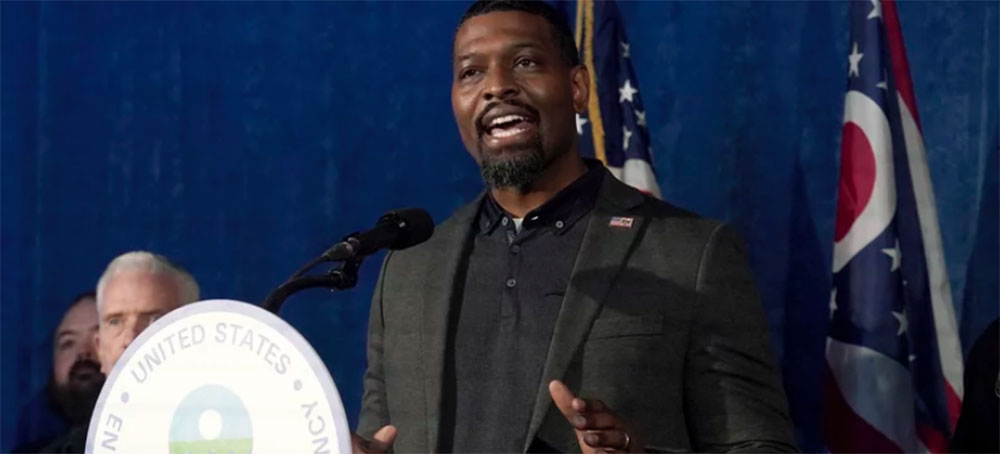 Environmental Protection Agency Administrator Michael Regan speaks during a news conference in East Palestine, Ohio, on Feb. 21. (photo: Matt Freed/AP)
Crews are still working to respond to the freight disaster in East Palestine as community members worry about possible adverse health effects from the toxic materials released when dozens of cars derailed after a likely mechanical failure.
Under the legally binding order, Norfolk Southern must identify and clean up contaminated soil and water resources, pay for the costs of work performed by the EPA and reimburse the agency for additional cleaning services offered to residents and businesses.
The agency's move comes as the emergency response effort has now morphed into an environmental cleanup that is the responsibility of the railroad, EPA Administrator Michael Regan said during a Tuesday press conference.
"Norfolk Southern will pay for cleaning up the mess that they created and the trauma that they inflicted," Regan said. "In no way, shape or form will Norfolk Southern get off the hook for the mess that they created."
The company will also have to attend and participate in public meetings requested by the EPA, he said.
If Norfolk Southern fails to act, Regan said, the EPA can do the work itself and recoup triple the cost of any remediation efforts.
In statement to NPR on Tuesday, Norfolk Southern said it has already been paying for the cleanup in East Palestine and will continue to do so.
"We recognize that we have a responsibility, and we have committed to doing what's right for the residents of East Palestine," the railroad said. "We are committed to thoroughly and safely cleaning the site, and we are reimbursing residents for the disruption this has caused in their lives."
The company has committed more than $6 million to date in East Palestine, it said, including $3.8 million in direct financial assistance to families impacted by the accident.
Norfolk Southern also vowed to work with regulators and elected officials to improve railroad safety in light of the crash.
In an interview with CNBC on Tuesday, CEO Alan Shaw responded to criticism from Transportation Secretary Pete Buttigieg and Ohio Sen. Sherrod Brown, saying the company invests more than $1 billion a year in "science-based" safety solutions, including maintaining tracks, equipment and technology.
"It's pretty clear that our safety culture and our investments in safety didn't prevent this accident," Shaw said. "We need to take a look at this and see what we can do differently and what we can do better."
Pennsylvania Gov. Josh Shapiro praised the EPA for taking charge of the cleanup from the crash, which took place less than a mile from the Ohio-Pennsylvania border.
"It is my view that Norfolk Southern wasn't going to do this out of the goodness of their own heart. There's not a lot of goodness in there," Shapiro said. "They needed to be compelled to act."
Hazardous chemicals were in 11 derailed train cars
On Feb. 3, about three dozen Norfolk Southern freight cars derailed near East Palestine, a town of roughly 4,800. Investigators from the National Transportation Safety Board have indicated that the derailment was likely caused by a wheel bearing failure; a preliminary report is expected next week.
Shaw declined to comment in the CNBC interview on potential causes, citing the investigation. He also said Norfolk Southern is fully cooperating with the NTSB and the Federal Railroad Administration to determine the cause.
Eleven of the derailed cars were carrying hazardous chemicals such as butyl acrylate and vinyl chloride, which is used to make the hard plastic resin PVC.
Authorities responding to the crash grew concerned that cars carrying vinyl chloride were at risk of a catastrophic explosion. Officials ultimately evacuated the area to conduct a "controlled explosion" instead, sending a black plume of smoke into the sky above the small town.
The evacuation order was lifted on Feb. 8. Since then, some residents in the area have complained of health problems, such as headaches and nausea, and many have expressed concerns over possible contamination of the air and water supply.
The EPA says East Palestine's air quality and municipal water supply quality is normal
The derailment caused the release of hazardous chemicals into the air and surface water. But more recent air monitoring and water sample tests have shown no concerns with air quality or water quality in East Palestine's municipal water supply, the EPA said Monday. The agency added that it would publish more detailed data "as it becomes available."
Ohio state officials have opened a health clinic in East Palestine for residents who believe they may have health issues as a result of the derailment, Ohio Gov. Mike DeWine said.
"This is really in response to the concerns that we have heard, that people want to be able to go someplace and get some answers about any kind of medical problems that they believe that they are, in fact, having," he said.
DeWine added that the remediation effort near the crash site was ongoing. About 4,600 cubic yards of soil and 1.1 million gallons contaminated water have been removed so far.
READ MORE  Migrants at the border. (photo: Getty Images)
US President Joe Biden's administration has unveiled a plan that would make it harder for migrants to claim asylum once Covid border controls lift in May.
Failure to comply would make migrants ineligible if they subsequently reach the border.
Human rights groups likened the plan to Trump-era policies.
The proposed measure is the toughest yet introduced by Mr Biden, who came into office promising a more humane approach to the border crisis.
The proposed rule would apply to adults and families but not to unaccompanied children.
Under the plan, migrants would have to use a phone app to make an appointment to speak with a US immigration official when they arrive at the border.
Those who failed to make the appointment would be presumed to have been found ineligible for asylum in the other countries they passed through.
The proposal - issued jointly by the US Department of Homeland Security and the Department of Justice - allows for those undocumented migrants to be swiftly deported.
If approved, it would be enacted on 11 May, when Title 42 - a Trump-era health emergency provision allowing migrants to be expelled back to Mexico - is due to expire.
The Biden policy would remain in place for two years with the option of extending it.
The American Civil Liberties Union (ACLU) said it would sue to block the rule from ever taking effect.
The organisation compared the plan to actions previously taken by former President Donald Trump that were ruled unconstitutional in the courts.
Oxfam America said: "This sweeping asylum ban will shut the door to countless refugees seeking safety and protection in the United States."
But an unnamed Biden administration official told AFP news agency: "This administration will not allow mass chaos and disorder at the border because of Congress's failure to act."
The public has 30 days to comment on the draft proposal.
About 200,000 undocumented migrants attempt to enter the US each month, recent government records show.
READ MORE 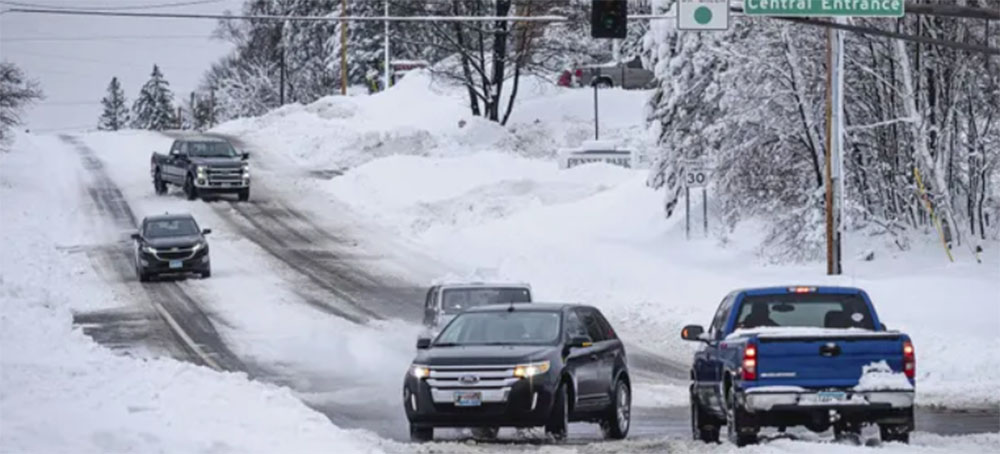 Snow in northern Minnesota on 15 December 2022. As much as 25in of snow may pile up in parts of the state in the coming days. (photo: Holden Law/AP)
Storm system expected to affect about 43 million people, first in the northern US plains and then on the east coast later this week
Schools throughout the Dakotas, Minnesota and Wisconsin were called off for Wednesday. Offices closed and so did the Minnesota legislature. Emergency management leaders warned people to stay off the roads or face potential “whiteout” conditions.
The storm will make its way toward the east coast later in the week. Places that do not get snow may get dangerous ice. Forecasters expect up to a half-inch of ice in areas of southern Michigan, northern Illinois and some eastern states.
The snowfall could be historic. As much as 25in may pile up, with the heaviest amounts falling across east-central Minnesota and west-central Wisconsin, the National Weather Service (NWS) said. Wind gusts could reach 50mph and wind chills are expected to hit -50F (-46C) in some parts of the Dakotas and Minnesota.
The Minneapolis-St Paul area could see 2ft of snow or more for the first time in over 30 years.
The weather service said the blizzard would involve two rounds. For the Minneapolis-St Paul area, the first blast arrives on Wednesday afternoon with up to 7in of snow. Round two extending into Thursday is the real whopper, “with an additional 10 to 20in expected”.
An NWS meteorologist, Frank Pereira, said the system was expected to affect about 43 million people.
Temperatures could plunge to -15F to -20F (-26C to -29C) on Thursday and to -25F (-32C) on Friday in Grand Forks, North Dakota. Wind chills may fall to -50F (-46C), said Nathan Rick, a meteorologist in Grand Forks.
Wind gusts of 35mph will be common in western and central Minnesota, with some reaching 50mph. That will result in “significant blowing and drifting snow with whiteout conditions in open areas”, the NWS said.
According to the NWS, the biggest snow event on record in the Twin Cities was 28.4in from 31 October to 3 November 1991 – known as the Halloween Blizzard.
“They’re not going to get them in time for this snow,” VandenBos said.
Forecasters at AccuWeather said the same storm system could result in icing across a 1,300-mile band from near Omaha, Nebraska, to New Hampshire on Wednesday and Thursday, creating potential travel hazards in or near cities such as Milwaukee, Detroit, Chicago and Boston.
At the same time, record warmth is expected in the mid-Atlantic and south-east – 30F to 40F above normal in some places. Record highs are expected from Baltimore to New Orleans and in much of Florida, Pereira said.
Washington DC could hit 80F on Thursday, which would top the record of 78F set in 1874.
California was also preparing for a winter storm. A “major snow event” was possible in foothills and mountains near Los Angeles, with several inches predicted even for elevations as low as 1,000ft, the NWS said.
“Nearly the entire population of California will be able to see snow from some vantage point later this week,” a UCLA climate scientist, Daniel Swain, wrote on Twitter.
Daytime temperatures in southern California were unlikely to get out of the low to mid-50sF and potentially damaging winds reaching 50mph were predicted along the central coast, with gusts of 70mph possible in mountains.
Follow us on facebook and twitter!
PO Box 2043 / Citrus Heights, CA 95611
The Hound | Aug. 25
LOTS OF POSTS IGNORED BY BLOGGER..... OR REMOVED ON THEIR WHIM! ALL POSTS ARE AVAILABLE ON MIDDLEBORO REVIEW AND SO ON BLOGGER DOES...

-
04 April 23 Live on the homepage now! Reader Supported News Dahlia Lithwick | Let Donald Trump Cry It Out Dahlia Lithwick, Slate Lithwic...
-
LOTS OF POSTS IGNORED BY BLOGGER..... ALL POSTS ARE AVAILABLE ON MIDDLEBORO REVIEW AND SO ON Right now, we are standing on the edge of a he...
-
LOTS OF POSTS IGNORED BY BLOGGER..... ALL POSTS ARE AVAILABLE ON MIDDLEBORO REVIEW AND SO ON We love making ice cream, but our mission has ...


