
27 April 22
Live on the homepage now!
Reader Supported News
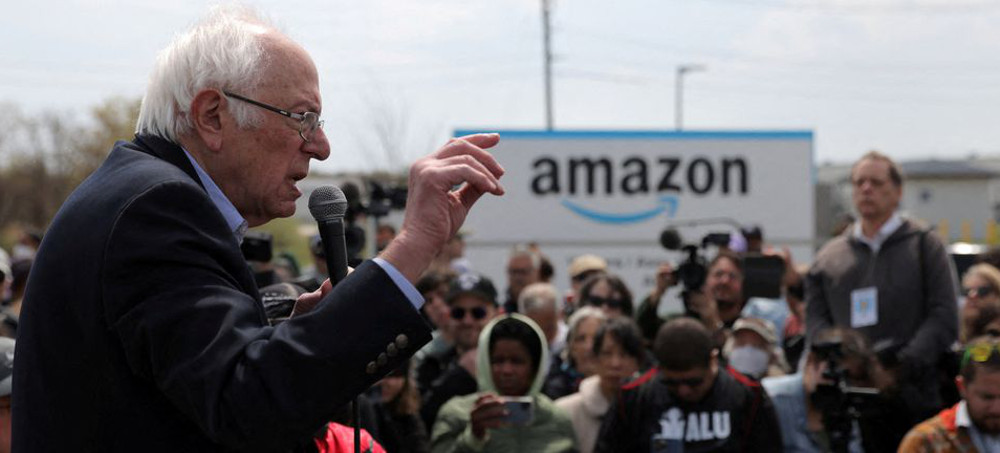
While Sen. Bernie Sanders’ Amazon antagonism is no surprise, his squeeze on Biden signals a new phase of his pro-union strategy.
The Vermont senator sent Biden a Tuesday letter, obtained by POLITICO, asking the president to cut off federal contracts to Amazon until the massive company stops what he calls its “illegal anti-union activity.” As the Senate Budget Committee chair, Sanders will also hold a hearing next week dedicated to calculating how many federal contracts go to companies that are fighting back against unionization efforts, with a focus on Amazon.
While Sanders’ Amazon antagonism is no surprise, his squeeze on Biden for action against the company signals a new phase of his pro-union strategy. He’s urging Biden to create a new executive order that prevents companies that violate labor law from being eligible for government contracts.
And asked if Biden has fallen short in his union support thus far as president, Sanders said bluntly in an interview: “Yes, he has.”
“President Biden has talked more about his support for unions than any president I can remember. That’s good. But the time for talk is over. Workers need action. Now,” Sanders said. “What Biden talked about during the campaign … is that if large corporations engage in illegal anti-union activity, they will not be eligible for federal contracts. Well, Amazon is engaged in illegal anti-union activity.”
Biden’s stated goal of becoming the “most pro-union president” has had mixed success.
The Senate has not passed the Protecting the Right to Organize Act that would enable more workers to form a union. But the union allies who helped win Biden the office say they have no buyers’ remorse, pointing to oft-unilateral actions such as appointing union-friendly nominees to the National Labor Relations Board, pushing for policies that would ensure federally funded projects go to contractors with unionized workforces and creating a task force to promote unionization in the public and private sectors.
Sanders often uses his senatorial perch to push Democratic presidents to the left. And with six months before the midterms, he believes that Biden has a big opportunity to deliver at a time of mounting unionization efforts nationwide.
“All I am asking the president to do is what he explicitly stated that he would do during the campaign. It’s the right thing to do. And this is a time when working people need to know that the president is on their side,” Sanders said in the interview.
A White House official said that the president “has stated consistently and firmly that every worker in every state must have a free and fair choice to join a union and the right to bargain collectively with their employer.” The official, who declined to be named, added that Biden believes “there should be no intimidation, no coercion, no threats, and no anti-union propaganda from employers while workers are making that vitally important choice about a union.”
Union allies are hailing Sanders moves this week as welcome moves to push Biden further. AFL-CIO President Liz Shuler said that “Biden has been, from the bully pulpit, supportive of Amazon workers.” But, she added, “could there be more? Always.”
“I’m glad the senator has weighed in, because we need voices from all corners coming down hard on Amazon’s union busting tactics,” Shuler said. “As we’re picking up momentum, it will be even more important to have that voice.”
Biden has not explicitly endorsed the fight to unionize Amazon — though he has been more vocal on the issue than his predecessors. The president released a video earlier this year at the onset of the first Amazon union election in Bessemer, Ala., implying his support for the push.
“Let me be really clear: It’s not up to me to decide whether anyone should join a union,” he said. “But let me be even more clear: It’s not up to an employer to decide that either.”
More recently, he told the North America’s Building Trades Union annual conference in D.C. this month that “the choice to join a union belongs to workers alone” before leaning into the mic and saying: “By the way, Amazon, here we come. Watch.”
“We need any kind of help from the federal level; that would actually make it much easier for us,” Alabama warehouse worker Isiah Thomas said Tuesday. “Because we’re trying our hardest, especially in Alabama.”
Fresh off visits to an Amazon warehouse in Staten Island, N.Y., and with Starbucks workers in Virginia, Sanders said that Amazon is essentially using its resources to elongate negotiations with warehouses that vote to unionize in order to prevent a contract from ever being ratified. Summing up their strategy, he said “they have unlimited resources, they’ll drag it out.”
At the Budget panel hearing next week, “we are going to determine how much federal money has gone to companies — not just Amazon, but primarily Amazon, who are engaging in illegal anti-union activities,” Sanders said.
Amazon declined to comment for this story.
Sanders pointed to the e-commerce giant’s recent anti-union behavior in Staten Island in particular. Workers at one of its facilities in that New York City borough voted last month to form Amazon’s first union.
There, Amazon spent millions in an attempt to discourage employees from organizing — a strategy that has paid off in Alabama, where an earlier unionization attempt proved unsuccessful. (The union representing those workers, the Retail, Wholesale and Department Store Union, is in the process of challenging the results of a redo election amid allegations that Amazon again unlawfully intervened.)
“They bring people in, they work them as hard as they possibly can. And then a year later, these people are forced to leave and they bring in new people,” Sanders said. “That is the business model for Amazon, and workers are beginning to stand up.”
There are more than 50 unfair labor practice cases against Amazon pending before the NLRB, Sanders said. The NLRB did not immediately comment.
Sanders’ letter also raises concerns over Amazon’s classification of its drivers as independent contractors, rather than employees, which provides them with a narrower set of benefits while preventing them from forming a union. And he called out Amazon’s workplace safety policies, which he said are “inadequate.”
Employees at Amazon facilities sustained injuries at more than twice the rate of workers at other facilities in 2021, according to a Strategic Organizing Center analysis of Occupational Safety and Health Administration data. That year, Amazon employed one-third of all warehouse workers in the U.S. — but accounted for nearly half of all injuries in the sector.
 A report from Human Right First finds the US operates the world's largest immigration detention system. (photo: Getty)
 A view of the damaged building of the Ministry of State Security, in Tiraspol, the capital of the breakaway region of Transnistria in Moldova, April 25, 2022. (photo: Matthias Schumann/Getty)
 Mark Meadows, chief of staff to then-President Donald Trump. (photo: Getty)
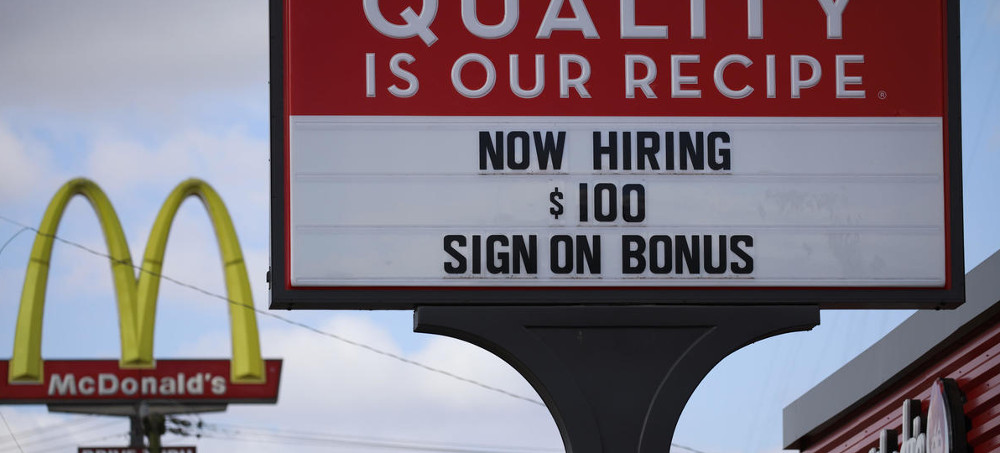 A new analysis uncovers how companies enriched themselves and their investors while boasting about jacking up prices.
ALSO SEE: Price Gouging:
Some Say Corporate Greed Is Driving Inflation
A Guardian analysis uncovers how companies enriched themselves and their investors while boasting about jacking up prices
One widely accepted narrative holds that companies and consumers are sharing in inflationary pain, but a Guardian analysis of top corporations’ financials and earnings calls reveals most are enjoying profit increases even as they pass on costs to customers, many of whom are struggling to afford gas, food, clothing, housing and other basics.
The analysis of Securities and Exchange Commission filings for 100 US corporations found net profits up by a median of 49%, and in one case by as much as 111,000%. Those increases came as companies saddled customers with higher prices and all but ten executed massive stock buyback programs or bumped dividends to enrich investors.
In earnings calls, executives detailed how even as demand and profits rose post-vaccine, they passed on most or all inflationary costs to customers via price increases, and some took the opportunity to add more on top. Margins – the share of sales converted into profits – also improved for the majority of the companies analyzed by the Guardian.
Economists who reviewed the data say it’s more evidence of a clear reality: Consumers are taking a financial hit as companies and shareholders profit or are largely shielded.
“It’s obvious that corporations are trying to pass on any form of short-term pain they might be feeling … and that’s serving the top, wealthiest class instead of those in need of fair wages or products that are affordable,” said Krista Brown, a policy analyst with the American Economic Liberties Project.
Media framing likely influences public perception. News reports of Hershey’s multiple price hikes over the last year read like so many dire reports on inflation’s pervasive toll. The company, which owns popular brands like Reese’s, KitKat and Skinny Pop, has been cast as the “latest victim of ever-increasing inflation”.
But a closer look at the company’s financials suggests a vastly different reality. Hershey’s net profits spiked 62% between the fourth quarters in 2019 and 2021, its operating margin widened, and it recently rewarded shareholders with $200m in stock buybacks.
Still, customers will pay even more for candy bars in 2022 as Hershey aims for even higher profits: “Pricing will be an important lever for us this year and is expected to drive most of our growth,” CEO Michele Buck told investors.
Similarly, a Kroger executive told investors in June, “a little bit of inflation is always good for our business”, while Hostess’s CEO in March said rising prices across the economy “helps” it profit.
The pandemic, war, supply chain bottlenecks and pricing decisions made in corporate suites have created a “smokescreen”, said Lindsay Owens, executive director of the Groundwork Collaborative, which tracks companies’ profits. That obscures questionable price increases, she added, and allows businesses to be portrayed as “victims”.
“That gray, nebulous area is fertile ground for companies right now, and you hear about it in their earnings calls,” Owens said. “Inflation itself is the opportunity.”
Profits or profiteering?
The Guardian’s findings are in line with recent US commerce department data that shows corporate profit margins rose 35% during the last year and are at their highest level since 1950. Inflation, meanwhile, rose to 8.5% year over year in March.
The Guardian’s analysis is the first to take a granular look at a cross-section of companies across a range of industries. It compared the most recent quarter’s profits to the same quarter two years prior, pre-pandemic. Price increases were obtained by checking earnings reports, though those often lacked specifics.
The data is not intended to be definitive, but does show how a wide sample of companies have raised prices even as profits jumped. In earnings call after earnings call, executives made no secret of their strategies.
- As gas prices soared, Chevron’s 240% profit spike was part of “the best two quarters the company has ever seen”, prompting a dividend increase and assurances it would keep production low to maintain high prices.
- Steel Dynamics profits increased 809%. The company was “not materially affected by inflation” as higher prices “exceeded” increased supply chain costs.
- Fertilizer giant Nutrien’s profits shot up by about $1.2bn on “higher selling prices [that] more than offset higher raw material costs and lower sales volume”.
- Nike’s 53% profit increase driven by higher prices was only “partially offset” by supply chain and inflationary cost increases.
- Keurig-Dr Pepper’s “significant pricing actions” and productivity outpaced inflationary costs, leading to an 83% profit jump.
The analysis found commodity companies trading in oil, timber, rubber, meat, wheat, steel and mining recorded the highest profit increases, while restaurants and retailers saw comparatively lower improvements, or losses. Commodity price spikes reverberate down the supply chain, eventually hitting consumers, noted Martin Schmalz, an Oxford University economist.
The Guardian’s data, he added, objectively shows a massive “transfer of wealth” from consumers, who pay higher prices, to shareholders and investment firms that reap the benefits.
The potential consequences are enormous and global. Inflation may already have sealed Democrats’ midterm fate, and in France, Marie Le Pen, a far-right candidate from a Holocaust-denying party, gained on her liberal opponent as she positioned herself as the “pricing power” candidate taking on the “oligarchy” and “elitism”.
But even as profits skyrocket, many have dismissed the idea they play a meaningful role in inflation, including Larry Summers, a former Obama adviser with clout in the Biden White House. He previously called profiteering claims “business bashing” that are “terrible economics”.
A Hershey spokesperson stressed that its growth was driven in part by volume, and it would be re-investing much of its profits to meet growing demand: “These investments are where we are making the biggest use of cash,” he said.
Financial observers have varying takes on whether companies are “profiteering” or “price gouging”, or simply profiting. George Pearkes, an analyst at Bespoke Investment, pointed to Caterpillar, which recorded a 958% profit increase driven by volume growth and price realization between 2019 and 2021’s fourth quarters. Eliminating price increases may have dropped the company’s 2021 quarter four operating profits slightly below the $1.3bn it made in 2020.
“This isn’t price gouging … and it shows pretty concretely that there’s a lot of nuance here,” Pearkes said, adding profiteering is “not the primary driver of inflation, nor the primary driver of corporate profits”. However, he added that it’s reasonable to question whether Caterpillar should have passed on its cost increases.
The company also spent $5bn on buybacks last year, and $1.3bn for a quarter of profits is still high, Brown noted, especially in the context of inflation eating into workers’ wage gains.
“Companies have access to massive capital,” she said. “They could have one or two years that are more painful – not even more painful, just less profitable for their investors, and they’re choosing not to.”
‘It’s a fix’
One industry that neatly illustrates how corporations have used the current imbalance of supply and demand to increase their profits is housing.
In recent months, the white-hot market for newly built houses shut out many Americans as average sale prices shot above $500,000. The popular explanation: inflation, supply chain squeezes and building material costs.
But another less publicized factor contributed. Two of the nation’s largest builders, PulteGroup and Lennar, intentionally kept home starts low and took other steps seemingly designed to maintain high prices by restricting supply.
“ We could sell another 1,000 homes in the quarter if we wanted to without too much effort. It just doesn’t make sense to do that,” Lennar co-CEO Jon Jaffe told investors in an earnings call. Lennar’s profits are up 78%, while PulteGroup’s jumped 97%. Lennar didn’t respond to a request for comment.
A step up the supply chain, wood producer Boise Cascade saw profits spike more than 1,100%, which it largely attributed to “unprecedented” pricing in 2021. Executives boasted that improved margins were only “offset partially” by inflationary and supply chain costs.
And at Home Depot and Lowe’s, where profits are up 38% and by about $2bn, respectively, volume and pricing drove sales as customers paid four times more for lumber.
Observers note a common thread along the supply chain: consolidation. By some estimates, Home Depot and Lowe’s control about one-third of the home improvement market, and hold even more of consumer lumber. Lennar and PulteGroup control about 11% of the home building market, though that figure is probably much higher in many metro regions, and Boise Cascade controls about one-third of the plywood market, according to a Forest Economic Advisors analysis.
“Those who have market power can raise prices above what’s considered fair market value,” Brown said. “We’re at a point in our market concentrations that we haven’t seen ever before.”
The influence of consolidation is pervasive. A Procter & Gamble executive noted to investors it and Kimberly Clark benefit from controlling 70% of the diaper market. It’s what Owens called a “concentration of necessities”. Reports say customers have “shrugged off” diaper cost increases, but antitrust advocates note very limited alternatives exist for many consumers. After multiple price increases, Procter & Gamble’s profits are up and Kimberly Clark’s are down, though the latter expects to “cover the majority of inflation with pricing” in 2022.
Similarly, Hershey’s 30 companies control at least 46% of the candy market. Prices on some of its products are probably up by double digits while the CPI index shows candy is up 7.6%.
Concentration is particularly pronounced among commodity companies, a problem highlighted in the grain market. CPI data shows bread and cereal prices increased by 30% and 7% between 2019 and 2021’s fourth quarters, while wheat skyrocketed to an all-time high in March as war largely eliminated Ukrainian and Russian crops.
Meanwhile, four large grain producers control about 90% of the market. Among them are Archer Daniels Midland, whose profits jumped 55%, and Bunge, whose profits swung by about $280m. Three companies control 73% of the cereal market.
That level of concentration breeds higher prices, said Alex Turnbull, a commodities analyst.
“When you go from 15 to 10 companies, not much changes,” he said. “When you go from 10 to six, a lot changes. But when you go from six to four – it’s a fix.”
Depending on the material or good, some commodity prices are set by exchanges, which Pearkes noted largely eliminates some companies’ pricing power. But commodity consolidation can open the door to another form of pricing power: boosting prices by keeping supply low.
“Price is set by supply and demand at some metals exchange, but what is the supply? That is what the companies determine, no?” Schmalz asked.
Just as PulteGroup kept housing starts down, oil companies have kept production low while gas topped $7 a gallon in some regions. In earnings calls across the industry, oil executives like Diamondback Energy CEO Travis Stice have promised to keep production flat in the years ahead, “putting returns and, therefore, shareholders first”.
“No one wants to see that shareholder return program put at risk with volume growth,” Stice said.
Some companies are enacting price increases in a less direct manner: by eliminating lower-cost products. The CEO of Kohl’s said in a previous interview the store was shifting its merchandise toward higher-end brands like PVH-owned Tommy Hilfiger, where profits are up 183%, because they’re more profitable for Kohl’s.
Similarly, General Motors profits jumped 49% between the full years in 2019 and 2021 despite selling about a million fewer vehicles. The company said it focused on moving more expensive trucks and SUVs than in previous years, but it also raised prices – a Silverado can now cost over $5,000 more than it did in 2019. That includes two rounds of March price increases just weeks after GM announced record profits and margins.
Such strategies further squeeze lower income consumers, said University of Massachusetts Amherst economist Isabella Weber.
“That’s a general trend that can enhance price increases quite dramatically, especially with cars and groceries,” she said.
‘Sick and tired of being ripped off’
Not everyone is raising prices. Arizona Iced Tea owner Don Vultaggio became a populist hero in April when he declared he’d rather take a hit than push prices above 99 cents: “I don’t want to do what the bread guys and the gas guys and everybody else is doing,” Vultaggio told the Los Angeles Times.
But Arizona is a privately owned company that doesn’t face shareholders’ wrath. When Target and Walmart declined to pass all inflationary costs on to customers ahead of the holiday season, an investor revolt ensued, and their shares temporarily plummeted.
“Shareholders are not interested in seeing anyone be cautious with price increases, and in some cases they’re saying ‘let’s throttle supply, let’s see how far we can take this’,” Owens said.
The surge in pandemic profits has not gone unnoticed. A spate of Senate and House bills aim to rein in excessive profits, while Biden proposals and executive actions target stock buybacks and consolidation. Meanwhile, many consumer advocates and economists argue that enforcing antitrust laws already on the book, or strengthening them, could help reduce companies’ pricing power. Others have argued for the implementation of very targeted price controls on essential items, like bread.
In March, Senator Bernie Sanders began a push to bring back a windfall profit tax last used after the second world war, while Senator Elizabeth Warren introduced similar legislation that focused on oil companies’ profits.
“The American people are sick and tired of the unprecedented corporate greed that exists all over this country. They are sick and tired of being ripped off by corporations making record-breaking profits while working families are forced to pay outrageously high prices for gas, rent, food, and prescription drugs,” said Sanders.
Sanders may well be right, but if “sick and tired” Americans vote against the Biden administration in November, his chances of pushing for change will fall.
 A special tribunal in Colombia said last year that the Colombian military carried out more than 6,400 so-called 'false positive' extrajudicial killings between 2002 and 2008 (photo: Daniel Munoz/AP)
 Steam and smoke rises from the world's largest lignite coal-fired power station - the Belchatow Power Station in Rogowiec, Poland on Feb. 23, 2021. (photo: Omar Marques/Getty)
That’s why it’s concerning that coal capacity actually increased by nearly one percent in 2021, according to a new report from Global Energy Monitor (GEM).
“It’s up by a small number,” GEM research analyst Flora Champenois told Reuters. “But it comes at a time when the world needs a dramatic fall in the capacity, not any rise.”
In 2021, the number of operating coal plants grew by 18.2 gigawatts to a total of around 2,100 gigawatts or an increase of approximately 0.87 percent. This comes at a time when scientists have said that no new coal plants should be built if we are to avoid the worst impacts of the climate crisis, according to GEM. Further, all coal plants in developing countries should be retired by 2030.
Overall, things are moving in the right direction. The coal plant capacity under development fell by 13 percent in 2021, after rising for the first time since 2015 during 2020. Planned capacity now stands at 457 gigawatts, a record low. Still, GEM says the decline is not moving swiftly enough.
“The coal plant pipeline is shrinking, but there is simply no carbon budget left to be building new coal plants. We need to stop now,” Champenois said, as The Guardian reported. “The latest IPCC report’s directive for a fighting chance at a livable climate is clear – stop building new coal plants and retire existing ones in the developed world by 2030, and the rest of the world soon after.”
There are currently more than 2,400 coal plants still running, and plans to retire them are not currently moving quickly enough to limit global warming to 1.5 degrees Celsius above pre-industrial levels.
China continues to be a major driver of coal use, accounting for 52 percent of the new coal plant capacity being built in 2021, New Scientist reported.
“Everywhere outside of China, plans for new coal-fired power plants have been scaled back dramatically,” report author Lauri Myllyvirta at the Centre for Research on Energy and Clean Air told New Scientist. “However, Chinese firms have continued to announce new coal-fired power stations and there is very clear government backing for that. That’s a worrying sign.”
More than 20 countries promised to stop burning coal at the COP26 UN climate conference in Glasgow in November of 2021. However, neither China nor the U.S. signed the agreement. The U.S. and China did both join in with the other G20 countries in promising stop funding coal plants abroad, GEM pointed out.
China’s participation in this pledge meant that plants with a combined capacity of 13 gigawatts were canceled in 2021 and a further 37-gigawatts worth of plants should be canceled in 2022, New Scientist reported.
The rise in coal in 2020 was prompted by the coronavirus pandemic and subsequent economic downturn, according to The Guardian. There is now concern that the high energy prices caused by the Russian invasion of Ukraine could lead more countries to rely on coal power. However, Myllyvirta said some may turn towards renewable energy instead.
“It’s really important to note how much movement there has been towards clean energy and efficiency in response to the invasion,” he told The Guardian.
Special Coverage: Ukraine, A Historic Resistance
READ MORE
Follow us on facebook and twitter!
PO Box 2043 / Citrus Heights, CA 95611


