|

|
|
|


|
|
|
|
|
|
|


|
|
|
|
|
|
|
|
|
|
|
|
|
IT'S TIME FOR THE MASS GOP LIARS TO PUT PRESSURE ON THE MAGA GOP TO
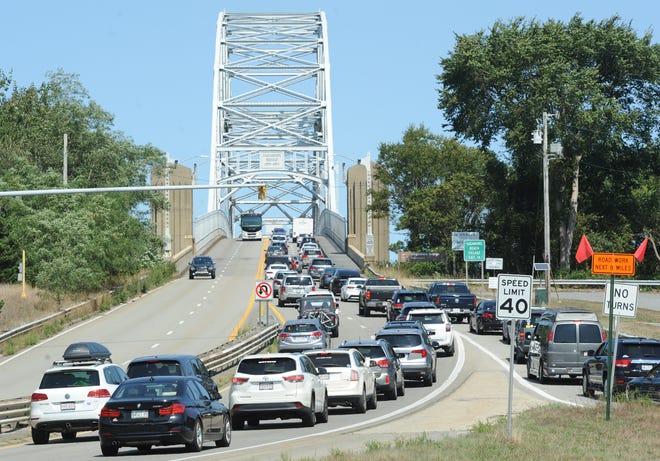
FUND THE ARMY CORPS OF ENGINEERS! BOTH BRIDGES BELOW TO THEM!

In what officials cast as a watershed moment, the Biden administration is awarding Massachusetts nearly $1 billion toward replacing one of the two aging Cape Cod bridges, cementing the most significant piece of funding yet to help realize the multibillion-dollar project, people with knowledge of the award told the Globe.
The $993 million grant accounts for nearly half of the estimated $2.1 billion it would take to replace the Sagamore Bridge, one of the two 89-year-old structures that provide the only roads on and off the Cape.
State officials have said they plan to replace the Sagamore first, before pursuing more funding for a new span in place of the nearby Bourne Bridge. Replacing both bridges is expected to cost $4.5 billion, state officials have estimated.
The amount Massachusetts is receiving nearly matches the $1.06 billion the state and the US Army Corps of Engineers — which owns and maintains the bridges — had applied for last year through the federal Bridge Investment Program.
Consequently, the new funding effectively ensures a new bridge will be built in place of the Sagamore, federal Massachusetts lawmakers said. US Senator Elizabeth Warren on Friday said the state is “ready to put shovels in the ground,” noting that two years ago, the federal government had committed no money to the project. She called the new grant a “billion-dollar home run.”
“There’s no question: It’s all systems go,” US Representative Bill Keating told the Globe, adding the project was dependent on winning the $1 billion grant. “We would have been nowhere without it. There would be no timeline without it.”
State officials said Massachusetts has now secured more than $1.71 billion in federal funding for the project, including a $372 million grant the state won in December and another $350 million it received in a separate federal appropriations bill. Governor Maura Healey has promised up to $700 million in state money for the entire project, while the Army Corps of Engineers agreed to commit $600 million, subject to Congress appropriating the money.
In an interview Friday evening, Healey emphasized that “there’s still a ways to go” until construction, noting the state is working through environmental permitting, and that it must next select a firm to design and build the bridge.
But she said the state has “never been closer to rebuilding the bridges.”
“This is Christmas in July,” US Senator Edward Markey told the Globe, noting the Sagamore replacement is expected to be wider than the original. “This announcement means that a brand-new shiny Sagamore Bridge is going to be constructed.”
The Sagamore and Bourne bridges are considered functionally obsolete, and officials have said pursuing lengthy and costly fixes in lieu of replacement could be catastrophic to crossings that carry tens of millions of cars each year.
The bridges, which first opened to traffic in 1935, were intended to stand for just 50 years, and the Army Corps recommended in 2020 that both be replaced.
The project is a complex one. The bridges are owned by the federal government, though under an agreement with state officials, the state will take over ownership of and operate the two new spans over the Cape Cod Canal once they are built. State transportation officials said earlier this month that the first new span would be built “fully offset” from the current Sagamore Bridge, so that traffic can continue to flow over it during construction.
Officials have warned that without replacing or fixing each bridge, they’ll be forced to permanently close a lane in each direction by 2032 on the Bourne Bridge and 2036 on the Sagamore Bridge. The Healey administration has estimated that for the Sagamore Bridge alone, construction on a new bridge would begin in late calendar year 2028 and would last until late 2035 or early 2036.
Past attempts to secure federal help went nowhere. The state whiffed on $3 billion in requests to fund the replacement of both during the final months of then-governor Charlie Baker’s administration, partly because the state and Army Corps of Engineers didn’t have a fully fleshed-out financing plan.
A Department of Transportation official told state officials last year that it had identified a $630 million shortfall in the project, according to meeting notes obtained by the Globe.
That prompted Healey to change course. She said last year she’d seek to replace the bridges in a “phased process,” starting first with the Sagamore Bridge, in part because it carries nearly 17,000 more cars on average each day than the Bourne.
The nearly $1 billion grant the state is now getting, however, was crucial for anything to move forward. “This is a game-changing award for Massachusetts,” Healey said.
It remains unclear when, or whether, the state will be able to win the funding to replace the Bourne. A big factor in the state’s success rests with this year’s election, Massachusetts officials said, illustrating how something as bureaucratic as bridge funding can be tightly wound into politics.
President Biden has long been the Democratic Party’s presumptive nominee, but he is facing growing calls to step aside in the wake of his disastrous debate performance. Biden has repeatedly said he would not drop out of the race.
Warren has publicly stood by Biden, declaring that he’s the party’s nominee and touting his accomplishments, and Markey on Friday told the Globe he believes Biden is “going to be our nominee.” Healey has said Biden should “carefully evaluate” whether he remains Democrats’ best candidate to win against former president Donald Trump in November.
“The Sagamore Bridge is a done deal because Joe Biden defeated Donald Trump in 2020 and because Democrats controlled the House and the Senate. And now we have to find the funding for the Bourne Bridge,” Markey said Friday, arguing it will be “much more likely” the state can secure the funding for the Bourne Bridge with Biden in office.
“We need to make sure that Joe Biden gets reelected,” he said.
Healey declined to address the “conjecture” of what impact the 2024 presidential election could have on the state’s chances.
“We demonstrated through this application how critical this infrastructure is to Massachusetts and to the region,” she said. “I’ll continue to make that point to Washington, D.C.”
Friend: Hawaii's native residents are at risk from leftover bombs – known as unexploded ordnance (UXO) – left behind from past military training.
These dangerous bombs not only threaten their lives and well being, they also prevent them from using their own land for everything from permanent housing to farming.
So far, the U.S. Army Corps of Engineers (ACE), the organization responsible for leading the remediation efforts, has failed in its duty to remove these dangerous weapons after numerous unsuccessful attempts to make any real progress.
It's past time for immediate action to clear these bombs from Hawaii and protect the safety of all communities.
The daily threat and incredible hardship caused by the presence of UXO is real and urgent.
Native Hawaiians have been waiting for decades for ACE to clear these bombs from their lands.
The government's failure to address this issue has had detrimental consequences for the Native Hawaiian community, and it is time for justice to be served.
It's not just about the physical danger posed by the UXO, it's also about the emotional toll of being denied a basic human need: a safe place to call home.
Hawaii has a long history of military presence. As a result, UXO poses a serious danger and it is crucial that it all be removed as soon as possible.
Together, we can protect Hawaii's lives and culture.
Thank you for working for peace,
Stephen and the Win Without War team
A commitment to the replacement of the aging Cape Cod Canal bridges. along with federal transportation dollars, were tucked into the massive package of emergency relief, government funding and tax cuts approved by Congress this week.
The replacement of the 85-year-old Bourne and Sagamore bridges was among 65 projects the Secretary of the Army would expedite to preconstruction planning, engineering and design, if justified, as part of the Water Resources Development Act of 2020 — one of several pieces of legislation that was included in an omnibus package passed along with the $900 billion stimulus bill.
Also in the more than 5,000-page package, which made headlines for the contentious $600 stimulus checks, was possible funding for bridges in poor condition and other transportation projects, U.S. Rep. William Keating said. He had already spoken with Massachusetts Transportation Secretary Stephanie Pollack about the potential for as much as $60 million for bridges across the state in the federal budget portion of the bill, he said.
Transportation overall will receive about $45 billion in the economic relief piece of the legislation.
Leaders brokered the coronavirus package on Sunday and the text was unveiled on Monday.
U.S. senators Edward Markey and Elizabeth Warren commended the infrastructure bill for including several Massachusetts projects.
“During the coronavirus pandemic, it is more important than ever that we provide relief and support to communities throughout Massachusetts,” Sen. Markey, D-Mass, said in a statement. “I am proud that the water infrastructure legislation passed today includes many of our key provisions, which will provide new and more robust resources to help localities recover and grow their economies, while also bracing for the impacts of climate change. I look forward to building on this progress with comprehensive investments in sustainable and resilient infrastructure in the next Congress.”
Markey is a member of the Environment and Public Works Committee, which had jurisdiction over the legislation.
Sen. Warren, D-Mass, also was glad to see the legislation support critically important infrastructure projects in the state.
"I will continue to fight to ensure our communities have the resources they need to protect against future impacts of climate change and allow for continued economic growth,” she said in the statement.
The U.S. Army Corps of Engineers owns and operates the two automobile bridges over the Cape Cod Canal. Facing increasingly bigger and more frequent maintenance, the Corps announced earlier this year that it planned to replace the bridges, though the state would lead the new construction efforts and take over ownership once they were completed.
What the new bridges would look like and the timeline for replacement haven't been nailed down yet, but a report by the Corps last fall included wider lanes to meet highway standards, a median, shoulders and separated pedestrian and bicycle areas. The bridges would have two travel lanes in either direction, plus a pair of auxiliary lanes for vehicles getting on and off the adjacent exits.
The Corps' projected construction could start as early as 2025, but funding has not yet been allocated for the estimated $1 billion project.
It's not clear what would be expedited or how this change would affect the project's trajectory since the Corps and the state have said they plan to do it.
The Massachusetts Department of Transportation was thankful for the state's delegation for working for extra money and is evaluating how this new funding can help improve the transportation network across the state, a spokeswoman wrote in an email.
MassDOT continues to meet with the Corps and is working on internal design planning for the roads around the canal with more information for the public next year.
Corps spokesman Bryan Purtell said it wouldn't be prudent to comment on pending legislation.
"We will have to wait for this stimulus bill to be signed by the President into law and then passed down to (the Department of Defense) and through the Secretary of the Army priority chain before we may have any specifics for release or know more how this affects specific projects," he said.
|

Tahlequah, the Southern Resident mother whale who carried her dead calf two years ago for 17 days and more than 1,000 miles, is pregnant once again.
Without enough food, though, her new calf could die as the last one did.
The U.S. Army Corps of Engineers just blocked the best option for getting these whales the food they need — and keeping them from going extinct.
We can't stand by as whales starve before our eyes.
Your help is needed if we're going to keep these orcas from vanishing.
The only way to save Southern Resident killer whales is to grow and secure their main food supply: Chinook salmon. But four dams along the Snake River in the Columbia River system cut off more than half of spawning and rearing habitat for salmon.
And many wild salmon runs in the region survive at 2% or less of their historic numbers.
Without enough salmon orcas will waste away and die off, one by one.
In deciding not to remove Snake River dams, the Corps ignored science and the plight of both salmon and orcas. Our activists and organizers will keep up the battle to take down these dams.
We're fighting for these whales every way we can. We're pressing for stronger rules on commercial boaters to adhere to protective limits so they don't interfere with whales' search for food. We also took legal action challenging the Washington Fish and Wildlife Department's permitting of in-water steelhead net pens, which can also make it harder for whales to find food.
Hope for the species remains: In addition to Tahlequah, scientists have announced pregnancies in other Southern Resident orca pods.
The fight for protection of our salmon and orcas must go on.
These whales are among the most endangered mammals on the planet. Only 72 are left.
We can't let them disappear on our watch.
|
|
Center for Biological Diversity
P.O. Box 710
Tucson, AZ 85702
United States
LOTS OF POSTS IGNORED BY BLOGGER..... OR REMOVED ON THEIR WHIM! ALL POSTS ARE AVAILABLE ON MIDDLEBORO REVIEW AND SO ON BLOG...


