Showing posts with label ANTI-ABORTION VIGILANTES. Show all posts

Tuesday, March 28, 2023

FOCUS: Rebecca Traister | Abortion Wins Elections


Reader Supported News
27 March 23

Live on the homepage now!
Reader Supported News

A HANDFUL OF DONATIONS ARE KEEPING RSN GOING — Each day the people who take a moment out of their day to make a donation to RSN are the ones keeping RSN going. It may not be a record fundraising haul but it works if the people who believe in RSN do what they can to help out. It does matter.
Marc Ash • Founder, Reader Supported News

Sure, I'll make a donation!


Representative Shirley Chisholm speaking at an abortion demonstration in Union Square in 1972. (photo: Bettye Lane/Schlesinger Library/Harvard Radcliffe Institute)
FOCUS: Rebecca Traister | Abortion Wins Elections
Rebecca Traister, The Cut
Traister writes: "The fight to make reproductive rights the centerpiece of the Democratic Party’s 2024 agenda." 

The question,” New York representative Shirley Chisholm declared in 1969, “is not: can we justify abortions, but can we justify compulsory pregnancy?”

The first Black woman elected to the United States Congress, Chisholm had recently been named the first honorary co-president of NARAL. She was both frank and morally assured in the remarks she delivered to the Republican Task Force on Earth Resources and Population, asking pointedly, “What is more immoral, granting an abortion or forcing a young girl … to assume the responsibilities of an adult while she is still a child?”

Chisholm was speaking during the last period in this country’s history in which American lawmakers were facing the open and urgent question of how to expand access to abortion care via legislative means, though at the time it was not clear which party was going to lead the charge. Chisholm’s 1969 remarks survive in part because they so impressed the chair of the committee, Texas representative George H.W. Bush, that he made the unusual move of entering them into the Congressional Record, explaining that they “deserve widespread attention.”

Two years earlier, California governor Ronald Reagan had signed one of the country’s most liberal abortion laws, permitting “therapeutic” abortions in cases of rape, incest, and threat to the life of the mother. In 1970, New York decriminalized the procedure for any reason prior to the 24th week of pregnancy, and activists won similar victories in Washington, Alaska, and Hawaii with support from both sides of the aisle. That same year, the first bill to legalize abortion federally was introduced to the Senate by Oregon Republican Bob Packwood, a man who would fight vociferously for abortion access until he resigned in 1995 amid allegations of serial sexual assault and harassment.

Though Packwood’s Senate bill went nowhere, it was emblematic of an era of partisan realignment and social upheaval in which the civil-rights movements of the mid-20th century had created unprecedented political possibilities. By 1972, Chisholm was making a historic run for the presidency, and the issue of abortion came to a head at the Democratic Convention in Miami, where the newly formed National Women’s Political Caucus was not supporting her but instead hoping to win concessions on abortion from the man who was to be the nominee, South Dakota senator George McGovern.

Nora Ephron, then a journalist covering the convention for Esquire, reported that the proposed abortion plank “produced the most emotional floor fight of the convention.” McGovern refused to support legalization, a stance he viewed as perilous to his candidacy, but women’s-caucus leaders believed they had at least extracted an assurance from him that he would reject anti-abortion rhetoric.

California representative Barbara Lee, who attended the convention as a Chisholm delegate, remembered asking these feminist activists, “You guys believe this man?” Lee’s skepticism proved warranted. At the last minute, McGovern’s campaign invited an opponent of abortion rights to give a seconding speech from the floor.

Gloria Steinem, a founding member of the caucus, was furious. By the end of that bad night, she was tearfully yelling at McGovern’s campaign manager, Gary Hart, “You promised us you would not take the low road, you bastards.” The next day, she raged to Ephron while walking down a Miami street: “I’m just tired of being screwed, and being screwed by my friends.” In the fall of 2022, Steinem would recall to me, in more sanguine terms, “McGovern was a good guy, but he was nowhere on women’s issues. We were trying to educate him, but he just didn’t get it.”

The Australian feminist Germaine Greer, writing about the convention for Harper’s, felt McGovern had made not just a moral mistake but a strategic one. “If the ‘abortion’ plank had been adopted as part of the party platform,” she wrote, “thousands of people with energy and experience would have campaigned for McGovern in a positive and intense way, just as they had done in the primaries; they might lose, but they would lose honorably.” McGovern lost in a landslide.

Then, less than three months after his defeat by Richard Nixon, the Supreme Court handed down a surprise decision legalizing abortion. Overnight, the legislative push became moot; the Court had settled the issue, saving members of both parties from the daunting and complex process of figuring out how to guarantee abortion access on state and federal levels. During the decades that Roe v. Wade held, the parties became rigidly divided on the topic, with Republicans converting or purging their pro-choice moderates and Democrats forcing most of their anti-abortion hard-liners to get on the side of abortion rights.

For decades, Democrats touted a commitment to “choice,” largely in reference to their efforts to cultivate an abortion-friendly judiciary and, when in executive power, the veto. Meanwhile, Republicans worked every anti-abortion angle, building spidery networks of local and state anti-abortion legislators, creating a judicial pipeline through the Federalist Society, and getting fat on the language of faith and family values. The right dreamed up ever more imaginative TRAP laws that shut down clinics based on building-code requirements related to hallway width. The GOP enforced waiting periods and circulated literature making fictionalized claims about links between cancer and abortion. Republicans used the House floor as a stage to vote again and again to defund Planned Parenthood — understanding that, even as they lost, they sent a dramatic public message to the very people most motivated to organize for them.

When the Supreme Court, in Dobbs v. Jackson Women’s Health Organization, overturned Roe last year, it not only inflicted grievous harm but ensured that the job of protecting abortion rights and access must once again be undertaken legislatively. It’s different work than it was in 1972: Medication abortion, data-tracking technology, and hyperpolarization have all altered the terrain. But even if that were not the case, Democrats would have no useful road map for this moment, no muscle memory. Because, in fact, the party has simply not applied much legislative muscle to this task before.

But Dobbs also catalyzed a revolution in the politics of abortion. And now it’s not just some loud activists and marginalized lady pols telling Democrats to move quickly and assertively to figure out how to make abortion available again across the country: It’s voters. Voters who just saved the Democratic Party during a midterm year in which inflation and gas prices should have meant a drubbing for the incumbent president’s party but instead resulted in a historic success for Democrats, who retained control of all their state legislatures, flipped Republican chambers in Michigan and Pennsylvania, and, at the federal level, gained a Senate seat and kept House losses to the single digits.

Multiple factors, including a slate of ghoulish right-wing candidates, helped Democrats, but there is no question that abortion was the preeminent issue for voters. “Democrats should have gotten wiped out,” said the pollster Tom Bonier. “But they overperformed. When you look at where they overperformed, it’s in places where choice was most present in the election, either literally on the ballot, like Michigan and Kentucky, or effectively in terms of the perceived stakes and the extent to which the candidates were talking about abortion, like Pennsylvania.”

“I don’t think Democrats have fully processed that this country is now 10 to 15 percent more pro-choice than it was before Dobbs in state after state and national data,” said pollster Celinda Lake.

The Democrats, in other words, are the bewildered dog that has caught the bus. A motivated base has turned to them for leadership on abortion while they are staring down a Republican House majority, a Senate filibuster, and an obdurate Supreme Court. Upon hearing that I was writing about their party’s plan to tackle abortion post-Dobbs, more than one Democratic staffer, and at least one elected official, silently mouthed to me, “There is no plan.”

What Democrats have is incentive: One of their most urgent policy issues has just shown itself to be their most politically effective. And they are undergoing a generational turnover that has already started to reshape the party and its approach to the battle — a dawning, in the midst of cataclysm, of a new era of political possibility.

At the state level, the face of a new approach to abortion politics is indisputably Michigan governor Gretchen Whitmer. “If you look at what happened across the country, there was no more profound outcome than in the state of Michigan,” Whitmer told me two days before her State of the State address in January. “We won all the constitutional offices; we flipped both chambers of our legislature for the first time in 40 years. It’s only happened four times in 130 years in the state.”

Democrats’ success was owed in large part to the presence on the ballot of Prop 3, a citizen-driven constitutional amendment that protected abortion rights in the state. Whitmer and her fellow Michigan Democrats were unique in that they had been running on abortion before Dobbs and continued to do so even when, in the months before the November elections, Democratic leaders and strategists cautioned them to ratchet it down a notch. Their gamble paid off: According to Bonier, the gender gap in Michigan in favor of Democrats was even higher than it had been in 2018, when it had hit a historic peak. And Whitmer — or “Big Gretch,” as she was appreciatively nicknamed by Detroit rapper Gmac Cash in 2020 — was at the forefront of channeling that raw support into an agenda. “I was so associated with the issue I don’t know how you pull it apart” from other aspects of the platform, she said.

Big Gretch, 51, has Ava Gardner bone structure, a flat midwestern cadence, and a fondness for athletic metaphor (before politics, she had planned to go into sports broadcasting). She is widely referred to as a possible future presidential contender. And she is selling abortion as both a practical, voter-friendly issue and an inalienable human right at the center of a galaxy of related concerns.

At the Michigan State of the State, she did not treat abortion as Democrats often do, as if it’s slightly icky and private, damp and sad. She did not cordon it off in its own dolorous corner separate from all the rousing stuff about creating a mighty Michigan economy. Rather, she led with it, weaving it into a business-forward spiel called “Make It in Michigan,” suggesting that prioritizing abortion rights and LGBTQ+ protections would help bring businesses and expertise back to her former manufacturing state. States with anti-abortion and anti-trans laws, she told her audience, “are losing talent and investment because bigotry is bad for business.” Then she went ahead and cast these issues as universal family values. “Every parent,” Whitmer said, “Republican, Democrat, or independent, wants our kids to stay in Michigan. Let’s give them reasons to stay; let’s … protect fundamental freedoms.”

The speech was aggressive to the point of being in-your-face competitive, like a football game except about civil rights (“I want anyone living in a state that wants to control your body or deny your existence to know that Michigan has a place for you … I’m looking at you, Ohio and Indiana!”). It was a little discombobulating for anyone who has grown up in a world in which politicians — even those who cared about protecting abortion rights and access — simply did not speak this way. Whitmer’s commitment to reproductive freedom was integrated into everything we have come to recognize as political meat and potatoes (the creation of a pre-K program and affordable college options, for example), and she spoke with the winking assuredness of a politician on the winning side.

Spending time with Michigan’s newly elected governing majority is a little like landing on a planet where no white men are in charge. When Whitmer stood at the dais, she was flanked by Joe Tate, the first Black Speaker of the Michigan House; Winnie Brinks, the first female majority leader; and Garlin Gilchrist, entering his second term alongside Whitmer as the state’s first Black lieutenant governor. Michigan’s attorney general is Dana Nessel, the first openly gay person elected to statewide office there, and the secretary of state is Jocelyn Benson.

This group’s version of Democratic politics feels different from what has come before. That’s not because it’s left-leaning, exactly; when Whitmer first ran for governor in 2018, she was the moderate in the Democratic primary. The day after her speech, she told me, “I think 80 percent of what I said last night was not partisan, not ideological. It was economic development, skills training, and infrastructure.” It’s a fascinating experiment: What if you wrested away issues that Democrats have long ceded as fundamentally feminized, fringe, radical, or dangerous and presented them as unapologetic centerpieces of a forward-looking, morally robust economic agenda?

This experiment was born in a recent historical moment that has gone underappreciated in the political press: the galvanization of all kinds of voters, but especially women, in response to the presidency of Donald Trump. Often mocked as being part of the pussy-hat-wearing hashtag resistance, a new generation of politicians and voters is in the midst of correcting one of the Democratic Party’s signature failures of the Roe era: its lack of investment in state government.

Since the mid-’80s, anti-abortion Republicans have run for unsexy offices on school boards and city councils, building the army of legislators who soon controlled courts and voter rolls, who made punitive state laws and gerrymandered districts in order to keep their majorities — all while the Democratic Party was distracted by the shiny objects of the presidency and the Senate. For decades, Democrats in state races have been wildly outspent by their opponents. But Hillary Clinton’s loss spurred a mass awakening that swept through the 2018 elections and gave Democrats the biggest midterm victory since the Ford administration, putting a historic new class of candidates in office.

Mallory McMorrow was an industrial designer who had worked for Hot Wheels and Gawker before moving to Royal Oak, Michigan, in 2015. In the week after Trump’s victory, she was sent the viral video of fifth-graders chanting “Build that wall” at a Latina student. It was from Royal Oak Elementary, the polling place where she’d cast her vote for Clinton. “I Googled, ‘How to run for office,’” she told me, and she was not alone. “There was one city in my district where you could vote a woman ticket all the way down to county commissioner, which was very cool.” McMorrow flipped her state-senate district in 2018; she is now majority whip and the star of a viral video of her own: Her vigorous 2022 rebuttal to a senate colleague who had accused her of “grooming” school-children has been watched by 16 million people. “Our class, we’re never going to forget the 2016 cycle,” McMorrow told me.

Laurie Pohutsky, a microbiologist working at start-ups in Ann Arbor, was 28 when Clinton lost to Trump. “There were things that became clear to me post-2016,” she told me, sitting in her office at the State Capitol, which is decorated with old Ms. magazine covers and action figures of Clinton, AOC, and Elizabeth Warren. She went to the Women’s March in Washington and heard a speaker exhort those gathered there to run for school board, city council, anything that might be a good fit. “I remember this feeling of dread just washing over me,” Pohutsky said, “because I was like, I know that I am going to end up doing this, but it sounds impossible.” Pohutsky flipped her gerrymandered House district from red to blue on a campaign that led with reproductive rights and state single-payer health care.

2018 was the year that Whitmer, who had served in the state legislature, was first elected governor. It was the year that Nessel and Benson came to office. (Nessel’s campaign, launched at the height of Me Too, featured an ad that opened, “When you’re choosing Michigan’s next attorney general, ask yourself this: Who can you trust most not to show you their penis in a professional setting? Is it the candidate who doesn’t have a penis?”) It was the year that Michigan’s Rashida Tlaib, Elissa Slotkin, and Haley Stevens were elected to the House of Representatives. The Democratic power structure in Michigan is overwhelmingly the class of 2018.

“Gretchen and Jocelyn and Dana were elected, and we went from one Democratic woman in the state senate to eight,” said State Senator Erika Geiss. Geiss, who is 52, was born in Brooklyn. Her grandparents, she said, had been close friends of Shirley Chisholm’s. “I guess I must have been breathing all this in,” she said with a laugh. As a state representative in 2017, Geiss took a hard look at a 1931 law criminalizing abortion that was still on the books and could spring back to life if Roe fell. She thought it might be a good idea to repeal it.

“There was pushback” from others in her party, Geiss said, “because the belief was ‘You don’t want to remind them that it exists.’” The messaging gap, she said, originated with “higher-ups” who felt that after Roe, “‘We don’t have to deal with this now.’ The conversation stopped.” And with it, any attempt to craft a coherent worldview that might encompass other political necessities. “Child care never happened,” said Geiss. “The Equal Rights Amendment still hasn’t happened. There are all these things attached to the issue of abortion, and we got lazy.” This willful lassitude, she said, was part of a broad Democratic blindness to the right-wing anti-abortion project and the ways in which state laws were rendering Roe ever less protective for millions. “TRAP laws, mandatory waiting periods, requiring ultrasounds — it’s been so insidious,” she said.

After getting elected to the state senate in 2018, Geiss reintroduced her bill to repeal the 1931 law, partnering with Pohutsky in the House. They were told by the Legislative Service Bureau that, if they were serious, they’d need to take a close look at everything the 1931 bill touched.

That included rules rooted in so-called Comstock regulations, conceived in the 1870s, that made it illegal to circulate material deemed “obscene, lewd or lascivious”; in Michigan, the remnants of Comstock applied to language not only about abortion and contraception but relief from menstrual cramps and hot flashes. There were economic fines placed on schools and universities that mentioned abortion — a startling genre of free-speech restriction reigniting around the country.

By 2022, with the conservative-led Supreme Court strongly signaling that Roe was a goner, the 1931 law was on everyone’s radar, and Whitmer made the unusual choice to file a lawsuit asking her state’s Supreme Court to find it unconstitutional. The lawsuit was far from a sure bet. When I asked her at the time whether she was anxious about taking a risk on an issue Democrats had historically treated gingerly, she told me, “The scariest thing is not taking action.”

Preemptive legal maneuvering by Whitmer and Nessel meant that after Dobbs, the 1931 law, which would have made advertising abortion services a misdemeanor and providing one a felony, did not take hold. This had tangible consequences for the human beings who live in Michigan: There was not a single 24-hour period between Dobbs and the November election during which you could not get abortion care in the state.

In the aftermath of Dobbs, activists on the ground immediately started gathering signatures for a ballot amendment. Bonier recalled that he landed in Michigan within days of the ruling: “I got out of a car in this little town and had someone walk up right away to ask if I would sign the petition. They were organized, and they were ready.”

Prop 3 gathered a historic 750,000-plus signatures, far more than enough to put it on the midterm ballot. Yet as the election approached, consultants, opinion columnists, and Democratic Party insiders were telling Michigan Democrats to stop leaning so heavily into abortion and instead focus on economics. Gilchrist said, “It was ridiculous. Reporters would ask us, ‘What do you think is more important to people? Abortion or things being expensive?’ It’s like, Do you have children? I have three. They’re expensive.”

“I don’t have a poker face, so you could see immediately that I was irritated by those questions,” Whitmer concurred. “If you don’t think abortion is an economic issue, you probably don’t have a uterus. I said that at one point, and my communications staff was like, ‘Oh God.’”

Prop 3 won by 13 points, enshrining a broadly defined right to “reproductive freedom” in the state’s constitution. The referendum did a shade better than Whitmer, who beat Tudor Dixon — an anti-abortion zealot who argued that a forced pregnancy in the case of rape would entail “healing through that baby” — by 11 points.

But among the many lessons of the past 50 years is that stopping at a single victory is a mistake. Geiss acknowledged that there is no model for how to make expansive abortion protections legislatively. “We have to build it,” she said. One of the first steps is cleaning out all the corners and crevices into where abortion criminalization has crept over the years. “We need to go through with a fine-tooth comb and figure out all the other places it touches and repeal those: all of those things that stymie access to abortion and the ability of childbearing people to safely get to a provider or have access to medication abortion,” she said.

“Any right that is conferred by basis of substantive due processes is now very much at risk,” said Whitmer. “That’s why it’s not just getting the abortion zombie laws off the books; it’s any law that penalizes same-sex relationships, marital privacy, contraception. All of these things could very well fall, depending on when the Supreme Court’s got these cases teed up. We’re taking a fresh look at everything that’s been codified, whether it’s in practice or enforced or not.”

That they have a plan and a mandate does not mean Democratic leadership in Michigan has an easy path ahead. Less than three weeks after Whitmer’s State of the State, a shooter killed three people and wounded five on Michigan State’s campus. Whitmer pressed forward with plans to enact universal background checks and red-flag laws. Like abortion protections, these are measures supported by clear majorities of voters, but also like abortion laws, spending political capital on them often provokes extremist responses, a nontheoretical reality in Michigan, where Whitmer was the subject of a violent kidnapping plot in 2020 and armed protesters breached the State Capitol months before the January 6 insurrection. In 2021, the Michigan state chair of the Republican Party referred to Whitmer, Nessel, and Benson as “three witches” who should be “burning at the stake.” Everyone is keenly aware of the high-wire act they are performing. Pohutsky has a tattoo on the inside of her wrist that reads DON’T LOOK DOWN.

More mundanely, Whitmer and her colleagues are aware of the evanescence of their authority. “We can’t make the mistake that predecessors did,” Whitmer told me, “that just because we’ve made an advancement that it’s the new floor.” Majorities change. Leaders move on. Whitmer says she’s working with an eye toward what happens when “you get a different legislature and governor, that they don’t try to bring that back to life again.”

Perhaps this too is a generational shift, the awareness of the fallibility of our governing institutions, which means making the most of the time in power and preparing for what follows. “We amended the constitution of Michigan; we are safe for now,” said Whitmer. “But if there’s a national ban, we’re back in the soup. We’ve got to make sure people understand that this fight is not over. It is happening state by state right now, but it’s going to continue to be a national fight. People in solidly blue states who think, Abortion is safe in my town or in my state? It’s not.”

What is happening in Michigan — an empowered Democratic-controlled government, a mechanism for changing the state constitution via direct referendum, a leadership class committed to adopting abortion rights as a central plank of its agenda — obviously cannot be replicated everywhere, which leaves millions of people in red states in particular without access to abortion care.

These elements are also notably missing in Washington, D.C., where the onus is on federal lawmakers to protect and expand abortion care in a terrifying post-Roe world. Democrats must remain on top of the onslaught of draconian restrictions in the wake of Dobbs, enforce every regulatory option through the executive branch, and give the appearance to voters of fighting fiercely while working in the minority in the House, against an insuperable filibuster in the Senate and in the shadow of a judiciary shaped by Trump. And they must do it all within the context of a federal party structure in which — unlike Michigan — the next generation is most assuredly not yet in charge.

It is chaos. Mayhem in the face of mayhem, all part of the anti-abortion right’s goal of confusing and stupefying the opposition. If Michigan felt like a different political planet, Washington offered bumpy reentry to the gravitational limitations of Earth.

Central to the tensions in Washington is the fact that Joe Biden, the president tasked with leading his party into this potentially era-defining battle, is a Catholic boy from Scranton, first sworn into the Senate weeks before Roe was decided in 1973, who spent the early decades of his career as an opponent of abortion rights. He was one of several Democratic senators who helped pass the Hyde Amendment, which has since the 1970s banned federal insurance programs from paying for abortion, making the procedure essentially inaccessible to poor women. Biden has worked mightily to evolve on the issue, becoming more solidly pro-choice than many could have imagined. Though he was caught flat-footed by Dobbs, he has since empowered people in his administration to make fighting back a full-time job. “The administration has shifted a lot,” said Deirdre Schifeling, political director at the ACLU, who has worked at Planned Parenthood and in the Biden administration. “It used to be hard to get a lot of focus on repro inside the administration, but after Dobbs, that’s really changed.” Jennifer Klein, co-chair of the White House’s Gender Policy Council, said there are people in the White House who are “waking up every day thinking about this.”

It also remains clear that Biden doesn’t really care to talk a lot about abortion, let alone hold it up as a central value. In February, he gave his finest State of the Union — pugilistic and playful and bold — in which he somehow managed to choke out only four bland sentences about abortion 5,200 words into a 7,200-word speech.

Maybe Biden’s lack of performed enthusiasm doesn’t matter. “It just matters what he does,” said Schifeling. “And he has given the green light for the administration to do whatever they can actually legally do to facilitate access.”

Perhaps most consequentially, Biden has played catch-up with the Republicans on filling the judiciary, appointing more judges in the federal courts than any president since John Kennedy. The White House has also taken meaningful action on abortion access itself, most notably in January, when Biden’s FDA ordered that mifepristone — a form of medication abortion — be sold at retail pharmacies. In December, the Department of Justice cleared postal workers to deliver medication abortion through the mail, even to abortion-restricted states. In a reversal of its previous policy, the Department of Veterans Affairs now provides abortion counseling and some abortions. The administration’s current priority is fighting a lawsuit brought in Texas, to be decided by virulently anti-abortion judge Matthew Kacsmaryk, which is trying to force mifepristone off shelves based on the farcical claim that the medication wasn’t tested rigorously enough before its approval 23 years ago.

In mid-March, Biden put out the third budget in a row that did not include the Hyde Amendment (though the budget will not pass the Republican-controlled House without it). This came after years of pressure from activists and progressive Democrats, including Barbara Lee. “We negotiated that,” Lee told me of the long struggle to excise Hyde from the budget. “His people were squeamish, but we got it done.”

Lee is sympathetic to the president’s position. “It was difficult for him, but he has moved on it,” she said. In 2021, after she publicly told her own story of having had an abortion as a teen, Biden phoned her. “We talked about him being a Catholic, me being raised a Catholic,” she said. “It takes time. To have him say he supports repealing Hyde? Look, this man … he didn’t quite understand. I’m not defending him, I’m just telling what I know.”

Yet there remains a significant disconnect between a party that just won on this issue and a president who is constitutionally incapable of giving it the warm, expressive embrace the moment calls for, of showing voters that he understands the post-Dobbs landscape to be a legal perversion, a four-alarm public-health emergency, a chilling rollback of human rights, and even — in mercenary terms — a tremendously rich political opportunity. The pollster Tresa Undem found that Dobbs had the biggest impact on women of reproductive age (18 to 44), an integral part of the Democratic base. “Few policy events have such a profound personal impact,” she said, emphasizing that abortion is a visceral, energizing, potent electoral force. It thus carries a danger for Democrats: For young voters — some of whom went to the polls for the first time because of Dobbs — a perceived lack of commitment from the people they voted for “may demotivate them” for future elections, Undem said.

Perhaps the administration’s loudest voice on abortion belongs to Vice-President Kamala Harris. When she was competing against Biden in the 2020 presidential primary, Harris proposed that states wishing to pass restrictions on reproductive-health care come before the Justice Department for review and approval. It was a pre-clearance approach that would have never made it through the filibuster and would surely have been ruled unconstitutional by the Supreme Court, as in Shelby County v. Holder, another pre-clearance proposition. But it was inventive and bellicose, the kind of flex that seems a more natural match for this moment than Biden’s labored evolution. Even before Dobbs, in the wake of Texas’s 2021 SB8 bounty-hunting abortion ban, Harris had convened abortion providers at the White House, likely the first such gathering in history.

Sources inside and outside the administration told me that Harris, who campaigned energetically on abortion through the fall of 2022, regularly pushes the White House to exhaustively explore every legal avenue and has met with more than 200 state and local leaders on the topic, which one administration source credits with reaffirming her sense that abortion remains a top priority for Democratic voters on the ground.

Over the phone, Harris described to me how “blatantly paternalistic and offensive to the autonomy of women” the post-Dobbs reality is for millions. “As a former prosecutor who specialized in violence against women and children, knowing what it means for women who have endured a violation of their body, depriving women of their autonomy and dignity? All these issues cut to the core of so much of the work I’ve done my entire career,” she said. When I asked whether the conventional wisdom in Washington last fall that abortion might not motivate voters gave her pause, she replied, “My perspective was … well, not a polite word that I would speak. That’s how I felt.”

Harris is at ease, in a way her boss simply is not, with casting abortion as “an attribute of democracy,” as she put it to me, one linked to other moral and patriotic obligations. On the 50th anniversary of Roe in January, Harris delivered a speech in Tallahassee, Florida, two miles from Governor Ron DeSantis’s mansion, in which she connected abortion rights to the promises made in the Declaration of Independence: “These rights were not bestowed on us. They belong to us. As Americans.” In oblique reference to DeSantis, she told me, “These extremist so-called leaders, what gall they have to talk about the vanguard of freedom when they continue to take away the right to reproductive freedom.”

The tension between a calcified leadership that remains ambivalent about making abortion access truly central to a Democratic rhetorical and policy framework, and frustrated politicians who see the fight for reproductive autonomy as both a moral and strategic linchpin, is evident in the White House’s relationship to Democrats in Congress.

Although Democrats may not have a plan, there is no shortage of ideas. In February, Texas representative Lizzie Fletcher introduced a bill that would protect patients’ constitutional right to cross state lines to obtain abortion care. Senator Tina Smith and Representative Cori Bush have reintroduced their bill to protect access to medication abortion. Smith is also thinking about codifying legal access to contraception ahead of any potential rollback of the Supreme Court decision Griswold v. Connecticut.

And Senator Elizabeth Warren regularly pelts the administration with public calls to exercise more executive authority by, among other things, invoking the PREP Act (an emergency health law that would enable providers in blue states to dispense medication abortion to women in red states); ensuring that health information and data cannot be shared with law enforcement; and instructing federal agencies to explore the possibility of financing travel, child care, and vouchers to those who need to travel for abortion care.

Some of these proposals are the subject of intense behind-the-scenes examination at the White House, which has rejected or expressed skepticism about several of the showiest notions — including the PREP Act — on the grounds that they might ultimately create more danger for patients than they would alleviate, by inviting legal challenges in conservative courts that could leave patients with less access to care than they have now, as in the Texas case currently in front of Kacsmaryk. “The other side is trying to do everything they can to limit access, almost precisely because this is where most women are trying to get abortions post-Dobbs and because of the success that we have had in increasing access to mifepristone,” said Klein.

Figuring out the balance of risk, reward, and consequence is daunting. “It’s a tremendous amount of pressure because there are a lot of solutions that sound really nice,” said Klein. “But my job is, was, and will continue to be to evaluate everything and figure out whether it’s legally viable and whether it would actually work to help people, or if in the long run it would do more harm than good.”

But caution has its drawbacks: After all, the alternative can’t be to let Republicans run rampant. Warren emphasized that “dozens of lawmakers, legal experts, and advocates have put forward legal and impactful ideas for executive actions to protect abortion access” and applauded the president for having “already adopted and implemented many of them.” She went on, “With the health and welfare of millions of women in jeopardy, he should continue to act boldly and use every tool at his disposal to the fullest extent possible.” In the more pointed words of one congressional aide, “Democrats need to spend time demonstrating that we’re willing to fight like hell to protect women’s rights and less time coming up with reasons not to act.”

Especially now that it is clear the triumph of Dobbs did not break the stride of powerful factions on the anti-abortion right. In Kansas, which voted overwhelmingly to protect abortion rights last summer, a Republican lawmaker has suggested that individual cities might criminalize it. The Florida legislature is taking up a six-week abortion ban, a move that would cut off access to millions of patients in the American South. In South Carolina, some Republicans have sought to classify abortion as homicide. In response to threats from right-wing attorneys general, Walgreens announced it was preemptively deciding not to stock mifepristone in certain states, including some where abortion remains legal. Texas wants to rescind tax breaks for companies that pay for their employees’ abortion care, and one man’s lawsuit against his ex-wife’s friends for helping her get an abortion may create a model for criminal prosecution. In Nebraska, a teenager and her mother being criminally tried for getting abortion care are facing data evidence that was handed over by Facebook.

This omnidirectional storm invites some kind of unified response from congressional Democrats, but the caucus has not historically been capable of asserting itself on the issue. “Before Dobbs, we just hadn’t had all Democrats voting to protect abortion,” said Pramila Jayapal, head of the Progressive Caucus. “It has not been a clear winner to the party. Often when we raised abortion, it would be pitted in some way against economic issues.”

Between 1989 and 2007, Democrats had opportunities to pass versions of the Freedom of Choice Act, which would essentially have codified Roe. As a candidate, Barack Obama promised that his first act as president would be to sign the bill, but it could never garner enough support — even when he had a supermajority — to hit his desk. In 2009, Obama said pushing the legislation through was simply “not my highest legislative priority.” In 2013, California representative Judy Chu first introduced the Women’s Health Protection Act, a different attempt to legislatively enshrine abortion protections; it died in committee in four consecutive Congresses, passing the House only in the fall of 2021, just before oral arguments in Dobbs. In 2015, when Lee first introduced the EACH Act, which would have effectively overturned Hyde, it had 70 original co-sponsors; when she reintroduced it in January, there were 168.

“It helped a lot when we started diversifying our members of Congress and we got younger and more women of color in,” Jayapal said. “They are not yet in leadership, but this generation are movement organizers in a way that perhaps the current generation of power isn’t used to seeing.”

“These members aren’t going to put up with this old-school stuff,” Lee said, noting that Massachusetts representative Ayanna Pressley and New York representative Alexandria Ocasio-Cortez were among those who pushed the Rules Committee to remove Hyde from the appropriations bill, where it had long been a legislative rider, to enable members to vote against it. Pressley told me that at the House Democratic Issues Conference in March, she hosted a session dedicated to abortion rights and access, scheduled at
8 a.m. at the end of what she called “a brutal week.” The session had some of “the most robust attendance” of any at the conference, she said. “And people were engaged. They understood that not only are these policies a matter of life and death but that, also, they are popular.”

The unpopularity of abortion restrictions, especially the attacks on medication abortion, has dramatically changed the politics on the issue. Celinda Lake has recently done polling on how the anti-abortion right’s recent attacks are going over. “The biggest surprise,” she said, “was that it didn’t matter if you were in a legal or an illegal or a hostile state; it didn’t matter if you were a Democrat or a Republican or an independent. The unanimity of opposition to restriction of access to medication abortion was stunning and almost equal across all states. You would have thought it would have differed a lot between California and Mississippi, but it didn’t.” Polling like Lake’s, Schifeling argued, “opens up a whole world of support that we can leverage to change the conversation and put the extremist lawmakers, with their ever more extreme backdoor bans, on the back foot.” On some level, Republicans understand this. It’s why Speaker Kevin McCarthy’s majority has not yet passed a federal abortion ban out of the House. But Republicans are facing their own quandary: They must find a way to satisfy a ravening anti-abortion base.

The political opportunity is so great, and the polling so clear, that a few Democrats I spoke with see a path to legalization through Congress — not generations down the line but in a second Biden term.

“We need a clean bill to meet the moment, a right to abortion and birth control. We need to get rid of Comstock once and for all,” one person who has worked with the administration told me. “Then Democrats need to win back a trifecta; they should be able to win back the House in a presidential cycle, hold the Senate, reelect the president, then pass a right to abortion and contraception in 2025. I am so sick of people talking about a 30-year plan for abortion. I want to have a two-year plan for abortion.”

Is such a scenario possible? Even if reclaiming the House in a presidential-election year is doable — there are seats ripe for picking in blue states like New York and California — Senate Democrats face what political scientists and poll nerds call an “unfavorable” electoral map in 2024, defending far more seats than they can reasonably expect to pick up. It is possible that the map is so rigid, and polarization so entrenched, that Democrats can never get to the right number of votes. But the past two midterm contests have broken or exceeded historical assumptions. Abortion may not be just a winning issue but a model-exploding one. “We won big-time on abortion,” Lee said. “And let me tell you, before the election, there was a lot of sentiment: ‘Don’t talk about abortion. Don’t make it central to the agenda.’ But afterward, everyone was like, ‘Thank you very much.’”

This strategy means acknowledging the popularity of a fight for abortion access and the unpopularity of the right’s extreme incursions into pharmacies and mailboxes. It means replacing stalwart supporters of the filibuster like Kyrsten Sinema and electing enough Democrats to disempower Joe Manchin, a red-state Democrat the party has relied on as much as it has reviled. With every Senate seat gained in 2024, 2026, and beyond, “we’re one step closer to being able to get rid of the filibuster, which is when the key turns in the lock,” Warren told me.

Adjacent to the filibuster is Court reform. And though few would say so on the record, some policy-makers cannot discuss abortion protections without looking toward an inevitable conflict. They say there’s no working around judicial roadblocks, only ramming straight into them. Would an abortion law “tee up a challenge from the Supreme Court?” said the person who has worked with the administration. “Yes, there will likely be an inflection point in terms of the legitimacy of the Supreme Court.” While the administration is a very long way from talking about anything like Court reform, Harris was willing to go after the Court itself. “My role models are Thurgood Marshall, Charles Hamilton Houston, Constance Baker Motley,” she told me, “who all understood the responsibility of the highest court in our land to ensure fundamental freedoms. The Supreme Court took a right that had been recognized from the people of America; it was so foundational and fundamental.”

Perhaps it is time for Democrats to begin to use the theater of Congress as aggressively as Republicans have done. “When the Supreme Court forces women to have pregnancies that in some cases are dooming them to potential death?” asked Representative Jimmy Gomez of California, founder of the new Congressional Dads Caucus. “That should piss people off. Sometimes I don’t feel that outrage.” Another person who has worked at a senior level in both federal electoral and advocacy capacities wondered, “Why aren’t they reintroducing WHPA every damn week? I realize they’re not in the majority, but do it as a caucus vote! Make something up!” There was a plan to kick off Women’s History Month by reintroducing the WHPA in the House, but it was held up by procedural delays; according to a congressional source, it will happen before March is over. A version was reintroduced in the Senate on March 8. Meanwhile, Biden spent the month cementing his reelection bid’s focus on protecting Medicare, surely important and more comfortable terrain for him than abortion but definitely not the issue that won his party the midterms.

One lesson from Michigan is to make the connections between abortion and health care, child care, economic  opportunity, affordable education, and democracy itself. When I described how Whitmer is linking abortion access to pre-K and featuring it as a centerpiece of a pro-business agenda, Warren got excited. “It just takes the fight straight up the middle,” she said.

And as Lake said, many Democratic leaders have still not grasped “what a strong frame this is in terms of freedom.” Tina Smith of Minnesota told me, “There was this weird idea that voters can only have one thing in their head at a time.” Campaigning in her state in the fall, she said, “I saw so clearly that voters understood the infringement on personal decision-making, connecting that with the other thing that these crazy radical Republicans are doing, which is trying to undermine the democracy. In the minds of the voters in Minnesota, it came together.”

“The challenge Democrats have had,” Bonier said, “is in drawing the charge of extremism to anyone but Trump. And what happened with Dobbs is that it not only had the impact as an issue by itself but it actually made voters look at arguments about Republican extremism and democracy denial and January 6 in a way that suddenly resonated for them.”

As more states attempt to put abortion measures on their ballots and Republicans do everything possible to keep this from happening, the connection between abortion and democracy could grow ever stronger. This year, lawmakers in Arkansas, Florida, Idaho, Missouri, North Dakota, and Oklahoma have debated bills meant to undermine citizen-led ballot initiatives. Wisconsin Republicans rejected Democratic governor Tony Evers’s proposal that voters cast ballots on abortion in that state’s crucial April 4 election, which will determine control of the State Supreme Court. And in Ohio, where citizens are already collecting signatures for a constitutional ballot measure, some Republicans are pushing to make the electoral threshold for constitutional amendments 60 percent.

To truly reframe the issue moving forward might mean moving away from one old frame: Roe itself. Activists have long argued that it should never have been the ceiling but the floor. Now that it’s gone, those mourning its demise can strive to build a more expansive, less vulnerable model dependent not on legally precarious notions of privacy, and not tied to gestational age in a way that permits restriction, and not as exposed to limitations that hurt the poor most. Whatever comes next, multiple Democrats suggested to me, should not be modeled on Roe or try to recapitulate it. “We have a chance to imagine something much more fundamental to women’s futures and rights than we’ve ever had before,” Jayapal said.

In her 1969 speech, Shirley Chisholm cited a poll showing that 64 percent of respondents were in favor of abortion decisions being made between a woman and her doctor. After Roe, survey after survey turned up a nation irrevocably divided on the issue: 50-50 for and against. It got embedded in the very psyche of the Democratic Party that abortion was a lightning rod and that to come too close to it was to risk electrocution.

Only in the past decade has a new and more diverse generation of pollsters begun asking questions about abortion differently. As Undem has explained, when surveys asked first whether respondents personally supported abortion and then whether they believed the government should be making decisions about it, it became clear that 60 to 75 percent of Americans believe abortion should be legal. In other words, it took more than 50 years to get back to where Chisholm said we were in 1969.

Chisholm also saw the links between gender, racial, and economic inequity. “The poor rely most heavily on the contraceptive methods which have the highest incidence of failure,” she said. And just four years after the nine male Supreme Court justices who made birth control legal in Griswold v. Connecticut had not been able to bring themselves to actually utter the names of any contraceptive methods, Chisholm rattled them off: “withdrawal, rhythm, douche, suppositories, foam as opposed to the Pill, the diaphragm, coil.”

Chisholm was trying to normalize reproductive health; she was acknowledging the quotidian human experience of people with the capacity for pregnancy. When abortion is integrated into our lives, when it is not placed into its own special and highly charged category, when it is based on real stories of real people, a subtle shift occurs, as if we’re cocking our heads to see a photograph in a different way.

Back in Michigan, Erika Geiss posited to me that one reason her party had long struggled to lead on abortion rights was that “people came up with stupid names for everything having to do with sexuality, reproduction, women’s health, periods” and that this unwillingness to use precise language stemmed from a failure to take certain bodies seriously. Indeed, 11 years ago, a Michigan legislator was kicked off the floor for saying the word vagina during an abortion debate.

In Michigan and Washington, I noticed how frequently elected officials spoke on the record to me about periods, menopause, the nauseating pain of IUD insertion. Whitmer and I compared notes about being women old enough not to have ever used period-tracking apps. Nessel has told the story of an early meeting of executive leadership in 2019 at which she’d gotten her period unexpectedly; when she asked if anyone had a tampon, Whitmer replied, “Madame Attorney General, everyone here has a tampon.” At a federal level, many of the most active legislators have told stories of their own abortions and experiences of sexual assault. Jimmy Gomez remembered that as a kid, “we were so poor that we would gather change to go to the gas station and buy my sisters’ feminine products out of the machines.”

It changes the tenor of debate when a legislative body is populated by the kinds of bodies that have historically been legislated against. “The reason why we’ve championed the need for more representative government was not for contrived moments of ‘Kumbaya’ or greater visual diversity in the photos,” said Pressley. “It’s because of how it shows up in our policy-making.”

Elected officials at the forefront of this fight, like Whitmer and Jayapal and Lee and Pressley, are asking us to conceptualize abortion as part of the complex but ultimately ordinary warp and weft of everyday life. What if business development necessarily entailed abortion protections? What if family values meant families being able to make choices about how and when they form and having access to the health care they need? What if the protection of democracy were very clearly tied to access to reproductive care?

Perhaps this sounds like a stoned conversation in a dorm room, but then again, the kind of strategizing the right has done since the late-20th century has also sounded like a stoned conversation in a dorm room. What if we said the clinic hallways had to be a certain width, dudes? What if we force doctors to tell patients there’s a link between breast cancer and abortion? What if we behaved like second-trimester fetuses had the chubby cheeks of 6-month-olds?

For some Democrats, the project ahead may mean casting abortion as a draw for employers, businesses, and students deciding where to attend schools. For others, abortion may land smack in the middle of a series of health-care priorities that should support Americans from birth to death. For still others, it is one of the many civil rights that generations of Americans fought for, part of the inclusive vision of the American promise that Republicans are eager to tear up. In every case, Democrats should present abortion as simply and plainly integral to an American ideal, a promise made without apology but also without fetishization.

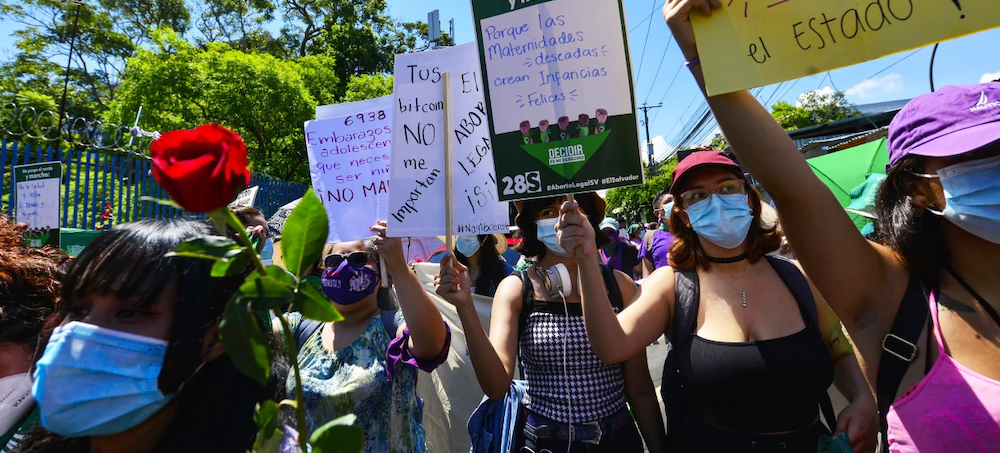
In the same years that availability of abortion in the United States has decreased, battles for greater access in other nations have succeeded. Abortion has been decriminalized in Mexico, Argentina, and Colombia as part of Latin America’s
so-called Green Wave, in which protesters have made green bandannas their symbol, a color choice that stemmed in part, as one Argentine activist told the Washington Post, from the conviction that “the term ‘life’ should return to us.” In 2018, Irish voters elected to make the procedure legal there, and in 2021 the Constitutional Court decriminalized it in South Korea.

Lawmakers and activists around the world have focused not simply on privacy or individual decision-making (a matter between a woman and her doctor, as Democrats often said in the days of Roe) but on abortion as a human right strongly tied to democracy reform, resistance to authoritarianism, and violence against women. In Colombia, reproductive-rights proponents pointed to the cruel absurdity of regulating abortion through the criminal code, an argument that will be ever more relevant in the U.S. as states move to charge both abortion providers and seekers with crimes. In nations where restrictions remain tight, advocates have pushed to recognize those who help patients get abortions as human-rights defenders, ensuring them legal representation.

Creative strategies and political practices that the Democratic Party failed to develop over the past 50 years have blossomed elsewhere. The most successful of them have been holistic, connecting the dots between health care, good governance, maternal mortality, workforce participation, climate justice, economic inequality, and criminal-justice reform.

Catalina Martínez Coral, regional director at the Center for Reproductive Rights in Latin America and the Caribbean, wrote last year after the victory in Colombia, “It wasn’t enough to change our laws. How people thought and talked about abortion had to evolve too.” However long it may take to undo the damage of Dobbs and the decades of erosion that preceded it, the longer and deeper project — of revising not just the way we legislate but the way we think — will remain.

This is one of the most important post-Roe lessons. It was never pass-fail or win-lose. There should never have been a pause in thinking, fighting, arguing, debating, being creative. Democrats are now late to this project. Yet it is also early. As Barbara Lee told me, “If you are in this thing just for a minute? Good-bye. You just have to figure out how to keep at it.”


READ MORE


Contribute to RSN

Follow us on facebook and twitter!

Update My Monthly Donation

PO Box 2043 / Citrus Heights, CA 95611


Sunday, May 15, 2022

RSN: Israel's Policy: Kill the Messenger, Attack the Mourners


Reader Supported News
15 May 22

Big Problems Over Trivial Cash

We are really struggling for the bare-bones budget that we need to function. The reason, the ratio of readers to donors is 1000 to 1.

Many people are helping. Many, many more are not.

Have to break through that barrier.

Situation growing unnecessarily dire, again.

In earnest.

Marc Ash
Founder, Reader Supported News

Sure, I'll make a donation!


If you would prefer to send a check:
Reader Supported News
PO Box 2043 / Citrus Heights, CA 95611

Follow us on facebook and twitter!

Update My Monthly Donation


Reader Supported News
14 May 22

Live on the homepage now!
Reader Supported News

THE FUTILITY OF “EMERGENCY ONLY” CONTRIBUTING: We are blessed with supporters, readers, community members who sustain Reader Supported News month in and month out. But for some reason, only when it becomes clear that the organization is absolutely desperate. If there is any hint of optimism in our fundraising messages, whatsoever the donations stop immediately. Yesterday we said we had “momentum” … that killed the momentum. This is the exact recipe for long, aggravating fundraisers. We can finish with reasonable support. Why not do it?
Marc Ash • Founder, Reader Supported News

Sure, I'll make a donation!


Video showed Israeli police officers attacking mourners at the funeral of Shireen Abu Akleh, a Palestinian American journalist for Al Jazeera who was killed this week in the West Bank. (photo: Ahmad Gharabli/AFP/Getty Images)
Israel's Policy: Kill the Messenger, Attack the Mourners
Belen Fernandez, Al Jazeera
Fernandez writes: "On Friday, May 13, The New York Times website ran the headline 'Israeli Police Attack Funeral of Slain Palestinian Journalist,' which was then updated to 'Israeli Police Attack Mourners at Palestinian Journalist's Funeral."

Unfortunately for Israel, however, Palestinian identity cannot be eradicated at the barrel of a gun.

On Friday, May 13, The New York Times website ran the headline “Israeli Police Attack Funeral of Slain Palestinian Journalist”, which was then updated to “Israeli Police Attack Mourners at Palestinian Journalist’s Funeral”. The journalist in question, of course, was 51-year-old Shireen Abu Akleh, the veteran Al Jazeera reporter shot in the head and killed by Israeli forces on Wednesday in the occupied West Bank.

As the Times reported, Israeli police officers had commenced “beating and kicking mourners” at the funeral procession in Jerusalem, thereby “forcing pallbearers to nearly drop the coffin”. This, at least, was mercifully straightforward information coming from the same news outlet that had just days before opted to use the noncommittal phrase “Dies at 51” in its announcement of Abu Akleh’s murder.

The US newspaper of record has also been known for such journalistic perversions as reducing the 2014 Israeli military slaughter of four Palestinian children playing football in the Gaza Strip to the following headline: “Boys Drawn to Gaza Beach, and Into Centre of Mideast Strife”. One might well have expected a May 13 summary from the Times along the lines of: “Coffin Nearly Falls at Journalist’s Funeral, In Regrettable Embodiment of Israeli-Palestinian Conflict”.

Over the course of her dedicated career, Abu Akleh herself embodied Palestinian humanity by speaking truth to power. Now, the occupying power has spoken back by shooting her in the head and attacking her mourners – a response that can only be classified as acute and multitiered state savagery, in keeping with Israel’s modus operandi of refusing to let Palestinians live, die, or be buried in peace.

There is also the matter of not allowing dead and buried Palestinians to remain dead and buried in peace, which is what happens when, for example, the Israeli military undertakes to bomb cemeteries in Gaza – as though it were somehow possible to retroactively obliterate Palestinian existence by blowing up bones.

To be sure, Israeli attacks on funerals are nothing new – which no one should really find surprising given Israel’s track record of attacking ambulances, hospitals, medical personnel, schools, United Nations compounds, apartment buildings, animals, trees, babies, and pretty much anything else that can be attacked.

Recall the July 29, 2021 assault by Israeli forces on the funeral of 12-year-old Mohammed al-Alami, who had been shot in the chest by Israeli soldiers the previous day as he travelled in a car with his father in the West Bank town of Beit Omar. Al-Alami’s funeral, in turn, led to another: that of 20-year-old Shawkat Awad from the same town, who was killed by Israeli fire while mourning al-Alami.

In another case illustrating Israel’s apparent fetish for funeral attacks, Israeli security forces were unleashed against the March 2, 2022 funeral for 19-year-old Palestinian student Ammar Abu Afifa, killed by an Israeli bullet in the Al-Aroub refugee camp north of Hebron. Even the Times of Israel, a fiercely Zionist outfit, felt compelled to run the headline: “Israeli troops shot dead a Palestinian teen. The army hasn’t said what he did wrong”.

Fast forward two months to Abu Akleh’s funeral, and the violent footage of baton-wielding Israeli police has earned a rare denunciation from outgoing White House press secretary Jen Psaki, who described the scenes as “deeply disturbing”. Not that the United States does not engage in deeply disturbing behaviour on a regular basis, including vis-à-vis funerals.

Anyway, Israel and the US have long been two peas in a sadistic pod; Israeli malevolence simply has a more intense geographic focus. Incidentally, May 15 – a mere two days after Abu Akleh was buried in Jerusalem – marks the seventy-fourth anniversary of the Nakba, when Palestinians mourn the founding of the state of Israel on Palestinian land in 1948. This entailed the destruction of more than 500 Palestinian villages, the killing of more than 10,000 Palestinians, and the expulsion of at least three-quarters of a million more – the start of a bloody trajectory that continues to this day.

Unfortunately for Israel, however, Palestinian identity cannot be eradicated at the barrel of a gun; nor will Palestinians spontaneously forget their existence now that Israeli security forces have arrested mourners for carrying the Palestinian flag at Abu Akleh’s funeral. And as Israel drives the final nails into the coffin of its own projected image of humanity, the truth is that any pretensions to Israeli humaneness should have been buried a long time ago.


READ MORE


Ukrainian Refugees in Russia Report Interrogations, Detention and Other AbusesRussian servicemen oversee the boarding of a bus on May 6 for civilians who were evacuated from the Azovstal steel plant in Mariupol, Ukraine. (photo: Alessandro Guerra/EPA-EFE/Shutterstock)

Ukrainian Refugees in Russia Report Interrogations, Detention and Other Abuses
Michael Birnbaum and Mary Ilyushina, The Washington Post
Excerpt: "Russian authorities are forcing Ukrainians who seek safety to submit to strip searches and interrogations, placing some refugees in guarded camps, stripping them of their vital documents and in some cases forcing them to remain in Russia, according to displaced Ukrainians, volunteers helping refugees, and Ukrainian and Western officials."

They say they’re forced into ‘filtration camps’ to face strip searches and harsh questioning

Russian authorities are forcing Ukrainians who seek safety to submit to strip searches and interrogations, placing some refugees in guarded camps, stripping them of their vital documents and in some cases forcing them to remain in Russia, according to displaced Ukrainians, volunteers helping refugees, and Ukrainian and Western officials.

At least 1 million Ukrainian civilians have fled the fighting into Russia, according to Russian Defense Ministry numbers that the Ukrainian government also accepts as valid. In many cases, especially in the devastated city of Mariupol, residents were effectively forced into Russia with no option to seek refuge on friendlier soil. In other cases, especially in the breakaway territories of eastern Ukraine, the travel to Russia was voluntary.

Almost everyone has had to pass through “filtration camps,” a perilous process in which Ukrainians are strip-searched and interrogated. People suspected of having sympathies to the Ukrainian military are being detained and tortured, according to refugees, representatives of volunteer organizations, and Ukrainian and U.S. officials.

“They are disappearing people who talk openly about pro-Ukrainian positions,” said Lyudmila Denisova, the Ukrainian parliament’s human rights ombudsman.

Not every story has ended badly. In some cases, Ukrainians who wanted to pass through Russia and go to another country were able to do so, even if they were staunchly pro-Kyiv. Some spoke appreciatively of help from local Russian humanitarian groups.

But many Ukrainians have been transferred to a constellation of temporary refugee settlements across Russia’s vast territory, leaving them trapped inside the country that had targeted them with hatred and leveled their homes.

At the camps, the questioning often continues, refugees said.

“‘Who are you for?’ they asked. ‘For Russia or for Ukraine?’” said Bohdan, a 26-year-old construction worker from Mariupol, who escaped the city with his wife and 7-year-old daughter in mid-March when buildings in their neighborhood began collapsing because of heavy fighting. He spoke on the condition that his family name not be published because he fears for his security.

He fled into Russian-held territory, the only place he could reach at the time. Eventually, he made his way to a refugee center in Yalta, in Crimea, on the site of an abandoned Soviet health resort that he said had not been renovated since then. He was repeatedly interrogated about his loyalties.

“I said, ‘You are interesting people. There was a war happening in my homeland, Russian soldiers attacked, and my house was smashed. And you want me to shout pro-Russian proclamations?’” he recalled telling them.

Russian officials also questioned him about the location of Ukrainian military positions inside Mariupol, he said.

He and his family went on to leave Russia in mid-April with the help of some foreign volunteer organizations, he said, and are now in Stockholm. The rest of his group of refugees was taken to a run-down health resort somewhere in a remote area of Russia, more than 600 miles inside the border, he said.

Repeated rounds of questioning

Alexander Shevchuk, 19, who studied information technology at a local college, had lived with his family on the eastern bank of the Kalmius River that bisects Mariupol, close to the headquarters of the pro-Kyiv Azov Regiment that has been a target of Russian firepower.

From the ninth floor of a nearby apartment building, he could witness the city’s methodical destruction by Russian artillery. “For the first time, I understood what apocalypse looked like,” he said. When he was caught in the crossfire inside a shuttered supermarket while hunting for food, a fragment of an artillery shell lodged in his back, he said. Many others around him were killed.

When soldiers from the breakaway Donetsk People’s Republic captured the area where Shevchuk’s family was hiding at the end of March, there was little choice but to try to make it to Russia. Even before he reached the border, he said, he endured repeated rounds of questioning by separatist soldiers, Russian border guards and agents of Russia’s FSB, the internal security agency; they all tried to establish whether he had taken part in fighting. He was strip-searched repeatedly and checked for pro-Ukrainian tattoos and the calluses and bruises that can be signs of having handled weaponry.

Shevchuk said he was questioned about his long hair and goatee, which soldiers and border agents believed was a sign of Ukrainian nationalism. Men who had military certificates that suggested they had actively served in the Ukrainian army were taken into custody, he said. One acquaintance of his was taken to another building, then beaten, tortured and robbed before he was released again.

“I was terribly afraid,” Shevchuk said. “I was scared they would say I was from Azov,” the pro-Kyiv battalion, he said.

Shevchuk and his family ultimately spent about a week at a “filtration camp” on the Ukrainian side of the border, awaiting a final round of questioning. The refugees were given questionnaires asking their attitudes about the Ukrainian military, the Ukrainian government and various elements of Ukrainian life. Shevchuk and the others wrote “negative,” since they figured that was the correct response. “We didn’t want any problems,” he said.

Interrogators also checked phones and tablets, looking at apps and photos to try to find any trace of military combat, and removed SIM cards from some of them because, they said, they could be used for targeting by the Ukrainian military.

If any of the Ukrainians slipped up and referred to what had happened as “war,” the interrogators would immediately become aggressive, Shevchuk said. “Why do you think this is war? War against whom?” he said they asked. “You know you shouldn’t say this word.”

The ordeal continues

Many refugees are careful about expressing their views openly on Russian soil, unsure about the loyalties of other displaced Ukrainians around them and of the Russians who are helping them.

“They will never say anything against Russia, because they don’t trust us,” said Laila Rogozina, head of the reception office at the Civic Assistance Committee, a Russian volunteer organization that helps refugees and has been harassed by the Kremlin.

The treatment of refugees inside Russia appears to vary widely. Much depends on luck. Some border guards prevent Ukrainians without the proper documents from leaving Russia. Others are laxer, according to Ukrainians who have made the passage.

“It’s like roulette. They can let you out or send you back” at the border, said Kirill Zhivoy, a coordinator at Volunteers in Tbilisi, a group in the capital of Georgia that is helping Ukrainians who manage to cross the border from Russia.

Some refugees are able to find decent short-term housing. Others have access only to guarded camps where refugees cannot come and go as they please.

Ukraine’s Western backers have expressed alarm.

“If women and children and elderly and other individuals are being displaced forcibly,” Michael Carpenter, the U.S. ambassador to the Organization for Security and Cooperation in Europe, told reporters last week, “that would be a war crime and it would just be appalling as a completely uncivilized endeavor.”

The Russian Foreign Ministry has said the reports of forcible displacement are “lies.”

“We are talking about checkpoints for civilians leaving the zone of active hostilities,” the Russian Embassy in Washington wrote in a Telegram post. “In order to avoid sabotage operations by Ukrainian national battalions, soldiers of the Russian armed forces thoroughly inspect vehicles heading to safe regions. We will detain all bandits and fascists. The Russian military does not create any obstacles for the civilian population, but helps them stay alive and provides them with food and medicines.”

Many Ukrainians arrive in Russia with little more than the clothes on their backs, leaving them few choices. Some lack money for bus tickets or understand the country’s labyrinthine bureaucracy. Others are unfamiliar with Russia’s vast geography, and do not appear to understand that promises of extra support and temporary housing in Russia’s eastern regions can take them thousands of miles away from Ukraine.

“Some people from Mariupol said they’d already decided to go to the Khabarovsk region” on Russia’s far eastern Pacific coast, a six-day train journey from Moscow, said Danil Makhnitsky, the head of a Moscow-based volunteer organization that is helping refugees with supplies and practical support. Some of the refugees don’t understand where they are going when they sign up, said Makhnitsky, whose group goes by the name “Society. Future.”

Trapped in Russia

If Ukrainians want assistance from the Russian government — often a necessity, since Ukrainian cash can’t be exchanged into Russian rubles — they often need to give up their passports to get it. Both temporary housing and asylum require turning over documents to the authorities. It can be difficult to get them back.

“They are taking Ukrainians hostage,” said Denisova, the Ukrainian human rights ombudsman.

Even Ukrainians who say that Russia was their preferred destination say they worry about the challenges of being a refugee there.

“The migration service said that if I want my passport back, I will need to write an official letter saying that I am refusing this temporary residence asylum certificate,” said Marina Tsymbalova, 33, a refugee from Mariupol who is in Moscow with two of her daughters and has applied for a one-year temporary asylum status in Russia that required her to hand over her Ukrainian documents.

“I want to go back at some point,” she said. “My mom is there, and my older daughter. I worry about them.”

Once Shevchuk and his family had reached the Russian side of the border, they spent about a week in temporary housing for refugees before buying bus tickets to neighboring Georgia. He said they had been able to move around freely and had wanted to leave as quickly as possible. It was oppressive to stay in a country where most people support the war and billboards everywhere are plastered with the letter Z, which has become a symbol of the invasion. Inside Russia, it was not possible to express his views openly, he said.

“We had a peaceful life. They took it away from me and left me with nothing,” he said. “All of a sudden they tell you you’re being saved. Saved from what? I’ve never seen fascists or Nazis.”


READ MORE


The Antiabortion Movement's Track Record: Constant ViolenceAntiabortion demonstrators hold a protest outside the Planned Parenthood Reproductive Health Services Center in St Louis, Missouri. (photo: Saul Loeb/AFP/Getty Images)

The Antiabortion Movement's Track Record: Constant Violence
Ari Paul, Jacobin
Paul writes: "News coverage of the antiabortion movement tends to omit its history of violence. So we're here to remind you: the antiabortion right has a violent track record, from attacking clinics and patients to assassinating abortion providers."

News coverage of the antiabortion movement tends to omit its history of violence. So we're here to remind you: the antiabortion right has a violent track record, from attacking clinics and patients to assassinating abortion providers.

Politico’s leak of a draft Supreme Court opinion overturning Roe v. Wade has generated a fair share of news coverage about the future of abortion rights and the history of the antiabortion movement.

A number of pieces have explored how conservatives got us to this moment and how abortion rights have divided US politics for half a century. Journalists and commentators have examined the judicial philosophy of antiabortion activists, the public’s opinion on reproductive rights, and how abortion became a hot-button topic at election time.

But one topic has largely been missing from mainstream coverage: the role of right-wing violence in the movement against reproductive freedom. Yes, antiabortion forces defeated Roe through dogged political campaigning. But they also used outright violence, including attacks on abortion clinics, doctors, and patients.

This isn’t exactly a secret. In 1991, the American Journal of Obstetrics and Gynecology warned that there was an “epidemic of antiabortion violence in the United States.” From 1977 to 1988, the journal reported, there had been a hundred ten instances of arson, firebombing, or bombing of abortion clinics, and over the same stretch “the national rate of violence was 3.7 per 100 abortion providers and 7.2 per 100 nonhospital abortion providers.” One study a few years earlier, published in the American Journal of Political Science, found that antiabortion crime was concentrated in areas with a “greater acceptance of violence toward women.”

When filing their amicus brief in Dobbs v. Jackson Women’s Health Organization, the case that will likely overturn Roe, a group of feminists made sure to mention the antiabortion right’s violent track record:

Acts of anti-abortion violence during the period from 1977 to 2019 include at least 11 murders, 26 attempted murders and at least 756 threats of harm or death, 620 stalking incidents and four kidnappings. Crimes directed at clinic facilities have included at least 42 bombings, 189 arsons, 100 attempted bombings or arsons, and 662 bomb threats. The actual numbers are likely much higher.

Among these incidents were the 2009 assassination of George Tiller, a Wichita, Kansas doctor who performed late-term abortions, while he was at church and a 1997 abortion clinic bombing outside Atlanta that killed two and injured six. (The perpetrator of the latter, antiabortion extremist Eric Rudolph is currently serving a life sentence at the ADX Florence Supermax prison.)

Eleanor Bader, coauthor of Targets of Hatred: Anti-Abortion Terrorism, wrote in an email to Jacobin that antiabortion zealots have “stalked provider’s children with relentless messaging that their ‘parent kills babies,’ and shot at, and ultimately killed, more than 10 clinic staff people, including doctors and receptionists. This violence has not been directed to any other type of medical care and has led to increased antiabortion stigma. This relentless movement has fought against all gains made by women and has had tremendous success in its efforts to roll back feminist progress.” Since 2017, abortion rights advocates say they’ve seen a general rise in antiabortion violence.

While it’s commonly thought that these acts are the random outbursts of lone wolves, at least one study, focusing just on incidents of violence in Pensacola, Florida, found:

There is evidence that many of the militant anti-abortion groups have affiliations with the Ku Klux Klan, various militias and militant anti-taxation groups. One of these groups, the United States Taxpayers Party, is preparing a training facility to teach “militant” and “unmerciful” techniques. Two of its leaders, Jeffrey Baker and Howard Phillips, have publicly advocated the killing of abortion providers. Although the number of violent extremists is small, their impact has been disproportionately large.

In recent days, some commentators have correctly noted this violent strain of the antiabortion right. Writing in the Washington Post, Monica Hesse gave a nod to “abortionists who go to work in bulletproof vests in picketed buildings,” and USA Today outlined how abortion clinics are reassessing their safety measures in light of Roe’s imminent demise.

But for the most part, this major piece of post-Roe history has been rendered a footnote. That not only distorts the historical record, it whitewashes the antiabortion movement. Because those seeking to guarantee reproductive freedom by providing abortions haven’t just been harassed and defamed — they’ve been under the constant threat of violence.


READ MORE


ICE Released Sick and Dying Detainees, Avoiding Responsibility"Why is ICE choosing to release people from custody who are on their deathbeds while they're hospitalized?" (image: Clay Rodery/LA Times)

ICE Released Sick and Dying Detainees, Avoiding Responsibility
Andrea Castillo and Jie Jenny Zou, Los Angeles Times
Excerpt: "Johana Medina Leon spent years advocating for the LGBTQ community and HIV awareness before fleeing the violence she faced as a transgender woman in El Salvador. The 25-year-old nurse technician had hoped to start a new life in California."

Johana Medina Leon spent years advocating for the LGBTQ community and HIV awareness before fleeing the violence she faced as a transgender woman in El Salvador. The 25-year-old nurse technician had hoped to start a new life in California.

But just over a month after she was detained by U.S. Immigration and Customs Enforcement and booked into New Mexico’s Otero County Processing Center, her health was in free-fall. She was transferred to an El Paso hospital, where she died on June 1, 2019.

Medina Leon’s name wasn’t among the nine deaths recorded by ICE that year. She had been hurriedly released from custody while hospitalized, just before succumbing to the same failures in care she had worked to prevent for others.

The circumstances surrounding Medina Leon’s release and death were discovered among more than 16,000 pages of documents disclosed as part of an ongoing lawsuit brought by The Times against the U.S. Department of Homeland Security seeking records of abuse at immigration detention centers. The documents provide a rare look into one of several known instances in which detainees were discharged on the edge of death, underscoring long-standing complaints from advocates about uncounted deaths of people who have been in ICE custody.

Medina Leon’s case was investigated by the DHS Office of Inspector General, a watchdog agency with oversight of ICE that has recently come under fire from transparency advocates for how it handles investigations.

Emails reviewed by The Times show immigration officials moved with unusual speed to remove Medina Leon from custody. While it took six weeks and several visits with medical staff before she saw a doctor in detention, ICE expedited her release in less than six hours — relieving the agency of responsibility when she died four days later.

ICE’s field medical coordinator initiated the rapid-fire process on May 28, recommending Medina Leon’s release from Otero. The facility is operated by Management and Training Corp., a private prison company known as MTC.

“If this detainee were to become further seriously ill there is a potential for a poor outcome,” the official wrote, noting that Medina Leon was “so underweight.”

In an email the same day marked “high” importance, another ICE official replied that her “vitals do not look good.”

“Could we please get detainee property for full release ready ASAP,” a detention supervisor responded.

Within hours of her being admitted to the hospital, two ICE agents arrived at Medina Leon’s bed with parole paperwork for her to sign. One of the agents later told investigators that the process was being expedited though he “was not aware of the reasons for the rush.” He said he had never before served release documents at a hospital.

That night, a status update noted Medina Leon’s condition was “serious/critical.” A final email came 20 minutes later: “The detainee has been served with parole paperwork, and is no longer in ICE custody.”

ICE spokeswoman Paige Hughes declined to comment on Medina Leon’s case, but wrote in a statement that the agency “takes very seriously the health, safety, and welfare of those in our care, including those who come into ICE custody with prior medical conditions or who have never before received appropriate medical evaluation or care.”

MTC spokesman David Martinson also declined to comment on the case.

“We take the medical care of detainees very seriously,” he wrote in a statement, adding that “detainees have access to appropriate and necessary medical, dental, and mental health care, including emergency services.”

The swift processing of Medina Leon’s parole was highly unusual — such reprieves typically take several days or weeks. During the Trump administration, ICE more often released detainees on bond, which requires families to front thousands of dollars to help loved ones avoid remaining in detention for months as they await decisions on their immigration cases. Others were released under different discretionary orders of recognizance or supervision while their case was pending.

Advocates for detainees say Medina Leon’s death highlights a history of actions by ICE officials that allow the agency to avoid responsibility for sick or dying detainees. ICE has long been criticized for inadequate medical care provided by detention facilities, most of which are managed by for-profit companies like MTC.

After the first private prison contract was granted in 1983 for a Texas facility, the federal government’s immigrant detention network expanded until it peaked in 2019 with an average daily population of more than 55,000. So far this year, that figure is around 20,000. Nearly 80% of detainees are held in for-profit facilities, though the Biden administration has closed or scaled back several troubled facilities and has favored alternatives such as using ankle monitors to track those awaiting immigration court proceedings.

Despite detaining hundreds of thousands of people nationwide, ICE has said that fewer than a dozen detainees die in custody each year. Recorded deaths have remained low even during the pandemic. ICE reported a high of 21 deaths in 2020 and just five for all of 2021. No deaths have been recorded so far in 2022.

The agency began recording in-custody deaths in 2009 as part of reforms during the Obama administration. That same year, ICE officials admitted they had failed to disclose 10 additional deaths in a list of 90 that the agency delivered to Congress. In 2018, Congress required ICE to publicly release reports on every in-custody death within 90 days. But ICE has failed to comply since the mandate began, according to a September 2020 congressional oversight report.

The American Civil Liberties Union is suing ICE for access to records about deaths of detainees who were released from custody in their final days after experiencing medical emergencies. The lawsuit names four people — Medina Leon and three men who were released while they were hospitalized and had fallen into comas.

“Why is ICE choosing to release people from custody who are on their deathbeds while they’re hospitalized?” said Eunice Cho, an attorney at the ACLU. “The impact is, of course, that ICE is then exempt from reporting requirements, investigation requirements and financial requirements from the deaths that have taken place” as a result of inadequate healthcare.

‘We wanted to change the world’

For nearly a decade, Medina Leon volunteered for Alexia Sanchez’s advocacy organization, Gay Sin Fronteras, in El Salvador.

Sanchez said Medina Leon accompanied queer and transgender people to medical appointments and pharmacies. She talked people out of acting on thoughts of suicide. And she made hospital visits to ensure that doctors treated patients with HIV, which is heavily stigmatized in El Salvador. Advocates say more than 500 trans people have been killed there since 1995.

The friends saw each other regularly until Medina Leon stopped showing up at organizing efforts. Sanchez, who is also trans, fled months later and now lives in Los Angeles.

“We wanted to change the world,” Sanchez said. “Knowing what happened to Johana was a very tough blow.”

After presenting herself to border officials near El Paso and requesting asylum, Medina Leon was transferred on April 14, 2019, to the Otero County Processing Center. Like most immigrants detained by ICE, she had no criminal record.

Two days into her stay at Otero, Medina Leon made the first of at least five requests for medical attention, often complaining of stomach pain, vomiting and nausea. Homeland Security Department records reviewed by The Times show nurses prescribed antacids, attributing her condition to the facility’s “spicy food” and a prior history of gastrointestinal issues.

Medina Leon marked the top of each handwritten request “urgent.”

“I can’t keep down the food in any way because of my gastric issue and it gives me constant stomach pain,” she wrote on May 11. “I’ve lost 13 pounds and would like to know if I can be seen.”

By Memorial Day weekend — five weeks into her detention — Medina Leon had lost nearly 18% of her body weight, going from 126 to 103 pounds. Her final request, inquiring about a rash that had developed on her forehead, appeared more desperate: “Urgent please.”

A nurse flagged her case as “serious,” jotting down a growing list of symptoms that now included weakness, a sore throat, cough and acid reflux. She referred Medina Leon for a follow-up appointment with Otero’s on-call nurse practitioner, but he never saw her.

A wrongful-death lawsuit filed by Medina Leon’s family claims that another medical request she made the next day went unanswered. MTC policy requires medical staff to review requests within a day — or immediately in urgent situations. Staff then have another 24 hours to evaluate sick detainees in person.

In depositions, nurses who treated Medina Leon said that, at the time, Otero staff relied on a paper system to refer detainees’ medical requests to providers. Under that system, one staffer testified, it could take “a couple days” for a provider to respond to a referral.

A nurse practitioner who was supposed to treat Medina Leon on May 24 told inspector general investigators that he had not heard about her case. Two days later, when he called to check in on patients during his next scheduled shift, he was told “nothing exciting was awaiting.”

The nurse practitioner, who spent just a few days a week at Otero, also had a full-time job at a clinic and owned a restaurant, according to a deposition transcript. He admitted in his testimony that he never saw Medina Leon in person.

In a separate deposition, Otero’s warden acknowledged the nurse practitioner had violated MTC’s company policy by stamping his name on Medina Leon’s medical record without actually seeing her.

By the time Medina Leon saw a doctor on May 27, her skin had yellowed, her temperature was fluctuating and her heart struggled to pump blood. Unsure of what was causing her rapid decline, staff ordered tests for hepatitis, HIV and chickenpox.

The next morning, the wrongful-death lawsuit claims, Medina Leon was found unconscious in her cell. Inspector general records show she had been dizzy, threw up her breakfast and complained of chest pains.

Sanchez said Medina Leon had always radiated optimism, frequently telling friends, “Everything is possible.” But when her HIV test came back positive May 28, she grew distraught, covered her face and cried, a staffer told investigators.

Within hours, an ambulance was called to rush Medina Leon to Del Sol Medical Center in El Paso. Staff waited by her side with a defibrillator in case her heart gave out.

As word of Medina Leon’s plummet spread, ICE officials moved swiftly to process her parole.

A death certificate listed sepsis — a life-threatening condition that arises when the body struggles to fight an infection — as the primary cause of death, with pneumonia and HIV as underlying causes. A private autopsy ordered for the family’s lawsuit found a blood clot in Medina Leon’s lungs and a fungal infection that had spread to multiple organs.

An ICE statement at the time said her death was “another unfortunate example of an alien who enters the United States with an untreated, unscreened medical condition.”

But behind the scenes, officials at the inspector general’s office and ICE had begun an internal investigation that would lead to more questions than answers.

Medical staff involved in her care agreed more could have been done sooner, though they disagreed over who or what was at fault. The doctor who rushed Medina Leon to the hospital told investigators he thought someone should have phoned him earlier because he was on call 24 hours a day. Meanwhile, a nurse told investigators that company protocol allowed emergency calls only for patients in “acute distress.”

Accounts also differ as to Medina Leon’s awareness of her HIV status. One nurse told investigators Medina Leon said she might have HIV, mentioning that she was stuck by a dirty needle while working as a nurse in El Salvador a year earlier. But the doctor who treated her ordered the HIV test as part of a slate of exams that included chickenpox and syphilis. And ICE’s medical coordinator said Medina Leon denied any history of known HIV exposure when they spoke at the hospital.

Under ICE policy, detainees receive comprehensive health assessments within two weeks of being booked into a facility. But staff at the Otero detention center told investigators that lab tests are not standard and are typically ordered by doctors in specific cases for certain preexisting conditions. ICE doesn’t proactively screen detainees for HIV.

ICE’s own medical experts had warned the agency about patients like Medina Leon. Two months before her death, the same medical coordinator who recommended Medina Leon’s release suggested the agency begin treating transgender detainees as “chronic” patients in order to facilitate earlier diagnoses.

The coordinator had also flagged several healthcare deficiencies at Otero. Among the issues: Detainees with identified chronic conditions weren’t evaluated quickly enough, the level of urgency for cases wasn’t documented by providers in referrals to outside specialists, and detainees arriving with prescribed medications were “not having their medications continued.”

Despite a slew of unresolved questions, investigators closed their case on Medina Leon’s death in September 2020, concluding there was no “evidence of malfeasance or policy violations.” Aside from the ICE medical coordinator who recommended her release, Medina Leon’s entire medical team of more than seven people was employed by private contractor MTC.

In an email, the Office of Inspector General stood behind its investigation, which found “no misconduct by DHS staff or contractor personnel.” Officials declined to explain the decision to investigate Medina Leon’s death, but noted that it was one of two ICE out-of-custody deaths reviewed by the agency since 2003.

ICE spokeswoman Hughes noted that the agency’s policy of reviewing detainee deaths was updated in October 2021 to include deaths that occur within a month of release from custody “when appropriate, to ensure accountability and maximum transparency.”

‘A death sentence’

Healthcare experts say deaths like Medina Leon’s are avoidable.

“Young women don’t have to die of sepsis, for God’s sake,” said Coleen Kivlahan, medical director of the human rights asylum clinic at UC San Francisco. “Was this death preventable by early screening and early care? The answer would be yes.”

Kivlahan said any medical provider with experience treating trans patients would have checked for HIV early on, particularly in cases of severe weight loss. Many of the trans patients she sees in her clinic — who are seeking asylum in the U.S. after trauma and abuse in their home countries — are HIV-positive, but go largely undiagnosed while in detention.

Activists quickly sounded the alarm about Medina Leon’s death in 2019, noting its striking similarities to that of another trans woman who died in ICE custody a year earlier.

As with Medina Leon, Roxsana Hernandez’s HIV went untreated throughout her detention until her condition worsened, landing her in the hospital in 2018. She died of dehydration and complications from HIV less than a month after arriving at the Tijuana border from Honduras and requesting asylum. Hernandez never received an intake medical screening, said Dale Melchert, who led a wrongful-death lawsuit for the Transgender Law Center.

Unlike with Medina Leon, Hernandez’s death was officially recorded by ICE, requiring the agency to notify Congress and disclose some records.

Both women made repeated requests for medical attention as they experienced telltale signs of untreated HIV: weight loss, yellowing skin, fever and disorientation.

“In both Roxsana and Johana’s cases, treatable medical conditions became a death sentence,” Melchert said. Had the government provided Hernandez “with the care she was entitled to within 12 hours of custody, she would be here today,” he said.

Watchdog groups have urged Congress to investigate and publicize death reviews for people released from immigration custody just before they die, including during a 2019 House committee hearing on oversight of ICE detention three months after Medina Leon’s death.

Advocates say quantifying how many cases like Medina Leon’s exist is difficult because ICE has historically refused to provide basic information about detainees who die just after being released from custody. In addition to Medina Leon, the ACLU lawsuit names Martin Vargas Arellano, Jose Ibarra Bucio and Teka Gulema, each of whom died soon after release.

Vargas Arellano contracted COVID-19 at the Adelanto ICE Processing Facility in San Bernardino County and had a stroke. The 55-year-old from Mexico was released from custody last year while brain-dead at a local hospital. He had repeatedly asked to be released from detention because of health conditions including diabetes, hypertension and hepatitis C.

Ibarra Bucio, a 27-year-old from Mexico who was also detained at Adelanto, had a brain hemorrhage in 2019 and was transferred to a hospital while comatose. He died four weeks after being released from ICE custody when his family took him off life support.

Gulema, a 33-year-old Ethiopian man, became paralyzed from a bacterial infection while detained at a facility in Alabama and was transferred to a hospital where he remained for nearly a year. He was released from custody weeks before he died in 2016 at the hospital.

“How many more individuals are out there that we don’t know about?” Cho said.

There are more. Guatemalan toddler Mariee Juárez, who acquired a viral lung infection while detained in Texas in 2018 and died at a hospital weeks after being released. Oscar López Acosta, who was infected with COVID-19 in an Ohio facility in 2020 and was released as his health deteriorated and died two weeks later. And Saliou Ndiaye from Senegal, who attempted suicide at Adelanto in 2017 and was released from custody while on life support.

Hoping to ensure the government’s continued responsibility for Ndiaye’s care, his lawyer Carrye Washington asked an immigration judge to find that ICE could not release an unconscious person and order him back into custody. Washington said the judge declined to intervene, and Ndiaye remains on life support.

Ten days passed after Vargas Arellano died before his lawyer learned about it by filing a missing-person’s report and calling the coroner’s office.

A court-appointed investigation into his death led to a scathing special master’s report last July on the actions of ICE, Adelanto and its contract healthcare provider, Wellpath. The report notes that the decision to release Vargas Arellano while comatose and near death resulted in his being “moved off the ‘books’ at ICE.”

“Because ICE released him to the hospital, all three were relieved of their obligations to report his death,” the report states. “Further, this seems to have been the sole purpose of the release.”

ICE declined to comment on Arellano’s case and others reviewed by The Times.

Dr. Marc Stern, a physician specializing in correctional healthcare who has served as an expert for the DHS Office for Civil Rights and Civil Liberties, said that it may be more fiscally responsible to release someone from custody who is hospitalized. That way, he said, the government avoids spending taxpayer money on guards and paying medical bills that some hospitals already cover for low-income patients.

But Stern said that flouting reporting requirements indicates there could also be a political motivation in ICE’s release of sick detainees. All deaths should be reported, he noted, particularly when someone’s health deteriorates under ICE’s watch.

“Our system is fundamentally flawed in not defining deaths completely enough,” Stern said.

Rafe Foreman, a Texas attorney who represented Medina Leon’s family in their wrongful-death lawsuit, said he believes ICE has an incentive to release people who are about to die.

The case named as defendants MTC and its employees — the Otero facility warden and four healthcare providers. ICE and the Department of Homeland Security were not parties to the lawsuit, which was dismissed in court. Foreman said the case was resolved but declined to say whether there was an out-of-court settlement. Medina Leon’s parents declined to comment.

“This was the worst case of medical malpractice that I’ve seen in a while,” Foreman said. “From the minute she walked in there until she died, she was neglected.”

In court filings, lawyers for MTC denied the allegations, argued that Medina Leon’s family had no basis to receive punitive damages and said the case should be dismissed.

The lawyers also spelled out what happened after she died: No medical personnel were disciplined, and “no changes in policy, practice, protocols or procedures occurred.”

READ MORE


Leonard Peltier's Continued Imprisonment Is an 'Open Wound for Indian Country'Leonard Peltier has been in prison for over four decades. (photo: Jeffry Scott)

Leonard Peltier's Continued Imprisonment Is an "Open Wound for Indian Country"
Democracy Now!
Excerpt: "Calls are growing for President Biden to grant clemency to Leonard Peltier, the 77-year-old imprisoned Native American activist who has spent 46 years behind bars for a crime he says he did not commit."

Calls are growing for President Biden to grant clemency to Leonard Peltier, the 77-year-old imprisoned Native American activist who has spent 46 years behind bars for a crime he says he did not commit. Amnesty International considers Peltier a political prisoner, and numerous legal observers say his 1977 conviction for alleged involvement in killing two FBI agents in a shootout on the Pine Ridge Reservation was riddled with irregularities and prosecutorial misconduct. “At this point, there’s no reason other than vindictive revenge for him to be in prison,” says writer and activist Nick Estes, co-founder of the Indigenous resistance group The Red Nation. “He survived COVID, he’s in poor health, and the man deserves to be with his people,” says Estes, who calls for a full congressional investigation into the deaths of Indigenous activists on Pine Ridge Reservation, where the shootout that led to Peltier’s arrest occurred.

AMY GOODMAN: But, Nick Estes, before we end, I wanted to ask you about Leonard Peltier, the 77-year-old Anishinaabe Lakota Native American activist who’s been in prison for 46 years for a crime he says he did not commit. Leonard Peltier was a member of the American Indian Movement, convicted of involvement in the killing of two FBI agents in a shootout on the Pine Ridge Reservation in South Dakota in 1975, his arrest and trial marred by prosecutorial conduct, withheld evidence, coerced and fabricated eyewitness testimony and more. Amnesty International has long called him a political prisoner. In late April, Hawaii Senator Brian Schatz asked Attorney General Merrick Garland about calls to grant Peltier clemency.

SEN. BRIAN SCHATZ: A final question, easy one: What is your position on clemency for Leonard Peltier?

ATTORNEY GENERAL MERRICK GARLAND: So, this is a matter that goes into — applications go to the pardon attorney. Pardon attorney makes recommendations through the deputy attorney general to the president. And so I’m not going to comment on that now.

SEN. BRIAN SCHATZ: Can you comment on where we are in the process?

ATTORNEY GENERAL MERRICK GARLAND: I don’t — I assume, but don’t know, that an application has been made. I actually don’t even know whether — I mean, I’ve read about this in the press, so I don’t know anything more about it than what I’ve read in the press.

SEN. BRIAN SCHATZ: And this doesn’t cross your desk?

ATTORNEY GENERAL MERRICK GARLAND: Certainly not as an initial or even secondary matter. This goes to the pardon attorney and then the deputy attorney general. I’m not saying I wouldn’t be involved, but it certainly has not crossed my desk.

SEN. BRIAN SCHATZ: Thank you very much.

AMY GOODMAN: Nick Estes, can you talk about Leonard Peltier? You recently currently co-wrote a piece for The Guardian headlined “Leonard Peltier is America’s longest-held Indigenous prisoner. He should be freed.”

NICK ESTES: Yeah. It’s important to point out, first of all, Leonard Peltier is a product of this federal Indian boarding school system. He was actually — his name was actually mentioned in the press conference yesterday on this particular initiative. And in fact, it’s also important to point out that during her tenure as a congresswoman for New Mexico, Deb Haaland was a strident advocate for Leonard Peltier’s release. And so we’re seeing a growing momentum around the question of Leonard Peltier’s continued unjust imprisonment. And the Obama administration had an opportunity to correct the course of history in releasing Leonard Peltier or granting him clemency, because that’s the only option on the table right now for his release.

But he is an elder. He’s an endeared elder to his community. Turtle Mountain Ojibwe have a plan in place so that once he is released, he has housing and he’s taken in by the community itself. You have Representative Ruth Buffalo from North Dakota, who’s up for reelection this year, who’s been a strident advocate for Leonard Peltier, who talks to Leonard Peltier on a weekly basis. And so you have this massive support from Indian Country, from elected officials to tribal governments, advocating for his release.

And if we want true justice in this country, whether it’s for the boarding school system, something that Leonard Peltier himself was fighting against as part of the American Indian Movement, then we also need to not only advocate for his release, but advocate for a full congressional investigation into the conditions that led to the shootout at the Jumping Bull property in 1975 and the multiple, the tens, you know, the dozens of deaths that have gone unsolved on the Pine Ridge Indian Reservation during the so-called reign of terror following the occupation of Wounded Knee in 1973.

And so, this is an open wound for Indian Country. It’s an open wound for the federal government. And his committee is advocating for healing. And the first step of that process is to grant him clemency. At this point, there’s no reason other than vindictive revenge for him to be in prison. He survived COVID, he’s in poor health, and the man deserves to be with his people.

AMY GOODMAN: Why don’t we end with Leonard Peltier’s voice? By the way, his new attorney is a former chief judge from Tennessee. But I spoke to Leonard, oh, 10 years ago — that’s this clip — on the phone in a Florida prison.

AMY GOODMAN: Leonard, this is Amy Goodman from Democracy Now! I was —

LEONARD PELTIER: Oh, hi, Amy. How are you?

AMY GOODMAN: Hi. I’m good. I was wondering if you have a message for President Obama?

LEONARD PELTIER: I just hope he can, you know, stop the wars that are going on in this world, and stop getting — killing all those people getting killed, and, you know, give the Black Hills back to my people, and turn me loose.

AMY GOODMAN: Can you share with people at the news conference and with President Obama your case for why you should be — your sentence should be commuted, why you want clemency?

LEONARD PELTIER: Well, I never got a fair trial, for one. … They wouldn’t allow me to put up a defense, and manufactured evidence, manufactured witnesses, tortured witnesses. You know, the list is — just goes on. So I think I’m a very good candidate for — after 37 years, for clemency or house arrest, at least.

AMY GOODMAN: I was speaking to Leonard Peltier at a public forum a day after a major event at the Beacon Theatre had taken place in his honor and to raise money for his support here in New York City. Well,, Nick Estes, we thank you for being with us, writer, historian, author of Our History Is the Future: Standing Rock Versus the Dakota Access Pipeline, and the Long Tradition of Indigenous Resistance, co-founder of The Red Nation.

You can link to all of our interviews with Leonard Peltier, as well as my questioning of President Clinton at the time, whether he would be granting clemency, and you hear Leonard Peltier himself talking about asking President Obama for that. Now the question is: What will President Biden and Attorney General Merrick Garland do?

This is Democracy Now! Next up, we go to Mexico, where three journalists have been killed in the last week, bringing the toll to 11 so far this year, making Mexico the deadliest country in the world for journalists, behind Ukraine. Stay with us.


READ MORE


Woman Sentenced to 30 Years in Prison for Abortion in El SalvadorWomen protest the Legislative Assembly during a demonstration to demand legal abortion in San Salvador, El Salvador. (photo: Roque Alvarenga/Getty Images)

Woman Sentenced to 30 Years in Prison for Abortion in El Salvador
Associated Press
Excerpt: "A court in El Salvador has sentenced a woman who suffered an obstetric emergency that ended her pregnancy to 30 years in prison for aggravated homicide, according to a nongovernmental organization assisting in her defense."

A woman who sought care at a hospital for an obstetric emergency was instead accused of abortion and found guilty of aggravated homicide in a country with a total ban on abortion.


A court in El Salvador has sentenced a woman who suffered an obstetric emergency that ended her pregnancy to 30 years in prison for aggravated homicide, according to a nongovernmental organization assisting in her defense.

The Citizen Group for the Decriminalization of Abortion said Tuesday in a statement that a woman they identified only as “Esme” was sentenced Monday. The woman had already been in pre-trial detention for two years following her arrest when she sought medical care in a public hospital.

“The judge acted with partiality, giving greater weight to the version offered by the Attorney General’s Office, which was loaded with stigmas and gender stereotypes,” the group said. They said they would appeal.

The sentence could not be immediately confirmed because the courts were closed Tuesday for Mother’s Day.

El Salvador maintains a total ban on abortion and a number of women have been arrested and sentenced to prison after suffering apparent miscarriages that were reported to authorities.

In the past two decade, nearly 180 women have been prosecuted. Since 2009, the government has released 64 of them. Just since December, eight women serving long prison sentences have had those sentences commuted.

READ MORE


Wildfires Are Still Catching Us Off-Guard. Congress' Plan to Fix That Isn't Going Anywhere.A firefighter monitors the Dixie fire near Janesville, California, which burned more than 800,000 acres and destroyed over 1,000 structures. (photo: Justin Sullivan/Getty Images)

Wildfires Are Still Catching Us Off-Guard. Congress' Plan to Fix That Isn't Going Anywhere.
Chad Small, Grist
Small writes: "The historic wildfires in New Mexico have triggered containment and evacuations at the local, state, and federal levels. The yet-to-be contained fires have incinerated over 280,000 acres of land since the beginning of April, while the Hermits Peak Fire, just east of Santa Fe, has burned more acreage than all wildfires in New Mexico last year."

How the proposal to connect federal research agencies and improve wildfire research crashed and burned.

The historic wildfires in New Mexico have triggered containment and evacuations at the local, state, and federal levels. The yet-to-be contained fires have incinerated over 280,000 acres of land since the beginning of April, while the Hermits Peak Fire, just east of Santa Fe, has burned more acreage than all wildfires in New Mexico last year. So far, at least 30,000 people have had to flee their homes.

New Mexico Governor Michelle Lujan Grisham called this year’s wildfire season “dangerously early,” but premature fire seasons catching local, state, or federal authorities off-guard has long been a concern for fire managers and fire researchers. To get ahead of that problem, some members of Congress have a solution. But that legislation hit a bureaucratic roadblock last autumn and has basically died.

Last year, during a Congressional hearing on the state of wildfire research, researchers and fire managers said that coordination among federal agencies to improve wildfire research would be tremendously helpful to prepare for future fires. Partnerships between research agencies, like NOAA, and forest management agencies like, the Department of the Interior, or DOI, do exist. The Joint Fire Science Program, for example, has been helpful in getting necessary information to stakeholders on the ground when wildfires spread. But what these programs often don’t do is connect all the relevant science research agencies together that contribute pieces to the wildfire fighting puzzle.

“[Research agencies] currently provide research and tools, such as fire weather predictions, satellite imagery, predictive fire analysis research and building codes,” testified Erik Litzenberg, Chair of the Wildland Fire Policy Committee of the International Association of Fire Chiefs. “A standardized warning system would help emergency managers and the public act as the fire develops.”

In the wake of the hearing, and the record-breaking wildfires that swept the West in 2020 and 2021, a group of Western House Democrats introduced a bill last October hoping to fill that research gap. The National Wildland Fire Risk Reduction Program Act aims to “to support the development of novel tools and technologies to improve understanding, monitoring, prediction, and mitigation of wildland fires, associated smoke, and their impacts.”

In practice, the bill codifies coordinated wildfire research between agencies like NASA, NOAA, The Department of Energy, Federal Emergency Management Agency, and the Environmental Protection Agency. The bill would also help facilitate collaboration from a host of other agencies including the United States Forest Service and the Department of Housing and Urban Development.

The bill would allocate over $2 billion to fund research into writing fire codes, supporting wildfire related classes for university students, improve smoke modeling, and study how wildfires might affect nationwide energy grids. The end result of the coordinated research could have improved how first responders prepare for, and manage, wildfires.

But the bill has stalled in Congress, caught in a parliamentary maze: To prevent slowing the bill’s passage, lawmakers opted to keep legislation’s jurisdiction limited to the House Committee on Space, Science, and Technology, effectively barring any direct conversations with firefighters and forest managers – services under the umbrella of different congressional committees. That carve out led Republicans to conclude that the bill wouldn’t be truly comprehensive, while representatives opined that their Democratic colleagues did not include them as directly in the bill drafting process. As such, Ranking Member of the House Science Committee, Oklahoma Representative Frank Lucas, indicated that the bill would have “no legislative future.”

But in New Mexico, less than half of the Hermits Peak Fire is fully contained, and firefighters haven’t yet managed to contain any of the Bear Trap Fire that’s burning near the San Mateo Mountains. Officials say that costs to contain the fires, so far, have hit $65 million. The region’s wildfire season can last through December.


READ MORE

Special Coverage: Ukraine, A Historic Resistance
READ MORE


Contribute to RSN

Follow us on facebook and twitter!

Update My Monthly Donation

PO Box 2043 / Citrus Heights, CA 95611


Another Shoe Is About To Drop

                                   LOTS OF POSTS IGNORED BY BLOGGER..... OR REMOVED ON THEIR WHIM! ALL POSTS ARE AVAILABLE ON MIDDLEBORO REV...