SUBSCRIBE TO THIS NEWSLETTER TO RECEIVE TIMELY REPORTS!
Everything this Book Predicted on Wall Street Megabanks Ruling their Regulators Is Now Unfolding
By Pam Martens and Russ Martens: September 16, 2024 ~
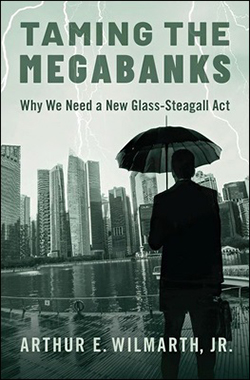 It is rare for a book to be so comprehensive and insightful that it provides a roadmap for the future – especially when its cast of characters are the lawyered-up megabanks on Wall Street and their legions of lobbyists and public relations flacks. We’re referring to Taming the Megabanks: Why We Need a New Glass-Steagall Act by Arthur E. Wilmarth, Professor Emeritus of Law at George Washington University.
Last Tuesday, the Federal Reserve completely capitulated to the demands of the Wall Street megabanks on its plan to dramatically raise capital levels at the megabanks — the so-called Basel III Endgame. The Fed, via its Vice Chair for Supervision, Michael Barr, announced it was cutting the required capital it had formally proposed in July of 2023 by more than half and will continue to allow the megabanks to use their own dodgy internal models to assess market risk.
How did the megabanks achieve such a quick victory on such a critical matter? They threatened to tie the Fed up in court for years and hired a Big Law operative to drive home the point.
Wilmarth’s book presciently saw that occurring – because the megabanks have been gaming and bucking and beating meaningful financial reform since President Obama signed into law the easily manipulated Dodd-Frank financial reform legislation in 2010.
Chapter 12 in Taming the Megabanks is titled “Unfinished Business.” It walks readers through each of the much-touted financial reforms that Obama’s minions told the American people they could count on following the worst megabank-induced financial crisis since the Great Depression. But many of Dodd-Frank’s promised key reforms never happened, as Wilmarth details by naming names and pulling back layers of dark curtains.
Instead of Dodd-Frank’s Volcker Rule ending the megabanks’ ability to bet the house via hedge funds, the rule was stonewalled for years, then ignored, then it essentially disappeared. As we reported earlier this month, the U.S. Treasury’s Office of Financial Research (OFR) revealed that as of March 31, 2024, Global Systemically Important Banks in the U.S. (G-SIBs/megabanks) had loaned out $2.348 trillion to hedge funds. Foreign Global Systemically Important Banks had loaned out another $1.628 trillion to hedge funds; and “Other Lenders” had loaned out an additional $566 billion to hedge funds. That brought the total of margin loans to just hedge funds on March 31, 2024 to a total of $4.542 trillion. (Put your cursor on the graph lines here.)
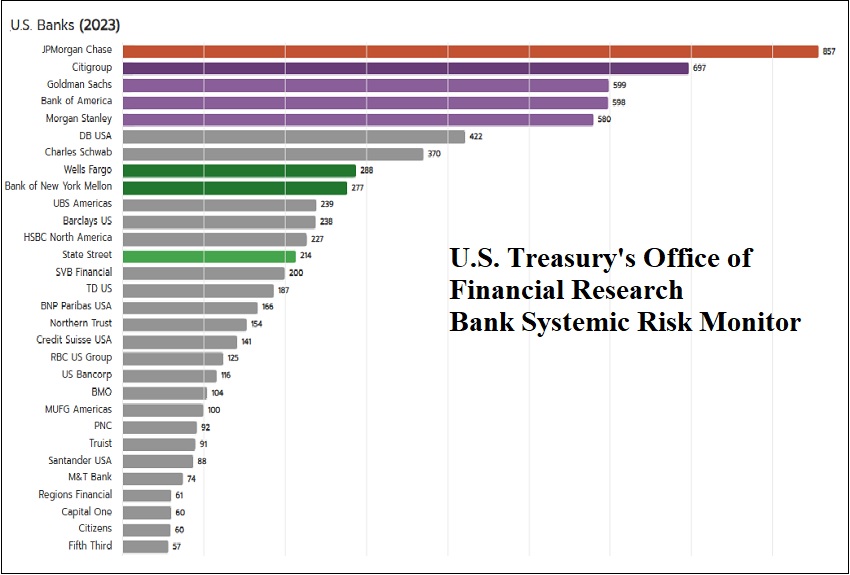
And remember all that talk about the push-out rule for derivatives? That illusion bit the dust in 2014, thanks to Citigroup and two former cronies in Congress. As of December 31, 2023, Goldman Sachs Bank USA, JPMorgan Chase Bank N.A., Citigroup’s Citibank and Bank of America held a staggering total of $168.26 trillion in derivatives out of a total of $192.46 trillion at all federally-insured U.S. banks, savings associations and trust companies. That’s just four banks holding 87 percent of all derivatives at all 4,587 federally-insured financial institutions in the U.S. that existed as of December 31, 2023. This data comes from the quarterly report at the Office of the Comptroller of the Currency (OCC), another of the federal regulators that says it’s going along with the Fed’s plan to scale back capital requirements at the megabanks.
In response to our query last week as to whether the OCC was on board with the Fed’s scaled back capital requirements, the OCC gave us this statement from Acting Comptroller Michael Hsu:
“The changes outlined by Vice Chair Barr reflect the work the three agencies undertook together. To ensure that the capital requirements for the nation’s largest banks are modernized and strengthened, I am committed to working with my peers on next steps to drive the Basel 3 endgame to closure.”
The FDIC is the third federal agency involved in setting the capital levels for the megabanks. It gave us this statement last week from FDIC Chair Martin Gruenberg:
“The Federal Reserve, OCC, and the FDIC have worked cooperatively on the Basel III proposal, including the changes outlined in Vice Chairman Barr’s remarks. I look forward to the agencies working together to bring Basel III to a conclusion that will strengthen bank capital and bolster financial system resilience and stability.”
In July, Wilmarth revealed the illusory nature of yet another promised reform from Dodd-Frank in an opinion piece at the American Banker (paywall) titled: “The FDIC’s resolution plan for failed megabanks is an empty promise.”
Wilmarth explains in the American Banker piece that one of Dodd-Frank’s primary goals was to prevent taxpayers from having to rescue megabanks, as occurred in 2008. A key component of that goal is Title II of Dodd-Frank, which provides an Orderly Resolution Plan to unwind failing megabanks without the need for taxpayer or Federal Reserve bailouts. That Plan, in turn, requires a giant pool of instantly available cash, which Dodd-Frank calls the Orderly Liquidation Fund or OLF. Shockingly, Wilmarth reveals that there hasn’t been a dime in the OLF since its creation in 2010. Wilmarth explains:
“…the FDIC’s sole source of funding for a Title II receivership is the Orderly Liquidation Fund, or OLF, which the Treasury administers. When Congress passed the Dodd-Frank Act, the big-bank lobby defeated proposals that would have required megabanks to pay risk-based premiums to prefund the OLF. As a result, the OLF has a zero balance. The FDIC must therefore borrow from the Treasury to pay the costs of a Title II receivership that cannot be covered by wiping out the holding company’s shareholders and debt-holders.”
Wilmarth correctly concludes in Taming the Megabanks that there is only one way to protect the U.S. economy and the financial stability of the nation’s banking system and that is to break up the megabanks by restoring the Glass-Steagall Act, which would separate Wall Street’s global trading houses from federally-insured banks. Otherwise, the megabanks will continue to dictate government policy, regulate their own regulators, and set the stage for the next destabilizing Wall Street and banking collapse.