Showing posts with label MEGABANKS. Show all posts

Monday, September 16, 2024

CRYPTO SCAMMER JOHN DEATON....


CARPETBAGGER JOHN DEATON HAS NO TIES TO MASSACHUSETTS & WAS 

TOO LAZY To RESEARCH FACTS BEFORE BLAMING SENATOR ELIZABETH

WARREN FOR THE FAILURES OF FUNDING THE CAPE COD BRIDGES & DEPENDS ON THE IGNORANCE OF "R" VOTERS....WHEN 

IT WAS TRUMP WHO WAS RESPONSIBLE FOR THE LACK OF FUNDING!

John Deaton, a candidate in the Republican primary for U.S. Senate, speaks near the Sagamore Bridge. With him are state legislative candidates Kari MacRae, Susanne Conley, and Christopher Lauzon.

Jennette Barnes
/
CAI
John Deaton, a candidate in the Republican primary for U.S. Senate, speaks near the Sagamore Bridge. With him are state legislative candidates Kari MacRae, Susanne Conley, and Christopher Lauzon.


THAT MAKES JOHN DEATON A LIAR! 

JOHN DEATON WAS SURROUNDED BY OTHER BRAIN DEAD REPUBLICANS 

AT THE TIME.... 

JOHN DEATON HAD SO LITTLE INTEREST IN POLITICS THAT HE VOTED 

3 TIMES IN 20 YEARS!


I am a firm believer in NOT SUPPORTING ANY CANDIDATE who has never held 

ELECTED OFFICE! 

In addition, that CRYPTO SCAMMER JOHN DEATON LIED about the CAPE COD 

BRIDGE FUNDING defines a candidate willing to MISINFORM VOTERS....

MASSACHUSETTS does not need of deserve a LIAR!

In addition, JOHN DEATON has LIED about SENATOR ELIZABETH WARREN's 

RECORD! 

JOHN DEATON insists he would only vote for legislation the benefits 

MASSACHUETTS....that's a narrow & deceiving focus that does not 

protect ALL AMERICANS! 

SENATOR ELIZABETH WARREN
authored CFPB - CONSUMER FINANCIAL 

PROTECTION BUREAU that REPUBLICANS have fought to destroy. It's 

the only government agency that fights abuse to protect CONSUMERS - 

THAT'S YOU! 

There's a great deal of information available about Senator Warren's actions--

some of which seem pretty dull & boring, but they matter! 

MEGABANKS have record breaking DERIVATIVES & HEDGE FUND INVESTMENTS

that duplicate the previous economic crash - the FEDERAL RESERVE is not 

reigning them in, but rather lowering the CASH RESERVE LIMITS....that's a sleeper 

if there ever was one...BUT IT'S IMPORTANT!


CRYPTO SCAMMER JOHN DEATON is promoting CRYPTO (& his supporters are CRYPTO SCAMMERS) that is UNREGULATED and has been BANNED IN CHINA & OTHER NATIONS....WARREN BUFFETT called 

CRYPTO 'RAT POISON SQUARED' ! 

Crypto Took Down Another Federally-Insured Bank and Just Handed Its CEO a 24-Year Prison Sentence

WALL STREET ON PARADE


Much of what SENATOR ELIZABETH WARREN has accomplished is complex 

regulation that protects the ECONOMY, the BANKING SYSTEM & ALL AMERICANS....that's what we need!  It's called LEADERSHIP! 

CRYPTO SCAMMER JOHN DEATON is a superficial clown, fully uninformed 

about issues, spouting MAGA GOP MANURE! 

SCRUTINIZE A CANDIDATE & MAKE INFORMED VOTES! 


Everything this Book Predicted on Wall Street Megabanks Ruling their Regulators Is Now Unfolding


SUBSCRIBE TO THIS NEWSLETTER TO RECEIVE TIMELY REPORTS!


Everything this Book Predicted on Wall Street Megabanks Ruling their Regulators Is Now Unfolding

By Pam Martens and Russ Martens: September 16, 2024 ~

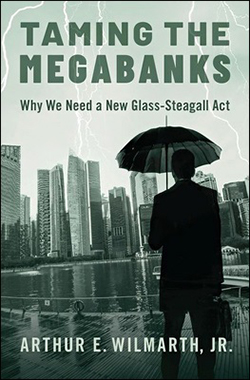
Taming the Megabanks, Book JacketIt is rare for a book to be so comprehensive and insightful that it provides a roadmap for the future – especially when its cast of characters are the lawyered-up megabanks on Wall Street and their legions of lobbyists and public relations flacks. We’re referring to Taming the Megabanks: Why We Need a New Glass-Steagall Act by Arthur E. Wilmarth, Professor Emeritus of Law at George Washington University.

Last Tuesday, the Federal Reserve completely capitulated to the demands of the Wall Street megabanks on its plan to dramatically raise capital levels at the megabanks — the so-called Basel III Endgame. The Fed, via its Vice Chair for Supervision, Michael Barr, announced it was cutting the required capital it had formally proposed in July of 2023 by more than half and will continue to allow the megabanks to use their own dodgy internal models to assess market risk.

How did the megabanks achieve such a quick victory on such a critical matter? They threatened to tie the Fed up in court for years and hired a Big Law operative to drive home the point.

Wilmarth’s book presciently saw that occurring – because the megabanks have been gaming and bucking and beating meaningful financial reform since President Obama signed into law the easily manipulated Dodd-Frank financial reform legislation in 2010.

Chapter 12 in Taming the Megabanks is titled “Unfinished Business.” It walks readers through each of the much-touted financial reforms that Obama’s minions told the American people they could count on following the worst megabank-induced financial crisis since the Great Depression. But many of Dodd-Frank’s promised key reforms never happened, as Wilmarth details by naming names and pulling back layers of dark curtains.

Instead of Dodd-Frank’s Volcker Rule ending the megabanks’ ability to bet the house via hedge funds, the rule was stonewalled for years, then ignored, then it essentially disappeared. As we reported earlier this month, the U.S. Treasury’s Office of Financial Research (OFR) revealed that as of March 31, 2024, Global Systemically Important Banks in the U.S. (G-SIBs/megabanks) had loaned out $2.348 trillion to hedge funds. Foreign Global Systemically Important Banks had loaned out another $1.628 trillion to hedge funds; and “Other Lenders” had loaned out an additional $566 billion to hedge funds. That brought the total of margin loans to just hedge funds on March 31, 2024 to a total of $4.542 trillion. (Put your cursor on the graph lines here.)

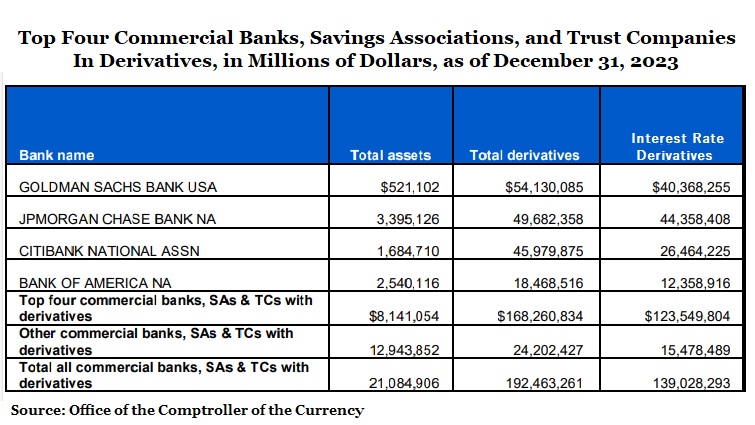
And remember all that talk about the push-out rule for derivatives? That illusion bit the dust in 2014, thanks to Citigroup and two former cronies in Congress. As of December 31, 2023, Goldman Sachs Bank USA, JPMorgan Chase Bank N.A., Citigroup’s Citibank and Bank of America held a staggering total of $168.26 trillion in derivatives out of a total of $192.46 trillion at all federally-insured U.S. banks, savings associations and trust companies. That’s just four banks holding 87 percent of all derivatives at all 4,587 federally-insured financial institutions in the U.S. that existed as of December 31, 2023. This data comes from the quarterly report at the Office of the Comptroller of the Currency (OCC), another of the federal regulators that says it’s going along with the Fed’s plan to scale back capital requirements at the megabanks.

In response to our query last week as to whether the OCC was on board with the Fed’s scaled back capital requirements, the OCC gave us this statement from Acting Comptroller Michael Hsu:

“The changes outlined by Vice Chair Barr reflect the work the three agencies undertook together. To ensure that the capital requirements for the nation’s largest banks are modernized and strengthened, I am committed to working with my peers on next steps to drive the Basel 3 endgame to closure.”

The FDIC is the third federal agency involved in setting the capital levels for the megabanks. It gave us this statement last week from FDIC Chair Martin Gruenberg:

“The Federal Reserve, OCC, and the FDIC have worked cooperatively on the Basel III proposal, including the changes outlined in Vice Chairman Barr’s remarks. I look forward to the agencies working together to bring Basel III to a conclusion that will strengthen bank capital and bolster financial system resilience and stability.”

In July, Wilmarth revealed the illusory nature of yet another promised reform from Dodd-Frank in an opinion piece at the American Banker (paywall) titled: “The FDIC’s resolution plan for failed megabanks is an empty promise.”

Wilmarth explains in the American Banker piece that one of Dodd-Frank’s primary goals was to prevent taxpayers from having to rescue megabanks, as occurred in 2008. A key component of that goal is Title II of Dodd-Frank, which provides an Orderly Resolution Plan to unwind failing megabanks without the need for taxpayer or Federal Reserve bailouts. That Plan, in turn, requires a giant pool of instantly available cash, which Dodd-Frank calls the Orderly Liquidation Fund or OLF. Shockingly, Wilmarth reveals that there hasn’t been a dime in the OLF since its creation in 2010. Wilmarth explains:

“…the FDIC’s sole source of funding for a Title II receivership is the Orderly Liquidation Fund, or OLF, which the Treasury administers. When Congress passed the Dodd-Frank Act, the big-bank lobby defeated proposals that would have required megabanks to pay risk-based premiums to prefund the OLF. As a result, the OLF has a zero balance. The FDIC must therefore borrow from the Treasury to pay the costs of a Title II receivership that cannot be covered by wiping out the holding company’s shareholders and debt-holders.”

Wilmarth correctly concludes in Taming the Megabanks that there is only one way to protect the U.S. economy and the financial stability of the nation’s banking system and that is to break up the megabanks by restoring the Glass-Steagall Act, which would separate Wall Street’s global trading houses from federally-insured banks. Otherwise, the megabanks will continue to dictate government policy, regulate their own regulators, and set the stage for the next destabilizing Wall Street and banking collapse.

WALL STREET ON PARADE


Wednesday, August 21, 2024

All the Devils from 2008 Are Back at the Megabanks: Leverage, Off-Balance-Sheet Debt, Over $192 Trillion in Derivatives, Shaky Capital Levels


SUBSCRIBE TO THIS NEWSLETTER TO RECEIVE TIMELY REPORTS!


All the Devils from 2008 Are Back at the Megabanks: Leverage, Off-Balance-Sheet Debt, Over $192 Trillion in Derivatives, Shaky Capital Levels

Four Megabanks' Exposure to Interest Rate Derivatives

By Pam Martens and Russ Martens: August 20, 2024 ~

Taming the Megabanks, Book JacketAs indicated on the above graph, as of December 31, 2023, Goldman Sachs Bank USA, JPMorgan Chase Bank N.A., Citigroup’s Citibank and Bank of America held a staggering total of $168.26 trillion in derivatives out of a total of $192.46 trillion at all federally-insured U.S. banks, savings associations and trust companies. That’s just four banks holding 87 percent of all derivatives at all 4,587 federally-insured financial institutions in the U.S. that existed as of December 31, 2023.

You might be asking yourself the very valid question as to why the Dodd-Frank financial reform legislation of 2010, that followed the Wall Street financial quake of 2008, didn’t correct the derivatives gambling that played a central role in crashing the U.S. financial system. For why the threat of derivatives never actually went away, see our report: Meet the Two Congressmen Who Facilitated Today’s Derivatives Nightmare at Wall Street’s Mega Banks.

As one example of the insane level of leverage concentrated in a handful of megabanks, look at the entry in the above chart for Goldman Sachs Bank USA. That federally-insured bank, part of the international trading conglomerate known as Goldman Sachs Group, is allowed by its federal regulators to have $521 billion in assets but $54 trillion in derivatives.

But don’t worry. Under U.S. accounting rules, these derivatives can be whittled down under the magic known as “netting,” and conveniently moved out-of-sight/out-of-mind off the balance sheet.

When the Financial Crisis Inquiry Commission released their final forensic report on the causes of the 2007 to 2010 financial collapse – the worst crisis since the 1929-1932 collapse and Great Depression that followed – it pointed to hidden leverage in off-balance sheet entities at the megabanks on Wall Street as a key driver of the crisis. It wrote:

“From 2000 to 2007, large banks and thrifts generally had $16 to $22 in assets for each dollar of capital, for leverage ratios between 16:1 and 22:1. For some banks, leverage remained roughly constant. JP Morgan’s reported leverage was between 20:1 and 22:1. Wells Fargo’s generally ranged between 16:1 and 17:1. Other banks upped their leverage. Bank of America’s rose from 18:1 in 2000 to 27:1 in 2007. Citigroup’s increased from 18:1 to 22:1, then shot up to 32:1 by the end of 2007, when Citi brought off-balance sheet assets onto the balance sheet. More than other banks, Citigroup held assets off of its balance sheet, in part to hold down capital requirements. In 2007, even after bringing $80 billion worth of assets on balance sheet, substantial assets remained off. If those had been included, leverage in 2007 would have been 48:1, or about 53% higher. In comparison, at Wells Fargo and Bank of America, including off-balance-sheet assets would have raised the 2007 leverage ratios 17% and 28%, respectively.”

Citigroup, of course, blew itself up in 2008 and received the largest bailouts in global banking history. By March of 2009, its stock was trading at 99 cents. By July 2010, it had received $2.5 trillion in secret revolving loans from the Fed over the span of 2-1/2 years, according to the 2011 audit of the Fed’s emergency bailout programs that was released by the Government Accountability Office.

Today, JPMorgan Chase is creating unfathomable risk transfer vehicles and placing them off its balance sheet. What could possibly go wrong?

In January, Anat Admati, Professor of Finance and Economics at Stanford Graduate School of Business, and German economist Martin Hellwig, released an updated and expanded version of their 2013 book The Bankers’ New Clothes: What’s Wrong with Banking and What to Do about It. In it, the authors write:

“Some of the risks that make JPMorgan Chase dangerous cannot actually be seen by looking at its balance sheet because the positions that give rise to them are not included there. These are risks from business units that JPMorgan Chase might own in part or that it sponsors, and to which it has provided guarantees to serve as a backstop if they should have funding problems. These units might be full-flown subsidiaries, or they might be mere ‘letterhead firms,’ vehicles without any drivers, that are established for legal or tax reasons only. The bank’s commitments to these units amount to almost a trillion dollars, but these potential liabilities of the bank are left off the bank’s balance sheet. Yet they are quite relevant to the financial health of JPMorgan Chase.”

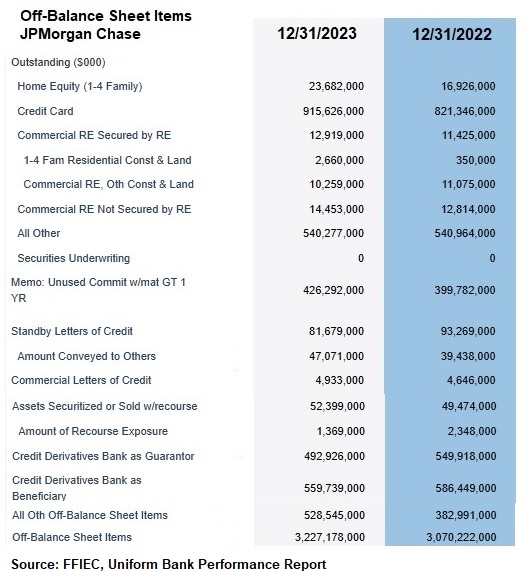
According to financial data at the Federal Financial Institutions Examination Council (FFIEC), as of December 31, 2023, JPMorgan Chase held $3.227 trillion off-balance sheet.

In JPMorgan Chase’s 10-K public filing with the Securities and Exchange Commission for the period ending December 31, 2023, it reported total assets on its balance sheet of $3.875 trillion. (See page 46 at this link.) That’s versus the FFIEC data showing it has another $3.227 trillion off-balance sheet.

The chart below shows the stunning breakdown of the $3.2 trillion JPMorgan Chase is holding off-balance sheet according to data at the FFIEC. (See this link; check the box “Off-Balance Sheet Items,” then click the hyperlink for “Off-Balance Sheet Items.”)

JPMorgan Chase’s off-balance sheet hubris goes a long way in explaining why the bank’s federal regulators are demanding that it increase its capital by 25 percent. The bank’s response to that was to go on the offensive through its lobbying groups and threaten to sue its federal bank regulators. On Saturday, Bloomberg News reported that Dimon and other megabank CEOs had huddled in private with Jerome Powell, Chair of the Federal Reserve, on July 19 in an effort to weaken the proposed increases in the capital rule.

Because Wall Street megabanks have honed to perfection a century-old bag of tricks that enable them to get their way by intimidating their regulators, game accounting rules with impunity, and put personal greed above the good of the country – the only means of restoring sanity and stability to the U.S. financial system is for Congress to restore the Glass-Steagall Act, which would permanently separate federally-insured banks from the trading casinos on Wall Street.

The seminal book on the critical and urgent need to restore the Glass-Steagall Act is Taming the Megabanks: Why We Need a New Glass-Steagall Act, by Arthur E. Wilmarth. Engaged and concerned Americans owe it to themselves and their families to read this book, understand how the U.S. financial system has morphed into an institutionalized wealth-transfer system, moving wealth from the middle class to the pockets of the denizens of Wall Street. (See, for example, PBS Drops Another Bombshell: Wall Street Is Gobbling Up Two-Thirds of Your 401(k).)

Off-Balance Sheet Items, JPMorgan Chase


 WALL STREET ON PARADE


Monday, December 26, 2022

FTX Was Creating Money Out of Thin Air Like the Fed; and Trading Its Own “Stock” Like the Wall Street Mega Banks in their Dark Pools


SUBSCRIBE TO THIS NEWSLETTER TO RECEIVE TIMELY REPORTS 


FTX Was Creating Money Out of Thin Air Like the Fed; and Trading Its Own “Stock” Like the Wall Street Mega Banks in their Dark Pools

By Pam Martens and Russ Martens: November 16, 2022 ~

BubblesOn June 10 of last year, Wall Street On Parade penned this headline: Seven Years after Michael Lewis Described on National TV How the U.S. Stock Market Is Rigged, SEC Chair Gensler Says He’s Going to Tackle Market Structure. Unfortunately for confidence in U.S. markets, that’s yet to happen. And it’s not just the fault of Gensler. The Senate Banking Committee and House Financial Services Committee that should be holding in-depth hearings on the most corrupted market structure since 1929 have opted instead to hold superficial hearings each time something blows up as a result of that corrupted market structure, but never actually get around to tackling the corrupt market structure itself.

So here we are today with another abject failure of market structure causing a week of sensational headlines around the globe that make U.S. markets look unhinged.

If one looks very closely at the structure of FTX, the collapsed crypto exchange now in bankruptcy and causing everything it touched to teeter, it was actually using a technique of the U.S. central bank – the Fed – to create money out of thin air; and a technique we’ve been writing about repeatedly since 2014, Wall Street mega banks trading their own stocks in their own Dark Pools, effectively making a market in their own stock.

Let’s start with our comparison of what FTX was doing to the Fed’s creation of money out of thin air by pushing an electronic button. You don’t have to take our word for what the Fed is doing. The Fed actually created an educational video to explain how it creates electronic money out of thin air. That video was released in 2011 and the spokesman for the Fed says this in the video: “The Fed will not keep buying large amounts of securities on an ongoing basis,” noting that “Its purchases are a temporary measure to help the economy recover.”

At the time of that video on January 14, 2011, the Fed had used its magic money button to buy up $2.2 trillion of debt securities from Wall Street, thus pushing the interest rates on debt instruments artificially lower. And despite that promise that this would be a “temporary measure” the Fed continued over the next decade to use its magic money spigot to the point that it now holds $8.256 trillion of debt securities on its balance sheet and it can’t figure out how to unwind that monster pile of debt securities without collapsing the U.S. economy.

What Sam Bankman-Fried, co-founder and CEO of FTX, did with the help of his colleagues, was to create their own magic money creation tool. It was a crypto token called FTT and was backed by nothing more than the hyped reputation of FTX and Sam Bankman-Fried. In that sense, it traded much like the “stock” of FTX.

And much like the price of debt on Wall Street was levitated by the Fed’s $8 trillion buying binge over a decade, the price of FTT soared through a buying binge by FTX and Sam Bankman-Fried’s own hedge fund, Alameda Research. FTT’s price went from less than $4 in December 2020 to more than $84 in September 2021 – a 2,000 percent gain in less than a year. (And all those sophisticated institutional investors in FTX didn’t find that suspicious?) This morning FTT is trading at $1.61 – despite the fact that some very sophisticated investors in FTX have written down their investment to zero.

CNBC explains what was going on with the FTT token as follows:

“The source explained that Alameda could post the FTT tokens it held as collateral and borrow customer funds. Even if FTX created more FTT tokens, it would not drive down the coin’s value because these coins never made it onto the open market. As a result, these tokens held their market value, allowing Alameda to borrow against them – essentially receiving free money to trade with.

“FTX had been able to sustain this pattern as long as it maintained the price of FTT and there was not a flood of customer withdrawals on the exchange. In the week leading up to the bankruptcy filing, FTX did not have enough assets to match customer withdrawals, the source said.”

Reuters reported that Bankman-Fried had moved as much as $10 billion of FTX customers’ money to his hedge fund, Alameda Research, through a “backdoor” in its software. Alameda lost much of the money on wild bets while $1 billion to $2 billion had just “disappeared,” according to Reuters. The Financial Times reported that FTX held just $900 million “in easily sellable assets” against $9 billion “of liabilities the day before it collapsed into bankruptcy.”

CoinDesk reported that a significant amount of the assets listed at Alameda were FTT tokens.

In trading FTT, the equivalent of stock in FTX, Sam Bankman-Fried was using a technique deployed by Wall Street mega banks to trade their own bank stock – right under the nose of their comatose regulators – in what are called Dark Pools. These Dark Pools are effectively unregulated stock exchanges operated internally by the trading units of the mega banks.

On August 26 of last year, we reported the following:

“Until August of 2017, JPMorgan Chase operated only one Dark Pool, known as JPM-X. But in August 2017, the bank added a second Dark Pool, which also began to trade in the shares of its own bank stock. That second Dark Pool is known as JPB-X…

“For the past seven years we have checked that FINRA data and witnessed JPMorgan Chase (as well as other banks) trading in the shares of their own bank stocks. We have repeatedly in the past asked the SEC to explain how this constitutes legal activity. We have yet to receive an answer.

“In the most recent week reported by FINRA for Dark Pool trading, JPMorgan’s two Dark Pools traded a total of 518,277 shares of JPMorgan Chase stock in a total of 3,308 separate trades. As the chart below from FINRA data indicates, JPMorgan Chase’s own Dark Pool, JPM-X, was the third largest Dark Pool trader in the shares of its own stock for the week of August 2, 2021. In the four weeks from July 12 through the week of August 2, FINRA data shows that JPMorgan’s two Dark Pools made a total of 22,070 trades in its own stock.”

For more on this Dark Pool insanity that has been allowed to continue in U.S. markets, see “Related Articles” below.

To make a long story short, those FTX wizards from MIT and Stanford seem to have adopted the corrupt market structure of Wall Street and simply tweaked it for crypto.

Editor’s Update:

Just moments after we posted this article, the House Financial Services Committee released the following statement:

“WASHINGTON, D.C. – Today, the Chairwoman of the House Financial Services Committee, Congresswoman Maxine Waters (D-CA), and the Ranking Member of the House Financial Services Committee, Congressman Patrick McHenry (R-NC), announced a bipartisan hearing into the collapse of FTX and the broader consequences for the digital asset ecosystem. In December, the Committee expects to hear from the companies and individuals involved, including Sam Bankman-Fried, Alameda Research, Binance, FTX, and related entities, among others.”

We would strongly suggest that the Big Law firm of Sullivan & Cromwell be ordered to send a law partner to testify at the House hearing on how that law firm performed such extensive legal work for FTX and Alameda Research without spotting a house of cards.

Related Articles:

FINRA Bombshell: Biggest Wall Street Banks Are Trading Their Own Stock in Dark Pools

Wall Street Banks Are Trading in Their Own Company’s Stock: How Is This Legal?

As Markets Plunged in March, Dark Pools Upped their Trading in JPMorgan’s Stock

Goldman Sachs Is Quietly Trading Stocks In Its Own Dark Pools on 4 Continents

The Silence on Wall Street’s Dark Pools Is Deafening

Another Wall Street Inside Job?: Stock Buybacks Carried Out in Dark Pools

Shades of 1930 in Wall Street Banks’ Dark Pools?

Dark Pools, Barclays and the ‘Tone at the Top’

Citigroup’s Dark Pools: Here’s Why the Public Doesn’t Trust Wall Street


LINK


Tuesday, June 28, 2022

Five U.S. Megabanks Have Lost $300 Billion in Market Cap in One Year; Crypto Is in Meltdown this Morning; and the Fed Will Hike Rates Further on Wednesday


SUBSCRIBE TO THIS NEWSLETTER

Five U.S. Megabanks Have Lost $300 Billion in Market Cap in One Year; Crypto Is in Meltdown this Morning; and the Fed Will Hike Rates Further on Wednesday

One Year Performance of JPMorgan Chase, Bank of America, Morgan Stanley, Goldman Sachs and Citigroup.

By Pam Martens and Russ Martens: June 13, 2022 ~

Welcome to Monday morning and market hell.

As of 8:47 a.m. (ET) this morning, Dow futures are down 553 points; Bitcoin futures have lost 17 percent of their value on the news that cryptocurrency lender, Celsius Network, has frozen withdrawals. The 5-year Treasury note has spiked to yield 3.38 percent, a 50-basis point increase in a month, leading to an inverted yield curve against the 10-year Treasury note, which is trading at 9:01 a.m. (ET) this morning at a yield of 3.27 percent. (An inversion signals a rising recession risk.)

All of this comes as the Fed has signaled that it will announce another interest rate hike this Wednesday, following the two-day meeting of its Federal Open Market Committee (FOMC). Stocks are developing a habit of tanking one day after Fed Chair Jerome Powell holds his FOMC Wednesday afternoon press conference, so watch out for stock market activity this Thursday.

The Fed has also announced that on Thursday of next week, June 23, at 4:30 p.m. (after the stock market closes) it will announce the results of its stress tests of the G-SIBs, the Global Systemically Important Banks. It can’t be too comforting to the Fed that the same banks that cratered the global economy in 2008, and required a mind-blowing $29 trillion bailout, have a lot less capital than they had one year ago.

As of last Friday’s closing prices, five U.S. megabanks that constitute the core of the U.S. financial system have $300 billion less common equity market capitalization than they had one year ago on June 10, 2021.

Citigroup, which has fared the worst of the lot in terms of percentage decline, is down 38 percent year-over-year with a market cap plunge of $56.6 billion. JPMorgan Chase’s share price is down 25 percent year-over-year but its market cap loss makes Citigroup look like a piker. JPMorgan Chase has seen its market cap evaporate by $120 billion in one year. That’s because it has a bizarrely large 2.94 billion shares outstanding that have been bleeding.

Bank of America has lost 20 percent year-over-year with a market cap loss of $68.67 billion. Morgan Stanley is down 16 percent year-over-year for a market cap loss of $25 billion; and Goldman Sachs has given up 23 percent year-over-year with a market cap decline of $29.85 billion.

The five megabanks that the Office of Financial Research says make up the core of the U.S. financial system have lost a combined $300 billion in market cap year-over-year and the Fed is still tightening monetary policy.

But that’s not even the worst of the news. U.S. megabanks are heavily interconnected to foreign megabanks through trillions of dollars in notional derivatives. Despite the economic devastation in 2008 from derivatives, the Fed and Congress have continued to allow foreign megabanks to serve as counterparties to U.S. megabanks’ derivatives. (U.S. megabanks also serve as counterparties to each other’s derivatives.)

The share prices of foreign megabanks are doing even worse than those of U.S. megabanks. Credit Suisse’s ADR closed on Friday on the New York Stock Exchange at $6.17, a year-over-year decline of more than 40 percent. Nomura has lost more than 30 percent year-over-year while the serially-troubled Deutsche Bank, which was a $120 stock in 2007, closed on Friday in New York at $9.98.


LINK


Thursday, June 9, 2022

Fed Data Shows a Half Century of Moderate Growth in the Fed’s Balance Sheet through Two World Wars – Then a Seismic Explosion Under Bernanke, Yellen and Powell


SUBSCRIBE TO THIS NEWSLETTER

Fed Data Shows a Half Century of Moderate Growth in the Fed’s Balance Sheet through Two World Wars – Then a Seismic Explosion Under Bernanke, Yellen and Powell

Federal Reserve Balance Sheet -- 1914 to 2018

Growth in the Federal Reserve Balance Sheet -- 2003 to 2022

By Pam Martens and Russ Martens: June 6, 2022 ~

Last month the Federal Reserve Bank of New York released its 2021 annual report from its “Markets Group.” That’s the group that operates a trading floor (complete with speed dials to the trading houses on Wall Street) at the New York Fed, located not far from the New York Stock Exchange, as well as another trading floor on the premises of the Chicago Fed, which is not far from the futures exchanges in Chicago. That report showed that despite all of the recent talk about the Fed dramatically shrinking its balance sheet from its current size of $8.9 trillion, the internal Federal Reserve plan for the balance sheet is actually this: “After declining by about $2.5 trillion from the peak size reached in the first half of 2022, the portfolio stops declining in mid-2025, at which point it is held constant at $5.9 trillion.” It is thereafter projected to start growing again in line with GDP. (See page 47 of the report at this link.)

The charts above show that the Federal Reserve was able to get through World War I, the Great Depression, World War II, the Vietnam War and the stagflation of the 1970s, without an explosion in its balance sheet. But since Ben Bernanke, Janet Yellen and Jerome Powell have, in turn, sat at the helm of the Federal Reserve, there has been unprecedented growth in the Fed’s Balance Sheet.

For example, from June 1960 to August 1990, the Fed’s balance sheet increased from $53 billion to $309 billion – an increase of 483 percent in 30 years. But during the tenures of Bernanke, Yellen and Powell, the Fed’s balance sheet has exploded from $880 billion in May 2008 to $8.9 trillion in May of 2022 – an increase of 911 percent in just 14 years.

There are a number of factors to explain this unprecedented growth in the Fed’s balance sheet. Chief among them are the following:

The Federal Reserve Board of Governors has outsourced its open market operations to the New York Fed, which is, literally, owned by a handful of Wall Street megabanks. (See related articles below.)

Congress has failed to separate the giant federally-insured banks from the Wall Street casino (trading houses), by restoring the Glass-Steagall Act. This lack of Congressional action has led to the perpetual giant bailouts of Wall Street banks, which have exploded the Fed’s balance sheet through so-called Quantitative Easing (a/k/a “bailout”) measures.

The advent of the 401(k) plan which incentivizes U.S. workers to save for retirement through investments in the stock market (or to a much smaller extent, the bond market). This removes much of the public outcry to Congress when the Fed bails out Wall Street because tens of millions of workers feel that their retirement savings are also being bailed out. To fully grasp this concept, see our 2008 report on the “ownership society.” (Unknown to the average American, the top 10 percent of the wealthiest households in America own the vast majority of the stock market.)

Related Articles:

New York Fed’s Answer to Cartels Rigging Markets – Form Another Cartel

Is the New York Fed Too Deeply Conflicted to Regulate Wall Street?

New Data Shows Fed Chair Powell Misled Congress on the Condition of the Megabanks and their Need for Emergency Loans

In a Six-Day Span in March 2020, the Dow Crashed 5,676 Points; the Fed Responded with Almost $1 Trillion in Repo Loans to 24 Trading Houses

Nomura, JPMorgan and Goldman Sachs Received a Cumulative $8 Trillion from the Fed’s Emergency Repo Loans in Fourth Quarter of 2019

Economist Michael Hudson Says the Fed “Broke the Law” with its Repo Loans to Wall Street Trading Houses

Janet Yellen’s Cash Haul of $7 Million Is Just the Tip of the Iceberg; She Failed to Report Her Wall Street Speaking Fees from JPMorgan and Others in 2018

Fed Chair Bernanke Held 84 Secret Meetings in the Lead Up to the Wall Street Collapse


LINK


Sunday, June 5, 2022

Senator Sherrod Brown Goes After 0-Count Felon Wells Fargo; Ignores 5-Count Felon JPMorgan Chase


SUBSCRIBE TO THIS NEWSLETTER

Senator Sherrod Brown Goes After 0-Count Felon Wells Fargo; Ignores 5-Count Felon JPMorgan Chase

By Pam Martens and Russ Martens: June 1, 2022 ~
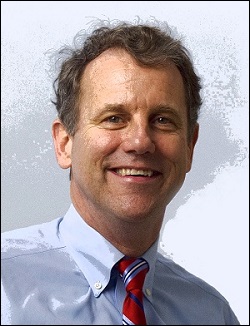
Senator Sherrod Brown

Senator Sherrod Brown

Wall Street On Parade was previously a big fan of Senator Sherrod Brown, the Chair of the Senate Banking Committee. Not so much anymore.

Brown supported the nutty nomination of Saule Omarova to head the Office of the Comptroller of the Currency (OCC), the regulator of national banks, while attempting to spin the naysayers as part of a smear campaign.

So far this year, the Senate Banking Committee has held hearings on tangential areas while ignoring the biggest threats to financial stability in the U.S.: the $200.18 trillion in notional derivatives (face amount) concentrated at just five Wall Street megabanks (JPMorgan Chase, Citigroup, Goldman Sachs, Morgan Stanley and Bank of America).

There have been no subpoenas flying from the Senate Banking Committee as the Fed continues to cover up the largest trading scandal in its history and refusing to release to the media the dates of the former Dallas Fed President Robert Kaplan’s trades. Two of the megabanks overseen by the Senate Banking Committee – Goldman Sachs and Citigroup – have potential involvement in this trading scandal but the public has had no enlightenment from the Senate Banking Committee. (See our Fed Trading Scandal archive here.)

There has also been no in-depth investigation with subpoenas by the Senate Banking Committee of how many more Archegos family office hedge funds are out there, ready to blow up a federally insured megabank on Wall Street because it has given these hedge funds 85 percent leverage on margin loans, while disguising the hedge funds’ stock positions as if they belong to the bank. We have also seen no pushback from the Senate Banking Committee as the Justice Department portrays the most sophisticated megabanks on Wall Street as the victims of Archegos.

We could go on and on but you get the point.

Now Brown is going after Wells Fargo and its CEO Charles Scharf – which has zero felony counts notched in its belt – while ignoring JPMorgan Chase and its Chairman and CEO, Jamie Dimon, who has presided over five criminal felony counts, all of which the bank admitted to, while entering into an endless series of highly-suspect non-prosecution agreements and probation periods with the U.S. Department of Justice.

Yesterday Brown’s office sent out a press release assailing Wells Fargo and Scharf, calling out its “history of consumer abuses and gross mismanagement.” While it’s true that Wells Fargo has not been an Eagle Scout , it’s also true that when it comes to criminal activities, Wells Fargo is completely out of the league of JPMorgan Chase.

JPMorgan Chase’s first two felony counts from the Justice Department came in 2014 for its aiding and abetting role in the way it handled the business bank account of Ponzi-schemer Bernie Madoff. The bank told U.K. authorities that it thought Madoff was running a Ponzi scheme while failing to report its suspicions and money laundering by Madoff to U.S. authorities. The very next year the bank pleaded guilty to its role in a bank cartel (actually called “The Cartel”) that rigged the foreign exchange market. That resulted in felony count three.

There was a litany of other non-felony charges brought against the bank between 2015 and 2019. See its jaw-dropping Rap Sheet here. Then in September 2020 the bank agreed to pay criminal fines and admit to two felony counts of wire fraud for manipulating (spoofing) trading in the precious metals and U.S. Treasury markets. The Justice Department charged that JPMorgan Chase’s traders engaged in “tens of thousands of instances of unlawful trading in gold, silver, platinum, and palladium…as well as thousands of instances of unlawful trading in U.S. Treasury futures contracts and in U.S. Treasury notes and bonds….” Not to put too fine a point on it, but the U.S. Treasury market is how the U.S. government pays its bills and instills trust in the U.S. dollar as the world’s reserve currency.

In every one of these criminal cases, instead of going to trial, JPMorgan Chase was simply allowed to admit guilt and was given a deferred prosecution agreement by the U.S. Department of Justice. And, more outrageous, after every criminal count, the Chairman and CEO of the bank, Jamie Dimon, was not only allowed to remain in place but ended up with a bigger salary and bonus. (See After JPMorgan Chase Admits to Its 4th and 5th Felony Charge, Its Board Gives a $50 Million Bonus to Its CEO, Jamie Dimon.)

That $50 million “retention” bonus, by the way, was voted down by shareholders two weeks ago but the bank’s Board decided to ignore what its shareholders wanted and pay the bonus anyway. The $50 million bonus was on top of Dimon’s regular compensation for 2021, which totaled $34.5 million.

If Senator Brown is looking for the quintessential symbol of “gross mismanagement,” let us spell it out for him: the year after JPMorgan Chase, under Dimon’s management, scores its fourth and fifth criminal felony counts from the Justice Department, its Board of Directors awards Dimon a total of $84.5 million. That’s because the Board of JPMorgan Chase is, itself, a study in outrageous conflicts of interest.

In the letter that Brown sent to Wells Fargo’s CEO Charles Scharf yesterday, he says this about keeping the growth restriction that the Fed placed on Wells Fargo in 2018:

“It is clear that Wells Fargo still has a long way to go to fix its governance and risk management before it should be allowed to grow in size.”

But despite the fact that Jamie Dimon has presided over an unprecedented series of criminal charges, his bank has been allowed to grow to a mind-boggling size. Since the criminal charges started in 2014, JPMorgan’s deposit base has been allowed to double in size, from $1 trillion to more than $2 trillion according to the Federal Deposit Insurance Corporation’s data.

The OCC reports that the bank holding company for JPMorgan Chase has grown its assets from $2.57 trillion as of December 31, 2014 to $3.74 trillion as of December 31, 2021 – an increase of 46 percent in seven years. (See Table 14 here.)

As of December 31, 2021, Wells Fargo’s holding company’s assets stood at $1.95 trillion, or $1.79 trillion less than JPMorgan Chase.

In addition, the OCC also reports that the bank holding company for Wells Fargo held just $9.3 trillion in derivatives as of December 31, 2021 versus a staggering $49.2 trillion in derivatives at JPMorgan Chase. (See the same Table 14 linked above.)

What might explain why Senator Brown and the Fed are shining a bright light on Wells Fargo while allowing Jamie Dimon and his criminal enterprise to hide in the shadows? When it comes to Senator Brown, it’s more than likely that he has either conflicted or incompetent aides rooting out the problems at the megabanks.

When it comes to the Fed, the facts speak for themselves. JPMorgan Chase is the largest shareowner of the New York Fed, the regional bank to whom the Federal Reserve Board of Governors has outsourced supervision of the megabanks in that region. To put it more bluntly, bank examiners investigating JPMorgan Chase report to an institution that is owned by the very banks they are examining and whose CEOs rotate on and off its Board of Directors. (Dimon previously served two terms on the Board of Directors of the New York Fed, and was allowed to remain in that perch while he was Chairman and CEO of JPMorgan Chase and his bank was under investigation by the Fed and FBI for losing $6.2 billion of bank deposits from its federally-insured bank. The losses arose from its gambling in derivatives in London.)

Wells Fargo, headquartered in San Francisco, is a shareowner of the San Franciso Fed and is supervised by that regional Fed bank. It lacks influence at the powerful New York Fed.

JPMorgan Chase became the largest shareowner of the New York Fed because it has been insanely allowed to gobble up huge banks, antitrust law be damned. JPMorgan Chase’s massive deposit base came about as a result of these prior commercial bank mergers:  In 1955 Chase National Bank merged with The Bank of the Manhattan Company to form Chase Manhattan Bank. In 1991, Chemical Bank and Manufacturers Hanover announced their merger. Both banks had been severely weakened – Chemical from bad real estate loans and Manufacturers from bad loans to developing nations. In 1995, Chemical Bank merged with Chase Manhattan Bank. In 2000, JPMorgan merged with Chase Manhattan Corporation. In 2004, JPMorgan Chase merged with Bank One. In 2008, during the height of the financial crisis, JPMorgan Chase was allowed to buy Washington Mutual. These are just the largest bank consolidations. Over the years, Chase acquired dozens of smaller banks.

It’s time for Senator Brown to hire an experienced, non-conflicted investigative team to genuinely examine what’s really going on at the Wall Street megabanks – starting with the viper’s nest at JPMorgan Chase.

LINK


Top News | 'He’s Not Going to Run Unopposed': Sanders Rejects Schumer for Majority Leader

                                                               LOTS OF POSTS IGNORED BY BLOGGER..... OR REMOVED ON THEIR WHIM! ALL POSTS ARE...