Showing posts with label REPO LOANS. Show all posts

Monday, January 29, 2024

The Fed Has a Dirty Little Secret: It’s Been Allowing the Wall Street Mega Banks to Calculate their Own Capital Requirements


SUBSCRIBE TO THIS NEWSLETTER TO RECEIVE TIMELY REPORTS


The Fed Has a Dirty Little Secret: It’s Been Allowing the Wall Street Mega Banks to Calculate their Own Capital Requirements

By Pam Martens and Russ Martens: January 29, 2024 ~
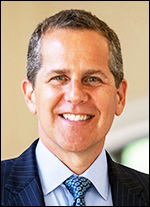
Michael Barr

Michael Barr, Vice Chair for Supervision, Federal Reserve 

On July 27 of last year, the Vice Chair for Supervision at the Federal Reserve Board of Governors, Michael Barr, made the following statement as part of the proposed new capital requirements for mega banks in the U.S. – revealing the stunning news that the serially-charged mega banks on Wall Street have been allowed to use their own internal risk models to tell the Fed how much risk-weighted assets they have and, thus, how much capital they need to hold. Barr stated:

“For a firm’s lending activities, the proposed rules would end the practice of relying on a bank’s own individual estimates of their own risk and instead use a standardized, but risk-based measure of credit risk. Standardized credit risk approaches do a reasonably good job of approximating risks, while internal models are prone to underestimate such risks.

“Second, for a firm’s trading activities, the proposed rules would adjust the way that the firm is required to measure market risk, which is the risk of loss from movements in market prices. These changes are intended to correct for gaps in the current rules.”

Relying on the mega banks that have been regularly charged with criminal acts and manipulating markets and who brought the U.S. economy to its knees with their financial crash of 2008, because their risk models were as helpful as a row boat in a tsunami, is yet one more clear indication that federal banking regulators have been completely captured by the Wall Street mega banks.

According to the Fed, the newly proposed capital rules will not stop federal regulators from relying on the mega banks to provide the information that sets their capital requirements, it will just change the models. The Fed and its fellow bank regulators wrote as follows about their so-called Basel III reforms:

“Under the proposed expanded risk-based approach, banking organizations would calculate total risk-weighted assets using (1) a new standardized approach for credit risk; (2) the revised approach for credit valuation adjustment (CVA) risk; (3) a new standardized approach for operational risk; and (4) the revised approach to market risk.”

Two economists are now calling out this insanity in a new academic paper. Anat Admati is the Professor of Finance and Economics at Stanford Graduate School of Business. Martin Hellwig is a German economist. The two are co-authors of the newly released and expanded book The Bankers’ New Clothes: What’s Wrong with Banking and What to Do about It. To call attention to the lies that bankers and their lobbyists perpetuate to get watered-down or gutted rules from their regulators, Admati and Hellwig have released a paper debunking the 44 flawed claims that bankers have been getting away with. One of those flawed claims goes to the heart of this debate on required capital. The pair write:

“Flawed Claim 29: Assigning risk weights to assets when determining required equity [equity capital] is a way of bringing serious quantitative analysis to bear on bank regulation…

“Proper measurement of the risks to which a bank is exposed would have to consider the counterparty credit risks and their correlations with the underlying risks of the banks. The scope for doing so is limited by a lack of data and by the never-ending changes in risks and correlations that occur when counterparties change their own positions. In practice, the use of risk weights in bank regulation allows banks to be extremely highly indebted, masks important risks, and adds to the interconnectedness of the system. Whereas proponents of the system argue that it is important to require banks to have more equity funding when their assets are riskier, in fact the system allows banks to get away with much less equity funding when they say that their assets are less risky. A uniform ratio of required equity [equity capital] to total assets would provide a lower bound on the banks’ leverage and would enable supervisors to intervene when the ratio is breached before it may be too late. By contrast, because some risk weights are (near) zero, the risk-weighting system allows very high leverage.

“The ability of banks to ‘economize on equity’ is enhanced by their ability to use their own models to assess risks. The scope for manipulation they have is largest for assets in the trading book, which is why they were keen to put mortgage-backed securities and the like into the trading book, subject to mark-to-market accounting rules. Most of the losses in 2007-2009 were incurred on assets in the trading book, where equity often was as low as 1 percent of investments…”

What the Fed and its fellow federal regulators have been effectively doing is turning capital requirements over to the casino. Consider what happened when the 158-year old Lehman Brothers failed in 2008 and filed for bankruptcy. Just five days before Lehman failed, it was sporting a capital ratio of 11 percent, suggesting that it was adequately capitalized. But four weeks after its bankruptcy on September 15, 2008, its debt was valued at only 9 cents on the dollar, suggesting its unsecured creditors were going to lose 91 percent of their money. While the recovery rate improved over time as market values stabilized, there is no question that Lehman’s regulators were in the dark – or chose to be in the dark – about just how highly leveraged this financial institution was in 2008.

Unknown to most Americans, the reckless Lehman Brothers was allowed by its regulators to own two federally-insured banks: Lehman Brothers Bank, FSB and Lehman Brothers Commercial Bank. Together, they held $17.2 billion in assets as of June 30, 2008, 75 days before Lehman went belly up.

Today, four of the largest trading houses on Wall Street own federally-insured banks that rank among the largest seven federally-insured banks in the U.S.: JPMorgan Chase, Bank of America, Citigroup, and Goldman Sachs.

Another key problem with allowing the criminally-inclined mega banks to calculate their own risk-weighted capital needs is that only a handful of people inside the bank understand the risks that are hiding in the shadows in the bank’s off-balance-sheet exposures.

On its way to becoming a 99-cent stock in March of 2009 and needing a secret $2.5 trillion bailout in cumulative loans from the Fed between December 2007 and June 2010, Citigroup was using off-balance-sheet SIVs (Structured Investment Vehicles) to boost its profits and hide its risks. When the bank was forced to move these vehicles back onto its balance sheet, its debt was downgraded and its stock tanked further.

Any suggestion that the mega banks on Wall Street have cleaned up their reckless risk-taking is undermined by the number of times they have needed to be bailed out since the crash of 2008 – the worst economic crisis since the Great Depression. (The New York Fed has become the official money funnel for Wall Street bailouts while being, literally, owned by some of the biggest banks on Wall Street.)

The first banking crisis since that of 2008 began on September 17, 2019 – for reasons the Fed has yet to explain with any credibility. In the last quarter of 2019, the New York Fed had to shovel emergency repo loans cumulatively totaling (on a term-adjusted basis) $19.87 trillion into Wall Street banks. As the chart below indicates, just six trading units of the mega banks on Wall Street received 62 percent of that amount. (Unadjusted for the term of the loan, the cumulative total was $4.5 trillion.)
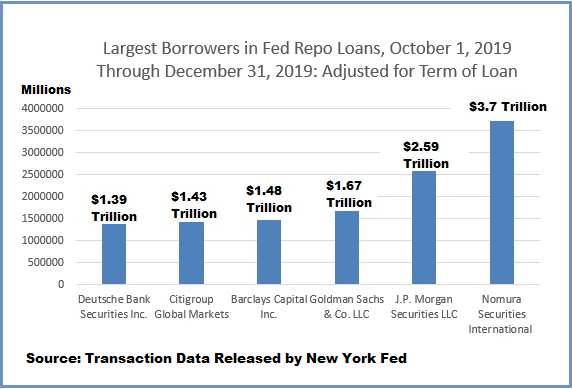
Fed's Repo Loans to Largest Borrowers, Q4 2019, Adjusted for Term of Loan

Under the Dodd-Frank financial reform legislation of 2010, the Fed had to release the names of the banks that received these bailouts, and the dollar amounts of each loan, two years after the program began. While mainstream media went to court to get this information in 2008, there was a total mainstream media blackout when the Fed released the data for the 2019 bailouts. (See There’s a News Blackout on the Fed’s Naming of the Banks that Got Its Emergency Repo Loans; Some Journalists Appear to Be Under Gag Orders.)

The next banking crisis occurred in March 2020 and was blamed on the pandemic. The share prices of the four largest banks (by deposits) collapsed by as much as 40 to 60 percent between January 2, 2020 and March 18, 2020. The Fed rolled out the same alphabet soup of emergency lending programs that it had rolled out in 2008 – with the New York Fed once again in charge of the bulk of those programs.

Three years later, in the spring of 2023, the second, third and fourth largest bank failures in U.S. history occurred: Silicon Valley Bank and Signature Bank in March and First Republic Bank on May 1.

To deal with last year’s failures, the Fed did something that it has never done before in its 110-year history. It began accepting underwater bonds as collateral for emergency loans to teetering banks while paying 100-cents on the dollar on that collateral for loans of up to one year in duration. (Historically, the Fed has imposed a haircut on collateral and made overnight loans through its Discount Window.) The Fed called this bailout program the Bank Term Funding Program (BTFP).

In recent weeks, the amounts being borrowed under the Bank Term Funding Program have spiked. The bailout facility had a balance of $121.7 billion as of December 7, 2023. As of its last report date on January 24, 2024, it had soared to $167.8 billion.

Last Wednesday, after weeks of watching banks increasingly tap the Bank Term Funding Program almost a year after the banking crisis was supposed to have subsided, the Fed announced it would cut off any more loans from the BTFP on March 11.
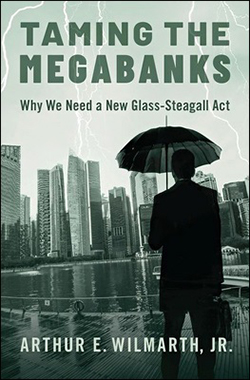
Taming the Megabanks, Book JacketAs we have repeatedly stated, and the brilliant Law Professor Art Wilmarth has documented, the only meaningful way to genuinely reform the mega banks is to restore the Glass-Steagall Act, which will separate casino banking from the federally-insured deposits of U.S. commercial banks.



Monday, May 15, 2023

Former New York Fed Pres Bill Dudley Calls This the First Banking Crisis Since 2008; Charts Show It’s the Third


SUBSCRIBE TO THIS NEWSLETTER TO RECEIVE IT IN A TIMELY MANNER

Former New York Fed Pres Bill Dudley Calls This the First Banking Crisis Since 2008; Charts Show It’s the Third

By Pam Martens and Russ Martens: April 20, 2023

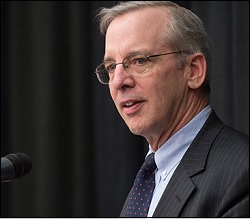
William Dudley, Former President of the New York Fed

The official that oversaw the secret funneling of trillions of dollars of bailout money from the New York Fed to the grossly mismanaged mega banks on Wall Street during the financial crisis of 2008 to 2010, had the temerity yesterday to pen an opinion piece at Bloomberg News pointing his finger at current Fed officials for today’s banking crisis – without once mentioning his role in getting us here.

The article was written by William (Bill) Dudley, who served as President of the New York Fed from January 27, 2009 to June 18, 2018. Prior to that Dudley was Executive Vice President of the Markets Group at the New York Fed, the group that runs its own trading floors in New York and Chicago and trades with the Wall Street mega banks it is also supposed to be supervising.

The New York Fed has become the official money spigot for Wall Street bailouts while being, literally, owned by some of the biggest banks on Wall Street. (See These Are the Banks that Own the New York Fed and Its Money Button.) Prior to joining the New York Fed in 2007, Dudley worked for two decades at – wait for it – Goldman Sachs, becoming a partner, managing director and chief economist.

Dudley’s broader agenda became clear in the opening sentence of his opinion piece yesterday. He writes that this is the “first banking crisis since 2008,” which dovetails nicely with the Wall Street lobbyists’ propaganda that there is nothing significantly wrong with the U.S. banking system so Congress shouldn’t start thinking about separating the Wall Street trading casinos from the federally-insured commercial banks by restoring the Glass-Steagall Act – which prevented systemic banking crises for 66 years until its repeal in 1999.

In fact, this is the third major banking crisis since 2008 and all three have occurred in the span of less than four years – a clear indication that the structure of the U.S. banking system is in desperate need of a major overhaul.

The first banking crisis since 2008 began on September 17, 2019 – for reasons the Fed has yet to explain with any credibility. In the last quarter of 2019, the New York Fed had to shovel emergency repo loans cumulatively totaling (on a term-adjusted basis) $19.87 trillion into Wall Street banks. As the chart below indicates, just six trading units of the mega banks on Wall Street received 62 percent of that amount. (Unadjusted for the term of the loan, the cumulative total was $4.5 trillion.)

Fed's Repo Loans to Largest Borrowers, Q4 2019, Adjusted for Term of Loan

Under the Dodd-Frank financial reform legislation of 2010, the Fed had to release the names of the banks that received these bailouts, and the dollar amounts of each loan, two years after the program began. While mainstream media went to court to get this information in 2008, there was a total mainstream media blackout when the Fed released the data for the 2019 bailouts. (See There’s a News Blackout on the Fed’s Naming of the Banks that Got Its Emergency Repo Loans; Some Journalists Appear to Be Under Gag Orders.)

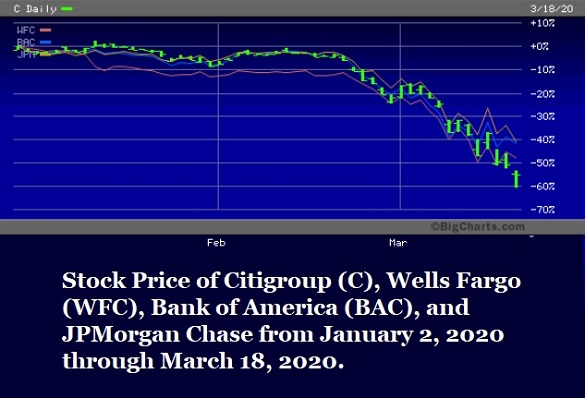
The next banking crisis occurred in March 2020 and was blamed on the pandemic. The share prices of the four largest banks (by deposits) collapsed by as much as 40 to 60 percent between January 2, 2020 and March 18, 2020. (See chart below.) The Fed rolled out the same alphabet soup of emergency lending programs that it had rolled out in 2008 – with the New York Fed once again in charge of the bulk of those programs.

Prices of Four Largest Banks During Early Part of Pandemic in 2020

Three years later, in March of 2023, the second and third largest bank failures in U.S. history occurred: Silicon Valley Bank and Signature Bank, respectively, were put into receivership by the Federal Deposit Insurance Corporation (FDIC). In addition, federal regulators had allowed Silvergate Bank, a federally-insured bank, to immerse itself with crypto outfits (including the crypto house of frauds owned by Sam Bankman-Fried) and it also experienced a bank run and was allowed to quietly wind down in March. It is far from clear that there will not be more bank failures before this latest crisis runs its course.

The good ole Fed is now doing something it has never done before in its 110-year history. It is accepting underwater bonds as collateral for emergency loans to teetering banks and paying 100-cents on the dollar on that collateral for loans of up to one year. (Historically, the Fed has imposed a haircut on collateral and made overnight loans through its Discount Window.) The Fed calls its new program the Bank Term Funding Program (BTFP).

Related Articles:

Is the New York Fed Too Deeply Conflicted to Regulate Wall Street?

The New York Fed Has Contracted JPMorgan to Hold Over $1.7 Trillion of its QE Bonds Despite Two Felony Counts and Serial Charges of Crimes

As Criminal Probes of JPMorgan Expand, Documents Surface Showing JPMorgan Paid $190,000 Annually to Spouse of the Bank’s Top Regulator

New Documents Show How Power Moved to Wall Street, Via the New York Fed 

Intelligence Gathering Plays Key Role at New York Fed’s Trading Desk 


LINK


Wednesday, April 5, 2023

A Growing Lack of Confidence in the Fed Is Spilling Over into a Lack of Confidence in U.S. Banks


SUBSCRIBE TO THIS NEWSLETTER TO RECEIVE IT IN A TIMELY MANNER

A Growing Lack of Confidence in the Fed Is Spilling Over into a Lack of Confidence in U.S. Banks

By Pam Martens and Russ Martens: April 5, 2023

Jerome Powell (Thumbnail)

Jerome (Jay) Powell, Chairman of the Federal Reserve Board

Millions of Americans are beginning to ask themselves this question: Is the Federal Reserve (the “Fed”) a competent central bank or a terminally compromised regulator that simply does the bidding of Wall Street’s mega banks to the peril of average Americans and the U.S. economy? Millions of other Americans have already made up their minds on this point.

These persistent doubts about an institution with an $8.8 trillion balance sheet – that is backstopped by the U.S. taxpayer – is very bad for confidence in the U.S. banking system, especially when the Fed pivots from one banking bailout to the next. (What was the size of the Fed’s balance sheet prior to its serial bailouts? On December 26, 2007, the Fed’s balance sheet stood at $929 billion. It has soared by 847 percent in just over 15 years of serial bailouts.)

Let’s look at the evidence that’s been stacking up against the Fed since the financial crisis of 2008 – the worst economic collapse in America since the Great Depression of the 1930s.

In response to the 2008 financial crisis, the Fed introduced a hodge podge of emergency lending programs to Wall Street’s biggest banks, as well as cranking out its traditional discount window loans. While the Fed released general details of what the programs were created to do, it did not release the names of the Wall Street firms that were doing the bulk of the borrowing, or the sums borrowed by each institution.

A tenacious investigative reporter at Bloomberg News, the late Mark Pittman, filed a Freedom of Information Act (FOIA) request with the Fed for the names of the banks, the amounts borrowed and the terms. Under the law, the Fed had to respond in 20 business days. The Fed stalled Pittman for six months, leading to the parent of Bloomberg News, Bloomberg LP, filing a lawsuit against the Fed in the Federal District Court in Manhattan in November 2008. Bloomberg won that suit. The Fed then appealed the decision to the Second Circuit Court of Appeals. A large number of other mainstream media outlets and groups filed an Amicus brief in the matter, in support of the release of the information.

The Fed also lost at the Second Circuit. The Fed was, apparently, too embarrassed to take the case to the U.S. Supreme Court, because President Obama’s acting Solicitor General, Neal Katyal, planned to file a brief contrary to the Fed’s position, so a group called The Clearing House Association LLC, made up of some of the very same Wall Street banks that were being bailed out by the Fed, filed their own appeal with the Supreme Court. The Supreme Court declined to hear the case in March of 2011, leaving the decision of the Second Circuit standing.

The financial reform legislation known as the Dodd-Frank Act (which was signed into law by President Obama on July 21, 2010) had forced the Fed to release the transaction details of its seven emergency lending facilities in December of 2010. When the Supreme Court declined to hear the court case, the Fed finally released the discount window transactions in March 2011.

On March 21, 2011, then Bloomberg News Editor in Chief Matthew Winkler released this statement:

“At some point long before the credit markets seized up in 2007, financial markets collapsed and the economy plunged into the worst recession since the 1930s, the Federal Reserve forgot that it is the central bank for the people of the United States and not a private academy where decisions of great importance may be withheld from public scrutiny. As only Congress has the constitutional power to coin money, Congress delegates that power to the Fed and the Fed must be accountable to Congress, especially in disclosing what it does with the people’s money.”

The Dodd-Frank legislation, thanks to an amendment by Senator Bernie Sanders, required the Government Accountability Office (GAO) to conduct an audit of the Fed’s emergency lending programs. When that information was released in July of 2011, it revealed that the Fed had sluiced more than $16 trillion in cumulative loans at below-market interest rates to teetering banks. (Just three Wall Street firms, Citigroup, Morgan Stanley and Merrill Lynch, received $5.7 trillion of that.)

The GAO report notes on page two that the audit does not include the Fed’s loans made through its discount window during the financial crisis. Also, in a tiny footnote on page 2 of the GAO audit, there is this statement: “…this report does not cover the single-tranche term repurchase agreements conducted by FRBNY in 2008. FRBNY conducted these repurchase agreements with primary dealers through an auction process under its statutory authority for conducting temporary open market operations.” FRBNY stands for the Federal Reserve Bank of New York – the deeply conflicted and crony regulator of Wall Street’s largest banks, which is, literally, owned by the same banks. (See These Are the Banks that Own the New York Fed and Its Money Button.)

When the Levy Institute of Economics tallied up all of the Fed’s lending programs, including the single-tranche repurchase agreements (called ST OMO or single-tranche open market operations) and added in the Fed’s dollar swap lines, it came up with a cumulative tally of $29 trillion in emergency Fed loans.

Mainstream media’s attitude about holding the Fed accountable to the people has changed dramatically for the worse since the 2008 crisis.

Wall Street On Parade is the only media outlet that continues to demand accountability for the former President of the Dallas Fed, Robert Kaplan, making million dollar plus trades in S&P 500 futures while sitting on inside information as a voting member of the Federal Reserve’s Federal Open Market Committee (FOMC). (See After 16 Months, There Are Still No Arrests in the Fed’s Trading Scandal.) The Chair of the Fed, Jerome (Jay) Powell, had the audacity to refer this investigation to the Fed’s own Inspector General, who reports to the Fed Board of Governors that is chaired by Powell.

Wall Street On Parade is also the only media outlet to crunch the numbers and report on another multi-trillion dollar bailout of the mega banks on Wall Street by the Fed that began on September 17, 2019 – months before there was any COVID-19 pandemic that the Fed could blame for the relaunch of its emergency lending programs.

These were the first emergency repo loans issued by the Fed since the financial crisis of 2008. That fact alone should have galvanized mainstream media to investigate what was going on. Instead, when the Fed was forced (under the Dodd-Frank legislation) to release after two years the names of the banks that borrowed the huge sums and the amounts borrowed, there was a bizarre total news blackout by mainstream media. (See our report: There’s a News Blackout on the Fed’s Naming of the Banks that Got Its Emergency Repo Loans; Some Journalists Appear to Be Under Gag Orders.)

From September 17, 2019 to December 31, 2019, $5.269 trillion was cumulatively doled out by the Fed in emergency repo loans to its primary dealers (the trading houses on Wall Street, most of which have federally-insured banks under the same bank holding company roof). Adjusted for the term of the loan, these figures are even more staggering.

The normal repo loan market is typically an overnight (one-day) loan market. The Fed started out with one-day overnight loans but then periodically also added 14-day, 28-day, 42-day and other term loans – suggesting an extremely serious liquidity crisis. We had to adjust our cumulative tallies to account for these term loans in order to get an accurate picture as to who was grabbing the bulk of these cheap loans from the Fed. For example, let’s say a trading firm took a $10 billion loan for one-day but on the same day took another $10 billion loan for a term of 14 days. The 14-day loan for $10 billion represented the equivalent of 14-days of borrowing $10 billion or a cumulative tally of $140 billion.

If we simply tallied the column the Fed provided for “trade amount” per trading firm, it listed only $10 billion for that 14-day term loan and not the $140 billion it actually translated into. The chart below provides the term-adjusted numbers for emergency repo loan borrowers in the last quarter of 2019.

Fed's Repo Loans to Largest Borrowers, Q4 2019, Adjusted for Term of Loan

The trading unit of the largest bank in the United States, JPMorgan Chase, was one of the largest borrowers under the Fed’s repo loans in 2019, despite its Chairman and CEO, Jamie Dimon, constantly bragging about the bank’s “fortress balance sheet.” The trading unit of the bank that received the largest bailout in global banking history during and after the 2008 financial crisis, Citigroup, was a major borrower. Goldman Sachs, which has a storied history of reckless and irresponsible trading behavior, but is nonetheless allowed to own a federally-insured bank, was a major borrower. And the trading units of numerous foreign banks, such as the Japanese bank, Nomura, and German, Deutsche Bank, were large borrowers. (The share price of Deutsche Bank, a major derivatives counterparty to Wall Street banks, was in a death spiral at the time.)

In some cases, the Fed appeared to be customizing loans for specific borrowers -– something that the Dodd-Frank financial reform legislation of 2010 expressly prohibits. For example, on December 17, 2019, the Fed made a 13-day term loan for $6.1 billion. BNP Paribas Securities received $1 billion of that; Daiwa Capital Markets got $100 million; Deutsche Bank Securities took $3 billion; and Societe Generale took the balance of $2 billion. That’s only four firms while the legal mandate of Dodd-Frank is that the Fed can only lend to “broad-based” programs. On the same date of December 17, 2019, the Fed also made an overnight loan of $52.65 billion. Deutsche Bank took three lots of that loan totaling $6.5 billion, bringing its total borrowing on that date to $9.5 billion.

The Fed’s audited financial statements show that on its peak day in the last quarter of 2019, the Fed’s emergency repo loans outstanding stood at $259.95 billion. The cause of that banking crisis remains unexplained to the American people.

Excluding the banking crisis related to the COVID-19 pandemic in 2020, Americans now find themselves in Banking Crisis 3.0 with a new Fed bailout program called the Bank Term Funding Program (BTFP). That program came on the heels of the second and third largest bank failures in U.S. history in March: respectively, Silicon Valley Bank and Signature Bank, both of which are now in FDIC receivership.

On March 12, the Fed explained its emergency action as follows:

“The additional funding will be made available through the creation of a new Bank Term Funding Program (BTFP), offering loans of up to one year in length to banks, savings associations, credit unions, and other eligible depository institutions pledging U.S. Treasuries, agency debt and mortgage-backed securities, and other qualifying assets as collateral. These assets will be valued at par. The BTFP will be an additional source of liquidity against high-quality securities, eliminating an institution’s need to quickly sell those securities in times of stress.”

The operative words in the above statement from the Fed are “one year” and “valued at par.” The Fed has now morphed from an historic practice of making overnight loans to making long-term loans and is now accepting as collateral debt instruments valued at par (meaning the full face amount), despite the fact that their market value is deeply underwater. Under the Federal Reserve Act, the Fed is mandated to accept only “good” collateral. The collateral the Fed is accepting might be good in 5, 10 or 15 years, but right now it’s underwater — the reason for this new Fed emergency lending program in the first place.

Democrats on the Senate Banking Committee have asked the Government Accountability Office to investigate the supervisory practices of bank regulators in regard to the recent bank failures. That GAO investigation needs to broaden dramatically to focus on the 15-year hubris of the Fed and its bailouts.

LINK


Friday, June 24, 2022

JPMorgan Chase’s Derivatives Spike by $14 Trillion in First Quarter to Six-Year High of $60 Trillion


SUBSCRIBE TO THIS NEWSLETTER


JPMorgan Chase’s Derivatives Spike by $14 Trillion in First Quarter to Six-Year High of $60 Trillion

By Pam Martens and Russ Martens: June 24, 2022 ~

Add JPMorgan Chase, the biggest bank in the United States with an unprecedented five criminal felony counts since 2014, to the growing list of debacles of which the Fed has lost control.

The Fed has its bank examiners pouring over the books of JPMorgan Chase on an ongoing basis, but somehow the bank’s dangerous book of derivatives has been allowed to spike by $14.42 trillion in the first quarter of this year, soaring from $45.84 trillion on December 31, 2021 to $60.26 trillion on March 31, 2022. That’s an increase of 24 percent in a three-month span. That information comes from page 18 of the newly-released report on derivatives in the banking system from the Office of the Comptroller of the Currency (OCC).

The Dodd-Frank Act of 2010 was supposed to stop the insanity of unfathomable amounts of risky derivatives being held at federally-insured banks. Under the so-called “push-out” rule in Dodd-Frank, derivatives were supposed to be moved out of the federally-insured bank to other parts of the bank holding company so that they could be wound down in a bankruptcy proceeding without endangering the federally-insured bank. Citigroup and its lobbyists succeeded in getting that provision repealed in a sneak maneuver in December 2014.

Then there was Dodd-Frank’s promise that all of these dangerous derivatives would become centrally-cleared in short order instead of being opaque over-the-counter contracts with bespoke (custom) terms that regulators and the public could not make heads or tails of. Well, that didn’t happen either. The current OCC report tells us that 71 percent of JPMorgan Chase’s equity derivatives are not centrally cleared; 100 percent of its precious metals contracts are not centrally cleared; and 96 percent of its foreign exchange derivative contracts are not centrally cleared.

The Fed and its fellow regulators deserve a grade of F for brazenly ignoring the intent of Congress when it passed the Dodd-Frank Act in 2010. Twelve years after its passage, dangerous derivatives are still not centrally cleared and instead of shrinking, their quantities and threat to financial stability are growing.

According to the official report from the Financial Crisis Inquiry Commission, which was statutorily mandated to investigate and report on the Wall Street financial collapse of 2008, derivatives played a central role in the crash. The report summarized its findings as follows:

“We conclude over-the-counter derivatives contributed significantly to this crisis. The enactment of legislation in 2000 to ban the regulation by both the federal and state governments of over-the-counter (OTC) derivatives was a key turning point in the march toward the financial crisis…without any oversight, OTC derivatives rapidly spiraled out of control and out of sight, growing to $673 trillion [globally] in notional amount. This report explains the uncontrolled leverage; lack of transparency, capital, and collateral requirements; speculation; interconnections among firms; and concentrations of risk in this market. OTC derivatives contributed to the crisis in three significant ways.

“First, one type of derivative—credit default swaps (CDS)—fueled the mortgage securitization pipeline. CDS were sold to investors to protect against the default or decline in value of mortgage-related securities backed by risky loans. Companies sold protection—to the tune of $79 billion, in AIG’s case—to investors in these newfangled mortgage securities, helping to launch and expand the market and, in turn, to further fuel the housing bubble.

“Second, CDS were essential to the creation of synthetic CDOs. These synthetic CDOs were merely bets on the performance of real mortgage-related securities. They amplified the losses from the collapse of the housing bubble by allowing multiple bets on the same securities and helped spread them throughout the financial system. Goldman Sachs alone packaged and sold $73 billion in synthetic CDOs from July 1, 2004, to May 31, 2007…

“Finally, when the housing bubble popped and crisis followed, derivatives were in the center of the storm. AIG, which had not been required to put aside capital reserves as a cushion for the protection it was selling, was bailed out when it could not meet its obligations. The government ultimately committed more than $180 billion because of concerns that AIG’s collapse would trigger cascading losses throughout the global financial system. In addition, the existence of millions of derivatives contracts of all types between systemically important financial institutions—unseen and unknown in this unregulated market—added to uncertainty and escalated panic, helping to precipitate government assistance to those institutions.”

As an example of just how lax regulators have been when it comes to reining in the threat of derivatives at the megabanks on Wall Street which, like JPMorgan Chase, own the largest federally-insured banks in the country, consider the research report that was released by the Office of Financial Research (OFR) on July 12, 2021. (OFR was also created under the Dodd-Frank Act to keep U.S. regulators informed about threats to financial stability.)

The OFR report is titled: “Counterparty Choice, Bank Interconnectedness, and Systemic Risk.” The researchers, Andrew Ellul and Dasol Kim, examined 18 different over-the-counter (OTC) derivative markets and concluded the following:

“Bank interconnectedness through the OTC derivative markets was identified as an important factor that contributed to the severity of the Great Financial Crisis…and remains an area of fragility of systemically important banks on which we have very limited understanding. The trading of OTC derivatives is notoriously concentrated in the largest banks, which are also the ones for which we have data. One important feature is the substantial counterparty risk that banks face, in our context the most important counterparty risk is that faced by banks trading with non-bank entities.”

Just how concentrated are these risky derivatives at the megabanks? The current report from the OCC tells us this:

“A total of 1,291 insured U.S. national and state commercial banks and savings associations reported trading and derivatives activities at the end of the first quarter of 2022. A small group of large financial institutions continues to dominate trading and derivatives activity in the U.S. commercial banking system. During the first quarter of 2022, four large commercial banks represented 89.0 percent of the total banking industry notional amounts [of derivatives] and 68.8 percent of industry net current credit exposure (NCCE).”

Notional means face amount of derivatives. As of March 31, 2022, the four federally-insured commercial banks that held 89 percent of all derivatives in the banking system were as follows: JPMorgan Chase with $60.26 trillion; Goldman Sachs Bank USA with $49.75 trillion; Citibank (part of Citigroup) with $45.74 trillion; and Bank of America NA with $22.48 trillion.

Yesterday, Fed Chairman Powell appeared before the House Financial Services Committee to deliver his monetary policy report. During the hearing, Powell was asked a question about systemic risks in the financial system by Congressman Jim Himes, a Democrat from Connecticut. The exchange went as follows:

Himes: “In my remaining minute I’m going to ask you a question I ask you a lot, Mr. Chairman. We’re obviously seeing pretty dramatic swings in the financial markets. Money is no longer free. We’re seeing that in the SPAC market, in the high yield market, the equities market, cryptocurrency. In my very short remaining time Mr. Chairman, what should we be focused on? What is concerning you with respect to systemic risk that may develop in the face of rising rates and rising inflation?”

Powell: “Basically, the financial markets have been functioning well and the banking system in particular is very strong, well-capitalized, has lots of liquidity, better understanding and management of its risks….”

Consider that statement from Powell against this headline from May 27: “Dow Ends Biggest Losing Streak Since 1932 as Tech Prevails.” Not to put too fine a point on it, but 1932 was the early days of the Great Depression – the worst economic collapse in U.S. history.

Under Powell’s tenure at the helm of the Fed, the Fed has lost control of inflation, which is now hovering at a 40-year high. The Fed lost control of policing its own officials, triggering the biggest trading scandal in the Fed’s 109-year history. (Investigative findings regarding that scandal, by the way, have yet to be released by any federal body after nine months.) Instead of reining in the trading abuses on Wall Street, the Fed has encroached further into markets with its own trading activities. See our report: The New York Fed Has Quietly Staffed Up a Second Trading Floor Near the S&P 500 Futures Market in Chicago.

Powell also permitted the biggest, secret, bailout of the megabanks and their derivative counterparties beginning in September 2019 – months before there was any reported case of COVID-19 anywhere in the world. And, somehow, when the names of the banks that received these windfall repo loans from the Fed were finally released two years later, there was a blanket news blackout by mainstream media. Only Wall Street On Parade, a two-person investigative team, has documented this bailout, graphed the data, and named names. (See our archive of more than 100 articles on these Fed bailouts.)

Senator Elizabeth Warren is the only member of Congress with the courage to tell the simple truth to the American people about Fed Chairman Powell: He’s a “dangerous man.”


LINK


Thursday, June 9, 2022

Fed Data Shows a Half Century of Moderate Growth in the Fed’s Balance Sheet through Two World Wars – Then a Seismic Explosion Under Bernanke, Yellen and Powell


SUBSCRIBE TO THIS NEWSLETTER

Fed Data Shows a Half Century of Moderate Growth in the Fed’s Balance Sheet through Two World Wars – Then a Seismic Explosion Under Bernanke, Yellen and Powell

Federal Reserve Balance Sheet -- 1914 to 2018

Growth in the Federal Reserve Balance Sheet -- 2003 to 2022

By Pam Martens and Russ Martens: June 6, 2022 ~

Last month the Federal Reserve Bank of New York released its 2021 annual report from its “Markets Group.” That’s the group that operates a trading floor (complete with speed dials to the trading houses on Wall Street) at the New York Fed, located not far from the New York Stock Exchange, as well as another trading floor on the premises of the Chicago Fed, which is not far from the futures exchanges in Chicago. That report showed that despite all of the recent talk about the Fed dramatically shrinking its balance sheet from its current size of $8.9 trillion, the internal Federal Reserve plan for the balance sheet is actually this: “After declining by about $2.5 trillion from the peak size reached in the first half of 2022, the portfolio stops declining in mid-2025, at which point it is held constant at $5.9 trillion.” It is thereafter projected to start growing again in line with GDP. (See page 47 of the report at this link.)

The charts above show that the Federal Reserve was able to get through World War I, the Great Depression, World War II, the Vietnam War and the stagflation of the 1970s, without an explosion in its balance sheet. But since Ben Bernanke, Janet Yellen and Jerome Powell have, in turn, sat at the helm of the Federal Reserve, there has been unprecedented growth in the Fed’s Balance Sheet.

For example, from June 1960 to August 1990, the Fed’s balance sheet increased from $53 billion to $309 billion – an increase of 483 percent in 30 years. But during the tenures of Bernanke, Yellen and Powell, the Fed’s balance sheet has exploded from $880 billion in May 2008 to $8.9 trillion in May of 2022 – an increase of 911 percent in just 14 years.

There are a number of factors to explain this unprecedented growth in the Fed’s balance sheet. Chief among them are the following:

The Federal Reserve Board of Governors has outsourced its open market operations to the New York Fed, which is, literally, owned by a handful of Wall Street megabanks. (See related articles below.)

Congress has failed to separate the giant federally-insured banks from the Wall Street casino (trading houses), by restoring the Glass-Steagall Act. This lack of Congressional action has led to the perpetual giant bailouts of Wall Street banks, which have exploded the Fed’s balance sheet through so-called Quantitative Easing (a/k/a “bailout”) measures.

The advent of the 401(k) plan which incentivizes U.S. workers to save for retirement through investments in the stock market (or to a much smaller extent, the bond market). This removes much of the public outcry to Congress when the Fed bails out Wall Street because tens of millions of workers feel that their retirement savings are also being bailed out. To fully grasp this concept, see our 2008 report on the “ownership society.” (Unknown to the average American, the top 10 percent of the wealthiest households in America own the vast majority of the stock market.)

Related Articles:

New York Fed’s Answer to Cartels Rigging Markets – Form Another Cartel

Is the New York Fed Too Deeply Conflicted to Regulate Wall Street?

New Data Shows Fed Chair Powell Misled Congress on the Condition of the Megabanks and their Need for Emergency Loans

In a Six-Day Span in March 2020, the Dow Crashed 5,676 Points; the Fed Responded with Almost $1 Trillion in Repo Loans to 24 Trading Houses

Nomura, JPMorgan and Goldman Sachs Received a Cumulative $8 Trillion from the Fed’s Emergency Repo Loans in Fourth Quarter of 2019

Economist Michael Hudson Says the Fed “Broke the Law” with its Repo Loans to Wall Street Trading Houses

Janet Yellen’s Cash Haul of $7 Million Is Just the Tip of the Iceberg; She Failed to Report Her Wall Street Speaking Fees from JPMorgan and Others in 2018

Fed Chair Bernanke Held 84 Secret Meetings in the Lead Up to the Wall Street Collapse


LINK


The Bushes Just Picked A Side In Texas. It Wasn’t Trump’s. Plus A Reporter Says Foreign Spies Watched Jared Kushne…

                                                                                   LOTS OF POSTS IGNORED BY BLOGGER..... OR REMOVED ON THEIR...