Showing posts with label WALL STREET ON PARADE. Show all posts

Thursday, February 27, 2025

In Trump 1.0, the State Department Used Taxpayer Money to Publish a Book Elevating Elon Musk to a Superhero; It Was Funded by USAID, the Agency Musk Wants to Quickly Shut Down


SUBSCRIBE TO THIS NEWSLETTER TO RECEIVE TIMELY REPORT!


In Trump 1.0, the State Department Used Taxpayer Money to Publish a Book Elevating Elon Musk to a Superhero; It Was Funded by USAID, the Agency Musk Wants to Quickly Shut Down

By Pam Martens and Russ Martens: February 25, 2025 ~

excerpt: 


During Donald Trump’s first term as president, while Mike Pompeo was serving as his Secretary of State, the State Department authorized a government contract on September 23, 2019 to translate and publish a book for young people that lavished praise on Elon Musk as an inspiring role model.

The book’s title was: “Elon Musk and the Quest for a Fantastic Future, Young Readers Edition.” It was authored by then Bloomberg/Businessweek writer, Ashlee Vance, and based on his New York Times bestseller for adults, “Elon Musk: Tesla, SpaceX and The Quest for a Fantastic Future.”

Curiously, however, the book wasn’t for U.S. children or even children on the same continent. The State Department award went to an organization called Steps to Success Public Association in Karakol, Kyrgyzstan.

The federal account from which the $17,054 contract came was USAID, the federal agency that has been gutted and reputationally savaged as riddled with fraud, waste and abuse by Elon Musk.

FULL ARTICLE:

WALL STREET ON PARADE

Thursday, February 13, 2025

Elon Musk’s Companies Were Under Investigation by Five Inspectors General When the Trump Administration Fired Them and Made Musk the Investigator


SUBSCRIBE TO THIS NEWSLETTER TO RECEIVE TIMELY REPORTS!

Elon Musk’s Companies Were Under Investigation by Five Inspectors General When the Trump Administration Fired Them and Made Musk the Investigator

By Pam Martens and Russ Martens: February 13, 2025 ~

Yesterday, the newly formed House Subcommittee on Delivering on Government Efficiency (DOGE) held its first hearing titled: “The War on Waste: Stamping Out the Scourge of Improper Payments and Fraud.” The Subcommittee appears to be part of an echo chamber attempting to bring legitimacy to President Donald Trump tapping his largest campaign donor, billionaire Elon Musk, to lead an effort to gut federal law enforcement and regulatory agencies and create enough savings to give tax breaks and other perks to the ultra-rich.

Musk should be immediately disqualified from any such watchdog role for the following reasons: he effectively put Trump over the election finish line, giving $288 million to PACs or Super PACs supporting Trump; the Wall Street Journal (paywall) reported that Musk has been communicating with Russian President Vladimir Putin since 2022, notwithstanding the fact that Musk’s company SpaceX is a U.S. military defense contractor and Putin is on a U.S. sanctions list for launching a war on Ukraine.

In addition, Musk’s companies have received $19.8 billion in U.S. government contracts since 2009. (See chart above.)

And finally, and most importantly, Musk’s so-called Department of Government Efficiency (with the same acronym as the Subcommittee, i.e. DOGE, and the same name as a crypto coin Musk has boosted) is now investigating the same federal agencies whose Inspectors General were investigating Musk’s companies until they were sacked by the Trump administration last month.

Yesterday, during the DOGE Subcommittee’s first hearing, Congressman Greg Casar (D-TX) revealed that the Inspectors General of five federal agencies that were investigating Musk’s companies had been fired by the Trump administration last month. Casar said that the Inspector General of the Department of Labor had 17 open investigations into Tesla and SpaceX, where Musk is the CEO of both and a major shareholder. Casar also called out that the Inspector General of the Department of Transportation was investigating Tesla when he was fired by the Trump administration.

According to Casar, the Department of Defense’s Inspector General was looking into SpaceX when he was fired. The investigation was potentially a result of the Wall Street Journal’s reporting on Musk’s use of illegal drugs and secret conversations with Putin, both of which would be highly problematic for a defense contractor with security clearance.

Also, according to Casar, the Inspector General of the U.S. Department of Agriculture was investigating Neuralink, another Musk company (experimenting with computer brain implants) when he was fired; and the Inspector General of the Environmental Protection Agency (EPA) was repeatedly “taking on” Tesla, when he was fired.

Musk’s companies currently have over $3 billion in existing contracts with the U.S. government. In that regard, Casar told the witnesses at the hearing that Musk will receive an average of $8 million a day from his companies’ contracts while the Social Security recipients that he’s investigating receive an average of $65 a day.

You can watch the Casar exchange with the hearing witnesses here.

Monday, February 3, 2025

As Elon Musk Begins Shutting Down Payments to Federal Contractors, a Strange Money Trail Emerges to His Operatives Inside the U.S. Treasury’s Payment System


SUBSCRIBE TO THIS NEWSLETTER TO RECEIVE TIMELY REPORTS!


As Elon Musk Begins Shutting Down Payments to Federal Contractors, a Strange Money Trail Emerges to His Operatives Inside the U.S. Treasury’s Payment System

By Pam Martens and Russ Martens: February 3, 2025 ~

Elon Musk, CEO of Tesla

Elon Musk

Elon Musk is the billionaire CEO of the publicly-traded EV company, Tesla. As such, under corporate law, he owes a Duty of Loyalty to Tesla. Notwithstanding this well-established law, Musk is engaged in an array of other corporate endeavors outside of Tesla, including being the CEO of SpaceX, a private rocket company.

SpaceX is a major federal contractor to NASA and the Department of Defense. See our report: The U.S. Government Is Plowing Billions into SpaceX, Overlooking Drug Use, Sex Parties, and Elon Musk’s Coziness with Putin.

Now, the New York Times, Wall Street Journal, Bloomberg News, and a host of other media outlets are reporting that Musk has used his 2-week old position as the head of a Donald Trump faux agency – the Department of Government Efficiency (DOGE) – which Trump created out of thin air last month by Executive Order, to have his DOGE operatives gain access to the U.S. Treasury’s $6 trillion payment system and snoop on its payments. This means that Musk’s DOGE hires could potentially access confidential information on government contract payments made to Musk’s competitors as well as highly confidential payments related to national security.

There are media reports this morning that Musk has begun to cancel payments to some federal contractors.

One of the individuals engaged in this snooping on behalf of Musk, according to reporting at the New York Times, is Tom Krause, the CEO of Cloud Software Group, which describes itself as “Developer of enterprise infrastructure software” whose platform encompasses, among other things, “business intelligence.”

Krause is still listed at the website of Cloud Software Group as its current CEO, as well as using that same title on his personal LinkedIn page. So how, exactly, did he gain security clearance to snoop on this vast U.S. government payment system. Why is the Board of Directors of Cloud Software Group allowing him to engage in this legally dubious undertaking?

Cloud Software Group’s major owners include Vista Equity Partners and Elliott Investment Management, according to an interview with Krause at SpencerStuart.

The founder, Chairman and CEO of Vista Equity Partners is billionaire Robert F. Smith, whose net worth is pegged at $10.8 billion according to Forbes. In 2020, during the first Trump administration, Smith was charged by the U.S. Department of Justice with engaging in a massive 15-year international tax fraud scheme. Smith was given a non-prosecution agreement and settled the matter for $139 million after cooperating with prosecutors.

The other major co-owner of Krause’s firm, Elliott Investment Management, is the giant hedge fund founded by billionaire Paul Singer, who remains at Elliott as President, Co-Chief Executive Officer, and Co-Chief Investment Officer. Singer gave the Trump-supporting Make America Great Again Inc. PAC $5 million in one check in August of last year.

In addition, and notably, Singer is also Chairman of the Manhattan Institute for Policy Research, a right-wing think tank. William Barr, one of Donald Trump’s Attorneys General during his first term as President, is a member of the Board of Trustees of the Manhattan Institute. Megadonors to Trump and Republicans, including hedge fund titan John Paulson and former Education Secretary Betsy DeVos in Trump’s first term, also serve on the Manhattan Institute’s Board of Trustees.

Senator Ron Wyden, the Ranking Member of the Senate Finance Committee has sent a letter to Trump’s recently confirmed U.S. Treasury Secretary, Scott Bessent, raising national security concerns about the snooping by DOGE inside the Treasury’s payment system and demanding answers in short order.


WALL STREET ON PARADE


Tuesday, January 28, 2025

With Trump and Melania’s Crypto Coins Likely to Raise Legal Challenges, Why Didn’t Trump Fire the SEC’s Inspector General in His Purge of IGs?


SUBSCRIBE TO THIS NEWSLETTER TO RECEIVE TIMELY REPORTS!


With Trump and Melania’s Crypto Coins Likely to Raise Legal Challenges, Why Didn’t Trump Fire the SEC’s Inspector General in His Purge of IGs?

By Pam Martens and Russ Martens: January 28, 2025 ~
Senator Sheldon Whitehouse (D-RI)

Senator Sheldon Whitehouse (D-RI) Writes that Trump’s Firing of IGs Is to “Clear Out the Cops Before You Send in the Thieves.”

Last Friday night, when federal employees thought they could escape to a weekend of relief from Donald Trump’s rewriting of the Constitution by Executive Edict, emails went out to at least 16 Inspectors General – the fraud and abuse watchdogs of Federal agencies – informing  them that they were terminated “immediately,” without citing any grounds for dismissal, a legal requirement since 2022.

What is particularly strange about the mass firings is that many of these IGs were appointed by Trump himself in his first term as President, raising the suspicion that Trump’s current demands for personal loyalty have taken an even darker turn in Trump 2.0.

Mark Lee Greenblatt, the IG of the Interior Department (which Trump now seems eager to sacrifice to the fossil fuel industry) took to LinkedIn on Saturday to express his reaction to being fired as a government watchdog – after work hours, by email. Greenblatt, appointed by Trump as IG in 2019, wrote this:  

“President Trump fired me last night, along with a number of other Inspectors General.

“I poured my heart and soul into my DOI OIG team and the broader IG community. I tried to be the best IG and the best CIGIE Chair I could possibly be. I am incredibly proud of our high-impact work in the highest-risk areas facing the Department and the IG community. We made a difference for the American people.

“I’m just trying to process this right now. It’s all just so surreal.”

“Surreal” may be a bit of a stretch. This is surreal. Trump firing watchdogs is the sine qua non of his presidential career. Also see our report on the Trump 1.0 Friday night ouster of Federal prosecutor Geoffrey Berman here.

If Trump was expecting this cruel destruction of careers and livelihoods by email to frighten other federal workers into submission, it appears to have backfired. There are numerous comments under Greenblatt’s post on LinkedIn by current Interior Department employees, applauding Greenblatt’s performance and appearing to give a thumbs down to his ouster by Trump.

The news of the mass firings made their way to Senator Sheldon Whitehouse (D-RI), the Congressional expert on the corrupting influence of megadonor money in Washington. Whitehouse posted at X (Twitter):

“Corruption 101: Clear out the cops before you send in the thieves.”

The news also outraged 21 ranking (Democratic) members of House Committees, who whipped off a letter to Trump on Saturday, crisply advising him that his mass firings of IGs were illegal. The ranking members wrote:

“The Inspector General Act of 1978, amended in 2022 with broad bipartisan support, requires the President to notify Congress 30 days prior to removal of an inspector general and provide ‘substantive rationale, including detailed and case-specific reasons’ for such removal. The email terminating the inspectors general fails to provide the required notice and a legitimate rationale, as required by law.

“Firing inspectors general without due cause is antithetical to good government, undermines the proper stewardship of taxpayer dollars, and degrades the federal government’s ability to function effectively and efficiently. We urge you to withdraw your unlawful action and comply with your obligations to the American people.”

The Congressional Research Service, the research arm of Congress, has a policy paper on IG removal and updated it expressly to include Trump’s mass firings on January 24. It explains:

“The 30-day notice requirement was established under the Inspector General Reform Act of 2008 (P.L. 110-409), and the requirement that notice include a ‘substantive rationale’ was added by the Securing Inspector General Independence Act of 2022 (Title LII, Subtitle A, of P.L. 117-263)…

“President Trump’s January 2025 action appears to be a direct challenge to the enforceability of Congress’s removal procedures under the IG Act. If this matter is litigated, the executive branch may seek to curtail Congress’s options to control even procedural requirements for removals. A judicial decision limiting Congress’s authority to impose such rules could substantially impact fundamental oversight of agency programs, spending, and staff.”

The White House issued no press release on the firings, leaving media outlets in the position of having to call individual Inspectors General to learn if they had been fired. Thus far, terminations of IGs at the following federal agencies have been reported: Department of Agriculture; Department of Commerce; Department of Defense (now in the hands of Trump appointee Pete Hegseth, accused by multiple persons of being routinely drunk in public); Department of Energy; Environmental Protection Agency; Health and Human Services; HUD; Department of the Interior; Department of Labor; Small Business Administration; Social Security Administration; Department of State; Department of Transportation; Veterans Affairs; and White House Office of Personnel Management.

Note that the Inspector General of the Securities and Exchange Commission (SEC) is not listed in the above tally of firings. Given that Trump and First Lady Melania each issued their own crypto coins just days before moving into the White House, whose trading charts now look like pump and dump schemes, and the SEC is one of the federal agencies that oversees crypto, one would have suspected that its Inspector General would have been the first to be ousted.

As it turns out, the SEC Inspector General is not appointed by the President but by the SEC itself. Deborah Jeffrey has been the Inspector General of the SEC since 2023. She arrived during the tenure of Gary Gensler, a President Biden appointed SEC Chair for whom Donald Trump has had less than kind words. Trump’s stable of crypto megadonors have had even less kind words for Gensler.

Prior to government service, Jeffrey spent 23 years at the law firm of Zuckerman Spaeder LLP, where she defended both government and corporate individuals in criminal investigations. One of her high-profile clients was Lou Pai, the former Chairman and CEO of Enron Energy Services (EES), one of the few top Enron executives to avoid prison time. Pai also had the distinction of being nimble enough to cash out over $268 million of Enron stock before the stock price collapsed and the high-flying energy company filed for bankruptcy protection.

On July 30, 2008, Pai agreed to settle civil insider trading charges brought against him by the SEC for $31.5 million. The SEC wrote the following in its announcement of the settlement:

“Had Enron reported EES’s contract-related losses in its Retail Energy Services segment, that segment would have shown a quarterly loss of at least $60 million, rather than a profit of $40 million as falsely reported in Enron’s Form 10-Q for the first quarter of 2001. Pai knew or should have known that he could not sell Enron stock without first disclosing such material, nonpublic information. By selling Enron stock without disclosing this information, Pai breached his fiduciary duty to Enron shareholders.

“The Commission’s complaint further alleges that Pai avoided substantial losses from these sales when the price of Enron stock collapsed in the fall of 2001. Enron’s stock price averaged approximately $53.78 per share during the time of Pai’s sales, but closed at $0.40 on December 3, 2001 – the day after Enron filed for Chapter 11 bankruptcy protection. By selling his shares in May and June 2001 before the collapse of Enron’s share price, Pai avoided millions of dollars of losses.”

Given this background, it will be interesting to see if Jeffrey is one of the Inspectors General who remains in the Trump 2.0 administration.

The always insightful Robert Reich had some interesting thoughts on the future of the SEC and its regulation of crypto now that Trump has made himself a crypto billionaire with his crypto coin. Reich wrote this on Substack:

“Trump is putting crypto-friendly people into place at key federal agencies, boosting its prospects. In December, he picked Washington lawyer Paul Atkins, a known crypto booster, to chair the Securities and Exchange Commission, America’s main financial regulator. [Atkins has yet to be confirmed by the Senate.]

“Last week, the Securities and Exchange Commission altered its guidance so that financial institutions no longer have to account, on their own balance-sheets, for crypto assets held on behalf of customers. The SEC rolled back accounting guidance that had deterred banks from getting involved with crypto.

“Trump has tapped the venture investor and digital currency enthusiast David Sacks to oversee administration policies on crypto (and artificial intelligence).

“Then, this past Thursday, Trump issued an executive order committing the Trump administration to ‘protecting and promoting’ the crypto industry:

‘The digital asset industry plays a crucial role in innovation and economic development in the United States, as well as our nation’s international leadership. It is therefore the policy of my administration to support the responsible growth and use of digital assets.’

“The order gives his administration authority to establish a national cryptocurrency stockpile — a stash of digital coins that the crypto industry has spent months lobbying the new administration for because it further legitimizes crypto and adds to the demand for it.

“Trump’s order also prohibits the creation of a ‘central bank digital currency’ overseen by the government. And the order promises ‘fair and open access to banking services’ for crypto (responding to complaints from crypto companies that banks have denied them accounts).

‘In effect, Trump is writing the rules for a business venture from which he and his family are personally profiting. It could earn them hundreds of billions of dollars.”

Trump’s view that crypto plays “a crucial role in innovation and economic development” is countered by more than 1600 scientists and experts who call both crypto and blockchain a sham. 

WALL STREET ON PARADE


Friday, January 10, 2025

Wall Street Watchdog Warns “Clock Is Ticking on a Coming Catastrophic Financial Crash”


SUBSCRIBE TO THE NEWSLETTER TO RECEIVE TIMELY REPORTS! 


Wall Street Watchdog Warns “Clock Is Ticking on a Coming Catastrophic Financial Crash”

By Pam Martens and Russ Martens: January 10, 2025 ~

Dennis Kelleher, Co-Founder, President and Chief Executive Officer of Better Markets

Dennis Kelleher, Co-Founder and CEO, Better Markets

The indefatigable Dennis Kelleher, Co-Founder and CEO of the Wall Street watchdog, Better Markets, has just released his organization’s monthly newsletter for January 2025 and it’s a humdinger.

Kelleher warns that the financial deregulators that incoming President Donald Trump has packed into his administration means “that the clock is ticking on a coming catastrophic financial crash that will likely be much worse than 2008.”

Kelleher adds that this “is not hyperbole.” He cites evidence from past financial crashes, writing:

“…there is always a lag after deregulation and the creation of artificial liquidity. That was true for ‘roaring ‘20s’ followed by the crash and Great Depression; the ‘great moderation’ of the early 2000s followed by the crash and Great Recession; the deregulation of the first Trump administration in 2017-2020 that led to the 2023 banking crisis when 3 of the 4 largest bank failures in US history happened.  Much worse is likely to happen next time.”

The potential for another great crash might explain why the Vice President for Supervision at the Federal Reserve, Michael Barr, is abandoning the ship and lowering the life raft.

Kelleher has a way with coining a phrase, writing that “Banks don’t neglect their duties, act recklessly, engage in high-risk behavior, or break the law – bankers do” – and he warns that this is going to persist “until individual bankers are meaningfully and personally punished.”

Unfortunately, as Wall Street On Parade has documented time and again, regardless of which political party holds the reins in Washington, Wall Street has been able to draw a no-law zone around its activities with a wink and a nod from the U.S. Department of Justice.

In 2016 we reported on what the PBS Program, Frontline, had revealed about the Obama administration’s Department of Justice and its handling of the investigations after Wall Street had crashed the U.S. economy and left millions of Americans out of work with foreclosure notices nailed to their front doors:

NARRATOR: Frontline spoke to two former high-level Justice Department prosecutors who served in the Criminal Division under Lanny Breuer. In their opinion, Breuer was overly fearful of losing.

FRONTLINE’S MARTIN SMITH: We spoke to a couple of sources from within the Criminal Division, and they reported that when it came to Wall Street, there were no investigations going on. There were no subpoenas, no document reviews, no wiretaps.

LANNY BREUER: Well, I don’t know who you spoke with because we have looked hard at the very types of matters that you’re talking about.

MARTIN SMITH: These sources said that at the weekly indictment approval meetings that there was no case ever mentioned that was even close to indicting Wall Street for financial crimes.

Following the 2008 crash, Congress passed legislation that created the Financial Crisis Inquiry Commission (FCIC) to investigate and report on the causes of the crash. In 2016, previously withheld documents from the FCIC’s investigation were publicly released. Senator Elizabeth Warren was aghast at what they showed.

In a 20-page letter to the Inspector General of the U.S. Department of Justice, Senator Warren asked for an investigation into why the DOJ had failed to indict any of the Wall Street executives that had been referred to it by the FCIC for potential criminal prosecution. In a separate letter, Warren asked then FBI Director James Comey for his related files.

The FCIC documents showed that it had made multiple criminal referrals of Wall Street executives to the DOJ in 2010. Warren explained the referrals as follows in her letter:

“A review of these documents conducted by my staff has identified 11 separate FCIC referrals of individuals or corporations to DOJ in cases where the FCIC found ‘serious indications of violations[s]’ of federal securities or other laws. Nine individuals were implicated in these referrals (two were implicated twice). The DOJ has not filed any criminal prosecutions against any of the nine individuals. Not one of the nine has gone to prison or been convicted of a criminal offense. Not a single one has even been indicted or brought to trial. Only one individual was fined, in the amount of $100,000, and that was to settle a civil case brought by the SEC.”

The two individuals Warren refers to who were “implicated twice” in the FCIC’s criminal referrals are Robert Rubin, the former Treasury Secretary in the administration of Bill Clinton, who in the lead up to the crash of Citigroup in 2008 served as Executive Committee Chair of Citigroup’s Board of Directors. (After advocating for the repeal of the Glass-Steagall Act, which allowed Citigroup to own both an insured depository bank, an investment bank and brokerage firm, Rubin went straight from his post as Treasury Secretary to the Board of Citigroup, where he collected $126 million in compensation over the next decade.)

The other individual whose name appears twice is Chuck Prince, the Citigroup CEO during its implosion. A third Citigroup executive’s name appears as well on the list: Gary Crittenden, the Chief Financial Officer of Citigroup at the time of its crash. Crittenden was the individual that was fined $100,000 by the SEC.

Not only were Citigroup’s top executives not prosecuted, but the bank was secretly receiving cumulative revolving loans totaling $2.5 trillion from the Federal Reserve from December 2007 to at least July of 2010. That information was revealed in 2011 when the Government Accountability Office (GAO) released its audit of the Fed’s bailout programs.

The Fed is not legally allowed to make loans to insolvent institutions. But in the case of Citigroup, it appears that the Fed ignored its statutory mandate. Sheila Bair, who was the Chair of the Federal Deposit Insurance Corporation (FDIC) during the 2008 crisis, confirms this point in her book, Bull by the Horns. Bair writes:

“By November [2008], the supposedly solvent Citi was back on the ropes, in need of another government handout. The market didn’t buy the OCC’s [Office of the Comptroller of the Currency that supervises national banks] and NY Fed’s strategy of making it look as though Citi was as healthy as the other commercial banks…Instead, the OCC and the NY Fed stood by as that sick bank continued to pay major dividends and pretended that it was healthy.”

Actually, they weren’t standing by at all. The Fed was secretly propping up Citigroup with $2.5 trillion in loans – many of which were made at a fraction of one percent interest while Citigroup was charging double-digit interest rates to its struggling credit card customers.

Better Market’s Kelleher, in the organization’s current newsletter, asks and answers this question:

“How did we get here? The financial industry uses its economic power to buy political power which it then uses to increase its economic power. That just happened again in the November 2024 elections, and the financial industry is about to reap the rewards. The Trump administration is going to unleash a very dangerous juggernaut of deregulation of the financial industry.”

WALL STREET ON PARADE


Monday, January 6, 2025

In a Six-Week Span, this Dark Pool with a Curious Past Traded 3.7 Billion Shares


SUBSCRIBE TO THIS NEWSLETTER TO RECEIVE TIMELY REPORTS!


In a Six-Week Span, this Dark Pool with a Curious Past Traded 3.7 Billion Shares

By Pam Martens and Russ Martens: January 6, 2025 ~

Roman Ginis, Founder and CEO, Imperative Execution Inc.

Roman Ginis, Founder and CEO, Imperative Execution Inc.

There is a precise date as to when the American public became overtly aware that the stock market structure had become outrageously rigged. That date is March 30, 2014 when famed author and former Wall Street veteran, Michael Lewis, went on 60 Minutes to proclaim: “The United States stock market, the most iconic market in global capitalism, is rigged.”

When asked to explain just who it is that’s rigging the stock market, Lewis explained that it’s a “combination of these stock exchanges, the big Wall Street banks and high-frequency traders.”

That 60 Minutes program occurred during President Obama’s administration. Not only was nothing materially done to stop the rigging during Obama’s eight years in office, but the rigging has grown in both size and complexity since then as hedge funds and Dark Pools take over large segments of stock market structure.

Dark Pools are effectively stock exchanges that trade in the dark with limited oversight from the Securities and Exchange Commission (SEC). The most active Dark Pools are primarily owned by domestic and foreign megabanks like UBS, Goldman Sachs, JPMorgan Chase, Morgan Stanley, Citigroup and so forth. Bizarrely, these megabanks are allowed by the SEC to trade shares of their own bank stock in their own Dark Pools, as well as the shares of the other megabanks. (See Wall Street Banks Are Trading in Their Own Company’s Stock: How Is This Legal?)

On June 2, 2014 (two months after Michael Lewis blew the whistle on 60 Minutes) Wall Street’s self-regulator, FINRA, decided to engage in a charade of transparency by publishing three-week old Dark Pool data, lumped together for an entire week at a time. That practice has continued since 2014.

Wall Street On Parade periodically takes a look at FINRA Dark Pool data, to see if anything new jumps out. What jumped out at us recently is that the second largest Dark Pool by share volume over at least the past six months is not a megabank. Its name is IntelligentCross and it has a noteworthy history.

IntelligentCross is owned by Imperative Execution Inc., whose founder and CEO is Roman Ginis. Prior to founding the Dark Pool in 2016, Ginis was a quantitative trader for the multi-quant unit of SAC Capital, the hedge fund owned, operated and named after Steven A. Cohen. Ginis worked for Cohen for seven years, from 2009 to 2016. His unit was re-branded as Cubist Systematic Strategies in 2014.

According to a 2018 article in the Wall Street Journal, the venture-capital arm of Cohen’s firm provided investment funds to help launch the IntelligentCross Dark Pool.

Cohen’s SAC Capital changed its name – for good reason – in 2014 to Point72 Asset Management. The name change was part of a re-branding effort after SAC Capital became synonymous with insider trading. Eight employees of SAC Capital were convicted on criminal charges of insider trading. On November 4, 2013, SAC Capital pleaded guilty to criminal charges brought by the U.S. Department of Justice and agreed to pay $1.8 billion in fines and forfeitures.

Cohen was not criminally charged.

According to the FINRA data, for the six weeks running from November 11 through December 16, 2024 (the most recent Dark Pool data made available by FINRA), IntelligentCross traded the following number of shares:

12/16/24    740,933,347

12/09/24    636,475,217

12/02/24    626,026,343

11/25/24    404,506,996

11/18/24    628,462,065

11/11/24    690,228,833

In each week, the share volume of IntelligentCross is second only to the Dark Pool owned by the giant international trading firm, UBS, and ahead of the Dark Pool owned by the giant international trading firm of Goldman Sachs.


WALL STREET ON PARADE

Monday, December 16, 2024

$663 Billion in Cash Assets Have Gone Poof at the Largest U.S. Banks


SUBSCRIBE TO THIS NEWSLETTER TO RECEIVE TIMELY REPORTS!

$663 Billion in Cash Assets Have Gone Poof at the Largest U.S. Banks

Cash Assets at Largest U.S. Banks

By Pam Martens and Russ Martens: December 16, 2024 ~

According to the December 6 release of Federal Reserve H.8 data, cash assets at the 25 largest U.S. banks have dropped by a stunning $663 billion from their peak levels on December 15, 2021. (See chart above, taken from the St. Louis Fed’s FRED graph, which is updated on an ongoing basis. Put your cursor on the FRED chart line here to get the weekly dollar figures.)

Notice also on the chart that cash levels at the largest U.S. banks were a sea of calm for more than two decades prior to the financial crash of 2008, but since that time cash assets have displayed wild gyrations, rising sharply then precipitously plunging.

It should provide no comfort to Americans that the wild gyrations on the chart above are a product of the central bank of the United States (the “Fed”) inserting itself, time and again since December 2007, into bailing out the trading houses on Wall Street – which since the repeal of the Glass-Steagall Act in 1999 are in drag as federally-insured banks.

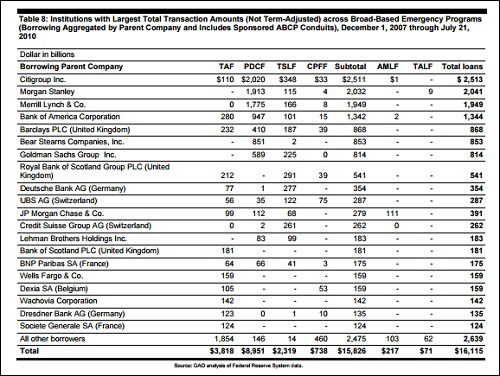
The Fed’s first giant money funnel began secretly in December 2007 and lasted through at least July 2010. The Fed battled in court for more than two years to keep the names of the banks and the $16 trillion they borrowed a secret from the American people. (See chart below from the GAO audit.) If you add in the dollar swap lines that the Fed made available to foreign central banks during the financial crisis, the Fed’s money funnel comes to an even more staggering $29 trillion.

On July 21, 2011 the investigative arm of Congress, the Government Accountability Office (GAO), released the first-ever government audit of the Federal Reserve. The audit came about as a result of the determined efforts of Senator Bernie Sanders, who was successful in adding an amendment to the Dodd-Frank financial reform legislation of 2010 that mandated a top-to-bottom audit of how much the Fed had spent on bailing out the megabanks on Wall Street.

Sanders issued a statement saying this on the day the findings were released:

“The first top-to-bottom audit of the Federal Reserve uncovered eye-popping new details about how the U.S. provided a whopping $16 trillion in secret loans to bail out American and foreign banks and businesses during the worst economic crisis since the Great Depression…The Fed outsourced virtually all of the operations of their emergency lending programs to private contractors like JP Morgan Chase, Morgan Stanley, and Wells Fargo. The same firms also received trillions of dollars in Fed loans at near-zero interest rates. Altogether, some two-thirds of the contracts that the Fed awarded to manage its emergency lending programs were no-bid contracts. Morgan Stanley was given the largest no-bid contract worth $108.4 million to help manage the Fed bailout of AIG.”

The Fed’s bailout of the giant insurance company, AIG, was, in effect, a thinly disguised bailout of the Wall Street megabanks, which received 100 cents on the dollar from AIG for the derivative trades (credit default swaps) that AIG owed the banks and would not otherwise have been able to pay.

The reality is that the Federal Reserve’s 2007-2010 bailout was conceived by Wall Street, run by Wall Street for its own benefit, and controlled behind a dark curtain at the Federal Reserve Bank of New York – which is, literally, owned by the megabanks on Wall Street. (See These Are the Banks that Own the New York Fed and Its Money Button.)

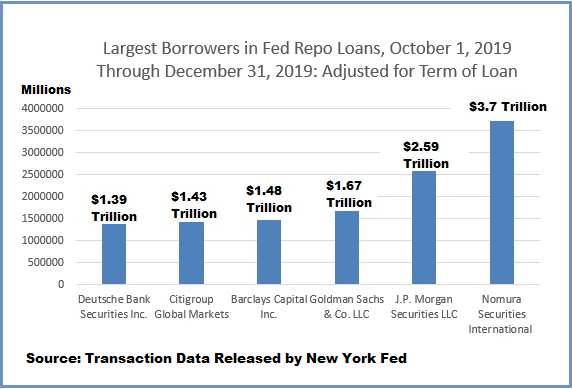
A very similar scenario played out during the repo crisis in the last quarter of 2019 when the Fed pumped more trillions of dollars into Wall Street megabanks. That crisis transitioned into the COVID-19 pandemic crisis of 2020 and beyond, which resurrected the emergency loan programs of 2008 by the Fed plus a bunch of new ones. Then there was the Fed’s emergency response to the 2023 spring banking panic that saw the second, third and fourth largest bank failures in U.S. history plus a run on uninsured deposits across the banking landscape. (See Former New York Fed Pres Bill Dudley Calls This the First Banking Crisis Since 2008; Charts Show It’s the Third.)

The Fed defines cash assets as “vault cash, cash items in process of collection, balances due from depository institutions, and balances due from Federal Reserve Banks.” As the chart above shows, cash assets at the 25 largest banks have plummeted from $2.163 trillion on December 15, 2021 to $1.5 trillion on December 4 of this year – a plunge of $663 billion.

Where is all of this cash going? Since a major part of what these federally-insured megabanks do today is trading, we suspect – but can’t say for sure – that the cash is being used in part to post cash collateral on the tens of trillions of dollars in derivative trades held by a handful of these megabanks.

Let’s look at another strange era of cash assets going poof at the megabanks. On April 8, 2015, cash assets stood at $1.398 trillion at the 25 largest U.S. banks according to Fed data at that time. By September 18, 2019, cash assets had plunged to $759 billion – a decline of 45.7 percent.

This next chart shows how the Fed responded to this cash crisis in the fall of 2019, making trillions of dollars in emergency revolving repo loans to U.S. and foreign banks.

Fed's Repo Loans to Largest Borrowers, Q4 2019, Adjusted for Term of Loan

When the names of the banks that received these trillions of dollars in cheap loans from the Fed were finally revealed by the Fed two years later, there was a complete mainstream media news blackout.  (Read our report: There’s a News Blackout on the Fed’s Naming of the Banks that Got Its Emergency Repo Loans; Some Journalists Appear to Be Under Gag Orders.)

The 2008 financial collapse was the worst economic crisis in the U.S. since the Great Depression of the 1930s. It took six years for jobs to recover; more than 10 million Americans fell into poverty; and more than 6 million families lost their homes to foreclosure. And yet, Congress has failed to reform the Fed under both Democrat and Republican leadership in the White House.

GAO Data on Emergency Lending Programs During Financial Crisis


Top News | 'He’s Not Going to Run Unopposed': Sanders Rejects Schumer for Majority Leader

                                                               LOTS OF POSTS IGNORED BY BLOGGER..... OR REMOVED ON THEIR WHIM! ALL POSTS ARE...