HERE’S THE DEAL— We know that President Joe Biden and a group of senators agreed to something this week. We also know that the agreement may be on the verge of falling apart . But what’s much less clear is what exactly the president and the senators agreed to do together, however briefly. Nightly turned to transportation editor Kathryn A. Wolfe to break down the details of the infrastructure agreement — if in fact you can still call it that — over Slack today. This conversation has been edited.
Why is it so hard to figure out what’s actually in this bill?
It’s still extremely vague. There are basically giant pots of money for broad areas. For instance, transit is set at $49 billion, electric vehicle infrastructure at $7.5 billion (which is probably things like charging station infrastructure). Roads, highways and what they call “other projects” is the biggest pot at $109 billion.
Then there are other big pots for things like water infrastructure — helping places like Flint with lead issues, or even just fixing up our decrepit water and sewer infrastructure. There’s also $65 billion for building out broadband to places that don’t currently have it.
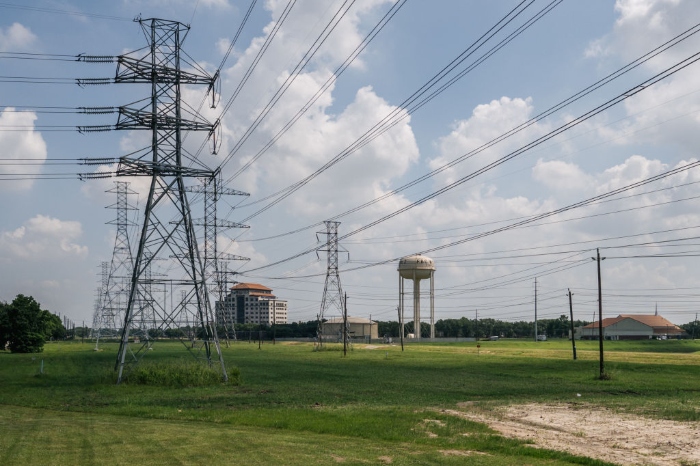
There are also pots of money for things like the electric grid, which of course we’ve seen experience some major failures and issues in the South and West, and then things like “resiliency” which is hardening our infrastructure against climate change, writ broadly.
Powerlines are shown on June 15, 2021 in Houston. | Brandon Bell/Getty Images
Who gets to decide how that money is spent? Congress? Federal agencies? States?
A lot will be further delineated when they write the bill, but some of this is almost certainly going to take the form of grants, which could be handed out to states or cities if they meet certain criteria — similar to how grant programs are run now.
We also have a formula now for how, say, federal money for roads and highways and bridges gets doled out, and it’s possible some could be run through that formula. This is essentially a pass-through or block grant to state DOTs. And the formula is super complicated, depending on a lot of factors like size, population, etc.
How does it all get paid for?
So they have come up with a list of pay-fors, but some of them are a little fantastical. I think most expert observers don’t think it will truly, fully offset what the bill will cost the federal government. Which means the rest will be made up with by deficit spending
There’s also $20 billion for a “financing authority,” which sounds something similar to an infrastructure bank. This concept has been around a long time and never really caught on. But the idea is you seed the bank with initial money, and then it uses it to leverage other capital to finance projects that it thinks are worthy.
Do you think that existing problems with infrastructure, say a bridge collapse, could get lawmakers moving?
There was a bridge collapse here in D.C. right as lawmakers were putting all of this together, but the cause wasn’t that the bridge was decrepit (though it seems like it actually was decrepit) — the cause was that a big truck plowed into it. So that vanished quickly.
Politically speaking, disasters have to be responded to quickly, because otherwise attention fades and with it political will. There was the instance of the bridge collapse in Minnesota in 2007, when the late Jim Oberstar was chairman of T&I, and was working on a surface transportation bill. He told me that he had support for raising the gas tax and was set to go to the floor with it.
Except Congress went on a recess and when they got back, the moment had passed. He was still sad about that even years later. I think he told me that story five times.
Amazon starting wage: $15 Federal minimum wage: $7.25
Amazon has seen the impact $15 can make. Learn more.
WHAT'D I MISS?
— At the border, Harris says her focus is on ‘root causes’ of migration:Vice President Kamala Harris repeatedly emphasized that her focus is on the “root causes” of immigration during her today visit to the U.S.-Mexico border, an event that came after Republicans continually criticized her for not making the trip earlier in her term. Harris, who was put in charge of diplomatic efforts to stem the flow of migrants arriving on the southern border, visited Guatemala and Mexico earlier this month. The U.S.-Mexico border has recently seen an increase in arrivals, and Harris advised migrants “do not come” during a speech in Guatemala.
— Trudeau: ‘Canadians are horrified and ashamed’:Prime Minister Justin Trudeau apologized to the Cowessess First Nation today after news that 751 unmarked graves had been discovered at the site of the former Marieval Indian Residential School in Saskatchewan. The shocking discovery revealed Thursday was only the latest reminder of Canada’s historic mistreatment of Indigenous people — a deadly history and enduring legacy that a federal inquiry called a genocide in 2019.
— Government report can’t explain UFOs, but offers no evidence of aliens:A new intelligence report sent to Congress today concludes that virtually all of the 144 sightings of unidentified flying objects documented by the military since 2004 are of unknown origin , in an extremely rare public accounting of the U.S. government’s data on UFOs that is likely to fuel further speculation about phenomena the intelligence community has long struggled to understand. The report — the government’s first unclassified assessment in half a century — does not offer any definitive answers on who or what may be operating a variety of aircraft that, in some cases, appear to defy known characteristics of aerodynamics, and that officials believe pose a threat to national security.
— Garland backs legislation to end subpoenas for reporters’ records: Attorney General Merrick Garland has endorsed the idea of legislation to create an enduring ban on federal prosecutors subpoenaing reporters or their phone or email records in federal investigations, but he stopped short of announcing an official endorsement on behalf of the Biden administration. During a press conference at Justice Department headquarters today, Garland reiterated that he is planning both an informal directive and new regulations to implement the policy change he announced last month ending such demands.
SUBSCRIBE TO WEST WING PLAYBOOK: Add West Wing Playbook to keep up with the power players, latest policy developments and intriguing whispers percolating inside the West Wing and across the highest levels of the Cabinet. For buzzy nuggets and details you won't find anywhere else, subscribe today.
For Angela Merkel, the German chancellor and longest-serving person around the EU leaders’ table, the summit that ended today almost certainly wasn’t her last European Council — she’ll likely still be a caretaker German leader at EU gatherings in October, as coalition talks back home determine her successor. But the impending retirement of the EU’s middle-ground tone-setter was already palpable this week, as leaders shed their political politesse to implore Viktor Orbán to drop an anti-LGBTQ+ law.
And the main combatants in the room just happened to be the EU’s next longest-serving leaders: the Netherlands’ Mark Rutte and Hungary’s Orbán, who have both been in power since 2010.
Rutte and Orbán clashed fiercely over LGBTQ+ rights Thursday night, with the Dutch premier even going so far as to suggest that Hungary should just leave the EU if it can’t respect fundamental rights and freedoms. And while the argument was ostensibly about the new Hungarian measures, it represented the start of a broader battle over EU values, and who will shape the EU’s voice once Merkel is gone — Rutte, a socially progressive liberal, or Orbán, the self-proclaimed champion of illiberal Christian democracy.
NIGHTLY NUMBER
22.5
The number of years in prison Derek Chauvin, the former Minneapolis police officer who murdered George Floyd last year, was sentenced to today . In his ruling, Hennepin County Judge Peter Cahill cited the ex-officer’s abuse of a position of trust and authority and particular cruelty to Floyd.
SUBSCRIBE TO "THE RECAST" TODAY: Power is shifting in Washington and in communities across the country. More people are demanding a seat at the table, insisting that politics is personal and not all policy is equitable. The Recast is a twice-weekly newsletter that explores the changing power dynamics in Washington and breaks down how race and identity are recasting politics and policy in America. Get fresh insights, scoops and dispatches on this crucial intersection from across the country and hear critical new voices that challenge business as usual. Don't miss out, SUBSCRIBE . Thank you to our sponsor, Intel.
PUNCHLINES
CONGRESS’ SUMMER GRIND— The recent longest day of the year gave farmers more time to work their crops, and Matt Wuerker more time to find the best political satire and cartoons for the Weekend Wrap , including on increased airline violence, the various negotiations taking place on the Hill, and the debate around critical race theory.
PARTING WORDS
EU’S VIEWS ON RUSSIA CONFUSE— French President Emmanuel Macron thinks his fellow leaders from Poland and the Baltics are Russophobic, and that they insist on an unnecessarily tough policy toward Moscow out of misplaced paranoia.
Leaders in Warsaw, Tallinn, Riga and Vilnius, by contrast, see themselves as Russo-realistic and the French president as dangerously deluded in his soft approach to President Vladimir Putin.
But in Central and Eastern Europe, Russia is the cause of violence that led hundreds of thousands of Ukrainians to emigrate to neighboring countries. Poland lives with heavy militarization in the neighboring Russian region of Kaliningrad, while the Baltics offer shelter to political opposition leaders and journalists who have fled potential persecution, including staff of news sites like Meduza, or allies of the jailed anti-corruption activist Alexei Navalny.
These contradictory views came into sharp focus this week as Macron and German Chancellor Angela Merkel pushed for a new Russia policy, only to be brutally rebuffed.
A message from Amazon:
It’s not just Amazon employees who noticed the immediate benefit of increasing their starting wage to at least $15 an hour — a new study from the University of California-Berkeley and Brandeis University found that when Amazon raised its wages, the average hourly wage in the surrounding area rose by 4.7% as other employers followed their lead. Learn more about what else the research found.
Did someone forward this email to you? Sign up here.
This does note bode well for the U.S., though I hope I'm wrong.
"Another clear trait of the successful responses against COVID-19 is that they've all been "apolitical." The efforts haven't been framed as coming from one political party or another but rather as efforts for the good of everyone."
Over the past month, Hong Kong has averaged one new confirmed coronavirus case a day.
Taiwan has reported only one case in the past three weeks. The situation is similar in Vietnam. Although the number of coronavirus cases continues to grow globally, there are places that have managed to successfully control COVID-19.
New Zealand's triumph
Perhaps the greatest success story is New Zealand, which has stopped local transmission and has a plan to completely eliminate the virus from its territory.
"The lesson is that it can be done," says Siouxsie Wiles, an associate professor of microbiology in New Zealand. "Obviously, the longer you leave it, and the more cases there are, the harder it becomes. But that doesn't mean that we shouldn't try."
Wiles heads up the Bioluminescent Superbugs Lab at the University of Auckland. Much of her work focuses on antibiotic resistance and infectious diseases. When the coronavirus hit, she got involved in communication efforts in New Zealand to help explain the virus, including by using a popular cartoon.
But it wasn't just scientists who led the charge. Wiles — and many other New Zealanders — give much of the credit for their country's success to the swift and decisive leadership of Prime Minister Jacinda Ardern in March.
Jacinda Ardern, the prime minister of New Zealand, briefs the media on COVID-19. She issued a call for New Zealanders to protect one another from the health threat.
Mark Mitchell/Pool/AFP via Getty Images
"Our prime minister made the decision that she did not want what was happening in Italy to happen in New Zealand," Wiles says. In mid-March, as cases were exploding in Italy and Spain, Ardern ordered anyone entering New Zealand into quarantine. At that point, the country had confirmed just six cases. A few days later, on March 19, Ardern shut down travel to the country, essentially banning all foreigners from entering the island nation of 4.8 million.
She took to the national airwaves to explain a four-stage lockdown system that New Zealand would use to confront the health crisis. "I'm speaking to all New Zealanders today to give you as much certainty and clarity as we can as we fight COVID-19," she said in a nationally televised address on March 21.
Ardern called the threat "unprecedented," but she was calm and reassuring. "Here's how we'll know what to do and when," she said as she laid out plans to shut down schools, most businesses and domestic travel.
Wiles at the University of Auckland says that the prime minister did something quite interesting, "which was that unlike many other countries, she never put us on a war footing."
So Ardern's speeches weren't about attacking an invisible enemy — as many world leaders would say.
Instead she called on New Zealanders to confront this crisis by protecting their fellow citizens.
"She talked over and over about us being a team of 5 million and that we all do our part to break these chains of transmission and to eliminate the virus," Wiles says. "I think that has been one of the really crucial things — everybody knowing how they had to behave and that they were behaving for the good of everybody."
Wiles heard the prime minister's calls for everyone to come together so many times that she refers to it as Ardern doing her "united thing."
New Zealand is now reopening most businesses and is even talking about complete elimination of the coronavirus from its territory.
As of late May, New Zealand had had roughly 1,500 cases and fewer than two dozen deaths from COVID-19.
Outstanding in Asia
Several nations in Asia have had far larger outbreaks but have managed to bring the disease under control.
For example, South Korea has reported more than 11,000 cases. In late February and early March, South Korea was reporting about 750 new cases a day. Now the country is down to an average just a few dozen per day.
Gi-Wook Shin, the head of Walter H. Shorenstein Asia-Pacific Research Center at Stanford University, says the most successful countries all did some things similar to New Zealand.
"There are some common threads," Shin says. One is very swift and effective action by the state against the outbreak.
Hong Kong, Taiwan, Vietnam and South Korea all either banned incoming visitors early in the outbreak or placed them in two-week quarantines. South Korea quickly developed its own testing system.
Many countries in the Asia-Pacific region have experience with the central government being involved in business development, particularly technology development. So they know how to harness their manufacturing and research hubs to attack particular problems. Shin says the faith in government in these countries and the experience of having the state lead economic development in the past helped these countries respond faster to the pandemic.
"In those countries in Asia, absolutely, they believe that the state, the central government, is responsible for intervening and then solving this problem," Shin says.
Another clear trait of the successful responses against COVID-19 is that they've all been "apolitical." The efforts haven't been framed as coming from one political party or another but rather as efforts for the good of everyone.
The successful Asian countries had national plans, and the leaders articulated them to their people.
"If you look at like Korea, Taiwan, Vietnam or maybe even Hong Kong," Shin says. "The message from the central government was very clear, very straightforward, very coherent and, I think, very effective."
Angela Merkel's TV strategy
Countries in other parts of the world have also managed, for various reasons, to tame COVID-19.
Many nations in the Caribbean have corralled the virus after it arrived on their shores. In addition, Costa Rica, Iceland and Rwanda have also reduced spread to extremely low levels. Mauritius has only reported two cases since April.
In Europe, Germany is still dealing with hundreds of cases a day, but it brought transmission down faster and with far fewer deaths than most other countries in Europe. On March 18, German Chancellor Angela Merkel did something that she had never done before while in office. She took to the airwaves and gave a televised national address. The topic: explaining her plan for how to tackle the coronavirus outbreak. "It is serious," Merkel said of the virus. "Take it seriously."
Jana Puglierin, a senior policy fellow at the European Council on Foreign Relations in Berlin, says Merkel going on TV to give a speech in a crisis was very unusual for her.
"She has never done that in any of the previous crises, not in the migration crisis, not during the eurozone crisis. So this was really a first for her," Puglierin says.
As a public speaker, Merkel has a reputation as being cold.
"But in this speech, she really managed to connect with the people," Puglierin says. Merkel brought Germans on board to fight the outbreak. She told them that the only way to overcome this crisis was for every German to accept it as their own responsibility to reduce the spread of the virus. "She convinced them that this was necessary," Puglierin says.
Merkel added that since the end of World War II and national reunification, there has been no other challenge that depends as strongly on Germans working together.
"She was very human, very approachable, very transparent and very clear in her message," Puglierin says. And it also helped that Merkel is a scientist, with a doctorate in quantum chemistry. She understood the science behind the outbreak. "And she has this tremendous gift of explaining everything that is related to that virus in a very clear and understandable way for ordinary citizens."
Germany is still dealing with coronavirus transmission but has brought its daily case numbers down significantly. Parts of the country are starting to reopen. Things aren't perfect. Some of the reopening is fairly chaotic. Students are going back to school at different times.
"My kids, for example," Puglierin says. "One goes to school once before the summer break starts. The other goes every third day, and the neighbor kid goes every day. So that adds to a lot of frustration."
But there's a feeling that things are moving in the right direction. Case numbers in Germany are going down. Millions of students are returning to school. That's the kind of progress that so many people around the world desperately want to see.