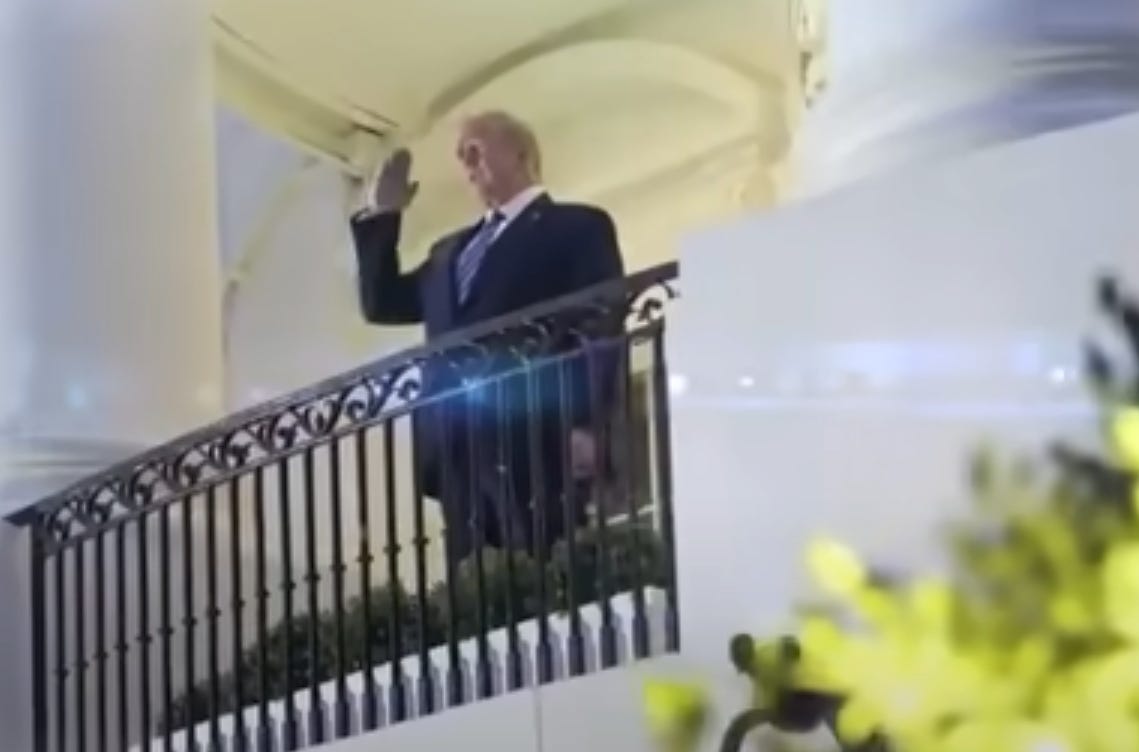
MeidasTouch host Ben Meiselas reports on Donald Trump’s unhinged post from this weekend including the most bizarre and dangerous video about himself and Meiselas compares it with the posts and video that President Biden posted.
MeidasTouch host Ben Meiselas reports on Donald Trump’s unhinged post from this weekend including the most bizarre and dangerous video about himself and Meiselas compares it with the posts and video that President Biden posted.
 |
Note this kind comment from Gene, a new paid subscriber: "Steven is always on point, his articles accurate, timely and with insight that not many have. Always a highlight to my day when I see an email pop into my inbox."
|
 |
A few weeks back, I listened to Donald Trump’s speech in Dayton, Ohio—you know, the “bloodbath” and migrants are “not people” rant—so you didn’t have to. But I suggest a different response to a new video, a look into the hostile, hateful view of Tom Klingenstein, a mega-rich Republican donor, investor and chairman of the increasingly extremist Claremont Institute in Southern California of which he is a major funder. The video, which is narrated by Klingenstein with an apocalyptic tone, is ingratiatingly dedicated to Trump and the need to defeat “woke communists,” America’s “evil” enemies better known as progressive Democrats.
This eight-minute battle call, unironically titled “Trump’s Virtues Part II,” requires your attention because it provides such a vivid expression of the toxic mindset that is enabling Trump among a so-called conservative intellectual elite that has become so openly contemptuous of diversity and democracy. An avid supporter of Trump back in 2016 and one of the GOP’s largest donors of more than $11 million between 2020 and 2023, Klingenstein showcases the authoritarian and fascistic, anti-democratic and anti-diversity goals that are driving various pro-Trump groups. It’s no wonder that Trump has proudly posted this video on his Truth Social platform.
I have questioned whether I should amplify this poisonous work. But I am increasingly convinced that—now and in the coming months—we cannot be indifferent or turn away from the hostility and hatred that surrounds us. This is especially true when the hateful message—dressed up as righteous thinking—reduces the people of America to good and evil and transforms the ugly malignancy of Trump into messianic-level necessity.
As mad as this thinking may sound, we have to look squarely at what these right-wing extremists, especially those with deep-deep pockets, are saying and doing. Not because their messages are entertaining, but because they provide us clarity about what they’re pursuing and what they believe will resonate with the Trump cult’s followers and leading enablers.
Klingenstein’s opening makes clear that it’s time to toss away the values of decency and compassion to stand with Trump. Why? Because he wants Republicans to accept that they are at war with the “woke regime,” which “will not stop until it destroys America.”
“It’s time for Republicans, including those who doubt him or even can’t stand him, to get behind him,” Klingenstein asserts. “The times demand it…I call our enemy the woke regime or the group quota regime. This war is a contest between those who love America and those who hate it.”
In the face of this presumed moral collapse—what he has called elsewhere a cold civil war—Klingenstein argues for Republicans to put aside their traditional values and throw their lot with Trump. “We shouldn’t much care whether our commander-in-chief is a real conservative,” he says, “whether he is a role model for children, or says lots of silly things, or whether he is modest or dignified. What we should care about is whether he knows we are in a war, knows who the enemy is and knows how to win. Trump does.”
Put aside Trump losing the 2020 election and significantly contributing to the GOP losses in 2022. The video never discusses voting or the need for Republicans to win elections; the focus is on fighting and winning a war. It is laced with malice, an unspoken readiness to pursue political violence if that’s what it takes.
As this narrator notes later in the video, Trump is molding “patriotic Americans into an army. We cannot stop the left’s revolution and retake the nation without these men and women. Unlike most conservatives [and here we see footage of Mitch McConnell], they will actually fight for America.”
And what are they fighting for exactly? And why is Trump the man to lead them?
“Trump never apologizes for America,” Klingenstein says with admiration. “Trump says in effect we have our culture, it’s exceptional and that’s the way we want to keep it. And we won’t keep it if we usher in millions of immigrants with cultures different from our own. Trump knows his job is to protect Americans—and just Americans. Protect them not just from enemies abroad, but from the woke globalists within. He knows America does not need more diversity. It needs more cohesion.”
Let’s put aside the ludicrous notion that Trump has any interest in cohesion. Klingenstein’s words underscore the divisiveness that he and his fellow Trumpists are spawning with their aggressive rejection of efforts to achieve racial equality in America. As this narrative unfolds, Klingenstein articulates the rationale for denying Trump’s criminality, rejecting the pursuit of justice and the rule of law—and letting the Trump cult revel in bigotry.
“The woke radicals tell the Trump voters they are a threat to democracy and tell us, ad nauseam, that America is systemically racist. Trump knows this is deadly nonsense,” he says. “This charge of systemic racism bounces off Trump because he has no white guilt—or any guilt for that matter. Trump tells his supporters what they already know: They are not racist and they do not have white privilege. The woke radicals shut up those who disagree.”
And here’s the kicker: “Trump will not be shut up. If they manage to put him in jail, he will still roar like a lion.”
In contrast to Klingenstein’s insistence that “the woke radicals have the moral arrogance of fanatics,” he lovingly describes Trump as the reasonable businessman and a man of the people. Clearly, psychological awareness is not high on this man’s list of attributes.
“Trump is a businessman who takes the world on its own terms and navigates by facts and common sense,” he says, noting that his base loves him and “they know he loves them.” According to Klingenstein, Trump doesn’t talk down to his crowd: “Despite his billions, he is one of them.” His proof? Trump is “a man who takes catchup on his steak and is as disgusted as they are with the anti-American elite.”
When his rally crowds begin cheering “USA, USA,” he says, “Trump and his audience mutually pledge to each other their fidelity and their sacred honor.”
While Klingenstein doesn’t directly discuss the January 6 insurrection, he does talk about Trump’s growing “army” of “patriotic Americans” who will “fight for America.” And he turns the advocacy for democracy and fierce rejection of Trump into “a reason for hope,” explaining that “the America haters rightly fear that Trump and his party are on the threshold of a successful counter-revolution.
Ignoring Trump’s use of Hitler phrases and his pledge to be a dictator on day one, he talks about the “hysteria” of Trump’s enemies who are disturbed by these behaviors. Then this: “Trump hates his enemies as much as they hate him. His enemies are America’s enemies,” he says, showing footage of Senate Minority Leader Chuck Schumer and former Chairman of the Joint Chiefs of Staff, Gen. Mark Milley. Klingenstein expresses excitement that Trump would “go after the deep state without pity or compassion.”
Inevitably, this poisonous pro-Trump attack ends with the biblical, just in case we doubted the necessity of another Trump term and the singular moment his ascendancy represents. “Is it too much to wonder if the appearance of this most unconventional man is providential?” he asks.
His answer to this seemingly rhetorical question is squarely targeted to Christian evangelicals and White Christian nationalists: “Trump gives hope” that God will not forsake America.
In the coming months, we should expect more of such incendiary, apocalyptic, good- versus-evil justifications for why America must align itself with Trump—especially if the criminal defendant finally goes to trial and faces convictions. Years ago, before Trump descended his golden escalator in 2015, Klingenstein’s Claremont Institute was considered right-wing, but not extremist. Those days are gone: The prospects for moderation by almost any influential leader in the GOP has become nigh impossible.
As for Claremont, writer Katherine Stewart may have summed it up best in her long New Republic profile of the institute last year. “…the men of Claremont aren’t here to propose practical policy solutions to the problems facing America,” she writes. “They come to rile up a grievance-addled base and satisfy their own resentments—and to raise enough money to keep the circus on tour.”
As for Klingenstein, who may be both a true believer and cynically calculating the way into Trump’s inner circle in a second term, Stewart describes the conservative influence peddlers who are now embracing authoritarianism and even dictatorship as the inevitable outgrowth of “polluting American political discourse” over the last half century. “If your power depends on lying to the people, that doesn’t make you noble,” she concludes. “It just leaves you with a choice: Accept that you are a fraud, or embrace the lie.”
Sadly, I’ve never been wrong by predicting—when it comes to Trump and his influence—that it will get worse before it gets better. Klingenstein’s video is a reminder of that reliable adage. Let’s keep paying attention.

24 December 22
Live on the homepage now!
Reader Supported News
The Supreme Court justice and the lawyer referred by the House Jan. 6 panel for criminal investigation became acquainted years before Eastman served as Thomas’s clerk
Photos from the event show beaming former clerks with Thomas and his wife, Virginia, who goes by Ginni. In one image posted to social media, she offers the camera two thumbs up. To her left, smiling in a maroon polo shirt, is John Eastman, the architect of the legal strategy that former president Donald Trump had used six months earlier to try to overturn his 2020 election loss.
Some former Thomas clerks had made clear by then that they disapproved of Eastman’s involvement in the events of Jan. 6, 2021, a role that this week prompted members of Congress to refer him to the Justice Department for criminal investigation. But Eastman, who clerked for Thomas for the term starting in 1996, was welcomed at the Greenbrier gathering as a member of the tightknit clerk family, according to people familiar with the event, who spoke on the condition of anonymity to discuss the private gathering. One said Eastman’s attendance at the clerk reunion, which has not been previously reported, caused discomfort for some of his fellow former clerks.
The Supreme Court justice and the lawyer who worked to help Trump try to overturn the election have a remarkable relationship that dates back more than three decades and that began years before Eastman served as Thomas’s clerk and before Thomas joined the bench, a Washington Post examination found. In the 1980s in Washington, as acquaintances working in the Reagan administration, they each explored writings and legal theories that informed their views of the Constitution, according to interviews and a Post review of their writings and speeches.
Thomas and Eastman were both influenced in those years by the intellectual tradition of Southern California’s conservative Claremont Institute, particularly the interpretation of the Constitution through the lens of the founders’ belief in “natural law,” which holds that moral principles and the fundamental rights of men and women come from God or nature, not from government.
Some of these views have gained increasing attention as Thomas has become ascendant in a court remade by Trump.
The congressional committee investigating the Jan. 6, 2021, insurrection recommended on Monday that the Justice Department consider prosecuting Eastman and the former president himself for charges including conspiracy to defraud the United States and obstruction of an official proceeding. The referral is largely symbolic, because Congress has no legal control over what the Justice Department does. The department had already seized Eastman’s phone as part of its own sprawling criminal investigation.
In the lead-up to Jan. 6, Eastman argued that swing-state lawmakers could determine that Joe Biden’s victory had been marred by fraud or illegality, then choose electors representing Trump. When no state legislature took that step, records show that Eastman went further, laying out options for Vice President Mike Pence that included delaying certification of Biden’s victory or simply certifying Trump as the winner.
Eastman, 62, declined to comment on the DOJ probe or the committee vote but disputed the notion that he was trying to overturn the election results, saying he was only seeking time for investigations to determine the “rightful winner.” Challenging elections should not be the subject of criminal investigation, he added: “The criminalization of political differences is a dangerous path for those in political power to walk down.”
Eastman’s lawyer has said the referral by the House committee was intended to “create political advantage for the Democratic Party and stigmatize disfavored political groups.”
Eastman told The Post that he does not speak about his relationship with Thomas but said that they do not discuss issues pending or likely to come before the court. He said that he and Thomas share a view of the Constitution that was shaped by the tutelage they both received in the 1980s from scholars associated with the Claremont Institute, where Eastman is now a senior fellow.
“We studied the same things. We approached it in the same way. And, not surprisingly, we come to similar conclusions,” Eastman said in an interview. By email, he added that Thomas is “his own man, and a truly great man at that.”
Scholars interviewed by The Post agreed that the two men share a legal worldview. “Just because John writes it doesn’t mean that Thomas would rule that way,” said Lawrence Lessig, a Harvard law professor who has known Eastman since teaching him in law school in Chicago in the 1990s. “That said, they both look at the law in the same way. The fact that John writes it might well be a signal that Thomas would view it in the same way.”
Their shared view of the 14th Amendment’s “due process” clause was at the heart of Thomas’s June concurrence in Dobbs v. Jackson, the case finding that there is no right to abortion in the Constitution.
While he signed on to the majority opinion, Thomas wrote in his concurrence that the court should go on to “correct” other “demonstrably erroneous” rulings rooted in the due process clause, such as those guaranteeing rights to contraception and same-sex marriage. No other justice joined.
Thomas, 74, did not respond to a request for comment and has not publicly addressed his former clerk’s role in challenging the election outcome. His wife, a conservative activist, also did not respond to an inquiry from The Post.
Eastman’s relationship with Ginni Thomas has come under scrutiny since the 2020 election. In December of that year, as she pressed swing-state lawmakers to set aside Biden’s popular-vote victory and assign electoral-college votes to Trump, Ginni Thomas invited Eastman to speak to a group of activists about his post-election activities, according to email and court records.
Her lawyer has said that the invitation does not indicate that she endorsed his work, and that while she was aware of Eastman’s public involvement in post-election litigation, she was not familiar with his specific efforts. Eastman has said that Thomas simply asked him to give an “update about election litigation to a group she met with periodically,” and that he did not discuss with her or her husband “any matters pending or likely to come before the court.”
The Thomases have both spoken about their efforts to stay in touch with clerks from across the years. “My law clerks are my kids,” the justice said at a public event in 2008. “ … I hire them knowing that I want them to be a part of my family. They are family.”
Thomas said he has his clerks watch a movie based on “The Fountainhead,” the Ayn Rand novel that glorifies individualism. He said he wanted them to understand “that just because the whole world’s against you, it doesn’t mean you’re wrong. They could be wrong.”
‘Many fond dinners’
Originally from Nebraska, Eastman moved around growing up but by high school had landed in Texas — and was already leaning toward becoming a lawyer. A copy of his 1978 yearbook from Lewisville High outside Dallas described him as “pre-law” and as a wrestler and member of the National Honor Society.
He attended the University of Dallas with the help of a scholarship, graduating in 1982 with a bachelor’s degree in politics and economics.
Eastman then enrolled in graduate school and began working toward a doctorate in government from Claremont Graduate School in Southern California. He has said that, although he knew he wanted to be a lawyer, he thought it important to first study political theory, so he could figure out how to use the law as “a tool,” he once put it, “to advance the goals of the American founding.”
When his dissertation adviser, William B. Allen, ran for the Republican nomination for U.S. Senate from California in 1986, Eastman served as his campaign chair. “He was a political animal from his undergraduate days,” Allen recalled in an interview, describing Eastman as “one of my most able students.”
Allen lost that race, but the following year won a nomination from Ronald Reagan to serve on the U.S. Commission on Civil Rights. Allen then hired Eastman as his assistant in California. Soon, Eastman moved to Washington to become a full-time congressional liaison and spokesman at the commission, a bipartisan panel responsible for investigating discrimination.
In Washington, he was a gregarious go-getter and was well-connected in Republican circles, according to Melvin Jenkins, who served as acting staff director for the commission. Jenkins recalled that Eastman introduced him to Thomas in 1989 or 1990, by which time Eastman and Thomas seemed to already know one another well.
Thomas was the chairman of the Equal Employment Opportunity Commission (EEOC), which investigates complaints involving workplace discrimination. A descendant of enslaved people born into poverty, Thomas had graduated from Yale Law School and was serving as head of the civil rights division in Reagan’s Education Department when the president tapped him, at age 33, to take over the employment commission.
Members of the civil rights commission lived around the country but often gathered with EEOC leaders when they came to Washington, Eastman recalled in a 2011 speech commemorating Thomas’s 20-year anniversary on the high court, describing how he had come to know Thomas. “We had many fond dinners,” he said.
Eastman said that, in Thomas’s writings and speeches during this period, he could see the justice-to-be sharpening his views of the Constitution. “I would have the good fortune to get to know him at that time and see that inquiry going on,” Eastman said in the speech, a keynote address at a symposium sponsored by the University of Detroit Mercy Law Review. “It was a marvelous thing to watch.”
At the EEOC, Thomas had hired a pair of scholars from the Claremont Institute, at the base of the San Gabriel Mountains outside Los Angeles, where Eastman had been a research associate during graduate school. As Thomas has told the story, John Marini and Ken Masugi engaged him in a sort of tutorial on the American founding, complete with reading assignments and discussions.
“I was looking for a way of thinking, a set of ideals,” Thomas said in “Created Equal,” a book of interviews with him published earlier this year. He spoke of traveling to the Claremont Institute and seeking out conversations with leaders there to supplement those he was having with Marini and Masugi in Washington. “I consider it not only one of the seminal periods of my time at the EEOC, but also one of the most formative intellectually of my tenure in D.C.,” he said.
Eastman told The Post that he was close to Masugi, given their Claremont connection, and that they spoke at the time about the ideas that Masugi and Marini were discussing with Thomas.
“They were having conversations about important questions,” Eastman said, adding that he and friends were preoccupied with “the same conversations” when they gathered for Sunday brunch to watch “The McLaughlin Group” public affairs show.
Masugi and Marini, who are senior fellows at the Claremont Institute, did not respond to requests for comment.
Harry Jaffa, who was a professor of political philosophy at Claremont Graduate School, Eastman’s alma mater, is considered the intellectual father of the Claremont Institute; it was founded by several of his former students.
Jaffa was a proponent of interpreting the Constitution in light of natural law, articulated by the founders in the Declaration of Independence, which says that “all men are created equal” and are “endowed by their creator with certain unalienable rights,” including “life, liberty and the pursuit of happiness.” According to the Claremont school of thought, these fundamental rights were so integral to the conception of the nation that they must shape the interpretation of the Constitution.
The 14th Amendment, for instance, and an article of the Constitution containing similar language, “simply cannot be understood apart from the natural law principles of the Declaration from which they were drawn,” Eastman has written. He has argued that history shows the framers codified their natural-law philosophy in references protecting citizens’ “privileges” and “immunities.” That language, he has written, was meant to secure “well-understood, fundamental rights [that] enjoyed recognition and acceptance in the years after the Constitution was adopted.”
Beginning his career in the law
Natural law — and the role of the Declaration of Independence — were among the key ideas that Thomas explored in the 1980s with the Claremont scholars. It would influence his approach to interpreting the Constitution, setting him apart from many other conservative jurists, including Antonin Scalia, according to Eastman, Masugi and some other conservative scholars.
President George H.W. Bush nominated Thomas to an appeals court judgeship in 1990 and to the Supreme Court in 1991. As the chairman of the Senate Judiciary Committee, Biden said at the time that sussing out how Thomas might apply his views on natural law was “the single most important task” senators faced — at least until Anita Hill, who had worked with Thomas at the EEOC, accused him of sexual harassment. Thomas denied her allegations.
Biden and other Democrats at the time worried that a natural-law approach to the Constitution could be used to override precedents in a way that would undermine Americans’ rights — including the right to abortion that was then guaranteed by Roe v. Wade. In his confirmation hearings, Thomas sought to distance himself from the notion that the natural-law philosophy would dictate his judging, but he acknowledged under Biden’s questioning that he would apply the founders’ ideas about natural law to his interpretation of constitutional language.
By the time Thomas was being grilled by senators about his natural-law philosophy, Eastman had returned to California. He ran unsuccessfully for Congress in 1990 on a platform including opposition to abortion and support for a constitutional amendment against flag-burning, according to a story at the time in the Los Angeles Times.
Years later, as a justice, Thomas spoke admiringly about Eastman’s run for office, according to Stephen F. Smith, who clerked for Thomas beginning in fall 1993, during the justice’s second full term on the court. The subject came up when Thomas introduced Eastman and Smith sometime in the 1990s, Smith told The Post. “It seemed like he was very impressed by John’s commitment to getting out there and being an ideological warrior,” said Smith, who is now a Notre Dame law professor.
Eastman received his doctorate in 1993 and went on to law school at the University of Chicago, according to his résumé. He was in his early 30s and married — older than many of his fellow students — and noticeably confident. “He came in almost like he was the experienced guy that was going to teach the rest of us,” said one former classmate who remembered Eastman as outspoken on conservative political and social issues. The classmate spoke on the condition of anonymity to avoid being publicly associated with a controversial figure.
After graduating in 1995, Eastman became a clerk for J. Michael Luttig, a conservative judge then sitting on the U.S. Court of Appeals for the 4th Circuit in Richmond. By then, Eastman’s views on the Constitution were well-formed, according to Luttig.
Eastman sought a clerkship on the Supreme Court for the following year. He most wanted to work for Thomas, he told The Post. “I thought, given his background, you know, that his career and his jurisprudence would be more in line with the original understanding of the founding than anybody else’s,” Eastman said.
Thomas named Eastman as one of his four clerks for the 1996-1997 term.
“John and Justice Thomas were close from the very beginning of John’s clerkship at the Supreme Court,” said Luttig, who knows both men well. “They shared the same views about the Constitution and constitutional interpretation.”
‘Privileges or immunities’
Eastman was known among fellow clerks for advocating a particular view of the 14th Amendment, one former clerk said, speaking on the condition of anonymity to discuss confidential conversations. “I remember him trying to persuade any of us in the lunchroom,” the clerk recalled. “It was like that all the time with him.”
For decades, the Supreme Court has held that the amendment’s due process clause, which says that no one can be deprived of “life, liberty, or property, without due process of law,” guarantees fundamental rights that are not explicitly named in the Constitution. Among them, the court has ruled over the years, are rights to same-sex marriage and — until Dobbs — abortion.
Eastman believed that the Constitution protects fundamental rights in a different clause of the 14th Amendment, which says that states cannot “abridge the privileges or immunities of citizens.” He has written that this clause was wrongly neutered by an 1873 Supreme Court decision and was originally meant to guarantee the rights inherent in natural law — the concept that he and Thomas had been exploring since the 1980s.
But resuscitating this clause as the amendment’s guarantor of fundamental rights, as Eastman advocated, could overturn decades of precedents protecting rights that the modern court has determined are owed to Americans under the due process clause, according to experts in constitutional law.
Thomas had expressed interest in revisiting the privileges or immunities clause in a 1989 law review article in which he referred to Jaffa’s scholarship and thanked Masugi for his research assistance. But Thomas did not publicly endorse resuscitating the clause in his earliest years on the bench.
In fact, it was not until about two decades later, in 2010, that Thomas expansively articulated his support for looking to the privileges or immunities clause in an approximately 18,000-word concurrence.
Thomas’s embrace of the privileges or immunities clause came in a gun rights case known as McDonald v. Chicago. The court had already held that the federal government could not infringe on an individual’s right to keep and bear arms. Now it would consider whether states could do so.
By then, Eastman had been working for years as a professor and then dean at Chapman University’s law school, a private university in Southern California. Eastman also founded the Claremont Institute’s Center for Constitutional Jurisprudence, filing litigation and amicus briefs in pursuit of what he has described as an effort to restore the ideals of the American founding.
In an amicus brief in the McDonald case, Eastman urged the justices to rule not only that state governments were required to protect the right, but also that the court should locate this right in the amendment’s privileges or immunities clause. The brief was co-signed by Edwin Meese III, who had been the U.S. attorney general under Reagan.
The court issued a 5-4 ruling that states were indeed required to uphold an individual’s right to own guns. The conservative majority located the right in the due process clause, which the court had long used to protect all kinds of rights. Thomas joined the majority opinion, but he wrote separately from his fellow conservatives to reject their due process analysis. Thomas argued for locating the right in the privileges or immunities clause instead, calling that a “more straightforward path” and one “more faithful to the Fourteenth Amendment’s text and history.”
Thomas had embraced the view that Eastman had also endorsed.
In Dobbs, this summer’s landmark abortion ruling, Thomas wrote that the due process clause does not secure the right to abortion or any of the other “substantive” rights that have been attributed to it, including to same-sex marriage and contraception. In previous cases, the court has found that such rights, while not specifically mentioned in the Constitution, are so fundamental that the government has no adequate justification to deprive a person of them.
But according to Thomas, the clause guarantees only that the government must undertake a process before infringing on a person’s rights. “Because the Due Process Clause does not secure any substantive rights, it does not secure a right to abortion,” he wrote.
There is still an open question, he wrote, about whether these rights are protected by the privileges or immunities clause or by other constitutional provisions. To answer that question, the court will have to decide whether the clause protects any rights that are not specifically mentioned in the Constitution, he wrote. But if it does protect any such rights, he added, abortion is not among them “under any plausible interpretive approach.”
In coming to this conclusion, Thomas did not lean on natural law, a doctrine often understood to mean abortion should be illegal because it is immoral. Instead, he pointed to language in the majority opinion that the nation’s history and traditions do not provide a basis for a federal right to the procedure.
The 2020 election
In 2010, Eastman stepped down from his position as dean at Chapman to seek the Republican nomination for California attorney general. (He ended his relationship with the school altogether about a decade later, retiring after he faced outrage for speaking at the pro-Trump rally on Jan. 6.)
Meese, the former attorney general, was his honorary campaign chair, and his donors included Ted Cruz, the soon-to-be senator who had clerked alongside Eastman for Luttig and at the Supreme Court, and Leonard Leo, a key power broker in the conservative legal movement. Ginni Thomas donated $500, according to state records.
Eastman’s campaign website featured the motto “securing the blessings of liberty,” along with a prominent photograph of his family posing with Justice Thomas. Eastman lost the primary by a wide margin to a Republican who went on to lose to Democrat Kamala D. Harris in the general election.
Though Eastman’s scholarship was known in conservative constitutional law circles, it did not gain intense mainstream attention until it intersected with the political force that was Trump.
In August 2020, Eastman wrote a Newsweek column questioning whether Harris, whose parents were both immigrants, was truly a “natural-born” citizen of the United States and thus qualified to serve as vice president. It was built on an idea that Eastman had been articulating for years: that “birthright citizenship,” or the long-standing custom that anyone born in the United States is a citizen, is not grounded in the Constitution.
Trump, who had mused for years about doing away with birthright citizenship, did not directly answer questions about whether he believed Harris was eligible to serve, but he called Eastman at one news conference “a very highly qualified, very talented lawyer” and “a brilliant lawyer” at another.
Late that year, Eastman joined Trump’s bid to overturn Biden’s victory. In early December, he testified before Georgia senators, telling them that, although the vote count had showed that Biden had won their state, allegations of fraud and illegality in the election meant they were empowered to choose Trump electors.
“The Supreme Court has described this constitutional authority of the state legislatures as plenary. That means it knows no other limit. The legislature gets to do what it wants,” he said, articulating a theory of unrestrained power over federal elections known as the “independent state legislature doctrine.”
He was echoing the same argument that he had made when he was invited to speak to the Florida legislature during the disputed 2000 election: State legislatures had ultimate power to determine the manner in which electors were chosen. Chief Justice William H. Rehnquist, citing the plain text of the Constitution and an 1892 Supreme Court opinion, indicated support for a version of this theory in a Bush v. Gore concurrence joined by Thomas and Scalia.
This month, the Supreme Court heard a case widely seen as a test of the independent state legislature doctrine. Put into practice in its most extreme form, the doctrine would mark a radical change in the way federal elections are conducted, according to scholars from across the political spectrum.
Eastman endorsed the independent state legislature doctrine in an amicus brief. He cited the Bush v. Gore concurrence that Thomas had signed on to more than two decades earlier.
Follow us on facebook and twitter!
PO Box 2043 / Citrus Heights, CA 95611
LOTS OF POSTS IGNORED BY BLOGGER..... OR REMOVED ON THEIR WHIM! ALL POSTS ARE AVAILABLE ON MIDDLEBORO REVIEW AND SO ON BLOGGER DOESN...


